


John 21:15
Bible text: King James Version (1769 Blayney text) · Public domain
Bible text: King James Version with Strong's numbers · Public domain
Bible text: Berean Standard Bible · Public domain
Bible text: American Standard Version (1901) · Public domain
Bible text: World English Bible, Messianic edition · Public domain
Bible text: Geneva Bible (1599) · Public domain
Bible text: Young's Literal Translation · Public domain
- ὍτεHoteWhenG3753CONJConjunction
- οὖνounthereforeG3767CONJConjunction
- ἠρίστησανēristēsanthey had dinedG709V-AAI-3PVerb Aorist Active Indicative 3rd Plural
- λέγειlegeisaysG3004V-PAI-3SVerb Present Active Indicative 3rd Singular
- τῷtō<the>G3588T-DSMDefinite article Dative Singular Masculine
- ΣίμωνιSimōnito SimonG4613N-DSM-PNoun Dative Singular Masculine Individual
- ΠέτρῳPetrōto PeterG4074N-DSM-PNoun Dative Singular Masculine Individual
- ὁho<the>G3588T-NSMDefinite article Nominative Singular Masculine
- Ἰησοῦς·IēsousJesusG2424N-NSM-PNoun Nominative Singular Masculine Individual
- ΣίμωνSimōnSimonG4613N-VSM-PNoun Vocative Singular Masculine Person Gentilic
- ἸωάννουIōannou[son] of JohnG2491N-GSM-PNoun Genitive Singular Masculine Individual
- ἀγαπᾷςagapaslove youG25V-PAI-2SVerb Present Active Indicative 2nd Singular
- μεmeMeG3165P-1ASPersonal pronoun Accusative 1st Singular
- πλέονpleonmoreG4119A-ASN-CAdjective Accusative Singular Neuter Comparative
- τούτων;toutōnthan these?G3778D-GPMDemonstrative pronoun Genitive Plural Masculine
- λέγειlegeiHe saysG3004V-PAI-3SVerb Present Active Indicative 3rd Singular
- αὐτῷ·autōto HimG846P-DSMPersonal pronoun Dative Singular Masculine
- ναὶnaiYesG3483PRTParticle or Disjunctive
- κύριεkurieLordG2962N-VSM-TNoun Vocative Singular Masculine Person Gentilic
- σὺsuYou yourselfG4771P-2NSPersonal pronoun Nominative 2nd Singular
- οἶδαςoidasknowG1492V-RAI-2SVerb Perfect Active Indicative 2nd Singular
- ὅτιhotithatG3754CONJConjunction
- φιλῶphilōI dearly loveG5368V-PAI-1SVerb Present Active Indicative 1st Singular
- σεseYouG4771P-2ASPersonal pronoun Accusative 2nd Singular
- λέγειlegeiHe saysG3004V-PAI-3SVerb Present Active Indicative 3rd Singular
- αὐτῷ·autōto himG846P-DSMPersonal pronoun Dative Singular Masculine
- βόσκεboskedo feedG1006V-PAM-2SVerb Present Active Imperative 2nd Singular
- τὰtatheG3588T-APNDefinite article Accusative Plural Neuter
- ἀρνίαarnialambsG721N-APNNoun Accusative Plural Neuter
- μουmouof MineG3165P-1GSPersonal pronoun Genitive 1st Singular
English is a literal word-by-word gloss of the Greek, not the KJV's wording. Why?
This is the original text the KJV's translators worked from — each Greek word with its own literal English meaning in this verse, prepared by scholars at Tyndale House, Cambridge. The KJV translates whole sentences, not word by word, so its wording differs: one Greek word can become several English words, and the KJV may choose “charity” where the gloss reads “love”. Both are faithful — they answer different questions. For the KJV's own rendering, switch to the KJV text.
Details
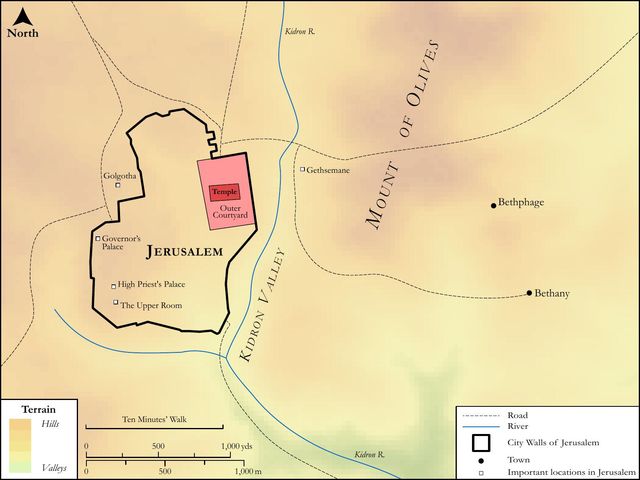
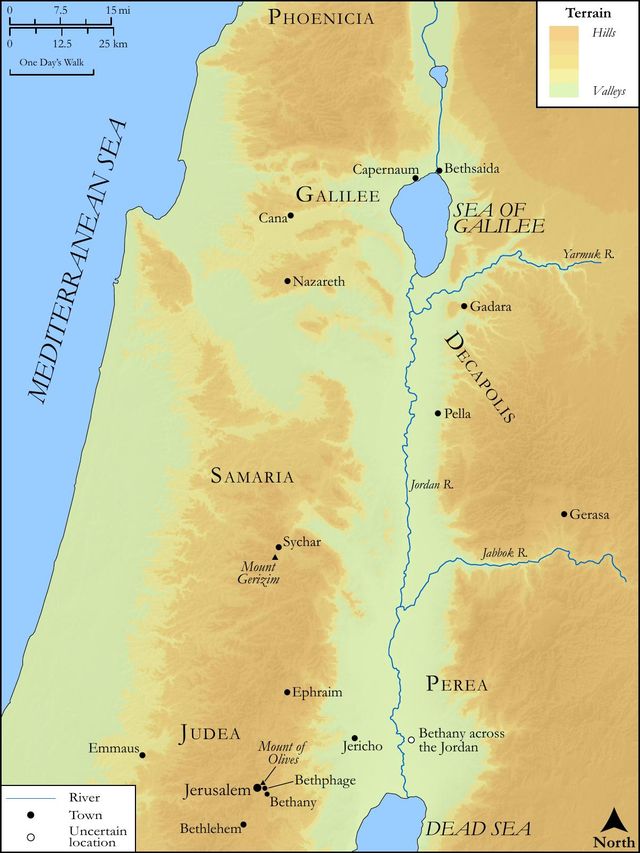
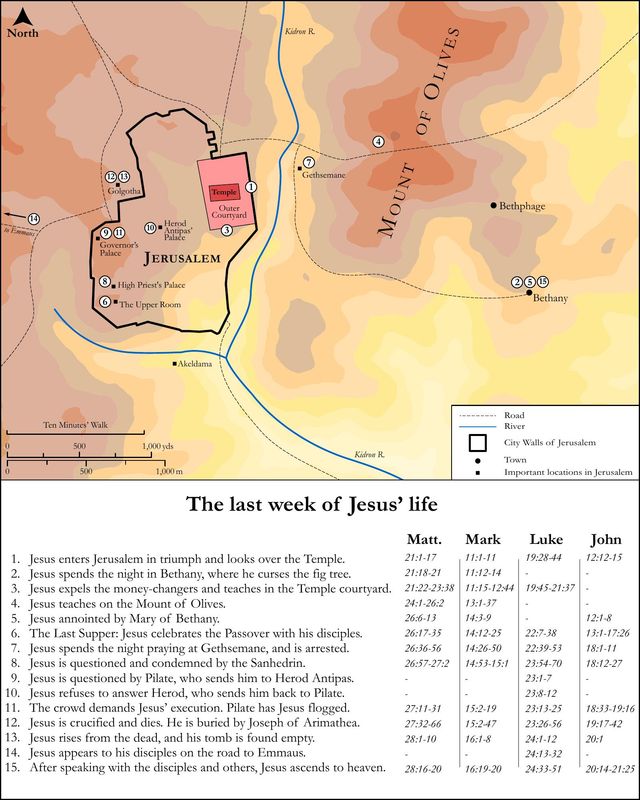
See on the biblical-era maps
Study this verse
Public-domain commentary
Matthew Henry
From his Commentary on the Whole Bible. Henry comments on passages, not single verses — this entry covers John 21:15–19. His four-level outline is real structure in the source text, so it is rendered as structure.
We have here Christ's discourse with Peter after dinner, so much of it as relates to himself, in which,
I.He examines his love to him, and gives him a charge concerning his flock, Joh 21:15-17. Observe,
1.When Christ entered into this discourse with Peter. - It was after they had dined: they had all eaten, and were filled, and, it is probable, were entertained with such edifying discourse as our Lord Jesus used to make his table-talk. Christ foresaw that what he had to say to Peter would give him some uneasiness, and therefore would not say it till they had dined, because he would not spoil his dinner. Peter was conscious to himself that he had incurred his Master's displeasure, and could expect no other than to be upbraided with his treachery and ingratitude. "Was this thy kindness to thy friend? Did not I tell thee what a coward thou wouldest prove?" Nay, he might justly expect to be struck out of the roll of the disciples, and to be expelled the sacred college. Twice, if not thrice, he had seen his Master since his resurrection, and he said not a word to him of it. We may suppose Peter full of doubts upon what terms he stood with his Master; sometimes hoping the best, because he had received favour from him in common with the rest; yet not without some fears, lest the chiding would come at last that would pay for all. But now, at length, his Master put him out of his pain, said what he had to say to him, and confirmed him in his place as an apostle. He did not tell him of his fault hastily, but deferred it for some time; did not tell him of it unseasonably, to disturb the company at dinner, but when they had dined together, in token of reconciliation, then discoursed he with him about it, not as with a criminal, but as with a friend. Peter had reproached himself for it, and therefore Christ did not reproach him for it, nor tell him of it directly, but only by a tacit intimation; and, being satisfied in his sincerity, the offence was not only forgiven, but forgotten; and Christ let him know that he was as dear to him as ever. Herein he has given us an encouraging instance of his tenderness towards penitents, and has taught us, in like manner, to restore such as are fallen with a spirit of meekness.
2.What was the discourse itself. Here was the same question three times asked, the same answer three times returned, and the same reply three times given, with very little variation, and yet no vain repetition. The same thing was repeated by our Saviour, in speaking it, the more to affect Peter, and the other disciples that were present; it is repeated by the evangelist, in writing it, the more to affect us, and all that read it.
(1.)Three times Christ asks Peter whether he loves him or no. The first time the question is, Simon, son of Jonas, lovest thou me more than these? Observe,
[1.]How he calls him: Simon, son of Jonas. He speaks to him by name, the more to affect him, as Luk 22:31. Simon, Simon. He does not call him Cephas, nor Peter, the name he had given him (for he had lost the credit of his strength and stability, which those names signified), but his original name, Simon. Yet he gives him no hard language, does not call him out of his name, though he deserved it; but as he had called him when he pronounced him blessed, Simon Bar-jona, Mat 16:17. He calls him son of Jonas (or John or Johanan), to remind him of his extraction, how mean it was, and unworthy the honour to which he was advanced.
[2.]How he catechises him: Lovest thou me more than these?
First, Lovest thou me? If we would try whether we are Christ's disciples indeed, this must be the enquiry, Do we love him? But there was a special reason why Christ put in now to Peter. 1. His fall had given occasion to doubt of his love: "Peter, I have cause to suspect thy love; for if thou hadst loved me thou wouldst not have been ashamed and afraid to own me in my sufferings. How canst thou say thou lovest me, when thy heart was not with me?" Note, We must not reckon it an affront to have our sincerity questioned, when we ourselves have done that which makes it questionable; after a shaking fall, we must take heed of settling too soon, lest we settle upon a wrong bottom. The question is affecting; he does not ask, "Dost thou fear me? Dost thou honour me? Dost thou admire me?" but, "Dost thou love me? Give but proof of this, and the affront shall be passed by, and no more said of it." Peter had professed himself a penitent, witness his tears, and his return to the society of the disciples; he was now upon his probation as a penitent; but the question is not, "Simon, how much hast thou wept? how often hast thou fasted, and afflicted thy soul?" but, Dost thou love me? It is this that will make the other expressions of repentance acceptable. The great thing Christ eyes in penitents is their eyeing him in their repentance. Much is forgiven her, not because she wept much, but because she loved much. 2. His function would give occasion for the exercise of his love. Before Christ would commit his sheep to his care, he asked him, Lovest thou me? Christ has such a tender regard to his flock that he will not trust it with any but those that love him, and therefore will love all that are his for his sake. Those that do not truly love Christ will never truly love the souls of men, or will naturally care for their state as they should; nor will that minister love his work that does not love his Master. Nothing but the love of Christ will constrain ministers to go cheerfully through the difficulties and discouragements they meet with in their work, Co2 5:13, Co2 5:14. But this love will make their work easy, and them in good earnest in it.
Secondly, Lovest thou me more than these? pleion toutōn. 1. "Lovest thou me more than thou lovest these, more than thou lovest these persons?" Dost thou love me more than thou dost James or John, thy intimate friends, or Andrew, thy own brother and companion: Those do not love Christ aright that do not love him better than the best friend they have in the world, and make it to appear whenever they stand in comparison or in competition. Or, "more than thou lovest these things, these boats and nets - more than all the pleasure of fishing, which some make a recreation of - more than the gain of fishing, which others make a calling of." Those only love Christ indeed that love him better than all the delights of sense and all the profits of this world. "Lovest thou me more than thou lovest these occupations thou art now employed in? If so, leave them, to employ thyself wholly in feeding my flock." So Dr. Whitby. 2. "Lovest thou me more than these love me, more than any of the rest of the disciples love me?" And then the question is intended to upbraid him with his vain-glorious boast, Though all men should deny thee, yet will not I. "Art thou still of the same mind?" Or, to intimate to him that he had now more reason to love him than any of them had, for more had been forgiven to him than to any of them, as much as his sin in denying Christ was greater than theirs in forsaking him. Tell me therefore which of them will love him most? Luk 7:42. Note, We should all study to excel in our love to Christ. It is no breach of the peace to strive which shall love Christ best; nor any breach of good manners to go before others in this love.
Thirdly, The second and third time that Christ put this question, 1. He left out the comparison more than these, because Peter, in his answer, modestly left it out, not willing to compare himself with his brethren, much less to prefer himself before them. Though we cannot say, We love Christ more than others do, yet we shall be accepted if we can say, We love him indeed. 2. In the last he altered the word, as it is in the original. In the first two enquiries, the original word is Agapas me - Dost thou retain a kindness for me? In answer to which Peter uses another word, more emphatic, Philō se - I love thee dearly. In putting the question the last time, Christ uses that word: And dost thou indeed love me dearly?
(2.)Three times Peter returns the same answer to Christ: Yea, Lord, thou knowest that I love thee. Observe,
[1.]Peter does not pretend to love Christ more than the rest of the disciples did. He is now ashamed of that rash word of his, Though all men deny thee, yet will not I; and he had reason to be ashamed of it. Note, Though we must aim to be better than others, yet we must, in lowliness of mind, esteem others better than ourselves; for we know more evil of ourselves than we do of any of our brethren.
[2.]Yet he professes again and again that he loves Christ: "Yea, Lord, surely I love thee; I were unworthy to live if I did not." He had a high esteem and value for him, a grateful sense of his kindness, and was entirely devoted to his honour and interest; his desire was towards him, as one he was undone without; and his delight in him, as one he should be unspeakably happy in. This amounts to a profession of repentance for his sin, for it grieves us to have affronted one we love; and to a promise of adherence to him for the future Lord, I love thee, and will never leave thee. Christ prayed that his faith might not fail (Luk 22:32), and, because his faith did not fail, his love did not; for faith will work by love. Peter had forfeited his claim of relation to Christ. He was now to be re-admitted, upon his repentance. Christ puts his trial upon this issue: Dost thou love me? And Peter joins issue upon it: Lord, I love thee. Note, Those who can truly say, through grace, that they love Jesus Christ, may take the comfort of their interest in him, notwithstanding their daily infirmities.
[3.]He appeals to Christ himself for the proof of it: Thou knowest that I love thee; and the third time yet more emphatically: Thou knowest all things, thou knowest that I love thee. He does not vouch his fellow-disciples to witness for him - they might be deceived in him; nor does he think his own word might be taken - the credit of that was destroyed already; but he calls Christ himself to witness, First, Peter was sure that Christ knew all things, and particularly that he knew the heart, and was a discerner of the thoughts and intents of it, Joh 16:30. Secondly, Peter was satisfied of this, that Christ, who knew all things, knew the sincerity of his love to him, and would be ready to attest it in his favour. It is a terror to a hypocrite to think that Christ knows all things; for the divine omniscience will be a witness against him. But it is a comfort to a sincere Christian that he has that to appeal to: My witness is in heaven, my record is on high. Christ knows us better than we know ourselves. Though we know not our own uprightness, he knows it.
[4.]He was grieved when Christ asked him the third time, Lovest thou me? Joh 21:17. First, Because it put him in mind of his threefold denial of Christ, and was plainly designed to do so; and when he thought thereon he wept. Every remembrance of past sins, even pardoned sins, renews the sorrow of a true penitent. Thou shalt be ashamed, when I am pacified towards thee. Secondly, Because it put him in fear lest his Master foresaw some further miscarriage of his, which would be as great a contradiction to this profession of love to him as the former was. "Surely," thinks Peter, "my Master would not thus put me upon the rack if he did not see some cause for it. What would become of me if I should be again tempted?" Godly sorrow works carefulness and fear, Co2 7:11.
(3.)Three times Christ committed the care of his flock to Peter: Feed my lambs; feed my sheep; feed my sheep.
[1.]Those whom Christ committed to Peter's care were his lambs and his sheep. The church of Christ is his flock, which he hath purchased with his own blood (Act 20:28), and he is the chief shepherd of it. In this flock some are lambs, young and tender and weak, others are sheep, grown to some strength and maturity. The Shepherd here takes care of both, and of the lambs first, for upon all occasions he showed a particular tenderness for them. He gathers the lambs in his arms, and carries them in his bosom. Isa 40:11.
[2.]The charge he gives him concerning them is to feed them. The word used in Joh 21:15, Joh 21:17, is boske, which strictly signifies to give them food; but the word used in Joh 21:16 is poimaine, which signifies more largely to do all the offices of a shepherd to them: "Feed the lambs with that which is proper for them, and the sheep likewise with food convenient. The lost sheep of the house of Israel, seek and feed them, and the other sheep also which are not of this fold." Note, It is the duty of all Christ's ministers to feed his lambs and sheep. Feed them, that is, teach them; for the doctrine of the gospel is spiritual food. Feed them, that is, "Lead them to the green pastures, presiding in their religious assemblies, and ministering all the ordinances to them. Feed them by personal application to their respective state and case; not only lay meat before them, but feed those with it that are wilful and will not, or weak and cannot feed themselves." When Christ ascended on high, he gave pastors, left his flock with those that loved him, and would take care of them for his sake.
[3.]But why did he give this charge particularly to Peter? Ask the advocates for the pope's supremacy, and they will tell you that Christ hereby designed to give to Peter, and therefore to his successors, and therefore to the bishops of Rome, an absolute dominion and headship over the whole Christian church as if a charge to serve the sheep gave a power to lord it over all the shepherds; whereas, it is plain, Peter himself never claimed such a power, nor did the other disciples ever own it in him. This charge given to Peter to preach the gospel is by a strange artifice made to support the usurpation of his pretended successors, that fleece the sheep, and, instead of feeding them, feed upon them. But the particular application to Peter here was designed, First, To restore him to his apostleship, now that he repented of his abjuration of it, and to renew his commission, both for his own satisfaction, and for the satisfaction of his brethren. A commission given to one convicted of a crime is supposed to amount to a pardon; no doubt, this commission given to Peter was an evidence that Christ was reconciled to him else he would never have reposed such a confidence in him. Of some that have deceived us we say, "Though we forgive them, we will never trust them;" but Christ, when he forgave Peter, trusted him with the most valuable treasure he had on earth. Secondly, It was designed to quicken him to a diligent discharge of his office as an apostle. Peter was a man of a bold and zealous spirit, always forward to speak and act, and, lest he should be tempted to take upon him the directing of the shepherds, he is charged to feed the sheep, as he himself charges all the presbyters to do, and not to lord it over God's heritage, Pe1 5:2, Pe1 5:3. If he will be doing, let him do this, and pretend no further. Thirdly, What Christ said to him he said to all his disciples; he charged them all, not only to be fishers of men (though that was said to Peter, Luk 5:10), by the conversion of sinners, but feeders of the flock, by the edification of saints.
II.Christ, having thus appointed Peter his doing work, next appoints him his suffering work.
Having confirmed to him the honour of an apostle, he now tells him of further preferment designed him - the honour of a martyr. Observe,
1.How his martyrdom is foretold (Joh 21:18): Thou shalt stretch forth thy hands, being compelled to it, and another shall gird thee (as a prisoner that is pinioned) and carry thee whither naturally thou wouldest not.
(1.)He prefaces the notice he gives to Peter of his sufferings with a solemn asseveration, Verily, verily, I say unto thee. It was not spoken of as a thing probable, which perhaps might happen, but as a thing certain, I say it to thee. "Others, perhaps, will say to thee, as thou didst to me, This shall not be unto thee; but I say it shall." As Christ foresaw all his own sufferings, so he foresaw the sufferings of all his followers, and foretold them, though not in particular, as to Peter, yet in general, that they must take up their cross. Having charged him to feed his sheep, he bids him not to expect ease and honour in it, but trouble and persecution, and to suffer ill for doing well.
(2.)He foretels particularly that he should die a violent death, by the hands of an executioner. The stretching out of his hands, some think, points at the manner of his death by crucifying; and the tradition of the ancients, if we may rely upon that, informs us that Peter was crucified at Rome under Nero, a.d. 68, or, as others say, 79. Others think it points at the bonds and imprisonments which those are hampered with that are sentenced to death. The pomp and solemnity of an execution add much to the terror of death, and to any eye of sense make it look doubly formidable. Death, in these horrid shapes, has often been the lot of Christ's faithful ones, who yet have overcome it by the blood of the Lamb. This prediction, though pointing chiefly at his death, was to have its accomplishment in his previous sufferings. It began to be fulfilled presently, when he was imprisoned, Act 6:3; Act 5:18; Act 12:4. No more is implied here in his being carried whither he would not than that it was a violent death that he should be carried to, such a death as even innocent nature could not think of without dread, nor approach without some reluctance. He that puts on the Christian does not put off the man. Christ himself prayed against the bitter cup. A natural aversion to pain and death is well reconcileable with a holy submission to the will of God in both. Blessed Paul, though longing to be unloaded, owns he cannot desire to be unclothed, Co2 5:4.
(3.)He compares this with his former liberty. "Time was when thou knewest not any of these hardships, thou girdest thyself, and walkedst whither thou wouldest." Where trouble comes we are apt to aggravate it with this, that it has been otherwise; and to fret the more at the grievances of restraint, sickness, and poverty, because we have known the sweets of liberty, health, and plenty, Job 29:2; Psa 42:4. But we may turn it the other way, and reason thus with ourselves: "How many years of prosperity have I enjoyed more than I deserved and improved? And, having received good, shall I not receive evil also?" See here,
[1.]What a change may possibly be made with us, as to our condition in this world! Those that have girded themselves with strength and honour, and indulged themselves in the greatest liberties, perhaps levities, may be reduced to such circumstances as are the reverse of all this. See Sa1 2:5.
[2.]What a change is presently made with those that leave all to follow Christ! They must no longer gird themselves, but he must gird them! and must no longer walk whither they will, but whither he will.
[3.]What a change will certainly be made with us if we should live to be old! Those who, when they were young, had strength of body and vigour of mind, and could easily go through business and hardship, and take the pleasures they had a mind to, when they shall be old, will find their strength gone, like Samson, when his hair was cut and he could not shake himself as at other times.
(4.)Christ tells Peter he should suffer thus in his old age.
[1.]Though he should be old, and in the course of nature not likely to live long, yet his enemies would hasten him out of the world violently when he was about to retire out of it peaceably, and would put out his candle when it was almost burned down to the socket. See Ch2 36:17.
[2.]God would shelter him from the rage of his enemies till he should come to be old, that he might be made the fitter for sufferings, and the church might the longer enjoy his services.
2.The explication of this prediction (Joh 21:19), This spoke he to Peter, signifying by what death he should glorify God, when he had finished his course. Observe,
(1.)That it is not only appointed to all once to die, but it is appointed to each what death he shall die, whether natural or violent, slow or sudden, easy or painful. When Paul speaks of so great a death, he intimates that there are degrees of death; there is one way into the world, but many ways out, and God has determined which way we should go.
(2.)That it is the great concern of every good man, whatever death he dies, to glorify God in it; for what is our chief end but this, to die to the Lord, at the word of the Lord? When we die patiently, submitting to the will of God, - die cheerfully, rejoicing in hope of the glory of God, - and die usefully, witnessing to the truth and goodness of religion and encouraging others, we glorify God in dying: and this is the earnest expectation and hope of all good Christians, as it was Paul's, that Christ may be magnified in them living and dying, Phi 1:20.
(3.)That the death of the martyrs was in a special manner for the glorifying of God. The truths of God, which they died in the defence of, are hereby confirmed. The grace of God, which carried them with so much constancy through their sufferings, is hereby magnified. And the consolations of God, which have abounded towards them in their sufferings, and his promises, the springs of their consolations, have hereby been recommended to the faith and joy of all the saints. The blood of the martyrs has been the seed of the church, and the conversion and establishment of thousands. Precious therefore in the sight of the Lord is the death of his saints, as that which honours him; and those who thereby at such an expense honour him he will honour.
3.The word of command he gives him hereupon: When he had spoken thus, observing Peter perhaps to look blank upon it, he saith unto him, Follow me. Probably he rose from the place where he had sat at dinner, walked off a little, and bade Peter attend him. This word, Follow me, was (1.) A further confirmation of his restoration to his Master's favour, and to his apostleship; for Follow me was the first call. (2.) It was an explication of the prediction of his sufferings, which perhaps Peter at first did not fully understand, till Christ gave him that key to it, Follow me: "Expect to be treated as I have been, and to tread the same bloody path that I have trodden before thee; for the disciple is not greater than his Lord." (3.) It was to excite him to, and encourage him in, faithfulness and diligence in his work as an apostle. He had told him to feed his sheep, and let him set his Master before him as an example of pastoral care: "Do as I have done." Let the under-shepherds study to imitate the Chief Shepherd. They had followed Christ while he was here upon earth, and now that he was leaving them he till preached the same duty to them though to be performed in another way, Follow me; still they must follow the rules he had given them and the example he had set them. And what greater encouragement could they have than this, both in services and in sufferings? [1.] That herein they did follow him, and it was their present honour; who would be ashamed to follow such a leader? [2.] That hereafter they should follow him, and that would be their future happiness; and so it is a repetition of the promise Christ had given Peter (Joh 13:36), Thou shalt follow me afterwards. Those that faithfully follow Christ in grace shall certainly follow him to glory.
Historical interpretation
Seventeen Centuries of Reception
20 surviving comments on this verse. Each one is dated, so this reads as a timeline rather than a list.
Select a marker to jump to its quote. Markers stagger vertically where authors wrote within a few decades of each other.
We have been informed by Crementius the sub-deacon, who came to us from you, that the blessed father Cyprian has for a certain reason withdrawn; "in doing which he acted quite rightly, because he is a person of eminence, and because a conflict is impending," which God has allowed in the world, for the sake of cooperating with His servants in their struggle against the adversary, and was, moreover, willing that this conflict should show to angels and to men that the victor shall be crowned, while the vanquished shall in himself receive the doom which has been made manifest to us. Since, moreover, it devolves upon us who appear to be placed on high, in the place of a shepherd, to keep watch over the flock; if we be found neglectful, it will be said to us, as it was said to our predecessors also, who in such wise negligent had been placed in charge, that "we have not sought for that which was lost, and have not corrected the wanderer, and have not bound up that which was broken, but have eaten their milk, and been clothed with their wool; " and then also the Lord Himself, fulfilling what had been written in the law and the prophets, teaches, saying, "I am the good shepherd, who lay down my life for the sheep. But the hireling, whose own the sheep are not, seeth the wolf coming, and leaveth the sheep, and fleeth, and the wolf scatter-eth them." To Simon, too, He speaks thus: "Lovest thou me? He answered, I do love Thee. He saith to him, Feed my sheep." We know that this saying arose out of the very circumstance of his withdrawal, and the rest of the disciples did likewise.
If any one consider and examine these things, there is no need for lengthened discussion and arguments. There is easy proof for faith in a short summary of the truth. The Lord speaks to Peter, saying, "I say unto thee, that thou art Peter; and upon this rock I will build my Church, and the gates of hell shall not prevail against it. And I will give unto thee the keys of the kingdom of heaven; and whatsoever thou shalt bind on earth shall be bound also in heaven, and whatsoever thou shalt loose on earth shall be loosed in heaven." And again to the same He says, after His resurrection, "Feed nay sheep." And although to all the apostles, after His resurrection, He gives an equal power, and says, "As the Father hath sent me, even so send I you: Receive ye the Holy Ghost: Whose soever sins ye remit, they shall be remitted unto him; and whose soever sins ye retain, they shall be retained; " yet, that He might set forth unity, He arranged by His authority the origin of that unity, as beginning from one. Assuredly the rest of the apostles were also the same as was Peter, endowed with a like partnership both of honour and power; but the beginning proceeds from unity. Which one Church, also, the Holy Spirit in the Song of Songs designated in the person of our Lord, and says, "My dove, my spotless one, is but one. She is the only one of her mother, elect of her that bare her." Does he who does not hold this unity of the Church think that he holds the faith? Does he who strives against and resists the Church trust that he is in the Church, when moreover the blessed Apostle Paul teaches the same thing, and sets forth the sacrament of unity, saying, "There is one body and one spirit, one hope of your calling, one Lord, one faith, one baptism, one God?"
O pastors! Imitate that diligent pastor, the chief of the whole flock, who cared so greatly for his flock. He brought near those who were far away. He brought back the wanderers. He visited the sick. He strengthened the weak. He bound up the broken. He guarded those who were well fed. He gave himself up for the sake of the sheep. He chose and instructed excellent leaders, and committed the sheep into their hands and gave them authority over all his flock. For he said to Simon Cephas, “Feed my sheep and my lambs and my ewes.” So Simon fed his sheep and fulfilled his calling and handed over the flock to you and departed. And so you also must feed and guide them well. For the pastor who cares for his sheep engages in no other pursuit along with that. He does not make a vineyard, or plant gardens, or fall into the troubles of this world. Never have we seen a pastor who left his sheep in the wilderness and became a merchant, or one who left his flock to wander and became a husbandman. But if he deserts his flock and does these things, he thereby hands over his flock to the wolves.
It is Peter, chosen by the Lord himself to feed his flock, who merits three times to hear the words “Feed my little lambs; feed my lambs; feed my sheep.” And so, by feeding well the flock of Christ with the food of faith, he effaced the sin of his former fall. For this reason he is admonished three times to feed the flock. He is asked three times whether he loves the Lord in order that he may confess him three times whom he had denied three times before his crucifixion.
There are indeed many other things which are able to give us boldness towards God, and to show us bright and approved, but that which most of all brings good will from on high, is tender care for our neighbor. Which therefore Christ requireth of Peter.
When then having been asked once and again, he called Him to witness who knoweth the secrets of the heart, and then was asked even a third time, he was troubled, fearing a repetition of what had happened before, (for then, having been strong in assertion, he was afterwards convicted,) and therefore he again betaketh himself to Him. For the saying, "Thou knowest all things," meaneth, "things present, and things to come." Seest thou how he had become better and more sober, being no more self-willed, or contradicting? For on this account he was troubled, "lest perchance I think that I love, and love not, as before when I thought and affirmed much, yet I was convicted at last." But Jesus asketh him the third time, and the third time giveth him the same injunction, to show at what a price He setteth the care of His own sheep, and that this especially is a sign of love towards Him.
And why, having passed by the others, doth He speak with Peter on these matters? He was the chosen one of the Apostles, the mouth of the disciples, the leader of the band; on this account also Paul went up upon a time to enquire of him rather than the others. And at the same time to show him that he must now be of good cheer, since the denial was done away, Jesus putteth into his hands the chief authority among the brethren; and He bringeth not forward the denial, nor reproacheth him with what had taken place, but saith, "If thou lovest Me, preside over thy brethren, and the warm love which thou didst ever manifest, and in which thou didst rejoice, show thou now; and the life which thou saidst thou wouldest lay down for Me, now give for My sheep."
(Hom. lxxxviii. 1) That which most of all attracts the Divine love is care and love for our neighbour. Our Lord passing by the rest, addresses this command to Peter: he being the chief of the Apostles, the mouth of the disciples, and head of the college. Our Lord remembers no more his sin in denying Him, or brings that as a charge against him, but commits to him at once the superintendence over his brethren. If thou lovest Me, have rule over thy brethren, show forth that love which thou hast evidenced throughout, and that life which thou saidst thou wouldest lay down for Me, lay down for the sheep.
He saith to him again the second time, Simon, son of Jonas, lovest thou Me? He saith unto Him, Yea, Lord; Thou knowest that I love Thee.
(Hom. lxxxviii) A third time He asks the same question, and gives the same command; to show of what importance He esteems the superintendence of His own sheep, and how He regards it as the greatest proof of love to Him.
(Hom. lxxxviii) The question asked for the third time disturbed him: Peter was grieved because He said unto him the third time, Lovest thou Me? He was afraid perhaps of receiving a reproof again for professing to love more than he did. So he appeals to Christ Himself: And he said unto Him, Lord, Thou knowest all things, i. e. the secrets of the heart, present and to come.
Jesus promoted Peter and placed him as the head of the lambs of his herd and said, “Feed my lambs,” that is, all those who believe in me and who, because they were instructed only recently, are weaker. And for this reason, it is necessary that you carry their burden, and protect them, and comfort them in their weakness and nourish them with the grace that was given to you.
Feed “my” sheep; he did not say “yours,” did he? Feed, good servant, the Lord’s sheep that bear the Lord’s brand. After all, was Paul crucified for you, or were you baptized in the name of Peter and Paul? So feed his sheep, washed in his baptism, sealed in his name, redeemed with his blood. “Feed,” he says, “my sheep.”
Our Lord asked this, knowing it: He knew that Peter not only loved Him, but loved Him more than all the rest.
While our Lord was being condemned to death, he feared, and denied Him. But by His resurrection Christ implanted love in his heart, and drove away fear. Peter denied, because he feared to die: but when our Lord was risen from the dead, and by His death destroyed death, what should he fear? He saith unto Him, Yea, Lord; Thou knowest that I love Thee. On this confession of his love, our Lord commends His sheep to him: He saith unto him, Feed My lambs: as if there were no way of Peter's showing his love for Him, but by being a faithful shepherd, under the chief Shepherd.
(Tract. cxxii) Well doth He say to Peter, Lovest thou Me (ἀγαπᾶς diligis), and Peter answer, Amo Te (φελῶ amo), and our Lord replies again, Feed My lambs. Whereby, it appears that amor and dilectio are the same thing: especially as our Lord the third time He speaks does not say, Diligis Me, but Amas Me. He saith unto him the third time, Simon, son of Jonas, lovest thou Me? A third time our Lord asks Peter whether he loves Him. Three confessions are made to answer to the three denials; that the tongue might show as much love as it had fear, and life gained draw out the voice as much as death threatened.
(de Verb. Dom. serm. 50) He was grieved because he was asked so often by Him Who knew what He asked, and gave the answer. He replies therefore from his inmost heart; Thou knowest that I love Thee.
(Tract. cxxiv) He says no more, He only replies what he knew himself; he knew he loved Him; whether any else loved Him he could not tell, as he could not see into another's heart: (non occ.). Jesus saith unto him, Feed My sheep; as if to say, Be it the office of love to feed the Lord's flock, as it was the resolution of fear to deny the Shepherd.
(Tract. cxxiii) They who feed Christ's sheep, as if they were their own, not Christ's, show plainly that they love themselves, not Christ; that they are moved by lust of glory, power, gain, not by the love of obeying, ministering, pleasing God. Let us love therefore, not ourselves, but Him, and in feeding His sheep, seek not our own, but the things which are His. For whoso loveth himself, not God, loveth not himself: man that cannot live of himself, must die by loving himself; and he cannot love himself, who loves himself to his own destruction. Whereas when He by Whom we live is loved, we love ourselves the more, because we do not love ourselves; because we do not love ourselves in order that we may love Him by Whom we live.
(Serm. Pass.) But unfaithful servants arose, who divided Christ's flock, and handed down the division to their successors: and you hear them say, Those sheep are mine, what seekest thou with my sheep, I will not let thee come to my sheep. If we call our sheep ours, as they call them theirs, Christ hath lost His sheep.
We have it also demonstrated here that love and liking are one and the same thing; for the Lord also in the last question said not Diligis me? but, Amas me? Let us, then, love not ourselves, but Him; and in feeding His sheep, let us be seeking the things which are His, not the things which are our own. For in some inexplicable way, I know not what, every one that loveth himself, and not God, loveth not himself; and whoever loveth God, and not himself, he it is that loveth himself. For he that cannot live by himself will certainly die by loving himself; he therefore loveth not himself who loves himself to his own loss of life. But when He is loved by whom life is preserved, a man by not loving himself only loveth the more, when it is for this reason that he loveth not himself [namely] that he may love Him by whom he lives.
He is being armed for weightier and greater matters. He is told “Feed my sheep,” a task that was certainly going to mean danger for the flesh but glory for the spirit. Just think how much he was going to suffer for the name of Christ by feeding the sheep of Christ! “Feed my sheep, feed my lambs.” I mean, if you love me, what present are you going to give me? The prince of pastors made him a pastor so that Peter would feed Christ’s sheep, not his own.…“Feed my sheep.” Why? Because you love me, because you are devoted to me, I am committing my sheep to you. Feed them, but remember they are mine. Heretical leaders, though, wish to make their own the sheep that are really Christ’s. All the same, they are forced … to set the stamp of Christ on them. They may make them their own private flock, but they still have to register them in the Lord’s name.
Christ rose again in the flesh, and Peter rose in the spirit because, when Christ died in his passion, Peter died by his denial. Christ the Lord was raised from the dead, and out of his love he raised Peter. He questioned him about the love he was confessing and entrusted him with his sheep. After all, what benefit could Peter confer on Christ by the mere fact of his loving Christ? If Christ loves you, it is to your advantage, not Christ’s. And if you love Christ, it is to your advantage, not Christ’s. And yet Christ the Lord wanted to indicate how people ought to show that they love Christ. And he made it plain enough by entrusting him with his sheep. “Do you love me?” “I do.” “Feed my sheep.” All this once, all this a second time, all this a third time. Peter made no other reply than that he loved him. The Lord asked no other question but whether he loved him. When Peter answered, our Lord did nothing else but entrust his sheep to him.
"So when they had dined, He saith to Simon Peter, Simon, [son] of John, lovest thou me more than these? He saith unto Him, Yea, Lord; Thou knowest that I love Thee. He saith unto him, Feed my lambs." To the threefold denial there is now appended a threefold confession, that his tongue may not yield a feebler service to love than to fear, and imminent death may not appear to have elicited more from the lips than present life. Let it be the office of love to feed the Lord's flock, if it was the signal of fear to deny the Shepherd. Those who have this purpose in feeding the flock of Christ, that they may have them as their own, and not as Christ's, are convicted of loving themselves, and not Christ, from the desire either of boasting, or wielding power, or acquiring gain, and not from the love of obeying, serving, and pleasing God. Against such, therefore, there stands as a wakeful sentinel this thrice inculcated utterance of Christ, of whom the apostle complains that they seek their own, not the things that are Jesus Christ's. For what else mean the words, "Lovest thou me? Feed my sheep," than if it were said, If thou lovest me, think not of feeding thyself, but feed my sheep as mine, and not as thine own; seek my glory in them, and not thine own; my dominion, and not thine; my gain, and not thine; lest thou be found in the fellowship of those who belong to the perilous times, lovers of their own selves, and all else that is joined on to this beginning of evils?
Peter started to reach Jesus before the rest, disdaining, as it appears, to go by boat, because of the incomparable fervour and admirable zeal of his love towards Christ. Therefore He comes first to land, and draws up the net; for he was always an impressionable man, easily excited to enthusiasm both in speech and action. Therefore, also, he first made confession of faith when the Saviour put to them the inquiry in the parts of Caesarea Philippi, saying: Who do men say that I the Son of Man am? And of the other disciples some said Elijah, and others Jeremiah, or one of the prophets. But when Christ put the further question to them: But Who say ye that I am? Peter took the lead, and becoming spokesman for the rest, hastened to reply: Thou art the Christ, the Son of the living God. Moreover, when the band of soldiers came, together with the officers of the Jews, to take Jesus away to the rulers, the rest all left Him and fled, but Peter struck off Malchus' ear with a sword. For he thought it right by every means in his power to defend his Master, though the attack that he made was in fact altogether displeasing to Him. As, therefore, he came more impetuously than the rest, Christ puts to him the question whether he loved Him more than they, and repeated it three times; and Peter answers in the affirmative, and confesses his love for Him, saying that Christ Himself was a witness to his state of mind. And, after each confession, he heard Christ telling him in different words to take thought of His sheep, as He calls mankind in the parable.
And I think (for I say that we ought to search out the hidden meaning that is here implied) that these words were not written without a purpose, but the saying is pregnant with meaning, and the sense of the passage contains something more than meets the eye. May not someone reasonably ask, Why is it that Christ only asks Simon, though the other disciples were present? And what is the meaning of the words, Feed My lambs, and the like? We reply, that the inspired Peter had indeed already been elected, together with the other disciples, to be an Apostle of God (for our Lord Jesus Christ Himself named them Apostles, according to the Scripture), but, when the events connected with the plot of the Jews against Him came to pass, his fall came betwixt; for the inspired Peter was seized with uncontrollable fear, and thrice denied the Lord. Christ succours His erring disciple, and elicits by divers questions his thrice-repeated confession, counterbalancing, as it were, his error thereby, and making his recovery as signal as his fall. For a transgression which was verbal, and only in mere words supplied ground of accusation against him, could surely be wiped out in the same fashion as it was committed. He requires him to say whether he loved Him more than the rest. For in truth, as he had enjoyed a greater measure of forgiveness, and received from a more bountiful Hand the remission of his transgression, surely he would be likely to feel greater love than the rest, and requite his Benefactor with the extremity of affection. For although all the holy disciples alike betook themselves to flight, the inhumanity of the Jews inspiring them with a terror that they could not overcome, and the ferocity of the soldiers threatening them with cruel death when they came to take Jesus, still Peter's transgression by his thrice-repeated denial was special and peculiar to him.
Therefore, as he had received a greater measure of forgiveness than the rest, he is asked to tell Christ whether he loved Him more; for, as the Saviour Himself said, he to whom most is forgiven will also love much. Herein, also, is a type given to the. Churches, that they ought thrice to ask for a confession of Christ from those who have chosen to love Him by coming to Him in Holy Baptism. And, by dwelling on this passage, instructors in religion may arrive at the knowledge that they cannot please the Chief Shepherd, that is Christ, unless they take thought for the health of the sheep of His fold, and their continuance in well-being. Such was the inspired Paul, who shared the infirmities of his weak brethren, and called those who through him believed, and chose to gain repute by the glory of their deeds, the boast, and joy, and crown of his apostleship. For he knew that this was the visible fruit of love for Christ. And this, if he reason well and justly, any one may perceive. For if He died for us, surely He must esteem the salvation and life of us all as deserving of all care. And if they who sin against the brethren, and wound their conscience when it is weak, in truth sin against Christ; surely it is true to say, that they are doing the Lord Himself service who take, as it were, by the hand the mind of those who have been admitted to the faith, and who are expected to be called to perfection therein, and are eager to stablish them firmly in the faith, by every help that they can offer. Therefore, by his thrice-repeated confession the thrice-repeated denial of the blessed Peter was done away, and by the saying of our Lord, "Feed my lambs," we must understand a renewal as it were of the apostleship, already given unto him, washing away the disgrace of his fall that came betwixt, and obliterating his faint-heartedness, that arose from human infirmity.
Look to me, Peter, on how you offer instruction.
Remembering your own fall, sympathize with all.
Mindful of that maiden who caused your own downfall, do not be harsh.
If conceit attacks you, listen again to the sound of the rooster’s crow,
And remember the tears with whose streams I washed you,
I who alone know what is in your heart.
Peter, do you love me? Do what I say, feed my flock, and love those whom I love,
Sympathizing with sinners and remembering the compassion I had for you, since I received you after you denied me three times.
You have a thief as gatekeeper of paradise to give you courage.
Send him those whom you wish.
Because of you, Adam turned to me,
Crying, “O Creator offer me
The robber as gatekeeper, and Cephas as keeper of the keys.
You who alone know what is in the heart.”
He is called Simon, son of John, John being his natural father. But mystically, Simon is obedience, John grace, a name well befitting him who was so obedient to God's grace, that he loved our Lord more ardently than any of the others. Such virtue arising from divine gift, not mere human will.
The dinner being ended, He commits to Peter the superintendence over the sheep of the world, not to the others: So when they had dined, Jesus saith to Simon Peter, Simon, son of Jonas, lovest thou Me more than these?
Thence is taken the custom of threefold confession in baptism.
There is a difference perhaps between lambs and sheep. The lambs are those just initiated, the sheep are the perfected.
I myself am convinced by the Petrine claims, nor looking around the world does there seem much doubt which (if Christianity is true) is the True Church, the temple of the Spirit* dying but living, corrupt but holy, self-reforming and rearising. But for me that Church of which the Pope is the acknowledged head on earth has as chief claim that it is the one that has (and still does) ever defended the Blessed Sacrament, and given it most honour, and put it (as Christ plainly intended) in the prime place. 'Feed my sheep' was His last charge to St Peter; and since His words are always first to be understood literally, I suppose them to refer primarily to the Bread of Life. It was against this that the W. European revolt (or Reformation) was really launched – 'the blasphemous fable of the Mass' – and faith/works a mere red herring. I suppose the greatest reform of our time was that carried out by St Pius X surpassing anything, however needed, that the Council will achieve. I wonder what state the Church would now be but for it.
* Not that one should forget the wise words of Charles Williams, that it is our duty to tend the accredited and established altar, though the Holy Spirit may send the fire down somewhere else. God cannot be limited (even by his own Foundations) – of which St Paul is the first & prime example – and may use any channel for His grace. Even to love Our Lord, and certainly to call him Lord, and God, is a grace, and may bring more grace. Nonetheless, speaking institutionally and not of individual souls the channel must eventually run back into the ordained course, or run into the sands and perish. Besides the Sun there may be moonlight (even bright enough to read by); but if the Sun were removed there would be no Moon to see. What would Christianity now be if the Roman Church has in fact been destroyed?
Continue studying John 21:15 across the web’s major study libraries — every link below opens this exact verse, chapter, or book on the destination site.
Read & Compare
 BibleGatewayThis verse in more than 200 translations and 70 languages.
 Bible.comThe YouVersion reader — hundreds of translations, reading plans, and highlights.
 ESV.orgCrossway's official English Standard Version reader.
 NET BibleThe NET translation with 60,000+ translators' notes on every rendering decision.
 STEP BibleTyndale House's free study tool — original text, vocabulary, and scholarly resources.
 BibliaLogos Bible Software's free web reader.
 USCCBThe New American Bible (Revised Edition) with the U.S. bishops' study notes.
Commentaries
 BibleHub CommentariesDozens of classic commentaries on this verse, gathered on one page.
 StudyLightMore than 100 commentary sets — the largest collection on the web.
 BibleRefPlain-English commentary on what this verse means, verse by verse.
 Enduring WordDavid Guzik's free commentary on this chapter, widely used by Bible teachers.
 Bible Study ToolsVerse commentary alongside Greek and Hebrew study aids.
Original Language & Research
- BibleHub InterlinearThe verse word by word — original language, transliteration, and English.
- BibleHub LexiconEvery word's original-language definition and Strong's entry.
 Blue Letter BibleDeep-study tools — Strong's numbers, concordance, and word studies.
 CNTR CollationThe earliest Greek manuscripts of this verse, collated letter by letter.
Sermons, Hymns & Audio


TrulyRandomVerse is not affiliated with these sites and doesn’t control their content. They’re linked because they’re genuinely useful.
Summary
John 21:15 records a pivotal moment of restoration and recommissioning between the resurrected Jesus and Simon Peter on the shore of the Sea of Galilee. Following Peter's triple denial of Christ, this verse initiates a profound three-fold dialogue where Jesus tenderly probes the depth of Peter's love, setting the stage for his renewed call to shepherd Christ's flock, emphasizing that genuine affection for the Lord is the indispensable foundation for all faithful service.
Context
ShowHideLiterary Context
This verse is part of the climactic concluding chapter of John's Gospel, which details Jesus' third post-resurrection appearance to His disciples, specifically at the Sea of Tiberias (Galilee). It immediately follows a miraculous catch of fish, reminiscent of Peter's initial call, and a shared breakfast of fish and bread. The preceding chapters, particularly John 18, recount Peter's three denials of Jesus before the crucifixion, a deeply painful failure that this current interaction directly addresses. The three-fold questioning of Peter's love in John 21:15-17 is widely understood as Jesus' compassionate restoration of Peter, mirroring and reversing his earlier denials, and preparing him for future leadership.
Historical & Cultural Context
The setting on the Sea of Galilee evokes strong memories of Jesus' initial calling of Peter and other disciples as "fishers of men" (Matthew 4:19). Fishing was a primary industry in this region, and the disciples' return to it after Jesus' crucifixion highlights their uncertainty and perhaps a sense of lost purpose. The act of sharing a meal, particularly breakfast, carried significant cultural weight, signifying fellowship, reconciliation, and the establishment of a covenantal bond. Jesus' direct address to "Simon, son of Jonas" (or John) rather than "Peter" (the name Jesus had given him, meaning "rock") subtly reminds Peter of his human vulnerability and past failure, yet it is immediately followed by a profound question of love that invites restoration.
Key Themes
ShowHideThis passage profoundly contributes to several overarching themes in John's Gospel and biblical theology. First, it powerfully illustrates Restoration and Forgiveness, demonstrating God's boundless grace in offering reconciliation even after profound failure, as seen in the parable of the Prodigal Son. Second, it underscores the theme of Love as the Foundation for Service, emphasizing that genuine, sacrificial love for Christ (agape) is the essential prerequisite for all Christian ministry and leadership, echoing Jesus' command for His disciples to love one another. Finally, it highlights the Pastoral Commission, signifying the shepherd's vital role in nurturing and caring for Christ's flock, a theme found throughout Scripture, from the Old Testament prophets (e.g., Ezekiel 34) to Peter's own later exhortations to elders (1 Peter 5:2).
Exposition and Analysis
ShowHideKey Word Analysis
ShowHideThis verb, used by Jesus in His first question ("lovest thou me"), denotes a divine, unconditional, self-sacrificial love, often associated with God's love for humanity. It describes a love of will and principle, a deliberate choice of devotion rather than mere sentiment. Jesus asks Peter if he possesses this highest form of love for Him, a love that transcends circumstances and personal feelings.
Peter's response, "I love thee," uses this verb, which signifies a strong brotherly affection, fondness, or friendship. It denotes a love based on personal attachment, sentiment, and emotional connection. Peter's choice of philéō rather than agapáō in his initial response reveals his honest assessment of his current capacity for love, acknowledging his human limitations and perhaps the recent failure that had exposed his lack of agapáō in a moment of crisis.
This verb, translated as "Feed" in Jesus' command "Feed my lambs," means "to pasture" or "to fodder." It implies providing nourishment, guidance, and protection, much like a shepherd tending to his flock. This command directly links Peter's love for Jesus to a practical, nurturing ministry, emphasizing the active care required for the spiritual well-being of believers.
This word, translated as "lambs," is a diminutive form, literally meaning "lambkin." It suggests tender, vulnerable, and young sheep. In the context of the church, "lambs" represent new believers, those weak in faith, or those in need of special care and guidance. Jesus' use of this term highlights the delicate and crucial responsibility Peter is being entrusted with—to care for the most vulnerable members of Christ's flock.
Verse Breakdown
ShowHide"So when they had dined"
This phrase sets the scene immediately after a shared meal, emphasizing a moment of fellowship and intimacy. The meal itself, a breakfast of fish and bread prepared by Jesus, signifies His continued care for His disciples and establishes a relaxed, personal setting for the profound conversation that follows.
"Jesus saith to Simon Peter, 'Simon, [son] of Jonas, lovest thou me more than these?'"
Jesus initiates the dialogue by addressing Peter by his birth name, "Simon, son of Jonas," a tender yet pointed reminder of his human identity and perhaps his recent failure. The crucial question, "lovest thou me more than these?", uses the Greek word agapáō (divine, unconditional love). The phrase "more than these" is ambiguous, potentially referring to the other disciples (Is Peter's love for Jesus greater than theirs, as he once boasted?), or to the fishing nets/boats (Does Peter love Jesus more than his former livelihood?), or even to the fish they just caught (Does he love Jesus more than earthly sustenance?). Regardless of the precise comparison, Jesus is probing the absolute priority and quality of Peter's love for Him.
"He saith unto him, Yea, Lord; thou knowest that I love thee."
Peter's immediate response is an affirmation, "Yea, Lord." However, he uses the Greek word philéō (brotherly affection, fondness) for "I love thee." This choice is significant; it reflects Peter's honest self-assessment. He acknowledges his genuine affection and friendship for Jesus, but perhaps not yet the full measure of the divine, self-sacrificial agapáō that Jesus initially asked about, especially in light of his recent denial. His appeal, "thou knowest," indicates a reliance on Jesus' omniscience to discern the sincerity of his heart, despite his past failings.
"He saith unto him, 'Feed my lambs.'"
Jesus' immediate command to Peter, "Feed my lambs," is a direct pastoral charge. The verb "feed" (bóskō) implies providing nourishment and care, while "my lambs" (arníon) refers to the vulnerable, young, or new members of Christ's flock. This command links Peter's expressed philéō love directly to a practical act of service, demonstrating that genuine love for Christ manifests in caring for His people. It is the first of three such commands in this dialogue, each building upon the other, signifying Peter's restoration to his apostolic ministry.
Literary Devices
ShowHideThe passage makes rich use of Symbolism, particularly the imagery of the "lambs" and the act of "feeding." The lambs symbolize the vulnerable and nascent members of Christ's church, while the act of feeding represents the spiritual nourishment, protection, and guidance that a shepherd (Peter, and by extension, all spiritual leaders) must provide. This imagery connects to the broader biblical motif of God as the ultimate Shepherd of His people. The Repetition of the question of love and the command to "feed" or "tend" (in subsequent verses) creates a powerful rhetorical structure, emphasizing the profound importance of Peter's restoration and the nature of his recommissioning. This three-fold exchange also serves as a direct Parallelism to Peter's three-fold denial, offering a symmetrical act of restoration and reaffirmation. Furthermore, the dialogue itself is a form of Interrogation, where Jesus' questions are not merely seeking information but are designed to elicit a confession of love and to facilitate Peter's spiritual healing and recommissioning.
Theological and Thematic Connections
ShowHideJohn 21:15 is a profound theological statement on the nature of divine forgiveness, the prerequisite for Christian service, and the core responsibility of spiritual leadership. It underscores that God's grace is always available for restoration, even after significant failure, and that true ministry flows from a heart genuinely devoted to Christ. The subtle interplay between agapáō and philéō highlights the journey of spiritual growth, where human affection (philéo) is a starting point that Christ seeks to transform and deepen into divine, self-sacrificial love (agape) as the foundation for effective service. This passage serves as a timeless reminder that love for Christ is not merely an emotion but an active commitment that expresses itself in caring for His people.
Reflection and Application
ShowHideJohn 21:15 offers profound and comforting truths for every believer. It reminds us that our past failures, no matter how grievous, do not disqualify us from God's grace or His call to service. Just as Jesus tenderly restored Peter, He extends the same grace to us, inviting us to confess our love and receive renewed purpose. This passage challenges us to examine the depth and quality of our love for Christ: Is it merely a sentimental affection (philéō), or is it a deep, committed, and sacrificial love (agapáō) that prioritizes Him above all else, including our ambitions, possessions, or even other relationships? Furthermore, it underscores that genuine love for Jesus is not passive; it compels us to action, specifically to care for others within the body of Christ. Whether through formal ministry or informal acts of kindness, we are all called to "feed His lambs"—to nurture, teach, protect, and guide those who are vulnerable, new in faith, or in need of spiritual sustenance.
Questions for Reflection
ShowHideFAQ
ShowHideWhat is the significance of Jesus asking Peter "lovest thou me more than these?"
ShowHideThis question is deeply significant because it probes the depth and priority of Peter's love for Jesus, especially in light of his earlier boast that he would never deny Jesus, even if others did (Matthew 26:33). The phrase "more than these" can be interpreted in several ways: more than the other disciples love Jesus, more than Peter loves the other disciples, or more than Peter loves his former life as a fisherman (symbolized by the nets and boats). Regardless of the specific comparison, Jesus is challenging Peter to confirm that his ultimate allegiance and affection are for Him above all else. This question sets the stage for Peter's restoration and recommissioning, ensuring that his future service will be rooted in genuine love for Christ.
Why does Jesus use "lambs" and "sheep" (in subsequent verses) and command Peter to "feed" them?
ShowHideThe imagery of lambs and sheep, along with the command to "feed" or "tend" them, is rich in biblical symbolism, portraying believers as a flock and spiritual leaders as shepherds. "Lambs" (arníon) specifically refers to the young, vulnerable, or new believers, emphasizing their need for tender care, protection, and spiritual nourishment. The command to "feed" (bóskō) implies providing sustenance, guidance, and watchfulness. This metaphor highlights the pastoral nature of Peter's renewed commission: he is called to nurture, protect, and lead Christ's followers, ensuring their spiritual well-being. This aligns with the Old Testament concept of God as the Shepherd of Israel (Psalm 23) and Jesus as the Good Shepherd (John 10:11).
Christ-Centered Fulfillment
ShowHideJohn 21:15, while a deeply personal exchange between Jesus and Peter, finds its ultimate fulfillment and significance in the person and work of Christ. Jesus, as the Good Shepherd who lays down His life for the sheep, embodies the perfect love and sacrificial care that He now commissions Peter to emulate. His question of love and subsequent command to "Feed my lambs" is a direct outflow of His own redemptive work. Having triumphed over sin and death, Jesus is now building His church, and He entrusts its care to those who genuinely love Him. Peter's restoration, facilitated by Jesus' grace, foreshadows the ongoing work of Christ through His Spirit, empowering flawed individuals to participate in His divine mission. The "lambs" that Peter is called to feed are Christ's own, purchased by His blood (Acts 20:28), and their spiritual nourishment ultimately comes from Christ Himself, who is the Bread of Life. Thus, Peter's commission, and indeed all Christian ministry, is a participation in Christ's continuing shepherding of His people, a ministry rooted in His perfect love and empowered by His resurrection life, ultimately pointing all glory back to Him as the Chief Shepherd.