


Isaiah 40:11
Bible text: King James Version (1769 Blayney text) · Public domain
Bible text: King James Version with Strong's numbers · Public domain
Bible text: Berean Standard Bible · Public domain
Bible text: American Standard Version (1901) · Public domain
Bible text: World English Bible, Messianic edition · Public domain
Bible text: Geneva Bible (1599) · Public domain
Bible text: Young's Literal Translation · Public domain
- כְּרֹעֶהke·ro·'Ehlike a shepherdH7462Prep-k ¦ V-Qal-Prtcpl-msVerb Qal Participle Singular Masculine Absoluteכְּlikeרֹעֶהa shepherd
- עֶדְרוֹed·Rohis flockH5739N-msc ¦ 3msNoun Singular Masculine Constructעֶדְרflockוֹhis
- יִרְעֶהyir·'Ehhe will shepherdH7462V-Qal-Imperf-3msVerb Qal Imperfect 3rd Singular Masculine
- בִּזְרֹעוֹbiz·ro·'Oin his arm[s]H2220Prep-b ¦ N-fsc ¦ 3msNoun Singular Feminine Constructבִּinזְרֹעarm[s]וֹhis
- יְקַבֵּץye·ka·Betzhe will gatherH6908V-Piel-Imperf-3msVerb Piel Imperfect 3rd Singular Masculine
- טְלָאִיםte·la·'ImlambsH2922N-mpNoun Plural Masculine Absolute
- וּבְחֵיקוֹu·ve·chei·Koand in his bosomH2436Conj-w ¦ Prep-b ¦ N-msc ¦ 3msNoun Singular Masculine Constructוּandבְinחֵיקbosomוֹhis
- יִשָּׂאyi·Sa'he will carry [them]H5375V-Qal-Imperf-3msVerb Qal Imperfect 3rd Singular Masculine
- עָלוֹתa·Lotnursing [ewes]H5763V-Qal-Prtcpl-fpVerb Qal Participle Plural Feminine Absolute
- יְנַהֵלye·na·Helhe will leadH5095V-Piel-Imperf-3msVerb Piel Imperfect 3rd Singular Masculine
English is a literal word-by-word gloss of the Hebrew, not the KJV's wording. Why?
This is the original text the KJV's translators worked from — each Hebrew word with its own literal English meaning in this verse, prepared by scholars at Tyndale House, Cambridge. The KJV translates whole sentences, not word by word, so its wording differs: one Hebrew word can become several English words, and the KJV may choose “the LORD” where the gloss reads “Yahweh”. Both are faithful — they answer different questions. For the KJV's own rendering, switch to the KJV text.
Details
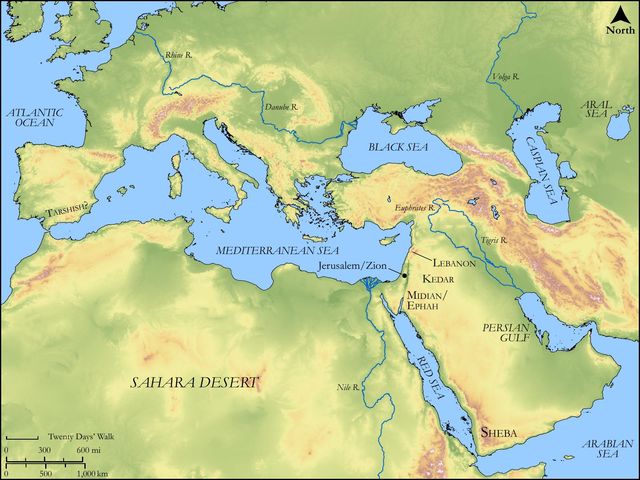
See on the biblical-era map
Study this verse
Public-domain commentary
Matthew Henry
From his Commentary on the Whole Bible. Henry comments on passages, not single verses — this entry covers Isaiah 40:9–11. His four-level outline is real structure in the source text, so it is rendered as structure.
It was promised (Isa 40:5) that the glory of the Lord shall be revealed; that is it with the hopes of which God's people must be comforted. Now here we are told,
I.How it shall be revealed, Isa 40:9.
1.It shall be revealed to Zion and Jerusalem; notice shall be given of it to the remnant that are left in Zion and Jerusalem, the poor of the land, who were vine-dressers and husbandmen; it shall be told them that their brethren shall return to them. This shall be told also to the captives who belonged to Zion and Jerusalem, and retained their affection for them. Zion is said to dwell with the daughter of Babylon (Zac 2:7); and there she receives notice of Cyrus's gracious proclamation; and so the margin reads it, O thou that tellest good tidings to Zion, etc., meaning the persons who were employed in publishing that proclamation; let them do it with a good will, let them make the country ring of it, and let them tell it to the sons of Zion in their own language, saying to them, Behold your God.
2.It shall be published by Zion and Jerusalem (so the text reads it); those that remain there, or that have already returned, when they find the deliverance proceeding towards perfection, let them proclaim it in the most public places, whence they may be best heard by all the cities of Judah; let them proclaim it as loudly as they can: let them lift up their voice with strength, and not be afraid of overstraining themselves; let them not be afraid lest the enemy should hear it and quarrel with them, or lest it should not prove true, or not such good tidings as at first it appeared; let them say to the cities of Judah, and all the inhabitants of the country, Behold your God. When God is going on with the salvation of his people, let them industriously spread the news among their friends, let them tell them that it is God that has done it; whoever were the instruments, God was the author; it is their God, a God in covenant with them, and he does it as theirs, and they will reap the benefit and comfort of it. "Behold him, take notice of his hand in it, and look above second causes; behold, the God you have long looked for has come at last (Isa 25:9): This is our God, we have waited for him." This may refer to the invitation which was sent forth from Jerusalem to the cities of Judah, as soon as they had set up an altar, immediately upon their return out of captivity, to come and join with them in their sacrifices, Ezr 3:2-4. "When the worship of God is set up again, send notice of it to all your brethren, that they may share with you in the comfort of it." But this was to have its full accomplishment in the apostles' public and undaunted preaching of the gospel to all nations, beginning at Jerusalem. The voice crying in the wilderness gave notice that he was coming; but now notice is given that he has come. Behold the Lamb of God; take a full view of your Redeemer. Behold your King, behold your God.
II.What that glory is which shall be revealed. "Your God will come, will show himself,"
1."With the power and greatness of a prince (Isa 40:10): He will come with strong hand, too strong to be obstructed, though it may be opposed. His strong hand shall subdue his people to himself, and shall restrain and conquer his and their enemies. He will come who is strong enough to break through all the difficulties that lie in his way." Our Lord Jesus was full of power, a mighty Saviour. Some read, it, He will come against the mighty one, and overpower him, overcome him. Satan is the strong man armed; but our Lord Jesus is stronger than he, and he shall make it to appear that he is so, for,
(1.)He shall reign in defiance of all opposition: His arm shall rule, shall overrule for him, for the fulfilling of his counsels, to his own glory; for he is his own end.
(2.)He shall recompense to all according to their works, as a righteous Judge: His reward is with him; he brings along with him, as a returning prince, punishments for the rebels and preferments for his loyal subjects.
(3.)He shall proceed and accomplish his purpose: His work is before him, that is, he knows perfectly well what he has to do, which way to go about it, and how to compass it. He himself knows what he will do.
2."With the pity and tenderness of a shepherd," Isa 40:11. God is the Shepherd of Israel (Psa 80:1); Christ is the good Shepherd, Joh 10:11. The same that rules with the strong hand of a prince leads and feeds with the kind hand of a shepherd.
(1.)He takes care of all his flock, the little flock: He shall feed his flock like a shepherd. His word is food for his flock to feed on; his ordinances are fields for them to feed in; his ministers are under-shepherds that are appointed to attend them.
(2.)He takes particular care of those that most need his care, the lambs that are weak, and cannot help themselves, and are unaccustomed to hardship, and those that are with young, that are therefore heavy, and, if any harm be done them, are in danger of casting their young. He particularly takes care for a succession, that it may not fail or be cut off. The good Shepherd has tender care for children that are towardly and hopeful, for young converts, that are setting out in the way to heaven, for weak believers, and those that are of a sorrowful spirit. These are the lambs of his flock, that shall be sure to want nothing that their case requires.
[1.]He will gather them in the arms of his power; his strength shall be made perfect in their weakness, Co2 12:9. He will gather them in when they wander, gather them up when they fall, gather them together when they are dispersed, and gather them home to himself at last; and all this with his own arm, out of which none shall be able to pluck them, Joh 10:28.
[2.]He will carry them in the bosom of his love and cherish them there. When they tire or are weary, are sick and faint, when they meet with foul ways, he will carry them on, and take care they are not left behind.
[3.]He will gently lead them. By his word he requires no more service, and by his providence he inflicts no more trouble, than he will fit them for; for he considers their frame.
Historical interpretation
Three Centuries of Reception
4 surviving comments on this verse. Each one is dated, so this reads as a timeline rather than a list.
Select a marker to jump to its quote. Markers stagger vertically where authors wrote within a few decades of each other.
And that He also calls us lambs, the Spirit by the mouth of Isaiah is an unimpeachable witness: "He will feed His flock like a shepherd, He will gather the lambs with His arm,"—using the figurative appellation of lambs, which are still more tender than sheep, to express simplicity.
(V. 9 and following) Ascend to the high mountain, you who bring good news to Zion; lift up your voice with strength, you who bring good news to Jerusalem. Lift it up, do not fear; say to the cities of Judah, 'Here is your God!' See, the Lord God comes with might, and His arm rules for Him. See, His reward is with Him, and His recompense accompanies Him. He tends His flock like a shepherd; He gathers the lambs in His arms and carries them close to His heart; He gently leads the nursing ewes. LXX: Go up on a high mountain, you who bring good tidings to Zion; lift up your voice with strength, you who bring good tidings to Jerusalem. Lift it up, do not be afraid; say to the cities of Judah, 'Behold your God! Behold, the Lord God shall come with a strong hand, and His arm shall rule for Him; behold, His reward is with Him, and His work before Him. He will feed His flock like a shepherd; He will gather the lambs with His arm, and carry them in His bosom, and gently lead those who are with young.' The choir of the Apostles is commanded to ascend to the preaching of all flesh, which is going to see the salvation of God, and to dwell in high places, about to speak about great things. Moreover, the Hebrew and other interpreters put it in the feminine gender, so that they say, 'you who preach the gospel to Zion and you who preach the gospel to Jerusalem.' This word is ambiguous according to the Greeks, so that we can understand it as either the one who announces or the one to whom the announcement is made. Therefore, whether the word of God and the saving word of the Lord are announced to Zion and Jerusalem: for the law went forth from Zion, and the word of the Lord from Jerusalem (Isaiah II, 3); or whether it is announced to them through the Apostles, they ought to ascend to the heights and pass over the mountains. And in a wondrous way, even though Zion itself is a mountain, as Scripture says: Mount Zion, in which you have dwelt (Psalm LXXIII, 3): it is commanded to ascend another, higher mountain, from which the prince of Tyre was wounded. And because the teachings of the Apostles were going to be greatly opposed, and they were going to be led before governors and tribunals, it is joined, exalt, do not be afraid: say to the cities of Judea, namely the synagogues and the people of the Jews, of whom the Lord spoke: I have come only for the lost sheep of the house of Israel (Matthew 15:24). And the Apostle Paul says: It was necessary for the word of God to be proclaimed to you first (Acts 13:46). But what is it that they are commanded to say? Behold your God, whom you have always awaited: Behold the Lord God shall come in strength, whom you have despised coming in humility. And his strength shall rule, who first took the form of a servant, being obedient to the Father even unto death (Philippines III). Behold his reward is with him, and his work before him (Isaiah XL, and LXII). According to what he himself says in the Gospel: For the Son of Man shall come in the glory of his Father and he shall render to every man according to his works (Matthew XVI, 17). As a shepherd, he will feed his flock. This one who will come later in majesty, first takes on the form of a shepherd, and he says about himself: I am the good shepherd, and I know my sheep, and they know me, and I lay down my life for my sheep (John 10:14, 15). About this, the Father speaks in Zechariah: I will strike the shepherd; and the sheep will be scattered (Zechariah 13:7). In his arm, he says, he will gather the lambs; not bulls, and rams, and goats, and large sheep, of whom through Ezekiel (Chapter 34) he threatens that they should feed on milk and be covered with wool, and crush the weak flock, but rather the still tender lambs, and those new to Christ's infancy, who have recently been reborn in baptism, of whom the Lord himself spoke to Peter: Feed my lambs (John 21:15). And in the same Ezekiel it is written: I will raise up for them a single shepherd, and he will feed them, my servant David; he will be their shepherd, and I the Lord will be their God, and David will be their prince in their midst. I the Lord have spoken, and I will establish a covenant of peace with David (Ezekiel 34:23-25). It should be considered that after many generations, David, in contrast to the greedy and unworthy shepherds, says that our Lord, who is of the lineage of David, will rise up, gather the lambs, and nurture them in his bosom, and he himself will carry the lambs or sheep on his shoulder. As we read in the Gospel, that he carried the wandering sheep and the one remaining from the usual flock on his shoulders to the sheepfold (Luke 15). We can say that the pregnant ewes are the Apostles and the Apostolic men and all the doctors of the Church, who give birth to the salvation of many, and they say with the Apostle: My little children, whom I travail in birth again until Christ be formed in you (Galatians 4:19). The Hebrews assert, and there is no doubt among them about this matter, that the Holy Spirit is called in their language by the feminine gender, that is, the Shekinah. And that which is said in the sixty-seventh psalm: The Lord will give the word to the preachers with great power: they understand it thus: The Lord will give the word to the preachers with great power (Ps. 122:3): namely, to those souls who have received the Holy Spirit. Also this: As the eyes of a handmaid are in the hands of her mistress, so the soul is in the hands of the Holy Spirit, both a handmaid and a mistress. But also in the Gospel written according to the Hebrews, which the Nazarenes read, the Lord speaks: Now my mother took me up, the Holy Spirit. But no one should be scandalized by the fact that in the Hebrew language the Spirit is referred to as feminine, while in our language it is referred to as masculine, and in Greek it is referred to as neutral. For in divinity there is no gender. And therefore, in the three principal languages in which the title of the Lord's Passion is written, it is referred to in three genders, so that we may understand that there is no gender that is different.
Of this prophecy also let us observe the fulfillment in the exact way and in truth in the holy Gospels. In the first place, the Lord has said, “I am the good shepherd, and I know my sheep and am known by my own … and [I] lay down my life for the sheep.” Moreover, he has likewise gathered the lambs with his arms, [that is to say] by the power of his teachings. For soon he said to the fishermen, “Follow me, and I will make you fishers of men [people].” Presently he called the publicans and ate with them. Again, another time, he allowed even a woman who had led an evil life to shed tears at his feet. He has likewise comforted pregnant women with the thought that they would give birth for salvation. As they learned of the destruction of death and the hope of the resurrection, they possesed sufficient solace for their pains in the expectation of the benefits that had been announced. Finally, while the holy Virgin still carried him in her womb, he filled Elizabeth, who was with child, with joy.
I say that these [lambs] are the souls of those who are truly made heavenly philosophers, rejecting the world with its delights and false show and who prefer to dwell in the desert rather than in royal palaces.
Continue studying Isaiah 40:11 across the web’s major study libraries — every link below opens this exact verse, chapter, or book on the destination site.
Read & Compare
 BibleGatewayThis verse in more than 200 translations and 70 languages.
 Bible.comThe YouVersion reader — hundreds of translations, reading plans, and highlights.
 ESV.orgCrossway's official English Standard Version reader.
 NET BibleThe NET translation with 60,000+ translators' notes on every rendering decision.
 STEP BibleTyndale House's free study tool — original text, vocabulary, and scholarly resources.
 BibliaLogos Bible Software's free web reader.
 USCCBThe New American Bible (Revised Edition) with the U.S. bishops' study notes.
Commentaries
 BibleHub CommentariesDozens of classic commentaries on this verse, gathered on one page.
 StudyLightMore than 100 commentary sets — the largest collection on the web.
 BibleRefPlain-English commentary on what this verse means, verse by verse.
 Enduring WordDavid Guzik's free commentary on this chapter, widely used by Bible teachers.
 Bible Study ToolsVerse commentary alongside Greek and Hebrew study aids.
Original Language & Research
- BibleHub InterlinearThe verse word by word — original language, transliteration, and English.
- BibleHub LexiconEvery word's original-language definition and Strong's entry.
 Blue Letter BibleDeep-study tools — Strong's numbers, concordance, and word studies.
 SefariaThe Hebrew text with Rashi and centuries of Jewish commentary.
Sermons, Hymns & Audio


TrulyRandomVerse is not affiliated with these sites and doesn’t control their content. They’re linked because they’re genuinely useful.
Summary
Isaiah 40:11 presents a tender and profoundly comforting image of God as a compassionate shepherd, meticulously caring for His flock. This verse, nestled within the "Book of Comfort" (Isaiah 40-66), reassures a weary and exiled Israel of divine restoration and intimate provision. It portrays the Lord not merely as a powerful sovereign but as a gentle caregiver who gathers the vulnerable, carries the weak close to His heart, and patiently guides those burdened by new responsibilities or delicate conditions, promising steadfast and personalized attention to His people.
Context
ShowHideLiterary Context
Isaiah 40:11 is a pivotal verse within the opening section of Isaiah's "Book of Comfort" (chapters 40-66), which marks a profound shift from prophecies of judgment to messages of hope and restoration for Judah. The preceding verses establish God's incomparable greatness, His eternal word, and His sovereign power over all creation. For instance, Isaiah 40:8 declares the permanence of His word, contrasting it with the fleeting nature of humanity, and Isaiah 40:10 depicts His coming with strength and recompense. Following this declaration of omnipotence, verse 11 provides a striking and essential contrast, revealing the tender, personal character of this mighty God. It serves as a direct answer to the people's lament regarding their perceived abandonment and a promise of intimate care amidst their distress, setting the tone for the subsequent prophecies of return and renewal from exile.
Historical & Cultural Context
This prophecy was delivered to a people facing or enduring the Babylonian exile, a period of immense national trauma, displacement, and spiritual despair. The Israelites felt scattered, vulnerable, and punished, questioning God's presence and care. In Hebrew thought, the shepherd was a well-understood and highly respected figure, embodying leadership, protection, and provision for the flock. Kings and deities were often depicted as shepherds of their people, signifying their responsibility for the welfare of their subjects. By portraying Yahweh as a shepherd, Isaiah invoked a powerful, relatable image of a leader who not only rules but intimately knows, protects, and cares for each individual within His community, directly addressing the deep-seated fears and anxieties of a dispossessed nation longing for security and guidance in a foreign land.
Key Themes
ShowHideThe primary themes in Isaiah 40:11 revolve around Divine Shepherdhood, portraying God as the ultimate, compassionate caregiver. This imagery underscores His Tender Care for the Vulnerable, specifically highlighting His meticulous attention to "lambs" (the weakest and most defenseless) and "those that are with young" (those needing special consideration and gentle guidance due to their delicate condition or responsibilities). This verse is a cornerstone of the Comfort and Restoration theme prevalent throughout Isaiah 40-66, assuring Israel that despite their past failures and present suffering, God's steadfast love and meticulous care will lead them through their trials and bring them home. It contrasts sharply with the failures of human leaders (often depicted as negligent shepherds in other prophetic books, such as Ezekiel 34), emphasizing God's unique and perfect pastoral heart and His unwavering faithfulness to His covenant people.
Exposition and Analysis
ShowHideKey Word Analysis
ShowHideFrom a primitive root meaning "to tend a flock; i.e. pasture it; intransitively, to graze (literally or figuratively); generally to rule." This word encompasses the full scope of a shepherd's duties: feeding, guiding, protecting, and nurturing. When applied to God, it signifies His comprehensive care, leadership, and provision for His people, extending beyond mere sustenance to include spiritual, emotional, and physical well-being. It implies a relational and active role in the lives of His flock, demonstrating His sovereign rule intertwined with intimate care.
A primitive root meaning "properly, to run with a sparkle, i.e. flow; hence (transitively), to conduct, and (by inference) to protect, sustain." This word, translated as "gently lead," conveys a sense of careful, considerate guidance, adjusting the pace and path to suit the needs of the most vulnerable members of the flock. It speaks to God's patience, understanding, and willingness to accommodate the weaknesses and burdens of His people, ensuring none are left behind or overstrained, but are sustained and protected throughout their journey.
Meaning "the bosom (literally or figuratively); bosom, bottom, lap, midst, within." This term, translated "in his bosom," signifies extreme closeness, intimacy, and security. It evokes the image of a parent or caregiver holding a beloved child close to their chest, conveying deep affection, protection, and a place of ultimate safety and comfort. It underscores the personal, affectionate, and protective nature of God's care for His most vulnerable people, holding them in a place of profound intimacy and security.
Verse Breakdown
ShowHide"He shall feed his flock like a shepherd:"
This opening clause establishes the central metaphor: God as the ultimate shepherd. The verb "feed" (râʻâh) implies not just providing food but comprehensive care, guidance, and protection for the entire community, the "flock." It sets the tone for a relationship of dependence and divine provision, where God actively nurtures and sustains His people in every aspect of their lives.
"he shall gather the lambs with his arm,"
This phrase highlights God's particular attention to the most vulnerable members of the flock—the "lambs," symbolizing the weakest, youngest, or most defenseless among His people. "Gather" (qâbats) suggests bringing together those who are scattered, lost, or isolated, implying restoration, inclusion, and a drawing near. The use of "his arm" (zᵉrôwaʻ) signifies strength, power, and active intervention, demonstrating that God's care is not passive but involves His mighty, protective presence to rescue and secure His precious ones.
"and carry [them] in his bosom,"
This clause deepens the imagery of intimate and protective care. After gathering, God "carries" (nâsâʼ) the lambs, specifically "in his bosom" (chêyq). This conveys profound tenderness, affection, and security, illustrating God's personal, comforting, and protective nature. It speaks to His willingness to bear the burdens of the weakest and most fragile among His people, holding them close to His heart, where they are safe from harm and experience His profound love.
"[and] shall gently lead those that are with young."
This final clause extends God's compassionate care to another vulnerable group: ewes "with young" (ʻûwl), implying pregnant or nursing animals that require a slower, more careful pace and special consideration. "Gently lead" (nâhal) emphasizes God's patience, understanding, and adaptation to the specific needs and limitations of His people. It assures that He will not push them beyond their capacity but will guide them with grace, consideration, and a pace that ensures their well-being and prevents exhaustion, demonstrating His perfect pastoral wisdom.
Literary Devices
ShowHideIsaiah 40:11 is rich in Metaphor and Imagery, primarily portraying God as a Shepherd. This central metaphor is deeply resonant in biblical literature, conveying themes of leadership, protection, provision, and intimate care. The verse employs vivid Imagery of a shepherd's actions: feeding, gathering, carrying, and gently leading. These actions create a powerful mental picture of God's compassionate engagement with His people, appealing directly to the reader's emotions and understanding of nurturing care. The specific details, such as "lambs," "arm," "bosom," and "those that are with young," serve as Symbolism for the most vulnerable, weakest, or burdened members of God's people, emphasizing His particular attention to those in greatest need. The gentle tone and actions attributed to God also subtly employ Personification, presenting the divine in relatable human-like terms of tenderness and care, making God's character more accessible and comforting to the reader, especially in a context of national despair.
Theological and Thematic Connections
ShowHideIsaiah 40:11 profoundly shapes our understanding of God's character, revealing Him not only as an omnipotent Creator but also as an intimately involved and compassionate caregiver. This divine shepherdhood is a foundational theological concept, underscoring God's covenant faithfulness and His unwavering commitment to His people's well-being. It speaks to His personal knowledge of each individual's needs, His strength to protect against all threats, and His tenderness to comfort in times of distress. The verse assures believers that even in their greatest weakness, vulnerability, or most challenging circumstances, God's care is perfectly tailored, steadfast, and unfailing, reflecting His enduring love and sovereign provision for His flock. This image of God as a shepherd provides immense comfort and security, inviting His people to trust fully in His perfect guidance.
Reflection and Application
ShowHideIsaiah 40:11 offers profound comfort and practical assurance for believers today, reminding us that God is not a distant, impersonal deity but an engaged, personal caregiver who intimately knows and responds to our needs. When we feel like "lambs"—vulnerable, lost, overwhelmed by life's complexities, or spiritually immature—this verse assures us of His strong arm to gather us and His tender heart to carry us through. For those feeling burdened, perhaps "with young" in the sense of new responsibilities, delicate situations, or spiritual immaturity, God promises to "gently lead," providing the specific grace, patience, and strength needed for each step. This imagery calls us to trust in His unfailing love and to find rest in His perfect care, knowing that He adapts His guidance to our individual capacity and never pushes us beyond what we can bear. Furthermore, it challenges us to emulate this divine compassion in our own lives, extending gentle care and understanding to those around us, especially the weak, the burdened, and the vulnerable, thereby reflecting the heart of our Shepherd to the world.
Questions for Reflection
ShowHideFAQ
ShowHideWhy is the shepherd metaphor so significant for understanding God's character?
ShowHideThe shepherd metaphor is profoundly significant because it beautifully encapsulates God's multifaceted role as provider, protector, guide, and caregiver. In Israel, shepherds were vital for the survival of their flock, intimately knowing each animal, leading them to pasture and water, defending them from predators, and tending to their wounds. When applied to God, it illustrates His active, personal involvement in the lives of His people, demonstrating His deep love, constant vigilance, and unwavering commitment to their well-being. It contrasts with impersonal power, emphasizing a relational and compassionate deity who adapts His care to the specific needs of His flock, as powerfully articulated in Psalm 23.
What does "gently lead those that are with young" specifically imply for believers?
ShowHideThis phrase implies that God's guidance is not uniform but perfectly attuned to individual needs and capacities. "Those that are with young" refers to pregnant or nursing ewes, which require a slower pace and extra care to avoid harm to themselves or their offspring. For believers, this symbolizes those who are vulnerable, burdened by new responsibilities, facing delicate life transitions, or perhaps spiritually immature. God promises to "gently lead" them, meaning He will not push them beyond their limits, but will provide grace, patience, and a pace that allows for growth and healing without being overwhelmed. It assures us that God understands our unique burdens and provides tailored support, just as Jesus Himself invited the weary and burdened to find rest in Him in Matthew 11:28-30.
Christ-Centered Fulfillment
ShowHideIsaiah 40:11 finds its ultimate and most profound fulfillment in the person and work of Jesus Christ, the Good Shepherd. While the Old Testament prophets foretold God's shepherd-like care for Israel, Jesus perfectly embodies this divine characteristic. He declares Himself the "Good Shepherd" in John 10:11, explicitly stating that He lays down His life for His sheep, a sacrificial act of love that far surpasses any earthly shepherd's devotion. Just as Isaiah prophesied, Jesus actively "gathers" His lambs, drawing all who come to Him into His fold (John 6:37). He "carries them in His bosom" by intimately knowing His sheep (John 10:14) and providing ultimate security and comfort, ensuring that none can snatch them from His hand (John 10:28). Furthermore, Jesus "gently leads those that are with young," extending His compassionate invitation to the weary and burdened, promising rest for their souls (Matthew 11:28-30). He is the Chief Shepherd (1 Peter 5:4), whose self-sacrificial love and perfect guidance bring God's ancient promise of tender care to its glorious and saving reality, establishing a new covenant where His flock is eternally secure.