


Isaiah 40:9
Bible text: King James Version (1769 Blayney text) · Public domain
Bible text: King James Version with Strong's numbers · Public domain
Bible text: Berean Standard Bible · Public domain
Bible text: American Standard Version (1901) · Public domain
Bible text: World English Bible, Messianic edition · Public domain
Bible text: Geneva Bible (1599) · Public domain
Bible text: Young's Literal Translation · Public domain
- עַל'alonH5921PrepPreposition
- הַרhara mountainH2022N-msNoun Singular Masculine Absolute
- גָּבֹהַga·Vo·hahighH1364Adj-msAdjective Singular Masculine Absolute
- עֲלִי'a·ligo upH5927V-Qal-Imp-2fsVerb Qal Imperative 2nd Singular Feminine
- לָךְloKh<for> yourselfPrep-l ¦ 2fsSuffix Personal 2nd Singular Feminineלָ<for>ךְyourself
- מְבַשֶּׂרֶתme·va·Se·retO bearer of news ofH1319V-Piel-Prtcpl-fsVerb Piel Participle Singular Feminine Construct
- צִיּוֹןtzi·YonZionH6726N-properNoun Proper Location
- הָרִימִיha·Ri·milift upH7311V-Hiphil-Imp-2fsVerb Hiphil Imperative 2nd Singular Feminine
- בַכֹּחַva·Ko·achwith <the> strengthH3581Prep-b ¦ N-msNoun Singular Masculine Absoluteבַwith <the>כֹּחַstrength
- קוֹלֵךְko·Lekhyour voiceH6963N-msc ¦ 2fsNoun Singular Masculine Constructקוֹלֵvoiceךְyour
- מְבַשֶּׂרֶתme·va·Se·retO bearer of news ofH1319V-Piel-Prtcpl-fsVerb Piel Participle Singular Feminine Construct
- יְרוּשָׁלִָםye·ru·sha·LimJerusalemH3389N-properNoun Proper Location
- הָרִימִיha·Ri·milift [it] upH7311V-Hiphil-Imp-2fsVerb Hiphil Imperative 2nd Singular Feminine
- אַל'almay notH408NegParticle Negative
- תִּירָאִיti·Ra·'iyou be afraidH3372V-Qal-Imperf-2fsVerb Qal Imperfect 2nd Singular Feminine
- אִמְרִי'im·RisayH559V-Qal-Imp-2fsVerb Qal Imperative 2nd Singular Feminine
- לְעָרֵיle·'a·Reito [the] cities ofH5892Prep-l ¦ N-mpcNoun Plural Masculine Constructלְtoעָרֵי[the] cities of
- יְהוּדָהye·hu·DahJudahH3063N-properNoun Proper Location
- הִנֵּהhi·Nehhere!H2009PrtParticle Interjection
- אֱלֹהֵיכֶם'e·lo·hei·Khemyour GodH430N-mpc ¦ 2mpNoun Plural Masculine ConstructאֱלֹהֵיGodכֶםyour
English is a literal word-by-word gloss of the Hebrew, not the KJV's wording. Why?
This is the original text the KJV's translators worked from — each Hebrew word with its own literal English meaning in this verse, prepared by scholars at Tyndale House, Cambridge. The KJV translates whole sentences, not word by word, so its wording differs: one Hebrew word can become several English words, and the KJV may choose “the LORD” where the gloss reads “Yahweh”. Both are faithful — they answer different questions. For the KJV's own rendering, switch to the KJV text.
Details
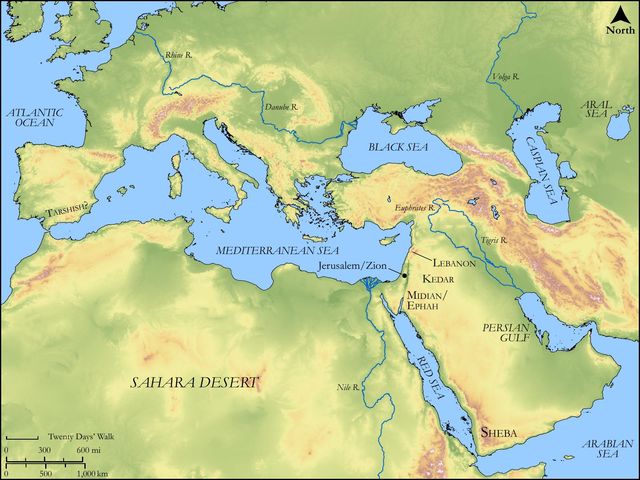
See on the biblical-era map
Study this verse
Public-domain commentary
Matthew Henry
From his Commentary on the Whole Bible. Henry comments on passages, not single verses — this entry covers Isaiah 40:9–11. His four-level outline is real structure in the source text, so it is rendered as structure.
It was promised (Isa 40:5) that the glory of the Lord shall be revealed; that is it with the hopes of which God's people must be comforted. Now here we are told,
I.How it shall be revealed, Isa 40:9.
1.It shall be revealed to Zion and Jerusalem; notice shall be given of it to the remnant that are left in Zion and Jerusalem, the poor of the land, who were vine-dressers and husbandmen; it shall be told them that their brethren shall return to them. This shall be told also to the captives who belonged to Zion and Jerusalem, and retained their affection for them. Zion is said to dwell with the daughter of Babylon (Zac 2:7); and there she receives notice of Cyrus's gracious proclamation; and so the margin reads it, O thou that tellest good tidings to Zion, etc., meaning the persons who were employed in publishing that proclamation; let them do it with a good will, let them make the country ring of it, and let them tell it to the sons of Zion in their own language, saying to them, Behold your God.
2.It shall be published by Zion and Jerusalem (so the text reads it); those that remain there, or that have already returned, when they find the deliverance proceeding towards perfection, let them proclaim it in the most public places, whence they may be best heard by all the cities of Judah; let them proclaim it as loudly as they can: let them lift up their voice with strength, and not be afraid of overstraining themselves; let them not be afraid lest the enemy should hear it and quarrel with them, or lest it should not prove true, or not such good tidings as at first it appeared; let them say to the cities of Judah, and all the inhabitants of the country, Behold your God. When God is going on with the salvation of his people, let them industriously spread the news among their friends, let them tell them that it is God that has done it; whoever were the instruments, God was the author; it is their God, a God in covenant with them, and he does it as theirs, and they will reap the benefit and comfort of it. "Behold him, take notice of his hand in it, and look above second causes; behold, the God you have long looked for has come at last (Isa 25:9): This is our God, we have waited for him." This may refer to the invitation which was sent forth from Jerusalem to the cities of Judah, as soon as they had set up an altar, immediately upon their return out of captivity, to come and join with them in their sacrifices, Ezr 3:2-4. "When the worship of God is set up again, send notice of it to all your brethren, that they may share with you in the comfort of it." But this was to have its full accomplishment in the apostles' public and undaunted preaching of the gospel to all nations, beginning at Jerusalem. The voice crying in the wilderness gave notice that he was coming; but now notice is given that he has come. Behold the Lamb of God; take a full view of your Redeemer. Behold your King, behold your God.
II.What that glory is which shall be revealed. "Your God will come, will show himself,"
1."With the power and greatness of a prince (Isa 40:10): He will come with strong hand, too strong to be obstructed, though it may be opposed. His strong hand shall subdue his people to himself, and shall restrain and conquer his and their enemies. He will come who is strong enough to break through all the difficulties that lie in his way." Our Lord Jesus was full of power, a mighty Saviour. Some read, it, He will come against the mighty one, and overpower him, overcome him. Satan is the strong man armed; but our Lord Jesus is stronger than he, and he shall make it to appear that he is so, for,
(1.)He shall reign in defiance of all opposition: His arm shall rule, shall overrule for him, for the fulfilling of his counsels, to his own glory; for he is his own end.
(2.)He shall recompense to all according to their works, as a righteous Judge: His reward is with him; he brings along with him, as a returning prince, punishments for the rebels and preferments for his loyal subjects.
(3.)He shall proceed and accomplish his purpose: His work is before him, that is, he knows perfectly well what he has to do, which way to go about it, and how to compass it. He himself knows what he will do.
2."With the pity and tenderness of a shepherd," Isa 40:11. God is the Shepherd of Israel (Psa 80:1); Christ is the good Shepherd, Joh 10:11. The same that rules with the strong hand of a prince leads and feeds with the kind hand of a shepherd.
(1.)He takes care of all his flock, the little flock: He shall feed his flock like a shepherd. His word is food for his flock to feed on; his ordinances are fields for them to feed in; his ministers are under-shepherds that are appointed to attend them.
(2.)He takes particular care of those that most need his care, the lambs that are weak, and cannot help themselves, and are unaccustomed to hardship, and those that are with young, that are therefore heavy, and, if any harm be done them, are in danger of casting their young. He particularly takes care for a succession, that it may not fail or be cut off. The good Shepherd has tender care for children that are towardly and hopeful, for young converts, that are setting out in the way to heaven, for weak believers, and those that are of a sorrowful spirit. These are the lambs of his flock, that shall be sure to want nothing that their case requires.
[1.]He will gather them in the arms of his power; his strength shall be made perfect in their weakness, Co2 12:9. He will gather them in when they wander, gather them up when they fall, gather them together when they are dispersed, and gather them home to himself at last; and all this with his own arm, out of which none shall be able to pluck them, Joh 10:28.
[2.]He will carry them in the bosom of his love and cherish them there. When they tire or are weary, are sick and faint, when they meet with foul ways, he will carry them on, and take care they are not left behind.
[3.]He will gently lead them. By his word he requires no more service, and by his providence he inflicts no more trouble, than he will fit them for; for he considers their frame.
Historical interpretation
Two Centuries of Reception
5 surviving comments on this verse. Each one is dated, so this reads as a timeline rather than a list.
Select a marker to jump to its quote. Markers stagger vertically where authors wrote within a few decades of each other.
For in the power of the Holy Spirit, by the will of the Father and the Son, Peter stood with the Eleven and, lifting up his voice (according to the text, “Lift up your voice with strength, you who bring good tidings to Jerusalem”), captured in the spiritual net of his words about three thousand souls. So great was the grace that worked in all the apostles together, that, out of the Jews … this great number believed, were baptized in the name of Christ and continued steadfast in the apostles’ doctrine and in the prayers.
Therefore, let us transcend the works of the world, so that we may be able to see God face to face. Ascend to the mountain that proclaims Zion. If the one who proclaims Zion ascends to the mountain, how much more the one who proclaims Christ and the risen Christ? Perhaps many will see him in the body; for we have known Christ according to the flesh: but now we no longer know him.
(V. 9 and following) Ascend to the high mountain, you who bring good news to Zion; lift up your voice with strength, you who bring good news to Jerusalem. Lift it up, do not fear; say to the cities of Judah, 'Here is your God!' See, the Lord God comes with might, and His arm rules for Him. See, His reward is with Him, and His recompense accompanies Him. He tends His flock like a shepherd; He gathers the lambs in His arms and carries them close to His heart; He gently leads the nursing ewes. LXX: Go up on a high mountain, you who bring good tidings to Zion; lift up your voice with strength, you who bring good tidings to Jerusalem. Lift it up, do not be afraid; say to the cities of Judah, 'Behold your God! Behold, the Lord God shall come with a strong hand, and His arm shall rule for Him; behold, His reward is with Him, and His work before Him. He will feed His flock like a shepherd; He will gather the lambs with His arm, and carry them in His bosom, and gently lead those who are with young.' The choir of the Apostles is commanded to ascend to the preaching of all flesh, which is going to see the salvation of God, and to dwell in high places, about to speak about great things. Moreover, the Hebrew and other interpreters put it in the feminine gender, so that they say, 'you who preach the gospel to Zion and you who preach the gospel to Jerusalem.' This word is ambiguous according to the Greeks, so that we can understand it as either the one who announces or the one to whom the announcement is made. Therefore, whether the word of God and the saving word of the Lord are announced to Zion and Jerusalem: for the law went forth from Zion, and the word of the Lord from Jerusalem (Isaiah II, 3); or whether it is announced to them through the Apostles, they ought to ascend to the heights and pass over the mountains. And in a wondrous way, even though Zion itself is a mountain, as Scripture says: Mount Zion, in which you have dwelt (Psalm LXXIII, 3): it is commanded to ascend another, higher mountain, from which the prince of Tyre was wounded. And because the teachings of the Apostles were going to be greatly opposed, and they were going to be led before governors and tribunals, it is joined, exalt, do not be afraid: say to the cities of Judea, namely the synagogues and the people of the Jews, of whom the Lord spoke: I have come only for the lost sheep of the house of Israel (Matthew 15:24). And the Apostle Paul says: It was necessary for the word of God to be proclaimed to you first (Acts 13:46). But what is it that they are commanded to say? Behold your God, whom you have always awaited: Behold the Lord God shall come in strength, whom you have despised coming in humility. And his strength shall rule, who first took the form of a servant, being obedient to the Father even unto death (Philippines III). Behold his reward is with him, and his work before him (Isaiah XL, and LXII). According to what he himself says in the Gospel: For the Son of Man shall come in the glory of his Father and he shall render to every man according to his works (Matthew XVI, 17). As a shepherd, he will feed his flock. This one who will come later in majesty, first takes on the form of a shepherd, and he says about himself: I am the good shepherd, and I know my sheep, and they know me, and I lay down my life for my sheep (John 10:14, 15). About this, the Father speaks in Zechariah: I will strike the shepherd; and the sheep will be scattered (Zechariah 13:7). In his arm, he says, he will gather the lambs; not bulls, and rams, and goats, and large sheep, of whom through Ezekiel (Chapter 34) he threatens that they should feed on milk and be covered with wool, and crush the weak flock, but rather the still tender lambs, and those new to Christ's infancy, who have recently been reborn in baptism, of whom the Lord himself spoke to Peter: Feed my lambs (John 21:15). And in the same Ezekiel it is written: I will raise up for them a single shepherd, and he will feed them, my servant David; he will be their shepherd, and I the Lord will be their God, and David will be their prince in their midst. I the Lord have spoken, and I will establish a covenant of peace with David (Ezekiel 34:23-25). It should be considered that after many generations, David, in contrast to the greedy and unworthy shepherds, says that our Lord, who is of the lineage of David, will rise up, gather the lambs, and nurture them in his bosom, and he himself will carry the lambs or sheep on his shoulder. As we read in the Gospel, that he carried the wandering sheep and the one remaining from the usual flock on his shoulders to the sheepfold (Luke 15). We can say that the pregnant ewes are the Apostles and the Apostolic men and all the doctors of the Church, who give birth to the salvation of many, and they say with the Apostle: My little children, whom I travail in birth again until Christ be formed in you (Galatians 4:19). The Hebrews assert, and there is no doubt among them about this matter, that the Holy Spirit is called in their language by the feminine gender, that is, the Shekinah. And that which is said in the sixty-seventh psalm: The Lord will give the word to the preachers with great power: they understand it thus: The Lord will give the word to the preachers with great power (Ps. 122:3): namely, to those souls who have received the Holy Spirit. Also this: As the eyes of a handmaid are in the hands of her mistress, so the soul is in the hands of the Holy Spirit, both a handmaid and a mistress. But also in the Gospel written according to the Hebrews, which the Nazarenes read, the Lord speaks: Now my mother took me up, the Holy Spirit. But no one should be scandalized by the fact that in the Hebrew language the Spirit is referred to as feminine, while in our language it is referred to as masculine, and in Greek it is referred to as neutral. For in divinity there is no gender. And therefore, in the three principal languages in which the title of the Lord's Passion is written, it is referred to in three genders, so that we may understand that there is no gender that is different.
It is the chorus of the apostles that the prophetic text raises here. It is precisely for this reason that after expressing this exhortation in the singular the text shifts into the plural and says, “Lift up [the voice], do not fear.” In the same way, in his turn, Christ our Master said to the apostles, “Do not fear those who kill the body but cannot kill the soul.” And again, after bringing them out from the prison, he bade them to proclaim quite freely the words of this life. Moreover, he calls “mountain” the summit of the knowledge of God.
The high mountain is the summit of doctrine and practice. Let one rise up who hurries to anoint the king. Let him reach into the heights. Let him rise up in lofty practice, in lofty contemplation, in the wisdom of the Word, in the power of love. He who is the One anointed by preaching is so great that he can be scarcely reached, even by the highest places.… The highest heights are the power of perfect conversation, and this is achieved by many perfectly.
Continue studying Isaiah 40:9 across the web’s major study libraries — every link below opens this exact verse, chapter, or book on the destination site.
Read & Compare
 BibleGatewayThis verse in more than 200 translations and 70 languages.
 Bible.comThe YouVersion reader — hundreds of translations, reading plans, and highlights.
 ESV.orgCrossway's official English Standard Version reader.
 NET BibleThe NET translation with 60,000+ translators' notes on every rendering decision.
 STEP BibleTyndale House's free study tool — original text, vocabulary, and scholarly resources.
 BibliaLogos Bible Software's free web reader.
 USCCBThe New American Bible (Revised Edition) with the U.S. bishops' study notes.
Commentaries
 BibleHub CommentariesDozens of classic commentaries on this verse, gathered on one page.
 StudyLightMore than 100 commentary sets — the largest collection on the web.
 BibleRefPlain-English commentary on what this verse means, verse by verse.
 Enduring WordDavid Guzik's free commentary on this chapter, widely used by Bible teachers.
 Bible Study ToolsVerse commentary alongside Greek and Hebrew study aids.
Original Language & Research
- BibleHub InterlinearThe verse word by word — original language, transliteration, and English.
- BibleHub LexiconEvery word's original-language definition and Strong's entry.
 Blue Letter BibleDeep-study tools — Strong's numbers, concordance, and word studies.
 SefariaThe Hebrew text with Rashi and centuries of Jewish commentary.
Sermons, Hymns & Audio


TrulyRandomVerse is not affiliated with these sites and doesn’t control their content. They’re linked because they’re genuinely useful.
Summary
Isaiah 40:9 issues a profound clarion call, personifying Zion and Jerusalem as heralds divinely commissioned to ascend a prominent mountain and fearlessly proclaim to all the cities of Judah the imminent and powerful return of their God. This pivotal verse marks a dramatic shift in Isaiah's prophetic message, transitioning from pronouncements of judgment to a glorious announcement of divine comfort, restoration, and the tangible, active presence of the Lord among His people after a period of perceived abandonment and exile.
Context
ShowHideLiterary Context
This verse stands as a foundational declaration at the very beginning of the "Book of Comfort" (Isaiah 40-66), a section of Isaiah's prophecy distinctly marked by a dramatic shift in tone from the preceding chapters (1-39), which primarily delivered messages of judgment and impending exile. Chapter 40 itself opens with a direct, tender command for comfort and consolation to God's people, as seen in Isaiah 40:1. This is followed by the famous prophetic voice preparing the way for the Lord's arrival, detailed in Isaiah 40:3. Verse 9 then builds directly upon this preparatory work, commissioning Zion and Jerusalem to actively participate in announcing the Lord's glorious advent, thereby setting the stage for the majestic descriptions of God's incomparable power, wisdom, and tender care that unfold throughout the remainder of the chapter, from Isaiah 40:10-31.
Historical & Cultural Context
The prophecies found in Isaiah 40-55 are primarily addressed to the Jewish exiles in Babylon, a people who had endured decades of displacement, despair, and a profound sense of abandonment by their God. Jerusalem lay in ruins, its temple destroyed, and the Davidic monarchy overthrown, plunging the nation into deep spiritual and national crisis. In this context of profound hopelessness, the command to "bring good tidings" was nothing short of revolutionary, offering a radical message of hope and divine intervention. The imagery of ascending a "high mountain" for proclamation reflects well-established practices of that day, where significant announcements, military victories, or royal decrees were often declared from elevated positions. This ensured maximum audibility and visibility across a wide geographical area, signifying the public, undeniable, and authoritative nature of the message. The "cities of Judah" represent the broader population, both those in exile and the scattered remnant still within the land, all reeling from the aftermath of destruction and yearning for a tangible sign of divine favor and presence.
Key Themes
ShowHideIsaiah 40:9 powerfully articulates several core theological and narrative themes central to the book of Isaiah and indeed to biblical theology as a whole. Firstly, it emphasizes the Proclamation of Good Tidings, highlighting God's sovereign initiative to bring comfort and restoration. This transforms His people from passive recipients of judgment into active heralds of His grace and faithfulness. Secondly, it underscores the critical necessity of Boldness and Fearlessness in delivering God's message, a crucial attribute for a people who had every reason to be timid, disheartened, and intimidated by their circumstances. This direct command to "be not afraid" is a recurring and vital motif throughout the "Book of Comfort," consistently reinforcing God's protective presence and empowering His messengers, as seen in Isaiah 41:10. Finally, the climactic and profound declaration, "Behold your God!", serves as the ultimate message. It signifies the imminent return of God's active presence, His unwavering sovereignty, and His steadfast faithfulness to His covenant promises, assuring His people that He is not distant or indifferent, but intimately involved in their deliverance and future.
Exposition and Analysis
ShowHideKey Word Analysis
ShowHideThis primitive root (H1319) properly means "to be fresh, i.e., full (rosy, figuratively cheerful); to announce (glad news)." It encompasses the joyous act of being a messenger, preaching, publishing, or showing forth good news. In the context of Isaiah 40:9, it denotes the vital task of proclaiming a message of comfort, hope, and restoration, standing in stark contrast to the previous pronouncements of judgment and impending doom. The inherent cheerfulness and freshness of the word underscore the nature of the news being delivered—a message of profound relief, divine intervention, and renewed life.
This word (H1364), derived from a root meaning "to be elevated," describes something "elevated (or elated), powerful, arrogant." While it can indeed carry negative connotations of haughtiness or pride in other contexts, here it refers to a physical elevation—a "high mountain"—from which a message can be effectively broadcast. It implies prominence, visibility, and authority, ensuring that the proclamation reaches far and wide across the land, reflecting the immense importance and divine authority of the message being delivered.
This primitive root (H3372) means "to fear; morally, to revere; caus. to frighten." In Isaiah 40:9, it is used in the imperative negative: "be not afraid." This command directly addresses the natural human tendency towards fear in the face of daunting circumstances, powerful opposition, or the sheer magnitude of a divine commission. The instruction to not fear is a divine assurance, empowering the heralds to deliver their message with unwavering conviction, trusting implicitly in the power and protection of the One who sends them. It transforms potential timidity into courageous proclamation.
Verse Breakdown
ShowHide"O Zion, that bringest good tidings, get thee up into the high mountain; O Jerusalem, that bringest good tidings,"
This opening apostrophe powerfully personifies Zion and Jerusalem, the spiritual and political heart of Judah, as active heralds or messengers. The repetition of the phrase "that bringest good tidings" emphatically underscores their assigned role and the inherently joyful, transformative nature of their message. The command to "get thee up into the high mountain" is both a literal and symbolic instruction, urging them to ascend a prominent vantage point. This ascent signifies the public, visible, and authoritative nature of the proclamation, ensuring it is seen and heard by all.
"lift up thy voice with strength; lift [it] up, be not afraid;"
These are potent and urgent imperatives. "Lift up thy voice with strength" demands a loud, clear, and unhesitant declaration, implying that the message is far too important to be whispered or delivered timidly. It calls for a robust and confident delivery. The subsequent command, "lift [it] up, be not afraid," powerfully reinforces the absolute necessity of boldness and courage. It directly addresses and dispels any potential fear, hesitation, or intimidation that might arise from the dire circumstances of exile or the sheer magnitude of the divine message. This is a divine empowerment against all forms of fear, enabling fearless proclamation.
"say unto the cities of Judah, Behold your God!"
This is the climactic and core content of the "good tidings," the ultimate message to be proclaimed. The instruction to "say unto the cities of Judah" signifies that the message is not exclusively for Jerusalem's inhabitants but for all the outlying towns and communities, representing a universal message of hope and restoration for the entire nation. "Behold your God!" is a profound, revelatory declaration. It announces God's imminent return, His active, tangible presence, and His sovereign power, reassuring a people who felt abandoned that their God is indeed present, powerfully at work, and utterly faithful to His covenant promises.
Literary Devices
ShowHideIsaiah 40:9 is richly layered with literary techniques that enhance its impact and meaning. Personification is prominent, as Zion and Jerusalem, typically geographical locations or their populations, are imbued with human agency—they are depicted as "bringing good tidings" and commanded to "lift up their voice." This device makes the message more immediate and relatable, transforming abstract entities into active, responsible participants in God's redemptive plan. Repetition is strategically employed with the phrase "that bringest good tidings" and the imperative "lift up," serving to emphasize the central theme of proclamation and the urgency and importance of the message. The verse is also characterized by its dominant use of the Imperative Mood verbs ("get thee up," "lift up," "be not afraid," "say"), which create a powerful sense of divine command and urgency, compelling the audience to act decisively and without delay. Finally, Symbolism is evident in the "high mountain," which represents a prominent place of authority and wide dissemination for the message, ensuring its reach and impact. The "voice" itself symbolizes the power, clarity, and authority of the divine word being spoken. The ultimate symbolic declaration, "Behold your God!", encapsulates the very essence of God's manifest presence, His sovereign power, and His unwavering faithfulness, serving as a beacon of hope for a despairing nation.
Theological and Thematic Connections
ShowHideIsaiah 40:9 is a foundational text for understanding the nature of divine revelation and the enduring role of God's people as heralds of His truth. It powerfully underscores God's unwavering faithfulness to His covenant, even in the midst of severe judgment and prolonged exile, by promising His triumphant return and active presence among His people. The "good tidings" proclaimed are not merely a human report or wishful thinking, but a divine announcement of restoration, comfort, and the ultimate triumph of God's sovereign will. This prophetic call to fearless proclamation foreshadows the ongoing mission of God's people throughout history to declare His truth, culminating in the ultimate good news of salvation through Christ.
Reflection and Application
ShowHideIsaiah 40:9 issues a timeless and profound mandate for believers today: to be bold, courageous, and fearless heralds of God's truth in a world desperately in need of genuine hope and divine perspective. Just as Zion and Jerusalem were commissioned to declare God's imminent return and active presence to a disheartened and exiled Judah, so too are we called to proclaim the good news of Jesus Christ, who is the ultimate "Behold your God!" This involves not merely sharing information, but embodying a message of divine comfort, God's unwavering sovereignty, and His active, redemptive presence in the world. Our proclamation must be strong, clear, and unhindered by fear of opposition, ridicule, apathy, or the seemingly overwhelming challenges and complexities of our modern age. The core of our message remains "Behold your God!"—a compelling call to recognize His active reign, His finished redemptive work on the cross, and His ultimate victory over sin and death. This powerful verse encourages us to live as confident and unwavering witnesses, knowing with absolute certainty that the God we proclaim is sovereign, eternally faithful, and actively at work in the world and in our individual lives, transforming darkness into light and despair into hope.
Questions for Reflection
ShowHideFAQ
ShowHideWho is "Zion" and "Jerusalem" in this context, and why are they commanded to bring good tidings?
ShowHideIn Isaiah 40:9, "Zion" and "Jerusalem" are used interchangeably and are profoundly personified. They represent not merely the physical city and its sacred mountain, but symbolically, the very people of God—the faithful remnant, the spiritual heart of the nation of Judah, and the center of God's covenantal activity. They are commanded to bring good tidings because they are the primary recipients of God's profound comfort, promised restoration, and renewed covenant relationship. As such, they are uniquely positioned and bear the sacred responsibility to share this message of hope, divine intervention, and God's imminent return with the wider community, specifically "the cities of Judah." This divine commission transforms them from a suffering and passive people into active, empowered participants in God's grand redemptive plan, becoming faithful messengers of His grace and truth to others.
What are these "good tidings" that Zion and Jerusalem are to proclaim?
ShowHideThe "good tidings" (Hebrew: bâsar, meaning "glad news") are primarily the joyous announcement of God's triumphant return to His people and His active, tangible presence among them after the devastating Babylonian exile. The climactic phrase, "Behold your God!", encapsulates the very essence of this message. It signifies that God, who may have seemed distant, absent, or even indifferent during their prolonged period of judgment and captivity, is now coming with overwhelming power, comfort, and a steadfast commitment to restore His people. This comprehensive message includes promises of liberation from captivity, the miraculous rebuilding of Jerusalem and its temple, and the glorious re-establishment of God's covenant relationship with Israel. It is a message of profound divine intervention, ultimate sovereignty, and unwavering faithfulness, offering deep hope and assurance to a nation steeped in despair.
Why is it important to "lift up thy voice with strength" and "be not afraid" when proclaiming these tidings?
ShowHideThe commands to "lift up thy voice with strength" and "be not afraid" are crucial imperatives that emphasize the urgency, clarity, and unwavering courage required for this divine proclamation. In the historical context of post-exilic Judah, the people were undoubtedly disheartened, fearful, and perhaps even skeptical after decades of suffering and perceived divine silence. A message of such magnitude—the imminent return of God Himself—needed to be delivered with absolute conviction and boldness to cut through the prevailing despair, unbelief, and spiritual apathy. It implies that the message is powerful, true, and divinely authoritative, not to be whispered in doubt or fear, but declared openly, confidently, and without compromise. The command to "be not afraid" is a direct antidote to the fear, intimidation, or human timidity that might prevent the heralds from fulfilling their sacred mission, assuring them of God's unwavering backing, protection, and empowering presence as they declare His truth. This call for fearless proclamation resonates throughout Scripture, empowering God's messengers to speak His word without compromise, regardless of opposition or personal cost, as seen in Acts 4:29.
Christ-Centered Fulfillment
ShowHideIsaiah 40:9 finds its ultimate, most profound, and glorious fulfillment in the person and redemptive work of Jesus Christ. The "good tidings" that Zion is commanded to proclaim are fully realized in the Gospel of Jesus, who is the very embodiment of "Behold your God!" While Isaiah's immediate prophetic context pointed to God's return to His people after the Babylonian exile, this prophecy reaches its zenith in the incarnation, where God Himself literally "tabernacled among us," making His dwelling with humanity, as beautifully articulated in John 1:14. Jesus' earthly ministry began with the powerful declaration of the "good news of the kingdom of God," calling people to repentance and faith, echoing the ancient prophetic call to proclaim glad tidings, as recorded in Mark 1:14-15. He is Immanuel, truly "God with us," the ultimate and tangible manifestation of God's promised presence among humanity, a truth foretold in Matthew 1:23. The ancient commission to "lift up thy voice with strength; lift it up, be not afraid" is perfectly fulfilled in Christ's Great Commission, where He empowers His disciples to fearlessly proclaim the Gospel to all nations, assuring them of His abiding presence "to the end of the age," as found in Matthew 28:19-20. Thus, the ancient call to announce "Behold your God!" culminates in the joyous, world-transforming proclamation of Jesus Christ, who is the visible image of the invisible God, bringing ultimate comfort, eternal salvation, and the tangible, indwelling presence of the divine to all who believe in Him, as affirmed in Colossians 1:15.