


John 21:14
Bible text: King James Version (1769 Blayney text) · Public domain
Bible text: Berean Standard Bible · Public domain
Bible text: American Standard Version (1901) · Public domain
Bible text: World English Bible, Messianic edition · Public domain
Bible text: Geneva Bible (1599) · Public domain
Bible text: Young's Literal Translation · Public domain
- τοῦτοtoutoThis [is]G3778D-ASNDemonstrative pronoun Accusative Singular Neuter
- ἤδηēdēnowG2235ADVAdverb
- τρίτονtriton[the] third timeG5154A-ASNAdjective Accusative Singular Neuter
- ἐφανερώθηephanerōthēwas revealedG5319V-API-3SVerb Aorist Passive Indicative 3rd Singular
- ὁho<the>G3588T-NSMDefinite article Nominative Singular Masculine
- ἸησοῦςIēsousJesusG2424N-NSM-PNoun Nominative Singular Masculine Individual
- τοῖςtoisto theG3588T-DPMDefinite article Dative Plural Masculine
- μαθηταῖςmathētaisdisciplesG3101N-DPMNoun Dative Plural Masculine
- αὐτοῦautouof himG846P-GSMPersonal pronoun Genitive Singular Masculine
- ἐγερθεὶςegertheishaving been raisedG1453V-APP-NSMVerb Aorist Passive Participle Nominative Singular Masculine
- ἐκekout fromG1537PREPPreposition
- νεκρῶνnekrōn[the] deadG3498A-GPMAdjective Genitive Plural Masculine
English is a literal word-by-word gloss of the Greek, not the KJV's wording. Why?
This is the original text the KJV's translators worked from — each Greek word with its own literal English meaning in this verse, prepared by scholars at Tyndale House, Cambridge. The KJV translates whole sentences, not word by word, so its wording differs: one Greek word can become several English words, and the KJV may choose “charity” where the gloss reads “love”. Both are faithful — they answer different questions. For the KJV's own rendering, switch to the KJV text.
Details
See on the biblical-era maps
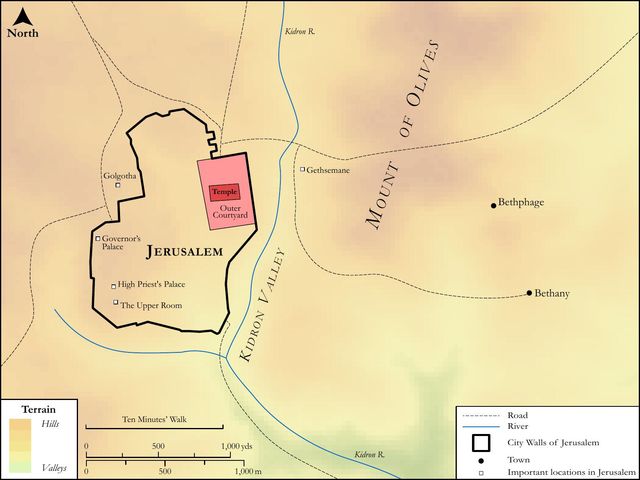
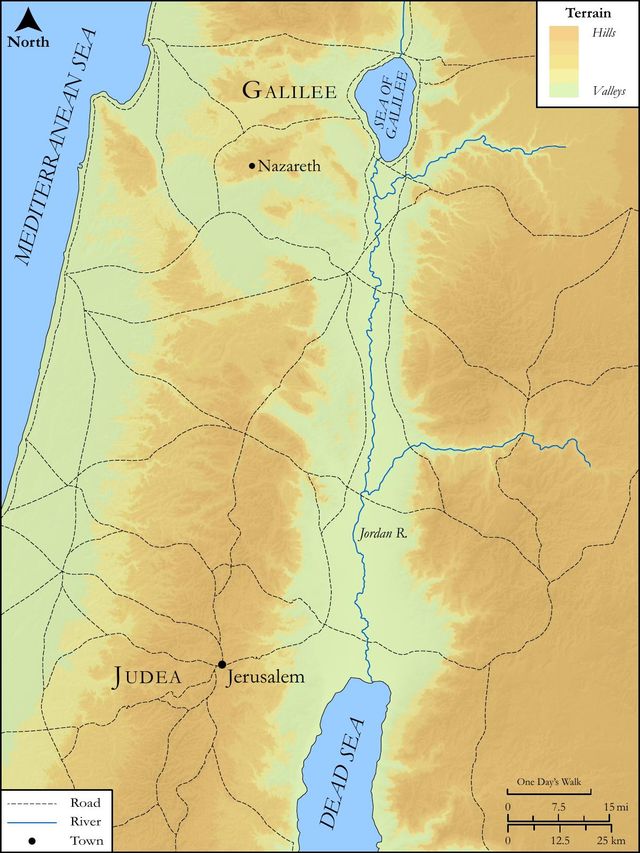
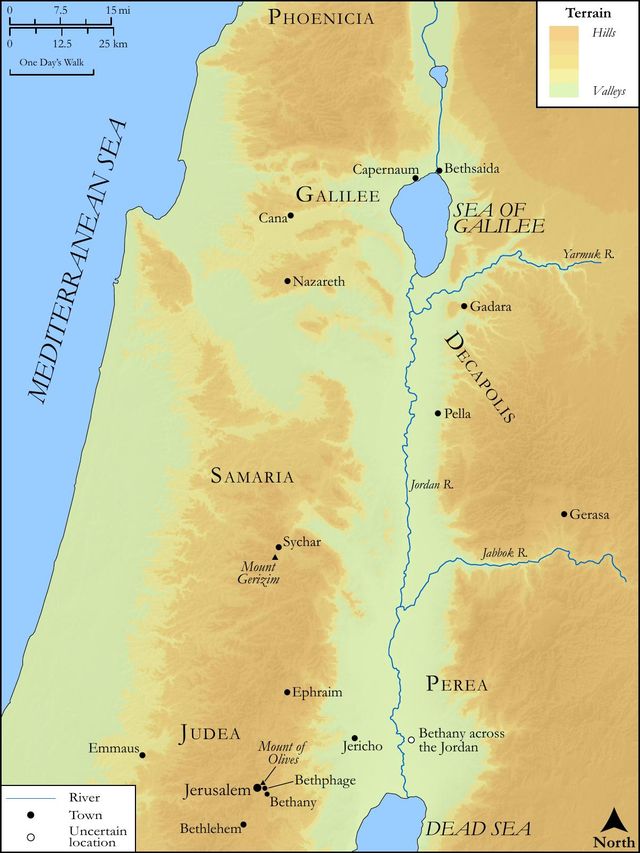
Study this verse
Public-domain commentary
Matthew Henry
From his Commentary on the Whole Bible. Henry comments on passages, not single verses — this entry covers John 21:1–14. His four-level outline is real structure in the source text, so it is rendered as structure.
We have here an account of Christ's appearance to his disciples at the sea of Tiberias. Now, 1. Let us compare this appearance with those that went before, In those Christ showed himself to his disciples when they were met in a solemn assembly (it should seem, for religious worship) upon a Lord's day, and when they were all together, perhaps expecting his appearing; but in this he showed himself to some of them occasionally, upon a week-day, when they were fishing, and little thought of it. Christ has many ways of making himself known to his people usually in his ordinances, but sometimes by his Spirit he visits them when they are employed in common business, as the shepherds who were keeping their flocks by night (Luk 2:8), even so here also, Gen 16:13. 2. Let us compare it with that which followed at the mountain in Galilee, where Christ had appointed them to meet him, Mat 28:16. Thitherward they moved as soon as the days of unleavened bread were over, and disposed of themselves as they saw fit, till the time fixed for this interview, or general rendezvous. Now this appearance was while they were waiting for that, that they might not be weary of waiting. Christ is often better than his word, but never worse, often anticipates and outdoes the believing expectations of his people, but never disappoints them. As to the particulars of the story, we may observe,
I.Who they were to whom Christ now showed himself (Joh 21:2):
not to all the twelve, but to seven of them only. Nathanael is mentioned as one of them, whom we have not met with since, ch. 1. But some think he was the same with Bartholomew, one of the twelve. The two not named are supposed to be Philip of Bethsaida and Andrew of Capernaum. Observe here, 1. It is good for the disciples of Christ to be much together; not only in solemn religious assemblies, but in common conversation, and about common business. Good Christians should by this means both testify and increase their affection to, and delight in, each other, and edify one another both by discourse and example. 2. Christ chose to manifest himself to them when they were together; not only to countenance Christian society, but that they might be joint witnesses of the same matter of fact, and so might corroborate one another's testimony. Here were seven together to attest this, on which some observe that the Roman law required seven witnesses to a testament. 3. Thomas was one of them, and is named next to Peter, as if he now kept closer to the meetings of the apostles than ever. It is well if losses by our neglects make us more careful afterwards not to let opportunities slip.
II.How they were employed, Joh 21:3. Observe,
1.Their agreement to go a fishing. They knew not well what to do with themselves. For my part, says Peter, I will go a fishing; We will go with thee then, say they, for we will keep together. Though commonly two of a trade cannot agree, yet they could. Some think they did amiss in returning to their boats and nets, which they had left; but then Christ would not have countenanced them in it with a visit. It was rather commendable in them; for they did it,
(1.)To redeem time, and not be idle. They were not yet appointed to preach the resurrection of Christ. Their commission was in the drawing, but not perfected. The hour for entering upon action was to come. It is probable that their Master had directed them to say nothing of his resurrection till after his ascension, nay, not till after the pouring out of the Spirit, and then they were to begin at Jerusalem. Now, in the mean time, rather than do nothing, they would go a fishing; not for recreation, but for business. It is an instance of their humility. Though they were advanced to be sent of Christ, as he was of the Father, yet they did not take state upon them, but remembered the rock out of which they were hewn. It is an instance likewise of their industry, and bespeaks them good husbands of their time. While they were waiting, they would not be idling. Those who would give an account of their time with joy should contrive to fill up the vacancies of it, to gather up the fragments of it.
(2.)That they might help to maintain themselves and not be burdensome to any. While their Master was with them those who ministered to him were kind to them; but now that the bridegroom was taken from them they must fast in those days, and therefore their own hands, as Paul's, must minister to their necessities and for this reason Christ asked them, Have you any meat? This teaches us with quietness to work and eat our own bread.
2.Their disappointment in their fishing. That night they caught nothing, though, it is probable, they toiled all night, as Luk 5:5. See the vanity of this world; the hand of the diligent often returns empty. Even good men may come short of desired success in their honest undertakings. We may be in the way of our duty, and yet not prosper. Providence so ordered it that all that night they should catch nothing, that the miraculous draught of fishes in the morning might be the more wonderful and the more acceptable. In those disappointments which to us are very grievous God has often designs that are very gracious. Man has indeed a dominion over the fish of the sea, but they are not always at his beck; God only knows the paths of the sea, and commands that which passeth through them.
III.After what manner Christ made himself known to them.
It is said (Joh 21:1), He showed himself. His body, though a true and real body, was raised, as ours will be, a spiritual body, and so was visible only when he himself was pleased to make it so; or, rather, came and removed so quickly that it was here or there in an instant, in a moment, in the twinkling of an eye. Four things are observable in the appearance of Christ to them: -
1.He showed himself to them seasonably (Joh 21:4): When the morning was now come, after a fruitless night's toil, Jesus stood on the shore. Christ's time of making himself known to his people is when they are most at a loss. When they think they have lost themselves, he will let them know that they have not lost him. Weeping may endure for a night; but joy comes, if Christ comes, in the morning. Christ appeared to them, not walking upon the water, because, being risen from the dead, he was not to be with them as he had been; but standing upon the shore, because now they were to make towards him. Some of the ancients put this significancy upon it, that Christ, having finished his work, was got through a stormy sea, a sea of blood, to a safe and quiet shore, where he stood in triumph; but the disciples, having their work before them, were yet at sea, in toil and peril. It is a comfort to us, when our passage is rough and stormy, that our Master is at shore, and we are hastening to him.
2.He showed himself to them gradually. The disciples, though they had been intimately acquainted with him, knew not, all at once, that it was Jesus. Little expecting to see him there, and not looking intently upon him, they took him for some common person waiting the arrival of their boat, to buy their fish. Note, Christ is often nearer to us than we think he is, and so we shall find afterwards, to our comfort.
3.He showed himself to them by an instance of his pity, Joh 21:5. He called to them, Children, paidia - "Lads, have you any meat? Have you caught any fish?" Here,
(1.)The compellation is very familiar; he speaks unto them as unto his sons, with the care and tenderness of a father: Children. Though he had now entered upon his exalted state, he spoke to his disciples with as much kindness and affection as ever. They were not children in age, but they were his children, the children which God had given him.
(2.)The question is very kind: Have you any meat? He asks as a tender father concerning his children whether they be provided with that which is fit for them, that if they be not, he may take care for their supply. Note, The Lord is for the body, Co1 6:13. Christ takes cognizance of the temporal wants of his people, and has promised them not only grace sufficient, but food convenient. Verily they shall be fed, Psa 27:3. Christ looks into the cottages of the poor, and asks, Children, have you any meat? thereby inviting them to open their case before him, and by the prayer of faith to make their requests known to him: and then let them be careful for nothing; for Christ takes care of them, takes care for them. Christ has herein set us an example of compassionate concern for our brethren. There are many poor householders disabled for labour, or disappointed in it, that are reduced to straits, whom the rich should enquire after thus, Have you any meat? For the most necessitous are commonly the least clamorous. To this question the disciples gave a short answer, and, some think, with an air of discontent and peevishness. They said, No; not giving him any such friendly and respectful title as he had given them. So short do the best come in their returns of love to the Lord Jesus. Christ put the question to them, not because he did not know their wants, but because he would know them from them. Those that would have supplies from Christ must own themselves empty and needy.
4.He showed himself to them by an instance of his power; and this perfected the discovery (Joh 21:6): he ordered them to cast the net on the right side of the ship, the contrary side to what they had been casting it on; and then they, who were going home empty-handed, were enriched with a great draught of fishes. Here we have,
(1.)The orders Christ gave them, and the promise annexed to those orders: Cast the net there in such a place, and you shall find. He from whom nothing is hid, no, not the inhabitants under the waters (Job 26:5), knew on what side of the ship the shoal of fishes was, and to that side he directs them. Note, Divine providence extends itself to things most minute and contingent; and they are happy that know how to take hints thence in the conduct of their affairs, and acknowledge it in all their ways.
(2.)Their obedience of these orders, and the good success of it. As yet they knew not that it was Jesus; however, they were willing to be advised by any body, and did not bid this supposed stranger mind his own business and not meddle with theirs, but took his counsel; in being thus observant of strangers, they were obedient to their Master unawares. And it sped wonderfully well; now they had a draught that paid them for all their pains. Note, Those that are humble, diligent, and patient (though their labours may be crossed) shall be crowned; they sometimes live to see their affairs take a happy turn, after many struggles and fruitless attempts. There is nothing lost by observing Christ's orders. Those are likely to speed well that follow the rule of the word, the guidances of the Spirit, and the intimations of Providence; for this is casting the net on the right side of the ship. Now the draught of fishes may be considered,
[1.]As a miracle in itself: and so it was designed to prove that Jesus Christ was raised in power, though sown in weakness, and that all things were put under his feet, the fishes of the sea not excepted. Christ manifests himself to his people by doing that for them which none else can do, and things which they looked not for.
[2.]As a mercy to them; for the seasonable and abundant supply of their necessities. When their ingenuity and industry failed them, the power of Christ came in opportunely for their relief; for he would take care that those who had left all for him should not want any good thing. When we are most at a loss, Jehovah - jireh.
[3.]As the memorial of a former mercy, with which Christ had formerly recompensed Peter for the loan of his boat, Luk 5:4, etc. This miracle nearly resembled that, and could not but put Peter in mind of it, which helped him to improve this; for both that and this affected him much, as meeting him in his own element, in his own employment. Latter favours are designed to bring to mind former favours, that eaten bread may not be forgotten.
[4.]As a mystery, and very significant of that work to which Christ was now with an enlarged commission sending them forth. The prophets had been fishing for souls, and caught nothing, or very little; but the apostles, who let down the net at Christ's word, had wonderful success. Many were the children of the desolate, Gal 4:27. They themselves, in pursuance of their former mission, when they were first made fishers of men, had had small success in comparison with what they should now have. When, soon after this, three thousand were converted in one day, then the net was cast on the right side of the ship. It is an encouragement to Christ's ministers to continue their diligence in their work. One happy draught, at length, may be sufficient to repay many years of toil at the gospel net.
IV.How the disciples received this discovery which Christ made of himself, Joh 21:7, Joh 21:8, where we find,
1.That John was the most intelligent and quick-sighted disciple. He whom Jesus loved was the first that said, It is the Lord; for those whom Christ loves he will in a special manner manifest himself to: his secret is with his favourites. John had adhered more closely to his Master in his sufferings than any of them: and therefore he has a clearer eye and a more discerning judgment than any of them, in recompence for his constancy. When John was himself aware that it was the Lord, he communicated his knowledge to those with him; for this dispensation of the Spirit is given to every one to profit withal. Those that know Christ themselves should endeavor to bring others acquainted with him; we need not engross him, there is enough in him for us all. John tells Peter particularly his thoughts, that it was the Lord, knowing he would be glad to see him above any of them. Though Peter had denied his Master, yet, having repented, and being taken into the communion of the disciples again, they were as free and familiar with him as ever.
2.That Peter was the most zealous and warm-hearted disciple; for as soon as he heard it was the Lord (for which he took John's word) the ship could not hold him, nor could he stay till the bringing of it to shore, but into the sea he throws himself presently, that he might come first to Christ.
(1.)He showed his respect to Christ by girding his fisher's coat about him that he might appear before his Master in the best clothes he had, and to rudely rush into his presence, stripped as he was to his waistcoat and drawers, because the work he was about was toilsome, and he was resolved to take pains in it. Perhaps the fisher's coat was made of leather, or oil-cloth, and would keep out wet; and he girt it to him that he might make the best of his way through the water to Christ, as he used to do after his nets, when he was intent upon his fishing.
(2.)He showed the strength of his affection to Christ, and his earnest desire to be with him, by casting himself into the sea; and either wading or swimming to shore, to come to him. When he walked upon the water to Christ (Mat 14:28, Mat 14:29), it was said, He came down out of the ship deliberately; but here it is said, He cast himself into the sea with precipitation; sink or swim, he would show his good-will and aim to be with Jesus. "If Christ suffer me," thinks he, "to drown, and come short of him, it is but what I deserve for denying him." Peter had had much forgiven, and made it appear he loved much by his willingness to run hazards, and undergo hardships, to come to him. Those that have been with Jesus will be willing to swim through a stormy sea, a sea of blood, to come to him. And it is a laudable contention amongst Christ's disciples to strive who shall be first with him.
3.That the rest of the disciples were careful and honest hearted. Though they were not in such a transport of zeal as to throw themselves into the sea, like Peter, yet they hastened in the boat to the shore, and made the best of their way (Joh 21:8): The other disciples, and John with them, who had first discovered that it was Christ, came slowly, yet they came to Christ. Now here we may observe,
(1.)How variously God dispenses his gifts. Some excel, as Peter and John; are very eminent in gifts and graces, and are thereby distinguished from their brethren; others are but ordinary disciples, that mind their duty, and are faithful to him, but do nothing to make themselves remarkable; and yet both the one and the other, the eminent and the obscure, shall sit down together with Christ in glory; nay, and perhaps the last shall be first. Of those that do excel, some, like John, are eminently contemplative, have great gifts of knowledge, and serve the church with them; others, like Peter, are eminently active and courageous, are strong, and do exploits, and are thus very serviceable to their generation. Some are useful as the church's eyes, others as the church's hands, and all for the good of the body.
(2.)What a great deal of difference there may be between some good people and others in the way of their honouring Christ, and yet both accepted of him. Some serve Christ more in acts of devotion, and extraordinary expressions of a religious zeal; and they do well, to the Lord they do it. Peter ought not to be censured for casting himself into the sea, but commended for his zeal and the strength of his affection; and so must those be who, in love to Christ, quit the world, with Mary, to sit at his feet. But others serve Christ more in the affairs of the world. They continue in that ship, drag the net, and bring the fish to shore, as the other disciples here; and such ought not to be censured as worldly, for they, in their place, are as truly serving Christ as the other, even in serving tables. If all the disciples had done as Peter did, what had become of their fish and their nets? And yet if Peter had done as they did we had wanted this instance of holy zeal. Christ was well pleased with both, and so must we be.
(3.)That there are several ways of bringing Christ's disciples to shore to him from off the sea of this world. Some are brought to him by a violent death, as the martyrs, who threw themselves into the sea, in their zeal for Christ; others are brought to him by a natural death, dragging the net, which is less terrible; but both meet at length on the safe and quiet shore with Christ.
V.What entertainment the Lord Jesus gave them when they came ashore.
1.He had provision ready for them. When they came to land, wet and cold, weary and hungry, they found a good fire there to warm them and dry them, and fish and bread, competent provision for a good meal.
(1.)We need not be curious in enquiring whence this fire, and fish, and bread, came, any more than whence the meat came which the ravens brought to Elijah. He that could multiply the loaves and fishes that were could make new ones if he pleased, or turn stones into bread, or send his angels to fetch it, where he knew it was to be had. It is uncertain whether this provision was made ready in the open air, or in some fisher's cabin or hut upon the shore; but here was nothing stately or delicate. We should be content with mean things, for Christ was.
(2.)We may be comforted in this instance of Christ's care of his disciples; he has wherewith to supply all our wants, and knows what things we have need of. He kindly provided for those fishermen, when they came weary from their work; for verily those shall be fed who trust in the Lord and do good. It is encouraging to Christ's ministers, whom he hath made fishers of men, that they may depend upon him who employs them to provide for them; and if they should miss of encouragement in this world, should be reduced as Paul was to hunger, and thirst, and fastings often, let them content themselves with what they have here; they have better things in reserve, and shall eat and drink with Christ at his table in his kingdom, Luk 22:30. Awhile ago, the disciples had entertained Christ with a broiled fish (Luk 24:42), and now, as a friend, he returned their kindness, and entertained them with one; nay, in the draught of fishes, he repaid them more than a hundred fold.
2.He called for some of that which they had caught, and they produced it, Joh 21:10, Joh 21:11. Observe here,
(1.)The command Christ gave them to bring their draught of fish to shore: "Bring of the fish hither, which you have now caught, and let us have some of them;" not as if he needed it; and could not make up a dinner for them without it; but,
[1.]He would have them eat the labour of their hands, Psa 128:2. What is got by God's blessing on our own industry and honest labour, if withal God give us power to eat of it, and enjoy good in our labour, hath a peculiar sweetness in it. It is said of the slothful man that he roasteth not that which he took in hunting; he cannot find in his heart to dress what he has been at the pains to take, Pro 12:27. But Christ would hereby teach us to use what we have.
[2.]He would have them taste the gifts of his miraculous bounty, that they might be witnesses both of his power and of his goodness. The benefits Christ bestows upon us are not to be buried and laid up, but to be used and laid out.
[3.]He would give a specimen of the spiritual entertainment he has for all believers, which, in this respect, is most free and familiar - that he sups with them, and they with him; their graces are pleasing to him, and his comforts are so to them; what he works in them he accepts from them.
[4.]Ministers, who are fishers of men, must bring all they catch to their Master, for on him their success depends.
(2.)Their obedience to this command, Joh 21:11. It was said (Joh 21:6), They were not able to draw the net to shore, for the multitude of fishes; that is, they found it difficult, it was more than they could well do; but he that bade them bring it to shore made it easy. Thus the fishers of men, when they have enclosed souls in the gospel net, cannot bring them to shore, cannot carry on and complete the good work begun, without the continued influence of the divine grace. If he that helped us to catch them, when without his help we should have caught nothing, do not help us to keep them, and draw them to land, by building them up in their most holy faith, we shall lose them at last, Co1 3:7. Observe,
[1.]Who it was that was most active in landing the fishes: it was Peter, who, as in the former instance (Joh 21:7), had shown a more zealous affection to his Master's person than any of them, so in this he showed a more ready obedience to his Master's command; but all that are faithful are not alike forward.
[2.]The number of the fishes that were caught. They had the curiosity to count them, and perhaps it was in order to the making of a dividend; they were in all a hundred and fifty three, and all great fishes. These were many more than they needed for their present supply, but they might sell them, and the money would serve to bear their charges back to Jerusalem, whither they were shortly to return.
[3.]A further instance of Christ's care of them, to increase both the miracle and the mercy: For all there were so many, and great fishes too, yet was not the net broken; so that they lost none of their fish, nor damaged their net. It was said (Luk 5:6), Their net broke. Perhaps this was a borrowed net, for they had long since left their own; and, if so, Christ would teach us to take care of what we have borrowed, as much as if it were our own. It was well that their net did not break, for they had not now the leisure they had formerly had to mend their nets. The net of the gospel has enclosed multitudes, three thousand in one day, and yet is not broken; it is still as mighty as ever to bring souls to God.
3.He invited them to dinner. Observing them to keep their distance and that they were afraid to ask him, Who art thou? because they knew it was their Lord, he called to them very familiarly, Come, and dine.
(1.)See here how free Christ was with his disciples; he treated them as friends; he did not say, Come, and wait, Come, and attend me, but Come, and dine; not, Go dine by yourselves, as servants are appointed to do, but Come, and dine with me. This kind invitation may be alluded to, to illustrate,
[1.]The call Christ gives his disciples into communion with him in grace here. All things are now ready; Come, and dine. Christ is a feast; come, dine upon him; his flesh is meat indeed, his blood drink indeed. Christ is a friend; come, dine with him, he will bid you welcome, Sol 5:1.
[2.]The call he will give into the fruition of him in glory hereafter: Come, ye blessed of my Father; come, and sit down with Abraham, and Isaac, and Jacob. Christ has wherewithal to dine all his friends and followers; there is room and provision enough for them all.
(2.)See how reverent the disciples were before Christ. They were somewhat shy of using the freedom he invited them to, and, by his courting them to their meat, it should seem that they stood pausing. Being to eat with a ruler, such a ruler, they consider diligently what is before them. None of them durst ask him, Who art thou? Either,
[1.]Because they would not be so bold with him. Though perhaps he appeared now in something of a disguise at first, as to the two disciples when their eyes were holden that they should not know him, yet they had very good reason to think it was he, and could be no other. Or,
[2.]Because they would not so far betray their own folly. When he had given them this instance of his power and goodness, they must be stupid indeed if they questioned whether it was he or no. When God, in his providence, has given us sensible proofs of his care for our bodies, and has given us, in his grace, manifest proofs of his good-will to our souls, and good work upon them, we should be ashamed of our distrusts, and not dare to question that which he has left us no room to question. Groundless doubts must be stifled, and not started.
4.He carved for them, as the master of the feast, Joh 21:13. Observing them to be still shy and timorous, he comes, and takes bread himself, and gives them, some to each of them, and fish likewise. No doubt he craved a blessing and gave thanks (as Luk 24:30), but, it being his known and constant practice, it did not need to be mentioned.
(1.)The entertainment here was but ordinary; it was only a fish-dinner, and coarsely dressed; here was nothing pompous, nothing curious; plentiful indeed, but plain and homely. Hunger is the best sauce. Christ, though he entered upon his exalted state, showed himself alive by eating, not showed himself a prince by feasting. Those that could not content themselves with bread and fish, unless they had sauce and wine, would scarcely have found in their hearts to dine with Christ himself here.
(2.)Christ himself began. Though, perhaps, having a glorified body, he needed not eat, yet he would show that he had a true body, which was capable of eating. The apostles produced this as one proof of his resurrection, that they had eaten and drank with him, Act 10:41.
(3.)He gave the meat about to all his guests. He not only provided it for them, and invited them to it, but he himself divided it among them, and put it into their hands. Thus to him we owe the application, as well as the purchase, of the benefits of redemption. He gives us power to eat of them.
The evangelist leaves them at dinner, and makes this remark (Joh 21:14): This is now the third time that Jesus showed himself alive to his disciples, or the greater part of them. This is the third day; so some. On the day he rose he appeared five times; the second day was that day seven-night; and this was the third. Or this was his third appearance to any considerable number of his disciples together; though he had appeared to Mary, to the women, to the two disciples, and to Cephas, yet he had but twice before this appeared to any company of them together. This is taken notice of, [1.] For confirming the truth of his resurrection; the vision was doubled, was trebled, for the thing was certain. Those who believed not the first sign would be brought to believe the voice of the latter signs. [2.] As an instance of Christ's continued kindness to his disciples; once, and again, and a third time, he visited them. It is good to keep account of Christ's gracious visits; for he keeps account of them, and they will be remembered against us if we walk unworthily of them, as they were against Solomon, when he was reminded that the Lord God of Israel had appeared unto him twice. This is now the third; have we made a due improvement of the first and second? See Co2 12:14. This is the third, perhaps it may be the last.
Historical interpretation
Two Centuries of Reception
5 surviving comments on this verse. Each one is dated, so this reads as a timeline rather than a list.
Select a marker to jump to its quote. Markers stagger vertically where authors wrote within a few decades of each other.
(Hom. lxxxvi) John does not say that He ate with them, but Luke does. He ate however not to satisfy the wants of nature, but to show the reality of His resurrection.
(Hom. lxxxvii) He means that they had not confidence to talk to Him, as before, but sat looking at Him in silence and awe, absorbed in regarding His altered and now supernatural form, and unwilling to ask any question. Knowing that it was the Lord, they were in fear, and only ate what, in exercise of His great power, He had created. He again does not look up to heaven, or do any thing after a human sort, thus showing that His former acts of that kind were done only in condescension: Jesus then cometh, and taketh bread, and giveth them, and fish likewise.
(Hom. lxxxvii) Inasmuch, however, as He did not converse with them regularly, or in the same way as before, the Evangelist adds, This is now the third time that Jesus showed Himself to His disciples, after that He was risen from the dead.
What then doth Jesus? "Come," He saith, "dine." "And none of them durst ask Him." For they no longer had the same boldness, nor were they so confident, nor did they now approach Him with speech, but with silence and great fear and reverence, sat down giving heed to Him. "For they knew that it was the Lord." And therefore they did not ask Him, "Who art Thou?" But seeing that His form was altered, and full of much awfulness, they were greatly amazed, and desired to ask somewhat concerning it; but fear, and their knowledge that He was not some other, but the Same, checked the enquiry, and they only ate what He created for them with a greater exertion of power than before. For here He no more looketh to heaven, nor performeth those human acts, showing that those also which He did were done by way of condescension. And to show that He remained not with them continually, nor in like manner as before, It saith that, "This was the third time that Jesus appeared to them, after that He arose from the dead."
And He biddeth them "to bring of the fish," to show that what they saw was no appearance. But here indeed it saith not that He ate with them, but Luke, in another place, saith that He did; for "He was eating together with them." But the, "how," it is not ours to say; for these things came to pass in too strange a manner, not as though His nature now needed food, but from an act of condescension, in proof of the Resurrection.
(Tract. cxxiii. 3) Which has reference not to manifestations, but to days; i. e. the first day after He had risen, eight days after that, when Thomas saw and believed, and this day at the draught of fishes; and thenceforward as often as He saw them, up to the time of His ascension.
(de Con. Evang. iii. 25.) We find in the four Evangelists ten occasions mentioned, on which our Lord was seen after His resurrection: one at the sepulchre by the women; a second by the women returning from the sepulchre; a third by Peter; a fourth by the two going to Emmaus; a fifth in Jerusalem, when Thomas was not present; a sixth when Thomas saw Him; a seventh at the sea of Tiberias; an eighth by all the eleven on a mountain of Galilee, mentioned by Matthew; a ninth when for the last time He sat at meat with the disciples; a tenth when He was seen no longer upon earth, but high up on a cloud.
"This was now," he says, "the third time that Jesus showed Himself to His disciples after that He was risen from the dead." And this we are to refer not to the manifestations themselves, but to the days; that is to say, taking the first day when He rose again, and the [second] eight days after, when the disciple Thomas saw and believed, and [the third] on this day when He so acted in connection with the fishes, although how many days afterwards it was that He did so we are not told; for on that first day He was seen more than once, as is shown by the collated testimonies of all the evangelists: but, as we have said, it is in accordance with the days that His manifestations are to be calculated, making this the third; for that [manifestation] is to be reckoned the first, and all one and the same, as included in one day, however often and to however many He showed Himself on the day of His resurrection; the second eight days afterwards, and this the third, and thereafter as often as He pleased on to the fortieth day, when He ascended into heaven, although all of them have not been recorded in Scripture.
This does not differ from this reading either, for he ate fish and bread. For he who could be roasted like a fish from his humanity, refreshes us with bread from his divinity, who says: "I am the living bread who came down from heaven." Therefore he ate roasted fish and bread, so that by his own food he might show us that he both endured suffering from our humanity, and provided our refreshment from his divinity. If we consider this carefully, we see how it is also fitting for us to imitate. For thus the Redeemer shows his own things, that he might prepare the way of imitation for us who follow. Behold, in his food our Lord wished to join a honeycomb to the roasted fish, because clearly he receives into his body for eternal rest those who, while they feel tribulations here for the Lord, do not depart from the love of inner sweetness. The honeycomb is taken with the roasted fish, because those who here accept affliction for the truth are satisfied there with true sweetness.
It should also be noted that the Lord is described as having his last banquet with seven disciples; for Peter and Thomas, Nathanael, the sons of Zebedee, and two others of his disciples are mentioned as having been present. Why does he celebrate the last banquet with seven disciples, unless because he announces that only those who are full of the sevenfold grace of the Holy Spirit will be with him in eternal refreshment? All this present time also unfolds in seven days, and often perfection is designated by the number seven. Therefore those feast at the last banquet on the presence of truth who now transcend earthly things by the pursuit of perfection, whom the love of this world does not bind, for whom even if it somehow clamors through temptations, it still does not blunt their begun desires. Of this final banquet it is said elsewhere through John: "Blessed are those who are called to the wedding supper of the Lamb." For this reason he relates that they are called not to a lunch but to a supper, because surely a banquet at the end of the day is a supper. Therefore those who, when the time of the present life is finished, come to the refreshment of heavenly contemplation, are called not to the lunch but to the supper of the Lamb. This supper is expressed by this last banquet, at which seven disciples are mentioned as being present, because, as we said, inner refreshment then restores those who are now full of sevenfold grace and pant in the love of the Spirit.
Continue studying John 21:14 across the web’s major study libraries — every link below opens this exact verse, chapter, or book on the destination site.
Read & Compare
 BibleGatewayThis verse in more than 200 translations and 70 languages.
 Bible.comThe YouVersion reader — hundreds of translations, reading plans, and highlights.
 ESV.orgCrossway's official English Standard Version reader.
 NET BibleThe NET translation with 60,000+ translators' notes on every rendering decision.
 STEP BibleTyndale House's free study tool — original text, vocabulary, and scholarly resources.
 BibliaLogos Bible Software's free web reader.
 USCCBThe New American Bible (Revised Edition) with the U.S. bishops' study notes.
Commentaries
 BibleHub CommentariesDozens of classic commentaries on this verse, gathered on one page.
 StudyLightMore than 100 commentary sets — the largest collection on the web.
 BibleRefPlain-English commentary on what this verse means, verse by verse.
 Enduring WordDavid Guzik's free commentary on this chapter, widely used by Bible teachers.
 Bible Study ToolsVerse commentary alongside Greek and Hebrew study aids.
Original Language & Research
- BibleHub InterlinearThe verse word by word — original language, transliteration, and English.
- BibleHub LexiconEvery word's original-language definition and Strong's entry.
 Blue Letter BibleDeep-study tools — Strong's numbers, concordance, and word studies.
 CNTR CollationThe earliest Greek manuscripts of this verse, collated letter by letter.
Sermons, Hymns & Audio


TrulyRandomVerse is not affiliated with these sites and doesn’t control their content. They’re linked because they’re genuinely useful.
Summary
John 21:14 marks a pivotal moment in the Gospel of John, explicitly stating that this appearance by the Sea of Tiberias was the third time Jesus manifested himself to a group of his disciples after his resurrection from the dead. This verse serves as a crucial historical marker, underscoring the undeniable reality of Christ's triumph over death and providing cumulative proof to his followers, solidifying their faith and preparing them for their future mission.
Context
ShowHideLiterary Context
This verse concludes the narrative of Jesus' third major post-resurrection appearance to his disciples as a group, specifically to seven of them by the Sea of Tiberias (Galilee), as detailed in John 21. It follows a miraculous catch of fish, reminiscent of their initial calling, and a shared breakfast on the shore. The immediate preceding verses recount Peter's impulsive leap into the water upon recognizing Jesus and the disciples dragging the net full of 153 large fish to shore. This event sets the stage for the subsequent intimate conversation between Jesus and Peter, where Peter is restored and commissioned, highlighting the continuity of Jesus' pastoral care and leadership transfer.
Historical & Cultural Context
The setting in Galilee, specifically by the Sea of Tiberias (also known as the Sea of Galilee), is significant. It was the primary region of Jesus' public ministry and the home of many of his disciples. After the traumatic events of the crucifixion and the initial resurrection appearances in Jerusalem, the disciples had returned to their familiar livelihoods, fishing. This return to Galilee and their former occupation reflects a period of uncertainty and transition for them. Jesus' appearance here, engaging in a common meal and demonstrating his power over creation (the fish), would have been deeply reassuring and grounding, affirming his physical presence and divine authority within a familiar cultural context of communal eating and fishing as a livelihood.
Key Themes
ShowHideThe primary theme is the undeniable reality of the resurrection. The explicit numbering ("third time") emphasizes the cumulative and irrefutable evidence provided by Jesus himself to his chosen witnesses. This appearance, like the others (e.g., John 20:19 and John 20:26), served to confirm the disciples' faith and dispel any doubt about his victory over death. It also highlights the continuity of Jesus' relationship with his followers, demonstrating his ongoing care and intention to commission them for their future ministry, particularly evident in the restoration of Peter in the subsequent verses of John 21.
Exposition and Analysis
ShowHideKey Word Analysis
ShowHideThis word, translated as "third time," is an ordinal number emphasizing the sequence and repetition of Jesus' post-resurrection manifestations. Its inclusion here is deliberate, serving as a numerical marker that underscores the cumulative and undeniable evidence of Jesus' physical appearances to his disciples, solidifying the reality of his resurrection through multiple eyewitness accounts.
Translated as "shewed himself," this verb means "to render apparent," "to make manifest," or "to reveal." It implies a clear, undeniable, and purposeful act of making oneself visible. This is not a fleeting glimpse or an ambiguous vision, but a distinct and unmistakable manifestation, reinforcing the certainty of Jesus' physical presence and identity after rising from the dead.
This verb, used in the phrase "was risen," signifies "to waken," "to rouse," or "to raise up," particularly from sleep, disease, or death. In this context, it unequivocally refers to Jesus' bodily resurrection from the grave, highlighting the miraculous and transformative event that underpins all his post-resurrection appearances and the entirety of Christian faith.
Verse Breakdown
ShowHide"This is now the third time"
This opening clause immediately establishes the numerical significance of the current event. It points back to previous group appearances, signaling that this is not an isolated incident but part of a deliberate pattern of Jesus revealing himself to his disciples, building a robust body of evidence for his resurrection.
"that Jesus shewed himself to his disciples"
This phrase emphasizes the active agency of Jesus in revealing his resurrected self. He was not merely "seen" by chance, but he "shewed himself," implying a purposeful manifestation to his chosen followers. The term "disciples" here refers to the specific group present, but also represents the broader community of those who followed him, to whom the reality of his resurrection was paramount.
"after that he was risen from the dead."
This concluding clause provides the foundational context for the entire verse. The appearances are explicitly linked to and dependent upon Jesus' resurrection from the dead. This clarifies that these are not pre-crucifixion encounters, nor are they mere spiritual visions, but tangible manifestations of a living, resurrected Christ who has conquered death.
Literary Devices
ShowHideThe verse primarily employs Emphasis through numerical specificity. By explicitly stating "the third time," the author underscores the cumulative and undeniable nature of Jesus' post-resurrection appearances, reinforcing the reality of his resurrection for the reader. This numerical detail also serves as a form of Repetition, echoing the pattern of multiple witnesses and repeated confirmations found throughout the New Testament accounts of the resurrection. Furthermore, there is an element of Climax in the narrative, as this third appearance often precedes significant commissioning or instruction, bringing the disciples to a point of full conviction and readiness for their future mission.
Theological and Thematic Connections
ShowHideJohn 21:14 serves as a crucial theological anchor, firmly establishing the historical reality of Jesus' bodily resurrection through repeated, tangible encounters. The emphasis on "the third time" is not merely a chronological detail but a theological affirmation of the certainty and sufficiency of the evidence provided to the disciples. These appearances were not fleeting visions but concrete interactions, designed to transform doubt into unwavering conviction and fear into courageous witness. This verse underscores the foundational truth of Christianity: that Christ truly conquered death, and his victory is not a spiritual metaphor but a historical event with profound implications for human salvation and the hope of eternal life. The resurrected Christ continues to interact with his followers, demonstrating his ongoing care and preparing them for their mission to proclaim the Gospel.
Reflection and Application
ShowHideThe explicit statement that this was the "third time" Jesus appeared to his disciples after his resurrection is profoundly significant for believers today. It highlights Jesus' deliberate and patient efforts to confirm his victory over death, not just to a few, but to a collective body of witnesses. This repeated manifestation was essential for solidifying their faith, dispelling their fears, and equipping them to be bold proclaimers of the Gospel. For us, this historical bedrock provides an unshakeable foundation for our own faith in the resurrected Christ. It reminds us that our hope is not built on myth or wishful thinking, but on the verifiable reality of a living Savior. Just as Jesus patiently revealed himself to his disciples, he continues to reveal himself to us through His Word, His Spirit, and His Church, calling us to a deeper relationship and empowering us for our own witness in the world.
Questions for Reflection
ShowHideFAQ
ShowHideWhy is the "third time" mentioned specifically?
ShowHideThe explicit mention of "the third time" serves several crucial purposes. Firstly, it provides a chronological marker, indicating that this appearance is distinct from and subsequent to the two previous group appearances recorded in John 20. Secondly, it emphasizes the cumulative nature of the evidence for Jesus' resurrection. Multiple, distinct appearances to various groups of disciples provided irrefutable proof, transforming their initial fear and doubt into unwavering conviction. This repetition underscores the certainty and reliability of the resurrection accounts, laying a firm foundation for the disciples' future witness.
Who were "his disciples" in this specific context?
ShowHideWhile the term "his disciples" can refer broadly to all followers of Jesus, in the immediate context of John 21:14, it refers specifically to the seven disciples mentioned by name in John 21:2: Simon Peter, Thomas (Didymus), Nathanael of Cana in Galilee, the sons of Zebedee (James and John), and two other unnamed disciples. This group represents a significant portion of the inner circle, and their collective witness to the resurrected Christ was vital for the early church's foundation.
What was the overall purpose of Jesus' post-resurrection appearances?
ShowHideJesus' post-resurrection appearances served multiple vital purposes. Primarily, they provided infallible proof of his bodily resurrection (Acts 1:3), confirming his victory over sin and death and validating his claims as the Son of God. They also served to comfort and reassure his grieving and fearful disciples, transforming their sorrow into joy and their doubt into faith. Furthermore, these appearances were crucial for commissioning and empowering his disciples for their future mission of spreading the Gospel to the world (Matthew 28:18-20). They provided direct instruction, restored broken relationships (like Peter's), and prepared them for the coming of the Holy Spirit.
Christ-Centered Fulfillment
ShowHideJohn 21:14, by explicitly marking the "third time" Jesus "shewed himself" after being "risen from the dead," powerfully underscores the Christ-centered reality of the Gospel. These post-resurrection appearances are the ultimate fulfillment of Old Testament prophecies concerning the Messiah's triumph over death and his establishment of an eternal kingdom (e.g., Psalm 16:10). Jesus' bodily resurrection, confirmed by these repeated manifestations, is the cornerstone of Christian faith, validating his identity as the Son of God and the Savior of the world. It is through His death and resurrection that sin is atoned for and eternal life is offered to all who believe. The appearances transformed the disciples from fearful individuals into courageous witnesses, empowered by the living Christ to proclaim the good news. This divine pattern of revelation and commissioning continues through the Holy Spirit, whom Christ sent to indwell believers, ensuring His abiding presence and empowering His church to carry on His mission until His glorious return (e.g., John 14:16-18 and Acts 1:8). The reality of the resurrected Christ, attested by these historical encounters, is the very hope of our own resurrection and eternal life with Him (1 Corinthians 15:20-22).