


2 Corinthians 5:14
Bible text: King James Version (1769 Blayney text) · Public domain
Bible text: Berean Standard Bible · Public domain
Bible text: American Standard Version (1901) · Public domain
Bible text: World English Bible, Messianic edition · Public domain
Bible text: Geneva Bible (1599) · Public domain
Bible text: Young's Literal Translation · Public domain
- ἡhēTheG3588T-NSFDefinite article Nominative Singular Feminine
- γὰρgarforG1063CONJConjunction
- ἀγάπηagapēloveG26N-NSFNoun Nominative Singular Feminine
- τοῦtou<the>G3588T-GSMDefinite article Genitive Singular Masculine
- ΧριστοῦChristouof ChristG5547N-GSM-TNoun Genitive Singular Masculine Title
- συνέχειsunecheicompelsG4912V-PAI-3SVerb Present Active Indicative 3rd Singular
- ἡμᾶςhēmasusG3165P-1APPersonal pronoun Accusative 1st Plural
- κρίνανταςkrinantashaving concludedG2919V-AAP-APMVerb Aorist Active Participle Accusative Plural Masculine
- τοῦτοtoutothisG3778D-ASNDemonstrative pronoun Accusative Singular Neuter
- ὅτιhotithatG3754CONJConjunction
- εἰeiifG1487CONDConjunction
- εἷςheisOneG1520A-NSMAdjective Nominative Singular Masculine
- ὑπὲρhuperforG5228PREPPreposition
- πάντωνpantōnallG3956A-GPMAdjective Genitive Plural Masculine
- ἀπέθανεν·apethanenhas diedG599V-2AAI-3SVerb 2nd Aorist Active Indicative 3rd Singular
- ἄραarathereforeG686CONJConjunction
- οἱhoi<the>G3588T-NPMDefinite article Nominative Plural Masculine
- πάντεςpantesallG3956A-NPMAdjective Nominative Plural Masculine
- ἀπέθανονapethanonhave diedG599V-2AAI-3PVerb 2nd Aorist Active Indicative 3rd Plural
English is a literal word-by-word gloss of the Greek, not the KJV's wording. Why?
This is the original text the KJV's translators worked from — each Greek word with its own literal English meaning in this verse, prepared by scholars at Tyndale House, Cambridge. The KJV translates whole sentences, not word by word, so its wording differs: one Greek word can become several English words, and the KJV may choose “charity” where the gloss reads “love”. Both are faithful — they answer different questions. For the KJV's own rendering, switch to the KJV text.
Details
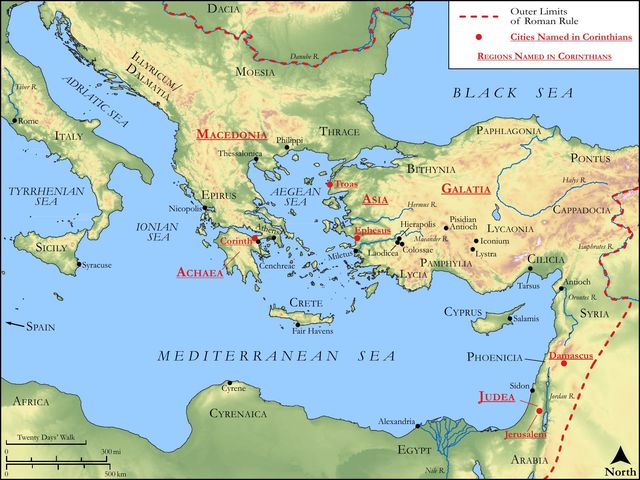
See on the biblical-era maps

Study this verse
Public-domain commentary
Matthew Henry
From his Commentary on the Whole Bible. Henry comments on passages, not single verses — this entry covers 2 Corinthians 5:12–15. His three-level outline is real structure in the source text, so it is rendered as structure.
Here observe, I. The apostle makes an apology for seeming to commend himself and his fellow-labourers (Co2 5:13), and tells them, 1. It was not to commend themselves, nor for their own sakes, that he had spoken of their fidelity and diligence in the former verses; nor was he willing to suspect their good opinion of him. But, 2. The true reason was this, to put an argument in their mouths wherewith to answer his accusers, who made vain boastings, and gloried in appearances only; that he might give them an occasion to glory on their behalf, or to defend them against the reproaches of their adversaries. And if the people can say that the word has been manifested to their consciences, and been effectual to their conversion and edification, this is the best defence they can make for the ministry of the word, when they are vilified and reproached.
II.He gives good reasons for their great zeal and diligence.
Some of Paul's adversaries had, it is likely, reproached him for his zeal and fervour, as if he had been a madman, or, in the language of our days, a fanatic; they imputed all to enthusiasm, as the Roman governor told him, Much learning has made thee mad, Act 26:24. But the apostle tells them,
1.It was for the glory of God, and the good of the church, that he was thus zealous and industrious: "Whether we be beside ourselves, or whether we be sober (whether you or others do think the one or the other), it is to God, and for his glory: and it is for your cause, or to promote your good," Co2 5:13. If they manifested the greatest ardour and vehemency at some times, and used the greatest calmness in strong reasonings at other times, it was for the best ends; and in both methods they had good reason for what they did. For,
2.The love of Christ constrained them, Co2 5:14. They were under the sweetest and strongest constraints to do what they did. Love has a constraining virtue to excite ministers and private Christians in their duty. Our love to Christ will have this virtue; and Christ's love to us, which was manifested in this great instance of his dying for us, will have this effect upon us, if it be duly considered and rightly judged of. For observe how the apostle argues for the reasonableness of love's constraints, and declares,
(1.)What we were before, and must have continued to be, had not Christ died for us: We were dead, Co2 5:14. If one died for all, then were all dead; dead in law, under sentence of death; dead in sins and trespasses, spiritually dead. Note, This was the deplorable condition of all those for whom Christ died: they were lost and undone, dead and ruined, and must have remained thus miserable for ever if Christ had not died for them.
(2.)What such should do, for whom Christ died; namely, that they should live to him. This is what Christ designed, that those who live, who are made alive unto God by means of his death, should live to him that died for them, and rose again for their sakes also, and that they should not live to themselves, Co2 5:15. Note, We should not make ourselves, but Christ, the end of our living and actions: and it was one end of Christ's death to cure us of this self-love, and to excite us always to act under the commanding influence of his love. A Christian's life should be consecrated to Christ; and then do we live as we ought to live when we live to Christ, who died for us.
Historical interpretation
Historical reception
7 surviving comments on this verse. Each one is dated, so this reads as a timeline rather than a list.
Select a marker to jump to its quote. Markers stagger vertically where authors wrote within a few decades of each other.
Because of the love of Christ the apostles were not silent about the gifts they received from him. Those who love him are surrounded by such gifts. They were not boasting about them but inviting their hearers to become Christ’s disciples.
Paul explains that although he is beside himself, the love of God controls him.
For not the fear of things to come only, he saith, but also those which have already happened allow us not to be slothful nor to slumber; but stir us up and impel us to these our labors on your behalf. And what are those things which have already happened?
"That if one died for all, then all died." Surely then it was because all were lost, saith he. For except all were dead, He had not died for all. For here the opportunities of salvation exist; but there are found no longer. Therefore, he says, "The love of God constraineth us," and allows us not to be at rest. For it cometh of extreme wretchedness and is worse than hell itself, that when He hath set forth an act so mighty, any should be found after so great an instance of His provident care reaping no benefit. For great was the excess of that love, both to die for a world of such extent, and dying for it when in such a state.
All this, in fact, blessed Paul had in mind, that fervent lover of Christ, who like a winged bird traversed the whole world.… See his uprightness, see the extraordinary degree of his virtue, see his fervent love. “The love of Christ,” he says, “constrains us,” that is, urges, impels, coerces us. Then, wishing to explain what had been said by him, he says, “convinced of this, that if one person [died] indeed for all, then all have died, he did die for all so that the living might live no longer for themselves but for the one who died and rose for them.” Do you see how appropriate it was for him to say, “The love of Christ constrains us”? He is saying, you see, if he died for the sake of us all, he died for the purpose that we the living might live no longer for ourselves but for him who died and rose for us. Accordingly, let us heed the apostolic exhortation, not living for ourselves but for him who died and rose for us.
As the apostle says, and as we have often repeated: “Since one died for all, therefore all died, and he died for all in order that they who are alive may live no longer for themselves but for him who died for them and rose again.” The living are those for whom he who was living died in order that they might live; more plainly, they are freed from the chains of death, they for whom the one free among the dead died. Or, still more plainly: they have been freed from sin, for whom he who was never in sin died. Although he died once, he dies for each at that time when each, whatever his age, is baptized in his death; that is, the death of him who was without sin benefits each man at the time when, having been baptized in his death, he who was dead in sin shall also die to sin.
Paul said: “Therefore all died; and Christ died for all, in order that they who are alive may live no longer for themselves, but for him who died for them and rose again.” All people, consequently, without a single exception, were dead through sin, original sin or original with personal sin superadded, either by ignorance of or conscious refusal to do what is right. And for all these dead souls one living man died—a man utterly free from sin—with the intention that those who come alive by forgiveness of their sins live no longer for themselves but for him who died for all on account of our sins and rose again for our justification.
But how is it that “one died for all,” one who is worth all others, if the suffering is considered simply that of some man? If he suffered according to his human nature, since he made the sufferings of his body his own.… The death of him alone according to the flesh is known to be worth the life of all, not the death of one who is as we are, even though he became like to us, but we say that he, being God by nature, became flesh and was made man according to the confession of the Fathers.
Continue studying 2 Corinthians 5:14 across the web’s major study libraries — every link below opens this exact verse, chapter, or book on the destination site.
Read & Compare
 BibleGatewayThis verse in more than 200 translations and 70 languages.
 Bible.comThe YouVersion reader — hundreds of translations, reading plans, and highlights.
 ESV.orgCrossway's official English Standard Version reader.
 NET BibleThe NET translation with 60,000+ translators' notes on every rendering decision.
 STEP BibleTyndale House's free study tool — original text, vocabulary, and scholarly resources.
 BibliaLogos Bible Software's free web reader.
 USCCBThe New American Bible (Revised Edition) with the U.S. bishops' study notes.
Commentaries
 BibleHub CommentariesDozens of classic commentaries on this verse, gathered on one page.
 StudyLightMore than 100 commentary sets — the largest collection on the web.
 BibleRefPlain-English commentary on what this verse means, verse by verse.
 Enduring WordDavid Guzik's free commentary on this chapter, widely used by Bible teachers.
 Bible Study ToolsVerse commentary alongside Greek and Hebrew study aids.
Original Language & Research
- BibleHub InterlinearThe verse word by word — original language, transliteration, and English.
- BibleHub LexiconEvery word's original-language definition and Strong's entry.
 Blue Letter BibleDeep-study tools — Strong's numbers, concordance, and word studies.
 CNTR CollationThe earliest Greek manuscripts of this verse, collated letter by letter.
Sermons, Hymns & Audio


TrulyRandomVerse is not affiliated with these sites and doesn’t control their content. They’re linked because they’re genuinely useful.
Summary
The Apostle Paul declares that the overwhelming, compelling love of Christ is the singular driving force behind his ministry and life. This profound conviction stems from a foundational theological judgment: if Christ, as the "one," died on behalf of all humanity, then it logically follows that all humanity was, in a spiritual and condemnatory sense, dead in their sins, necessitating such a sacrifice. This verse encapsulates the core motivation for Christian service and the universal spiritual plight of humanity.
Context
ShowHideLiterary Context
This verse is situated within Paul's fervent defense of his apostolic ministry to the Corinthian church, particularly in 2 Corinthians 5. Paul has just articulated his profound longing for eternity with the Lord, stating his desire to be absent from the body and present with the Lord and his ultimate ambition to be accepted by Him. Verse 14 serves as the pivotal explanation for his tireless zeal and the integrity of his motives, laying the groundwork for the subsequent declaration of the new creation in Christ and the ministry of reconciliation that he and other believers are entrusted with. It clarifies that his actions are not for self-gain or human approval, but are an unavoidable response to Christ's love.
Historical & Cultural Context
Paul's ministry to the Corinthians was fraught with challenges, including accusations against his character, authority, and methods. Some in Corinth likely questioned his motives, perhaps viewing his suffering and unconventional approach as signs of weakness or insincerity. In this letter, Paul is not only defending himself but also re-establishing the foundational truths of the Gospel against a backdrop of worldly wisdom, spiritual pride, and factionalism within the church. The emphasis on Christ's love as the ultimate constraint would have directly countered any perception that Paul was driven by personal ambition, financial gain, or a desire for human acclaim, which were common motivations among the Greeks and Romans for public figures and rhetoricians. His argument grounds his apostolic legitimacy in divine, not human, principles.
Key Themes
ShowHideThe verse powerfully contributes to several key themes woven throughout 2 Corinthians and Paul's broader theology. First, it highlights the compelling power of divine love, specifically the love of Christ, as the ultimate motivator for Christian living and service, transcending mere duty or obligation. Second, it underscores the universal spiritual death of humanity, a state of separation from God due to sin, which makes Christ's intervention absolutely necessary. This theme resonates with Paul's teaching in Romans 3:23 that "all have sinned and fall short of the glory of God." Finally, it articulates the foundational doctrine of Christ's substitutionary atonement, where "one died for all," signifying that Jesus' death was a vicarious act on behalf of humanity, bearing the penalty for sin that we deserved. This concept is central to the Gospel message and is further explored in passages like Romans 5:8.
Exposition and Analysis
ShowHideKey Word Analysis
ShowHideFrom agapáō; affection or benevolence; specifically (plural) a love-feast; (feast of) charity(-ably), dear, love. Here, it refers to the self-sacrificial, divine love of Christ for humanity, which is the ultimate source of Paul's compulsion. It is not merely an emotion but an active, benevolent will directed towards others.
From sýn and échō; to hold together, i.e. to compress (the ears, with a crowd or siege) or arrest (a prisoner); figuratively, to compel, perplex, afflict, preoccupy. This word conveys a powerful, internal pressure or an overwhelming force that leaves Paul with no other option. It implies being held fast or hemmed in by Christ's love, directing his actions and choices. It is not external coercion but an internal, loving compulsion.
From apó and thnḗskō; to die off (literally or figuratively); be dead, death, die, lie a-dying, be slain (X with). This verb is used twice in the verse, first for Christ's physical and spiritual death on the cross, and second for the spiritual state of humanity prior to His intervention. It signifies a complete cessation of life, whether physical or spiritual, implying separation and condemnation.
Verse Breakdown
ShowHide"For the love of Christ constraineth us;"
This opening clause establishes the ultimate motivation for Paul's life and ministry. The "love of Christ" can be understood as both Christ's love for Paul (and humanity) and Paul's responsive love for Christ. The verb "constraineth" (Greek synéchō) vividly portrays this love as an irresistible, all-encompassing force that grips Paul, compelling his actions and leaving him no alternative but to serve. It is an internal, powerful, and loving compulsion that directs his entire being.
"because we thus judge,"
Paul explains the logical basis for this compelling love. His ministry is not driven by irrational emotion but by a profound theological conviction and reasoned judgment. The term "judge" (Greek krínō) implies a careful, decisive conclusion reached through spiritual discernment, not merely a casual opinion. This judgment forms the bedrock of his understanding of Christ's work and humanity's need.
"that if one died for all,"
This is the premise of Paul's judgment. "One" unequivocally refers to Jesus Christ. The phrase "died for all" (Greek hypér all) signifies a vicarious, substitutionary death. Christ died "on behalf of" or "instead of" all humanity, bearing the penalty for sin. This clause points directly to the central act of atonement, where Christ's singular sacrifice addresses the universal problem of sin.
"then were all dead:"
This is the logical conclusion drawn from the premise. If Christ had to die for all, it necessarily implies that "all" were in a state of spiritual death, condemnation, and helplessness, unable to save themselves. This "dead" state refers to humanity's fallen condition, separated from God and under the dominion of sin, making Christ's atoning work absolutely essential for their redemption and new life.
Literary Devices
ShowHidePaul employs several powerful literary devices to convey his message. Personification is evident in "the love of Christ constraineth us," where love is depicted as an active, compelling force that seizes and directs human will, rather than a passive emotion. This emphasizes the dynamic and irresistible nature of divine love. The phrase "if one died for all, then were all dead" utilizes logical inference or deductive reasoning, presenting a profound theological truth as an inescapable conclusion. The death of "one" (Christ) for "all" necessitates the prior "death" (spiritual condemnation) of "all," highlighting the universal scope of both sin and salvation. There is also an element of substitutionary language inherent in the phrase "died for all," which underscores the vicarious nature of Christ's sacrifice, where He stands in the place of humanity.
Theological and Thematic Connections
ShowHide2 Corinthians 5:14 stands as a theological cornerstone, articulating the profound connection between Christ's sacrificial love, humanity's desperate spiritual condition, and the compelling motivation for Christian life and ministry. It roots all genuine service in the overwhelming reality of the cross, where Christ's singular act of substitutionary atonement addresses the universal spiritual death of humanity. This verse underscores that Christian living is not a matter of obligation or self-effort, but a spontaneous, Spirit-empowered response to the love that rescued us from condemnation. It establishes that our identity and purpose are inextricably linked to Christ's death and resurrection, leading to a life lived no longer for ourselves, but for Him.
Reflection and Application
ShowHideThis verse serves as a profound mirror for every believer, inviting us to examine the true source of our spiritual drive. Is our service, our obedience, and our devotion primarily a response to the overwhelming, self-giving love of Christ, or is it motivated by duty, guilt, or the desire for human approval? To truly grasp that "if one died for all, then were all dead" is to comprehend the immense chasm from which Christ rescued us, transforming our understanding of grace and deepening our gratitude. When we allow Christ's love to "constrain" us, it liberates us from self-centered living, empowering us to live with purpose, passion, and an unwavering commitment to His kingdom. It calls us to a life of radical surrender, where every action is an overflow of love for the One who gave His all for us, transforming our perspective from obligation to joyful, compelled devotion.
Questions for Reflection
ShowHideFAQ
ShowHideWhat does "constraineth us" truly mean in this context?
ShowHideThe Greek word translated "constraineth" (G4912, synéchō) means to hold together, to compress, to compel, or to preoccupy. In this context, it signifies an intense, internal pressure or an overwhelming, irresistible force. It's not about external coercion or forced obedience, but rather a profound, internal compulsion stemming from the love of Christ. Paul is not forced against his will, but his will is so completely captivated and directed by Christ's love that he feels an unavoidable urgency to live and minister in response to it. It's a loving, all-consuming drive that shapes his entire existence.
If "one died for all," does "then were all dead" imply universal salvation?
ShowHideNo, this verse does not imply universal salvation, but rather universal spiritual condemnation and need. The phrase "if one died for all, then were all dead" is a logical deduction about the condition of humanity. If Christ's death was necessary for all, it means that all were in a state of spiritual death (separation from God, condemned by sin) requiring such a sacrifice. It highlights the universal extent of sin and humanity's desperate need for a savior. Christ's death makes salvation available to all, but it is appropriated through faith, as taught elsewhere in Scripture (e.g., John 3:16 and Romans 10:9-10).
Christ-Centered Fulfillment
ShowHide2 Corinthians 5:14 finds its profound Christ-centered fulfillment in the very act of the cross and its transformative implications. Christ, as the "one," willingly laid down His life, not merely as an example, but as a substitutionary sacrifice for a humanity that was "dead" in trespasses and sins (Ephesians 2:1). His death on the cross became the ultimate demonstration of divine love, reconciling us to God (2 Corinthians 5:18-19). Because He died, those who were spiritually dead can now be made alive in Him, experiencing a new creation where old things pass away and all things become new. This compelling love of Christ, revealed in His atoning death and triumphant resurrection, is the very power that transforms believers, compelling them to live no longer for themselves, but for Him who died for them and rose again. Thus, Christ's death is not just a historical event, but the ongoing, living reality that fuels Christian existence and mission.