


2 Corinthians 5:15
Bible text: King James Version (1769 Blayney text) · Public domain
Bible text: King James Version with Strong's numbers · Public domain
Bible text: Berean Standard Bible · Public domain
Bible text: American Standard Version (1901) · Public domain
Bible text: World English Bible, Messianic edition · Public domain
Bible text: Geneva Bible (1599) · Public domain
Bible text: Young's Literal Translation · Public domain
- καὶkaiAndG2532CONJConjunction
- ὑπὲρhuperforG5228PREPPreposition
- πάντωνpantōnallG3956A-GPMAdjective Genitive Plural Masculine
- ἀπέθανενapethanenHe diedG599V-2AAI-3SVerb 2nd Aorist Active Indicative 3rd Singular
- ἵναinathatG2443CONJConjunction
- οἱhoithoseG3588T-NPMDefinite article Nominative Plural Masculine
- ζῶντεςzōnteslivingG2198V-PAP-NPMVerb Present Active Participle Nominative Plural Masculine
- μηκέτιmēketino longerG3371ADV-NAdverb or adverb and particle combined Negative
- ἑαυτοῖςhe'autoisto themselvesG1438F-3DPMReflexive pronoun Dative 3rd Plural Masculine
- ζῶσινzōsinmay liveG2198V-PAS-3PVerb Present Active Subjunctive 3rd Plural
- ἀλλὰallabutG235CONJConjunction
- τῷtōto the [One]G3588T-DSMDefinite article Dative Singular Masculine
- ὑπὲρhuperforG5228PREPPreposition
- αὐτῶνautōnthemG846P-GPMPersonal pronoun Genitive Plural Masculine
- ἀποθανόντιapothanontihaving diedG599V-2AAP-DSMVerb 2nd Aorist Active Participle Dative Singular Masculine
- καὶkaiandG2532CONJConjunction
- ἐγερθέντιegerthentihaving been raised againG1453V-APP-DSMVerb Aorist Passive Participle Dative Singular Masculine
English is a literal word-by-word gloss of the Greek, not the KJV's wording. Why?
This is the original text the KJV's translators worked from — each Greek word with its own literal English meaning in this verse, prepared by scholars at Tyndale House, Cambridge. The KJV translates whole sentences, not word by word, so its wording differs: one Greek word can become several English words, and the KJV may choose “charity” where the gloss reads “love”. Both are faithful — they answer different questions. For the KJV's own rendering, switch to the KJV text.
Details
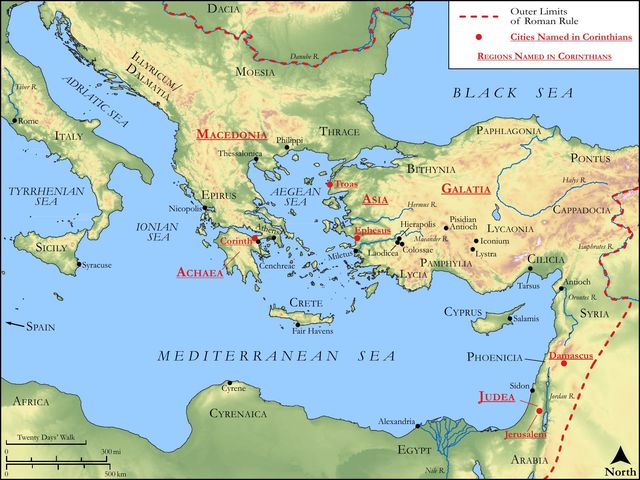
See on the biblical-era maps

Study this verse
Public-domain commentary
Matthew Henry
From his Commentary on the Whole Bible. Henry comments on passages, not single verses — this entry covers 2 Corinthians 5:12–15. His three-level outline is real structure in the source text, so it is rendered as structure.
Here observe, I. The apostle makes an apology for seeming to commend himself and his fellow-labourers (Co2 5:13), and tells them, 1. It was not to commend themselves, nor for their own sakes, that he had spoken of their fidelity and diligence in the former verses; nor was he willing to suspect their good opinion of him. But, 2. The true reason was this, to put an argument in their mouths wherewith to answer his accusers, who made vain boastings, and gloried in appearances only; that he might give them an occasion to glory on their behalf, or to defend them against the reproaches of their adversaries. And if the people can say that the word has been manifested to their consciences, and been effectual to their conversion and edification, this is the best defence they can make for the ministry of the word, when they are vilified and reproached.
II.He gives good reasons for their great zeal and diligence.
Some of Paul's adversaries had, it is likely, reproached him for his zeal and fervour, as if he had been a madman, or, in the language of our days, a fanatic; they imputed all to enthusiasm, as the Roman governor told him, Much learning has made thee mad, Act 26:24. But the apostle tells them,
1.It was for the glory of God, and the good of the church, that he was thus zealous and industrious: "Whether we be beside ourselves, or whether we be sober (whether you or others do think the one or the other), it is to God, and for his glory: and it is for your cause, or to promote your good," Co2 5:13. If they manifested the greatest ardour and vehemency at some times, and used the greatest calmness in strong reasonings at other times, it was for the best ends; and in both methods they had good reason for what they did. For,
2.The love of Christ constrained them, Co2 5:14. They were under the sweetest and strongest constraints to do what they did. Love has a constraining virtue to excite ministers and private Christians in their duty. Our love to Christ will have this virtue; and Christ's love to us, which was manifested in this great instance of his dying for us, will have this effect upon us, if it be duly considered and rightly judged of. For observe how the apostle argues for the reasonableness of love's constraints, and declares,
(1.)What we were before, and must have continued to be, had not Christ died for us: We were dead, Co2 5:14. If one died for all, then were all dead; dead in law, under sentence of death; dead in sins and trespasses, spiritually dead. Note, This was the deplorable condition of all those for whom Christ died: they were lost and undone, dead and ruined, and must have remained thus miserable for ever if Christ had not died for them.
(2.)What such should do, for whom Christ died; namely, that they should live to him. This is what Christ designed, that those who live, who are made alive unto God by means of his death, should live to him that died for them, and rose again for their sakes also, and that they should not live to themselves, Co2 5:15. Note, We should not make ourselves, but Christ, the end of our living and actions: and it was one end of Christ's death to cure us of this self-love, and to excite us always to act under the commanding influence of his love. A Christian's life should be consecrated to Christ; and then do we live as we ought to live when we live to Christ, who died for us.
Historical interpretation
Historical reception
3 surviving comments on this verse. Each one is dated, so this reads as a timeline rather than a list.
Select a marker to jump to its quote. Markers stagger vertically where authors wrote within a few decades of each other.
And again: "Christ died for all, that both they which live may not henceforth live unto themselves, but unto Him which died for them, and rose again."
What is the mark of those who eat the bread and drink the cup of Christ? That they keep in perpetual remembrance him who died for us and rose again. What is the mark of those who keep such remembrance? That they live not for themselves but for him who died for them and rose again. What is the mark of a Christian? That his justice abound in all things more than that of the scribes and Pharisees, according to the rule of the doctrine which has been handed down in the Lord’s gospel. What is the mark of the Christian? That they love one another as Christ has loved us. What is the mark of the Christian? To set the Lord always in his sight. What is the mark of the Christian? To watch daily and hourly and stand prepared in that state of perfection which is pleasing to God, knowing that at what hour he thinks not, the Lord will come.
If therefore we ought not to live unto ourselves, be not troubled, says he, nor be confounded when dangers and deaths assail you. And he assigns besides an indubitable argument by which he shows that the thing is a debt. For if through Him we live who were dead; to Him we ought to live through Whom we live. And what is said appears indeed to be one thing, but if any one accurately examine it, it is two: one that we live by Him, another that He died for us: either of which even by itself is enough to make us liable; but when even both are united consider how great the debt is. Yea, rather, there are three things here. For the First-fruits also for thy sake He raised up, and led up to heaven: wherefore also he added, "Who for our sakes died and rose again."
Continue studying 2 Corinthians 5:15 across the web’s major study libraries — every link below opens this exact verse, chapter, or book on the destination site.
Read & Compare
 BibleGatewayThis verse in more than 200 translations and 70 languages.
 Bible.comThe YouVersion reader — hundreds of translations, reading plans, and highlights.
 ESV.orgCrossway's official English Standard Version reader.
 NET BibleThe NET translation with 60,000+ translators' notes on every rendering decision.
 STEP BibleTyndale House's free study tool — original text, vocabulary, and scholarly resources.
 BibliaLogos Bible Software's free web reader.
 USCCBThe New American Bible (Revised Edition) with the U.S. bishops' study notes.
Commentaries
 BibleHub CommentariesDozens of classic commentaries on this verse, gathered on one page.
 StudyLightMore than 100 commentary sets — the largest collection on the web.
 BibleRefPlain-English commentary on what this verse means, verse by verse.
 Enduring WordDavid Guzik's free commentary on this chapter, widely used by Bible teachers.
 Bible Study ToolsVerse commentary alongside Greek and Hebrew study aids.
Original Language & Research
- BibleHub InterlinearThe verse word by word — original language, transliteration, and English.
- BibleHub LexiconEvery word's original-language definition and Strong's entry.
 Blue Letter BibleDeep-study tools — Strong's numbers, concordance, and word studies.
 CNTR CollationThe earliest Greek manuscripts of this verse, collated letter by letter.
Sermons, Hymns & Audio


TrulyRandomVerse is not affiliated with these sites and doesn’t control their content. They’re linked because they’re genuinely useful.
Summary
2 Corinthians 5:15 presents the profound theological truth that Jesus Christ's sacrificial death and glorious resurrection serve a singular, transformative purpose: to reorient the lives of those who receive His grace. No longer are believers to be governed by self-interest or personal ambition, but rather their existence is to be wholly dedicated to Christ, who gave His life for them and triumphed over death. This verse encapsulates the radical shift from a self-centered life to a Christ-centered one, defining the very essence of new covenant living.
Context
ShowHideLiterary Context
This verse is deeply embedded within Paul's discourse on the nature and motivation of his apostolic ministry in 2 Corinthians 5. Having just described the believer's future hope of a heavenly dwelling and the earnest desire to please the Lord (verses 1-10), Paul transitions to the compelling force behind his evangelistic zeal: "the love of Christ constraineth us" (verse 14). Verse 15 directly elaborates on the reason for this constraining love, explaining that Christ's death for all necessitates a fundamental reorientation of life for those who are made alive in Him. It serves as a foundational premise for the subsequent declaration of believers as a "new creation" in Christ and their role as ambassadors for reconciliation, highlighting the transformative power of the Gospel that underpins both their identity and mission.
Historical & Cultural Context
Paul's ministry in Corinth was marked by significant challenges, including internal divisions, moral laxity, and external opposition. The Corinthian church, situated in a bustling, cosmopolitan city known for its diverse religious practices and philosophical schools, often struggled with individualism and self-assertion, reflecting the broader outlook of the Greeks and Romans, who prioritized personal honor, autonomy, and self-advancement. Paul's exhortation for believers not to "live unto themselves" directly confronts this prevailing cultural ethos, calling them to a counter-cultural existence rooted in Christ's self-giving love. His emphasis on Christ's death "for all" also subtly pushes back against any elitist or exclusive tendencies that might have emerged within the community, reinforcing the universal scope of God's redemptive plan and the universal reach of the Gospel.
Key Themes
ShowHide2 Corinthians 5:15 contributes significantly to several major themes in Paul's theology and the broader book. Firstly, it underscores the Substitutionary Atonement of Christ, emphasizing that "he died for all," meaning He acted on behalf of humanity, bearing the penalty for sin. This theme is central to understanding the basis of salvation and God's justice and mercy. Secondly, the verse highlights the Radical Transformation that occurs in a believer's life, moving from self-centeredness to Christ-centeredness. This reorientation is a hallmark of the new covenant and is further expounded in Paul's teaching on being a new creation in Christ. Finally, the inclusion of "and rose again" emphasizes the Power of the Resurrection, not merely as a historical event but as the validating act that empowers believers to walk in newness of life and signifies Christ's victory over sin and death, establishing His ongoing Lordship.
Exposition and Analysis
ShowHideKey Word Analysis
ShowHideFrom apo (away from) and thnesko (to die), this verb signifies a complete cessation of life, a "dying off." In the context of Christ, it refers to His physical death on the cross, which was a final, decisive act of sacrifice. The Strong's definition "to die off (literally or figuratively)" captures the totality of this event, which was both a physical reality and a spiritual act of atonement.
This primary verb means "to live (literally or figuratively)." In this verse, it refers to the spiritual life that believers now possess through their union with Christ. It implies not just existence, but a vibrant, active, and purposeful life. The contrast with "died" highlights the profound spiritual regeneration experienced by those who believe.
Probably akin to the base of agora (through the idea of collecting one's faculties), this verb means "to waken (transitively or intransitively), i.e. rouse (literally, from sleep, from sitting or lying, from disease, from death; or figuratively, from obscurity, inactivity, ruins, nonexistence)." Here, it specifically denotes Christ's resurrection from the dead, signifying His triumph over death and His active, living reality, which empowers the new life of believers.
Verse Breakdown
ShowHide"And that he died for all"
This clause establishes the universal scope and substitutionary nature of Christ's atoning work. His death was not for a select few, but for the entirety of humanity, bearing the penalty for sin on behalf of everyone. This act of ultimate self-sacrifice is the foundation of the believer's new life.
"that they which live should not henceforth live unto themselves"
This is the immediate and direct purpose clause of Christ's death. "They which live" refers to those who have been spiritually regenerated through faith in Christ. The phrase "not henceforth live unto themselves" signifies a radical break from a life governed by self-interest, personal desires, and autonomy. It calls for a complete reorientation away from egocentric living.
"but unto him which died for them, and rose again"
This clause presents the positive command and new direction for the regenerated life. Instead of self-direction, believers are now to live "unto him" – for Christ's glory, according to His will, and in devotion to His purposes. The inclusion of "which died for them, and rose again" emphasizes that this new life is a response of gratitude and commitment to the One who made their spiritual life possible through His atoning death and victorious resurrection.
Literary Devices
ShowHideThe verse employs several powerful literary devices to convey its profound message. Most prominently, Antithesis or Contrast is used to highlight the radical shift in the believer's life: "not henceforth live unto themselves, but unto him." This stark opposition emphasizes the fundamental reorientation from self-centeredness to Christ-centeredness, underscoring the transformative power of the Gospel. The phrase "died for all" also functions as a form of Synecdoche, where "all" represents all humanity, implying the universal reach of Christ's sacrifice. Furthermore, the verse demonstrates Conciseness and Clarity, packing immense theological depth into a single, impactful sentence, making its core message easily graspable yet profoundly challenging.
Theological and Thematic Connections
ShowHideThis verse is a cornerstone for understanding the Christian life as a response to divine grace. It asserts that salvation is not merely an escape from judgment, but a call to a new existence defined by allegiance to Christ. The vicarious death of Christ for "all" establishes the breadth of God's redemptive love, while the subsequent call to live "unto him" illuminates the ethical and practical implications of that love. This reorientation of purpose is the natural outflow of genuine conversion, marking a profound shift from a life of self-gratification to one of Christ-glorification, empowered by His resurrection.
Reflection and Application
ShowHide2 Corinthians 5:15 serves as a potent reminder that the Christian life is fundamentally a life of radical reorientation. It challenges us to continually examine the true center of our existence. Are our daily decisions, our ambitions, our use of time and resources, primarily driven by our own desires and comforts, or are they submitted to the will and glory of Christ? This verse calls us beyond mere moral improvement to a complete shift in allegiance, recognizing that our very lives are a gift purchased by His sacrifice. It invites us to live with intentionality, purpose, and profound gratitude, allowing the love of Christ to be the ultimate motivator for all we do, transforming our relationships, our work, our leisure, and our witness.
Questions for Reflection
ShowHideFAQ
ShowHideWhat does "he died for all" mean in this context?
ShowHide"He died for all" signifies the universal scope of Christ's atoning sacrifice. It means that Jesus's death on the cross was sufficient to cover the sins of all humanity. While the benefits of this sacrifice are applied to those who believe, the offer and provision are for everyone. It underscores the boundless love of God and the comprehensive nature of Christ's redemptive work, making salvation available to anyone who responds in faith, as seen in John 3:16.
What does it mean to "not henceforth live unto themselves"?
ShowHideTo "not henceforth live unto themselves" means to cease living a life primarily driven by one's own desires, ambitions, comfort, or self-interest. It's a call to abandon egocentric living, where "self" is the ultimate authority and purpose. This doesn't mean neglecting personal well-being entirely, but rather that one's ultimate allegiance and direction are no longer rooted in autonomy but in submission to Christ. It's a fundamental shift in the governing principle of one's life, moving from self-rule to Christ's Lordship, as also echoed in Romans 14:7.
Christ-Centered Fulfillment
ShowHide2 Corinthians 5:15 finds its profound Christ-centered fulfillment in the person and work of Jesus, who is both the means and the end of our new life. His death "for all" is the ultimate act of vicarious atonement, where the Lamb of God takes away the sin of the world, bearing the penalty we deserved. But His sacrifice is not merely a historical event; it is inextricably linked to His glorious resurrection, which validates His claims, signifies His triumph over sin and death, and establishes Him as the living Lord. Consequently, those who are united with Him in His death and resurrection are called to a new existence where Christ is the very center and purpose. This means living not for personal gain or fleeting earthly desires, but as ambassadors for Christ, embodying His love, pursuing His will, and reflecting His glory in every facet of life. Our new identity in Christ compels us to surrender our self-sovereignty and embrace a life wholly devoted to the One who loved us and gave Himself for us.