


1 Peter 5:3
- μηδ᾽mēd᾽notG3366CONJ-NConjunction Negative
- ὡςhōsasG5613PRTParticle or Disjunctive
- κατακυριεύοντεςkatakurieuontesexercising lordship overG2634V-PAP-NPMVerb Present Active Participle Nominative Plural Masculine
- τῶνtōn<the>G3588T-GPMDefinite article Genitive Plural Masculine
- κλήρωνklērōnthose in your chargeG2819N-GPMNoun Genitive Plural Masculine
- ἀλλὰallabutG235CONJConjunction
- τύποιtupoiexamplesG5179N-NPMNoun Nominative Plural Masculine
- γινόμενοιginomenoibeingG1096V-PNP-NPMVerb Present Middle Or Passive Deponent Participle Nominative Plural Masculine
- τοῦtouto theG3588T-GSNDefinite article Genitive Singular Neuter
- ποιμνίου·poimniouflockG4168N-GSNNoun Genitive Singular Neuter
English is a literal word-by-word gloss of the Greek, not the KJV's wording. Why?
This is the original text the KJV's translators worked from — each Greek word with its own literal English meaning in this verse, prepared by scholars at Tyndale House, Cambridge. The KJV translates whole sentences, not word by word, so its wording differs: one Greek word can become several English words, and the KJV may choose “charity” where the gloss reads “love”. Both are faithful — they answer different questions. For the KJV's own rendering, switch to the KJV text.
Details
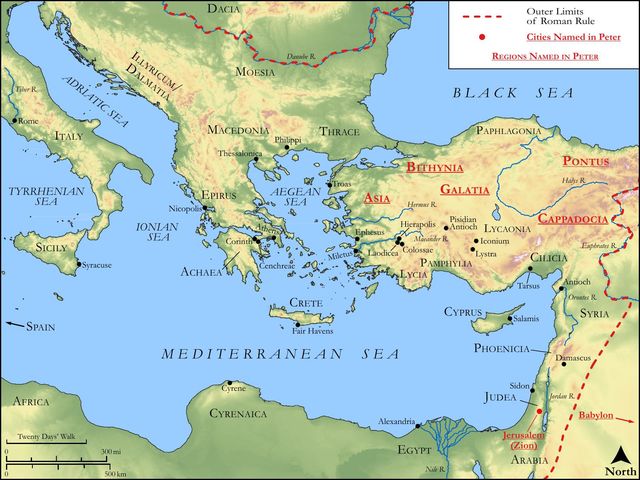
See on the biblical-era map

Study this verse
Public-domain commentary
Matthew Henry
From his Commentary on the Whole Bible. Henry comments on passages, not single verses — this entry covers 1 Peter 5:1–4. His two-level outline is real structure in the source text, so it is rendered as structure.
Here we may observe,
I.The persons to whom this exhortation is given - to the presbyters, pastors, and spiritual guides of the church, elders by office, rather than by age, ministers of those churches to whom he wrote this epistle.
II.The person who gives this exhortation - the apostle Peter:
I exhort; and, to give force to this exhortation, he tells them he was their brother-presbyter or fellow-elder, and so puts nothing upon them but what he was ready to perform himself. He was also a witness of the sufferings of Christ, being with him in the garden, attending him to the palace of the high-priest, and very likely being a spectator of his suffering upon the cross, at a distance among the crowd, Act 3:15. He adds that he was also a partaker of the glory that was in some degree revealed at the transfiguration (Mat 17:1-3), and shall be completely enjoyed at the second coming of Jesus Christ. Learn,
1.Those whose office it is to teach others ought carefully to study their own duty, as well as teach the people theirs.
2.How different the spirit and behaviour of Peter were from that of his pretended successors! He does not command and domineer, but exhort. He does not claim sovereignty over all pastors and churches, nor style himself prince of the apostles, vicar of Christ, or head of the church, but values himself upon being an elder. All the apostles were elders, though every elder was not an apostle.
3.It was the peculiar honour of Peter, and a few more, to be the witnesses of Christ's sufferings; but it is the privilege of all true Christians to be partakers of the glory that shall be revealed.
III.The pastor's duty described, and the manner in which that duty ought to be performed.
The pastoral duty is three-fold: - 1. To feed the flock, by preaching to them the sincere word of God, and ruling them according to such directions and discipline as the word of God prescribes, both which are implied in this expression, Feed the flock. 2. The pastors of the church must take the oversight thereof. The elders are exhorted to do the office of bishops (as the word signifies), by personal care and vigilance over all the flock committed to their charge. 3. They must be examples to the flock, and practise the holiness, self-denial, mortification, and all other Christian duties, which they preach and recommend to their people. These duties must be performed, not by constraint, not because you must do them, not from compulsion of the civil power, or the constraint of fear or shame, but from a willing mind that takes pleasure in the work: not for filthy lucre, or any emoluments and profits attending the place where you reside, or any perquisite belonging to the office, but of a ready mind, regarding the flock more than the fleece, sincerely and cheerfully endeavouring to serve the church of God; neither as being lords over God's heritage, tyrannizing over them by compulsion and coercive force, or imposing unscriptural and human inventions upon them instead of necessary duty, Mat 20:25, Mat 20:26; Co2 1:24. Learn, (1.) The eminent dignity of the church of God, and all the true members of it. These poor, dispersed, suffering Christians were the flock of God. The rest of the world is a brutal herd. These are an orderly flock, redeemed to God by the great Shepherd, living in holy love and communion one with another, according to the will of God. They are also dignified with the title of God's heritage or clergy, his peculiar lot, chosen out of the common multitude for his own people, to enjoy his special favour and to do him special service. The word is never restricted in the New Testament to the ministers of religion. (2.) The pastors of the church ought to consider their people as the flock of God, as God's heritage, and treat them accordingly. They are not theirs, to be lorded over at pleasure; but they are God's people, and should be treated with love, meekness, and tenderness, for the sake of him to whom they belong. (3.) Those ministers who are either driven to the work by necessity or drawn to it by filthy lucre can never perform their duty as they ought, because they do not do it willingly, and with a ready mind. (4.) The best way a minister can take to engage the respect of a people is to discharge his own duty among them in the best manner that he can, and to be a constant example to them of all that is good.
IV.In opposition to that filthy lucre which many propose to themselves as their principal motive in undertaking and discharging the pastoral office, the apostle sets before them the crown of glory designed by the great shepherd, Jesus Christ, for all his faithful ministers. Learn,
1.Jesus Christ is the chief shepherd of the whole flock and heritage of God. He bought them, and rules them; he defends and saves them for ever. He is also the chief shepherd over all inferior shepherds; they derive their authority from him, act in his name, and are accountable to him at last.
2.This chief shepherd will appear, to judge all ministers and under-shepherds, to call them to account, whether they have faithfully discharged their duty both publicly and privately according to the foregoing directions.
3.Those that are found to have done their duty shall have what is infinitely better than temporal gain; they shall receive from the grand shepherd a high degree of everlasting glory, a crown of glory that fadeth not away.
Historical interpretation
Five Centuries of Reception
4 surviving comments on this verse. Each one is dated, so this reads as a timeline rather than a list.
Select a marker to jump to its quote. Markers stagger vertically where authors wrote within a few decades of each other.
Even though you may have authority over the church in what you say or in the office which you occupy, you should never have a superior attitude toward others.
Practice what you preach, so that you may offer your people not only advice but a model as well, that they may imitate your example.
Nor as being lords over those assigned to your care, etc. So that the humility, which you desire your subjects to have towards you and among themselves, you may first show by your own actions and keep in your own mind intact, according to the word of the Lord: "You know that those who are regarded as rulers of the Gentiles lord it over them, and their high officials exercise authority over them. But it shall not be so among you. Whoever wants to become great among you must be your servant; and whoever wants to be first among you must be the servant of all" (Matthew XXIII). Paul carefully observing this precept says: "For we do not preach ourselves, but Jesus Christ as Lord, and ourselves as your servants for Jesus' sake."
I encourage the elders who are among you, I who am also an elder and a witness of the sufferings of Christ, and a partaker of the glory that will be revealed: feed the flock of Christ that is among you, exercising oversight not under coercion, but willingly; not for shameful gain, but eagerly; nor exercising dominion against the clergy, but being examples to the flock. And when the chief Shepherd appears, you will receive the unfading crown of glory.
Since Peter proposes to discuss the modesty of the spirit, which he even touches upon while speaking about "doing good", (1 Peter 4:19) and now calling himself a co-elder, that is, both an elder together with them. Through this, Peter designates either his own age or the honor of bishops. For it is known that bishops are also called elders, as the book of Acts indicates. (Acts 20:17;28) Then, wishing to demonstrate his own eminence, and that he calls himself a co-elder for the sake of modesty, he adds his dignity:
"witness of the sufferings of Christ:" wanting to signify through this: If I, who am an interpreter of such visions to you, do not contempt to call myself a co-elder, neither should you, who are righteous, be exalted against those who are inferior to you. Therefore, Christ, teaching this precept of modesty, thus pronounces: "If therefore I, your Lord and Master, have washed your feet." (Jn. 13:14)
Furthermore, "a partaker of the glory that will be revealed," to demonstrate the excellence of a modest spirit: just as Paul says, "When Christ is revealed, then we will also be revealed." (Col. 3:1)
Moreover, he does not feed the flock coercively, who, by presenting himself as an example of good conduct to his subordinates, has disciples who mutually encourage each other to imitate their teacher: Nor does he seek for shameful gain, who walks not arrogantly nor raises himself against those under him, but converses humbly, maintaining a constant frugality that requires no expense for costly garments or a lavish table, which receives pride with applause and seeks expense from shameful gain.
Peter calls the clergy a sacred assembly, just as we do even now. Furthermore, by adding,
"but being examples to the flock," Peter instructs that they should not feed the flock as if coercively.
Furthermore, when it is said, "And when the chief Shepherd appears," it is a conjunction. And it is informally placed for "So that": that is, "So that when the Chief Shepherd appears, you will receive the unfading crown of glory." Just as in Psalm 89, when it is said, "And look upon your servants and upon your works." For there "And" is placed in the place of "Because of which."
Continue studying 1 Peter 5:3 across the web’s major study libraries — every link below opens this exact verse, chapter, or book on the destination site.
Read & Compare
 BibleGatewayThis verse in more than 200 translations and 70 languages.
 Bible.comThe YouVersion reader — hundreds of translations, reading plans, and highlights.
 ESV.orgCrossway's official English Standard Version reader.
 NET BibleThe NET translation with 60,000+ translators' notes on every rendering decision.
 STEP BibleTyndale House's free study tool — original text, vocabulary, and scholarly resources.
 BibliaLogos Bible Software's free web reader.
 USCCBThe New American Bible (Revised Edition) with the U.S. bishops' study notes.
Commentaries
 BibleHub CommentariesDozens of classic commentaries on this verse, gathered on one page.
 StudyLightMore than 100 commentary sets — the largest collection on the web.
 BibleRefPlain-English commentary on what this verse means, verse by verse.
 Enduring WordDavid Guzik's free commentary on this chapter, widely used by Bible teachers.
 Bible Study ToolsVerse commentary alongside Greek and Hebrew study aids.
Original Language & Research
- BibleHub InterlinearThe verse word by word — original language, transliteration, and English.
- BibleHub LexiconEvery word's original-language definition and Strong's entry.
 Blue Letter BibleDeep-study tools — Strong's numbers, concordance, and word studies.
 CNTR CollationThe earliest Greek manuscripts of this verse, collated letter by letter.
Sermons, Hymns & Audio


TrulyRandomVerse is not affiliated with these sites and doesn’t control their content. They’re linked because they’re genuinely useful.
Summary
First Peter 5:3 serves as a crucial directive for spiritual leaders, specifically elders, within the Christian community. It issues a dual command: first, a prohibition against exercising domineering authority over God's people, emphasizing that believers are His cherished possession, not a leader's personal domain. Second, it provides a positive injunction, calling leaders to embody exemplary conduct, serving as living models of faith, humility, and Christ-like character for the entire congregation. This verse underscores a fundamental principle of biblical leadership: influence is gained through sacrificial service and integrity, not through coercion or hierarchical power.
Context
ShowHideLiterary Context
This verse is an integral part of Peter's direct exhortation to the elders of the church, beginning in 1 Peter 5:1. Having identified himself as a "fellow elder" and "witness of the sufferings of Christ," Peter appeals to those in leadership to "shepherd the flock of God among you" (1 Peter 5:2). The preceding verse sets the stage by defining the manner of shepherding—not by compulsion but willingly, not for financial gain but eagerly. 1 Peter 5:3 then elaborates on the spirit of leadership, specifically condemning oppressive authority and promoting leadership by example. This instruction is immediately followed by a promise of reward from the "Chief Shepherd" (1 Peter 5:4), and a broader call to humility for all believers in 1 Peter 5:5-7, demonstrating the interconnectedness of leadership and communal humility within Peter's overall message.
Historical & Cultural Context
Peter's letter was addressed to scattered believers in Asia Minor, likely facing persecution and social pressure. In the Greco-Roman world of the first century, leadership was typically characterized by a top-down, authoritarian structure, often involving the exercise of power and dominion over subordinates. Rulers and masters held absolute sway, and their authority was often enforced through coercion. Peter's instruction directly challenges this prevailing cultural norm, presenting a distinctly counter-cultural model of leadership derived from Christ's own example. The early church, as a nascent movement, needed clear guidance on how to structure its internal governance in a way that reflected its unique theological principles, rather than simply replicating secular power dynamics. This context highlights the radical nature of Peter's call for humble, servant-hearted leadership.
Key Themes
ShowHideThe central themes embedded in 1 Peter 5:3 are Servant Leadership, which stands in stark contrast to worldly models of power; Stewardship, emphasizing that leaders are entrusted with God's people, not owners of them; and Humility, a virtue Peter champions throughout his epistle, particularly in 1 Peter 5:5-7. The verse also implicitly addresses the theme of God's Ownership of His people, referring to them as "God's heritage," reinforcing that all authority ultimately belongs to Him. By rejecting "lording over" and advocating for "being ensamples," Peter articulates a foundational principle for healthy spiritual communities, reflecting the values of the kingdom of God rather than the kingdoms of this world, a principle echoed in Jesus' own teachings on leadership found in Mark 10:42-45.
Exposition and Analysis
ShowHideKey Word Analysis
ShowHideThis compound verb, derived from katá (down, against) and kyrieúō (to be lord, rule), literally means "to lord against" or "to exercise dominion over." It carries a strong connotation of oppressive, harsh, or despotic rule. It's the same term used in Matthew 20:25 and Mark 10:42 to describe the way Gentile rulers "exercise dominion over" their subjects—a practice Jesus explicitly forbade among His disciples. Peter's use of this word emphatically condemns any form of leadership that seeks to control, coerce, or subjugate believers rather than serving them.
While often translated as "inheritance" or "lot," in this context, klēros refers to the "portion" or "share" of God's people entrusted to the care of the elders. It signifies that the believers are God's chosen possession, His "allotment," much like Israel was His "peculiar treasure" (Exodus 19:5). This term underscores that the church does not belong to the leaders, but to God, reminding leaders of their accountability to the true Owner for how they steward His precious people.
From this word, we derive "type" or "pattern." It refers to a model, a stamp, or an impression that serves as a guide for imitation or a warning. In this context, it means that leaders are to be living illustrations of Christian character and conduct, providing a visible standard for the congregation to follow. Their lives, actions, and attitudes should serve as a practical demonstration of what it means to live out the Christian faith, making them worthy of emulation.
Verse Breakdown
ShowHide"Neither as being lords over [God's] heritage"
This is a strong negative injunction, directly forbidding a particular style of leadership. "Lords over" (katakyrieúō) implies an oppressive, authoritarian, or dictatorial exercise of power, where leaders treat those under their care as personal subjects or possessions. The phrase "[God's] heritage" (klēros) is crucial here, emphasizing that the believers belong to God, not to the human leaders. Leaders are merely stewards of God's precious people, and to "lord over" them is to usurp God's rightful ownership and authority. This clause warns against pride, self-aggrandizement, and the abuse of spiritual authority.
"but being ensamples to the flock."
This is the positive counter-command, defining the true nature of biblical leadership. Instead of dominating, leaders are to be "ensamples" (typos)—models, patterns, or examples—to "the flock" (poímnion), which is a common biblical metaphor for God's people. This means that genuine spiritual influence is cultivated through a life of integrity, humility, and Christ-like character that others can observe and emulate. Leaders are called to embody the teachings they preach, demonstrating what it means to follow Christ through their actions, attitudes, and service. Their leadership is not about wielding power, but about living a life worthy of imitation, inspiring and guiding the flock through personal example.
Literary Devices
ShowHidePeter employs several powerful Literary Devices in this concise verse. The most prominent is Antithesis or Contrast, where he juxtaposes two opposing models of leadership: the forbidden "lording over" versus the commanded "being ensamples." This stark contrast clarifies the unacceptable and acceptable forms of authority within the church. He also uses Metaphor, referring to believers as "God's heritage" and "the flock," while leaders are implicitly "shepherds" (building on 1 Peter 5:2). The metaphor of the "flock" evokes images of care, protection, and guidance, underscoring the nurturing role of leadership. Furthermore, the verse functions as a direct Exhortation or Imperative, providing clear, actionable guidance for those in positions of spiritual oversight. The term "ensamples" itself functions as a Symbolism of a living pattern or blueprint for Christian conduct.
Theological and Thematic Connections
ShowHideFirst Peter 5:3 profoundly shapes our understanding of spiritual authority, rooting it not in worldly power structures, but in the humble, self-sacrificial model of Christ. It affirms that the church belongs to God alone, making leaders stewards, not owners, of His people. This perspective safeguards against clericalism and authoritarianism, promoting a relational, servant-oriented leadership that fosters spiritual growth and health within the community. The verse underscores the theological truth that true influence in God's kingdom flows from character and example, aligning with the broader biblical emphasis on humility as a prerequisite for divine favor and effective service. It also highlights the importance of accountability, as leaders are ultimately answerable to the Chief Shepherd for how they tend His flock.
Reflection and Application
ShowHideFirst Peter 5:3 offers a timeless and counter-cultural blueprint for leadership, particularly within spiritual contexts. For those in positions of oversight, it serves as a powerful reminder that their authority is derived from God and is to be exercised with humility, care, and a deep sense of stewardship. It calls leaders to a profound self-awareness, challenging them to examine their motives and methods, ensuring they are driven by love for God and His people, rather than by a desire for power, recognition, or personal gain. The greatest impact a spiritual leader can have is not through decrees or demands, but through the consistent, authentic witness of a life lived in submission to Christ. For congregants, this verse provides a framework for discerning healthy leadership and encourages them to follow leaders who genuinely embody Christ-like character, rather than those who seek to control or manipulate. It fosters an environment of trust, mutual respect, and spiritual flourishing where all members are valued as God's precious heritage.
Questions for Reflection
ShowHideFAQ
ShowHideWhat does Peter mean by "God's heritage" in this context?
ShowHideIn 1 Peter 5:3, the Greek word for "heritage" is klēros (G2819). While it can mean an inheritance or a lot, in this specific context, it refers to God's "portion" or "allotment"—that is, the people of God themselves. It emphasizes that believers are God's chosen possession, His special people, not the property or personal domain of human leaders. This concept reminds elders that they are stewards, entrusted with precious souls who ultimately belong to the Chief Shepherd, Jesus Christ. Their responsibility is to care for these people on God's behalf, recognizing His ultimate ownership and authority over the church.
How does this verse relate to the concept of authority in the church? Does it mean leaders have no authority?
ShowHide1 Peter 5:3 does not negate the concept of authority in the church, but rather defines its nature and proper exercise. It condemns a specific type of authority—that which is domineering, oppressive, or self-serving, characterized by "lording over" others. Biblical authority, as modeled by Christ, is fundamentally servant-oriented. Leaders do have authority, but it is an authority to serve, to guide, to teach, and to protect the flock, not to control or exploit them. Their influence should stem from their exemplary character and faithful adherence to God's word, inspiring voluntary submission and imitation, rather than demanding obedience through coercion. This aligns with Jesus' teaching in Matthew 20:25-28, where He contrasts the way Gentile rulers "lord it over" their subjects with the servant-hearted leadership expected of His disciples.
Christ-Centered Fulfillment
ShowHideFirst Peter 5:3 finds its ultimate and most profound fulfillment in the person and ministry of Jesus Christ. He is the quintessential "ensample" to the flock, the perfect model of leadership that Peter exhorts elders to emulate. Unlike earthly rulers who "lord it over" their subjects, Jesus, though Lord of all, came "not to be served, but to serve, and to give His life a ransom for many" (Mark 10:45). He did not exploit or dominate His "heritage"—the people of God—but rather laid down His life for them, demonstrating the ultimate act of selfless love and service (John 10:11). His entire earthly life was a living pattern (týpos) of humility, obedience, and compassion, providing the perfect blueprint for those who would lead in His name. He is the "Chief Shepherd" (1 Peter 5:4), who perfectly embodies the principles of leading by example, caring for His flock, and never abusing His divine authority. Therefore, for any spiritual leader, looking to Christ is not merely an act of reverence but a practical necessity for understanding and embodying the true essence of biblical leadership, as encouraged in Philippians 2:5-8.