


1 Timothy 3:3
Bible text: King James Version (1769 Blayney text) · Public domain
Bible text: Berean Standard Bible · Public domain
Bible text: American Standard Version (1901) · Public domain
Bible text: World English Bible, Messianic edition · Public domain
Bible text: Geneva Bible (1599) · Public domain
Bible text: Young's Literal Translation · Public domain
- μὴmēnotG3361PRT-NNegative Particle Negative
- πάροινονparoinongiven to wineG3943A-ASMAdjective Accusative Singular Masculine
- μὴmēnotG3361PRT-NNegative Particle Negative
- πλήκτηνplēktēna strikerG4131N-ASMNoun Accusative Singular Masculine
- μὴmēnotG3361PRT-NNegative Particle Negative
- αἰσχροκερδῆaischrokerdēgreedy of base gainG146A-ASMAdjective Accusative Singular Masculine
- ἀλλ᾽all᾽butG235CONJConjunction
- ἐπιεικῆepieikēgentleG1933A-ASMAdjective Accusative Singular Masculine
- ἄμαχονamachonpeaceableG269A-ASMAdjective Accusative Singular Masculine
- ἀφιλάργυρονaphilarguronnot loving moneyG866A-ASMAdjective Accusative Singular Masculine
English is a literal word-by-word gloss of the Greek, not the KJV's wording. Why?
This is the original text the KJV's translators worked from — each Greek word with its own literal English meaning in this verse, prepared by scholars at Tyndale House, Cambridge. The KJV translates whole sentences, not word by word, so its wording differs: one Greek word can become several English words, and the KJV may choose “charity” where the gloss reads “love”. Both are faithful — they answer different questions. For the KJV's own rendering, switch to the KJV text.
Details
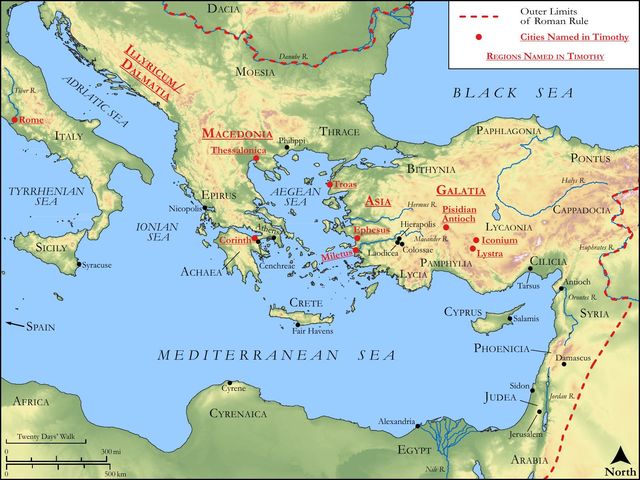
See on the biblical-era maps

Study this verse
Public-domain commentary
Matthew Henry
From his Commentary on the Whole Bible. Henry comments on passages, not single verses — this entry covers 1 Timothy 3:1–7. His two-level outline is real structure in the source text, so it is rendered as structure.
The two epistles to Timothy, and that to Titus, contain a scripture-plan of church-government, or a direction to ministers. Timothy, we suppose, was an evangelist who was left at Ephesus, to take care of those whom the Holy Ghost had made bishops there, that is, the presbyters, as appears by Act 20:28, where the care of the church was committed to the presbyters, and they were called bishops. It seems they were very loth to part with Paul, especially because he told them they should see his face no more (Act 20:38); for their church was but newly planted, they were afraid of undertaking the care of it, and therefore Paul left Timothy with them to set them in order. And here we have the character of a gospel minister, whose office it is, as a bishop, to preside in a particular congregation of Christians: If a man desires the office of a bishop, he desires a good work, Ti1 3:1. Observe,
I.The ministry is a work.
However the office of a bishop may be now thought a good preferment, then it was thought a good work.
1.The office of a scripture-bishop is an office of divine appointment, and not of human invention. The ministry is not a creature of the state, and it is a pity that the minister should be at any time the tool of the state. The office of the ministry was in the church before the magistrate countenanced Christianity, for this office is one of the great gifts Christ has bestowed on the church, Eph 4:8-11.
2.This office of a Christian bishop is a work, which requires diligence and application: the apostle represents it under the notion and character of a work; not of great honour and advantage, for ministers should always look more to their work than to the honour and advantage of their office.
3.It is a good work, a work of the greatest importance, and designed for the greatest good: the ministry is conversant about no lower concerns than the life and happiness of immortal souls; it is a good work, because designed to illustrate the divine perfections in bringing many sons to glory; the ministry is appointed to open men's eyes, and to turn them from darkness to light, and from the power of Satan unto God, etc., Act 26:18.
4.There ought to be an earnest desire of the office in those who would be put into it; if a man desire, he should earnestly desire it for the prospect he has of bringing greater glory to God, and of doing the greatest good to the souls of men by this means. This is the question proposed to those who offer themselves to the ministry of the church of England: "Do you think you are moved by the Holy Ghost to take upon you this office?"
II.In order to the discharge of this office, the doing of this work, the workman must be qualified.
1.A minister must be blameless, he must not lie under any scandal; he must give as little occasion for blame as can be, because this would be a prejudice to his ministry and would reflect reproach upon his office.
2.He must be the husband of one wife; not having given a bill of divorce to one, and then taken another, or not having many wives at once, as at that time was too common both among Jews and Gentiles, especially among the Gentiles.
3.He must be vigilant and watchful against Satan, that subtle enemy; he must watch over himself, and the souls of those who are committed to his charge, of whom having taken the oversight, he must improve all opportunities of doing them good. A minister ought to be vigilant, because our adversary the devil goes about like a roaring lion, seeking whom he may devour, Pe1 5:8.
4.He must be sober, temperate, moderate in all his actions, and in the use of all creature-comforts. Sobriety and watchfulness are often in scripture put together, because they mutually befriend one another: Be sober, be vigilant.
5.He must be of good behaviour, composed and solid, and not light, vain, and frothy.
6.He must be given to hospitality, open-handed to strangers, and ready to entertain them according to his ability, as one who does not set his heart upon the wealth of the world and who is a true lover of his brethren.
7.Apt to teach. Therefore this is a preaching bishop whom Paul describes, one who is both able and willing to communicate to others the knowledge which God has given him, one who is fit to teach and ready to take all opportunities of giving instructions, who is himself well instructed in the things of the kingdom of heaven, and is communicative of what he knows to others.
8.No drunkard: Not given to wine. The priests were not to drink wine when they went in to minister (Lev 10:8, Lev 10:9), lest they should drink and pervert the law.
9.No striker; one who is not quarrelsome, nor apt to use violence to any, but does every thing with mildness, love, and gentleness. The servant of the Lord must not strive, but be gentle towards all, etc., Ti2 2:24.
10.One who is not greedy of filthy lucre, who does not make his ministry to truckle to any secular design or interest, who uses no mean, base, sordid ways of getting money, who is dead to the wealth of this world, lives above it, and makes it appear he is so.
11.He must be patient, and not a brawler, of a mild disposition. Christ, the great Shepherd and Bishop of souls, is so. Not apt to be angry or quarrelsome; as not a striker with his hands, so not a brawler with his tongue; for how shall men teach others to govern their tongues who do not make conscience of keeping them under good government themselves?
12.Not covetous. Covetousness is bad in any, but it is worst in a minister, whose calling leads him to converse so much with another world.
13.He must be one who keeps his family in good order: That rules well his own house, that he may set a good example to other masters of families to do so too, and that he may thereby give a proof of his ability to take care of the church of God: For, if a man know not how to rule his own house, how shall he take care of the church of God. Observe, The families of ministers ought to be examples of good to all others families. Ministers must have their children in subjection; then it is the duty of ministers' children to submit to the instructions that are given them. - With all gravity. The best way to keep inferiors in subjection, is to be grave with them. Not having his children in subjection with all austerity, but with all gravity.
14.He must not be a novice, not one newly brought to the Christian religion, or not one who is but meanly instructed in it, who knows no more of religion than the surface of it, for such a one is apt to be lifted up with pride: the more ignorant men are the more proud they are: Lest, being lifted up with pride, he fall into the condemnation of the devil. The devils fell through pride, which is a good reason why we should take heed of pride, because it is a sin that turned angels into devils.
15.He must be of good reputation among his neighbours, and under no reproach from former conversation; for the devil will make use of that to ensnare others, and work in them an aversion to the doctrine of Christ preached by those who have not had a good report.
III.Upon the whole, having briefly gone through the qualifications of a gospel-bishop, we may infer,
1.What great reason we have to cry out, as Paul does, Who is sufficient for these things? Co2 2:16. Hic labor, hoc opus - This is a work indeed. What piety, what prudence, what zeal, what courage, what faithfulness, what watchfulness over ourselves, our lusts, appetites, and passions, and over those under our charge; I say, what holy watchfulness is necessary in this work!
2.Have not the best qualified and the most faithful and conscientious ministers just reason to complain against themselves, that so much is requisite by way of qualification, and so much work is necessary to be done? And, alas! how far short do the best come of what they should be and what they should do!
3.Yet let those bless God, and be thankful, whom the Lord has enabled, and counted faithful, putting them into the ministry: if God is pleased to make any in some degree able and faithful, let him have the praise and glory of it.
4.For the encouragement of all faithful ministers, we have Christ's gracious word of promise, Lo, I am with you always, even unto the end of the world, Mat 28:20. And, if he be with us, he will fit us for our work in some measure, will carry us through the difficulties of it with comfort, graciously pardon our imperfections, and reward our faithfulness with a crown of glory that fadeth not away, Pe1 5:4.
Historical interpretation
Nine Centuries of Reception
7 surviving comments on this verse. Each one is dated, so this reads as a timeline rather than a list.
Select a marker to jump to its quote. Markers stagger vertically where authors wrote within a few decades of each other.
Appoint, therefore, for yourselves, bishops and deacons worthy of the Lord, men meek, and not lovers of money, and truthful and proved; for they also render to you the service of prophets and teachers. Despise them not therefore, for they are your honoured ones, together with the prophets and teachers.
Beloved brethren! That a man should build up and establish the brethren on the faith in one God, this also is manifest and well-known. This too, again, is comely, that a man should not be envious of his neighbour. And moreover, again, it is suitable and comely that all those who work the works of the Lord should work the works of the Lord in the fear of God. Thus is it required of them to conduct themselves. That "the harvest is great, but the workmen are few," this also is well-known and manifest. Let us, therefore, "ask of the Lord of the harvest" that He would send forth workmen into the harvest; [Matthew 9:37-38] such workmen as "shall skilfully dispense the word of truth;" workmen "who shall not be ashamed;" faithful workmen; workmen who shall be "the light of the world;" [Matthew 5:14] workmen who "work not for the food that perishes, but for that food which abides unto life eternal;" [John 6:27] workmen who shall be such as the apostles; workmen who imitate the Father, and the Son, and the Holy Spirit; who are concerned for the salvation of men; not "hireling" [John 10:12-13] workmen; not workmen to whom the fear of God and righteousness appear to be gain; not workmen who "serve their belly;" not workmen who "with fair speeches and pleasant words mislead the hearts of the innocent;" [Romans 16:18] not workmen who imitate the children of light, while they are not light but darkness — "men whose end is destruction;" [Philippians 3:9] not workmen who practise iniquity and wickedness and fraud; not "crafty workmen;" [2 Corinthians 11:13] not workmen "drunken" and "faithless;" nor workmen who traffic in Christ; not misleaders; not "lovers of money; not malevolent."
"Not given to wine": here he does not so much mean intemperate, as insolent and impudent. "No striker": this too does not mean a striker with the hands. What means then "no striker"? Because there are some who unseasonably smite the consciences of their brethren, it seems to be said with reference to them. "Not greedy of filthy lucre, but patient: not a brawler, not covetous."
This could range widely in meaning from not delivering blows to the point of death to not striking the consciences of the weak with a bad example.
Let your breath never smell of wine, lest the philosopher’s words be said to you, “Instead of offering me a kiss, you are giving me a taste of wine.” Priests given to wine are both condemned by the apostle and forbidden by the old law.… Whatever intoxicates and disturbs the balance of the mind, avoid as you would wine. I do not say that we are to condemn what is a creature of God. The Lord himself was called a “wine-bibber,” and wine in moderation was allowed to Timothy because of his weak stomach. I only require that drinkers should observe that limit which their age, their health or their constitution requires.
Not striking without reasonable cause, for sometimes this is permitted, if for a good reason and not with undue fierceness.
Therefore, a bishop must be blameless, the husband of one wife, sober-minded, self-controlled, respectable, hospitable, able to teach; not a drunkard, not violent, not greedy for gain, but gentle, not quarrelsome, not a lover of money.
be blameless. So that he is aware of no evil in himself. For if he is aware, he acts badly desiring oversight, from which through his actions he has alienated himself.
A bishop must be the husband of one wife. This does not legislate that a bishop must necessarily have a wife, but rather, if he is married, he says, he must not be a second husband. Or that he should know only one lawful wife for marriage; but, when called to the office of bishop, he must fulfill that condition. "So that those who have wives may be as though they had none." (1 Cor. 7:29) And, "I wish that all were as I am," says Paul. (1 Cor. 7:7) And, "He who is married cares about worldly things." (1 Cor. 7:33) How then can a bishop rightly care for worldly matters? Some say that he said this concerning the Church, so that he would not transfer from one to another; for the matter is adultery.
Sober-minded. Awake, discerning, fervent in spirit.
self-controlled. For one ought to have restraint, good manners, and hospitality according to those who lead. Therefore, Paul added the teacher's own characteristic, saying self-controlled:
not a drunkard. Paul says this, not meaning the intoxicated (for that was often the case), but the brazen and arrogant.
Again, not violent, not one who strikes with hands, but one who strikes the conscience of the brothers.
Continue studying 1 Timothy 3:3 across the web’s major study libraries — every link below opens this exact verse, chapter, or book on the destination site.
Read & Compare
 BibleGatewayThis verse in more than 200 translations and 70 languages.
 Bible.comThe YouVersion reader — hundreds of translations, reading plans, and highlights.
 ESV.orgCrossway's official English Standard Version reader.
 NET BibleThe NET translation with 60,000+ translators' notes on every rendering decision.
 STEP BibleTyndale House's free study tool — original text, vocabulary, and scholarly resources.
 BibliaLogos Bible Software's free web reader.
 USCCBThe New American Bible (Revised Edition) with the U.S. bishops' study notes.
Commentaries
 BibleHub CommentariesDozens of classic commentaries on this verse, gathered on one page.
 StudyLightMore than 100 commentary sets — the largest collection on the web.
 BibleRefPlain-English commentary on what this verse means, verse by verse.
 Enduring WordDavid Guzik's free commentary on this chapter, widely used by Bible teachers.
 Bible Study ToolsVerse commentary alongside Greek and Hebrew study aids.
Original Language & Research
- BibleHub InterlinearThe verse word by word — original language, transliteration, and English.
- BibleHub LexiconEvery word's original-language definition and Strong's entry.
 Blue Letter BibleDeep-study tools — Strong's numbers, concordance, and word studies.
 CNTR CollationThe earliest Greek manuscripts of this verse, collated letter by letter.
Sermons, Hymns & Audio


TrulyRandomVerse is not affiliated with these sites and doesn’t control their content. They’re linked because they’re genuinely useful.
Summary
1 Timothy 3:3 serves as a vital component of Paul's comprehensive instructions regarding the character and conduct required of church overseers, or bishops. This verse articulates a series of negative prohibitions and contrasting positive virtues, emphasizing that spiritual leadership demands not only doctrinal soundness but also exemplary personal integrity, self-control, peacefulness, and freedom from the corrupting influence of greed. It underscores the profound importance of a leader's moral and ethical standing as a reflection of Christ and a model for the congregation.
Context
ShowHideLiterary Context
This verse is an integral part of Paul's detailed qualifications for church leadership, specifically for overseers, found in 1 Timothy 3:1-7. Following the aspirational statement in 1 Timothy 3:1 and the initial list of positive attributes in 1 Timothy 3:2, 1 Timothy 3:3 shifts focus to behaviors and attitudes that are strictly incompatible with the office. The passage as a whole provides a holistic picture of the ideal spiritual leader, emphasizing that internal character and external conduct are equally crucial for effective and credible ministry within the nascent Christian community.
Historical & Cultural Context
Paul's letter to Timothy was written to guide his protégé in establishing and maintaining order within the Ephesian church, a vibrant yet challenging urban center. Among the Greeks and Romans, various philosophical schools and religious cults competed for adherents, often with leaders whose moral standards were lax or driven by personal gain. Against this backdrop, Paul's insistence on unimpeachable character for Christian leaders was revolutionary and essential for the church's reputation and growth. The early church faced internal struggles with false teachers and external pressures from a hostile society, making the integrity of its leadership paramount. The qualifications in 1 Timothy 3 were therefore not merely ideals but practical necessities for the survival and spiritual health of the community in a complex cultural landscape.
Key Themes
ShowHideThe qualifications in 1 Timothy 3:3 contribute significantly to several overarching themes within 1 Timothy and the broader Pauline corpus. Temperance and Self-Control are highlighted by the prohibitions against being "given to wine" and "a brawler," underscoring the necessity for leaders to exhibit mastery over their appetites and emotions, setting a standard of sobriety and stability. This aligns with the broader call for believers to be filled with the Spirit, not wine, as seen in Ephesians 5:18. Peacefulness and Gentleness are emphasized by the directives "no striker" and "not a brawler," contrasted with the positive command to be "patient." This theme stresses the leader's role as a peacemaker and a calm presence, capable of handling conflict with grace and wisdom, reflecting the fruit of the Spirit which includes gentleness and self-control. Finally, Financial Integrity and Contentment are central, with the warnings "not greedy of filthy lucre" and "not covetous." These prohibitions address the pervasive danger of materialism, ensuring that leaders are motivated by genuine pastoral care rather than personal enrichment, a principle powerfully articulated in 1 Timothy 6:10.
Exposition and Analysis
ShowHideKey Word Analysis
ShowHideThis term literally means "staying near wine" or "a tippler." It describes someone prone to excessive drinking or intoxication, which would impair judgment, diminish self-control, and bring disrepute to the leader and the church. The prohibition emphasizes the need for sobriety and moderation.
This rich word signifies "appropriate," "mild," "gentle," "reasonable," or "forbearing." It describes a disposition that is gracious, considerate, and fair-minded, able to handle situations with calmness and understanding rather than harshness or rigidity. This positive virtue stands in stark contrast to the preceding negative traits.
This compound word means "unavaricious" or "not a lover of money." It directly addresses the internal disposition towards wealth, condemning a preoccupation with material gain or an insatiable desire for more. This quality ensures that a leader's motivations are pure and focused on spiritual service rather than personal financial advantage.
Verse Breakdown
ShowHide"Not given to wine"
This clause prohibits an overseer from being addicted to alcohol or prone to drunkenness. Such a habit would compromise their judgment, undermine their moral authority, and bring scandal to the church, as a leader must exemplify self-control and clear-headedness.
"no striker"
This forbids a leader from being physically violent or quarrelsome. An overseer must be peaceable, avoiding aggressive behavior, whether physical or verbally abusive, and instead demonstrating a spirit of calm and reconciliation.
"not greedy of filthy lucre"
This phrase condemns the pursuit of dishonest gain or an excessive love for money. It warns against leaders who would exploit their position for personal financial benefit, emphasizing that their service must be driven by genuine care for the flock, not by sordid profit.
"but patient"
This introduces a positive contrasting virtue. Instead of the negative traits, an overseer must be gentle, reasonable, and forbearing. This quality speaks to a leader's disposition, showing grace and understanding in their interactions, especially when dealing with difficult people or situations.
"not a brawler"
This reiterates the theme of peacefulness, prohibiting an overseer from being contentious or quarrelsome. It reinforces the idea that a leader should avoid disputes and arguments, fostering harmony rather than division within the community.
"not covetous"
This final prohibition reinforces the earlier warning against greed, specifically targeting an internal desire for money. It means a leader should not be driven by materialism or an insatiable longing for wealth, but rather be content with what they have, serving out of pure motives.
Literary Devices
ShowHidePaul employs Antithesis as a primary literary device in 1 Timothy 3:3, sharply contrasting undesirable behaviors ("not given to wine, no striker, not greedy of filthy lucre") with a single positive virtue ("but patient") and then returning to further negative prohibitions ("not a brawler, not covetous"). This structure effectively highlights the qualities to be avoided while simultaneously underscoring the essential positive disposition required for leadership. The repeated use of the negative particle "not" (Greek: mḗ) creates a strong sense of Exhortation and clear boundaries, leaving no ambiguity about the behaviors deemed unacceptable. Furthermore, the pairing of "not greedy of filthy lucre" and "not covetous" demonstrates a form of Repetition or Synonymy, emphasizing the critical importance of financial integrity and freedom from materialism for those in spiritual authority.
Theological and Thematic Connections
ShowHideThe qualifications in 1 Timothy 3:3 are deeply rooted in a theology of character, asserting that a leader's internal disposition and external conduct are inseparable from their spiritual authority and effectiveness. These virtues reflect the very nature of God, who is patient and just, and are essential for modeling Christ-like living within the community. The emphasis on self-control, peacefulness, and financial integrity speaks to the transformative power of the Holy Spirit in a believer's life, demonstrating that true spiritual leadership flows from a heart renewed and submitted to God's will. These qualities are not merely human attributes but divine graces cultivated through discipleship, ensuring that leaders are trustworthy stewards of God's people and resources, reflecting the kingdom's values to a watching world.
Reflection and Application
ShowHideWhile specifically addressed to overseers, the virtues and vices outlined in 1 Timothy 3:3 serve as a profound challenge and guide for all believers. Our character is the most potent witness to the transforming power of the Gospel, and cultivating self-control, patience, peacefulness, and contentment is foundational to a life that honors God. This verse prompts us to honestly examine our own lives: Do we exhibit mastery over our appetites? Are we quick to anger or prone to contention? Is our pursuit of material possessions hindering our spiritual growth or compromising our integrity? Embracing these qualities allows us to be effective ambassadors for Christ in our homes, workplaces, and communities, demonstrating the maturity and stability that reflects His nature. It reminds us that true spiritual influence stems not from position, but from a heart consistently aligned with God's will and a life lived in humble obedience.
Questions for Reflection
ShowHideFAQ
ShowHideAre these qualifications only for church leaders, or do they apply to all Christians?
ShowHideWhile 1 Timothy 3:3 is explicitly given as a standard for church overseers, the virtues it promotes are foundational to Christian character and are applicable to all believers. The qualities of self-control, patience, peacefulness, and freedom from greed are universal marks of spiritual maturity and are part of the fruit of the Spirit that all followers of Christ are called to cultivate. Leaders are simply held to a higher standard because their lives serve as a public example to the flock and the world, but the underlying principles are for everyone seeking to live a godly life.
What does "not given to wine" mean for Christians today? Does it prohibit all alcohol consumption?
ShowHideThe phrase "not given to wine" (Greek: pároinos) specifically refers to someone who is not habitually drunk or prone to excessive drinking. It implies a lack of self-control and a tendency to linger beside wine, leading to intoxication. The primary concern is the impairment of judgment, loss of self-control, and the disrepute it brings to the individual and the church. While interpretations vary on whether this prohibits all alcohol consumption, the clear emphasis is on sobriety, moderation, and avoiding any behavior that leads to drunkenness or addiction. The principle is about demonstrating self-mastery and maintaining a clear mind for spiritual discernment and leadership.
Why is financial integrity so heavily emphasized for church leaders in this verse?
ShowHideFinancial integrity is crucial for church leaders because greed and covetousness are powerful temptations that can corrupt ministry, undermine trust, and bring scandal to the Gospel. When leaders are "greedy of filthy lucre" or "covetous," their motivations become suspect, and their service can be perceived as self-serving rather than Spirit-led. The church's resources are God's, and leaders are stewards, not owners. This emphasis ensures that leaders are motivated by a genuine love for God and His people, rather than by personal gain, thus protecting the integrity of the church's mission and witness in the world. As Luke 12:15 warns, life does not consist in the abundance of possessions, and Hebrews 13:5 encourages contentment.
Christ-Centered Fulfillment
ShowHideThe virtues outlined in 1 Timothy 3:3 find their perfect embodiment and ultimate fulfillment in the person of Jesus Christ. He was the quintessential leader, never "given to wine" but always clear-headed and fully submitted to the Father's will. He was "no striker" and "not a brawler," but rather the Prince of Peace, who taught His disciples to turn the other cheek and respond to evil with love. His life was utterly devoid of "filthy lucre" or covetousness; indeed, though He was rich, yet for our sakes He became poor, that we through His poverty might be rich, as described in 2 Corinthians 8:9. Jesus perfectly modeled patience and gentleness, even in the face of immense provocation and suffering, never retaliating but entrusting Himself to Him who judges justly, as 1 Peter 2:21 illustrates. As believers, we are called to imitate Christ, to put on His character, and to allow the Holy Spirit to transform us into His likeness. The qualifications for leadership, therefore, are not merely a checklist of human abilities, but a divine invitation to reflect the very nature of our Lord, who came not to be served but to serve, and to give His life as a ransom for many, as He taught in Matthew 20:26-28. Our ability to live out these virtues flows from our union with Him, enabling us to serve with the same humility and integrity that He displayed, ultimately bringing glory to God.