


1 Timothy 3:8
Bible text: King James Version (1769 Blayney text) · Public domain
Bible text: Berean Standard Bible · Public domain
Bible text: American Standard Version (1901) · Public domain
Bible text: World English Bible, Messianic edition · Public domain
Bible text: Geneva Bible (1599) · Public domain
Bible text: Young's Literal Translation · Public domain
- ΔιακόνουςDiakonousDeaconsG1249N-APMNoun Accusative Plural Masculine
- ὡσαύτωςhōsautōslikewiseG5615ADVAdverb
- σεμνούςsemnous[must be] dignifiedG4586A-APMAdjective Accusative Plural Masculine
- μὴmēnotG3361PRT-NNegative Particle Negative
- διλόγουςdilogousdouble-tonguedG1351A-APMAdjective Accusative Plural Masculine
- μὴmēnotG3361PRT-NNegative Particle Negative
- οἴνῳoinōto wineG3631N-DSMNoun Dative Singular Masculine
- πολλῷpollōmuchG4183A-DSMAdjective Dative Singular Masculine
- προσέχονταςprosechontasbeing givenG4337V-PAP-APMVerb Present Active Participle Accusative Plural Masculine
- μὴmēnotG3361PRT-NNegative Particle Negative
- αἰσχροκερδεῖςaischrokerdeisgreedy of dishonest gainG146A-APMAdjective Accusative Plural Masculine
English is a literal word-by-word gloss of the Greek, not the KJV's wording. Why?
This is the original text the KJV's translators worked from — each Greek word with its own literal English meaning in this verse, prepared by scholars at Tyndale House, Cambridge. The KJV translates whole sentences, not word by word, so its wording differs: one Greek word can become several English words, and the KJV may choose “charity” where the gloss reads “love”. Both are faithful — they answer different questions. For the KJV's own rendering, switch to the KJV text.
Details
See on the biblical-era maps

Study this verse
Public-domain commentary
Matthew Henry
From his Commentary on the Whole Bible. Henry comments on passages, not single verses — this entry covers 1 Timothy 3:8–13.
We have here the character of deacons: these had the care of the temporal concerns of the church, that is, the maintenance of the ministers and provision for the poor: they served tables, while the ministers or bishops gave themselves only to the ministry of the word and prayer, Act 6:2, Act 6:4. Of the institution of this office, with that which gave occasion to it, you have an account in Act 6:1-7. Now it was requisite that deacons should have a good character, because they were assistants to the ministers, appeared and acted publicly, and had a great trust reposed in them. They must be grave. Gravity becomes all Christians, but especially those who are in the office in the church. Not doubled-tongued; that will say one thing to one and another thing to another, according as their interests leads them: a double tongue comes from a double heart; flatterers and slanderers are double-tongued. Not given to much wine; for this is a great disparagement to any man, especially to a Christian, and one in office, unfits men for business, opens the door to many temptations. Not greedy of filthy lucre; this would especially be bad in the deacons, who were entrusted with the church's money, and, if they were covetous and greedy of filthy lucre, would be tempted to embezzle it, and convert that to their own use which was intended for the public service. Holding the mystery of faith in a pure conscience, Ti1 3:9. Note, The mystery of faith is best held in a pure conscience. The practical love of truth is the most powerful preservative from error and delusion. If we keep a pure conscience (take heed of every thing that debauches conscience, and draws us away from God), this will preserve in our souls the mystery of faith. Let these also first be proved, Ti1 3:10. It is not fit that the public trusts should be lodged in the hands of any, till they have been first proved, and found fit for the business they are to be entrusted with; the soundness of their judgments, their zeal for Christ, and the blamelessness of their conversation, must be proved. Their wives likewise must have a good character (Ti1 3:11); they must be of a grave behaviour, not slanderers, tale-bearers, carrying stories to make mischief and sow discord; they must be sober and faithful in all things, not given to any excess, but trusty in all that is committed to them. All who are related to ministers must double their care to walk as becomes the gospel of Christ, lest, if they in any thing walk disorderly, the ministry be blamed. As he said before of the bishops or ministers, so here of the deacons, they must be the husband of one wife, such as had not put away their wives, upon dislike, and married others; they must rule their children and their own houses well; the families of deacons should be examples to other families. And the reason why the deacons must be thus qualified is (Ti1 3:13) because, though the office of a deacon be of an inferior degree, yet it is a step towards the higher degree; and those who had served tables well the church might see cause afterwards to discharge from that service, and prefer to serve in preaching the word and in prayer. Or it may be meant of the good reputation that a man would gain by his fidelity in this office: they will purchase to themselves great boldness in the faith that is in Christ Jesus. Observe, 1. In the primitive church there were but two orders of ministers or officers, bishops and deacons, Phi 1:1. After-ages have invented the rest. The office of the bishop, presbyter, pastor, or minister, was confined to prayer and to the ministry of the word; and the office of the deacon was confined to, or at least principally conversant about, serving tables. Clemens Romanus, in his epistle to the Christian (cap. 42, 44), speaks very fully and plainly to this effect, that the apostles, foreknowing, by our Lord Jesus Christ, that there would arise in the Christian church a controversy about the name episcopacy, appointed the forementioned orders, bishops and deacons. 2. The scripture-deacon's main employment was to serve tables, and not to preach or baptize. It is true, indeed, that Philip did preach and baptize in Samaria (Acts 8), but you read that he was an evangelist (Act 21:8), and he might preach and baptize, and perform any other part of the ministerial office, under that character; but still the design of the deacon's office was to mind the temporal concerns of the church, such as the salaries of the ministers and providing for the poor. 3. Several qualifications were very necessary, even for these inferior officers: The deacons must be grave, etc. 4. Some trial should be made of persons' qualifications before they are admitted into office in the church, or have any trust committed to them: Let these also first be proved. 5. Integrity and uprightness in an inferior office are the way to be preferred to a higher station in the church: They purchase to themselves a good degree. 6. This will also give a man great boldness in the faith, whereas a want of integrity and uprightness will make a man timorous, and ready to tremble at his own shadow. The wicked fleeth when no man pursueth, but the righteous are bold as a lion, Pro 28:1.
Historical interpretation
Nine Centuries of Reception
7 surviving comments on this verse. Each one is dated, so this reads as a timeline rather than a list.
Select a marker to jump to its quote. Markers stagger vertically where authors wrote within a few decades of each other.
Appoint, therefore, for yourselves, bishops and deacons worthy of the Lord, men meek, and not lovers of money, and truthful and proved; for they also render to you the service of prophets and teachers. Despise them not therefore, for they are your honoured ones, together with the prophets and teachers.
Knowing, then, that "God is not mocked," we ought to walk worthy of His commandment and glory. In like manner should the deacons be blameless before the face of His righteousness, as being the servants of God and Christ, and not of men. They must not be slanderers, double-tongued, or lovers of money, but temperate in all things, compassionate, industrious, walking according to the truth of the Lord, who was the servant of all. If we please Him in this present world, we shall receive also the future world, according as He has promised to us that He will raise us again from the dead, and that if we live worthily of Him, "we shall also reign together with Him," provided only we believe.
What Moses taught, Abraham observed. What Abraham observed, Noah and Enoch acknowledged, discriminating pure from impure and becoming acceptable to God. For Abel too in this way witnessed, knowing what he had learned from Adam. This one himself had learned from that Lord, who said, when he came at the end of the ages for the abolishment of sin, “I give no new commandment to you, but an old commandment, which you have heard from the beginning.” In the same way also the blessed apostle Paul, who had learned it from the Lord, when describing ecclesiastical functions, forbade that deacons, not to say bishops, should be double-tongued. In his rebuke of the Galatians, he made a broad declaration: If anyone preach any other gospel unto you than that which you have received, let him be anathema, as I have said, so say I again.
Discoursing of Bishops, and having described their character, and the qualities which they ought to possess, and having passed over the order of Presbyters, he proceeds to that of Deacons. The reason of this omission was, that between Presbyters and Bishops there was no great difference. Both had undertaken the office of Teachers and Presidents in the Church, and what he has said concerning Bishops is applicable to Presbyters. For they are only superior in having the power of ordination, and seem to have no other advantage over Presbyters.
"Likewise the Deacons." That is, they should have the same qualities as Bishops. And what are these same? To be blameless, sober, hospitable, patient, not brawlers, not covetous. And that he means this when he says "likewise," is evident from what he says in addition, "grave, not doubletongued"; that is, not hollow or deceitful. For nothing so debases a man as deceit, nothing is so pernicious in the Church as insincerity. "Not given to much wine, not greedy of filthy lucre; holding the mystery of the faith in a pure conscience." Thus he explains what he means by "blameless."
Since the ministry of deacons is at least as much toward the women in the community as the men, their integrity is all the more important. They are to be honorable and sincere in performing the duties assigned to them by the presbyters.
“Not double-tongued” means that the deacon is not to be a person who says one thing to one person and something else to another.
Deacons likewise must be honorable, not double-tongued, not given to much wine, not greedy for dishonest gain, holding the mystery of the faith with a pure conscience.
For what reason did Paul pass over the elders [πρεσβυτέρους]? Because he mingled them with the bishops themselves. For what he said about the bishops, he also applies to the elders: since they too are similarly priests, and have been entrusted with the duty of teaching.
not double-tongued. That is, deceitful and traitorous.
not given to much wine. Paul did not say: "Do not get drunk" (for this was very common), but rather, "Do not drink excessively." For even if, he says, they do not get drunk, yet the tone of the heart slackens.
with a pure conscience. He demands faith and life.
Continue studying 1 Timothy 3:8 across the web’s major study libraries — every link below opens this exact verse, chapter, or book on the destination site.
Read & Compare
 BibleGatewayThis verse in more than 200 translations and 70 languages.
 Bible.comThe YouVersion reader — hundreds of translations, reading plans, and highlights.
 ESV.orgCrossway's official English Standard Version reader.
 NET BibleThe NET translation with 60,000+ translators' notes on every rendering decision.
 STEP BibleTyndale House's free study tool — original text, vocabulary, and scholarly resources.
 BibliaLogos Bible Software's free web reader.
 USCCBThe New American Bible (Revised Edition) with the U.S. bishops' study notes.
Commentaries
 BibleHub CommentariesDozens of classic commentaries on this verse, gathered on one page.
 StudyLightMore than 100 commentary sets — the largest collection on the web.
 BibleRefPlain-English commentary on what this verse means, verse by verse.
 Enduring WordDavid Guzik's free commentary on this chapter, widely used by Bible teachers.
 Bible Study ToolsVerse commentary alongside Greek and Hebrew study aids.
Original Language & Research
- BibleHub InterlinearThe verse word by word — original language, transliteration, and English.
- BibleHub LexiconEvery word's original-language definition and Strong's entry.
 Blue Letter BibleDeep-study tools — Strong's numbers, concordance, and word studies.
 CNTR CollationThe earliest Greek manuscripts of this verse, collated letter by letter.
Sermons, Hymns & Audio


TrulyRandomVerse is not affiliated with these sites and doesn’t control their content. They’re linked because they’re genuinely useful.
Summary
The Apostle Paul, in his pastoral letter to Timothy, continues his instruction on church leadership by outlining the essential character qualifications for deacons. Following his directives for overseers, Paul emphasizes that deacons, who serve in practical ministry, must embody dignity, integrity in speech, temperance, and financial uprightness. These attributes are crucial not only for their personal testimony but also for maintaining the spiritual health and reputable witness of the church in the community.
Context
ShowHideLiterary Context
1 Timothy 3:8 is an integral part of Paul's detailed instructions regarding church leadership, immediately following his exposition on the qualifications for overseers (or elders) in 1 Timothy 3:1-7. This verse marks the beginning of a distinct section (extending through 1 Timothy 3:13) dedicated to the qualifications of deacons. The parallel structure between the two lists underscores Paul's concern for the moral and spiritual integrity of all who hold positions of responsibility within the nascent church, ensuring that both teaching and service roles are filled by individuals of proven character. The flow of thought moves from those who lead and teach to those who serve and administer, highlighting the complementary nature of these offices.
Historical & Cultural Context
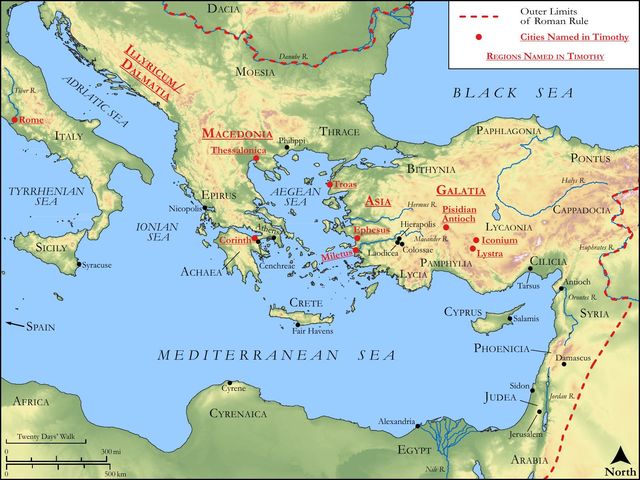
Paul wrote 1 Timothy to Timothy, his protégé, who was serving in Ephesus, a prominent city in Asia Minor known for its diverse religious practices and significant pagan influence. The early Christian church was still developing its organizational structures, and Paul's epistles, particularly the Pastoral Epistles, provided foundational guidance for establishing order, doctrine, and leadership. In a society where public reputation and integrity were highly valued, especially for those in positions of trust, the character qualifications for deacons were paramount. Deacons often handled practical matters such as distributing aid to the poor, caring for widows, and managing church finances. Their conduct directly impacted the church's credibility among both believers and unbelievers, making their moral standing a vital component of the church's mission and witness in a Hellenistic world.
Key Themes
ShowHideThis verse contributes significantly to several key themes within 1 Timothy and the broader New Testament. Foremost is the theme of Church Order and Leadership, emphasizing that ministry is not merely about skill but profoundly about character. The qualifications listed—gravity, honesty, temperance, and financial integrity—underscore the theme of Moral and Spiritual Integrity as non-negotiable for those in service. Paul's directives also highlight the theme of Christian Witness, as the conduct of leaders directly reflects on the gospel message itself. Furthermore, the warning against "filthy lucre" ties into the pervasive biblical theme of Stewardship and the Dangers of Greed, a concern also powerfully articulated in 1 Timothy 6:10. The emphasis on consistency in speech ("not doubletongued") reinforces the theme of Truthfulness and Sincerity in Christian communication, echoing broader calls for honesty found throughout the New Testament, such as in Ephesians 4:25.
Exposition and Analysis
ShowHideKey Word Analysis
ShowHideThis term, from which "deacon" is derived, literally means "an attendant," "a waiter (at table or in other menial duties)," or more broadly, "a minister" or "servant." In a Christian context, it refers to those appointed to specific roles of service within the church, often involving practical administration, care for the needy, and facilitating the ministry of the elders. It highlights that the office is fundamentally one of humble service.
Derived from a word meaning "to revere" or "to worship," semnós describes someone who is "venerable," "honorable," or "serious-minded." It denotes a dignified and respectable demeanor, indicating a person whose character commands respect and who takes their responsibilities seriously, avoiding frivolity or flippancy. This quality ensures that deacons are perceived as trustworthy and worthy of their sacred calling.
This compound word literally means "two-worded" or "saying two things." It describes someone who is insincere, inconsistent in their speech, or who says one thing to one person and another to someone else. It implies deceit, gossip, or a lack of straightforwardness, which would undermine trust and sow discord within the church community. The prohibition against being "doubletongued" emphasizes the necessity of absolute integrity and consistency in communication for deacons.
Verse Breakdown
ShowHide"Likewise must the deacons be grave"
Following the pattern set for overseers, deacons are called to exhibit a serious, dignified, and respectable character. This gravity is not somberness but a moral earnestness that reflects the importance of their service to God and the church. It signifies a person who is worthy of honor and who carries out their duties with appropriate solemnity and trustworthiness.
"not doubletongued"
This qualification demands integrity and consistency in speech. Deacons must be truthful and straightforward, avoiding duplicity, gossip, or saying different things to different people. Their words should be reliable and consistent, fostering an environment of trust and unity within the congregation. This ensures they do not cause division or undermine the truth.
"not given to much wine"
This injunction emphasizes temperance and self-control. It is a warning against excessive consumption of alcohol, which could impair judgment, lead to inappropriate behavior, or bring disrepute to the deacon and the church. The focus is on avoiding intemperance that would hinder their ability to serve effectively or maintain a blameless reputation.
"not greedy of filthy lucre"
This final qualification addresses financial integrity and freedom from avarice. "Filthy lucre" refers to dishonest gain or money acquired through shameful, immoral, or exploitative means. Deacons, who often managed church funds or oversaw distributions, must be entirely free from the love of money and the pursuit of illicit profit, ensuring that their motivations are pure and their financial dealings are beyond reproach.
Literary Devices
ShowHideThe primary literary device employed in 1 Timothy 3:8 is Enumeration (or List). Paul presents a clear, concise list of negative and positive character traits required for deacons. This direct listing provides a readily understandable and memorable set of standards. The use of Antithesis is also prominent, particularly in the negative prohibitions ("not doubletongued," "not given to much wine," "not greedy of filthy lucre"). By stating what deacons must not be, Paul implicitly highlights the positive virtues they must embody (e.g., sincerity, temperance, financial integrity). This contrast serves to sharpen the ethical demands and leaves no ambiguity about the undesirable traits. The structure itself mirrors the earlier list for overseers, creating a Parallelism that emphasizes the shared foundational importance of character for all church leaders, regardless of their specific function.
Theological and Thematic Connections
ShowHideThe qualifications for deacons in 1 Timothy 3:8 are not merely a list of ethical guidelines but deeply theological statements about the nature of Christian service and the character required to represent Christ's body. The emphasis on integrity, self-control, and freedom from greed reflects the holiness of God and the call for His people to live in a manner worthy of the gospel. These qualities are foundational because deacons, in their practical service, embody the church's love, compassion, and justice to the world. Their blameless conduct is a powerful testimony to the transforming power of Christ, ensuring that the church's practical ministry is not undermined by moral failings. This passage underscores that spiritual authority and effective ministry flow from a life submitted to God's standards, echoing the broader biblical principle that God's work must be done by God's people in God's way.
Reflection and Application
ShowHide1 Timothy 3:8 offers timeless principles for all believers, not just those in formal leadership. The call to be "grave" encourages a thoughtful, serious approach to our faith and responsibilities, reflecting the dignity of our calling as Christians. "Not doubletongued" challenges us to cultivate radical honesty and consistency in our words, building trust and unity in all our relationships, both within and outside the church. "Not given to much wine" reminds us of the importance of self-control in all areas of life, guarding against any excess that could compromise our witness or judgment. Finally, "not greedy of filthy lucre" serves as a powerful reminder to examine our hearts regarding money and possessions, ensuring that our motivations are pure and our lives are marked by generosity and contentment, rather than avarice. These qualities are essential for personal holiness, effective service, and a credible witness to the world.
Questions for Reflection
ShowHideFAQ
ShowHideWhat is the primary role of a deacon, according to this passage?
ShowHideWhile 1 Timothy 3:8 focuses on the character of deacons rather than a detailed job description, the broader context of the New Testament (e.g., Acts 6:1-6) suggests that deacons primarily serve in practical capacities. This includes administering church resources, caring for the physical needs of the congregation (such as distributing aid to widows and the poor), and supporting the spiritual ministry of the elders. Their role is one of humble service, ensuring that the practical needs of the church are met, thereby freeing the elders to focus on prayer and the ministry of the word.
Does "not given to much wine" mean deacons must be teetotalers?
ShowHideThe phrase "not given to much wine" (Greek: mḗ proséchō polýs oînos) literally means "not to hold oneself to much wine" or "not to be addicted to much wine." It emphasizes temperance and self-control, rather than an absolute prohibition. The concern is against excess that leads to drunkenness, impairs judgment, or brings disrepute. While some Christian traditions interpret this as a call for total abstinence, the primary biblical emphasis here, and in similar passages like Titus 2:3, is on avoiding intemperance and maintaining a clear mind and blameless reputation. The focus is on the abuse of wine, not necessarily its use.
Christ-Centered Fulfillment
ShowHideWhile 1 Timothy 3:8 directly addresses the qualifications for deacons in the early church, its profound Christ-centered fulfillment lies in how these very qualities find their ultimate and perfect expression in Jesus Christ himself. Jesus is the quintessential Servant (diákonos), who came "not to be served but to serve, and to give his life as a ransom for many" (Mark 10:45). He was supremely "grave" or dignified in His mission, always serious about His Father's will and the salvation of humanity, yet full of grace and truth (John 1:14). He was never "doubletongued," but spoke with absolute integrity and truth, His "yes" always meaning "yes" (Matthew 5:37). Jesus perfectly embodied temperance and self-control, never indulging in excess but always living in perfect obedience to the Father (John 6:38). Most significantly, He was utterly free from any "greedy of filthy lucre," possessing nothing of this world's wealth, and even rebuking those who sought earthly gain (Luke 9:58). Thus, the qualifications for deacons are not arbitrary rules but reflections of the very character of Christ, whom they are called to serve and emulate, serving as living examples of His humble, truthful, and selfless love to the world.