


1 Timothy 3:9
- ἔχονταςechontasholdingG2192V-PAP-APMVerb Present Active Participle Accusative Plural Masculine
- τὸtoto theG3588T-ASNDefinite article Accusative Singular Neuter
- μυστήριονmustērionmysteryG3466N-ASNNoun Accusative Singular Neuter
- τῆςtēsof theG3588T-GSFDefinite article Genitive Singular Feminine
- πίστεωςpisteōsfaithG4102N-GSFNoun Genitive Singular Feminine
- ἐνenwithG1722PREPPreposition
- καθαρᾷkatharaclearG2513A-DSFAdjective Dative Singular Feminine
- συνειδήσειsuneidēseia conscienceG4893N-DSFNoun Dative Singular Feminine
English is a literal word-by-word gloss of the Greek, not the KJV's wording. Why?
This is the original text the KJV's translators worked from — each Greek word with its own literal English meaning in this verse, prepared by scholars at Tyndale House, Cambridge. The KJV translates whole sentences, not word by word, so its wording differs: one Greek word can become several English words, and the KJV may choose “charity” where the gloss reads “love”. Both are faithful — they answer different questions. For the KJV's own rendering, switch to the KJV text.
Details
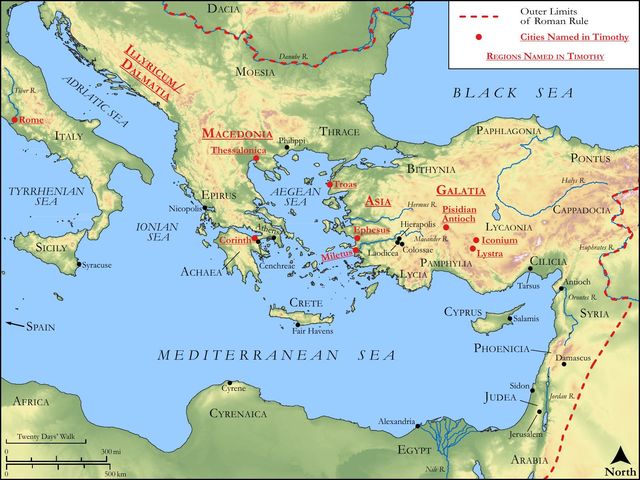
See on the biblical-era map

Study this verse
Public-domain commentary
Matthew Henry
From his Commentary on the Whole Bible. Henry comments on passages, not single verses — this entry covers 1 Timothy 3:8–13.
We have here the character of deacons: these had the care of the temporal concerns of the church, that is, the maintenance of the ministers and provision for the poor: they served tables, while the ministers or bishops gave themselves only to the ministry of the word and prayer, Act 6:2, Act 6:4. Of the institution of this office, with that which gave occasion to it, you have an account in Act 6:1-7. Now it was requisite that deacons should have a good character, because they were assistants to the ministers, appeared and acted publicly, and had a great trust reposed in them. They must be grave. Gravity becomes all Christians, but especially those who are in the office in the church. Not doubled-tongued; that will say one thing to one and another thing to another, according as their interests leads them: a double tongue comes from a double heart; flatterers and slanderers are double-tongued. Not given to much wine; for this is a great disparagement to any man, especially to a Christian, and one in office, unfits men for business, opens the door to many temptations. Not greedy of filthy lucre; this would especially be bad in the deacons, who were entrusted with the church's money, and, if they were covetous and greedy of filthy lucre, would be tempted to embezzle it, and convert that to their own use which was intended for the public service. Holding the mystery of faith in a pure conscience, Ti1 3:9. Note, The mystery of faith is best held in a pure conscience. The practical love of truth is the most powerful preservative from error and delusion. If we keep a pure conscience (take heed of every thing that debauches conscience, and draws us away from God), this will preserve in our souls the mystery of faith. Let these also first be proved, Ti1 3:10. It is not fit that the public trusts should be lodged in the hands of any, till they have been first proved, and found fit for the business they are to be entrusted with; the soundness of their judgments, their zeal for Christ, and the blamelessness of their conversation, must be proved. Their wives likewise must have a good character (Ti1 3:11); they must be of a grave behaviour, not slanderers, tale-bearers, carrying stories to make mischief and sow discord; they must be sober and faithful in all things, not given to any excess, but trusty in all that is committed to them. All who are related to ministers must double their care to walk as becomes the gospel of Christ, lest, if they in any thing walk disorderly, the ministry be blamed. As he said before of the bishops or ministers, so here of the deacons, they must be the husband of one wife, such as had not put away their wives, upon dislike, and married others; they must rule their children and their own houses well; the families of deacons should be examples to other families. And the reason why the deacons must be thus qualified is (Ti1 3:13) because, though the office of a deacon be of an inferior degree, yet it is a step towards the higher degree; and those who had served tables well the church might see cause afterwards to discharge from that service, and prefer to serve in preaching the word and in prayer. Or it may be meant of the good reputation that a man would gain by his fidelity in this office: they will purchase to themselves great boldness in the faith that is in Christ Jesus. Observe, 1. In the primitive church there were but two orders of ministers or officers, bishops and deacons, Phi 1:1. After-ages have invented the rest. The office of the bishop, presbyter, pastor, or minister, was confined to prayer and to the ministry of the word; and the office of the deacon was confined to, or at least principally conversant about, serving tables. Clemens Romanus, in his epistle to the Christian (cap. 42, 44), speaks very fully and plainly to this effect, that the apostles, foreknowing, by our Lord Jesus Christ, that there would arise in the Christian church a controversy about the name episcopacy, appointed the forementioned orders, bishops and deacons. 2. The scripture-deacon's main employment was to serve tables, and not to preach or baptize. It is true, indeed, that Philip did preach and baptize in Samaria (Acts 8), but you read that he was an evangelist (Act 21:8), and he might preach and baptize, and perform any other part of the ministerial office, under that character; but still the design of the deacon's office was to mind the temporal concerns of the church, such as the salaries of the ministers and providing for the poor. 3. Several qualifications were very necessary, even for these inferior officers: The deacons must be grave, etc. 4. Some trial should be made of persons' qualifications before they are admitted into office in the church, or have any trust committed to them: Let these also first be proved. 5. Integrity and uprightness in an inferior office are the way to be preferred to a higher station in the church: They purchase to themselves a good degree. 6. This will also give a man great boldness in the faith, whereas a want of integrity and uprightness will make a man timorous, and ready to tremble at his own shadow. The wicked fleeth when no man pursueth, but the righteous are bold as a lion, Pro 28:1.
Historical interpretation
Nine Centuries of Reception
5 surviving comments on this verse. Each one is dated, so this reads as a timeline rather than a list.
Select a marker to jump to its quote. Markers stagger vertically where authors wrote within a few decades of each other.
Appoint, therefore, for yourselves, bishops and deacons worthy of the Lord, men meek, and not lovers of money, and truthful and proved; for they also render to you the service of prophets and teachers. Despise them not therefore, for they are your honoured ones, together with the prophets and teachers.
And here he requires, though in other words, that he be "not a novice," where he says, "Let these also first be proved," where the conjunction "also" is added, as connecting this with what had been said before of Bishops, for nothing intervenes between. And there is the same reason for the "not a novice" in that case. For would it not be absurd, that when a newly purchased slave is not entrusted with anything in a house, till he has by long trial given proofs of his character, yet that one should enter into the Church of God from a state of heathenism, and be at once placed in a station of preeminence?
The mystery of faith is the passion of Christ, out of which comes the redeeming process by which our salvation is won. “The clear conscience” refers to the fact that the person who knows this mystery purely is not confounded by the spectacle of Christ’s humiliation, or, it means that this mystery should be preached straightforwardly, piety not requiring anything beyond the statement itself.
The mystery of faith referred to by the apostle here is the teaching about Christ, which he is about to expound in what follows.
Deacons likewise must be honorable, not double-tongued, not given to much wine, not greedy for dishonest gain, holding the mystery of the faith with a pure conscience.
For what reason did Paul pass over the elders [πρεσβυτέρους]? Because he mingled them with the bishops themselves. For what he said about the bishops, he also applies to the elders: since they too are similarly priests, and have been entrusted with the duty of teaching.
not double-tongued. That is, deceitful and traitorous.
not given to much wine. Paul did not say: "Do not get drunk" (for this was very common), but rather, "Do not drink excessively." For even if, he says, they do not get drunk, yet the tone of the heart slackens.
with a pure conscience. He demands faith and life.
Continue studying 1 Timothy 3:9 across the web’s major study libraries — every link below opens this exact verse, chapter, or book on the destination site.
Read & Compare
 BibleGatewayThis verse in more than 200 translations and 70 languages.
 Bible.comThe YouVersion reader — hundreds of translations, reading plans, and highlights.
 ESV.orgCrossway's official English Standard Version reader.
 NET BibleThe NET translation with 60,000+ translators' notes on every rendering decision.
 STEP BibleTyndale House's free study tool — original text, vocabulary, and scholarly resources.
 BibliaLogos Bible Software's free web reader.
 USCCBThe New American Bible (Revised Edition) with the U.S. bishops' study notes.
Commentaries
 BibleHub CommentariesDozens of classic commentaries on this verse, gathered on one page.
 StudyLightMore than 100 commentary sets — the largest collection on the web.
 BibleRefPlain-English commentary on what this verse means, verse by verse.
 Enduring WordDavid Guzik's free commentary on this chapter, widely used by Bible teachers.
 Bible Study ToolsVerse commentary alongside Greek and Hebrew study aids.
Original Language & Research
- BibleHub InterlinearThe verse word by word — original language, transliteration, and English.
- BibleHub LexiconEvery word's original-language definition and Strong's entry.
 Blue Letter BibleDeep-study tools — Strong's numbers, concordance, and word studies.
 CNTR CollationThe earliest Greek manuscripts of this verse, collated letter by letter.
Sermons, Hymns & Audio


TrulyRandomVerse is not affiliated with these sites and doesn’t control their content. They’re linked because they’re genuinely useful.
Summary
1 Timothy 3:9 outlines a foundational qualification for deacons in the early church: they must hold fast to the revealed truths of the Christian faith with an unblemished inner moral compass. This verse underscores that effective and credible ministry is rooted not only in a deep understanding of the Gospel's core doctrines but also in a life of consistent moral integrity and spiritual sincerity, ensuring that one's outward service is a genuine overflow of inward purity.
Context
ShowHideLiterary Context
This verse is an integral part of Paul's instructions to Timothy concerning the qualifications for church leadership within the burgeoning Christian communities. Following his detailed outline for overseers (or bishops) in 1 Timothy 3:1-7, Paul shifts his focus to deacons, beginning in 1 Timothy 3:8. While the preceding verses emphasize external behaviors and reputation—such as being dignified, not double-tongued, not addicted to wine, and not greedy for dishonest gain—verse 9 delves deeper into the internal spiritual and moral state required. It acts as a crucial bridge, connecting a deacon's practical service with their theological conviction and personal integrity, indicating that their outward actions must flow from a sound inner foundation.
Historical & Cultural Context
Paul's letters to Timothy and Titus were written to provide guidance for establishing and maintaining order in the nascent church, which was rapidly expanding but also facing internal challenges like false teaching and external pressures from a pagan society. In a world where religious leaders often sought personal gain or held sway through manipulative practices, the early church needed leaders whose character was unimpeachable. The emphasis on a "pure conscience" and "holding the mystery of the faith" was vital for distinguishing Christian leadership from prevailing cultural norms and for ensuring the integrity of the Gospel message. These qualifications were not arbitrary but designed to foster trust, protect the flock from error, and present a credible witness to a watching world.
Key Themes
ShowHide1 Timothy 3:9 powerfully contributes to several overarching themes in Paul's pastoral epistles. It highlights the Interconnectedness of Doctrine and Discipleship, asserting that genuine faith is never merely intellectual assent but must be accompanied by a life of moral uprightness and spiritual sincerity, a theme echoed in Paul's warning in 1 Timothy 1:19. The phrase "the mystery of the faith" underscores the theme of Sound Doctrine, emphasizing the necessity for church leaders, and indeed all believers, to have a firm and accurate understanding of the core truths of the Gospel, which were once hidden but now revealed through Christ. This aligns with Paul's exhortation to Timothy to "guard the good deposit" in 2 Timothy 1:14. Furthermore, the call for a "pure conscience" speaks to the theme of Personal Integrity and Moral Purity, signifying a moral awareness undefiled by sin, guilt, or hypocrisy, which is essential for authentic ministry and a credible witness, as seen in Paul's own testimony in Acts 24:16.
Exposition and Analysis
ShowHideKey Word Analysis
ShowHideThis primary verb signifies "to hold," "to have," or "to possess." In this context, it implies not merely intellectual comprehension or passive reception, but an active, firm grasp and retention. It suggests a steadfast adherence to the faith, implying both understanding and a committed embrace of its truths. It's a dynamic holding, not just a static possession.
Derived from a word meaning "to shut the mouth," this term in the New Testament refers not to something incomprehensible, but to a divine truth previously hidden or concealed, now revealed by God, especially through the person and work of Jesus Christ. Here, "the mystery of the faith" refers to the entire body of revealed Christian doctrine—the Gospel itself, its saving truths, and its implications for life.
This adjective means "clean," "clear," or "unspotted," both literally and figuratively. When applied to the conscience, it denotes a state free from guilt, hypocrisy, or defilement by sin. It implies an inner moral clarity and integrity that is unburdened and uncompromised.
Verse Breakdown
ShowHide"Holding the mystery of the faith"
This clause emphasizes the intellectual and theological requirement for deacons. It means they must not only understand the core doctrines of Christianity—the revealed truths about God, Christ, salvation, and the church—but also actively embrace, uphold, and live by them. This "mystery" is the Gospel, the good news of God's redemptive plan, which was once hidden but is now unveiled through Jesus Christ. To "hold" it implies a firm grasp, a steadfast adherence, and a commitment to its truth, guarding it against error and distortion.
"in a pure conscience"
This phrase speaks to the moral and ethical requirement, highlighting the internal spiritual state. A "pure conscience" is one that is not defiled by unconfessed sin, hypocrisy, or moral compromise. It signifies an inner integrity where one's beliefs and actions are consistent, and where the heart is sensitive to God's will and free from guilt. This internal purity is essential because it ensures that the deacon's service and their "holding" of the faith are genuine and not merely an outward show. It links sound doctrine with sound living.
Literary Devices
ShowHideThe verse employs several literary devices to convey its profound meaning. Juxtaposition is evident in the pairing of "the mystery of the faith" (referring to objective truth) and "a pure conscience" (referring to subjective moral integrity). This highlights the essential unity between orthodox belief and orthopraxic living. There is also a subtle Metaphor in "holding" the mystery, suggesting that faith is something tangible to be grasped, guarded, and maintained, much like a precious treasure. Furthermore, "pure conscience" functions as a form of Synecdoche, where the conscience, as the seat of moral awareness, represents the entire inner person—their motives, character, and spiritual state. This emphasizes that true leadership flows from a deeply integrated and unblemished inner life.
Theological and Thematic Connections
ShowHide1 Timothy 3:9 profoundly articulates the biblical principle that genuine faith is holistic, encompassing both intellectual conviction and moral purity. It teaches that the truths we embrace must transform the lives we live, creating an inseparable link between orthodoxy (right belief) and orthopraxy (right practice). This verse underscores the necessity of a clear conscience, not as a means of earning salvation, but as an indispensable fruit of salvation and a vital prerequisite for credible service. It reflects the broader New Testament emphasis on walking in the light, living consistently with one's profession of faith, and maintaining integrity before God and humanity. For leaders, this means their understanding of the Gospel must be matched by a life free from hypocrisy, enabling them to serve with authority and authenticity.
Reflection and Application
ShowHideWhile specifically addressed to deacons, the profound principle embedded in 1 Timothy 3:9 holds universal application for every believer. It serves as a powerful call to examine the authenticity of our faith, urging us to ensure that our intellectual grasp of Christian truth is genuinely reflected in the purity of our daily lives. This verse challenges us to cultivate a seamless integration between what we profess to believe and how we actually live, fostering a spiritual integrity where there is no disconnect between our doctrine and our deeds. It invites us to diligently study God's Word to truly "hold" the mystery of the faith, guarding against theological error, and simultaneously to cultivate a "pure conscience" through regular self-examination, confession of sin, and reliance on God's grace for cleansing. This holistic approach to faith empowers us to live as credible witnesses, serving God and others not out of obligation, but from a heart made pure and a mind anchored in truth.
Questions for Reflection
ShowHideFAQ
ShowHideWhat exactly is meant by "the mystery of the faith"?
ShowHideIn the New Testament, "mystery" (Greek: mystḗrion) does not refer to something incomprehensible or unknowable, but rather to a divine truth that was previously concealed by God and has now been revealed, particularly through the person and work of Jesus Christ. In the context of 1 Timothy 3:9, "the mystery of the faith" refers to the core, revealed truths of the Gospel—the entire body of Christian doctrine concerning God's plan of salvation through Christ. It encompasses the profound truths about Christ's incarnation, death, resurrection, and ascension, and the establishment of the church as His body. To "hold" this mystery means to embrace, understand, and steadfastly adhere to these foundational beliefs as the revealed will of God.
Why is a "pure conscience" so important for believers, especially for those in leadership?
ShowHideA "pure conscience" (Greek: kathara syneídēsis) signifies an inner moral awareness that is undefiled by sin, guilt, or hypocrisy. For all believers, it is crucial because it enables genuine fellowship with God and authentic living. A defiled conscience can lead to spiritual insensitivity, hypocrisy, and a lack of peace. For leaders, it is paramount because their integrity and credibility are essential for effective ministry. A leader with a pure conscience serves without hidden motives, unconfessed sin, or inner conflict, thus modeling transparency and trustworthiness. It ensures that their outward service is a true reflection of an inward commitment to Christ, preventing them from becoming a stumbling block to others or bringing disrepute to the Gospel, as Paul warns against in 1 Timothy 1:19.
Does this verse only apply to deacons, or is it relevant for all Christians?
ShowHideWhile 1 Timothy 3:9 is explicitly stated as a qualification for deacons, the underlying principles are universally applicable to all believers. The expectation to "hold the mystery of the faith" applies to every Christian, as all are called to understand and adhere to the core truths of the Gospel. Similarly, the call to live "in a pure conscience" is a fundamental aspect of Christian discipleship for everyone, as we are all called to walk in integrity and purity before God and others. The qualifications for leaders often represent an intensified standard of what is expected of all believers, serving as a model for the entire community. Therefore, this verse serves as a powerful reminder for every Christian to integrate sound doctrine with a blameless life, ensuring that our faith is both intellectually robust and morally consistent.
Christ-Centered Fulfillment
ShowHide1 Timothy 3:9, while setting a standard for deacons, finds its ultimate fulfillment and deepest meaning in Christ Himself. Jesus is the embodiment of "the mystery of the faith." Paul elsewhere declares that "Christ in you, the hope of glory" is "the mystery that has been kept hidden for ages and generations but is now disclosed to the Lord's people" Colossians 1:27. All the revealed truths of God's redemptive plan find their focal point and ultimate expression in Him. Moreover, Jesus lived a life of perfect purity, demonstrating the ultimate "pure conscience." He was "without sin" Hebrews 4:15, and His sacrifice on the cross is the very means by which believers can have their own consciences cleansed "from acts that lead to death, so that we may serve the living God!" Hebrews 9:14. Thus, Christ not only perfectly fulfills the requirements of this verse but also empowers His followers to "hold the mystery of the faith" with conviction and to live "in a pure conscience" through His atoning work and the sanctifying power of the Holy Spirit, enabling them to serve Him authentically.