


Philippians 1:1
Bible text: King James Version (1769 Blayney text) · Public domain
Bible text: King James Version with Strong's numbers · Public domain
Bible text: Berean Standard Bible · Public domain
Bible text: American Standard Version (1901) · Public domain
Bible text: World English Bible, Messianic edition · Public domain
Bible text: Geneva Bible (1599) · Public domain
Bible text: Young's Literal Translation · Public domain
- ΠαῦλοςPaulosPaulG3972N-NSM-PNoun Nominative Singular Masculine Individual
- καὶkaiandG2532CONJConjunction
- ΤιμόθεοςTimotheosTimothyG5095N-NSM-PNoun Nominative Singular Masculine Individual
- δοῦλοιdouloiservantsG1401N-NPMNoun Nominative Plural Masculine
- ΧριστοῦChristouof ChristG5547N-GSM-TNoun Genitive Singular Masculine Title
- ἸησοῦIēsouJesusG2424N-GSM-PNoun Genitive Singular Masculine Individual
- πᾶσινpasinTo allG3956A-DPMAdjective Dative Plural Masculine
- τοῖςtoistheG3588T-DPMDefinite article Dative Plural Masculine
- ἁγίοιςhagioissaintsG40A-DPMAdjective Dative Plural Masculine
- ἐνeninG1722PREPPreposition
- ΧριστῷChristōChristG5547N-DSM-TNoun Dative Singular Masculine Title
- ἸησοῦIēsouJesusG2424N-DSM-PNoun Dative Singular Masculine Individual
- τοῖςtoiswhoG3588T-DPMDefinite article Dative Plural Masculine
- οὖσινousinare beingG1510V-PAP-DPMVerb Present Active Participle Dative Plural Masculine
- ἐνeninG1722PREPPreposition
- ΦιλίπποιςPhilippoisPhilippiG5375N-DPM-LNoun Dative Plural Masculine Location
- σὺνsunwithG4862PREPPreposition
- ἐπισκόποιςepiskopois[the] overseersG1985N-DPMNoun Dative Plural Masculine
- καὶkaiandG2532CONJConjunction
- διακόνοις·diakonoisdeaconsG1249N-DPMNoun Dative Plural Masculine
English is a literal word-by-word gloss of the Greek, not the KJV's wording. Why?
This is the original text the KJV's translators worked from — each Greek word with its own literal English meaning in this verse, prepared by scholars at Tyndale House, Cambridge. The KJV translates whole sentences, not word by word, so its wording differs: one Greek word can become several English words, and the KJV may choose “charity” where the gloss reads “love”. Both are faithful — they answer different questions. For the KJV's own rendering, switch to the KJV text.
Details
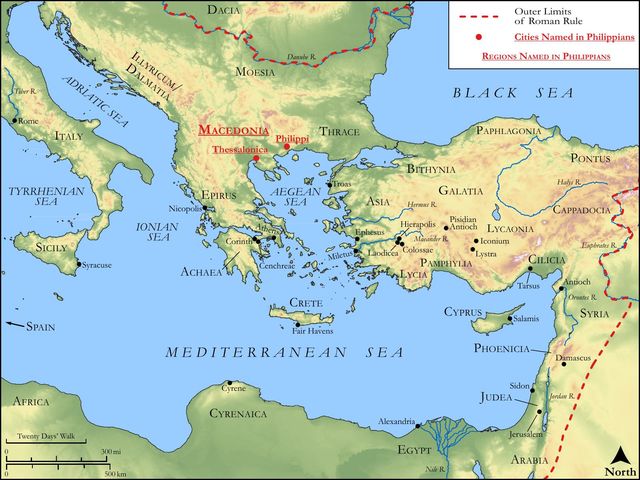
See on the biblical-era maps

Study this verse
Public-domain commentary
Matthew Henry
From his Commentary on the Whole Bible. Henry comments on passages, not single verses — this entry covers Philippians 1:1–2. His two-level outline is real structure in the source text, so it is rendered as structure.
We have here the inscription and benediction. Observe,
I.The persons writing the epistle - Paul and Timotheus.
Though Paul was alone divinely inspired, he joins Timothy with himself, to express his own humility, and put honour upon Timothy. Those who are aged, and strong, and eminent, should pay respect to, and support the reputation of, those who are younger, and weaker, and of less note. The servants of Jesus Christ; not only in the common relation of his disciples, but in the peculiar work of the ministry, the high office of an apostle and an evangelist. Observe, The highest honour of the greatest apostle, and most eminent ministers, is to be the servants of Jesus Christ; not the masters of the churches, but the servants of Christ. Observe,
II.The persons to whom it is directed.
1.To all the saints in Christ who are at Philippi. He mentions the church before the ministers, because the ministers are for the church, for their edification and benefit, not the churches for the ministers, for their dignity, dominion, and wealth. Not for that we have dominion over your faith, but are helpers of your joy, Co2 1:24. They are not only the servants of Christ, but the servants of the church for his sake. Ourselves your servants for Jesus' sake, Co2 4:5. Observe, The Christians here are called saints; set apart for God, or sanctified by his Spirit, either by visible profession or real holiness. And those who are not really saints on earth will never be saints in heaven. Observe, It is directed to all the saints, one as well as another, even the meanest, the poorest, and those of the least gifts. Christ makes no difference; the rich and the poor meet together in him: and the ministers must not make a difference in their care and tenderness upon these accounts. We must not have the faith of our Lord Jesus Christ with respect of persons, Jam 2:1. Saints in Christ Jesus; saints are accepted only by virtue of their being in Christ Jesus, or as they are Christians. Out of Christ the best saints will appear sinners, and unable to stand before God.
2.It is directed to the ministers, or church-officers - with the bishops and deacons, the bishops or elders, in the first place, whose office it was to teach and rule, and the deacons, or overseers of the poor, who took care of the outward business of the house of God: the place, the furniture, the maintenance of the ministers, and provision for the poor. These were all the offices which were then known in the church, and which were of divine appointment. The apostle, in the direction of his epistle to a Christian church, acknowledges but two orders, which he calls bishops and deacons. And whosoever shall consider that the same characters and titles, the same qualifications, the same acts of office, and the same honour and respect, are every where ascribed throughout the New Testament to those who are called bishops and presbyters (as Dr. Hammond and other learned men allow), will find it difficult to make them a different office or distinct order of ministry in the scripture times.
III.Here is the apostolical benediction:
Grace be unto you, and peace, from God our Father, and from the Lord Jesus Christ, Phi 1:2. This is the same, almost word for word, in all the epistles, to teach us that we must not be shy of forms, though we are not to be tied down to them, especially such as are not scriptural. The only form in the Old Testament is that of a benediction (Num 6:23-26), On this wise you shall bless the children of Israel, saying unto them, The Lord bless thee and keep thee: the Lord make his face shine upon thee, and be gracious unto thee: the Lord lift up the light of his countenance upon thee, and give thee peace. So in the New Testament, the good which is wished is spiritual good, grace and peace - the free favour and good-will of God, and all the blessed fruits and effects of it, and that from God our Father, and from the Lord Jesus Christ, jointly from them both, though in a different way. Observe,
1.No peace without grace. Inward peace springs from a sense of divine favour.
2.No grace and peace but from God our Father, the fountain and original of all blessings, the Father of lights, from whom cometh down every good and perfect gift, Jam 1:17.
3.No grace and peace from God our Father, but in and through our Lord Jesus Christ. Christ, as Mediator, is the channel of conveyance of all spiritual blessings to the church, and directs the disposal of them to all his members.
Historical interpretation
Three Centuries of Reception
6 surviving comments on this verse. Each one is dated, so this reads as a timeline rather than a list.
Select a marker to jump to its quote. Markers stagger vertically where authors wrote within a few decades of each other.
But the apostle himself also, being one who had been formed in a womb, and had issued thence, wrote to us, and confessed in his Epistle to the Philippians that "to live in the flesh was the fruit of
He writes to the saints in his customary manner, but his intent is to write to those who are “saints in Christ Jesus,” specifically those who confess that he is divine and human.… He is not writing to those who by their own deceptions suppress the truth.
He keeps silence about his status as an apostle. He is writing to people who already know who he is and have an informed opinion of him. He suppresses his dignity. He declares his lowly state, because the one who confesses Christ as Lord is all the more free and has salvation.
Here, as writing to those of equal honor, he does not set down his rank of Teacher, but another, and that a great one. And what is that? He calls himself a "servant," and not an Apostle. For great truly is this rank too, and the sum of all good things, to be a servant of Christ, and not merely to be called so. "The servant of Christ," this is truly a free man in respect to sin, and being a genuine servant, he is not a servant to any other, since he would not be Christ's servant, but by halves. And in again writing to the Romans also, he says, "Paul, a servant of Jesus Christ." But writing to the Corinthians and to Timothy he calls himself an "Apostle." On what account then is this? Not because they were superior to Timothy. Far from it. But rather he honors them, and shows them attention, beyond all others to whom he wrote. For he also bears witness to great virtue in them. For besides, there indeed he was about to order many things, and therefore assumed his rank as an Apostle. But here he gives them no injunctions but such as they could perceive of themselves.
"To the saints in Christ Jesus which are at Philippi." Since it was likely that the Jews too would call themselves "saints" from the first oracle, when they were called a "holy people, a people for God's own possession"; for this reason he added, "to the saints in Christ Jesus." For these alone are holy, and those henceforth profane. "To the fellow-Bishops and Deacons." What is this? were there several Bishops of one city? Certainly not; but he called the Presbyters so. For then they still interchanged the titles, and the Bishop was called a Deacon. For this cause in writing to Timothy, he said, "Fulfil thy ministry," when he was a Bishop. For that he was a Bishop appears by his saying to him, "Lay hands hastily on no man." And again, "Which was given thee with the laying on of the hands of the Presbytery." Yet Presbyters would not have laid hands on a Bishop. And again, in writing to Titus, he says, "For this cause I left thee in Crete, that thou shouldest appoint elders in every city, as I gave thee charge. If any man is blameless, the husband of one wife"; which he says of the Bishop. And after saying this, he adds immediately, "For the Bishop must be blameless, as God's steward, not self willed." So then, as I said, both the Presbyters were of old called Bishops and Deacons of Christ, and the Bishops Presbyters; and hence even now many Bishops write, "To my fellow-Presbyter," and, "To my fellow-Deacon." But otherwise the specific name is distinctly appropriated to each, the Bishop and the Presbyter.
He sends his news to everyone, both those who have been deemed worthy of ordination and those who are shepherded by them. By “those who are holy” he means those who have worthily received holy baptism.
He applies the term bishops to presbyters, for at that time they had both names. … And it is clear that he makes this assumption here also. For he joins the deacons to the bishops, making no mention of the presbyters. Furthermore, it was not possible for many bishops to be shepherds to one city. So it is clear that he is calling the presbyters bishops; yet in this same letter he calls the blessed Epaphroditus their apostle, … and thus he indicates plainly that he was entrusted with an episcopal function because he had the name of an apostle.
Continue studying Philippians 1:1 across the web’s major study libraries — every link below opens this exact verse, chapter, or book on the destination site.
Read & Compare
 BibleGatewayThis verse in more than 200 translations and 70 languages.
 Bible.comThe YouVersion reader — hundreds of translations, reading plans, and highlights.
 ESV.orgCrossway's official English Standard Version reader.
 NET BibleThe NET translation with 60,000+ translators' notes on every rendering decision.
 STEP BibleTyndale House's free study tool — original text, vocabulary, and scholarly resources.
 BibliaLogos Bible Software's free web reader.
 USCCBThe New American Bible (Revised Edition) with the U.S. bishops' study notes.
Commentaries
 BibleHub CommentariesDozens of classic commentaries on this verse, gathered on one page.
 StudyLightMore than 100 commentary sets — the largest collection on the web.
 BibleRefPlain-English commentary on what this verse means, verse by verse.
 Enduring WordDavid Guzik's free commentary on this chapter, widely used by Bible teachers.
 Bible Study ToolsVerse commentary alongside Greek and Hebrew study aids.
Original Language & Research
- BibleHub InterlinearThe verse word by word — original language, transliteration, and English.
- BibleHub LexiconEvery word's original-language definition and Strong's entry.
 Blue Letter BibleDeep-study tools — Strong's numbers, concordance, and word studies.
 CNTR CollationThe earliest Greek manuscripts of this verse, collated letter by letter.
Sermons, Hymns & Audio


TrulyRandomVerse is not affiliated with these sites and doesn’t control their content. They’re linked because they’re genuinely useful.
Summary
Philippians 1:1 serves as a foundational salutation, introducing the Apostle Paul and Timothy as "servants of Jesus Christ" and addressing the letter to "all the saints in Christ Jesus" at Philippi, specifically acknowledging the "bishops and deacons." This opening verse immediately establishes the authors' humble yet authoritative identity, defines the recipients by their spiritual union with Christ, and highlights the early church's structured leadership, setting a tone of shared purpose, spiritual identity, and communal order for the letter's subsequent themes of joy, unity, and perseverance in the gospel.
Context
ShowHideLiterary Context
Philippians 1:1 functions as the customary opening of a letter, yet it is imbued with profound theological meaning. As one of Paul's "Prison Epistles," likely penned during his imprisonment in Rome (circa A.D. 60-62), this salutation immediately establishes the letter's authorship and its intended audience. Unlike some of Paul's more confrontational letters, the tone here is one of deep affection, partnership, and shared joy, which is consistent with the overall tenor of the entire epistle. The specific mention of "bishops and deacons" in the opening, a detail not always present in Paul's other salutations, suggests an already established and organized church structure in Philippi, hinting at the practical and pastoral concerns that will unfold in the letter, such as unity and perseverance in the face of external pressures. The subsequent verses of the chapter, particularly Philippians 1:3-8, express Paul's profound gratitude and affection for the Philippian believers, reinforcing the warm relationship implied by this initial greeting.
Historical & Cultural Context
Philippi was a significant Roman colony in Macedonia, founded by Philip II of Macedon and later becoming a prominent city under Roman rule. Its status as a Roman colony meant its citizens enjoyed certain privileges, and its culture was heavily influenced by Roman customs and governance. The church in Philippi was the first Christian community Paul established in Europe, a pivotal event recounted in Acts 16. Paul's ministry there began with Lydia, a businesswoman, and included the conversion of the jailer, demonstrating the diverse social strata reached by the gospel. The Philippian believers had a uniquely supportive and affectionate relationship with Paul, frequently sending financial aid to him, as acknowledged later in the letter (Philippians 4:15-16). The presence of "bishops and deacons" indicates that by the time of this letter, the Philippian church, though relatively young, had developed a recognized and functional leadership structure, reflecting the organic growth and organization typical of early Christian communities.
Key Themes
ShowHideThis opening verse introduces several key themes that resonate throughout the Epistle to the Philippians. Firstly, it underscores Authorship and Partnership, with Paul explicitly including Timothy, highlighting the collaborative nature of apostolic ministry and the importance of faithful co-laborers in the gospel. Secondly, it emphasizes Identity in Christ, defining both the authors ("servants of Jesus Christ") and the recipients ("saints in Christ Jesus") by their profound union with Christ. This identity is foundational, shaping their purpose, status, and conduct, and is a recurring emphasis in Paul's theology, as seen in passages like Colossians 3:3. Thirdly, the verse highlights Church Structure and Leadership, uniquely specifying "bishops and deacons." This detail points to the early church's development of organized roles for oversight and service, which were crucial for the community's spiritual health and practical functioning. Finally, the inclusive address to "all the saints" at Philippi subtly introduces the theme of Unity and Fellowship, which Paul will later exhort them to maintain (Philippians 2:1-4).
Exposition and Analysis
ShowHideKey Word Analysis
ShowHideFrom δέω; a slave (literal or figurative, involuntary or voluntary; frequently, therefore in a qualified sense of subjection or subserviency):--bond(-man), servant. Paul's self-identification as a "servant" (δοῦλος) of Jesus Christ is not a statement of low social standing but a profound theological declaration. It signifies complete devotion, absolute submission, and willing ownership by Christ. For Paul, this was a title of honor and deep commitment, indicating that his life, ministry, and very being were entirely dedicated to his divine Master, echoing the ultimate humility of Christ Himself.
From (an awful thing) (compare ἁγνός, θάλπω); sacred (physically, pure, morally blameless or religious, ceremonially, consecrated):--(most) holy (one, thing), saint. The term "saints" (ἁγίοις) refers to believers as those who are "holy ones" or "set apart" by God. This status is not earned through moral perfection but is a positional holiness bestowed through their union with Christ. Every believer is a saint by virtue of being consecrated to God and called into His covenant relationship, implying a call to live in accordance with that consecrated status.
From ἐπί and σκοπός (in the sense of ἐπισκοπέω); a superintendent, i.e. Christian officer in genitive case charge of a (or the) church (literally or figuratively):--bishop, overseer. This term (ἐπίσκοπος) denotes those entrusted with oversight, supervision, and pastoral responsibility within the local church. They were the spiritual leaders responsible for guiding, teaching, and caring for the flock, ensuring the spiritual well-being and doctrinal purity of the congregation.
Verse Breakdown
ShowHide"Paul and Timotheus, the servants of Jesus Christ,"
This opening identifies the letter's authors. Paul, the primary apostle to the Gentiles, includes Timothy, his trusted co-worker and spiritual son, highlighting their shared commitment to Christ and collaborative ministry. Their self-designation as "servants" (δοῦλοι) signifies their complete allegiance and submission to Jesus Christ, emphasizing that their authority and mission derive solely from Him.
"to all the saints in Christ Jesus which are at Philippi,"
This clause specifies the broad audience of the letter. "All the saints" underscores the inclusive nature of the Christian community, encompassing every believer in Philippi, regardless of social status or background. The crucial phrase "in Christ Jesus" defines their new identity and spiritual reality; their standing as "saints" (holy ones) is not inherent but is a result of their mystical union with Christ, through whom they are set apart and consecrated to God.
"with the bishops and deacons:"
This unique addition to the salutation acknowledges specific leadership roles within the Philippian church. "Bishops" (ἐπίσκοποι, overseers) refers to those with pastoral and administrative oversight, while "deacons" (διάκονοι, servants/ministers) refers to those who provided practical service and ministry within the community. Their explicit mention signifies an established and recognized organizational structure within this early Christian assembly, indicating the importance of ordered leadership for the church's health and functioning.
Literary Devices
ShowHidePhilippians 1:1 employs several significant literary devices. The most prominent is Salutation, a standard feature of ancient letters, which here serves to formally introduce the authors and recipients, setting the stage for the communication. The use of Identification is crucial, as Paul and Timothy define themselves not by worldly status but by their spiritual relationship as "servants of Jesus Christ," establishing a humble yet authoritative posture. Similarly, the recipients are identified as "saints in Christ Jesus," emphasizing their new, divinely-granted status. The phrase "all the saints" demonstrates Universal Reach, highlighting the unity and comprehensive nature of the Christian community in Philippi. The specific mention of "bishops and deacons" is a form of Formal Address that acknowledges and validates the established leadership structure within the local church, lending weight to their roles and to the letter's contents as relevant to the entire body, including its leaders. This precise naming of roles also serves as a subtle form of Categorization, distinguishing specific functions within the broader assembly of "saints."
Theological and Thematic Connections
ShowHidePhilippians 1:1 lays a theological cornerstone for understanding Christian identity, ministry, and community. The self-designation of Paul and Timothy as "servants of Jesus Christ" establishes the paradigm for all Christian ministry: it is not self-appointed or self-serving, but a humble, devoted service to the Lord. This bond-servant relationship underscores Christ's ultimate authority and ownership over His followers. Furthermore, the address to "all the saints in Christ Jesus" emphasizes that every believer, regardless of their background or role, shares a common, holy identity rooted in their spiritual union with Christ. This positional holiness is the basis for their calling to live lives consecrated to God. The inclusion of "bishops and deacons" highlights the New Testament pattern of organized church leadership, demonstrating that spiritual order and practical service are integral to the flourishing of the local assembly, reflecting God's design for His people to be shepherded and served. This verse, therefore, affirms that the church is a community defined by its shared identity in Christ, united in service to Him, and structured for mutual edification and gospel proclamation.
Reflection and Application
ShowHidePhilippians 1:1 offers timeless principles for contemporary believers and the church. Our primary identity, like Paul and Timothy, is to be "servants of Jesus Christ." This calls us to a life of humble devotion, recognizing that our purpose and direction are found in submitting to His will and serving His kingdom. This identity transcends all earthly titles and achievements, grounding our worth and mission in Christ alone. Moreover, recognizing ourselves and fellow believers as "saints in Christ Jesus" fosters a profound sense of unity and shared purpose. It reminds us that our holiness is a gift, a status bestowed by God through faith, which then compels us to live out that calling in practical purity and love. This shared identity should break down barriers and promote genuine fellowship within the body of Christ. Finally, the mention of "bishops and deacons" underscores the enduring importance of biblical leadership within the local church. These roles, whether called by these specific titles or others, are essential for spiritual oversight, teaching, and practical service, ensuring the church is well-equipped to fulfill its mission. This verse encourages us to appreciate and support those in leadership while also recognizing our own call to service within the broader community of faith.
Questions for Reflection
ShowHideFAQ
ShowHideWhat is the significance of Paul and Timothy calling themselves "servants of Jesus Christ"?
ShowHideThe term "servants" (Greek: doûlos) here is significant because it literally means "slave" or "bond-servant." For Paul and Timothy, this was not a derogatory term but a title of honor and profound theological meaning. It signifies their complete and willing submission, devotion, and ownership by Jesus Christ. It highlights that their authority, mission, and very lives were entirely dedicated to Christ, reflecting a radical commitment that put Christ's will above their own. This identity as Christ's bond-servants formed the bedrock of their apostolic ministry, emphasizing their role as instruments of God's grace rather than independent agents, as seen in Paul's consistent emphasis on his calling by Christ throughout his letters, such as in Romans 1:1.
Who were the "saints in Christ Jesus" at Philippi?
ShowHideThe "saints" (Greek: hágios) refers to all believers in Philippi. In biblical terms, "saint" does not imply moral perfection, but rather a status of being "holy" or "set apart" by God. This holiness is positional, granted to believers through their faith and union "in Christ Jesus." It means they are consecrated to God, separated from the world for His purposes, and belong to His covenant community. Therefore, "all the saints" encompasses every Christian in the city, from new converts to mature leaders, emphasizing their shared identity and spiritual standing before God through their relationship with Christ, a concept central to Paul's understanding of the church as expressed in Ephesians 1:1.
What roles did the "bishops and deacons" play in the early church at Philippi?
ShowHideThe mention of "bishops" (Greek: epískopos, meaning "overseers" or "superintendents") and "deacons" (Greek: diákonos, meaning "servants" or "ministers") indicates an established, organized leadership structure within the Philippian church. Bishops were responsible for the spiritual oversight, teaching, and pastoral care of the congregation, ensuring doctrinal purity and guiding the community. Deacons, on the other hand, were primarily involved in practical service, such as caring for the needy, managing church resources, and assisting the bishops in various ministries. These roles were distinct yet complementary, essential for the healthy functioning and growth of the early Christian community, with qualifications for these offices later detailed in 1 Timothy 3 and Titus 1.
Christ-Centered Fulfillment
ShowHidePhilippians 1:1, though a salutation, profoundly points to Christ as the source and center of all Christian identity and ministry. Paul and Timothy's self-designation as "servants of Jesus Christ" finds its ultimate meaning in Christ Himself, who perfectly embodied servanthood. He, though God, "made himself nothing by taking the very nature of a servant" (Philippians 2:7), demonstrating that true greatness and authority are found in humble obedience to God's will. The recipients are "saints in Christ Jesus," highlighting that their holy status is not inherent but is a gift bestowed through their union with Christ's perfect righteousness and sacrificial work on the cross (2 Corinthians 5:21). It is through His atoning death and resurrection that believers are set apart and consecrated to God. Furthermore, the very existence and structure of the church, with its "bishops and deacons," are ultimately Christ-centered. Christ is the "head of the church" (Ephesians 5:23), the Chief Shepherd (1 Peter 5:4), who gifts and empowers leaders for the equipping of the saints for ministry (Ephesians 4:11-12). Thus, Philippians 1:1, in its concise greeting, powerfully encapsulates the truth that all Christian life, leadership, and community flow from and find their purpose in the person and work of Jesus Christ.