


Philippians 1:2
Bible text: King James Version (1769 Blayney text) · Public domain
Bible text: Berean Standard Bible · Public domain
Bible text: American Standard Version (1901) · Public domain
Bible text: World English Bible, Messianic edition · Public domain
Bible text: Geneva Bible (1599) · Public domain
Bible text: Young's Literal Translation · Public domain
- χάριςcharisGraceG5485N-NSFNoun Nominative Singular Feminine
- ὑμῖνhuminto youG4771P-2DPPersonal pronoun Dative 2nd Plural
- καὶkaiandG2532CONJConjunction
- εἰρήνηeirēnēpeaceG1515N-NSFNoun Nominative Singular Feminine
- ἀπὸapofromG575PREPPreposition
- θεοῦtheouGodG2316N-GSM-TNoun Genitive Singular Masculine Title
- πατρὸςpatrosFatherG3962N-GSM-TNoun Genitive Singular Masculine Title
- ἡμῶνhēmōnof usG3165P-1GPPersonal pronoun Genitive 1st Plural
- καὶkaiandG2532CONJConjunction
- κυρίουkuriou[the] LordG2962N-GSM-TNoun Genitive Singular Masculine Title
- ἸησοῦIēsouJesusG2424N-GSM-PNoun Genitive Singular Masculine Individual
- ΧριστοῦChristouChristG5547N-GSM-TNoun Genitive Singular Masculine Title
English is a literal word-by-word gloss of the Greek, not the KJV's wording. Why?
This is the original text the KJV's translators worked from — each Greek word with its own literal English meaning in this verse, prepared by scholars at Tyndale House, Cambridge. The KJV translates whole sentences, not word by word, so its wording differs: one Greek word can become several English words, and the KJV may choose “charity” where the gloss reads “love”. Both are faithful — they answer different questions. For the KJV's own rendering, switch to the KJV text.
Details
See on the biblical-era maps

Study this verse
Public-domain commentary
Matthew Henry
From his Commentary on the Whole Bible. Henry comments on passages, not single verses — this entry covers Philippians 1:1–2. His two-level outline is real structure in the source text, so it is rendered as structure.
We have here the inscription and benediction. Observe,
I.The persons writing the epistle - Paul and Timotheus.
Though Paul was alone divinely inspired, he joins Timothy with himself, to express his own humility, and put honour upon Timothy. Those who are aged, and strong, and eminent, should pay respect to, and support the reputation of, those who are younger, and weaker, and of less note. The servants of Jesus Christ; not only in the common relation of his disciples, but in the peculiar work of the ministry, the high office of an apostle and an evangelist. Observe, The highest honour of the greatest apostle, and most eminent ministers, is to be the servants of Jesus Christ; not the masters of the churches, but the servants of Christ. Observe,
II.The persons to whom it is directed.
1.To all the saints in Christ who are at Philippi. He mentions the church before the ministers, because the ministers are for the church, for their edification and benefit, not the churches for the ministers, for their dignity, dominion, and wealth. Not for that we have dominion over your faith, but are helpers of your joy, Co2 1:24. They are not only the servants of Christ, but the servants of the church for his sake. Ourselves your servants for Jesus' sake, Co2 4:5. Observe, The Christians here are called saints; set apart for God, or sanctified by his Spirit, either by visible profession or real holiness. And those who are not really saints on earth will never be saints in heaven. Observe, It is directed to all the saints, one as well as another, even the meanest, the poorest, and those of the least gifts. Christ makes no difference; the rich and the poor meet together in him: and the ministers must not make a difference in their care and tenderness upon these accounts. We must not have the faith of our Lord Jesus Christ with respect of persons, Jam 2:1. Saints in Christ Jesus; saints are accepted only by virtue of their being in Christ Jesus, or as they are Christians. Out of Christ the best saints will appear sinners, and unable to stand before God.
2.It is directed to the ministers, or church-officers - with the bishops and deacons, the bishops or elders, in the first place, whose office it was to teach and rule, and the deacons, or overseers of the poor, who took care of the outward business of the house of God: the place, the furniture, the maintenance of the ministers, and provision for the poor. These were all the offices which were then known in the church, and which were of divine appointment. The apostle, in the direction of his epistle to a Christian church, acknowledges but two orders, which he calls bishops and deacons. And whosoever shall consider that the same characters and titles, the same qualifications, the same acts of office, and the same honour and respect, are every where ascribed throughout the New Testament to those who are called bishops and presbyters (as Dr. Hammond and other learned men allow), will find it difficult to make them a different office or distinct order of ministry in the scripture times.
III.Here is the apostolical benediction:
Grace be unto you, and peace, from God our Father, and from the Lord Jesus Christ, Phi 1:2. This is the same, almost word for word, in all the epistles, to teach us that we must not be shy of forms, though we are not to be tied down to them, especially such as are not scriptural. The only form in the Old Testament is that of a benediction (Num 6:23-26), On this wise you shall bless the children of Israel, saying unto them, The Lord bless thee and keep thee: the Lord make his face shine upon thee, and be gracious unto thee: the Lord lift up the light of his countenance upon thee, and give thee peace. So in the New Testament, the good which is wished is spiritual good, grace and peace - the free favour and good-will of God, and all the blessed fruits and effects of it, and that from God our Father, and from the Lord Jesus Christ, jointly from them both, though in a different way. Observe,
1.No peace without grace. Inward peace springs from a sense of divine favour.
2.No grace and peace but from God our Father, the fountain and original of all blessings, the Father of lights, from whom cometh down every good and perfect gift, Jam 1:17.
3.No grace and peace from God our Father, but in and through our Lord Jesus Christ. Christ, as Mediator, is the channel of conveyance of all spiritual blessings to the church, and directs the disposal of them to all his members.
Historical interpretation
Historical reception
2 surviving comments on this verse. Each one is dated, so this reads as a timeline rather than a list.
Select a marker to jump to its quote. Markers stagger vertically where authors wrote within a few decades of each other.
It is evident that while God is called Father, Christ Jesus is called Lord. Does it not then appear that the Lord does not possess equal dignity with the Father? That might seem true in the world of human beings, but between God the Father and Christ the Lord there is complete harmony.
"Grace to you and peace from God our Father and the Lord Jesus Christ."
How is it that though he nowhere else writes to the Clergy, not in Rome, nor in Corinth, nor in Ephesus, nor anywhere, but in general, to "all the saints, the believers, the beloved," yet here he writes to the Clergy? Because it was they that sent, and bare fruit, and it was they that dispatched Epaphroditus to him.
Continue studying Philippians 1:2 across the web’s major study libraries — every link below opens this exact verse, chapter, or book on the destination site.
Read & Compare
 BibleGatewayThis verse in more than 200 translations and 70 languages.
 Bible.comThe YouVersion reader — hundreds of translations, reading plans, and highlights.
 ESV.orgCrossway's official English Standard Version reader.
 NET BibleThe NET translation with 60,000+ translators' notes on every rendering decision.
 STEP BibleTyndale House's free study tool — original text, vocabulary, and scholarly resources.
 BibliaLogos Bible Software's free web reader.
 USCCBThe New American Bible (Revised Edition) with the U.S. bishops' study notes.
Commentaries
 BibleHub CommentariesDozens of classic commentaries on this verse, gathered on one page.
 StudyLightMore than 100 commentary sets — the largest collection on the web.
 BibleRefPlain-English commentary on what this verse means, verse by verse.
 Enduring WordDavid Guzik's free commentary on this chapter, widely used by Bible teachers.
 Bible Study ToolsVerse commentary alongside Greek and Hebrew study aids.
Original Language & Research
- BibleHub InterlinearThe verse word by word — original language, transliteration, and English.
- BibleHub LexiconEvery word's original-language definition and Strong's entry.
 Blue Letter BibleDeep-study tools — Strong's numbers, concordance, and word studies.
 CNTR CollationThe earliest Greek manuscripts of this verse, collated letter by letter.
Sermons, Hymns & Audio


TrulyRandomVerse is not affiliated with these sites and doesn’t control their content. They’re linked because they’re genuinely useful.
Summary
Philippians 1:2 serves as Paul's customary apostolic greeting to the church in Philippi, imparting a profound spiritual blessing of "grace" and "peace." This salutation is not merely a formality but a theological declaration, establishing that these foundational Christian virtues originate solely "from God our Father, and from the Lord Jesus Christ," thereby underscoring the divine source of all spiritual blessings and the co-equality of the Father and the Son in their bestowal.
Context
ShowHideLiterary Context
Philippians 1:2 is the heart of the opening salutation (Philippians 1:1-2) of Paul's deeply personal and affectionate letter to the Philippian believers. Following the identification of the senders (Paul and Timothy) and the recipients (saints in Christ Jesus at Philippi, with bishops and deacons) in Philippians 1:1, this verse delivers the core blessing. It immediately precedes Paul's heartfelt thanksgiving and prayer for the Philippians' partnership in the gospel (Philippians 1:3-11), setting a tone of divine favor and spiritual well-being that permeates the entire epistle. This greeting establishes the theological framework for the themes of joy, unity, and perseverance that Paul will develop throughout the letter.
Historical & Cultural Context
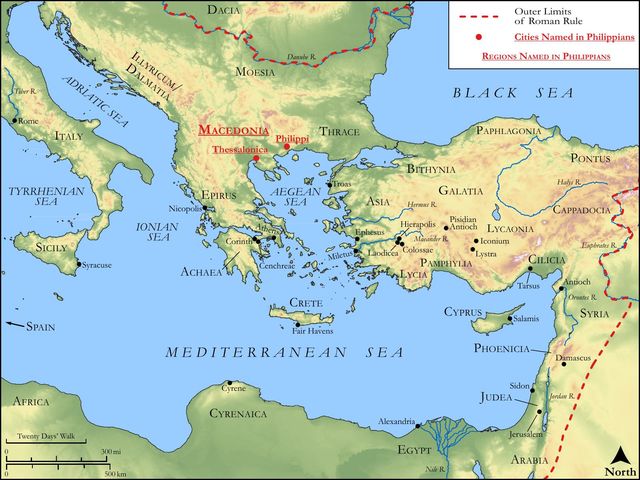
Philippi was a significant Roman colony in Macedonia, granting its citizens special privileges and a strong sense of Roman identity. The church there was unique among Paul's congregations, known for its steadfast partnership in the gospel, including consistent financial support for Paul's ministry (Philippians 4:15-16). Paul wrote this letter while imprisoned, likely in Rome, which adds a layer of poignancy to his message of joy and peace amidst suffering. The greeting itself, "Grace and peace," is a masterful blend of Greek and Hebrew cultural norms. "Grace" (Greek: charis) was a common Greek salutation, while "peace" (Hebrew: shalom) was the traditional Jewish greeting. By combining them, Paul infuses a common secular greeting with profound Christian theological meaning, signifying God's unmerited favor and holistic well-being.
Key Themes
ShowHideThis verse introduces several key themes prevalent in Philippians and Pauline theology. Firstly, it highlights the Divine Origin of Blessings, asserting that all true spiritual blessings—specifically grace and peace—flow directly from the triune God, emphasizing the unity and co-operation of God the Father and the Lord Jesus Christ. Secondly, it underscores God's Unmerited Favor (Grace) as the foundational principle of the Christian life, reminding believers that salvation and all spiritual benefits are freely given, not earned, a concept central to Paul's gospel as seen in Ephesians 2:8-9. Thirdly, it introduces the concept of Holistic Peace, which, rooted in the Hebrew shalom, encompasses not merely the absence of conflict but a profound spiritual well-being, reconciliation with God, and inner tranquility, a peace that surpasses understanding as later mentioned in Philippians 4:7. Finally, the inclusion of "the Lord Jesus Christ" emphasizes the Lordship of Christ and His indispensable role as the mediator of these divine blessings, a theme of Christological supremacy woven throughout the entire letter, particularly in the Christ hymn of Philippians 2:5-11.
Exposition and Analysis
ShowHideKey Word Analysis
ShowHideThis term signifies graciousness, favor, or a gift freely given. In a theological context, it refers to God's unmerited favor and benevolent disposition towards humanity, especially as manifested in salvation through Christ. It encompasses the divine influence upon the heart and its reflection in a transformed life, including gratitude and liberality. It underscores that God's blessings are not earned but are a free expression of His love.
Derived from a verb meaning "to join," this word denotes peace in a comprehensive sense. It includes the absence of conflict but extends far beyond, encompassing a holistic state of well-being, harmony, wholeness, and reconciliation. In the New Testament, it primarily refers to the peace with God achieved through Christ's atoning work and the inner tranquility that results from that reconciled relationship.
This term signifies supreme authority and control. As a noun, it denotes a master or one who holds ultimate power. In the context of Jesus Christ, it is a title of profound reverence and theological significance, acknowledging His divine sovereignty, His position as head over all creation, and His rightful claim to worship and obedience.
Verse Breakdown
ShowHide"Grace be unto you"
This opening phrase is a profound blessing, invoking God's unmerited favor upon the Philippian believers. It signifies a divine disposition of kindness and generosity that is freely bestowed, forming the very foundation of their standing before God and their Christian experience. It is the source of all spiritual life and strength.
"and peace"
Paired with "grace," this word completes the apostolic blessing, invoking a comprehensive state of well-being. This peace is not merely the absence of conflict but a deep, inner spiritual tranquility and harmony, particularly peace with God, which results from reconciliation through Christ, and a holistic sense of wholeness in all aspects of life.
"from God our Father"
This clause explicitly identifies the primary divine source of both grace and peace. It emphasizes God's paternal relationship with believers, highlighting His loving and authoritative role as the ultimate giver of all good gifts. The use of "our Father" underscores the intimate, familial relationship believers have with God through Christ.
"and from the Lord Jesus Christ"
This parallel clause identifies the second, equally vital, divine source of grace and peace. It asserts the co-equality and unity of the Son with the Father in bestowing these blessings. "Lord Jesus Christ" is a full confessional title, acknowledging Jesus' divine authority ("Lord"), His saving work ("Jesus"), and His messianic identity ("Christ"), through whom God's grace and peace are mediated and made accessible to humanity.
Literary Devices
ShowHidePhilippians 1:2 employs several significant literary devices. The most prominent is Apostolic Blessing, a common feature in Paul's epistles where he, as an apostle, invokes divine favor upon the recipients. This is not merely a wish but a declaration of spiritual reality and authority. There is also a powerful Fusion of Greetings, where Paul combines the traditional Greek salutation "charis" (grace) with the Hebrew "shalom" (peace). This blend infuses a common cultural practice with deep theological meaning, reflecting the universal scope of the gospel and its ability to transcend cultural boundaries. Furthermore, the structure "from God our Father, and from the Lord Jesus Christ" demonstrates Parallelism and Joint Agency, emphasizing that grace and peace flow equally and simultaneously from both divine persons, affirming their co-equality and unity within the Godhead in the act of blessing.
Theological and Thematic Connections
ShowHidePhilippians 1:2 is a concise yet profound theological statement, encapsulating the core of Christian blessing and its divine origin. It underscores that "grace" (God's unmerited favor) is the wellspring from which "peace" (holistic well-being and reconciliation with God) flows. This pairing is foundational to Paul's theology, emphasizing that peace is not achieved through human effort but is a direct result of God's sovereign, benevolent initiative. The dual source—"from God our Father, and from the Lord Jesus Christ"—is a powerful affirmation of the unity and co-operation within the Godhead, highlighting the active role of both the Father and the Son in bestowing salvation and its accompanying blessings. This Trinitarian dimension is crucial, establishing that all true spiritual life and sustenance are rooted in the divine nature and work of God through Christ.
Reflection and Application
ShowHidePhilippians 1:2 is far more than a mere opening pleasantry; it is a profound declaration of the Christian's standing and resources in Christ. For believers today, this verse serves as a timeless reminder that our spiritual life is entirely dependent on and sustained by God's unmerited favor and the holistic peace He provides. It calls us to live in constant gratitude for the freely given grace that saves us, forgives us, and empowers us daily. Understanding that this grace and peace flow from both God the Father and the Lord Jesus Christ deepens our appreciation for the unified work of the Godhead in our salvation and sanctification. This peace is not circumstantial but a deep spiritual serenity that transcends earthly troubles, enabling us to face life's challenges with confidence and joy. Embracing this truth encourages us to cease striving in our own strength and instead rest in the divine provision, allowing God's grace to shape our character and His peace to guard our hearts and minds.
Questions for Reflection
ShowHideFAQ
ShowHideWhy does Paul consistently pair "grace" and "peace" in his greetings?
ShowHidePaul's consistent pairing of "grace" and "peace" in his greetings is highly significant, blending Greek and Hebrew cultural salutations with profound theological meaning. "Grace" (Greek: charis) represents God's unmerited favor, His benevolent disposition towards humanity, and the free gift of salvation through Christ. It's the source of all spiritual blessings, emphasizing that our standing with God is not earned but freely given. "Peace" (Hebrew: shalom) signifies a holistic well-being, harmony, and reconciliation, particularly peace with God achieved through Christ's atoning work. The pairing is deliberate: grace is the cause, and peace is the effect. We first receive God's unmerited favor, and as a result, we experience true peace with Him and within ourselves. This sequence underscores the foundational truth that genuine peace is only possible through God's gracious initiative. This pattern is seen throughout Paul's letters, such as in Ephesians 1:2 and Colossians 1:2.
What is the significance of the blessings coming from "God our Father, and from the Lord Jesus Christ"?
ShowHideThe dual attribution of grace and peace "from God our Father, and from the Lord Jesus Christ" is a crucial theological statement affirming the co-equality and unified work of the Father and the Son in the Christian's salvation and spiritual life. It is not "from God our Father, through the Lord Jesus Christ," but "from... and from...," indicating that both divine persons are direct and equal sources of these blessings. This emphasizes the Trinitarian nature of God and the active participation of both the Father and the Son in bestowing salvation and its accompanying benefits. It highlights that Jesus Christ is not merely a messenger or an instrument, but Himself a divine giver of grace and peace, underscoring His full deity and essential role in the divine economy of salvation. This reinforces the New Testament's consistent portrayal of Christ as fully God, as seen in passages like John 1:1-3 and Colossians 2:9.
Christ-Centered Fulfillment
ShowHidePhilippians 1:2 finds its ultimate fulfillment and deepest meaning in the person and work of Jesus Christ. He is not merely the channel through whom grace and peace flow, but He is the very embodiment and source of these divine realities. The "grace" we receive is the unmerited favor of God made manifest in His Son, who "though he was rich, yet for your sakes he became poor, that ye through his poverty might be rich" (2 Corinthians 8:9). Jesus' life, death, and resurrection are the supreme demonstration of God's grace, offering forgiveness of sins and eternal life to all who believe. Similarly, the "peace" bestowed is intrinsically linked to Christ. He is "our peace," having broken down the dividing wall of hostility between God and humanity, and between people, through His sacrifice on the cross (Ephesians 2:14-16). Through His atoning work, we are reconciled to God (Romans 5:10), and the inner turmoil of sin and separation is replaced by a profound spiritual tranquility. Thus, "the Lord Jesus Christ" is not just a co-giver with the Father, but the very means by which God's grace is extended and His peace is established in the hearts of believers, making Him the central figure in all divine blessings.