


Philippians 1:3
Bible text: King James Version (1769 Blayney text) · Public domain
Bible text: Berean Standard Bible · Public domain
Bible text: American Standard Version (1901) · Public domain
Bible text: World English Bible, Messianic edition · Public domain
Bible text: Geneva Bible (1599) · Public domain
Bible text: Young's Literal Translation · Public domain
- ΕὐχαριστῶEucharistōI thankG2168V-PAI-1SVerb Present Active Indicative 1st Singular
- τῷtōtheG3588T-DSMDefinite article Dative Singular Masculine
- θεῷtheōGodG2316N-DSM-TNoun Dative Singular Masculine Title
- μουmouof mineG3165P-1GSPersonal pronoun Genitive 1st Singular
- ἐπὶepiuponG1909PREPPreposition
- πάσῃpasēeveryG3956A-DSFAdjective Dative Singular Feminine
- τῇtēatheG3588T-DSFDefinite article Dative Singular Feminine
- μνείᾳmneiaremembranceG3417N-DSFNoun Dative Singular Feminine
- ὑμῶνhumōnof youG4771P-2GPPersonal pronoun Genitive 2nd Plural
English is a literal word-by-word gloss of the Greek, not the KJV's wording. Why?
This is the original text the KJV's translators worked from — each Greek word with its own literal English meaning in this verse, prepared by scholars at Tyndale House, Cambridge. The KJV translates whole sentences, not word by word, so its wording differs: one Greek word can become several English words, and the KJV may choose “charity” where the gloss reads “love”. Both are faithful — they answer different questions. For the KJV's own rendering, switch to the KJV text.
Details
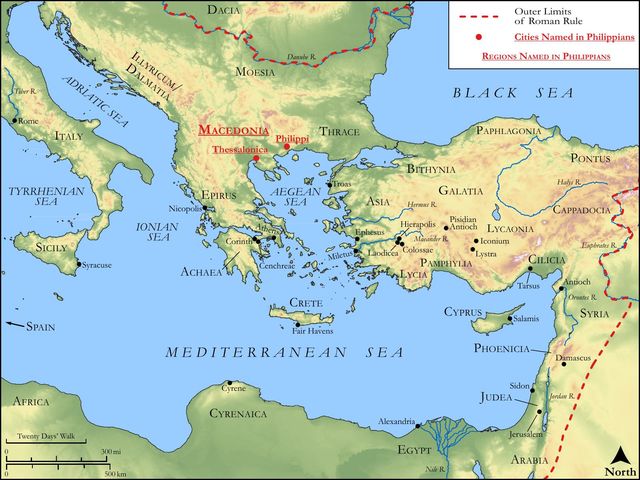
See on the biblical-era maps

Study this verse
Public-domain commentary
Matthew Henry
From his Commentary on the Whole Bible. Henry comments on passages, not single verses — this entry covers Philippians 1:3–6. His three-level outline is real structure in the source text, so it is rendered as structure.
The apostle proceeds after the inscription and benediction to thanksgiving for the saints at Philippi. He tells them what it was he thanked God for, upon their account. Observe here,
I.Paul remembered them:
he bore them much in his thoughts; and though they were out of sight, and he was at a distance from them, yet they were not out of his mind: or, Upon every mention of you - epi pasē tē mneia. As he often thought of them, so he often spoke of them, and delighted to hear them spoken of. The very mention of them was grateful to him: it is a pleasure to hear of the welfare of an absent friend.
II.He remembered them with joy.
At Philippi he was maltreated; there he was scourged and put into the stocks, and for the present saw little of the fruit of his labour; and yet he remembers Philippi with joy. He looked upon his sufferings for Christ as his credit, his comfort, his crown, and was pleased at every mention of the place where he suffered. So far was he from being ashamed of them, or loth to hear of the scene of his sufferings, that he remembered it with joy.
III.He remembered them in prayer:
Always in every prayer of mine for you all, Phi 1:4. The best remembrance of our friends is to remember them at the throne of grace. Paul was much in prayer for his friends, for all his friends, for these particularly. It should seem, by this manner of expression, that he mentioned at the throne of grace the several churches he was interested in and concerned for particularly and by name. He had seasons of prayer for the church at Philippi. God gives us leave to be thus free with him, though, for our comfort, he knows whom we mean when we do not name them.
IV.He thanked God upon every joyful remembrance of them.
Observe, Thanksgiving must have a part in every prayer; and whatsoever is the matter of our rejoicing ought to be the matter of our thanksgiving. What we have the comfort of, God must have the glory of. He thanked God, as well as made requests with joy. As holy joy is the heart and soul of thankful praise, so thankful praise is the lip and language of holy joy.
V.As in our prayers, so in our thanksgiving, we must eye God as our God:
I thank my God. It encourages us in prayer, and enlarges the heart in praise, to see every mercy coming from the hand of God as our God. - I thank my God upon every remembrance of you. We must thank our God for others' graces and comforts, and gifts and usefulness, as we receive the benefit of them, and God receives glory by them. But what is the matter of this thanksgiving?
1.He gives thanks to God for the comfort he had in them: for your fellowship in the gospel, from the first day until now, Phi 1:5. Observe, Gospel fellowship is a good fellowship; and the meanest Christians have fellowship in the gospel with the greatest apostles, for the gospel salvation is a common salvation (Jde 1:3), and they obtain like precious faith with them, Pe2 1:1. Those who sincerely receive and embrace the gospel have fellowship in it from the very first day: a new-born Christian, if he is true-born, is interested in all the promises and privileges of the gospel from the first day of his becoming such. - Until now. Observe, It is a great comfort to ministers when those who begin well hold on and persevere. Some, by their fellowship in the gospel, understand their liberality towards propagating the gospel, and translate koinōnia, not communion, but communication. But, comparing it with Paul's thanksgiving on the account of other churches, it rather seems to be taken more generally for the fellowship which they had, in faith, and hope, and holy love, with all good Christians - a fellowship in gospel promises, ordinances, privileges, and hopes; and this from the first day until now.
2.For the confidence he had concerning them (Phi 1:6): Being confident of this very thing, etc. Observe, The confidence of Christians is the great comfort of Christians, and we may fetch matter of praise from our hopes as well as from our joys; we must give thanks not only for what we have the present possession and evidence of, but for what we have the future prospect of. Paul speaks with much confidence concerning the good estate of others, hoping well concerning them in the judgment of charity, and being confident in the judgment of faith that if they were sincere they would be happy: That he who has begun a good work in you will perform it unto the day of Jesus Christ. A good work among you - En humin, so it may be read: understand it, in the general, of the planting of the church among them. He who hath planted Christianity in the world will preserve it as long as the world stands. Christ will have a church till the mystery of God shall be finished and the mystical body completed. The church is built upon a rock, and the gates of hell shall not prevail against it. But it is rather to be applied to particular persons, and then it speaks of the certain accomplishment of the work of grace wherever it is begun. Observe here,
(1.)The work of grace is a good work, a blessed work; for it makes us good, and is an earnest of good to us. It makes us like God, and fits us for the enjoyment of God. That may well be called a good work which does us the greatest good.
(2.)Wherever this good work is begun it is of God's beginning: He has begun a good work in you. We could not begin it ourselves, for we are by nature dead in trespasses and sins: and what can dead men do towards raising themselves to life; or how can they begin to act till they are enlivened in the same respect in which they are said to be dead? It is God who quickens those who are thus dead, Eph 2:1; Col 2:13.
(3.)The work of grace is but begun in this life; it is not finished here; as long as we are in this imperfect state there is something more to be done.
(4.)If the same God who begins the good work did not undertake the carrying on and finishing of it, it would lie for ever unfinished. He must perform it who began it.
(5.)We may be confident, or well persuaded, that God not only will not forsake, but that he will finish and crown the work of his own hands. For, as for God, his work is perfect.
(6.)The work of grace will never be perfected till the day of Jesus Christ, the day of his appearance. When he shall come to judge the world, and finish his mediation, then this work will be complete, and the top-stone will be brought forth with shouting. We have the same expression, Phi 1:10.
Historical interpretation
Historical reception
2 surviving comments on this verse. Each one is dated, so this reads as a timeline rather than a list.
Select a marker to jump to its quote. Markers stagger vertically where authors wrote within a few decades of each other.
"I thank my God," he says, "upon all my remembrance of you."
He said in another of his writings, "Obey them that have the rule over you, and submit to them: for they watch in behalf of your souls, as they that shall give account; that they may do this with joy, and not with grief." If then the "grief" be due to the wickedness of the disciples, the doing it "with joy" would be due to their advancement. As often as I remember you, I glorify God. But this he does from his being conscious of many good things in them. I both glorify, he says, and pray. I do not, because ye have advanced unto virtue, cease praying for you. But "I thank my God," he says, "upon all my remembrance of you."
Paul praises God every time he remembers the clergy of Philippi, who received the proclamation of the gospel cordially and have remained uncorrupted up to the present.
Continue studying Philippians 1:3 across the web’s major study libraries — every link below opens this exact verse, chapter, or book on the destination site.
Read & Compare
 BibleGatewayThis verse in more than 200 translations and 70 languages.
 Bible.comThe YouVersion reader — hundreds of translations, reading plans, and highlights.
 ESV.orgCrossway's official English Standard Version reader.
 NET BibleThe NET translation with 60,000+ translators' notes on every rendering decision.
 STEP BibleTyndale House's free study tool — original text, vocabulary, and scholarly resources.
 BibliaLogos Bible Software's free web reader.
 USCCBThe New American Bible (Revised Edition) with the U.S. bishops' study notes.
Commentaries
 BibleHub CommentariesDozens of classic commentaries on this verse, gathered on one page.
 StudyLightMore than 100 commentary sets — the largest collection on the web.
 BibleRefPlain-English commentary on what this verse means, verse by verse.
 Enduring WordDavid Guzik's free commentary on this chapter, widely used by Bible teachers.
 Bible Study ToolsVerse commentary alongside Greek and Hebrew study aids.
Original Language & Research
- BibleHub InterlinearThe verse word by word — original language, transliteration, and English.
- BibleHub LexiconEvery word's original-language definition and Strong's entry.
 Blue Letter BibleDeep-study tools — Strong's numbers, concordance, and word studies.
 CNTR CollationThe earliest Greek manuscripts of this verse, collated letter by letter.
Sermons, Hymns & Audio


TrulyRandomVerse is not affiliated with these sites and doesn’t control their content. They’re linked because they’re genuinely useful.
Summary
In Philippians 1:3, the Apostle Paul initiates his letter to the church in Philippi with a profound expression of personal gratitude, declaring his consistent thanksgiving to God whenever he remembers the believers there. This verse sets a deeply affectionate and joyful tone for the entire epistle, immediately highlighting the strong bond between Paul and the Philippian community, rooted in their shared faith and partnership in the gospel. It serves as a heartfelt opening, moving beyond a mere formal greeting to convey genuine appreciation for their spiritual vitality and support.
Context
ShowHideLiterary Context
Philippians 1:3 immediately follows Paul's customary apostolic salutation (Philippians 1:1-2), which identifies the senders (Paul and Timothy) and the recipients (saints in Philippi, with their overseers and deacons). This verse marks the beginning of the epistle's thanksgiving and prayer section (Philippians 1:3-11), a common feature in Paul's letters. However, unlike some of his other epistles where thanksgiving might be followed by rebuke or correction, here it flows seamlessly into an extended expression of joy and prayer for their continued growth in love and knowledge. This opening thanksgiving sets the stage for the letter's overarching themes of joy, unity, and perseverance in the gospel, even amidst suffering and imprisonment, establishing a warm and intimate tone that permeates the entire letter.
Historical & Cultural Context
Philippi was a significant city in Macedonia, designated a Roman colony, granting its citizens special privileges and a strong sense of Roman identity. Paul first preached the gospel here during his second missionary journey, as recounted in Acts 16, establishing the first church on European soil. The Philippian church was unique among Paul's congregations for its consistent and generous financial support of his ministry, even when he was in other regions (Philippians 4:15-16). This deep, reciprocal relationship fostered a profound affection and partnership between Paul and the Philippians, which is palpable throughout the letter. Paul writes this letter from prison (likely Rome), making his joyful and thankful disposition even more striking and a testament to his spiritual resilience.
Key Themes
ShowHidePhilippians 1:3 introduces several key themes that resonate throughout the epistle. Foremost is Profound Gratitude, not as a mere formality but as a genuine, heartfelt expression of thanks to God for the Philippians themselves—for their faith, their existence, and their faithfulness in Christ. This gratitude is intimately linked to Joy in Remembrance, as Paul states that every recollection of them consistently brings him joy and prompts him to give thanks. This consistent joy is a hallmark of the letter, contributing to Paul's overarching theme of joy despite his circumstances, famously reiterated in Philippians 4:4. Furthermore, while not explicitly stated in this verse, Paul's gratitude is deeply rooted in their Partnership in the Gospel, a theme he explicitly mentions in the very next verse, Philippians 1:5. Their support, both spiritual and financial, was a vital source of encouragement to Paul, enabling his ministry and demonstrating their shared commitment to the advance of the gospel.
Exposition and Analysis
ShowHideKey Word Analysis
ShowHideThis verb signifies "to be grateful" or "to express gratitude," often in a religious context. It conveys a deep sense of appreciation, acknowledging a favor or blessing received. From this word, we derive "Eucharist," emphasizing the element of thanksgiving in communion. Paul's use here indicates a deliberate, spiritual act of acknowledging God as the ultimate source of the blessing that the Philippian believers represent.
Referring to the supreme Divinity, this term highlights the personal and theological nature of Paul's gratitude. His thanks is not directed merely at the Philippians, but to his God for them, underscoring his personal relationship with the divine and recognizing God's sovereign work in their lives and in their relationship with him. It grounds his human appreciation in divine grace.
This noun denotes "recollection" or "mention." It implies a conscious, thoughtful act of bringing someone or something to mind, rather than a fleeting thought. For Paul, it suggests that he regularly and intentionally recalled the Philippian believers, and each time, this deliberate recollection prompted him to give thanks to God, indicating the profound and lasting positive impact they had on him.
Verse Breakdown
ShowHide"I thank my God"
This opening phrase immediately establishes the personal and devotional nature of Paul's relationship with God, using the possessive "my God." It signifies a deep, intimate connection, not merely a formal acknowledgment of a deity. The act of "thanking" (eucharistéō) is a spiritual discipline, an expression of gratitude that recognizes God's hand in the blessings received, in this case, the very existence and faithfulness of the Philippian believers.
"upon every remembrance of you"
This clause reveals the consistent and recurring nature of Paul's thanksgiving. The preposition "upon" (epí) here indicates the occasion or basis for his gratitude – it is triggered each time he remembers them. The word "remembrance" (mneía) suggests a deliberate and thoughtful recollection. This is not a casual or infrequent thought, but a regular and profound bringing to mind of the Philippians, which invariably leads him to express thanks to God. It highlights the deep and positive impact the Philippian church had on Paul's spiritual life and ministry.
Literary Devices
ShowHidePaul's opening in Philippians 1:3 employs several effective literary devices. The most prominent is Apostolic Thanksgiving, a common rhetorical feature in Pauline epistles where the apostle expresses gratitude to God for the recipients, often setting the tone and introducing key themes. This is not a mere formality but a genuine outpouring of emotion. The phrase "my God" exemplifies a Personal Tone, establishing an intimate and relational connection between Paul, God, and the Philippians, immediately signaling the warm and affectionate nature of the letter. Furthermore, the emphasis on "every remembrance" suggests a form of Repetition or consistent action, underscoring the enduring joy and gratitude Paul experiences whenever he recalls the Philippian believers. This consistent positive association reinforces the deep bond and mutual encouragement shared within the Christian community.
Theological and Thematic Connections
ShowHidePhilippians 1:3 profoundly illustrates the theological truth that genuine Christian fellowship is a gift from God, prompting gratitude and intercession. Paul's thanksgiving is not for material gain or personal comfort, but for the spiritual vitality and faithfulness of the Philippian believers. This highlights the value God places on His people and their growth in Christ. It underscores that the spiritual health and perseverance of fellow believers should be a primary source of joy and thanksgiving for us, recognizing God's work in and through them. This verse also implicitly connects to the theme of the church as the body of Christ, where the flourishing of one part brings joy and thanksgiving to another. It models a posture of consistent gratitude, shifting our focus from self to the blessings God provides through His community.
Reflection and Application
ShowHidePhilippians 1:3 offers a timeless blueprint for cultivating a heart of gratitude and strengthening Christian fellowship. Paul's consistent thanksgiving for the Philippians reminds us that our spiritual lives are deeply intertwined with others. We are called to intentionally remember fellow believers—friends, family, church members, and even those we know only through reputation—and to allow those memories to prompt genuine thanksgiving to God for their faith, their contributions, and their very existence in the body of Christ. This practice transforms our perspective, shifting us from a self-focused outlook to one that celebrates God's work in others. It also challenges us to consider if our own lives are lived in such a way that our remembrance brings joy and thanksgiving to others, just as the Philippians brought joy to Paul. Ultimately, this verse encourages a lifestyle of intercessory prayer, where our gratitude for others naturally flows into fervent prayer for their continued spiritual growth, perseverance, and joy in the Lord.
Questions for Reflection
ShowHideFAQ
ShowHideWhy is Paul so thankful for the Philippians?
ShowHidePaul's profound thankfulness for the Philippians stems from several deep reasons. Primarily, they were the first church he founded in Europe (Acts 16), and they maintained an exceptionally close and supportive relationship with him. They consistently partnered with him in the gospel, providing financial support for his ministry (as seen in Philippians 4:15-16) and demonstrating unwavering faithfulness. His gratitude is not merely for their actions but for their very spiritual existence and perseverance, which brought him immense joy and encouragement, especially during his imprisonment.
What does "upon every remembrance of you" mean?
ShowHideThis phrase signifies that Paul's gratitude was not a one-time event but a recurring, consistent experience. Whenever the Philippians came to his mind—whether through prayer, news, or simply reflection—that remembrance consistently prompted him to give thanks to God for them. It highlights the deep and lasting positive impression they had on him, indicating a profound and enduring bond. It suggests a deliberate and regular practice of recalling them in his thoughts and prayers.
Is this just a polite greeting, or does it have deeper meaning?
ShowHideWhile Paul's letters often begin with a salutation and thanksgiving, this expression in Philippians 1:3 goes far beyond mere politeness. It is a genuine outpouring of affection and spiritual appreciation. The warmth and personal tone ("my God") combined with the consistent nature of his thanksgiving ("upon every remembrance") reveal a deep, authentic bond. This heartfelt opening sets the tone for the entire letter, which is characterized by joy, unity, and mutual encouragement, underscoring the profound spiritual partnership Paul shared with the Philippian believers.
Christ-Centered Fulfillment
ShowHidePaul's thanksgiving for the Philippians, while directed to God for them, ultimately finds its Christ-centered fulfillment in several profound ways. The very faith and spiritual vitality of the Philippians, which is the source of Paul's joy and gratitude, is a direct result of Christ's redemptive work in their lives. They are "saints in Christ Jesus" (Philippians 1:1), meaning their identity and spiritual standing are entirely dependent on their union with Him. Paul's thanksgiving, therefore, is an acknowledgment of God's grace manifested through Christ, transforming individuals and forming them into a vibrant community. Furthermore, their "partnership in the gospel" (Philippians 1:5) is a participation in Christ's ongoing mission to reconcile the world to God. Their support for Paul's ministry enabled the spread of the good news of Christ, demonstrating that the body of Christ works together, empowered by the Spirit, to fulfill the Great Commission given by the Lord Himself (Matthew 28:18-20). Thus, Paul's joy in their remembrance is ultimately joy in Christ, the one who called them, sustains them, and works through them for His glory (Colossians 1:27). Every spiritual blessing, including the existence of faithful believers, flows from Christ, the head of the church (Ephesians 1:3).