


1 Thessalonians 1:2
Bible text: King James Version (1769 Blayney text) · Public domain
Bible text: Berean Standard Bible · Public domain
Bible text: American Standard Version (1901) · Public domain
Bible text: World English Bible, Messianic edition · Public domain
Bible text: Geneva Bible (1599) · Public domain
Bible text: Young's Literal Translation · Public domain
- ΕὐχαριστοῦμενEucharistoumenWe give thanksG2168V-PAI-1PVerb Present Active Indicative 1st Plural
- τῷtō<the>G3588T-DSMDefinite article Dative Singular Masculine
- θεῷtheōto GodG2316N-DSM-TNoun Dative Singular Masculine Title
- πάντοτεpantotealwaysG3842ADVAdverb
- περὶpericoncerningG4012PREPPreposition
- πάντωνpantōnallG3956A-GPMAdjective Genitive Plural Masculine
- ὑμῶνhumōnof youG4771P-2GPPersonal pronoun Genitive 2nd Plural
- μνείανmneianmentionG3417N-ASFNoun Accusative Singular Feminine
- ὑμῶνhumōnof youG4771P-2GPPersonal pronoun Genitive 2nd Plural
- ποιούμενοιpoioumenoimakingG4160V-PMP-NPMVerb Present Middle Participle Nominative Plural Masculine
- ἐπὶepiinG1909PREPPreposition
- τῶνtōntheG3588T-GPFDefinite article Genitive Plural Feminine
- προσευχῶνproseuchōnprayersG4335N-GPFNoun Genitive Plural Feminine
- ἡμῶνhēmōnof usG3165P-1GPPersonal pronoun Genitive 1st Plural
English is a literal word-by-word gloss of the Greek, not the KJV's wording. Why?
This is the original text the KJV's translators worked from — each Greek word with its own literal English meaning in this verse, prepared by scholars at Tyndale House, Cambridge. The KJV translates whole sentences, not word by word, so its wording differs: one Greek word can become several English words, and the KJV may choose “charity” where the gloss reads “love”. Both are faithful — they answer different questions. For the KJV's own rendering, switch to the KJV text.
Details
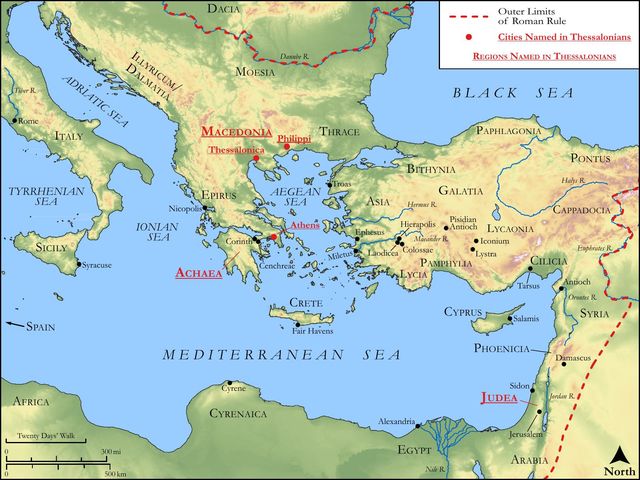
See on the biblical-era maps

Study this verse
Public-domain commentary
Matthew Henry
From his Commentary on the Whole Bible. Henry comments on passages, not single verses — this entry covers 1 Thessalonians 1:2–5. His four-level outline is real structure in the source text, so it is rendered as structure.
I.The apostle begins with thanksgiving to God.
Being about to mention the things that were matter of joy to him, and highly praiseworthy in them, and greatly for their advantage, he chooses to do this by way of thanksgiving to God, who is the author of all that good that comes to us, or is done by us, at any time. God is the object of all religious worship, of prayer and praise. And thanksgiving to God is a great duty, to be performed always or constantly; even when we do not actually give thanks to God by our words, we should have a grateful sense of God's goodness upon our minds. Thanksgiving should be often repeated; and not only should we be thankful for the favours we ourselves receive, but for the benefits bestowed on others also, upon our fellow-creatures and fellow-christians. The apostle gave thanks not only for those who were his most intimate friends, or most eminently favoured of God, but for them all.
II.He joined prayer with his praise or thanksgiving.
When we in every thing by prayer and supplication make our requests known to God, we should join thanksgiving therewith, Phi 4:6. So when we give thanks for any benefit we receive we should join prayer. We should pray always and without ceasing, and should pray not only for ourselves, but for others also, for our friends, and should make mention of them in our prayers. We may sometimes mention their names, and should make mention of their case and condition; at least, we should have their persons and circumstances in our minds, remembering them without ceasing. Note, As there is much that we ought to be thankful for on the behalf of ourselves and our friends, so there is much occasion of constant prayer for further supplies of good.
III.He mentions the particulars for which he was so thankful to God; namely,
1.The saving benefits bestowed on them. These were the grounds and reasons of his thanksgiving.
(1.)Their faith and their work of faith. Their faith he tells them (Th1 1:8) was very famous, and spread abroad. This is the radical grace; and their faith was a true and living faith, because a working faith. Note, Wherever there is a true faith, it will work: it will have an influence upon heart and life; it will put us upon working for God and for our own salvation. We have comfort in our own faith and the faith of others when we perceive the work of faith. Show me thy faith by thy works, Jam 2:18.
(2.)Their love and labour of love. Love is one of the cardinal graces; it is of great use to us in this life and will remain and be perfected in the life to come. Faith works by love; it shows itself in the exercise of love to God and love to our neighbour; as love will show itself by labour, it will put us upon taking pains in religion.
(3.)Their hope and the patience of hope. We are saved by hope. This grace is compared to the soldier's helmet and sailor's anchor, and is of great use in times of danger. Wherever there is a well-grounded hope of eternal life, it will appear by the exercise of patience; in a patient bearing of the calamities of the present time and a patient waiting for the glory to be revealed. For, if we hope for that we see not, then do we with patience wait for it, Rom 8:25.
2.The apostle not only mentions these three cardinal graces, faith, hope and love, but also takes notice,
(1.)Of the object and efficient cause of these graces, namely, our Lord Jesus Christ.
(2.)Of the sincerity of them: being in the sight of God even our Father. The great motive to sincerity is the apprehension of God's eye as always upon us; and it is a sign of sincerity when in all we do we endeavour to approve ourselves to God, and that is right which is so in the sight of God. Then is the work of faith, or labour of love, or patience of hope, sincere, when it is done under the eye of God.
(3.)He mentions the fountain whence these graces flow, namely, God's electing love: Knowing, brethren beloved, your election of God, Th1 1:4. Thus he runs up these streams to the fountain, and that was God's eternal election. Some by their election of God would understand only the temporary separation of the Thessalonians from the unbelieving Jews and Gentiles in their conversion; but this was according to the eternal purpose of him who worketh all things according to the counsel of his own will, Eph 1:11. Speaking of their election, he calls them, brethren beloved; for the original of the brotherhood that is between Christians and the relation wherein they stand one to another is election. And it is a good reason why we should love one another, because we are all beloved of God, and were beloved of him in his counsels when there was not any thing in us to merit his love. The election of these Thessalonians was known to the apostles, and therefore might be known to themselves, and that by the fruits and effects thereof - their sincere faith, and hope, and love, by the successful preaching of the gospel among them. Observe,
[1.]All those who in the fulness of time are effectually called and sanctified were from eternity elected and chosen to salvation.
[2.]The election of God is of his own good pleasure and mere grace, not for the sake of any merit in those who are chosen.
[3.]The election of God may be known by the fruits thereof.
[4.]Whenever we are giving thanks to God for his grace either to ourselves or others, we should run up the streams to the fountain, and give thanks to God for his electing love, by which we are made to differ.
3.Another ground or reason of the apostle's thanksgiving is the success of his ministry among them. He was thankful on his own account as well as theirs, that he had not laboured in vain. He had the seal and evidence of his apostleship hereby, and great encouragement in his labours and sufferings. Their ready acceptance and entertainment of the gospel he preached to them were an evidence of their being elected and beloved of God. It was in this way that he knew their election. It is true he had been in the third heavens; but he had not searched the records of eternity, and found their election there, but knew this by the success of the gospel among them (Th1 1:5), and he takes notice with thankfulness,
(1.)That the gospel came to them also not in word only, but in power; they not only heard the sound of it, but submitted to the power of it. It did not merely tickle the ear and please the fancy, not merely fill their heads with notions and amuse their minds for awhile, but it affected their hearts: a divine power went along with it for convincing their consciences and amending their lives. Note, By this we may know our election, if we not only speak of the things of God by rote as parrots, but feel the influence of these things in our hearts, mortifying our lusts, weaning us from the world, and raising us up to heavenly things.
(2.)It came in the Holy Ghost, that is, with the powerful energy of the divine Spirit. Note, Wherever the gospel comes in power, it is to be attributed to the operation of the Holy Ghost; and unless the Spirit of God accompany the word of God, to render it effectual by his power, it will be to us but as a dead letter; and the letter killeth, it is the Spirit that giveth life.
(3.)The gospel came to them in much assurance. Thus did they entertain it by the power of the Holy Ghost. They were fully convinced of the truth of it, so as not to be easily shaken in mind by objections and doubts; they were willing to leave all for Christ, and to venture their souls and everlasting condition upon the verity of the gospel revelation. The word was not to them, like the sentiments of some philosophers about matters of opinion and doubtful speculation, but the object of their faith and assurance. Their faith was the evidence of things not seen; and the Thessalonians thus knew what manner of men the apostle and his fellow-labourers were among them, and what they did for their sake, and with what good success.
Historical interpretation
Ten Centuries of Reception
5 surviving comments on this verse. Each one is dated, so this reads as a timeline rather than a list.
Select a marker to jump to its quote. Markers stagger vertically where authors wrote within a few decades of each other.
We give thanks to God always for all of you:
Since all things come from God, they first offer thanks for their progress, because God has been pleased not only to give His gift to people who were still in bondage to sin, but also to adopt them as His children, at the same time helping them to put up with all suffering so that they might become worthier.
Keeping the memory of you:
This is because they have grown in the work of faith more than other churches and by God's grace were perfecting the work which they had eagerly begun.
"Grace be unto you, and peace." Do you perceive that the very commencement of his Epistle is with encomiums? "We give thanks to God always for you all, making mention of you in our prayers." For to give thanks to God for them is the act of one testifying to their great advancement, when they are not only praised themselves, but God also is thanked for them, as Himself having done it all. He teaches them also to be moderate, all but saying, that it is all of the power of God. That he gives thanks for them, therefore, is on account of their good conduct, but that he remembers them in his prayers, proceeds from his love towards them.
Rightly he says grace first, then naming peace, because without grace there is no peace nor is reconciliation possible.
Of you in our prayers without ceasing:
This can be understood in three ways: in one way, as to the very act of praying, and then one is praying always or without ceasing, if he prays at the appointed times and hours: "Peter and John were going up to the temple at the hour of prayer, the ninth hour" (Ac 3:1). In another way, as to purpose of prayer which is that our mind rises up to God; and so a man prays as long as he directs his entire life to God: "Whether you eat or drink, or whatever you do, do all to the glory of God" (1 Cor 10:31). Thirdly, as to the cause; for when a person so acts that others pray for him, he seems to be praying, as in the case of those who give alms to the poor who pray for them: "Store up almsgiving in the heart of the poor: and it shall obtain help for you against all evil" (Si 29:12).
This he says twice, just as he says later on in this same letter (5:17).
Continue studying 1 Thessalonians 1:2 across the web’s major study libraries — every link below opens this exact verse, chapter, or book on the destination site.
Read & Compare
 BibleGatewayThis verse in more than 200 translations and 70 languages.
 Bible.comThe YouVersion reader — hundreds of translations, reading plans, and highlights.
 ESV.orgCrossway's official English Standard Version reader.
 NET BibleThe NET translation with 60,000+ translators' notes on every rendering decision.
 STEP BibleTyndale House's free study tool — original text, vocabulary, and scholarly resources.
 BibliaLogos Bible Software's free web reader.
 USCCBThe New American Bible (Revised Edition) with the U.S. bishops' study notes.
Commentaries
 BibleHub CommentariesDozens of classic commentaries on this verse, gathered on one page.
 StudyLightMore than 100 commentary sets — the largest collection on the web.
 BibleRefPlain-English commentary on what this verse means, verse by verse.
 Enduring WordDavid Guzik's free commentary on this chapter, widely used by Bible teachers.
 Bible Study ToolsVerse commentary alongside Greek and Hebrew study aids.
Original Language & Research
- BibleHub InterlinearThe verse word by word — original language, transliteration, and English.
- BibleHub LexiconEvery word's original-language definition and Strong's entry.
 Blue Letter BibleDeep-study tools — Strong's numbers, concordance, and word studies.
 CNTR CollationThe earliest Greek manuscripts of this verse, collated letter by letter.
Sermons, Hymns & Audio


TrulyRandomVerse is not affiliated with these sites and doesn’t control their content. They’re linked because they’re genuinely useful.
Summary
The Apostle Paul, along with Silvanus and Timothy, opens his first letter to the Thessalonian church by expressing profound and continuous gratitude to God for them. This verse immediately establishes a tone of deep pastoral affection and commitment, revealing that the apostles consistently remember the Thessalonian believers in their prayers, acknowledging God's transformative work in their lives and setting the stage for an epistle that encourages, affirms, and instructs a flourishing community facing adversity.
Context
ShowHideLiterary Context
1 Thessalonians 1:2 serves as the immediate follow-up to the standard Pauline salutation (1:1), transitioning from a formal greeting to a heartfelt expression of thanksgiving and prayer. This pattern of beginning an epistle with thanksgiving for the recipients is characteristic of Paul's letters, immediately establishing a warm, personal, and encouraging tone. It sets the stage for the themes of faith, love, and hope that will be elaborated upon in the subsequent verses (1:3) and throughout the entire letter. The verse emphasizes the consistent nature of the apostles' gratitude and intercession, underscoring the deep spiritual bond between them and the nascent church in Thessalonica.
Historical & Cultural Context
The church in Thessalonica was established by Paul, Silvanus (Silas), and Timothy during Paul's second missionary journey, as recounted in Acts 17:1-9. Paul's ministry there was relatively brief, lasting only about three weeks, before he and his companions were forced to leave due to intense opposition from some of the Jewish community. Despite the brevity of their stay and the subsequent persecution faced by the believers (1 Thessalonians 1:6), the church demonstrated remarkable spiritual vitality. This letter, likely written from Corinth around A.D. 50-51, is one of Paul's earliest epistles and reflects his deep concern for these new converts who were enduring hardship in a pagan Roman city, the capital of Macedonia, known for its commercial activity and diverse population.
Key Themes
ShowHideThis opening verse immediately introduces several key themes that permeate 1 Thessalonians. The theme of unwavering gratitude is paramount, demonstrating Paul's consistent recognition of God's grace at work in the lives of others, even amidst challenging circumstances. Closely linked is the theme of consistent intercessory prayer, highlighting the vital role of bringing fellow believers before God, a practice central to Christian community and pastoral care. Furthermore, the verse subtly introduces the theme of pastoral love and care, emphasizing the deep affection and concern Paul, Silvanus, and Timothy held for the Thessalonians. These foundational practices of thanksgiving and prayer are presented as responses to the Thessalonians' genuine faith, labor of love, and steadfast hope in the Lord Jesus Christ, which are explicitly praised in the subsequent verse (1 Thessalonians 1:3). The letter as a whole will further develop themes of eschatology (the "coming" of Christ), Christian conduct, and the nature of the church's mission.
Exposition and Analysis
ShowHideKey Word Analysis
ShowHideThis term signifies an active expression of gratitude, a state of being grateful that manifests in giving thanks. It conveys a deep sense of appreciation, often directed towards God, for His blessings and work. In this context, it is not merely a polite formality but a profound acknowledgment of God's transformative power evident in the Thessalonian believers.
Meaning "every when" or "at all times," this adverb emphasizes the continuous and consistent nature of the apostles' thanksgiving and prayer. It indicates a habitual and unbroken practice, underscoring the depth of their concern and the constancy of their spiritual discipline rather than an occasional or sporadic act.
Derived from a verb meaning "to remember," this noun refers to recollection or remembrance. In the context of prayer, "making mention" implies a specific and intentional remembrance of individuals or groups before God, bringing their needs, circumstances, and spiritual progress to His attention. It highlights the personal and focused nature of their intercession.
Verse Breakdown
ShowHide"We give thanks to God always"
This opening clause immediately establishes the posture of the apostles. The "we" refers to Paul, Silvanus, and Timothy, indicating a unified front in their spiritual practice. Their thanksgiving is directed specifically "to God," acknowledging Him as the ultimate source of all good things, including the spiritual vitality of the Thessalonians. The adverb "always" (pántote) underscores the continuous and habitual nature of this gratitude, suggesting it is a settled disposition rather than a fleeting emotion.
"for you all,"
The object of their thanksgiving is the entire community of believers in Thessalonica. The inclusion of "all" emphasizes the corporate nature of the church and the apostles' comprehensive concern for every member. This collective focus highlights the unity and shared spiritual journey of the Thessalonian congregation.
"making mention of you in our prayers;"
This clause clarifies the practical expression of their "always" giving thanks. Their gratitude is not merely an internal feeling but is concretized in consistent, specific intercessory prayer. To "make mention" (mneía poioumenoi) means to bring them to remembrance before God, indicating that the Thessalonians were regularly and intentionally presented in the apostles' private and corporate prayers. This reveals the depth of their pastoral care and their reliance on God's ongoing work in the lives of these believers.
Literary Devices
ShowHideThe opening of 1 Thessalonians 1:2 employs several literary devices that contribute to its profound impact. It begins with an Apostolic Benediction/Salutation, a common feature in Paul's epistles, which immediately sets a warm and relational tone, moving beyond mere formality to express genuine spiritual connection. The use of Universal Reach is evident in the phrase "for you all," which emphasizes the corporate identity of the Thessalonian church and the comprehensive scope of the apostles' concern, encompassing every believer within the community. The adverb "always" (Greek pántote) functions as a form of Emphasis or even Hyperbole, underscoring the consistent and unwavering nature of their thanksgiving and prayer. While not necessarily implying every single moment, it conveys a profound habitual practice. Overall, the verse establishes a deeply Pastoral Tone, conveying genuine affection, care, and spiritual commitment from the apostles to the church they served, modeling a foundational aspect of Christian leadership and community.
Theological and Thematic Connections
ShowHidePaul's opening expression of continuous thanksgiving and prayer for the Thessalonians is far more than a polite formality; it is a profound theological statement and a model for Christian living. It underscores the belief that the spiritual growth and perseverance of believers are ultimately God's work, prompting an unceasing posture of gratitude. This practice also highlights the essential role of intercessory prayer as a tangible expression of love and spiritual solidarity within the body of Christ. By consistently bringing the Thessalonians before God, Paul and his companions demonstrated their dependence on divine grace for the church's flourishing and their commitment to spiritual warfare on behalf of others. This foundational practice of thanksgiving and intercession reflects a deep understanding of God's sovereignty in salvation and sanctification, and it sets the tone for a letter that will encourage the Thessalonians to continue in their faith, love, and hope, knowing they are constantly held in the prayers of their spiritual mentors.
Reflection and Application
ShowHidePaul's opening to the Thessalonians offers a timeless blueprint for cultivating a vibrant spiritual life and fostering healthy Christian community. His "always" giving thanks for others challenges us to shift our perspective from self-focus or complaint to a consistent recognition of God's grace at work in the lives of those around us. This posture of gratitude is transformative; it cultivates joy, strengthens relationships, and acknowledges God's active presence in the world. Furthermore, the apostles' diligent practice of "making mention of you in our prayers" reminds us of the profound power and necessity of intercession. It calls us to move beyond vague good wishes to specific, consistent, and heartfelt prayer for our fellow believers, our church leaders, and those who are sharing the Gospel. This active love expressed through prayer not only strengthens the spiritual fabric of the church but also deepens our own compassion and reliance on God. To truly live out this verse is to embody a Christ-like concern for others, recognizing that our spiritual journey is intricately linked to the well-being of the entire body of Christ.
Questions for Reflection
ShowHideFAQ
ShowHideWhy does Paul emphasize "always" in his thanksgiving and prayer?
ShowHideThe emphasis on "always" (Greek pántote) signifies the consistent, habitual, and unwavering nature of Paul's gratitude and intercession. It's not a fleeting emotion or an occasional act, but a settled spiritual discipline and a deep, abiding concern for the Thessalonian believers. This continuous practice reflects Paul's profound recognition of God's ongoing work in their lives and his unwavering commitment to their spiritual well-being, demonstrating a model of persistent prayer and thanksgiving that should characterize all believers, as encouraged in Ephesians 6:18.
Is this just a polite opening, or does it have deeper theological significance?
ShowHideWhile it functions as an opening salutation, Paul's thanksgiving and prayer are far more than mere politeness; they carry profound theological significance. Paul's gratitude acknowledges God as the ultimate source of the Thessalonians' faith, their labor of love, and their steadfast hope, which are mentioned in the very next verse (1 Thessalonians 1:3). His consistent intercessory prayer demonstrates a deep dependence on God for their continued sanctification and perseverance amidst persecution. This opening models authentic pastoral leadership, highlights the vital role of intercession in the Christian life, and underscores the truth that all spiritual fruit is ultimately a gift from God, prompting a response of continuous praise and petition.
Christ-Centered Fulfillment
ShowHidePaul's opening expression of thanksgiving and prayer in 1 Thessalonians 1:2 finds its ultimate Christ-centered fulfillment in several profound ways. The very existence and spiritual vitality of the Thessalonian church, for which Paul gives thanks, are a direct result of the redemptive work of Jesus Christ. Their faith, love, and hope, which Paul will elaborate upon, are not self-generated but are fruits of the Holy Spirit, poured out because of Christ's finished work on the cross and His resurrection. Paul's consistent intercession for them mirrors the ongoing intercessory ministry of Christ Himself, who, having ascended to the right hand of God, "always lives to make intercession" for His people (Hebrews 7:25). Just as Christ continually pleads for His own, Paul, as Christ's ambassador, embodies this same selfless, intercessory love for the church. Furthermore, the unity implied by "you all" in Paul's prayer reflects the profound truth that in Christ, believers are brought together into one body, the Church, where mutual love and prayer become defining characteristics (John 13:34-35). Thus, this verse is not merely a pastoral pleasantry but a profound expression of the Christ-shaped life, lived in gratitude for God's grace and in imitation of Christ's own self-giving love and never-ceasing ministry of intercession for His beloved Church.