


Romans 1:9
Bible text: King James Version (1769 Blayney text) · Public domain
Bible text: King James Version with Strong's numbers · Public domain
Bible text: Berean Standard Bible · Public domain
Bible text: American Standard Version (1901) · Public domain
Bible text: World English Bible, Messianic edition · Public domain
Bible text: Geneva Bible (1599) · Public domain
Bible text: Young's Literal Translation · Public domain
- μάρτυςmartusWitnessG3144N-NSMNoun Nominative Singular Masculine
- γάρgarforG1063CONJConjunction
- μούmoumeG3165P-1GSPersonal pronoun Genitive 1st Singular
- ἐστινestinisG1510V-PAI-3SVerb Present Active Indicative 3rd Singular
- ὁho<the>G3588T-NSMDefinite article Nominative Singular Masculine
- θεόςtheosGodG2316N-NSM-TNoun Nominative Singular Masculine Title
- ᾧhōwhomG3739R-DSMRelative pronoun Dative Singular Masculine
- λατρεύωlatreuōI serveG3000V-PAI-1SVerb Present Active Indicative 1st Singular
- ἐνeninG1722PREPPreposition
- τῷtōtheG3588T-DSNDefinite article Dative Singular Neuter
- πνεύματίpneumatispiritG4151N-DSNNoun Dative Singular Neuter
- μουmouof mineG3165P-1GSPersonal pronoun Genitive 1st Singular
- ἐνeninG1722PREPPreposition
- τῷtōtheG3588T-DSNDefinite article Dative Singular Neuter
- εὐαγγελίῳeuangeliōgospelG2098N-DSNNoun Dative Singular Neuter
- τοῦtouof theG3588T-GSMDefinite article Genitive Singular Masculine
- υἱοῦhuiouSonG5207N-GSMNoun Genitive Singular Masculine
- αὐτοῦautouof HimG846P-GSMPersonal pronoun Genitive Singular Masculine
- ὡςhōshowG5613PRTParticle or Disjunctive
- ἀδιαλείπτωςadialeiptōsunceasinglyG89ADVAdverb
- μνείανmneianmentionG3417N-ASFNoun Accusative Singular Feminine
- ὑμῶνhumōnof youG4771P-2GPPersonal pronoun Genitive 2nd Plural
- ποιοῦμαιpoioumaiI makeG4160V-PMI-1SVerb Present Middle Indicative 1st Singular
- πάντοτεpantotealwaysG3842ADVAdverb
- ἐπὶepiuponG1909PREPPreposition
- τῶνtōntheG3588T-GPFDefinite article Genitive Plural Feminine
- προσευχῶνproseuchōnprayersG4335N-GPFNoun Genitive Plural Feminine
- μουmouof mineG3165P-1GSPersonal pronoun Genitive 1st Singular
English is a literal word-by-word gloss of the Greek, not the KJV's wording. Why?
This is the original text the KJV's translators worked from — each Greek word with its own literal English meaning in this verse, prepared by scholars at Tyndale House, Cambridge. The KJV translates whole sentences, not word by word, so its wording differs: one Greek word can become several English words, and the KJV may choose “charity” where the gloss reads “love”. Both are faithful — they answer different questions. For the KJV's own rendering, switch to the KJV text.
Details
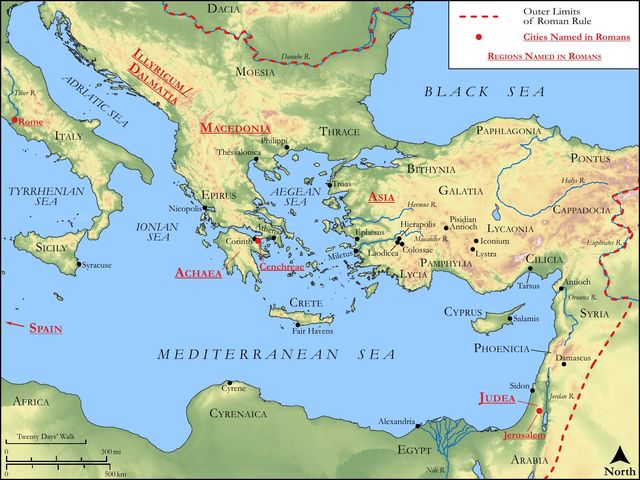
See on the biblical-era maps

Study this verse
Public-domain commentary
Matthew Henry
From his Commentary on the Whole Bible. Henry comments on passages, not single verses — this entry covers Romans 1:8–15. His three-level outline is real structure in the source text, so it is rendered as structure.
We may here observe,
I.His thanksgivings for them (Rom 1:8):
First, I thank my God. It is good to begin every thing with blessing God, to make that the alpha and omega of every song, in every thing to give thanks. - My God. He speaks this with delight and triumph. In all our thanksgivings, it is good for us to eye God as our God; this makes every mercy sweet, when we can say of God, "He is mine in covenant." - Through Jesus Christ. All our duties and performances are pleasing to God only through Jesus Christ, praises as well as prayers. - For you all. We must express our love to our friends, not only by praying for them, but by praising God for them. God must have the glory of all the comfort we have in our friends; for every creature is that to us, and no more, which God makes it to be. Many of these Romans Paul had no personal acquaintance with, and yet he could heartily rejoice in their gifts and graces. When some of the Roman Christians met him (Act 28:15), he thanked God for them, and took courage; but here his true catholic love extends itself further, and he thanks God for them all; not only for those among them that were his helpers in Christ, and that bestowed much labour upon him (of whom he speaks Rom 16:3, Rom 16:6), but for them all. - That your faith is spoken of. Paul travelled up and down from place to place, and, wherever he came, he heard great commendations of the Christians at Rome, which he mentions, not to make them proud, but to quicken them to answer the general character people gave of them, and the general expectation people had from them. The greater reputation a man hath for religion, the more careful he should be to preserve it, because a little folly spoils him that is in reputation, Ecc 10:1. - Throughout the whole world, that is, the Roman empire, into which the Roman Christians, upon Claudius's edict to banish all the Jews from Rome, were scattered abroad, but had now returned, and, it seems, left a very good report behind them, wherever they had been, in all the churches. There was this good effect of their sufferings: if they had not been persecuted, they had not been famous. This was indeed a good name, a name for good things with God and good people. As the elders of old, so these Romans, obtained a good report through faith, Heb 11:2. It is a desirable thing to be famous for faith. The faith of the Roman Christians came to be thus talked of, not only because it was excelling in itself, but because it was eminent and observable in its circumstances. Rome was a city upon a hill, every one took notice of what was done there. Thus those who have many eyes upon them have need to walk circumspectly, for what they do, good or bad, will be spoken of. The church of Rome was then a flourishing church; but since that time how is the gold become dim! How is the most fine gold changed! Rome is not what it was. She was then espoused a chaste virgin to Christ, and excelled in beauty; but she has since degenerated, dealt treacherously, and embraced the bosom of a stranger; so that (as that good old book, the Practice of Piety, makes appear in no less than twenty-six instances) even the epistle to the Romans is now an epistle against the Romans; little reason has she therefore to boast of her former credit.
II.His prayer for them, Rom 1:9.
Though a famous flourishing church, yet they had need to be prayed for; they had not yet attained. Paul mentions this as an instance of his love to them. One of the greatest kindnesses we can do our friends, and sometimes the only kindness that is in the power of our hands, is, by prayer to recommend them to the loving-kindness of God. From Paul's example here we may learn,
1.Constancy in prayer: Always without ceasing. He did himself observe the same rules he gave to others, Eph 6:18; Th1 5:17. Not that Paul did nothing else but pray, but he kept up stated times for the solemn performance of that duty, and those very frequent, and observed without fail.
2.Charity in prayer: I make mention of you. Though he had not particular acquaintance with them, nor interest in them, yet he prayed for them; not only for all saints in general, but he made express mention of them. It is not unfit sometimes to be express in our prayers for particular churches and places; not to inform God, but to affect ourselves. We are likely to have the most comfort in those friends that we pray most for. Concerning this he makes a solemn appeal to the searcher of hearts: For God is my witness. It was in a weighty matter, and in a thing known only to God and his own heart, that he used this asseveration. It is very comfortable to be able to call God to witness to our sincerity and constancy in the discharge of a duty. God is particularly a witness to our secret prayers, the matter of them, the manner of the performance; then our Father sees in secret, Mat 6:6. God, whom I serve with my spirit. Those that serve God with their spirits may, with a humble confidence, appeal to him; hypocrites who rest in bodily exercise cannot. His particular prayer, among many other petitions he put up for them, was that he might have an opportunity of paying them a visit (Rom 1:10): Making request, if by any means, etc. Whatever comfort we desire to find in any creature, we must have recourse to God for it by prayer; for our times are in his hand, and all our ways at his disposal. The expressions here used intimate that he was very desirous of such an opportunity: if by any means; that he had long and often been disappointed: now at length; and yet that he submitted it to the divine Providence: a prosperous journey by the will of God. As in our purposes, so in our desires, we must still remember to insert this, if the Lord will, Jam 4:15. Our journeys are prosperous or otherwise according to the will of God, comfortable or not as he pleases.
III.His great desire to see them, with the reasons of it, Rom 1:11-15.
He had heard so much of them that he had a great desire to be better acquainted with them. Fruitful Christians are as much the joy as barren professors are the grief of faithful ministers. Accordingly, he often purposed to come, but was let hitherto (Rom 1:13), for man purposeth, but God disposeth. He was hindered by other business that took him off, by his care of other churches, whose affairs were pressing; and Paul was for doing that first, not which was most pleasant (then he would have gone to Rome), but which was most needful - a good example to ministers, who must not consult their own inclinations so much as the necessity of their people's souls. Paul desired to visit these Romans,
1.That they might be edified (Rom 1:11): That I may impart unto you. He received, that he might communicate. Never were full breasts so desirous to be drawn out to the sucking infant as Paul's head and heart were to be imparting spiritual gifts, that is, preaching to them. A good sermon is a good gift, so much the better for being a spiritual gift. - To the end you may be established. Having commended their flourishing he here expresses his desire of their establishment, that as they grew upward in the branches they might grow downward in the root. The best saints, while they are in such a shaking world as this, have need to be more and more established; and spiritual gifts are of special use for our establishment.
2.That he might be comforted, Rom 1:12. What he heard of their flourishing in grace was so much a joy to him that it must needs be much more so to behold it. Paul could take comfort in the fruit of the labours of other ministers. - By the mutual faith both of you and me, that is, our mutual faithfulness and fidelity. It is very comfortable when there is a mutual confidence between minister and people, they confiding in him as a faithful minister, and he in them as a faithful people. Or, the mutual work of faith, which is love; they rejoiced in the expressions of one another's love, or communicating their faith one to another. It is very refreshing to Christians to compare notes about their spiritual concerns; thus are they sharpened, as iron sharpens iron. - That I might have some fruit, Rom 1:13. Their edification would be his advantage, it would be fruit abounding to a good account. Paul minded his work, as one that believed the more good he did the greater would his reward be.
3.That he might discharge his trust as the apostle of the Gentiles (Rom 1:14): I am a debtor.
(1.)His receivings made him a debtor; for they were talents he was entrusted with to trade for his Master's honour. We should think of this when we covet great things, that all our receivings put us in debt; we are but stewards of our Lord's goods.
(2.)His office made him a debtor. He was a debtor as he was an apostle; he was called and sent to work, and had engaged to mind it. Paul had improved his talent, and laboured in his work, and done as much good as ever any man did, and yet, in reflection upon it, he still writes himself debtor; for, when we have done all, we are but unprofitable servants. - Debtor to the Greeks, and to the barbarians, that is, as the following words explain it, to the wise and to the unwise. The Greeks fancied themselves to have the monopoly of wisdom, and looked upon all the rest of the world as barbarians, comparatively so; not cultivated with learning and arts as they were. Now Paul was a debtor to both, looked upon himself as obliged to do all the good he could both to the one and to the other. Accordingly, we find him paying his debt, both in his preaching and in his writing, doing good both to Greeks and barbarians, and suiting his discourse to the capacity of each. You may observe a difference between his sermon at Lystra among the plain Lycaonians (Act 14:15, etc.) and his sermon at Athens among the polite philosophers, Act 17:22, etc. He delivered both as debtor to each, giving to each their portion. Though a plain preacher, yet, as debtor to the wise, he speaks wisdom among those that are perfect, Co1 2:6. For these reasons he was ready, if he had an opportunity, to preach the gospel at Rome, Rom 1:15. Though a public place, though a perilous place, where Christianity met with a great deal of opposition, yet Paul was ready to run the risk at Rome, if called to it: I am ready - prothumon. It denotes a great readiness of mind, and that he was very forward to it. What he did was not for filthy lucre, but of a ready mind. It is an excellent thing to be ready to meet every opportunity of doing or getting good.
Historical interpretation
Historical reception
5 surviving comments on this verse. Each one is dated, so this reads as a timeline rather than a list.
Select a marker to jump to its quote. Markers stagger vertically where authors wrote within a few decades of each other.
In order to encourage brotherly love, Paul gives God, whom he serves, as a witness, to whom he prays on their behalf, not in keeping the law but in the gospel of his Son, i.e., not in that which Moses the servant handed down but in that which the most beloved Son taught. For the servant is as far from his Lord as the gospel is from the law, not because the law is wrong but because the gospel is better. Therefore Paul serves God in the gospel of his Son in order to show that it is God’s will that men should believe in Christ.“Whom I serve.” How? In my spirit, says Paul, not in the circumcision made with hands, nor in new moons, nor in the sabbath or the choice of foods, but in the spirit, that is, in the mind. Because God is a spirit, it is right that he should be served in spirit or in the mind, for whoever serves him in his mind serves him in faith. This is what the Lord said to the Samaritan woman in John. … He prays without ceasing for them, remembering them in his prayers in order to sow brotherly love among them; indeed, he makes this his desire for them. For who would not love someone when he hears that that person remembers him? For if they had willingly listened to the teaching brought to them in the name of Christ by those who were not sent, how much more would they want to listen to him who they knew was an apostle and whose words were accompanied by power!
Words these of an Apostle's bowels of affection, the showing forth this of fatherly concernment! And what is it which he says, and why does he call God to witness? He had to declare his feeling toward them. Since then he had not as yet ever seen them, he therefore called no man to witness, but Him Who entereth in the hearts. For since he was saying, "I love you," and as a token thereof alleged his praying continually for them, and wishing to come to them, and neither was this self-evident, he betakes himself to the trustworthy testimony. Will then any one of you be able to boast that he remembers, when praying at his house the entire body of the Church? I think not. But Paul drew near to God in behalf not of one city only, but of the whole world, and this not once, or twice, or thrice, but continually. But if the continually bearing any one about in one's memory would not happen without much love; to have any in one's prayers, and to have them there continually, think what great affection and friendship that implies. But when he says, "Whom I serve with my spirit in the Gospel of His Son," he shows us at once the grace of God, and also his own humble-mindedness; the grace of God because He entrusted to him so great a matter; but his own humility, because he imputes it all not to his own zeal, but to the assistance of the Spirit. But the addition of "the Gospel," shows the kind of ministry. For there are many and diverse modes of service. And as under kings all are ranged under one that beareth kingly power, and all have not to minister about the same thing, but to one belongeth the ministry of ruling armies and to another that of ordering cities and to another again that of keeping treasures in the storehouses, thus also in spiritual things, one serveth God and laboreth in believing and ordering his own life well, and another in undertaking the care of strangers, and another in taking in hand the patronship of them that be in need. As even during the Apostle's own time, they of Stephen's company served God in the guardianship of the widows, others in the teaching of the word, of whom also Paul was, serving in the preaching of the Gospel. And this was the fashion of his service: for it was to this that he was appointed. On this account, he not only calls God to witness, but also says what he was entrusted with, to show that having so great things put into his hands, he would not have called Him Who trusted them to him to witness what was false. And therewith he wished to make another point out also, viz. that he could not but have this love and care for them. For that they might not say "who art thou? and, from whence? that thou sayest that thou art anxious over a city so great, and most imperial," he shows that he must needs have this care, if at least the sort of service that was committed to him, was to declare the Gospel: for he that hath this put into his hands, must needs have continually upon his mind them that are to receive the word. And he shows another thing besides this by saying, "in my spirit;" that this service is much higher than either the Gentile or the Jewish. For the Gentile is both fleshly and in error, and the Jewish is true indeed, yet even this is fleshly. But that of the Church is the opposite of the Gentile, but more lofty than the Jewish by a great deal. For the mode of our service is not with sheep and oxen and smoke and fat, but by a spiritual soul, which Christ also shows in saying that "God is a Spirit, and they that worship Him must worship Him in spirit and in truth." (John iv. 24.)
"In the Gospel of His Son." Having said above that it was the Father's Gospel, here he says it is the Son's. So indifferent is it to say the Father's or the Son's! For he had learnt from that blessed voice that the things of the Father are the Son's, and the things of the Son are the Father's. For "all Mine are Thine, and Thine are Mine." (John xvii. 10.)
"That without ceasing I make mention of you always in my prayers." This is the part of genuine love, and he seems indeed to be saying some one thing, yet states four things even here. Both that he remembers, and that he does so continually, and that it is in his prayers, and that it is to ask great things for them.
Paul serves God with his whole heart and with a ready zeal.… He also presents a model of unceasing prayer.
Paul rightly says “with my spirit,” contrasting this with the carnal worship of the Jews in circumcision and sabbatarianism and other such sacrifices, none of which is either spiritual or true. Some have pointed out that the phrase is a simpler way of saying “with my mind and with my will.”
When Paul mentioned “his spirit,” he was not speaking about the person of the Spirit but about the grace of the Spirit which had been given to him to preach the gospel and by which, once he had been made worthy to be a coworker with God, he was enabled to carry out his work of mission.
Continue studying Romans 1:9 across the web’s major study libraries — every link below opens this exact verse, chapter, or book on the destination site.
Read & Compare
 BibleGatewayThis verse in more than 200 translations and 70 languages.
 Bible.comThe YouVersion reader — hundreds of translations, reading plans, and highlights.
 ESV.orgCrossway's official English Standard Version reader.
 NET BibleThe NET translation with 60,000+ translators' notes on every rendering decision.
 STEP BibleTyndale House's free study tool — original text, vocabulary, and scholarly resources.
 BibliaLogos Bible Software's free web reader.
 USCCBThe New American Bible (Revised Edition) with the U.S. bishops' study notes.
Commentaries
 BibleHub CommentariesDozens of classic commentaries on this verse, gathered on one page.
 StudyLightMore than 100 commentary sets — the largest collection on the web.
 BibleRefPlain-English commentary on what this verse means, verse by verse.
 Enduring WordDavid Guzik's free commentary on this chapter, widely used by Bible teachers.
 Bible Study ToolsVerse commentary alongside Greek and Hebrew study aids.
Original Language & Research
- BibleHub InterlinearThe verse word by word — original language, transliteration, and English.
- BibleHub LexiconEvery word's original-language definition and Strong's entry.
 Blue Letter BibleDeep-study tools — Strong's numbers, concordance, and word studies.
 CNTR CollationThe earliest Greek manuscripts of this verse, collated letter by letter.
Sermons, Hymns & Audio


TrulyRandomVerse is not affiliated with these sites and doesn’t control their content. They’re linked because they’re genuinely useful.
Summary
The Apostle Paul opens his letter to the Roman believers by invoking God as his personal witness, affirming the profound sincerity and spiritual depth of his service in the gospel of God's Son. This service, rooted in his innermost being, is concretely demonstrated by his unceasing and consistent intercessory prayers for them, underscoring his genuine pastoral affection and unwavering commitment to their spiritual well-being, even for a community he had not yet visited.
Context
ShowHideLiterary Context
Romans 1:9 is an integral part of Paul's opening salutation and thanksgiving in his letter to the church in Rome. Following his self-identification as an apostle called to preach the gospel (Romans 1:1-7), Paul expresses his gratitude for the Roman believers' widely known faith in Romans 1:8. Verse 9 then serves as the personal substantiation for this gratitude and his expressed desire to visit them (Romans 1:10-15). By calling God as his witness, Paul emphasizes the integrity and authenticity of his spiritual service and his constant remembrance of them in prayer, laying a foundation of trust and genuine affection before delving into the profound theological arguments of the letter. It establishes his pastoral heart before his doctrinal instruction.
Historical & Cultural Context
The city of Rome, the capital of the Roman Empire, was a melting pot of cultures, religions, and philosophical schools. The Christian community there was likely diverse, comprising both Jewish and Gentile believers, possibly organized into various house churches. Among the Greeks and Romans, the concept of a "witness" (Greek: martys) was crucial in legal and social contexts, lending credibility and weight to a statement. For Paul to call God as his witness was the highest form of oath and affirmation, demonstrating the absolute truthfulness and sincerity of his claim. Furthermore, the practice of intercessory prayer was common in both Jewish and early Christian traditions, reflecting a communal bond and spiritual solidarity. Paul's emphasis on "serving with his spirit" would resonate with a culture that valued both external religious observance and internal devotion, distinguishing his service from mere ritual or obligation.
Key Themes
ShowHideRomans 1:9 contributes significantly to several overarching themes in Romans and Paul's broader theology. It highlights Paul's Apostolic Authenticity and Integrity, as he appeals to God Himself to validate the truth of his claims and the sincerity of his ministry. His service is not merely external but deeply internal, "with his spirit," underscoring the theme of Holistic Devotion and Spiritual Worship (compare Romans 12:1). The verse also powerfully affirms the Centrality of the Gospel in Paul's life and ministry, as his service is explicitly "in the gospel of his Son." This foundational truth is elaborated throughout the letter, culminating in his declaration of the gospel as the power of God for salvation in Romans 1:16-17. Finally, Paul's "without ceasing" prayer for the Romans underscores the theme of Persistent Intercessory Prayer and Pastoral Care, demonstrating the vital role of prayer in fostering spiritual connection and support within the body of Christ, a theme he reiterates in passages like Ephesians 1:16 and Philippians 1:3-4.
Exposition and Analysis
ShowHideKey Word Analysis
ShowHideThis word signifies one who testifies, either judicially or figuratively. By calling God his "witness," Paul is making the strongest possible affirmation of the truthfulness and sincerity of his statement. It implies that God, being omniscient, knows the innermost thoughts and intentions of Paul's heart, thereby validating the authenticity of his service and prayers. This term is also the root from which the English word "martyr" derives, highlighting the potential for suffering or death in bearing testimony to the truth.
This verb means "to minister (to God)," specifically to "render religious homage" or perform sacred service. It implies a worshipful and devoted act, distinguishing Paul's work in the gospel from a mere secular occupation. His ministry is not just a job but an act of profound adoration and devotion directed towards God, indicating that his apostolic work is an expression of his personal worship.
In this context, "spirit" refers to the innermost part of Paul's being, his rational soul, or the vital principle that animates him. It signifies the deepest level of his commitment, indicating that his service is not superficial or external but emanates from his core identity and spiritual vitality. This emphasizes the internal, heartfelt nature of his devotion, empowered by the Holy Spirit, in contrast to mere outward religious performance.
Verse Breakdown
ShowHide"For God is my witness"
Paul begins with a solemn appeal to God's omniscience, establishing the absolute truthfulness and sincerity of his subsequent statements. This is the strongest form of affirmation, indicating that his claims are not merely human assertions but divinely attested realities. It underscores his integrity as an apostle.
"whom I serve with my spirit"
This clause clarifies the nature of Paul's relationship with God and the character of his ministry. His service (latreúō) is not just external activity but a deep, internal devotion originating from his innermost being, his "spirit" (pneûma). This emphasizes a worshipful, heartfelt, and authentic commitment to God.
"in the gospel of his Son"
This phrase defines the specific sphere and content of Paul's service. His entire life and ministry are centered on and dedicated to the "good news" (gospel) concerning Jesus Christ, God's Son. The gospel is not merely a message he preaches but the very essence and driving force of his existence and service.
"that without ceasing I make mention of you always in my prayers;"
This final clause provides the concrete evidence for Paul's sincerity and spiritual service. His constant and consistent remembrance of the Roman believers in his prayers serves as tangible proof of his genuine affection and pastoral concern for them. The repetition of "without ceasing" and "always" emphasizes the diligence and persistence of his intercession.
Literary Devices
ShowHidePaul employs several significant literary devices in Romans 1:9. The most prominent is Apostrophe, where he directly addresses God ("For God is my witness") to underscore the veracity of his statement. This direct appeal to a divine authority lends immense weight and solemnity to his words, establishing his credibility from the outset. He also uses Hyperbole with the phrases "without ceasing" (adialeíptōs) and "always" (pántote) when describing his prayers. While not literally meaning every single moment, these terms convey the consistent, diligent, and habitual nature of his intercession, emphasizing its unwavering regularity and deep commitment. Furthermore, the verse demonstrates Emphasis through repetition and strong affirmation. The entire clause serves to emphasize Paul's profound pastoral care and the authentic, spiritual nature of his ministry, ensuring the Roman believers understand the depth of his affection and the integrity of his apostolic calling.
Theological and Thematic Connections
ShowHideRomans 1:9 powerfully illustrates the theological truth that genuine Christian ministry is rooted in sincere devotion to God and expressed through selfless service in the gospel. Paul's appeal to God as a witness highlights divine omniscience and the call for believers to live lives of transparent integrity before God and humanity. His "service with his spirit" points to the New Covenant reality where worship is not merely ritualistic but a heartfelt, internal offering, empowered by the Holy Spirit. This verse also underscores the essential role of intercessory prayer as a tangible expression of Christian love and solidarity, transcending geographical distance. It reminds us that our spiritual service and prayer life are intimately connected to the advancement of the gospel and the edification of the body of Christ.
Reflection and Application
ShowHideRomans 1:9 offers a profound model for every believer's walk and ministry. Paul's willingness to call God as his witness challenges us to examine the authenticity and integrity of our own faith and service. Is our devotion merely external, or does it truly stem from our "spirit," our innermost being? This verse reminds us that all genuine service to God is an act of worship, centered on the good news of Jesus Christ. It calls us to consider the gospel not just as a message we believe, but as the very framework and purpose of our lives. Furthermore, Paul's consistent and "unceasing" prayer for those he had not yet met serves as a powerful call to diligent intercession for fellow believers, both near and far. In a world often characterized by superficial connections, Paul's example encourages us to cultivate deep, spiritual bonds through prayer, upholding one another before the throne of grace. This verse invites us to reflect on the sincerity of our hearts, the focus of our service, and the consistency of our prayer lives, striving for a walk that truly honors God and builds up His church.
Questions for Reflection
ShowHideFAQ
ShowHideWhy does Paul call God his witness in this verse?
ShowHidePaul calls God his witness to emphatically affirm the truthfulness and sincerity of his statements, particularly regarding his constant prayer for the Roman believers and the deep, spiritual nature of his service. Among the Greeks and Romans, invoking a deity as a witness was the highest form of oath or affirmation, signifying absolute veracity. By doing so, Paul underscores his integrity and the genuine, heartfelt nature of his apostolic ministry, appealing to God's omniscience as the ultimate validator of his inner disposition and outward actions. It establishes a foundation of trust between him and the Roman church.
What does "serve with my spirit in the gospel of his Son" mean?
ShowHideThis phrase highlights the profound depth and focus of Paul's ministry. "Serve" (Greek: latreúō) refers to religious service or worship, indicating that Paul's work is not merely a job but an act of devotion and homage to God. "With my spirit" signifies that this service originates from his innermost being, his vital core, rather than being a superficial or external duty. It implies a heartfelt, authentic, and Spirit-empowered commitment. The phrase "in the gospel of his Son" specifies that this entire spiritual service is centered on and directed towards the good news of Jesus Christ. Paul's life and ministry are wholly consumed by and dedicated to proclaiming and living out the truth of the gospel, which is the message about God's Son. It's a holistic, worshipful engagement with the divine mission.
How can one pray "without ceasing" or "always" as Paul claims to do?
ShowHidePaul's use of "without ceasing" (adialeíptōs) and "always" (pántote) is not meant to be taken literally as continuous, unbroken vocal prayer, which would be humanly impossible. Instead, it signifies a consistent, habitual, and persistent attitude of prayer. It means that prayer is a regular, integral part of one's life, frequently engaged in, and that one maintains a constant awareness of God's presence and a readiness to communicate with Him. It implies that the Roman believers were continually on Paul's mind and heart, leading him to regularly bring them before God in intercession. This concept is echoed in other Pauline exhortations like 1 Thessalonians 5:17, which encourages a lifestyle of prayerfulness and dependence on God.
Christ-Centered Fulfillment
ShowHideRomans 1:9, while a statement about Paul's personal ministry, finds its ultimate significance and fulfillment in Christ. Paul's "service with his spirit in the gospel of his Son" is a direct reflection of Christ's own perfect service and obedience to the Father. Jesus Himself came not to be served, but "to serve, and to give his life as a ransom for many" (Mark 10:45). His entire earthly life was an act of worshipful service, culminating in His sacrificial death on the cross, the very heart of the "gospel of his Son" that Paul proclaimed (Romans 5:8). Paul's unceasing prayers for the believers mirror Christ's own high-priestly intercession for His people, as He "always lives to intercede for them" before the Father (Hebrews 7:25). Thus, Paul's genuine, Spirit-led ministry and persistent intercession are not merely human endeavors, but a participation in the ongoing redemptive work of Christ, who is the ultimate "witness" to God's truth and the very content of the gospel that transforms lives (Revelation 1:5). Every aspect of Paul's devotion to the gospel and his care for the church flows from and points back to the person and work of Jesus Christ, the Son of God.