


Romans 1:10
- δεόμενοςdeomenosimploringG1189V-PNP-NSMVerb Present Middle Or Passive Deponent Participle Nominative Singular Masculine
- εἴeiifG1487CONDConjunction
- πωςpōssomehowG4458PRTParticle or Disjunctive
- ἤδηēdēnowG2235ADVAdverb
- ποτὲpoteat lastG4218PRTParticle or Disjunctive
- εὐοδωθήσομαιeuodōthēsomaiI will succeedG2137V-FPI-1SVerb Future Passive Indicative 1st Singular
- ἐνenbyG1722PREPPreposition
- τῷtōtheG3588T-DSNDefinite article Dative Singular Neuter
- θελήματιthelēmatiwillG2307N-DSNNoun Dative Singular Neuter
- τοῦtou<the>G3588T-GSMDefinite article Genitive Singular Masculine
- θεοῦtheouof GodG2316N-GSM-TNoun Genitive Singular Masculine Title
- ἐλθεῖνeltheinto comeG2064V-2AANVerb 2nd Aorist Active Infinitive
- πρὸςprostoG4314PREPPreposition
- ὑμᾶς·humasyouG4771P-2APPersonal pronoun Accusative 2nd Plural
English is a literal word-by-word gloss of the Greek, not the KJV's wording. Why?
This is the original text the KJV's translators worked from — each Greek word with its own literal English meaning in this verse, prepared by scholars at Tyndale House, Cambridge. The KJV translates whole sentences, not word by word, so its wording differs: one Greek word can become several English words, and the KJV may choose “charity” where the gloss reads “love”. Both are faithful — they answer different questions. For the KJV's own rendering, switch to the KJV text.
Details
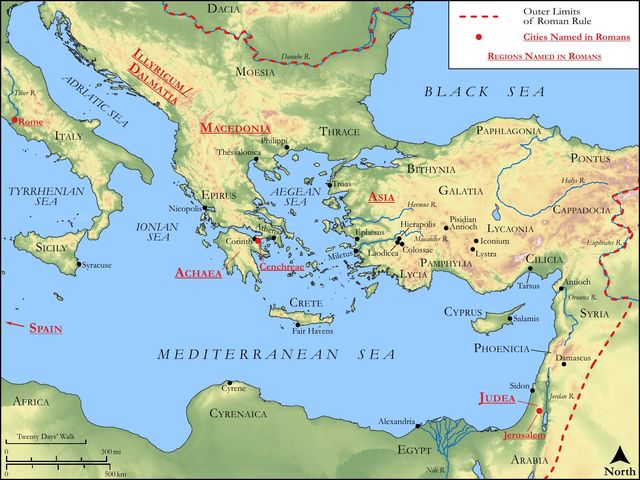
See on the biblical-era map

Study this verse
Public-domain commentary
Matthew Henry
From his Commentary on the Whole Bible. Henry comments on passages, not single verses — this entry covers Romans 1:8–15. His three-level outline is real structure in the source text, so it is rendered as structure.
We may here observe,
I.His thanksgivings for them (Rom 1:8):
First, I thank my God. It is good to begin every thing with blessing God, to make that the alpha and omega of every song, in every thing to give thanks. - My God. He speaks this with delight and triumph. In all our thanksgivings, it is good for us to eye God as our God; this makes every mercy sweet, when we can say of God, "He is mine in covenant." - Through Jesus Christ. All our duties and performances are pleasing to God only through Jesus Christ, praises as well as prayers. - For you all. We must express our love to our friends, not only by praying for them, but by praising God for them. God must have the glory of all the comfort we have in our friends; for every creature is that to us, and no more, which God makes it to be. Many of these Romans Paul had no personal acquaintance with, and yet he could heartily rejoice in their gifts and graces. When some of the Roman Christians met him (Act 28:15), he thanked God for them, and took courage; but here his true catholic love extends itself further, and he thanks God for them all; not only for those among them that were his helpers in Christ, and that bestowed much labour upon him (of whom he speaks Rom 16:3, Rom 16:6), but for them all. - That your faith is spoken of. Paul travelled up and down from place to place, and, wherever he came, he heard great commendations of the Christians at Rome, which he mentions, not to make them proud, but to quicken them to answer the general character people gave of them, and the general expectation people had from them. The greater reputation a man hath for religion, the more careful he should be to preserve it, because a little folly spoils him that is in reputation, Ecc 10:1. - Throughout the whole world, that is, the Roman empire, into which the Roman Christians, upon Claudius's edict to banish all the Jews from Rome, were scattered abroad, but had now returned, and, it seems, left a very good report behind them, wherever they had been, in all the churches. There was this good effect of their sufferings: if they had not been persecuted, they had not been famous. This was indeed a good name, a name for good things with God and good people. As the elders of old, so these Romans, obtained a good report through faith, Heb 11:2. It is a desirable thing to be famous for faith. The faith of the Roman Christians came to be thus talked of, not only because it was excelling in itself, but because it was eminent and observable in its circumstances. Rome was a city upon a hill, every one took notice of what was done there. Thus those who have many eyes upon them have need to walk circumspectly, for what they do, good or bad, will be spoken of. The church of Rome was then a flourishing church; but since that time how is the gold become dim! How is the most fine gold changed! Rome is not what it was. She was then espoused a chaste virgin to Christ, and excelled in beauty; but she has since degenerated, dealt treacherously, and embraced the bosom of a stranger; so that (as that good old book, the Practice of Piety, makes appear in no less than twenty-six instances) even the epistle to the Romans is now an epistle against the Romans; little reason has she therefore to boast of her former credit.
II.His prayer for them, Rom 1:9.
Though a famous flourishing church, yet they had need to be prayed for; they had not yet attained. Paul mentions this as an instance of his love to them. One of the greatest kindnesses we can do our friends, and sometimes the only kindness that is in the power of our hands, is, by prayer to recommend them to the loving-kindness of God. From Paul's example here we may learn,
1.Constancy in prayer: Always without ceasing. He did himself observe the same rules he gave to others, Eph 6:18; Th1 5:17. Not that Paul did nothing else but pray, but he kept up stated times for the solemn performance of that duty, and those very frequent, and observed without fail.
2.Charity in prayer: I make mention of you. Though he had not particular acquaintance with them, nor interest in them, yet he prayed for them; not only for all saints in general, but he made express mention of them. It is not unfit sometimes to be express in our prayers for particular churches and places; not to inform God, but to affect ourselves. We are likely to have the most comfort in those friends that we pray most for. Concerning this he makes a solemn appeal to the searcher of hearts: For God is my witness. It was in a weighty matter, and in a thing known only to God and his own heart, that he used this asseveration. It is very comfortable to be able to call God to witness to our sincerity and constancy in the discharge of a duty. God is particularly a witness to our secret prayers, the matter of them, the manner of the performance; then our Father sees in secret, Mat 6:6. God, whom I serve with my spirit. Those that serve God with their spirits may, with a humble confidence, appeal to him; hypocrites who rest in bodily exercise cannot. His particular prayer, among many other petitions he put up for them, was that he might have an opportunity of paying them a visit (Rom 1:10): Making request, if by any means, etc. Whatever comfort we desire to find in any creature, we must have recourse to God for it by prayer; for our times are in his hand, and all our ways at his disposal. The expressions here used intimate that he was very desirous of such an opportunity: if by any means; that he had long and often been disappointed: now at length; and yet that he submitted it to the divine Providence: a prosperous journey by the will of God. As in our purposes, so in our desires, we must still remember to insert this, if the Lord will, Jam 4:15. Our journeys are prosperous or otherwise according to the will of God, comfortable or not as he pleases.
III.His great desire to see them, with the reasons of it, Rom 1:11-15.
He had heard so much of them that he had a great desire to be better acquainted with them. Fruitful Christians are as much the joy as barren professors are the grief of faithful ministers. Accordingly, he often purposed to come, but was let hitherto (Rom 1:13), for man purposeth, but God disposeth. He was hindered by other business that took him off, by his care of other churches, whose affairs were pressing; and Paul was for doing that first, not which was most pleasant (then he would have gone to Rome), but which was most needful - a good example to ministers, who must not consult their own inclinations so much as the necessity of their people's souls. Paul desired to visit these Romans,
1.That they might be edified (Rom 1:11): That I may impart unto you. He received, that he might communicate. Never were full breasts so desirous to be drawn out to the sucking infant as Paul's head and heart were to be imparting spiritual gifts, that is, preaching to them. A good sermon is a good gift, so much the better for being a spiritual gift. - To the end you may be established. Having commended their flourishing he here expresses his desire of their establishment, that as they grew upward in the branches they might grow downward in the root. The best saints, while they are in such a shaking world as this, have need to be more and more established; and spiritual gifts are of special use for our establishment.
2.That he might be comforted, Rom 1:12. What he heard of their flourishing in grace was so much a joy to him that it must needs be much more so to behold it. Paul could take comfort in the fruit of the labours of other ministers. - By the mutual faith both of you and me, that is, our mutual faithfulness and fidelity. It is very comfortable when there is a mutual confidence between minister and people, they confiding in him as a faithful minister, and he in them as a faithful people. Or, the mutual work of faith, which is love; they rejoiced in the expressions of one another's love, or communicating their faith one to another. It is very refreshing to Christians to compare notes about their spiritual concerns; thus are they sharpened, as iron sharpens iron. - That I might have some fruit, Rom 1:13. Their edification would be his advantage, it would be fruit abounding to a good account. Paul minded his work, as one that believed the more good he did the greater would his reward be.
3.That he might discharge his trust as the apostle of the Gentiles (Rom 1:14): I am a debtor.
(1.)His receivings made him a debtor; for they were talents he was entrusted with to trade for his Master's honour. We should think of this when we covet great things, that all our receivings put us in debt; we are but stewards of our Lord's goods.
(2.)His office made him a debtor. He was a debtor as he was an apostle; he was called and sent to work, and had engaged to mind it. Paul had improved his talent, and laboured in his work, and done as much good as ever any man did, and yet, in reflection upon it, he still writes himself debtor; for, when we have done all, we are but unprofitable servants. - Debtor to the Greeks, and to the barbarians, that is, as the following words explain it, to the wise and to the unwise. The Greeks fancied themselves to have the monopoly of wisdom, and looked upon all the rest of the world as barbarians, comparatively so; not cultivated with learning and arts as they were. Now Paul was a debtor to both, looked upon himself as obliged to do all the good he could both to the one and to the other. Accordingly, we find him paying his debt, both in his preaching and in his writing, doing good both to Greeks and barbarians, and suiting his discourse to the capacity of each. You may observe a difference between his sermon at Lystra among the plain Lycaonians (Act 14:15, etc.) and his sermon at Athens among the polite philosophers, Act 17:22, etc. He delivered both as debtor to each, giving to each their portion. Though a plain preacher, yet, as debtor to the wise, he speaks wisdom among those that are perfect, Co1 2:6. For these reasons he was ready, if he had an opportunity, to preach the gospel at Rome, Rom 1:15. Though a public place, though a perilous place, where Christianity met with a great deal of opposition, yet Paul was ready to run the risk at Rome, if called to it: I am ready - prothumon. It denotes a great readiness of mind, and that he was very forward to it. What he did was not for filthy lucre, but of a ready mind. It is an excellent thing to be ready to meet every opportunity of doing or getting good.
Historical interpretation
Two Centuries of Reception
5 surviving comments on this verse. Each one is dated, so this reads as a timeline rather than a list.
Select a marker to jump to its quote. Markers stagger vertically where authors wrote within a few decades of each other.
When Paul says that he is praying that somehow and at some point he may have a successful journey, so that in the will of God he might come to Rome, it must be remembered that since the apostle of God is dedicated to a holy work, that is, to the work of the gospel, he is waiting until by his prayers not only may he have a journey which is successful but also that it might be successful according to the will of God. How much more therefore ought we, whose work and worth are so much less important, to ask God for success on our journey when we have some business to attend to!Nevertheless, I think that the apostle also wants us to understand that the success of a journey does not always mean that the journey is according to God’s will. For Balaam had a successful journey when he went to Balak in order to curse the people of Israel, but this success was not due to God’s will. And many people have great success in worldly affairs and rejoice in their prosperity, but such prosperity is not of God’s will unless the purpose of our journey is to do his will, as the apostle says here.
Paul here indicates the point of his prayer for the Romans. He says that he asks God that he might come to Rome in order to encourage them with the will of God, whose gift he preaches. Then when he arrives and is present among them, if something has to be done, it may be done with the will of God. Therefore he prays that for whatever reason an opportunity may be given to him to come to the city, since he was already busy preaching to others, reckoning it a successful journey if he might come by God’s will, because the will of God has prepared the way. A successful journey is not to endure the labor of traveling in vain. He asks that God will fill them by calling them to his grace. He speaks with eagerness of mind, for he desires their response, knowing that it will be to their mutual advantage…. For the apostle’s fruit is richer if it wins many. For since the joy is greater if the powerful people of this world are converted to Christ, because they are so much more serious enemies, even more are converted thereby, and the fruit of the apostle is richer if he can win many. Thus by God’s will the opportunity was given that Paul was arrested and appealed to Caesar, and was sent for a different reason to the city of Rome, by the will of God and in fulfillment of the desire of his will. For when Paul was shipwrecked, God appeared to him and said: “Do not be afraid, Paul. For as you have borne witness to me at Jerusalem, so also will you do at Rome.” Commentary on Paul’s Epistles.
You see him painfully desiring to see them, and yet not enduring to see them contrary to what seemed good unto God, but having his longing mingled with the fear of God. For he loved them, and was eager to come to them. Yet he did not, because he loved them, desire to see them, contrary to what seemed good unto God. This is true love not as we love who err on both sides from the laws of love: for either we love no one, or if we ever do love, we love contrary to what seemeth good unto God, acting in both against the Divine law. And if these things be grievous when spoken of, they are more grievous when done. And how do we love contrary to what seems good to God? (you will say.) When we neglect Christ pining with hunger, and provide our children and friends and relations above their needs. Or rather what need to carry the subject further. For if any one will examine his own conscience, he will find that this takes place in many things. But such was not that blessed person, but he knew both how to love and to love as he ought, and as was fitting, and though exceeding all men in loving, he transgressed not the measures of love. See then two things thrive extremely in him, fear of God, and also longing towards the Romans. For to be praying continually, and not to desist when he obtained not, shows exceeding love. But while loving, thus to continue yielding to the will of God, shows intense reverence. In another place, however, having "thrice besought the Lord" (2 Cor. xii. 8), he not only did not receive, but on the contrary, when he did not receive, he was very thankful for not having been heard. So, in all things did he look to God. But here he received, though not when he asked, but after delay, and neither hereat was he discontented. And these things I mention that we may not repine at not being heard, or at being heard slowly. For we are not better than Paul, who confesses his thankfulness for both, and with good ground. For when he had once given himself up to the all-governing Hand, and put himself with as much subjection under it, as clay under the potter, he followed wheresoever God led. Having then said that he desired to see them, he mentioned also the cause of his desire; and what is it?
Paul does not find the way propitious unless the will of God, who knows all things, has directed him to a place where he might reap some fruit. For example, we read in Acts that, although he wanted to go to one place, he was directed to another.
Paul does not simply say that he wants to come to Rome but adds that he wants to come in God’s will. For when the salvation of so many people was at stake, St. Paul left nothing unclear but acknowledged God’s will in his prayer, for it is only by God’s permission that we are worthy to deal with material things and to make choices. Do we not commit everything we have to the divine will on which we depend?
Continue studying Romans 1:10 across the web’s major study libraries — every link below opens this exact verse, chapter, or book on the destination site.
Read & Compare
 BibleGatewayThis verse in more than 200 translations and 70 languages.
 Bible.comThe YouVersion reader — hundreds of translations, reading plans, and highlights.
 ESV.orgCrossway's official English Standard Version reader.
 NET BibleThe NET translation with 60,000+ translators' notes on every rendering decision.
 STEP BibleTyndale House's free study tool — original text, vocabulary, and scholarly resources.
 BibliaLogos Bible Software's free web reader.
 USCCBThe New American Bible (Revised Edition) with the U.S. bishops' study notes.
Commentaries
 BibleHub CommentariesDozens of classic commentaries on this verse, gathered on one page.
 StudyLightMore than 100 commentary sets — the largest collection on the web.
 BibleRefPlain-English commentary on what this verse means, verse by verse.
 Enduring WordDavid Guzik's free commentary on this chapter, widely used by Bible teachers.
 Bible Study ToolsVerse commentary alongside Greek and Hebrew study aids.
Original Language & Research
- BibleHub InterlinearThe verse word by word — original language, transliteration, and English.
- BibleHub LexiconEvery word's original-language definition and Strong's entry.
 Blue Letter BibleDeep-study tools — Strong's numbers, concordance, and word studies.
 CNTR CollationThe earliest Greek manuscripts of this verse, collated letter by letter.
Sermons, Hymns & Audio


TrulyRandomVerse is not affiliated with these sites and doesn’t control their content. They’re linked because they’re genuinely useful.
Summary
Romans 1:10 reveals the apostle Paul's deep and persistent desire to visit the believers in Rome, a longing he consistently brought before God in prayer. This verse underscores Paul's commitment to apostolic ministry and his profound dependence on divine sovereignty, demonstrating that even his most earnest personal and missional aspirations were entirely submitted to the will and timing of God for their fulfillment.
Context
ShowHideLiterary Context
Romans 1:10 is nestled within the salutation and introductory remarks of Paul's magnum opus, the Epistle to the Romans. Having introduced himself as a "servant of Jesus Christ, called to be an apostle" in Romans 1:1, Paul immediately expresses his profound gratitude for the Roman believers' faith, which is "spoken of throughout the whole world" (Romans 1:8). He then assures them of his constant remembrance and intercession for them in his prayers (Romans 1:9), before detailing the specific request of his prayer in verse 10: a divinely ordained journey to Rome. This sets the stage for Paul's explanation of his apostolic mission and the theological exposition that follows in the letter.
Historical & Cultural Context
Paul wrote this letter from Corinth, likely around AD 57, as he prepared to deliver the collection for the saints in Jerusalem. Rome, as the capital of the vast Roman Empire, held immense strategic importance for Paul's missionary vision, which aimed to preach the gospel where Christ had not yet been named (Romans 15:20). Unlike many churches Paul founded, the Roman church was not established by him, but likely grew organically from Jewish converts returning from Pentecost (Acts 2:10) and other early Christian evangelism. Travel in the ancient world was arduous and often dangerous, making Paul's prayer for a "prosperous journey" a practical necessity for his ministry. His desire to visit Rome was not merely social but deeply missional, reflecting the common ancient practice of apostles or teachers visiting churches to strengthen them and impart spiritual gifts.
Key Themes
ShowHideThis verse highlights several key themes central to Paul's theology and the broader New Testament. Firstly, it underscores the theme of earnest prayer and persistent desire, showing that Paul's apostolic ambition was not self-driven but prayerfully submitted to God. Secondly, the phrase "by the will of God" emphasizes the crucial theme of divine sovereignty and human submission, a principle Paul consistently lived by and taught, echoing the sentiment found in James 4:15. Paul understood that his plans, however noble, were contingent upon God's perfect timing and purpose. Thirdly, the desire for a "prosperous journey" speaks to the theme of God's providential guidance in ministry, where success is defined not by human convenience but by alignment with divine purpose and the advancement of the gospel. This desire to "come unto you" also foreshadows the theme of mutual encouragement and spiritual impartation, which Paul explicitly states as a reason for his visit in Romans 1:11-12.
Exposition and Analysis
ShowHideKey Word Analysis
ShowHideThis word, derived from a root meaning "to bind oneself," signifies a fervent, earnest petition or supplication, often implying a sense of need or urgency. It's more than a casual wish; it's a heartfelt plea directed to God, indicating the depth of Paul's longing and the seriousness with which he presented his desire to the Lord.
Literally meaning "to be well-pathed" or "to have a good road," this term implies success or prosperity in the sense of reaching a desired goal or having a favorable outcome. For Paul, a "prosperous journey" was not necessarily one free from hardship, but one that would successfully bring him to Rome according to God's plan, enabling him to fulfill his ministry there. It denotes divine enablement and success in the endeavor.
This refers to a determination, purpose, or decree, encompassing both God's active choice and His inclination. In this context, it highlights the ultimate authority and direction of God in all matters, especially Paul's travel and ministry plans. Paul's desire was entirely contingent upon God's sovereign and perfect plan, demonstrating his complete submission to divine prerogative.
Verse Breakdown
ShowHide"Making request"
This phrase immediately establishes the context of prayer. Paul is not merely expressing a personal wish but is actively and persistently bringing this desire before God. The continuous nature of his "making request" (present participle in Greek) emphasizes his ongoing intercession.
"if by any means now at length I might have a prosperous journey"
This clause reveals Paul's humble submission and patient endurance. "If by any means" (Greek: ei pōs) expresses a hopeful uncertainty, acknowledging that the timing and method of his journey were entirely in God's hands. "Now at length" (Greek: ēdē poté) suggests a long-cherished desire that had been delayed, indicating Paul's persistent hope despite past obstacles. He prays for a "prosperous journey," not necessarily one without difficulty, but one that would achieve its divine purpose of bringing him to Rome.
"by the will of God"
This is the pivotal phrase of the verse, serving as the ultimate qualifier for Paul's request. It underscores that his plans and desires, however fervent or long-standing, were completely subordinate to God's sovereign will (thélēma). Paul understood that true prosperity and success in ministry are found only in alignment with God's perfect plan and timing.
"to come unto you"
This states the specific object of Paul's prayer and desire. His ultimate goal was to be physically present with the Roman believers, as further elaborated in the subsequent verses, for mutual encouragement and the impartation of spiritual gifts.
Literary Devices
ShowHideRomans 1:10 prominently features Prayer as a motif, highlighting Paul's consistent reliance on divine intervention for his apostolic endeavors. The phrase "Making request" establishes this immediately, portraying Paul as a man deeply committed to intercessory prayer. There is also a subtle Irony present when read with hindsight: Paul's "prosperous journey" to Rome eventually occurs, but not as a free traveler but as a prisoner, fulfilling God's will in an unexpected way (Acts 27-28). This demonstrates that God's "prosperous journey" may look different from human expectations, yet still perfectly accomplishes His purposes. Furthermore, the verse employs Emphasis through repetition of the theme of God's will, ensuring the reader understands that divine sovereignty governs all of Paul's ministry and aspirations.
Theological and Thematic Connections
ShowHideRomans 1:10 offers profound theological insights into the nature of prayer, divine sovereignty, and apostolic ministry. It teaches us that while we are to earnestly and persistently bring our desires before God, our ultimate posture must be one of humble submission to His perfect will. Paul's example demonstrates that true spiritual ambition is not about achieving personal goals, but about aligning one's life and ministry with God's overarching purposes. This submission does not negate fervent prayer but rather elevates it, transforming our petitions into acts of trust that God's timing and methods are superior to our own. The "prosperous journey" is not defined by ease or human success, but by its alignment with God's intended outcome, even if that outcome involves hardship or unexpected paths.
Reflection and Application
ShowHideRomans 1:10 provides a powerful template for how believers today should approach their own plans, desires, and aspirations. It calls us to cultivate a life of earnest and persistent prayer, bringing our hopes and intentions before the Lord with sincerity and regularity. However, it equally challenges us to hold these desires with open hands, always qualifying them with a profound submission to God's sovereign will. This means trusting that God's timing and methods are perfect, even when they differ from our expectations or involve delays and unexpected detours. A "prosperous journey" in God's economy is not necessarily one that is easy or aligns with our immediate comforts, but one that ultimately fulfills His divine purpose for our lives and for the advancement of His kingdom. Paul's eventual arrival in Rome as a prisoner, rather than a free missionary, serves as a poignant reminder that God's path to "prosperity" often looks different from our own, yet it is always the most effective for His glory.
Questions for Reflection
ShowHideFAQ
ShowHideWhy was Paul so keen to visit the Roman believers, and why did it take so long?
ShowHidePaul's desire to visit Rome was multifaceted and deeply rooted in his apostolic calling. As the apostle to the Gentiles, he saw Rome, the capital of the empire, as a strategic hub for the spread of the gospel to the "ends of the earth" (Romans 15:24). He longed to impart some spiritual gift to them, to strengthen their faith, and to be mutually encouraged by their faith (Romans 1:11-12). The delay in his visit was likely due to his commitment to ministering in regions where the gospel had not yet been proclaimed (Romans 15:20), as well as divine providence. God had other plans for Paul's immediate ministry, and his eventual arrival in Rome, though delayed and as a prisoner (Acts 28:16), ultimately served His greater purpose for the gospel's advancement even within Caesar's household (Philippians 4:22).
Christ-Centered Fulfillment
ShowHideRomans 1:10, with its emphasis on Paul's earnest prayer and submission to the "will of God" for his journey, finds its ultimate fulfillment and model in the person and work of Jesus Christ. Christ Himself perfectly embodied the principle of complete submission to the Father's will, even when it led to immense suffering and a path contrary to human expectation. In the Garden of Gethsemane, Jesus prayed, "Father, if you are willing, remove this cup from me; nevertheless, not my will, but yours, be done" (Luke 22:42). This profound act of obedience, even unto death on a cross, was the "prosperous journey" that secured salvation for humanity (Philippians 2:5-8). Paul's desire to impart spiritual gifts and to be mutually encouraged by the Roman believers also reflects the Christ-centered reality of the church as His body, where each member contributes to the growth and edification of the whole, under Christ, the head (Ephesians 4:11-16). Thus, Paul's prayer for a divinely guided journey to Rome, even with its unexpected outcome of imprisonment, ultimately served the sovereign will of God in advancing the gospel of Christ, demonstrating that Christ's redemptive plan is fulfilled through the obedient, Spirit-led journeys of His servants.