


1 Thessalonians 3:10
- νυκτὸςnuktosby nightG3571N-GSFNoun Genitive Singular Feminine
- καὶkaiandG2532CONJConjunction
- ἡμέραςhēmerasdayG2250N-GSFNoun Genitive Singular Feminine
- ὑπερεκπερισσοῦhuperekperissousuper overexcessivelyG1537PREP + G1537=PREP + G4057=ADV
- δεόμενοιdeomenoiimploringG1189V-PNP-NPMVerb Present Middle Or Passive Deponent Participle Nominative Plural Masculine
- εἰςeisfor [us]G1519PREPPreposition
- τὸto<the>G3588T-ASNDefinite article Accusative Singular Neuter
- ἰδεῖνideinto seeG1492V-2AANVerb 2nd Aorist Active Infinitive
- ὑμῶνhumōnyourG4771P-2GPPersonal pronoun Genitive 2nd Plural
- τὸto<the>G3588T-ASNDefinite article Accusative Singular Neuter
- πρόσωπονprosōponfaceG4383N-ASNNoun Accusative Singular Neuter
- καὶkaiandG2532CONJConjunction
- καταρτίσαιkatartisaito supplyG2675V-AANVerb Aorist Active Infinitive
- τὰtathe [things]G3588T-APNDefinite article Accusative Plural Neuter
- ὑστερήματαhusterēmatalackingG5303N-APNNoun Accusative Plural Neuter
- τῆςtēsin theG3588T-GSFDefinite article Genitive Singular Feminine
- πίστεωςpisteōsfaithG4102N-GSFNoun Genitive Singular Feminine
- ὑμῶν;humōnof you?G4771P-2GPPersonal pronoun Genitive 2nd Plural
English is a literal word-by-word gloss of the Greek, not the KJV's wording. Why?
This is the original text the KJV's translators worked from — each Greek word with its own literal English meaning in this verse, prepared by scholars at Tyndale House, Cambridge. The KJV translates whole sentences, not word by word, so its wording differs: one Greek word can become several English words, and the KJV may choose “charity” where the gloss reads “love”. Both are faithful — they answer different questions. For the KJV's own rendering, switch to the KJV text.
Details
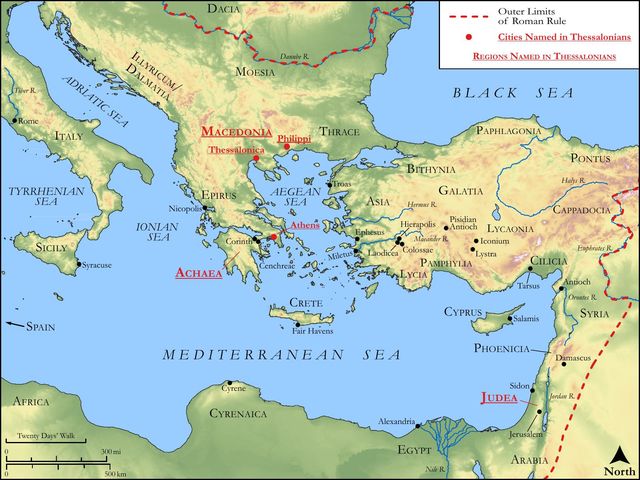
See on the biblical-era map

Study this verse
Public-domain commentary
Matthew Henry
From his Commentary on the Whole Bible. Henry comments on passages, not single verses — this entry covers 1 Thessalonians 3:6–10. His three-level outline is real structure in the source text, so it is rendered as structure.
Here we have Paul's great satisfaction upon the return of Timothy with good tidings from the Thessalonians, in which we may observe,
I.The good report Timothy made concerning them, Th1 3:6.
Without question, he was a willing messenger of these good tidings. Concerning their faith, that is, concerning their stedfastness in the faith, that they were not shaken in mind, nor turned aside form the profession of the gospel. Their love also continued; their love to the gospel, and the ministers of the gospel. For they had a good and a kind remembrance of the apostles, and that constantly, or always. The names of the apostles were very dear to them, and the thoughts of them, and what they themselves had received from them, were very precious, insomuch that they desired greatly to see them again, and receive some spiritual gift from them; and there was no love lost, for the apostle was as desirous to see them. It is happy where there is such mutual love between minister and people. This tends to promote religion, and the success of the gospel. The world hates them, and therefore they should love one another.
II.The great comfort and satisfaction the apostle had in this good report concerning them (Th1 3:7, Th1 3:8):
Therefore, brethren, we were comforted in all our affliction and distress. The apostle thought this good news of them was sufficient to balance all the troubles he met with. It was easy to him to bear affliction, or persecution, or fightings from without, when he found the good success of his ministry and the constancy of the converts he had made to Christianity; and his distress of mind on account of his fears within, lest he had laboured in vain, was now in a good measure over, when he understood their faith and the perseverance of it. This put new life and spirit into the apostle and made him vigorous and active in the work of the Lord. Thus he was not only comforted, but greatly rejoiced also: Now we live, if you stand fast in the Lord, Th1 3:8. It would have been a killing thing to the apostles if the professors of religion had been unsteady, or proved apostates; whereas nothing was more encouraging than their constancy.
III.The effects of this were thankfulness and prayer to God on their behalf. Observe,
1.How thankful the apostle was, Th1 3:9. He was full of joy, and full of praise and thanksgiving. When we are most cheerful we should be most thankful. What we rejoice in we should give thanks for. This is to rejoice before our God, to spiritualize our joy. Paul speaks as if he could not tell how to express his thankfulness to God, or his joy and rejoicing for their sakes. But he was careful God should not lose the glory of the comfort he received in the welfare of his friends. His heart was enlarged with love to them and with thanksgiving to God. He was willing to express the one and the other as well as he could. As to thankfulness to God, this especially is very imperfect in the present state; but, when we come to heaven, we shall do this work better than now we can.
2.He prayed for them night and day (Th1 3:10), evening and morning, or very frequently, in the midst of the business of the day or slumber of the night lifting up his heart to God in prayer. Thus we should pray always. And Paul's prayer was fervent prayer. He prayed exceedingly, and was earnest in his supplication. Note, When we are most thankful we should always give ourselves to prayer; and those we give thanks for have yet need to be prayed for. Those whom we most rejoice in, and who are our greatest comforts, must be our constant care, while in this world of temptation and imperfection. There was something still lacking in their faith; Paul desired that this might be perfected, and to see their face in order thereunto. Note,
(1.)The best of men have something wanting in their faith, if not as to the matter of it, there being some mysteries or doctrines not sufficiently known or believed by them, yet as to the clearness and certainty of their faith, there being some remaining darkness and doubtings, or at least as to the effects and operations of it, these being not so conspicuous and perfect as they should be. And,
(2.)The ministry of the word and ordinances is helpful, and to be desired and used for the perfecting of that which is lacking in our faith.
Historical interpretation
Historical reception
3 surviving comments on this verse. Each one is dated, so this reads as a timeline rather than a list.
Select a marker to jump to its quote. Markers stagger vertically where authors wrote within a few decades of each other.
"For what thanksgiving can we render again unto God for you, for all the joy wherewith we joy for your sakes before our God; night and day praying exceedingly that we may see your face, and may perfect that which is lacking in your faith?"
Not only, he says, are ye the causes of life to us, but also of much joy, and so much that we cannot worthily give thanks to God. Your good behavior, he says, we consider to be the gift of God. Such kindnesses have you shown to us, that we think it to be of God; yea, rather, and it is of God. For such a disposition of mind comes not of a human soul or carefulness.
"Night and day," he says, "praying exceedingly." This too is a sign of joy. For as any husbandman, hearing concerning his land that has been tilled by himself, that it is burdened with ears of grain, longs with his own eyes to see so pleasant a sight, so Paul to see Macedonia. "Praying exceedingly." Observe the excess; "that we may see your face, and may perfect that which is lacking in your faith."
Here there is a great question. For if now thou livest, because they stand fast, and Timothy brought thee "glad tidings of their faith and love," and thou art full of so much joy as not to be able worthily to give thanks to God, how sayest thou here that there are deficiencies in their faith? Were those then the words of flattery? By no means, far be it. For previously he testified that they endured many conflicts, and were no worse affected than the Churches in Judaea. What then is it? They had not enjoyed the full benefit of his teaching, nor learned all that it behoved them to learn. And this he shows toward the end. Perhaps there had been questionings among them concerning the Resurrection, and there were many who troubled them, not by temptations, nor by dangers, but by acting the part of teachers. This is what he says is lacking in their faith, and for this reason, he has so explained himself, and has not said, that you should be confirmed, where indeed he feared concerning the faith itself, "I have sent," he says, "Timothy to confirm you," but here, "to perfect that which is lacking," which is rather a matter of teaching than of confirming.
Let the admonition of the most blessed apostle not depart from your hearts, “If anyone preaches to you a gospel besides that which you have received, let him be anathema.” He did not say “more than you received” but “besides that which you have received.” For if he said the former, he himself would be prejudging himself, who desired to come to the Thessalonians that he might supply what things were lacking to their faith. But he who supplies adds to what was smaller, he does not take away what was there. But he who goes beyond the rule of faith does not go forward in the way but goes back to the way.
But every discourse on this topic, where one’s goal is that what is said may not only be believed but also understood and known, is burdensome for those still spiritually immature. These the apostle says are carnal, needing to be nourished with milk, as they do not have the strength to perceive such things and are more easily frustrated than fed. Because of this it happens that spiritual men do not in all circumstances refuse to discuss these things with the carnal, on account of the Catholic faith, which must be preached to all. Yet, having the desire to transmit some degree of truth to understandings not capable of a secure grasp, they take care to transmit these in a way that does not cause their discourse to be regarded with disdain and the truth contained therein to be completely ignored. Thus, in order to continue to nourish them despite their immaturity, [the apostle], writing to the Colossians, says, “Even if I am absent in body, in spirit I am with you, rejoicing and beholding your order and that which is lacking to your faith in Christ.” And to the Thessalonians, “Night and day,” he says, “more abundantly praying that we may see your face and may supply the things that are lacking to your faith.”
Continue studying 1 Thessalonians 3:10 across the web’s major study libraries — every link below opens this exact verse, chapter, or book on the destination site.
Read & Compare
 BibleGatewayThis verse in more than 200 translations and 70 languages.
 Bible.comThe YouVersion reader — hundreds of translations, reading plans, and highlights.
 ESV.orgCrossway's official English Standard Version reader.
 NET BibleThe NET translation with 60,000+ translators' notes on every rendering decision.
 STEP BibleTyndale House's free study tool — original text, vocabulary, and scholarly resources.
 BibliaLogos Bible Software's free web reader.
 USCCBThe New American Bible (Revised Edition) with the U.S. bishops' study notes.
Commentaries
 BibleHub CommentariesDozens of classic commentaries on this verse, gathered on one page.
 StudyLightMore than 100 commentary sets — the largest collection on the web.
 BibleRefPlain-English commentary on what this verse means, verse by verse.
 Enduring WordDavid Guzik's free commentary on this chapter, widely used by Bible teachers.
 Bible Study ToolsVerse commentary alongside Greek and Hebrew study aids.
Original Language & Research
- BibleHub InterlinearThe verse word by word — original language, transliteration, and English.
- BibleHub LexiconEvery word's original-language definition and Strong's entry.
 Blue Letter BibleDeep-study tools — Strong's numbers, concordance, and word studies.
 CNTR CollationThe earliest Greek manuscripts of this verse, collated letter by letter.
Sermons, Hymns & Audio


TrulyRandomVerse is not affiliated with these sites and doesn’t control their content. They’re linked because they’re genuinely useful.
Summary
The Apostle Paul expresses his profound, ceaseless longing to reunite with the Thessalonian believers, driven by a fervent desire to personally minister to them and address any remaining deficiencies in their faith. This verse encapsulates his deep pastoral affection, his commitment to intercessory prayer, and his unwavering dedication to the spiritual maturity and completeness of those he had disicipled.
Context
ShowHideLiterary Context
This verse immediately follows Paul's expression of immense comfort and joy upon receiving Timothy's positive report regarding the Thessalonians' steadfast faith amidst persecution (1 Thessalonians 3:6). Having been separated from them by force and filled with anxiety about their endurance, Paul's relief is palpable. However, his pastoral heart is not content with mere survival; he yearns to return to them to "perfect" their faith, indicating that while their faith was strong enough to endure, it still had areas for growth and deeper establishment. This desire for reunion and further equipping is a natural progression from his initial concern and subsequent joy.
Historical & Cultural Context
Paul's ministry in Thessalonica was brief but impactful, marked by intense opposition that forced his hasty departure (Acts 17:1-10). The Thessalonians were new converts, facing significant persecution from both Jewish and Gentile opposition. In the ancient world, face-to-face interaction was paramount for teaching, encouragement, and establishing relationships. Paul's longing to "see your face" was not merely sentimental but a practical necessity for continuing his apostolic work of nurturing and solidifying their nascent faith in a hostile environment. His inability to return had been a source of great distress, making Timothy's report, and his subsequent desire for personal ministry, all the more significant.
Key Themes
ShowHideThis verse powerfully contributes to several key themes within 1 Thessalonians and Paul's broader theology. It highlights Fervent Intercessory Prayer as a cornerstone of pastoral ministry, demonstrating Paul's commitment to praying "night and day exceedingly" for his spiritual children, a practice consistent with his exhortations in other epistles, such as his prayer for the Colossians to be filled with the knowledge of God's will (Colossians 1:9). It also underscores Deep Pastoral Affection and the Importance of Fellowship, as Paul's yearning to "see your face" reveals the personal, relational nature of his apostleship, emphasizing that spiritual growth is best fostered within genuine community and direct encouragement. Finally, the desire to "perfect that which is lacking in your faith" speaks to the theme of Progressive Sanctification and Spiritual Maturation, indicating that Christian faith, while genuine from conversion, is a dynamic process requiring ongoing development and equipping for completeness, a concept Paul elaborates on when discussing the church's growth into the fullness of Christ (Ephesians 4:12-13).
Exposition and Analysis
ShowHideKey Word Analysis
ShowHideThis word, G1189, signifies "to beg (as binding oneself), i.e. petition." It conveys a sense of urgent, earnest supplication, reflecting a deep personal need or intense desire. Paul's use of déomai here indicates that his prayers for the Thessalonians were not casual requests but fervent, persistent pleas to God, born out of a profound pastoral burden and sense of responsibility for their spiritual well-being.
G2675 means "to complete thoroughly, i.e. repair (literally or figuratively) or adjust." It implies bringing something to its proper state of readiness, functionality, or wholeness. This is the same word used for mending nets (Matthew 4:21) or equipping believers for ministry (Ephesians 4:12). Paul's aim was not to criticize their faith as fundamentally flawed, but to bring it to a state of full maturity and operational effectiveness, preparing them for continued endurance and service.
G5303 refers to "a deficit; specially, poverty." It denotes something that is missing, deficient, or incomplete. In the context of faith, it suggests areas where their understanding, application, or experience of Christian truth might still be immature or undeveloped. Paul's desire was to fill in these gaps, ensuring their faith was robust and comprehensive, able to withstand all challenges.
Verse Breakdown
ShowHide"Night and day praying exceedingly"
This phrase emphasizes the extraordinary intensity, persistence, and fervor of Paul's intercessory prayer life. It signifies that his concern for the Thessalonians was constant, occupying his thoughts and prayers around the clock, reflecting a deep, unceasing burden for their spiritual welfare. The "exceedingly" (from hyper-ekperissōs, a compound of G5228, G1537, G4053) further amplifies this, meaning "beyond measure" or "superabundantly," indicating an overwhelming degree of earnestness.
"that we might see your face"
This reveals Paul's profound personal affection and longing for direct fellowship and physical reunion with the Thessalonian believers. His desire to "see their face" (G4383, prósōpon) underscores the importance of personal presence and direct interaction in his pastoral ministry, allowing for mutual encouragement and the strengthening of bonds that could not be fully achieved through letters or messengers alone.
"and might perfect that which is lacking in your faith?"
This clause articulates the primary spiritual objective of Paul's longed-for reunion. Despite their admirable steadfastness, Paul recognized that their faith, being relatively new, still had areas of immaturity or incompleteness. His aim was to "perfect" (G2675, katartízō) or thoroughly equip these deficiencies (G5303, hystérēma), bringing their faith to a state of full maturity, comprehension, and practical application, enabling them to navigate future challenges with greater stability and understanding.
Literary Devices
ShowHidePaul employs several literary devices to convey the depth of his pastoral care. Hyperbole is evident in "Night and day praying exceedingly," a common Pauline expression to emphasize the intensity and ceaselessness of his efforts, rather than a literal twenty-four-hour prayer vigil. This exaggeration underscores his profound concern. The phrase "that we might see your face" serves as Metonymy, where "face" stands for the entire person and the desired personal presence and fellowship. Furthermore, the concept of "perfecting that which is lacking in your faith" utilizes Metaphor, portraying faith not as a static belief but as something dynamic and organic that can grow, mature, and have areas of deficiency that need to be "mended" or "equipped." This evokes an image of spiritual growth as a process of continuous development and completion.
Theological and Thematic Connections
ShowHidePaul's fervent prayer and longing to perfect the Thessalonians' faith profoundly illustrate the New Testament's emphasis on both the immediate efficacy of conversion and the ongoing process of sanctification. While salvation is a complete work of God received by faith, the believer's faith itself is a living, growing entity that requires nurturing, instruction, and correction. This verse highlights the divine-human partnership in spiritual growth: God initiates and sustains, but human agents, like Paul, are called to labor diligently through prayer and teaching to bring believers to maturity. It underscores the profound theological truth that God uses human instruments to build up His church, reflecting His commitment to the spiritual completeness of His people.
Reflection and Application
ShowHidePaul's heartfelt prayer in 1 Thessalonians 3:10 serves as a timeless model of authentic pastoral care and Christian devotion. It challenges believers today to cultivate a similar depth of concern for one another's spiritual well-being, moving beyond superficial interactions to engage in fervent, persistent intercessory prayer. Just as Paul recognized areas for growth in the Thessalonians' faith, we are called to humbly acknowledge that our own faith, regardless of its current strength, always has room for deeper understanding, more consistent application, and greater maturity. This verse reminds us that the Christian life is a journey of continuous development, where God graciously uses both personal fellowship and the diligent teaching of His Word to equip us for every good work and to bring our faith to its intended completeness. It also underscores the irreplaceable value of genuine community, where believers can minister to one another, filling in gaps and encouraging steadfastness in the face of life's challenges.
Questions for Reflection
ShowHideFAQ
ShowHideWhy was Paul so concerned about "perfecting" their faith if they were already praised for it?
ShowHidePaul's concern was not a criticism of their genuine faith, which he explicitly praised for its steadfastness amidst persecution (1 Thessalonians 3:6-7). Rather, "perfecting that which is lacking" (Greek katartízō and hystérēma) implies bringing something to its full functionality, completeness, or maturity. The Thessalonians were new converts, and while their initial faith was strong enough to endure severe trials, Paul, as their spiritual father, knew there would be areas of theological understanding, practical application, or spiritual discipline that were still undeveloped. His desire was to equip them more fully, like mending a net to make it fully functional, so they could stand even more firmly and effectively in their Christian walk. It highlights that faith is a dynamic, growing entity, not a static possession.
Does "night and day praying exceedingly" mean Paul literally prayed non-stop?
ShowHideWhile Paul was undoubtedly a man of intense prayer, the phrase "night and day praying exceedingly" (Greek nýx kai hēméra déomai hyper-ekperissōs) is a form of hyperbole or intense expression common in ancient literature and even in modern speech. It signifies extreme earnestness, persistence, and a profound, unceasing burden in prayer, rather than a literal 24/7, unbroken prayer vigil. Paul's life was characterized by constant ministry, travel, and letter-writing, which would preclude literal non-stop prayer. However, it underscores that his thoughts and petitions for the Thessalonians were continually before God, reflecting an extraordinary level of pastoral care and commitment to intercession.
Christ-Centered Fulfillment
ShowHidePaul's fervent desire to "perfect that which is lacking in your faith" finds its ultimate fulfillment and model in Christ Jesus. Just as Paul longed to present the Thessalonians "complete in Christ" (Colossians 1:28), Jesus Himself is the one who perfects our faith from beginning to end. He is the "author and perfecter of our faith" (Hebrews 12:2), continually working in believers to bring them to maturity and conformity to His image (Romans 8:29). Paul's longing to see their face echoes Christ's own desire for intimate fellowship with His disciples, a fellowship that will be fully realized when we see Him "face to face" (1 Corinthians 13:12) and are made perfectly complete in Him. The Spirit of Christ indwells believers, empowering them to grow and filling in the deficiencies of their understanding and practice, ensuring that the work He began will be brought to completion on the day of Jesus Christ (Philippians 1:6). Thus, Paul's pastoral heart reflects the very heart of Christ, who tirelessly intercedes for His own (Romans 8:34) and works to present His church as a radiant bride, without spot or wrinkle, perfectly complete in Him (Ephesians 5:27).