


1 Thessalonians 2:18
Bible text: King James Version (1769 Blayney text) · Public domain
Bible text: Berean Standard Bible · Public domain
Bible text: American Standard Version (1901) · Public domain
Bible text: World English Bible, Messianic edition · Public domain
Bible text: Geneva Bible (1599) · Public domain
Bible text: Young's Literal Translation · Public domain
- διότιdiotithereforeG1360CONJConjunction
- ἠθελήσαμενēthelēsamenwe wantedG2309V-AAI-1PVerb Aorist Active Indicative 1st Plural
- ἐλθεῖνeltheinto comeG2064V-2AANVerb 2nd Aorist Active Infinitive
- πρὸςprostoG4314PREPPreposition
- ὑμᾶςhumasyou —G4771P-2APPersonal pronoun Accusative 2nd Plural
- ἐγὼegōI myselfG1473P-1NSPersonal pronoun Nominative 1st Singular
- μὲνmenindeedG3303PRTParticle or Disjunctive
- ΠαῦλοςPaulosPaulG3972N-NSM-PNoun Nominative Singular Masculine Individual
- καὶkaibothG2532CONJConjunction
- ἅπαξhapaxonceG530ADVAdverb
- καὶkaiandG2532CONJConjunction
- δίςdistwice —G1364ADVAdverb
- καὶkaiandG2532CONJConjunction
- ἐνέκοψενenekopsenhinderedG1465V-AAI-3SVerb Aorist Active Indicative 3rd Singular
- ἡμᾶςhēmasusG3165P-1APPersonal pronoun Accusative 1st Plural
- ὁho<the>G3588T-NSMDefinite article Nominative Singular Masculine
- σατανᾶςsatanasSatanG4567N-NSM-TNoun Nominative Singular Masculine Title
English is a literal word-by-word gloss of the Greek, not the KJV's wording. Why?
This is the original text the KJV's translators worked from — each Greek word with its own literal English meaning in this verse, prepared by scholars at Tyndale House, Cambridge. The KJV translates whole sentences, not word by word, so its wording differs: one Greek word can become several English words, and the KJV may choose “charity” where the gloss reads “love”. Both are faithful — they answer different questions. For the KJV's own rendering, switch to the KJV text.
Details
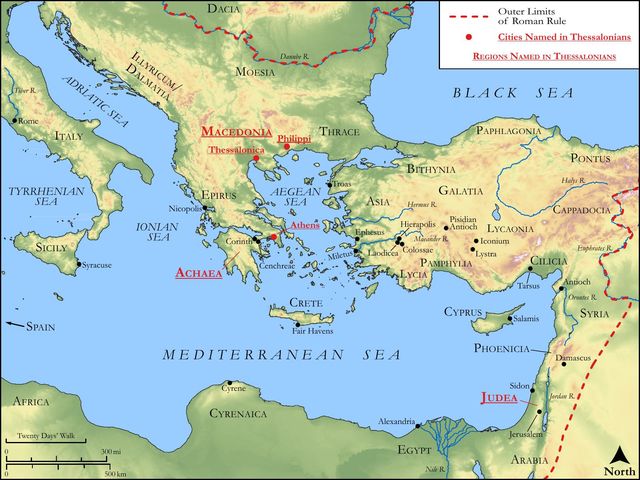
See on the biblical-era maps

Study this verse
Public-domain commentary
Matthew Henry
From his Commentary on the Whole Bible. Henry comments on passages, not single verses — this entry covers 1 Thessalonians 2:17–20.
In these words the apostle apologizes for his absence. Here observe, 1. He tells them they were involuntarily forced from them: We, brethren, were taken from you, Th1 2:17. Such was the rage of his persecutors. He was unwillingly sent away by night to Berea, Act 17:10. 2. Though he was absent in body, yet he was present in heart. He had still a remembrance of them, and great care for them. 3. Even his bodily absence was but for a short time, the time of an hour. Time is short, all our time on earth is short and uncertain, whether we are present with our friends or absent from them. This world is not a place where we are always, or long, to be together. It is in heaven that holy souls shall meet, and never part more. 4. He earnestly desired and endeavoured to see them again: We endeavoured more abundantly to see your face with great desire, Th1 2:17. So that the apostle at least intended his absence should be but for a short time. His desire and endeavour were to return again very soon to Thessalonica. But men of business are not masters of their own time. Paul did his endeavour, and he could do no more, Th1 2:18. 5. He tells them that Satan hindered his return (Th1 2:18), that is, either some enemy or enemies, or the great enemy of mankind, who stirred up opposition to Paul, either in his return to Thessalonica, when he intended to return thither, or stirred up such contentions or dissensions in those places whether he went as made his presence necessary. Note, Satan is a constant enemy to the work of God, and does all he can to obstruct it. 6. He assures them of his affection and high esteem for them, though he was not able, as yet, to be present with them according to his desire. They were his hope, and joy, and crown of rejoicing; his glory and joy. These are expressions of great and endeared affection, and high estimation. And it is happy when ministers and people have such mutual affection and esteem of each other, and especially if they shall thus rejoice, if those that sow and those that reap shall rejoice together, in the presence of our Lord Jesus Christ at his coming.
The apostle here puts the Thessalonians in mind that though he could not come to them as yet, and though he should never be able to come to them, yet our Lord Jesus Christ will come, nothing shall hinder this. And further, when he shall come, all must appear in his presence, or before him. Ministers and people must all appear before him, and faithful people will be the glory and joy of faithful ministers in that great and glorious day.
Historical interpretation
Historical reception
3 surviving comments on this verse. Each one is dated, so this reads as a timeline rather than a list.
Select a marker to jump to its quote. Markers stagger vertically where authors wrote within a few decades of each other.
"Wherefore we would fain have come unto you, I Paul once and again, and Satan hindered us."
Which is the part of love; yet here he mentions no other necessity but "that we might see you."
What sayest thou? does Satan hinder? Yes, truly, for this was not the work of God. For in the Epistle to the Romans, he says this, that God hindered him (from Rom. xv. 22); and elsewhere Luke says, that "the Spirit" hindered them from going into Asia. (Acts xvi. 7) And in the Epistle to the Corinthians he says, that it is the work of the Spirit, but here only of Satan. But what hindrance of Satan is he speaking of? Some unexpected and violent temptations: for a plot, it says, being formed against him by the Jews, he was detained three months in Greece. But it is another thing to remain for the sake of the dispensation, and willingly. For there he says, "Wherefore having no more place in these parts" (Rom. xv. 23), and, "To spare you I forbare to come unto Corinth." (2 Cor. i. 23) But here nothing of this sort. But what? That "Satan hindered" him. "Even I Paul," he says, "both once and again." Observe, how ambitious he is, and what a display he makes, in his willingness to show that he loved them most of all. "I Paul," he says, instead of Although no others. For they indeed were only willing, but I even attempted it.
You, too, when you are about to perform any duty for God, expect manifold dangers, punishments, deaths. Don’t be surprised or disturbed if such things happen. For it is said, “My Son, if you come to serve the Lord, prepare your soul for temptation.” For surely no one choosing to fight, expects to carry off the crown without wounds! And you, therefore, who have decided to wage full combat with the devil, don’t think to pursue such a life without danger, expecting luxury instead! God has not pledged to you his recompense and promise for this life. These splendid things await you in the future life! Be glad and rejoice then, if when you have yourself done any good action, you receive evil in return … inasmuch as your suffering is the source of a higher recompense!… We see Paul in prison, yes, even in chains, instructing and initiating. He does the very same in a court of justice, in shipwreck, in tempest and in a thousand dangers. You also imitate these saints, and as long as you are able continue in your good works. Although you see the devil thwarting you ten thousand times, never fall back! Perhaps you have lost your wealth in a shipwreck. Remember Paul, carrying God’s word, a message far more precious than all material wealth, was traveling to Rome and was wrecked, and sustained innumerable hardships. And this principle he himself signified when he said, “Many times we desired to come to you, but Satan hindered us.” And God permitted it, thus revealing more abundantly his power.
Paul, the chosen vessel, chastised his body and brought it into subjection, lest after preaching to others he himself should be found a reprobate. He relates that there was given to him “a thorn in the flesh, a messenger of Satan to buffet him.” And to the Corinthians he writes: “But I am afraid that as the serpent deceived Eve by his cunning, your thoughts will be led astray from a sincere and pure devotion to Christ.” And elsewhere he says, “Any one whom you forgive, I also forgive. What I have forgiven, if I have forgiven anything, has been for your sake in the presence of Christ, to keep Satan from gaining the advantage over us, for we are not ignorant of his designs.” And again, “No temptation has overtaken you that is not common to man, but God is faithful, and he will not let you be tempted beyond your strength; but with the temptation will also provide the way of escape, that you may be able to endure it.” And “Let anyone who thinks that he stands take heed lest he fall.” And to the Galatians, “You were running well; who hindered you from obeying the truth?” And elsewhere: “We greatly desired to have come unto you, I Paul once and again; and Satan hindered us.”
Continue studying 1 Thessalonians 2:18 across the web’s major study libraries — every link below opens this exact verse, chapter, or book on the destination site.
Read & Compare
 BibleGatewayThis verse in more than 200 translations and 70 languages.
 Bible.comThe YouVersion reader — hundreds of translations, reading plans, and highlights.
 ESV.orgCrossway's official English Standard Version reader.
 NET BibleThe NET translation with 60,000+ translators' notes on every rendering decision.
 STEP BibleTyndale House's free study tool — original text, vocabulary, and scholarly resources.
 BibliaLogos Bible Software's free web reader.
 USCCBThe New American Bible (Revised Edition) with the U.S. bishops' study notes.
Commentaries
 BibleHub CommentariesDozens of classic commentaries on this verse, gathered on one page.
 StudyLightMore than 100 commentary sets — the largest collection on the web.
 BibleRefPlain-English commentary on what this verse means, verse by verse.
 Enduring WordDavid Guzik's free commentary on this chapter, widely used by Bible teachers.
 Bible Study ToolsVerse commentary alongside Greek and Hebrew study aids.
Original Language & Research
- BibleHub InterlinearThe verse word by word — original language, transliteration, and English.
- BibleHub LexiconEvery word's original-language definition and Strong's entry.
 Blue Letter BibleDeep-study tools — Strong's numbers, concordance, and word studies.
 CNTR CollationThe earliest Greek manuscripts of this verse, collated letter by letter.
Sermons, Hymns & Audio


TrulyRandomVerse is not affiliated with these sites and doesn’t control their content. They’re linked because they’re genuinely useful.
Summary
In 1 Thessalonians 2:18, the Apostle Paul articulates his repeated, fervent desire to return to the believers in Thessalonica, a longing that was consistently thwarted by the direct opposition of Satan. This verse offers a poignant glimpse into the personal struggles and spiritual realities faced by early Christian missionaries, revealing that even divinely appointed endeavors can encounter supernatural resistance. It underscores Paul's deep pastoral affection for the Thessalonian church and the unseen spiritual warfare that often accompanies the advancement of God's kingdom.
Context
ShowHideLiterary Context
This verse is embedded within Paul's extensive defense and affirmation of his ministry among the Thessalonians, which spans 1 Thessalonians 2. Having passionately recounted his blameless conduct, selfless motives, and the genuine love with which he ministered to them (e.g., 1 Thessalonians 2:9-12), Paul transitions to expressing his profound affection and longing to be reunited with them. The preceding verses highlight the Thessalonians' commendable reception of the gospel despite persecution (1 Thessalonians 2:13-16), setting the stage for Paul's desire to further encourage and strengthen them. His thwarted attempts to return, as stated in this verse, lead directly into his decision to send Timothy in his stead, as detailed in 1 Thessalonians 3:1-2, demonstrating his unwavering commitment to their spiritual well-being despite obstacles.
Historical & Cultural Context
Paul's initial ministry in Thessalonica was relatively brief, lasting perhaps only a few weeks, before he was forced to leave due to intense Jewish opposition (as recounted in Acts 17:1-10). This abrupt departure left the nascent church vulnerable and Paul deeply concerned for their spiritual stability amidst persecution. The city of Thessalonica was a significant Roman provincial capital, a bustling port city, and a center of trade, making it strategically important for the spread of the gospel. However, its diverse population and established religious practices also presented challenges, including a strong Jewish community that often opposed Paul's message. Paul's desire to return was not merely a personal wish but a pastoral necessity, driven by his responsibility to nurture the young believers in a hostile environment. The concept of spiritual opposition from malevolent forces like Satan was well-understood in both Jewish and Hellenistic cultures, though Paul's explicit naming of Satan highlights a distinct theological understanding of the adversary's direct involvement in hindering God's work.
Key Themes
ShowHideThis verse powerfully contributes to several overarching themes within 1 Thessalonians:
Pastoral Affection and Concern
Paul's repeated attempts to visit underscore his deep, paternal love for the Thessalonian believers, viewing them as his "joy and crown" (1 Thessalonians 2:19-20). His desire to "see your face" and "supply what is lacking in your faith" (1 Thessalonians 3:10) highlights his commitment to their spiritual growth and perseverance.
The Reality of Spiritual Warfare
The explicit mention of "Satan" as the hindering force introduces the theme of spiritual opposition, revealing that the work of God is not merely a human endeavor but is actively contested by unseen powers. This aligns with Paul's broader teaching on the conflict between good and evil, as seen in his call to put on the "whole armor of God" in Ephesians 6:10-18.
Divine Sovereignty Amidst Opposition
While Satan could hinder Paul's immediate travel plans, he could not ultimately thwart God's overarching purpose for the Thessalonian church or the spread of the gospel. Paul's ability to send Timothy and write this letter demonstrates God's sovereign hand working through alternative means, ensuring that His will is accomplished despite the adversary's efforts. This tension between human plans, satanic opposition, and divine sovereignty is a recurring motif in Paul's epistles, such as his desire to visit Rome being hindered in Romans 15:22-23.
Exposition and Analysis
ShowHideKey Word Analysis
ShowHideThis conjunction, derived from "through which thing," functions as a logical connector, indicating a consequence or reason. Here, it links Paul's desire to visit with the preceding discussion of his genuine affection and concern for the Thessalonians, implying that his longing to return is a direct result of his deep pastoral bond and their spiritual state.
This verb literally means "to cut into" or "to cut off," and figuratively "to impede," "to obstruct," or "to block the way." It was used in ancient Greek for breaking up a road or placing obstacles in a path, suggesting an active, forceful, and deliberate obstruction rather than a passive difficulty or mere inconvenience. The perfect tense implies a completed action with ongoing results, meaning Satan's hindrance was effective and continued to prevent Paul's travel.
This is a transliteration of the Hebrew word meaning "adversary" or "accuser." In the New Testament, Satan refers to the chief enemy of God and humanity, the devil, who actively opposes God's purposes and seeks to undermine the faith of believers and the work of the gospel. Paul's explicit naming of Satan attributes the hindrance to a specific, malevolent spiritual entity, not just general misfortune or human opposition.
Verse Breakdown
ShowHide"Wherefore we would have come unto you, even I Paul, once and again"
This clause expresses Paul's strong and repeated intention to visit the Thessalonians. The phrase "we would have come" (from thélō and érchomai) indicates a firm desire and purpose on Paul's part, reflecting his deep pastoral heart. The inclusion of "even I Paul" emphasizes his personal commitment and the authenticity of this longing. The temporal phrase "once and again" (Greek hápax and dís) underscores the persistent and repeated nature of his attempts, demonstrating that this was not a fleeting thought but a consistent, thwarted endeavor.
"but Satan hindered us"
This stark declaration reveals the reason for Paul's inability to return. The conjunction "but" introduces a direct contrast and a powerful obstacle. Paul unequivocally identifies "Satan" as the active agent responsible for the hindrance. The verb "hindered" (Greek enkóptō) suggests a forceful, deliberate, and effective obstruction, implying that Satan actively intervened to prevent Paul's travel and ministry to the Thessalonians. This highlights the reality of spiritual warfare in the context of missionary work.
Literary Devices
ShowHideThe verse employs several literary devices to convey its powerful message. Direct Statement is evident in Paul's straightforward declaration of his desire and the obstacle he faced, lending credibility and immediacy to his account. The use of Personal Pronouns ("we," "I Paul," "you," "us") creates a strong sense of intimacy and direct communication between Paul and the Thessalonian believers, underscoring the personal nature of his pastoral relationship with them. Repetition in the phrase "once and again" (or "again and again" in some translations) emphasizes the persistence of Paul's desire and the repeated nature of Satan's obstruction, highlighting the ongoing spiritual battle. Finally, Personification is employed by attributing the action of "hindering" directly to "Satan," giving agency to a spiritual entity and underscoring the reality of spiritual warfare as a tangible force impacting human events and divine plans.
Theological and Thematic Connections
ShowHide1 Thessalonians 2:18 offers a profound theological insight into the nature of spiritual warfare and its impact on the advancement of God's kingdom. It reveals that the enemy, Satan, is not merely a symbolic force but an active adversary who seeks to disrupt divine purposes and discourage God's servants. Paul's experience demonstrates that even the most godly intentions and Spirit-led ministries can encounter direct, supernatural opposition. However, the verse also subtly affirms God's ultimate sovereignty; while Satan can hinder specific plans or timings, he cannot ultimately thwart God's overarching will or the spread of the gospel, as evidenced by Paul's ability to send Timothy and write this very letter. This tension invites believers to acknowledge the reality of spiritual conflict while resting in the assurance of God's ultimate victory and control.
Reflection and Application
ShowHidePaul's candid confession in 1 Thessalonians 2:18 serves as a crucial reminder for believers today that spiritual opposition is a tangible reality in the Christian life and ministry. Our good intentions, our desires to serve God, and our efforts to advance His kingdom are not immune to the schemes of the enemy. This verse encourages us to cultivate a spiritual discernment that looks beyond mere logistical challenges or human failings to recognize the potential hand of the adversary at work. Rather than becoming discouraged or defeated when plans are thwarted or obstacles arise, we are called to persevere in prayer, seeking God's wisdom and intervention. It also prompts us to consider how God might be redirecting our paths or teaching us patience and reliance on Him, even when our immediate desires are frustrated. Ultimately, Paul's experience reminds us that our ultimate trust must be in God's sovereign plan, knowing that He can use even satanic hindrances for His greater glory and the good of His people.
Questions for Reflection
ShowHideFAQ
ShowHideDid Satan literally block Paul's physical travel, or is this a metaphor for other difficulties?
ShowHideWhile the exact mechanism of Satan's hindrance is not specified, Paul's language strongly suggests a direct and active intervention, not merely a metaphor for general difficulties or human opposition. The Greek word enkóptō ("hindered") implies a forceful obstruction, like breaking up a road. While Satan might work through circumstances, people, or even internal discouragement, Paul attributes the ultimate cause to Satan himself. This aligns with other New Testament passages where Satan actively opposes God's work (e.g., Matthew 13:39 where Satan sows weeds, or Luke 22:31). Paul believed this was a direct spiritual assault on his missionary efforts.
Christ-Centered Fulfillment
ShowHideWhile 1 Thessalonians 2:18 speaks of Satan hindering Paul's specific missionary journey, it ultimately points to the greater truth of Christ's triumph over all satanic power. The very reason Satan sought to hinder Paul's ministry was to prevent the spread of the gospel, which proclaims the victory of Jesus Christ over sin, death, and the devil himself. The New Testament consistently presents Jesus as the one who has "destroyed the works of the devil" (1 John 3:8). Through His death and resurrection, Christ disarmed principalities and powers, triumphing over them (Colossians 2:15). Therefore, even when Satan hinders, as he did with Paul, his power is ultimately limited by the sovereign authority of the risen Christ. Believers, united with Christ, are given authority to overcome the enemy's schemes (Luke 10:19), and the gospel, though opposed, will ultimately prevail because it is the power of God unto salvation (Romans 1:16). Paul's frustration in this verse underscores the ongoing spiritual battle, but it is a battle in which the ultimate victory has already been secured by our Lord Jesus Christ.