


1 Thessalonians 2:19
Bible text: King James Version (1769 Blayney text) · Public domain
Bible text: King James Version with Strong's numbers · Public domain
Bible text: Berean Standard Bible · Public domain
Bible text: American Standard Version (1901) · Public domain
Bible text: World English Bible, Messianic edition · Public domain
Bible text: Geneva Bible (1599) · Public domain
Bible text: Young's Literal Translation · Public domain
- τίςtisWho [is]G5101I-NSFInterrogative pronoun Nominative Singular Feminine
- γὰρgarforG1063CONJConjunction
- ἡμῶνhēmōnourG3165P-1GPPersonal pronoun Genitive 1st Plural
- ἐλπὶςelpishopeG1680N-NSFNoun Nominative Singular Feminine
- ἢēorG2228CONJConjunction
- χαρὰcharajoyG5479N-NSFNoun Nominative Singular Feminine
- ἢēorG2228CONJConjunction
- στέφανοςstephanoscrownG4735N-NSMNoun Nominative Singular Masculine
- καυχήσεως;kauchēseōsof boasting?G2746N-GSFNoun Genitive Singular Feminine
- ἢēExceptG2228CONJConjunction
- οὐχὶouchionlyG3780PRT-NNegative Particle Negative
- καὶkaievenG2532CONJConjunction
- ὑμεῖςhumeisyouG4771P-2NPPersonal pronoun Nominative 2nd Plural
- ἔμπροσθενemprosthenbeforeG1715PREPPreposition
- τοῦtoutheG3588T-GSMDefinite article Genitive Singular Masculine
- κυρίουkuriouLordG2962N-GSM-TNoun Genitive Singular Masculine Title
- ἡμῶνhēmōnof usG3165P-1GPPersonal pronoun Genitive 1st Plural
- ἸησοῦIēsouJesusG2424N-GSM-PNoun Genitive Singular Masculine Individual
- ΧριστοῦChristouChristG5547N-GSM-TNoun Genitive Singular Masculine Title
- ἐνenatG1722PREPPreposition
- τῇtēa<the>G3588T-DSFDefinite article Dative Singular Feminine
- αὐτοῦautouHisG846P-GSMPersonal pronoun Genitive Singular Masculine
- παρουσίᾳ;parousiacoming?G3952N-DSFNoun Dative Singular Feminine
English is a literal word-by-word gloss of the Greek, not the KJV's wording. Why?
This is the original text the KJV's translators worked from — each Greek word with its own literal English meaning in this verse, prepared by scholars at Tyndale House, Cambridge. The KJV translates whole sentences, not word by word, so its wording differs: one Greek word can become several English words, and the KJV may choose “charity” where the gloss reads “love”. Both are faithful — they answer different questions. For the KJV's own rendering, switch to the KJV text.
Details
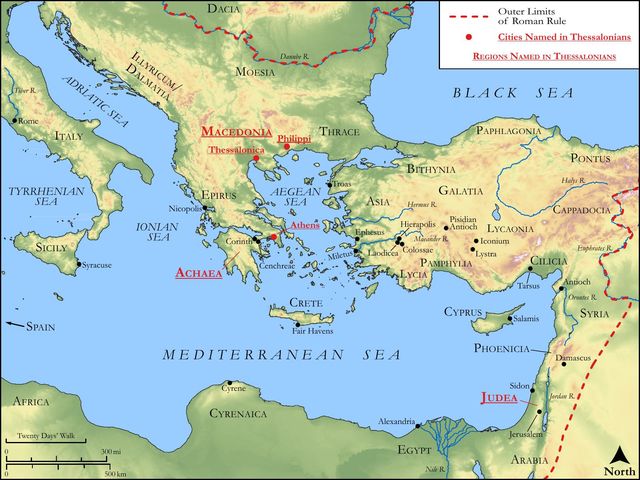
See on the biblical-era maps

Study this verse
Public-domain commentary
Matthew Henry
From his Commentary on the Whole Bible. Henry comments on passages, not single verses — this entry covers 1 Thessalonians 2:17–20.
In these words the apostle apologizes for his absence. Here observe, 1. He tells them they were involuntarily forced from them: We, brethren, were taken from you, Th1 2:17. Such was the rage of his persecutors. He was unwillingly sent away by night to Berea, Act 17:10. 2. Though he was absent in body, yet he was present in heart. He had still a remembrance of them, and great care for them. 3. Even his bodily absence was but for a short time, the time of an hour. Time is short, all our time on earth is short and uncertain, whether we are present with our friends or absent from them. This world is not a place where we are always, or long, to be together. It is in heaven that holy souls shall meet, and never part more. 4. He earnestly desired and endeavoured to see them again: We endeavoured more abundantly to see your face with great desire, Th1 2:17. So that the apostle at least intended his absence should be but for a short time. His desire and endeavour were to return again very soon to Thessalonica. But men of business are not masters of their own time. Paul did his endeavour, and he could do no more, Th1 2:18. 5. He tells them that Satan hindered his return (Th1 2:18), that is, either some enemy or enemies, or the great enemy of mankind, who stirred up opposition to Paul, either in his return to Thessalonica, when he intended to return thither, or stirred up such contentions or dissensions in those places whether he went as made his presence necessary. Note, Satan is a constant enemy to the work of God, and does all he can to obstruct it. 6. He assures them of his affection and high esteem for them, though he was not able, as yet, to be present with them according to his desire. They were his hope, and joy, and crown of rejoicing; his glory and joy. These are expressions of great and endeared affection, and high estimation. And it is happy when ministers and people have such mutual affection and esteem of each other, and especially if they shall thus rejoice, if those that sow and those that reap shall rejoice together, in the presence of our Lord Jesus Christ at his coming.
The apostle here puts the Thessalonians in mind that though he could not come to them as yet, and though he should never be able to come to them, yet our Lord Jesus Christ will come, nothing shall hinder this. And further, when he shall come, all must appear in his presence, or before him. Ministers and people must all appear before him, and faithful people will be the glory and joy of faithful ministers in that great and glorious day.
Historical interpretation
Two Centuries of Reception
7 surviving comments on this verse. Each one is dated, so this reads as a timeline rather than a list.
Select a marker to jump to its quote. Markers stagger vertically where authors wrote within a few decades of each other.
And again: "For what is our hope, or joy, or crown of rejoicing? Are not even ye in the presence of our Lord God, Jesus Christ, at His coming? " Likewise: "Before God, even our Father, at the coming of the Lord Jesus Christ, with the whole company of His saints.
For we ought to walk by the standard of the saints and the fathers, and imitate them, and to be sure that if we depart from them we put ourselves also out of their fellowship. Whom then do they wish you to imitate? The one who hesitated, and while wishing to follow, delayed the decision and took counsel because of his family? Or blessed Paul, who, the moment the stewardship was entrusted to him, “did not immediately consult with flesh and blood”? For although he said, “I am not worthy to be called an apostle,” yet, knowing what he had received and fully aware of the giver, he wrote, “For woe is me if I do not preach the gospel.” But, as it was “woe to me” if he did not preach, so, in teaching and preaching the gospel, he had his converts as his joy and crown. This explains why the saint was zealous to preach as far as Illyricum and did not shrink from proceeding to Rome or even going as far as the Spains, in order that the more he labored, he might receive so much the greater reward for his labor. He boasted then that he had fought the good fight and was confident that he should receive the great crown.
What then is my defense? If it be false, you must convict me. But if true, you on behalf of whom and in whose presence I speak, must bear witness to it. For you are my defense, my witnesses and my crown of rejoicing, if I also may venture to boast myself a little in the apostle’s language. This flock was, when it was small and poor, as far as appearances went, no, not even a flock, but only a trace and relic of a flock, without order, shepherd or boundaries, with neither the right to pasture nor the defense of a sheepfold. Instead, you were wandering upon the mountains, in caves and dens of the earth, scattered and dispersed hither and yon as each one could find shelter or pasture or could gratefully secure its own safety.… Such then was the condition of this flock. Now it is so healthy and well grown that if it is not yet perfect, it is advancing toward perfection by constant growth, and I prophesy that it will advance.
"For what is our hope, or joy, or crown of glorying? Are not even ye before our Lord Jesus at His coming? For ye are our glory and our joy."
Are the Macedonians, tell me, thy hope, O blessed Paul? Not these alone, he says. Therefore he has added, "Are not ye also?" For "what," he says, "is our hope, or joy, or crown of glorying"? Observe then the words, which are those of women, inflamed with tenderness, talking to their little children. "And crown of glorying," he says. For the name of "crown" was not sufficient to express the splendor, but also "of glorying." Of what fiery warmth is this! Never could either mother, or father, yea if they even met together, and commingled their love, have shown their own affection to be equivalent to that of Paul. "My joy and crown," he says, that is, I rejoice in you more than in a crown. For consider how great a thing it is, that an entire Church should be present, planted and rooted by Paul. Who would not rejoice in such a multitude of children, and in the goodness of those children? So that this also is not flattery. For he has not said "ye," but "ye also" together with the others.
He who will not seek in the well-being of his neighbor his own benefit will not attain to the crown for this reason: God himself has so decided that human beings should be mutually bound together. When one awakens a sleeping child and asks him to follow his brother, left to himself he is often unwilling. If, however, we place in his brother’s hand an object the child desires, he will pursue his brother to obtain what he desires. It is the same case here. God has placed our benefit in the hand of our neighbor so that we will pursue one another and not be torn apart.If you wish, apply this illustration to the one who addresses you today. For my benefit depends on you, as yours does on me. Thus, on the one hand, it is to your profit to be taught the things that please God, for these things have been entrusted to me that you might receive them from me and therefore might be compelled to run to me. On the other hand, it is to my benefit that you should be made better: for the reward which I shall receive for this will be great. This again, however, lies in you; and therefore am I compelled to follow after you that you may improve and that I may profit from your improvement. And so also Paul says, “For what is my hope? Are not you that?” And again, “My hope and my joy, and the crown of my rejoicing.”
Good teachers are accustomed to locate every hope and joy and crown in the progress of their students.
I beg you, therefore, “by the mercy of the Lord,” help with your prayers the one for whom you have voted with your desires. Pray that the “Spirit” of grace “might remain in me” and that you might not begin to reconsider your decision. May the one who has instilled in you an eager longing for agreement provide for us all the shared benefit of peace. I could then be made fit for serving almighty God and for surrendering myself to you for the rest of my life, entreating the Lord with confidence, “Holy Father, keep in your name the ones you have given me.” While you continually make progress toward salvation, “my soul could” then “proclaim the greatness of the Lord.” In the compensation of the judgment that is to come, the reckoning of my priesthood could take its stand before the just Judge in such a way that, through your good works, “you” might be “a joy” to me, and “you a crown.” You have already given sincere testimony about the present life by your good will.
Continue studying 1 Thessalonians 2:19 across the web’s major study libraries — every link below opens this exact verse, chapter, or book on the destination site.
Read & Compare
 BibleGatewayThis verse in more than 200 translations and 70 languages.
 Bible.comThe YouVersion reader — hundreds of translations, reading plans, and highlights.
 ESV.orgCrossway's official English Standard Version reader.
 NET BibleThe NET translation with 60,000+ translators' notes on every rendering decision.
 STEP BibleTyndale House's free study tool — original text, vocabulary, and scholarly resources.
 BibliaLogos Bible Software's free web reader.
 USCCBThe New American Bible (Revised Edition) with the U.S. bishops' study notes.
Commentaries
 BibleHub CommentariesDozens of classic commentaries on this verse, gathered on one page.
 StudyLightMore than 100 commentary sets — the largest collection on the web.
 BibleRefPlain-English commentary on what this verse means, verse by verse.
 Enduring WordDavid Guzik's free commentary on this chapter, widely used by Bible teachers.
 Bible Study ToolsVerse commentary alongside Greek and Hebrew study aids.
Original Language & Research
- BibleHub InterlinearThe verse word by word — original language, transliteration, and English.
- BibleHub LexiconEvery word's original-language definition and Strong's entry.
 Blue Letter BibleDeep-study tools — Strong's numbers, concordance, and word studies.
 CNTR CollationThe earliest Greek manuscripts of this verse, collated letter by letter.
Sermons, Hymns & Audio


TrulyRandomVerse is not affiliated with these sites and doesn’t control their content. They’re linked because they’re genuinely useful.
Summary
First Thessalonians 2:19 encapsulates the apostle Paul's profound pastoral affection and eschatological hope for the believers in Thessalonica. Through a series of rhetorical questions, Paul articulates that the Thessalonian Christians themselves, by virtue of their steadfast faith and spiritual growth, represent his ultimate source of hope, joy, and future reward. This reward is not earthly recognition or material gain, but the spiritual fruit of his labor, which will be fully realized and celebrated in the glorious presence of the Lord Jesus Christ at His return.
Context
ShowHideLiterary Context
This verse is situated within a highly personal and defensive section of Paul's letter, following his detailed explanation of his conduct and motives during his initial ministry in Thessalonica (1 Thessalonians 2:1-12). Paul refutes accusations that he was exploitative or self-serving, emphasizing his gentle, parental care for them. He then expresses his deep longing to return to them, thwarted by Satan (1 Thessalonians 2:17-18). Verse 19 serves as the culmination of this defense and expression of affection, directly linking his apostolic labor to their spiritual flourishing and anticipated future glory. It transitions into a strong affirmation of their spiritual standing and his personal connection to them, concluding chapter 2 by declaring them his "glory and joy" in the subsequent verse (1 Thessalonians 2:20).
Historical & Cultural Context
Paul's ministry in Thessalonica, a prominent Roman city in Macedonia, was brief but impactful (Acts 17:1-9). He faced immediate opposition from hostile Jewish leaders who incited a riot, forcing him and his companions (Silas and Timothy) to flee. Despite this, a significant number of Gentiles and prominent women believed. The cultural backdrop includes the prevalence of mystery religions and emperor worship, which made conversion to Christianity a radical and often dangerous decision. The concept of a "crown" (Greek: stéphanos) would have resonated deeply with the Thessalonians, who were familiar with athletic games and civic honors where wreaths were awarded to victors or those who brought honor to the city. Paul's use of this imagery connects his spiritual labor to a familiar cultural symbol of achievement and recognition, but redefines it in eschatological terms.
Key Themes
ShowHideThis verse powerfully contributes to several key themes woven throughout 1 Thessalonians. It highlights the theme of eschatological hope and the Parousia (Christ's coming), which is a dominant motif in the letter, providing comfort and motivation for the persecuted believers (e.g., 1 Thessalonians 4:13-18). It underscores the pastoral heart of Paul, demonstrating his profound love and spiritual investment in the believers, seeing their spiritual well-being as his ultimate reward, a theme also evident in his desire for their sanctification (e.g., 1 Thessalonians 3:10-13). Furthermore, it speaks to the fruit of ministry, emphasizing that genuine spiritual labor yields lasting results that will be recognized and celebrated at Christ's return, a concept Paul also explores in 1 Corinthians 3:10-15.
Exposition and Analysis
ShowHideKey Word Analysis
ShowHideFrom a primary root meaning "to anticipate, usually with pleasure"; expectation (abstractly or concretely) or confidence. In this context, Paul's "hope" is not a mere wish, but a confident expectation and assurance rooted in the reality of the Thessalonians' salvation and their future glorification with Christ. It is a hope that transcends earthly circumstances and looks forward to a divine vindication of his ministry.
From an apparently primary root meaning "to twine or wreathe"; a chaplet (as a badge of royalty, a prize in the public games or a symbol of honor generally; but more conspicuous and elaborate than the simple fillet, diádēma), literally or figuratively. This word signifies a victor's wreath, a symbol of honor, triumph, and reward, rather than a king's royal diadem. For Paul, the Thessalonians' perseverance in faith is the "wreath" that signifies his successful spiritual labor and will be his public commendation.
From the present participle of páreimi (to be near); a being near, i.e., advent (often, return; specially, of Christ to punish Jerusalem, or finally the wicked); (by implication) physically, aspect. This term specifically refers to the arrival or presence of a dignitary or king, and in the New Testament, it is consistently used to denote the second advent of Jesus Christ. Paul's ultimate reward is tied to this definitive future event, where the full reality of his spiritual impact will be unveiled.
Verse Breakdown
ShowHide"For what [is] our hope, or joy, or crown of rejoicing?"
Paul initiates a series of rhetorical questions, each designed to elicit an obvious affirmative answer. The "For" (Greek: gár) connects this statement directly to his preceding expression of longing to see them (1 Thessalonians 2:17-18), presenting their spiritual flourishing as the very reason and ultimate fulfillment of his apostolic aspirations. By listing "hope," "joy," and "crown of rejoicing," Paul comprehensively describes the multifaceted nature of his deep spiritual satisfaction and anticipated reward. These are not abstract concepts but are concretely embodied in the Thessalonian believers themselves.
"[Are] not even ye in the presence of our Lord Jesus Christ at his coming?"
This second rhetorical question provides the emphatic answer to the first. The "ye" (Greek: hymeîs) is emphatic, highlighting the Thessalonian believers as the singular and supreme object of Paul's spiritual reward. The phrase "in the presence of our Lord Jesus Christ" points to the ultimate judgment seat of Christ, where all works will be revealed and evaluated. The critical temporal marker "at his coming" (Greek: en tē parousía autoú) anchors this future vindication and celebration to the Second Advent of Christ, emphasizing that the true and lasting reward for ministry is not found in this life, but in the eternal glory of Christ's return.
Literary Devices
ShowHidePaul employs several powerful rhetorical questions in this verse to emphasize his point with undeniable force. By asking "For what [is] our hope, or joy, or crown of rejoicing? [Are] not even ye...", he compels the reader to agree with his profound assertion, making the Thessalonians' spiritual state the self-evident answer. The use of tricolon ("hope, or joy, or crown of rejoicing") creates a cumulative effect, building intensity and comprehensively describing the full scope of Paul's spiritual satisfaction. Furthermore, the verse utilizes metaphor with the phrase "crown of rejoicing," likening the Thessalonian believers to a victor's wreath, a tangible symbol of triumph and honor. This metaphor not only communicates Paul's profound sense of achievement in their faith but also connects it to the cultural understanding of athletic victories and public recognition, elevating the spiritual fruit of his labor to the highest form of commendation.
Theological and Thematic Connections
ShowHideThis verse profoundly illustrates the eschatological orientation of Christian ministry and the deep spiritual bond between evangelists/disciplers and their converts. Paul's ultimate "hope, joy, or crown" is not found in earthly accolades, material wealth, or personal comfort, but in the enduring faith and salvation of those he served. This highlights a core theological truth: true spiritual reward is intrinsically linked to the eternal destiny of others, culminating in the glorious appearing of Christ. It underscores the intrinsic value God places on every soul and the eternal significance of participating in His redemptive work, where the fruit of labor is not perishable but everlasting.
Reflection and Application
ShowHidePaul's heartfelt declaration in 1 Thessalonians 2:19 offers a powerful paradigm for all believers, whether in formal ministry or simply living out their faith. It challenges us to re-evaluate our sources of joy, hope, and perceived reward. Are we seeking fleeting earthly recognition, or are our deepest aspirations tied to the eternal impact we have on others for Christ? This verse encourages us to invest in people, to pour out our lives in love and truth, understanding that the most precious "crown" we can receive is the sight of those we've discipled standing firm in faith "in the presence of our Lord Jesus Christ at his coming." It reminds us that every act of evangelism, every word of encouragement, every prayer offered for another's spiritual growth contributes to an eternal legacy that will be celebrated when Christ returns.
Questions for Reflection
ShowHideFAQ
ShowHideWhat does Paul mean by "crown of rejoicing" in this context?
ShowHideThe "crown of rejoicing" (Greek: stéphanos kaúchēsis) refers to a victor's wreath, not a royal diadem. It symbolizes the honor, triumph, and public commendation that Paul anticipates at Christ's return. For Paul, the Thessalonian believers themselves, by their faith and perseverance, are the tangible evidence of his successful spiritual labor. Their salvation and spiritual maturity are his ultimate reward and the source of his boasting and joy before the Lord. It signifies that the fruit of his ministry, embodied in their lives, will be his public vindication and honor in the presence of Christ.
Why is the "coming" (Parousia) of Christ so significant to Paul's statement?
ShowHideThe "coming" (Greek: parousía) of Christ is crucial because it is the definitive future event when all things will be revealed, judged, and consummated. Paul grounds his hope and anticipated reward in this eschatological reality. It signifies that the true value and eternal significance of his ministry are not fully realized or recognized in the present age, but will be fully unveiled and celebrated when Christ returns. It underscores the ultimate accountability and the eternal nature of the rewards for faithful service in God's kingdom.
Christ-Centered Fulfillment
ShowHideWhile 1 Thessalonians 2:19 is a statement about Paul's personal hope and reward in the Thessalonians, it finds its ultimate Christ-centered fulfillment in the person and work of Jesus Himself. Paul's joy in the Thessalonians' steadfastness foreshadows the greater joy of Christ, who "for the joy that was set before him endured the cross, despising the shame" (Hebrews 12:2). The "crown of rejoicing" Paul anticipates is a reflection of the ultimate triumph and glory that Christ will receive through His redeemed people. Just as the Thessalonians are Paul's "crown," so too is the Church, the Bride of Christ, the ultimate "crown" and "rejoicing" of our Lord Jesus Christ, purchased by His blood and presented as a glorious Church, without stain or wrinkle, at His Second Coming. The "presence of our Lord Jesus Christ at his coming" is the very event where the full redemptive work of Christ will be displayed, and His victory over sin and death will be eternally celebrated, with His people, the fruit of His suffering, as His everlasting joy and glory. This verse, therefore, points beyond Paul's personal reward to the grander reality of Christ's ultimate triumph and the consummation of His kingdom, where He will be glorified in His saints (2 Thessalonians 1:10).