


1 Thessalonians 2:20
Bible text: King James Version (1769 Blayney text) · Public domain
Bible text: Berean Standard Bible · Public domain
Bible text: American Standard Version (1901) · Public domain
Bible text: World English Bible, Messianic edition · Public domain
Bible text: Geneva Bible (1599) · Public domain
Bible text: Young's Literal Translation · Public domain
- ὑμεῖςhumeisYou yourselvesG4771P-2NPPersonal pronoun Nominative 2nd Plural
- γάρgarforG1063CONJConjunction
- ἐστεesteareG1510V-PAI-2PVerb Present Active Indicative 2nd Plural
- ἡhētheG3588T-NSFDefinite article Nominative Singular Feminine
- δόξαdoxagloryG1391N-NSFNoun Nominative Singular Feminine
- ἡμῶνhēmōnof usG3165P-1GPPersonal pronoun Genitive 1st Plural
- καὶkaiandG2532CONJConjunction
- ἡhē<the>G3588T-NSFDefinite article Nominative Singular Feminine
- χαράcharajoyG5479N-NSFNoun Nominative Singular Feminine
English is a literal word-by-word gloss of the Greek, not the KJV's wording. Why?
This is the original text the KJV's translators worked from — each Greek word with its own literal English meaning in this verse, prepared by scholars at Tyndale House, Cambridge. The KJV translates whole sentences, not word by word, so its wording differs: one Greek word can become several English words, and the KJV may choose “charity” where the gloss reads “love”. Both are faithful — they answer different questions. For the KJV's own rendering, switch to the KJV text.
Details
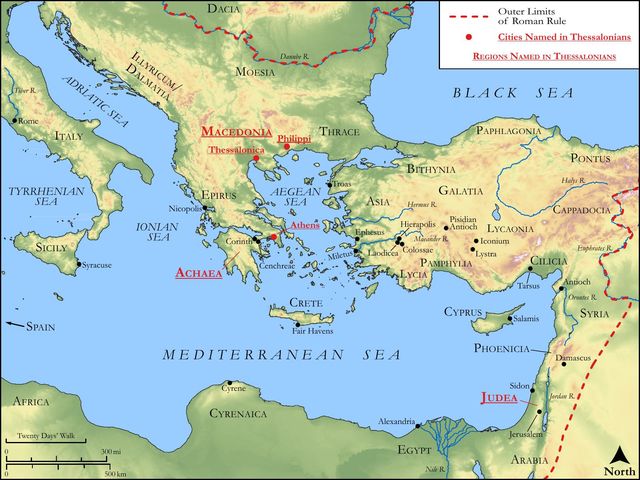
See on the biblical-era maps

Study this verse
Public-domain commentary
Matthew Henry
From his Commentary on the Whole Bible. Henry comments on passages, not single verses — this entry covers 1 Thessalonians 2:17–20.
In these words the apostle apologizes for his absence. Here observe, 1. He tells them they were involuntarily forced from them: We, brethren, were taken from you, Th1 2:17. Such was the rage of his persecutors. He was unwillingly sent away by night to Berea, Act 17:10. 2. Though he was absent in body, yet he was present in heart. He had still a remembrance of them, and great care for them. 3. Even his bodily absence was but for a short time, the time of an hour. Time is short, all our time on earth is short and uncertain, whether we are present with our friends or absent from them. This world is not a place where we are always, or long, to be together. It is in heaven that holy souls shall meet, and never part more. 4. He earnestly desired and endeavoured to see them again: We endeavoured more abundantly to see your face with great desire, Th1 2:17. So that the apostle at least intended his absence should be but for a short time. His desire and endeavour were to return again very soon to Thessalonica. But men of business are not masters of their own time. Paul did his endeavour, and he could do no more, Th1 2:18. 5. He tells them that Satan hindered his return (Th1 2:18), that is, either some enemy or enemies, or the great enemy of mankind, who stirred up opposition to Paul, either in his return to Thessalonica, when he intended to return thither, or stirred up such contentions or dissensions in those places whether he went as made his presence necessary. Note, Satan is a constant enemy to the work of God, and does all he can to obstruct it. 6. He assures them of his affection and high esteem for them, though he was not able, as yet, to be present with them according to his desire. They were his hope, and joy, and crown of rejoicing; his glory and joy. These are expressions of great and endeared affection, and high estimation. And it is happy when ministers and people have such mutual affection and esteem of each other, and especially if they shall thus rejoice, if those that sow and those that reap shall rejoice together, in the presence of our Lord Jesus Christ at his coming.
The apostle here puts the Thessalonians in mind that though he could not come to them as yet, and though he should never be able to come to them, yet our Lord Jesus Christ will come, nothing shall hinder this. And further, when he shall come, all must appear in his presence, or before him. Ministers and people must all appear before him, and faithful people will be the glory and joy of faithful ministers in that great and glorious day.
Historical interpretation
Historical reception
1 surviving comment on this verse from the historical church.
"For what is our hope, or joy, or crown of glorying? Are not even ye before our Lord Jesus at His coming? For ye are our glory and our joy."
Are the Macedonians, tell me, thy hope, O blessed Paul? Not these alone, he says. Therefore he has added, "Are not ye also?" For "what," he says, "is our hope, or joy, or crown of glorying"? Observe then the words, which are those of women, inflamed with tenderness, talking to their little children. "And crown of glorying," he says. For the name of "crown" was not sufficient to express the splendor, but also "of glorying." Of what fiery warmth is this! Never could either mother, or father, yea if they even met together, and commingled their love, have shown their own affection to be equivalent to that of Paul. "My joy and crown," he says, that is, I rejoice in you more than in a crown. For consider how great a thing it is, that an entire Church should be present, planted and rooted by Paul. Who would not rejoice in such a multitude of children, and in the goodness of those children? So that this also is not flattery. For he has not said "ye," but "ye also" together with the others.
Continue studying 1 Thessalonians 2:20 across the web’s major study libraries — every link below opens this exact verse, chapter, or book on the destination site.
Read & Compare
 BibleGatewayThis verse in more than 200 translations and 70 languages.
 Bible.comThe YouVersion reader — hundreds of translations, reading plans, and highlights.
 ESV.orgCrossway's official English Standard Version reader.
 NET BibleThe NET translation with 60,000+ translators' notes on every rendering decision.
 STEP BibleTyndale House's free study tool — original text, vocabulary, and scholarly resources.
 BibliaLogos Bible Software's free web reader.
 USCCBThe New American Bible (Revised Edition) with the U.S. bishops' study notes.
Commentaries
 BibleHub CommentariesDozens of classic commentaries on this verse, gathered on one page.
 StudyLightMore than 100 commentary sets — the largest collection on the web.
 BibleRefPlain-English commentary on what this verse means, verse by verse.
 Enduring WordDavid Guzik's free commentary on this chapter, widely used by Bible teachers.
 Bible Study ToolsVerse commentary alongside Greek and Hebrew study aids.
Original Language & Research
- BibleHub InterlinearThe verse word by word — original language, transliteration, and English.
- BibleHub LexiconEvery word's original-language definition and Strong's entry.
 Blue Letter BibleDeep-study tools — Strong's numbers, concordance, and word studies.
 CNTR CollationThe earliest Greek manuscripts of this verse, collated letter by letter.
Sermons, Hymns & Audio


TrulyRandomVerse is not affiliated with these sites and doesn’t control their content. They’re linked because they’re genuinely useful.
Summary
1 Thessalonians 2:20 serves as a tender and powerful capstone to Paul's defense of his ministry in Thessalonica, declaring the profound spiritual satisfaction and ultimate reward he, Silas, and Timothy derive from the Thessalonian believers' faith and perseverance. It encapsulates the deep pastoral affection and eschatological hope Paul held for this young church, viewing their spiritual flourishing as his greatest honor and source of joy, both in the present and especially at the coming of Christ.
Context
ShowHideLiterary Context
This verse, within the passage on Paul's longing to see the Thessalonians (2:17-3:5), looks back on a significant section in 1 Thessalonians 2, where Paul, Silas, and Timothy recount the nature and integrity of their initial ministry among the Thessalonians. From 1 Thessalonians 2:1-12 Paul defends their pure motives, gentle conduct, and diligent labor, contrasting their genuine care with the manipulative tactics of false teachers. He emphasizes how they shared not only the gospel but their very lives (1 Thessalonians 2:8). Following this, in 1 Thessalonians 2:13-16, Paul commends the Thessalonians for receiving the word of God not as the word of men, but as it truly is, the word of God, which was effectively at work in them. The immediate preceding verses, 1 Thessalonians 2:17-19, express Paul's intense longing to return to them, despite being hindered by Satan. He then poses a rhetorical question in 1 Thessalonians 2:19, asking, "For what is our hope, or joy, or crown of rejoicing? Are not even ye in the presence of our Lord Jesus Christ at his coming?" Verse 20 provides the definitive, affirmative answer, solidifying their identity as his ultimate spiritual reward.
Historical & Cultural Context
Paul's ministry in Thessalonica, as recounted in Acts 17:1-10, was intense but brief, cut short by violent opposition from unbelieving Jews who stirred up a mob. Paul and Silas were forced to leave, leaving behind a nascent church facing immediate persecution (1 Thessalonians 1:6). Despite the forced departure, Paul maintained a deep pastoral concern for their spiritual well-being, sending Timothy to check on them (1 Thessalonians 3:1-5). The letter itself was written from Corinth, likely within a year or two of his departure, after Timothy's positive report. Among the Greeks, "glory" (doxa) often referred to public honor, reputation, or fame, especially that gained through achievement. Paul redefines this concept, grounding his "glory" not in worldly acclaim or personal success, but in the spiritual vitality and faithfulness of those he discipled, a counter-cultural understanding of true honor.
Key Themes
ShowHideThis verse contributes significantly to several major themes within 1 Thessalonians. Firstly, it underscores the theme of Ministerial Reward and the Fruit of Labor. Paul viewed the Thessalonian believers, their steadfast faith, and their spiritual growth as the ultimate vindication and reward for his arduous missionary work, far surpassing any material gain or earthly recognition. Their spiritual health was his "glory" and "joy." Secondly, it highlights the theme of Deep Affection and Spiritual Parenthood. The verse reveals the profound, familial bond between the apostles and their converts, portraying Paul's genuine love and cherishing of these believers as his spiritual children. This echoes a similar sentiment Paul expresses for the Philippian church, whom he calls his "joy and crown" in Philippians 4:1. Finally, it strongly connects to the theme of Eschatological Hope and Christ's Return. The "glory and joy" are not merely for the present but are fully realized and consummated "at the coming" of our Lord Jesus Christ. Paul anticipated presenting these faithful believers to the Lord, which would be his ultimate vindication and source of rejoicing on that Day.
Exposition and Analysis
ShowHideKey Word Analysis
ShowHideFrom the base of δοκέω (dokeō, to seem, to think), this word signifies glory as that which is "very apparent." In this context, dóxa refers to the honor, prestige, or commendation derived from something. For Paul, the Thessalonians' faithfulness was his honor, a visible testament to God's transformative work through his ministry. It is a spiritual and eternal "glory," distinct from worldly acclaim. It reflects the honor bestowed upon the minister by God through the fruit of their labor.
Derived from χαίρω (chairō, to rejoice), chará denotes cheerfulness, deep, abiding gladness, or delight. It is often described as a divinely inspired inner satisfaction. For Paul, this was a profound inner contentment and delight that came from witnessing God's grace powerfully at work in the lives of the Thessalonian believers, seeing them stand firm in their faith despite persecution.
Verse Breakdown
ShowHide"For ye are"
This introductory phrase, using the Greek particle gár (for), provides the reason or explanation for the preceding statement in 1 Thessalonians 2:19. It directly answers Paul's rhetorical question, affirming that the Thessalonian believers themselves are the very essence of his hope, joy, and crown. The "ye" (Greek, hymeîs) emphasizes the believers' personal identity and collective existence as the object of Paul's affection and reward.
"our glory"
This phrase expresses that the spiritual flourishing and steadfastness of the Thessalonian church brought honor and commendation to Paul and his co-laborers. Their transformed lives and faithfulness were a visible demonstration of the effectiveness of the gospel they preached and the genuineness of their ministry. It was a "glory" not sought for personal aggrandizement, but as a reflection of God's power working through them.
"and joy"
Complementing "glory," this signifies the deep, profound delight and inner satisfaction that Paul experienced because of the Thessalonians. Their conversion, perseverance, and growth in Christ filled his heart with a spiritual gladness that transcended any earthly sorrow or hardship he endured in ministry. It was a joy rooted in seeing God's redemptive purposes fulfilled in human lives.
Literary Devices
ShowHideThe verse employs several powerful literary devices. Metonymy is evident as "glory and joy" stand in for the source of glory and joy. The Thessalonian believers are not literally glory or joy, but they are the cause and embodiment of these experiences for Paul. This highlights the profound impact they had on his spiritual and emotional well-being. The use of Rhetorical Question in the preceding verse (1 Thessalonians 2:19) followed by this definitive statement in 1 Thessalonians 2:20 creates a powerful Answering Affirmation, emphasizing the certainty and depth of Paul's conviction. Furthermore, the phrase "glory and joy" functions as a Merism, where two contrasting or complementary terms are used to express a single, comprehensive idea – in this case, the complete and utter satisfaction and honor derived from their spiritual children. Finally, the entire expression serves as a poignant Apostolic Affection, revealing the deep, personal, and parental love Paul held for the believers, transcending mere professional duty.
Theological and Thematic Connections
ShowHidePaul's declaration that the Thessalonian believers are his "glory and joy" profoundly shapes our understanding of true ministerial success and the nature of spiritual reward. It shifts the focus from external metrics of achievement to the internal transformation and faithfulness of those discipled. This perspective aligns with the biblical emphasis on the value of souls and the eternal fruit of righteous labor. It underscores that the ultimate reward for those who faithfully serve God is not earthly recognition or material gain, but the privilege of seeing lives transformed by the gospel, standing firm in faith, and being presented blameless before Christ at His coming. This spiritual fruit brings a joy that is deep, abiding, and eternal, reflecting God's own joy over His redeemed people.
Reflection and Application
ShowHide1 Thessalonians 2:20 offers profound lessons for both spiritual leaders and every believer. For those in ministry or mentorship roles, it reorients our perspective on success: true reward is not found in accolades, numbers, or worldly influence, but in the genuine spiritual growth, perseverance, and faithfulness of those we serve. It calls us to cultivate a deep, selfless love for our spiritual children, mirroring Paul's heart, and to find our deepest satisfaction in their walk with Christ, even amidst trials and opposition. For all believers, this verse is a powerful reminder of the interconnectedness of the body of Christ. Our individual growth in faith, our steadfastness in trials, and our commitment to living out the gospel bring immense joy and honor to those who have poured their lives into us, and ultimately, to God Himself. Your life, lived faithfully, can be a source of "glory and joy" to those who have discipled you, encouraging them and affirming their labor in the Lord. It inspires us to live lives worthy of the gospel, knowing that our spiritual health contributes to the collective joy and triumph of the church.
Questions for Reflection
ShowHideFAQ
ShowHideWhat does Paul mean by "glory" in this context?
ShowHideWhen Paul refers to the Thessalonians as his "glory," he is not speaking of personal fame or worldly recognition. Instead, "glory" (Greek, dóxa) here signifies the honor, commendation, or spiritual prestige that comes from seeing God's work powerfully manifested in the lives of the believers. Their transformed lives, their steadfast faith amidst persecution (1 Thessalonians 1:6-7), and their active witness (1 Thessalonians 1:8-9) were a visible testament to the authenticity of Paul's gospel message and the effectiveness of his ministry. It was a glory that redounded to God, but also brought profound spiritual honor to His servants.
Why does Paul refer to the Thessalonians as his "joy"?
ShowHideThe term "joy" (Greek, chará) here denotes a deep, abiding gladness and inner satisfaction. For Paul, this joy stemmed from witnessing the genuine conversion and spiritual perseverance of the Thessalonian believers. Despite the hardships and persecutions he endured in ministry (1 Thessalonians 2:2), the knowledge that these individuals had embraced the gospel and were walking in truth filled him with profound delight. It was a joy rooted in seeing God's grace at work, fulfilling His redemptive purposes in human lives, and knowing that these believers would stand firm "in the presence of our Lord Jesus Christ at his coming" (1 Thessalonians 2:19).
Christ-Centered Fulfillment
ShowHide1 Thessalonians 2:20, while expressing Paul's personal joy, ultimately finds its deepest fulfillment in the person and work of Jesus Christ. Paul's "glory and joy" in the Thessalonians is a reflection of Christ's own "glory and joy" in His redeemed people. Just as Paul anticipated presenting the Thessalonians as his "crown of rejoicing" at the Lord's coming (1 Thessalonians 2:19), so too will Christ present His church, "a glorious church, not having spot, or wrinkle, or any such thing; but that it should be holy and without blemish" (Ephesians 5:27). The Thessalonians' faith and perseverance were not merely a human achievement but the fruit of Christ's redemptive work in them, empowered by the Holy Spirit. Jesus Himself, "for the joy that was set before him endured the cross, despising the shame" (Hebrews 12:2), and that joy was the multitude of believers He would redeem. The "glory" Paul receives is derivative of the ultimate glory that belongs to Christ, who is "the image of the invisible God" (Colossians 1:15). Thus, the Thessalonians are Paul's glory and joy because they are first and foremost Christ's glory and joy, purchased by His blood and being conformed to His image, awaiting the day when they will be "like him; for we shall see him as he is" (1 John 3:2).