


Acts 17:10
Bible text: King James Version (1769 Blayney text) · Public domain
Bible text: King James Version with Strong's numbers · Public domain
Bible text: Berean Standard Bible · Public domain
Bible text: American Standard Version (1901) · Public domain
Bible text: World English Bible, Messianic edition · Public domain
Bible text: Geneva Bible (1599) · Public domain
Bible text: Young's Literal Translation · Public domain
- ΟἱHoi<the>G3588T-NPMDefinite article Nominative Plural Masculine
- δὲdeAndG1161CONJConjunction
- ἀδελφοὶadelphoithe brothersG80N-NPMNoun Nominative Plural Masculine
- εὐθέωςeutheōsimmediatelyG2112ADVAdverb
- διὰdiathroughG1223PREPPreposition
- τῆςtēs<the>G3588T-GSFDefinite article Genitive Singular Feminine
- νυκτὸςnuktosnightG3571N-GSFNoun Genitive Singular Feminine
- ἐξέπεμψανexepempsansent awayG1599V-AAI-3PVerb Aorist Active Indicative 3rd Plural
- τόνton<the>G3588T-ASMDefinite article Accusative Singular Masculine
- τεtebothG5037CONJConjunction
- ΠαῦλονPaulonPaulG3972N-ASM-PNoun Accusative Singular Masculine Individual
- καὶkaiandG2532CONJConjunction
- τὸνton<the>G3588T-ASMDefinite article Accusative Singular Masculine
- ΣιλᾶνSilanSilasG4609N-ASM-PNoun Accusative Singular Masculine Individual
- εἰςeistoG1519PREPPreposition
- ΒέροιανBeroianBereaG960N-ASF-LNoun Accusative Singular Feminine Location
- οἵτινεςoitineswhoG3748R-NPMRelative pronoun Nominative Plural Masculine
- παραγενόμενοιparagenomenoihaving arrivedG3854V-2ADP-NPMVerb 2nd Aorist Middle Deponent Participle Nominative Plural Masculine
- εἰςeisintoG1519PREPPreposition
- τὴνtēntheG3588T-ASFDefinite article Accusative Singular Feminine
- συναγωγὴνsunagōgēnsynagogueG4864N-ASFNoun Accusative Singular Feminine
- τῶνtōnof theG3588T-GPMDefinite article Genitive Plural Masculine
- ἸουδαίωνIoudaiōnJewsG2453N-GPM-PGNoun Genitive Plural Masculine Person Gentilic
- ἀπῄεσανapēesanwere goingG549V-IAI-3PVerb Imperfect Active Indicative 3rd Plural
English is a literal word-by-word gloss of the Greek, not the KJV's wording. Why?
This is the original text the KJV's translators worked from — each Greek word with its own literal English meaning in this verse, prepared by scholars at Tyndale House, Cambridge. The KJV translates whole sentences, not word by word, so its wording differs: one Greek word can become several English words, and the KJV may choose “charity” where the gloss reads “love”. Both are faithful — they answer different questions. For the KJV's own rendering, switch to the KJV text.
Details
See on the biblical-era maps
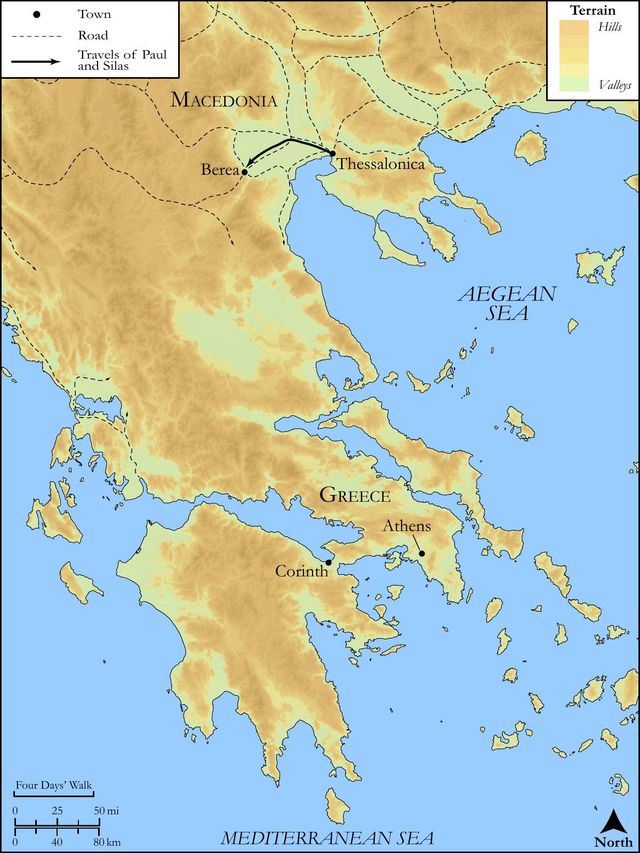
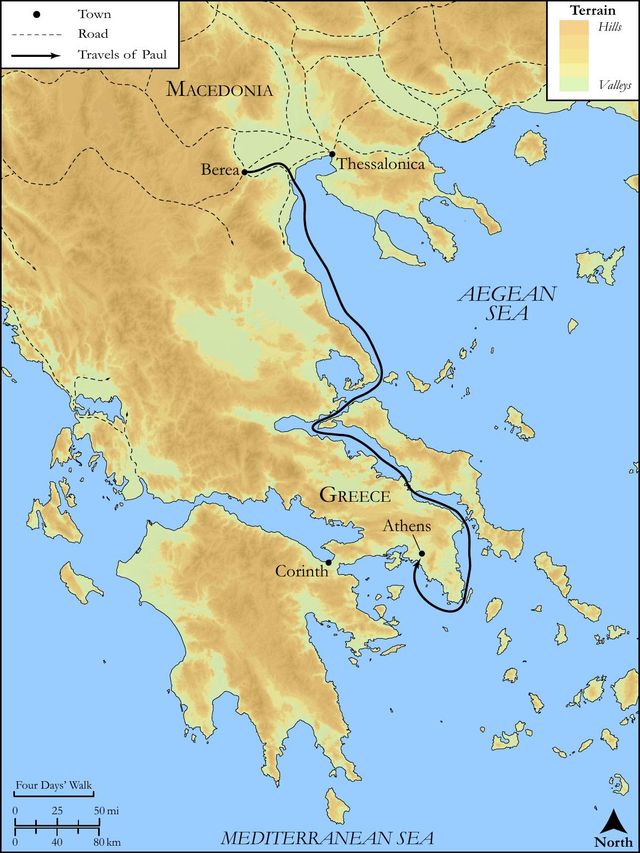
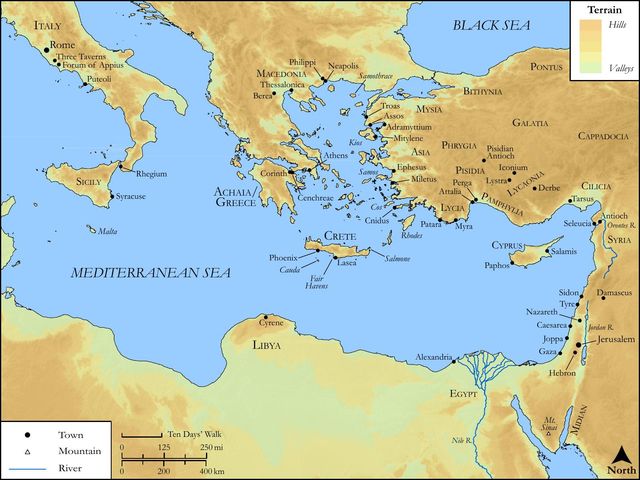
Study this verse
Public-domain commentary
Matthew Henry
From his Commentary on the Whole Bible. Henry comments on passages, not single verses — this entry covers Acts 17:10–15. His four-level outline is real structure in the source text, so it is rendered as structure.
In these verses we have,
I.Paul and Silas removing to Berea, and employed in preaching the gospel there, Act 17:10.
They had proceeded so far at Thessalonica that the foundations of a church were laid, and others were raised up to carry on the work that was begun, against whom the rulers and people were not so much prejudiced as they were against Paul and Silas; and therefore when the storm rose they withdrew, taking this as an indication to them that they must quit that place for the present. That command of Christ to his disciples, When they persecute you in one city flee to another, intends their flight to be not so much for their own safety ("flee to another, to hide there") as for the carrying on of their work ("flee to another, to preach there"), as appears by the reason given - You shall not have gone over the cities of Israel till the Son of man come, Mat 10:23. Thus out of the eater came forth meat, and the devil was outshot in his own bow; he thought by persecuting the apostles to stop the progress of the gospel, but it was so overruled as to be made to further it. See here,
1.The care that the brethren took of Paul and Silas, when they perceived how the plot was laid against them: They immediately sent them away by night, incognito, to Berea. This could be no surprise to the young converts; For when we were with you (saith Paul to them, Th1 3:4), when we came first among you, we told you that we should suffer tribulation, even as it came to pass, and you know. It should seem that Paul and Silas would willingly have staid, and faced the storm, if the brethren would have let them; but they would rather be deprived of the apostles' help than expose their lives, which, it should seem, were dearer to their friends than to themselves. They sent them away by night, under the covert of that, as if they had been evil doers.
2.The constancy of Paul and Silas in their work. Though they fled from Thessalonica, they did not flee from the service of Christ. When they came to Berea, they went into the synagogue of the Jews, and made their public appearance there. Though the Jews at Thessalonica had been their spiteful enemies, and, for aught they knew, the Jews at Berea would be so too, yet they did not therefore decline paying their respect to the Jews, either in revenge for the injuries they had received or for fear of what they might receive. If others will not do their duty to us, yet we ought to do ours to them.
II.The good character of the Jews in Berea (Act 17:11):
These were more noble than those in Thessalonica. The Jews in the synagogue at Berea were better disposed to receive the gospel than the Jews in the synagogue at Thessalonica; they were not so bigoted and prejudiced against it, not so peevish and ill-natured; they were more noble, eugenesteroi - better bred.
1.They had a freer thought, and lay more open to conviction, were willing to hear reason, and admit the force of it, and to subscribe to that which appeared to them to be truth, though it was contrary to their former sentiments. This was more noble.
2.They had a better temper, were not so sour, and morose, and ill-conditioned towards all that were not of their mind, As they were ready to come into a unity with those that by the power of truth they were brought to concur with, so they continued in charity with those that they saw cause to differ from. This was more noble. They neither prejudged the cause, nor were moved with envy at the managers of it, as the Jews at Thessalonica were, but very generously gave both it and them a fair hearing, without passion or partiality; for,
(1.)They received the word with all readiness of mind; they were very willing to hear it, presently apprehended the meaning of it, and did not shut their eyes against the light. They attended to the things that were spoken by Paul, as Lydia did, and were very well pleased to hear them. They did not pick quarrels with the word, nor find fault, nor seek occasion against the preachers of it; but bade it welcome, and put a candid construction upon every thing that was said. Herein they were more noble than the Jews in Thessalonica, but walked in the same spirit, and in the same steps, with the Gentiles there, of whom it is said that they received the word with joy of the Holy Ghost, and turned to God from idols, Th1 1:6-9. This was true nobility. The Jews gloried much in their being Abraham's seed, thought themselves well-born and that they could not be better born. But they are here told who among them were the most noble and the best-bred men - those that were most disposed to receive the gospel, and had the high and conceited thoughts in them subdued, and brought into obedience to Christ. They were the most noble, and, if I may so say, the most gentleman-like men. Nobilitas sola est atque unica virtus - Virtue and piety are true nobility, true honour; and, without these, Stemmata quid prosunt? - What are pedigrees and pompous titles worth?
(2.)They searched the scriptures daily whether those things were so. Their readiness of mind to receive the word was not such as that they took things upon trust, swallowed them upon an implicit faith: no; but since Paul reasoned out of the scriptures, and referred them to the Old Testament for the proof of what he said, they had recourse to their Bibles, turned to the places to which he referred them, read the context, considered the scope and drift of them, compared them with other places of scripture, examined whether Paul's inferences from them were natural and genuine and his arguments upon them cogent, and determined accordingly. Observe,
[1.]The doctrine of Christ does not fear a scrutiny. We that are advocates for his cause desire no more than that people will not say, These things are not so, till they have first, without prejudice and partiality, examined whether they be so or no.
[2.]The New Testament is to be examined by the Old. The Jews received the Old Testament, and those that did so, if they considered things aright, could not but see cause sufficient to receive the New, because in it they see all the prophecies and promises of the Old fully and exactly accomplished.
[3.]Those that read and receive the scriptures must search them (Joh 5:39), must study them, and take pains in considering them, both that they may find out the truth contained in them, and may not mistake the sense of them and so run into error, or remain in it; and that they may find out the whole truth contained in them, and may not rest in a superficial knowledge, in the outward court of the scriptures, but may have an intimate acquaintance with the mind of God revealed in them.
[4.]Searching the scriptures must be our daily work. Those that heard the word in the synagogue on the sabbath day did not think this enough, but were searching it every day in the week, that they might improve what they ha heard the sabbath before, and prepare for what they were to hear the sabbath after.
[5.]Those are truly noble, and are in a fair way to be more and more so, that make the scriptures their oracle and touchstone, and consult them accordingly. Those that rightly study the scriptures, and meditate therein day and night, have their minds filled with noble thoughts, fixed to noble principles, and formed for noble aims and designs. These are more noble.
III.The good effect of the preaching of the gospel at Berea:
it had the desired success; the people's hearts being prepared, a great deal of work was done suddenly, Act 17:12.
1.Of the Jews there were many that believed. At Thessalonica there were only some of them that believed (Act 17:4), but at Berea, where they heard with unprejudiced minds, many believed, many more Jews than at Thessalonica. Note, God gives grace to those whom he first inclines to make a diligent use of the means of grace, and particularly to search the scriptures.
2.Of the Greeks likewise, the Gentiles, many believed, both of the honourable women, the ladies of quality, and of men not a few, men of the first rank, as should seem by their being mentioned with the honourable women. The wives first embraced the gospel, and then they persuaded their husbands to embrace it. For what knowest thou, O wife, but thou shalt save thy husband? Co1 7:16.
IV.The persecution that was raised against Paul and Silas at Berea, which forced Paul thence.
1.The Jews at Thessalonica were the mischief-makers at Berea. They had notice that the word of God was preached at Berea (for envy and jealousy bring quick intelligence), and likewise that the Jews there were not so inveterately set against it as they were. They came thither also, to turn the world upside down there, and they stirred up the people, and incensed them against the preachers of the gospel; as if they had such a commission from the prince of darkness to go from place to place to oppose the gospel as the apostles had to go from place to place to preach it. Thus we read before that the Jews of Antioch and Iconium came to Lystra on purpose to incense the people against the apostles, Act 14:19. See how restless Satan's agents are in their opposition to the gospel of Christ and the salvation of the souls of men. This is an instance of the enmity that is in the serpent's seed against the seed of the woman; and we must not think it strange if persecutors at home extend their rage to stir up persecution abroad.
2.This occasioned Paul's removal to Athens. By seeking to extinguish this divine fire which Christ had already kindled, they did but spread it the further and the faster; so long Paul staid at Berea, and such success he had there, that there were brethren there, and sensible active men too, which appeared by the care they took of Paul, Act 14:14. They were aware of the coming of the persecuting Jews from Thessalonica, and that they were busy in irritating the people against Paul; and, fearing what it would come to, they lost no time, but immediately sent Paul away, against whom they were most prejudiced and enraged, hoping that this would pacify them, while they retained Silas and Timothy there still, who, now that Paul had broken the ice, might be sufficient to carry on the work without exposing him. They sent Paul to go even to the sea, so some; to go as it were to the sea, so we read it; hōs epi tēn thalassaṅ He went out from Berea, in that road which went to the sea, that the Jews, if they enquired after him, might think he had gone to a great distance; but he went by land to Athens, in which there was no culpable dissimulation at all. Those that conducted Paul (as his guides and guards, he being both a stranger in the country and one that had many enemies) brought him to Athens. The Spirit of God, influencing his spirit, directed him to that famous city, - famous of old for its power and dominion, when the Athenian commonwealth coped with the Spartan, - famous afterwards for learning; it was the rendezvous of scholars. Those who wanted learning went thither to show it. It was a great university, much resorted to from all parts, and therefore, for the better diffusing of gospel light, Paul is sent thither, and is not ashamed nor afraid to show his face among the philosophers there, and there to preach Christ crucified, though he knew it would be as much foolishness to the Greeks as it was to the Jews a stumbling-block.
3.He ordered Silas and Timothy to come to him to Athens, when he found there was a prospect of doing good there; or because, there being none there that he knew, he was solitary and melancholy without them. Yet it should seem that, great as was the haste he was in for them, he ordered Timothy to go about Thessalonica, to bring him an account of the affairs of that church; for he says (Th1 3:1, Th1 3:2), We thought it good to be left at Athens alone, and sent Timotheus to establish you.
Historical interpretation
Historical reception
1 surviving comment on this verse from the historical church.
"And the brethren immediately sent away Paul and Silas by night unto Berea: who coming thither went into the synagogue of the Jews. These were more noble," it says, "than they of Thessalonica: more noble," i.e. more gentle in their behavior: "in that they received the word with all readiness," and this not inconsiderately, but with a strictness wherein was no passion, "searching the Scriptures whether these things were so."
Continue studying Acts 17:10 across the web’s major study libraries — every link below opens this exact verse, chapter, or book on the destination site.
Read & Compare
 BibleGatewayThis verse in more than 200 translations and 70 languages.
 Bible.comThe YouVersion reader — hundreds of translations, reading plans, and highlights.
 ESV.orgCrossway's official English Standard Version reader.
 NET BibleThe NET translation with 60,000+ translators' notes on every rendering decision.
 STEP BibleTyndale House's free study tool — original text, vocabulary, and scholarly resources.
 BibliaLogos Bible Software's free web reader.
 USCCBThe New American Bible (Revised Edition) with the U.S. bishops' study notes.
Commentaries
 BibleHub CommentariesDozens of classic commentaries on this verse, gathered on one page.
 StudyLightMore than 100 commentary sets — the largest collection on the web.
 BibleRefPlain-English commentary on what this verse means, verse by verse.
 Enduring WordDavid Guzik's free commentary on this chapter, widely used by Bible teachers.
 Bible Study ToolsVerse commentary alongside Greek and Hebrew study aids.
Original Language & Research
- BibleHub InterlinearThe verse word by word — original language, transliteration, and English.
- BibleHub LexiconEvery word's original-language definition and Strong's entry.
 Blue Letter BibleDeep-study tools — Strong's numbers, concordance, and word studies.
 CNTR CollationThe earliest Greek manuscripts of this verse, collated letter by letter.
Sermons, Hymns & Audio


TrulyRandomVerse is not affiliated with these sites and doesn’t control their content. They’re linked because they’re genuinely useful.
Summary
Acts 17:10 details the urgent, clandestine departure of Paul and Silas from Thessalonica, facilitated by the local believers, and their immediate journey to Berea, where, upon arrival, they continued their established missionary practice of entering the Jewish synagogue to proclaim the Gospel. This verse marks a pivotal transition in their second missionary journey, highlighting both the persistent opposition they faced and their unwavering commitment to spreading the Christian message.
Context
ShowHideLiterary Context
This verse serves as a direct continuation and consequence of the events described in Acts 17:1-9. In Thessalonica, Paul and Silas had preached in the synagogue for three Sabbaths, reasoning from the Scriptures that Christ must suffer and rise from the dead, and that Jesus was this Christ. While some Jews and a large number of devout Greeks and prominent women believed, a group of unbelieving Jews became jealous. They incited a mob, assaulted Jason's house (where Paul and Silas were staying), and dragged Jason and some other believers before the city authorities, accusing them of treason against Caesar by proclaiming another king, Jesus. The authorities, after taking security from Jason and the others, released them. It is in this volatile and dangerous atmosphere that the Thessalonian "brethren" (the newly formed Christian community) recognized the necessity of immediately and secretly sending Paul and Silas away to ensure their safety and the continued propagation of the Gospel. The narrative flow emphasizes the rapid escalation of opposition and the swift, decisive action taken by the early church to protect its leaders and mission.
Historical & Cultural Context
Thessalonica was a significant Roman provincial capital in Macedonia, a free city with its own assembly and magistrates, which explains the specific legal accusations leveled against Paul and Silas. Its strategic location on the Egnatian Way, a major Roman road, made it an important center for trade and communication, and thus a crucial target for early Christian evangelism. Berea (modern Veria), located about 50 miles southwest of Thessalonica, was another Macedonian city, though perhaps less prominent. The "night" departure underscores the urgency and danger of the situation, a common tactic for evading arrest or mob violence, as when the disciples at Damascus took Paul by night and let him down by the wall in a basket. The consistent practice of Paul and Silas entering the "synagogue of the Jews" upon arriving in a new city reflects a well-established missionary strategy. Synagogues served not only as places of worship for Jewish communities but also as centers for learning, community gathering, and often, for Gentile "God-fearers" who were attracted to monotheism and Jewish ethics. This provided a natural entry point for the apostles to present the Gospel, as the audience already possessed a foundational understanding of the Old Testament Scriptures.
Key Themes
ShowHideActs 17:10 contributes to several overarching themes within the book of Acts and Paul's ministry. Firstly, it powerfully illustrates Missionary Perseverance and Resilience in the face of intense persecution. Despite being violently driven out of Thessalonica, Paul and Silas did not falter but immediately pressed on to a new city to continue their work, embodying the apostolic mandate to preach the Gospel "to the ends of the earth" Acts 1:8. Secondly, the actions of "the brethren" highlight the vital theme of Christian Community and Solidarity. The nascent church in Thessalonica demonstrated practical love and protective care for their spiritual leaders, underscoring the importance of mutual support within the body of Christ, especially during times of adversity. Thirdly, the verse subtly points to Divine Providence and Guidance, as God orchestrates events, even persecution, to direct His servants to new mission fields, ensuring the Gospel's spread. This aligns with the broader narrative of Acts where the Holy Spirit continually guides the apostles' movements, as seen earlier in Acts 16:6-10. Finally, Paul's consistent Missionary Strategy of first engaging with the Jewish community in the synagogue is reiterated here, reflecting his conviction that the Gospel was "to the Jew first and also to the Greek" Romans 1:16.
Exposition and Analysis
ShowHideKey Word Analysis
ShowHideThis adverb signifies a swift, direct, and instantaneous action. Its inclusion emphasizes the urgency and lack of delay in the brethren's decision to send Paul and Silas away, likely due to the immediate danger posed by the mob in Thessalonica. It also highlights the apostles' readiness to continue their mission without hesitation.
Derived from ek (out of) and pempō (to send), this verb means "to despatch" or "to send forth." It conveys the deliberate act of the Thessalonian believers in arranging and executing the departure of Paul and Silas. It suggests not merely a passive leaving but an active, protective escort or arrangement for their journey, underscoring the community's care.
This term refers to an "assemblage of persons," specifically a Jewish "synagogue," which served as the primary place of worship, study, and community gathering for Jews in the diaspora. Paul's consistent practice of entering the synagogue first upon arriving in a new city demonstrates his strategic approach to evangelism, leveraging existing religious frameworks and audiences familiar with the Old Testament Scriptures.
Verse Breakdown
ShowHide"And the brethren immediately sent away Paul and Silas by night unto Berea"
This clause reveals the immediate and protective action taken by the newly formed Christian community in Thessalonica. The term "brethren" (Greek: adelphoi) denotes the fellow believers, highlighting the solidarity and mutual care within the early church. The urgency ("immediately") and the timing ("by night") underscore the peril Paul and Silas faced, necessitating a discreet and swift departure to evade the hostile mob. Their destination, Berea, signifies the continued forward movement of the Gospel despite opposition.
"who coming [thither] went into the synagogue of the Jews"
This second clause describes Paul and Silas's actions upon arrival in Berea. The phrase "who coming thither" confirms their successful and safe arrival. Their immediate action of going "into the synagogue of the Jews" demonstrates their consistent missionary strategy. Regardless of the persecution faced in Thessalonica, they returned to their established method of engaging with Jewish communities first, using the Old Testament as a foundation to present Jesus as the Messiah. This highlights their unwavering commitment to their calling and their strategic approach to evangelism.
Literary Devices
ShowHideThe verse employs several literary devices to convey its meaning and impact. Narrative Pacing is evident in the use of "immediately" (euthéōs), which accelerates the narrative, emphasizing the urgency of the situation and the swift transition from conflict to continued mission. This creates a sense of continuous, dynamic movement characteristic of the book of Acts. Contrast is present between the hostile environment of Thessalonica, from which they are forced to flee, and the new, albeit temporary, opportunity for ministry in Berea. The "night" departure itself serves as a form of Symbolism, representing the danger and secrecy required for their escape, yet paradoxically leading to the light of the Gospel being brought to a new city. Furthermore, the Repetition of Paul's missionary pattern—entering the synagogue—reinforces his consistent methodology and commitment to reaching his own people first, even in the face of previous negative experiences.
Theological and Thematic Connections
ShowHideActs 17:10 powerfully illustrates the divine sovereignty that governs the spread of the Gospel, even through adverse circumstances. What appears to be a setback—being driven out of Thessalonica—is, in God's providence, a strategic redirection, opening a new door for ministry in Berea. This reflects a recurring pattern in Acts where persecution inadvertently serves to scatter believers and the message, leading to wider evangelization. The steadfastness of Paul and Silas, combined with the protective care of the Thessalonian believers, underscores the resilience of the early church and the vital role of Christian community in sustaining ministry. It teaches that the mission of God is unstoppable, finding new avenues even when old ones are closed, and that faithful obedience involves both courage in proclamation and wisdom in knowing when to withdraw and regroup.
Reflection and Application
ShowHideActs 17:10 offers profound lessons for contemporary believers. The immediate and decisive action of the Thessalonian "brethren" reminds us of the critical importance of Christian community in supporting and protecting those engaged in ministry, especially when they face opposition. It calls us to consider how we, as a church body, can actively care for and facilitate the work of those on the front lines, whether locally or globally. Furthermore, Paul and Silas's unwavering commitment to their mission, even after being forced to flee under duress, serves as a powerful example of perseverance. It challenges us to examine our own resilience in the face of difficulties, reminding us that setbacks in ministry or personal faith journeys are often opportunities for God to redirect us to new fields of service or to deepen our trust in His guidance. Their consistent strategy of engaging with those already familiar with God's word, even amidst hostility, also encourages us to be strategic and adaptable in our evangelism, meeting people where they are while remaining faithful to the core message of the Gospel.
Questions for Reflection
ShowHideFAQ
ShowHideWhy did the brethren send Paul and Silas away "by night"?
ShowHideThe phrase "by night" (Greek: dia nyktos) indicates that the departure was urgent, secretive, and intended to avoid detection by the hostile mob that had been stirred up in Thessalonica. Following the uproar described in Acts 17:5-9, Paul and Silas were in immediate danger of arrest or further violence. Sending them away under the cover of darkness was a practical and necessary measure to ensure their safety and allow them to escape unnoticed, demonstrating the Thessalonian believers' wisdom and protective care for the apostles.
What was the significance of Paul and Silas going "into the synagogue of the Jews" in Berea?
ShowHidePaul's consistent practice of first going to the Jewish synagogue in each new city was a strategic missionary approach. The synagogue served as a natural point of entry for the Gospel because it gathered people who already believed in the one true God and were familiar with the Old Testament Scriptures. This allowed Paul to present Jesus as the fulfillment of Jewish prophecy, reasoning from the very texts his audience held sacred. While his message often met with opposition from some Jews, it also provided a platform to reach both Jews and Gentile "God-fearers" who attended the synagogue, as seen in Acts 17:4 in Thessalonica and later in Acts 17:11-12. This method reflects Paul's commitment to the principle that the Gospel was "to the Jew first and also to the Greek" Romans 1:16.
Christ-Centered Fulfillment
ShowHideActs 17:10, though seemingly a simple narrative detail of travel, profoundly reflects Christ's ongoing mission and His sovereign care for His church. Just as Christ Himself faced relentless opposition and was ultimately "sent away" from this world through His crucifixion, only to rise and send His disciples forth John 20:21, so too are His servants continually propelled forward in the face of adversity. The "brethren" acting to protect Paul and Silas mirrors the communal love and self-sacrifice exemplified by Christ, who laid down His life for His sheep John 10:11. Furthermore, Paul and Silas's unwavering commitment to continue preaching the Gospel, even after being driven out, is a direct fulfillment of Christ's Great Commission Matthew 28:19-20 and His promise that the gates of hell would not prevail against His church Matthew 16:18. Their journey to Berea, facilitated by the community, demonstrates the living Christ actively guiding and preserving His witnesses, ensuring that His word continues to spread, ultimately building His kingdom until His glorious return Revelation 11:15.