


Acts 9:25
- λαβόντεςlabonteshaving takenG2983V-2AAP-NPMVerb 2nd Aorist Active Participle Nominative Plural Masculine
- δὲdehoweverG1161CONJConjunction
- οἱhoitheG3588T-NPMDefinite article Nominative Plural Masculine
- μαθηταὶmathētaidisciplesG3101N-NPMNoun Nominative Plural Masculine
- νυκτὸςnuktosby nightG3571N-GSFNoun Genitive Singular Feminine
- διὰdiathroughG1223PREPPreposition
- τοῦtoutheG3588T-GSNDefinite article Genitive Singular Neuter
- τείχουςteichouswallG5038N-GSNNoun Genitive Singular Neuter
- καθῆκανkathēkanthey let downG2524V-AAI-3PVerb Aorist Active Indicative 3rd Plural
- αὐτὸνautonhimG846P-ASMPersonal pronoun Accusative Singular Masculine
- χαλάσαντεςchalasanteshaving lowered [him]G5465V-AAP-NPMVerb Aorist Active Participle Nominative Plural Masculine
- ἐνeninG1722PREPPreposition
- σπυρίδιspuridia basketG4711N-DSFNoun Dative Singular Feminine
English is a literal word-by-word gloss of the Greek, not the KJV's wording. Why?
This is the original text the KJV's translators worked from — each Greek word with its own literal English meaning in this verse, prepared by scholars at Tyndale House, Cambridge. The KJV translates whole sentences, not word by word, so its wording differs: one Greek word can become several English words, and the KJV may choose “charity” where the gloss reads “love”. Both are faithful — they answer different questions. For the KJV's own rendering, switch to the KJV text.
Details
See on the biblical-era map
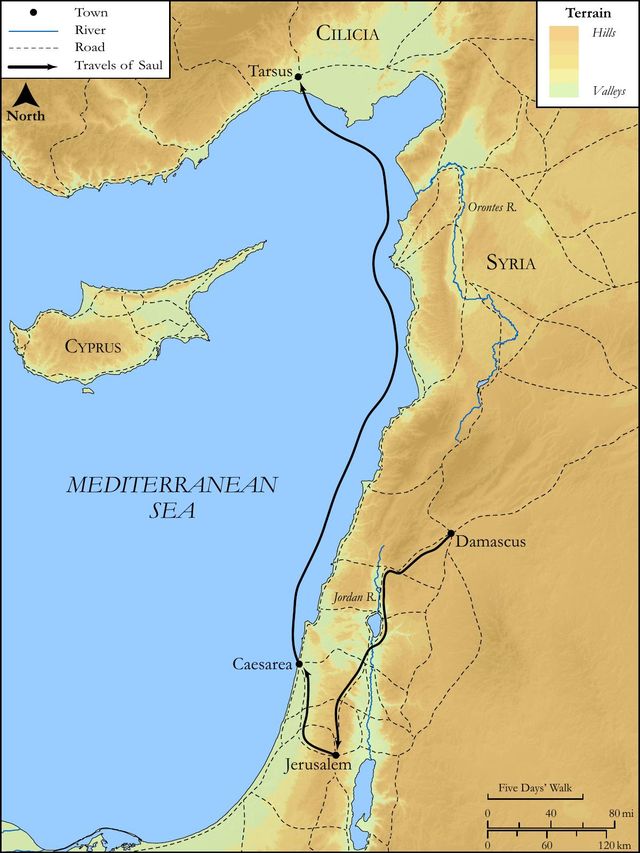
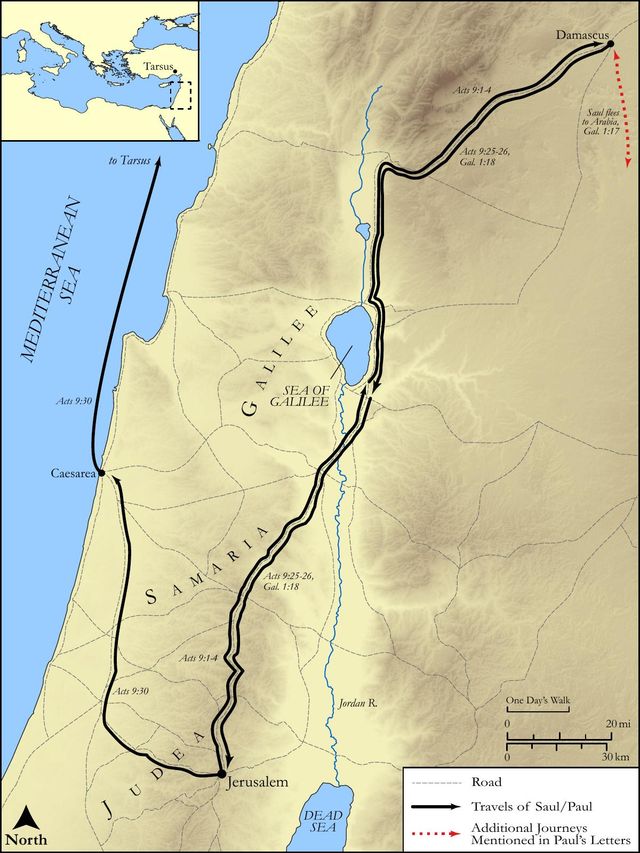
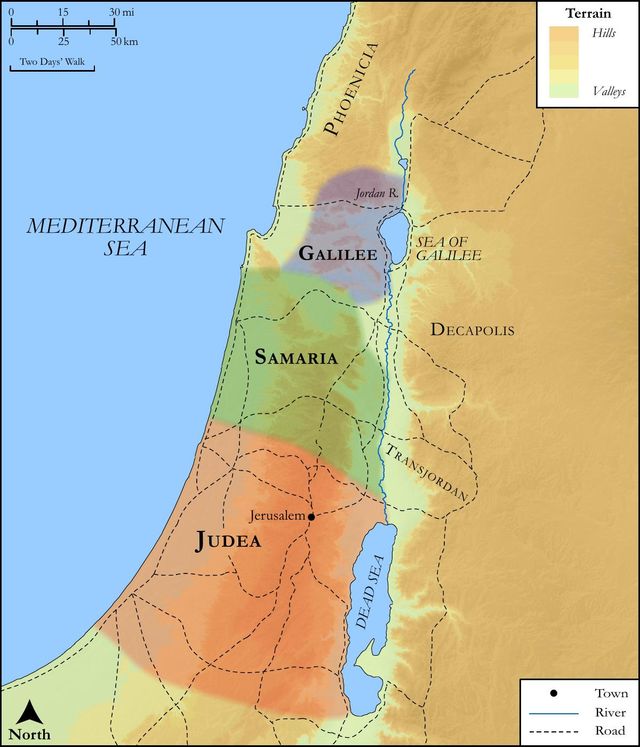
Study this verse
Public-domain commentary
Matthew Henry
From his Commentary on the Whole Bible. Henry comments on passages, not single verses — this entry covers Acts 9:23–31. His four-level outline is real structure in the source text, so it is rendered as structure.
Luke here makes no mention of Paul's journey into Arabia, which he tells us himself was immediately after his conversion, Gal 1:16, Gal 1:17. As soon as God had revealed his Son in him, that he might preach him, he went not up to Jerusalem, to receive instructions from the apostles (as any other convert would have done, that was designed for the ministry), but he went to Arabia, where there was new ground to break up, and where he would have opportunity of teaching, but not learning; thence he returned to Damascus, and there, three years after his conversion, this happened, which is here recorded.
I.He met with difficulties at Damascus, and had a narrow escape of being killed there. Observe,
1.What his danger was (Act 9:23): The Jews took counsel to kill him, being more enraged at him than at any other of the preachers of the gospel, not only because he was more lively and zealous in his preaching than any of them, and more successful, but because he had been such a remarkable deserter, and his being a Christian was a testimony against them. It is said (Act 9:24), The Jews watched the gates day and night to kill him; they incensed the governor against him, as a dangerous man, who therefore kept the city with a guard to apprehend him, at his going out or coming in, Co2 11:32. Now Christ showed Paul what great things he must suffer for his name (Act 9:16), when here was presently the government in arms against him, which was a great thing, and, as all his other sufferings afterwards, helped to make him considerable. Saul was no sooner a Christian than a preacher, no sooner a preacher than a sufferer; so quickly did he rise to the summit of his preferment. Note, Where God gives great grace he commonly exercises it with great trials.
2.How he was delivered.
(1.)The design against him was discovered: Their lying in wait was known of Saul, by some intelligence, whether from heaven or from men we are not told.
(2.)The disciples contrived to help him away - hid him, it is likely, by day; and in the night, the gates being watched, that he could not get away through them, they let him down by the wall, in a basket, as he himself relates it (Co2 11:33), so he escaped out of their hands. This story, as it shows us that when we enter into the way of God we must look for temptation, and prepare accordingly, so it shows us that the Lord knows how to deliver the godly out of temptation, and will with the temptation also make a way to escape, that we may not be by it deterred nor driven from the way of God.
II.He met with difficulties at Jerusalem the first time he went thither, Act 9:26.
He came to Jerusalem. This is thought to be that journey to Jerusalem of which he himself speaks (Gal 1:18): After three years I went up to Jerusalem, saith he, to see Peter, and abode with him fifteen days. But I rather incline to think that this was a journey before that, because his coming in and going out, his preaching and disputing (Act 9:28, Act 9:29), seem to be more than would consist with his fifteen days' stay (for that was no more) and to require a longer time; and, besides, now he came a stranger, but then he came, historēsai - to confer with Peter, as one he was intimate with; however, it might possibly be the same. Now observe,
1.How shy his friends were of him (Act 9:26): When he came to Jerusalem, he did not go to the chief priests and the Pharisees (he had taken his leave of them long since), but he assayed to join himself to the disciples. Wherever he came, he owned himself one of that despised persecuted people, and associated with them. They were now in his eyes the excellent ones of the earth, in whom was all his delight. He desired to be acquainted with them, and to be admitted into communion with them; but they looked strange upon him, shut the door against him, and would not go about any of their religious exercises if he were by, for they were afraid of him. Now might Paul be tempted to think himself in an ill case, when the Jews had abandoned and persecuted him, and the Christians would not receive and entertain him. Thus does he fall into divers temptations, and needs the armour of righteousness, as we all do, both on the right hand and on the left, that we may not be discouraged either by the unjust treatment of our enemies or the unkind treatment of our friends.
(1.)See what was the cause of their jealousy of him: They believed not that he was a disciple, but only pretended to be so, and came among them as a spy or an informer. They knew what a bitter persecutor he had been, with what fury he went to Damascus some time ago; they had heard nothing of him since, and therefore thought he was but a wolf in sheep's clothing. The disciples of Christ had need to be cautious whom they admit into communion with them. Believe not every spirit. There is need of the wisdom of the serpent, to keep the mean between the extremes of suspicion on the one hand and credulity on the other; yet methinks it is safer to err on the charitable side, because it is an adjudged case that it is better the tares should be found among the wheat than that the wheat should any of it be rooted up and thrown out of the field.
(2.)See how it was removed (Act 9:27): Barnabas took him to the apostles themselves, who were not so scrupulous as the inferior disciples, to whom he first assayed to join himself, and he declared to them,
[1.]What Christ had done for him: He had shown himself to him in the way and spoken to him; and what he said.
[2.]What he had since done for Christ: He had preached boldly at Damascus in the name of Jesus. How Barnabas came to know this, more than the rest of them, we are not told; whether he had himself been at Damascus, or had had letters thence, or discoursed with some of that city, by which he came to the knowledge of this; or whether he had formerly been acquainted with Paul in the Grecian synagogues, or at the feet of Gamaliel, and had such an account of his conversion from himself as he saw cause enough to give credit to: but so it was that, being satisfied himself, he gave satisfaction to the apostles concerning him, he having brought no testimonials from the disciples at Damascus, thinking he needed not, as some others, epistles of commendation, Co2 3:1. Note, The introducing of a young convert into the communion of the faithful is a very good work, and one which, as we have opportunity, we should be ready to do.
2.How sharp his enemies were upon him.
(1.)He was admitted into the communion of the disciples, which was no little provocation to his enemies. It vexed the unbelieving Jews to see Saul a trophy of Christ's victory, and a captive to his grace, who had been such a champion for their cause - to see him coming in, and going out, with the apostles (Act 9:28), and to hear them glorying in him, or rather glorifying God in him.
(2.)He appeared vigorous in the cause of Christ, and this was yet more provoking to them (Act 9:29): He spoke boldly in the name of the Lord Jesus. Note, Those that speak for Christ have reason to speak boldly; for they have a good cause, and speak for one who will at last speak for himself and them too. The Grecians, or Hellenist Jews, were most offended at him, because he had been one of them; and they drew him into a dispute, in which, no doubt, he was too hard for them, as he had been for the Jews at Damascus. One of the martyrs said, Though she could not dispute for Christ, she could die for Christ; but Paul could do both. Now the Lord Jesus divided the spoils of the strong man armed in Saul. For that same natural quickness and fervour of spirit which, while he was in ignorance and unbelief, made him a furious bigoted persecutor of the faith, made him a most zealous courageous defender of the faith.
(3.)This brought him into peril of his life, with which he narrowly escaped: The Grecians, when they found they could not deal with him in disputation, contrived to silence him another way; they went about to slay him, as they did Stephen when they could not resist the Spirit by which he spoke, Act 6:10. That is a bad cause that has recourse to persecution for its last argument. But notice was given of this conspiracy too, and effectual care taken to secure this young champion (Act 9:30): When the brethren knew what was designed against him they brought him down to Cesarea. They remembered how the putting of Stephen to death, upon his disputing with the Grecians, had been the beginning of a sore persecution; and therefore were afraid of having such a vein opened again, and hastened Paul out of the way. He that flies may fight again. He that fled from Jerusalem might do service at Tarsus, the place of his nativity; and thither they desired him by all means to go, hoping he might there go on in his work with more safety than at Jerusalem. Yet it was also by direction from heaven that he left Jerusalem at this time, as he tells us himself (Act 22:17, Act 22:18), that Christ now appeared to him, and ordered him to go quickly out of Jerusalem, for he must be sent to the Gentiles, Act 9:15. Those by whom God has work to do shall be protected from all the designs of their enemies against them till it be done. Christ's witnesses cannot be slain till they have finished their testimony.
III.The churches had now a comfortable gleam of liberty and peace (Act 9:31):
Then had the churches rest. Then, when Saul was converted, so some; when that persecutor was taken off, those were quiet whom he used to irritate, and then those were quiet whom he used to molest. Or, then, when he had gone from Jerusalem, the fury of the Grecian Jews was a little abated, and they were the more willing to bear with the other preachers now that Saul had gone out of the way. Observe,
1.The churches had rest. After a storm comes a calm. Though we are always to expect troublesome times, yet we may expect that they shall not last always. This was a breathing-time allowed them, to prepare them for the next encounter. The churches that were already planted were mostly in Judea, Galilee, and Samaria, within the limits of the holy land. There were the first Christian churches, where Christ had himself laid the foundation.
2.They made a good use of this lucid interval. Instead of growing more secure and wanton in the day of their prosperity, they abounded more in their duty, and made a good use of their tranquillity.
(1.)They were edified, were built up in their most holy faith; the more free and constant enjoyment they had of the means of knowledge and grace, the more they increased in knowledge and grace.
(2.)They walked in the fear of the Lord - were more exemplary themselves for a holy heavenly conversation. They so lived that all who conversed with them might say, Surely the fear of God reigns in those people.
(3.)They walked in the comfort of the Holy Ghost - were not only faithful, but cheerful, in religion; they stuck to the ways of the Lord, and sang in those ways. The comfort of the Holy Ghost was their consolation, and that which they made their chief joy. They had recourse to the comfort of the Holy Ghost, and lived upon that, not only in days of trouble and affliction, but in days of rest and prosperity. The comforts of the earth, when they had the most free and full enjoyment of them, could not content them without the comfort of the Holy Ghost. Observe the connection of these two: when they walked in the fear of the Lord, then they walked in the comfort of the Holy Ghost. Those are most likely to walk cheerfully that walk circumspectly.
3.God blessed it to them for their increase in number: They were multiplied. Sometimes the church multiplies the more for its being afflicted, as Israel in Egypt; yet if it were always so, the saints of the Most High would be worn out. At other times its rest contributes to its growth, as it enlarges the opportunity of ministers, and invites those in who at first are afraid of suffering. Or, then, when they walked in the fear of God and his comforts, they were multiplied. Thus those that will not be won by the word may be won by the conversation of professors.
Historical interpretation
Nine Centuries of Reception
9 surviving comments on this verse. Each one is dated, so this reads as a timeline rather than a list.
Select a marker to jump to its quote. Markers stagger vertically where authors wrote within a few decades of each other.
This is to be on fire, this to be fervent indeed! From that day forth he knew all the commands which the Apostles had heard: "Except a man take up his cross, and follow Me." The very fact that he had been slower to come than the rest made him more zealous: for "to whom much is forgiven" the same will love more, so that the later he came, the more he loved: and having done ten thousand wrongs, he thought he could never do enough to cast the former deeds into the shade.
"Then the disciples," etc. Of this occurrence he says: "The ethnarch of Aretas the king kept the city of the Damascenes with a garrison, desiring to apprehend me." But observe the Writer here, that he does not tell the story ambitiously, and so as to show what an important person Paul was, saying, "For they stirred up the king," and so forth: but only, "Then the disciples took him by night, and let him down by the wall-in a basket:" for they sent him out alone, and none with him. And it was well they did this: the consequence being, that he showed himself to the Apostles in Jerusalem. Now they sent him out, as bound to provide for his safety by flight: but he did just the contrary-he leaped into the midst of those who were mad against him.
That he fled from Damascus, this was no cowardice: he preserved himself for the preaching. Had he been a coward, he would not have gone to Jerusalem, would not immediately have commenced teaching: he would have abated somewhat of his vehemence: for he had been taught by the fate of Stephen. He was no coward, but he was also prudent in husbanding himself. Wherefore he thought it no great thing to die for the Gospel's sake, unless he should do this to great advantage: willing not even to see Christ, Whom most of all he longed to see, while the work of his stewardship among men was not yet complete.
"Then the disciples took him by night," that the affair might not be suspected, "and let him down by the wall in a basket." What then? having escaped such a danger, does he flee? By no means, but goes where he kindled them to greater rage.
He would not have fled from the snares laid for him by the prince, his persecutor, except that he wished to save himself for others who needed him, and that is why he said, “But I am pulled between the two: having a desire to be dissolved and to be with Christ, a thing by far the better; but to abide still in the flesh is needful for you.”
Since he had risen above the wicked, he deserves to escape their ambush while the gates are closed. A basket, which is customarily woven with bulrushes and palms in turn, gives covering to Saul, in glory retaining an allegory of the church, for there is always contained in it the bulrush, by the waters [of baptism], and the palm, by the crowns [of martyrdom]. The wave of baptism and the blood of martyrdom promote the church. Not long since, the food produced beneath the tooth began to swell the insides of seven baskets while the multitude was feeding; Scripture truly proclaims that number of churches in the world, inasmuch as the Spirit is the working force thus present in them and virtue marks their names, although we, however, sing the praises of one church in them all. Therefore the visible form [the basket] protects the man; he himself serves it as a soldier [and] as a vessel [of election] remaining in the Vessel [Christ], and with him as General he escapes safely from the enemy, a commander who conquers for him in all battles.
But his disciples took him by night. That is, the disciples of Christ. For in Greek, there is no addition of "his", but only "disciples" so that they are understood generally as disciples of Christ or the Church. For Paul had not yet been read as having made disciples but only as having confounded the Jews who lived in Damascus.
They let him down through the wall, lowering him in a basket. This kind of escape is still preserved in the Church today when someone, surrounded by the snares of the ancient enemy or the traps of this world, is not saved by his hope and faith. For the wall of Damascus, which is interpreted as drinking blood, is the adversity of the world. King Aretas, who is interpreted as descent, is understood as the devil. The basket, which is usually made of rushes and palm leaves, signifies the conjunction of faith and hope. For the rush signifies the greenness of faith, and the palm signifies the hope of eternal life. Therefore, whoever sees himself surrounded by the wall of adversity, let him quickly ascend by the basket of virtues by which he may escape.
He does as a soldier does who, shut up in a narrow space, flees to mor open terrain in order to slay the more.
Continue studying Acts 9:25 across the web’s major study libraries — every link below opens this exact verse, chapter, or book on the destination site.
Read & Compare
 BibleGatewayThis verse in more than 200 translations and 70 languages.
 Bible.comThe YouVersion reader — hundreds of translations, reading plans, and highlights.
 ESV.orgCrossway's official English Standard Version reader.
 NET BibleThe NET translation with 60,000+ translators' notes on every rendering decision.
 STEP BibleTyndale House's free study tool — original text, vocabulary, and scholarly resources.
 BibliaLogos Bible Software's free web reader.
 USCCBThe New American Bible (Revised Edition) with the U.S. bishops' study notes.
Commentaries
 BibleHub CommentariesDozens of classic commentaries on this verse, gathered on one page.
 StudyLightMore than 100 commentary sets — the largest collection on the web.
 BibleRefPlain-English commentary on what this verse means, verse by verse.
 Enduring WordDavid Guzik's free commentary on this chapter, widely used by Bible teachers.
 Bible Study ToolsVerse commentary alongside Greek and Hebrew study aids.
Original Language & Research
- BibleHub InterlinearThe verse word by word — original language, transliteration, and English.
- BibleHub LexiconEvery word's original-language definition and Strong's entry.
 Blue Letter BibleDeep-study tools — Strong's numbers, concordance, and word studies.
 CNTR CollationThe earliest Greek manuscripts of this verse, collated letter by letter.
Sermons, Hymns & Audio


TrulyRandomVerse is not affiliated with these sites and doesn’t control their content. They’re linked because they’re genuinely useful.
Summary
Acts 9:25 recounts a pivotal moment in the early ministry of Saul (later Paul), detailing his dramatic escape from Damascus. After his profound conversion and subsequent bold proclamation of Jesus as the Son of God, Jewish leaders in Damascus plotted to assassinate him. In response, a group of disciples, demonstrating remarkable solidarity and courage, facilitated Saul's clandestine departure by lowering him in a large basket through an opening in the city wall under the cover of night, thereby preserving his life for his future apostolic mission.
Context
ShowHideLiterary Context
This verse immediately follows the dramatic account of Saul's conversion on the road to Damascus, as detailed in Acts 9:1-19. Having been transformed from a zealous persecutor of Christians into a fervent evangelist, Saul immediately began proclaiming Jesus as the Messiah in the synagogues of Damascus. This sudden and powerful turnaround astonished many but also provoked intense opposition from the very Jewish authorities who had initially commissioned him to arrest believers. The narrative builds to a climax where a plot is uncovered to kill Saul (Acts 9:23-24), making his escape in Acts 9:25 a necessary and urgent act of preservation. This event marks the end of his initial ministry phase in Damascus before his journey to Jerusalem.
Historical & Cultural Context
Damascus was a significant city in the Roman province of Syria, known for its large and influential Jewish population. City walls were a standard defensive feature of ancient cities, with gates serving as the primary points of entry and exit, typically heavily guarded, especially at night. The plot against Saul, involving the guarding of gates, indicates the seriousness of the threat and the widespread animosity toward his new message. The method of escape—being lowered in a basket—suggests that all conventional exits were blocked, necessitating a clandestine and undignified means. This act highlights the precarious and often dangerous environment in which the early church operated, where conversion to Christianity could lead to immediate and severe persecution, often from former religious allies.
Key Themes
ShowHideActs 9:25 powerfully illustrates several recurring themes within the book of Acts and broader biblical theology. Firstly, it underscores Divine Protection and Providence, showcasing God's sovereign hand in preserving His chosen instruments for their appointed tasks, even amidst grave danger. Saul's life was spared to fulfill his unique calling as the apostle to the Gentiles, echoing God's faithfulness in delivering His servants, as seen in Psalm 34:19. Secondly, the actions of "the disciples" exemplify Brotherly Solidarity and Community Support. The believers in Damascus risked their own safety to protect Saul, demonstrating the practical love and unity that characterized the early church and should mark all genuine disciples, as Jesus commanded in John 13:35. Finally, for Saul, a man of considerable status and intellectual prowess, being lowered in a basket was an act of profound Humility and Dependence, a stark contrast to his former authoritative position. This humbling experience foreshadows the consistent theme in Paul's later epistles regarding his weakness and reliance on God's strength, a narrative he himself corroborates in 2 Corinthians 11:32-33.
Exposition and Analysis
ShowHideKey Word Analysis
ShowHideDerived from a word meaning "to learn," this term signifies a learner or pupil. In the context of the New Testament, "disciples" refers to followers of Jesus Christ. Here, it specifically denotes the believers in Damascus who had embraced the Christian faith, demonstrating their commitment and solidarity by aiding Saul, a new convert, in his escape. Their action embodies the practical outworking of Christian community.
This verb implies an active, objective taking or getting hold of something. It suggests a deliberate and purposeful action by the disciples to seize or secure Saul, not merely a passive reception. The urgency of the situation is conveyed through this active verb, indicating that the disciples took decisive measures to ensure Saul's safety.
This term refers to a large, flexible container, often made of woven material, typically used for provisions or carrying large quantities. It is distinct from smaller "baskets" (κοφίνος, kophinos) mentioned in other feeding miracles. The use of a spyrís here implies a container large enough to hold a person, emphasizing the undignified yet practical and necessary nature of Saul's escape. Its size also suggests a clandestine operation, as such a large object would not typically pass unnoticed through a city gate.
Verse Breakdown
ShowHide"Then the disciples took him by night,"
This phrase establishes the agents of the action—"the disciples," referring to the new believers in Damascus who had embraced Saul despite his notorious past. Their decision to "take him" implies a deliberate and protective act, acknowledging the grave danger Saul faced. The timing, "by night," underscores the clandestine and urgent nature of the escape, as the city gates would be less guarded or the cover of darkness would provide concealment from those plotting against him.
"and let [him] down by the wall in a basket."
This clause details the specific method of escape. "Let him down" suggests a controlled descent, likely from an opening or window in the city wall, bypassing the guarded gates. The instrument, "in a basket," highlights the humility and vulnerability of Saul's position, a stark contrast to his former authority. This undignified but effective means was essential for his survival, demonstrating the lengths to which the disciples went to protect him and God's use of ordinary means for extraordinary purposes.
Literary Devices
ShowHideThe narrative of Saul's escape in Acts 9:25 employs several significant literary devices. There is a strong element of Irony, as Saul, who once entered Damascus with authority to arrest Christians, now flees the city as a vulnerable fugitive, dependent on the very people he once persecuted. This reversal highlights the transformative power of his conversion. Symbolism is evident in the act of being lowered in a basket; it represents Saul's profound humility and dependence on both God and the Christian community, a stark departure from his former self-reliance and pride. This undignified descent foreshadows the self-emptying nature of Paul's future ministry, where he would often boast in his weaknesses. The narrative also functions as Dramatic Narrative, heightening the tension and urgency of the situation, emphasizing the immediate and life-threatening consequences of Saul's bold proclamation of the Gospel. Finally, the event serves as Foreshadowing, hinting at the numerous dangers and escapes Paul would experience throughout his apostolic journeys, consistently relying on God's protection and the support of the churches he established.
Theological and Thematic Connections
ShowHideActs 9:25 is a profound testament to God's sovereign protection over His chosen servants and the vital role of Christian community in supporting those called to ministry. Despite the immediate and intense opposition Saul faced after his conversion, God ensured his survival through the courageous actions of the Damascus disciples. This event underscores that God's plans are not thwarted by human hostility, and He often uses humble and unexpected means to preserve His instruments. It also powerfully illustrates the nascent church's commitment to mutual care and solidarity, demonstrating that the bond of Christ transcends past animosities and personal risk. The vulnerability of Saul's escape also speaks to the humility required in service, reminding us that even the most gifted leaders are utterly dependent on God and the body of Christ.
Reflection and Application
ShowHideThe dramatic escape of Saul from Damascus offers several profound lessons for believers today. Firstly, it reminds us that commitment to Christ and bold proclamation of the Gospel can often invite opposition and danger, but God's protection is real, even if it comes through unconventional or seemingly undignified means. We are called to trust in His providence, recognizing that His ways are not always our ways, and His deliverance may not always look like a grand miracle, but rather a simple basket and a helping hand. Secondly, this passage powerfully highlights the indispensable nature of Christian community. The disciples in Damascus did not abandon Saul in his peril; instead, they risked their own safety to ensure his. This challenges us to consider how we are actively supporting, protecting, and standing in solidarity with our brothers and sisters in Christ, especially those facing persecution or hardship. Finally, Saul's humbling descent in a basket serves as a potent reminder that true service to God often requires embracing humility and dependence. It calls us to lay aside pride, accept help from others, and acknowledge our vulnerability, just as Christ himself emptied himself for our sake.
Questions for Reflection
ShowHideFAQ
ShowHideWhy was Saul lowered in a basket?
ShowHideSaul was lowered in a basket to escape a plot by Jewish leaders in Damascus who sought to kill him because of his bold proclamation of Jesus as the Messiah. The city gates were being guarded day and night (Acts 9:24), making a conventional exit impossible. Being lowered in a large basket through an opening in the city wall was a clandestine and necessary method to bypass the guards and ensure his survival, allowing him to continue his vital ministry.
Who were "the disciples" who helped Saul escape?
ShowHide"The disciples" refers to the new believers in Damascus who had accepted Saul after his dramatic conversion. Despite Saul's notorious past as a persecutor of Christians, these disciples demonstrated remarkable Christian love, courage, and solidarity by risking their own safety to protect him. Their actions exemplify the strong communal bonds and mutual support characteristic of the early church.
Is this event mentioned anywhere else in the Bible?
ShowHideYes, Saul himself (now known as Paul) recounts this very escape later in his ministry in his letter to the Corinthians. In 2 Corinthians 11:32-33, Paul mentions, "In Damascus the governor under Aretas the king guarded the city of the Damascenes with a garrison, desiring to apprehend me: And through a window in a basket was I let down by the wall, and escaped his hands." This corroboration from Paul's own testimony validates the historical accuracy and significance of the event described in Acts.
Christ-Centered Fulfillment
ShowHideThe dramatic escape of Saul in a basket, while a testament to human ingenuity and communal solidarity, ultimately points to a deeper Christ-centered fulfillment. Saul's vulnerability, being lowered in an undignified manner, strikingly mirrors the profound humility and self-emptying of Christ. Just as Saul, the future apostle to the Gentiles, had to be "let down" to begin his mission, so too did Christ, the Son of God, "empty himself, by taking the form of a servant, being born in the likeness of men" (Philippians 2:7). His incarnation was the ultimate "descent," a humbling act of divine condescension to save humanity. Furthermore, Saul's escape from a plot to kill him foreshadows the ultimate victory of Christ over the powers of death and darkness. Christ's own life was marked by plots and attempts on His life, culminating in His crucifixion. Yet, His resurrection from the grave (Matthew 28:1-10) ensures that the mission of His church, embodied by figures like Paul, cannot ultimately be thwarted. The God who protected Saul in a basket is the same God who raised Christ from the dead, guaranteeing the preservation and triumph of His kingdom. Thus, Saul's escape is not merely a historical anecdote but a vivid illustration of God's sovereign power to protect His purposes and His people, a power ultimately demonstrated and secured through the finished work of Jesus Christ, who promised that "the gates of hell shall not prevail against" His church (Matthew 16:18).