


1 Samuel 19:12
Bible text: King James Version (1769 Blayney text) · Public domain
Bible text: Berean Standard Bible · Public domain
Bible text: American Standard Version (1901) · Public domain
Bible text: World English Bible, Messianic edition · Public domain
Bible text: Geneva Bible (1599) · Public domain
Bible text: Young's Literal Translation · Public domain
- וַתֹּרֶדva·To·redand she let downH3381Conj-w ¦ V-Hiphil-ConsecImperf-3fsVerb Hiphil Consecutive Imperfect 3rd Singular Feminineוַandתֹּרֶדshe let down
- מִיכַלmi·KhalMichalH4324N-proper-fNoun Proper Feminine
- אֶת'et<obj.>H853DirObjMParticle Object Indicator
- דָּוִדda·VidDavidH1732N-proper-mNoun Proper Masculine
- בְּעַדbe·'AdthroughH1157Adj-cscAdjective Numerical Singular common gender Construct
- הַחַלּוֹןha·cha·Lonthe windowH2474Art ¦ N-msNoun Singular Masculine Absoluteהַtheחַלּוֹןwindow
- וַיֵּלֶךְvai·Ye·lekhand he wentH1980Conj-w ¦ V-Qal-ConsecImperf-3msVerb Qal Consecutive Imperfect 3rd Singular Masculineוַandיֵּלֶךְhe went
- וַיִּבְרַחvai·yiv·Rachand he fledH1272Conj-w ¦ V-Qal-ConsecImperf-3msVerb Qal Consecutive Imperfect 3rd Singular Masculineוַandיִּבְרַחhe fled
- וַיִּמָּלֵטvai·yi·ma·Letand he escapedH4422Conj-w ¦ V-Niphal-ConsecImperf-3msVerb Niphal Consecutive Imperfect 3rd Singular Masculineוַandיִּמָּלֵטhe escaped
English is a literal word-by-word gloss of the Hebrew, not the KJV's wording. Why?
This is the original text the KJV's translators worked from — each Hebrew word with its own literal English meaning in this verse, prepared by scholars at Tyndale House, Cambridge. The KJV translates whole sentences, not word by word, so its wording differs: one Hebrew word can become several English words, and the KJV may choose “the LORD” where the gloss reads “Yahweh”. Both are faithful — they answer different questions. For the KJV's own rendering, switch to the KJV text.
Details
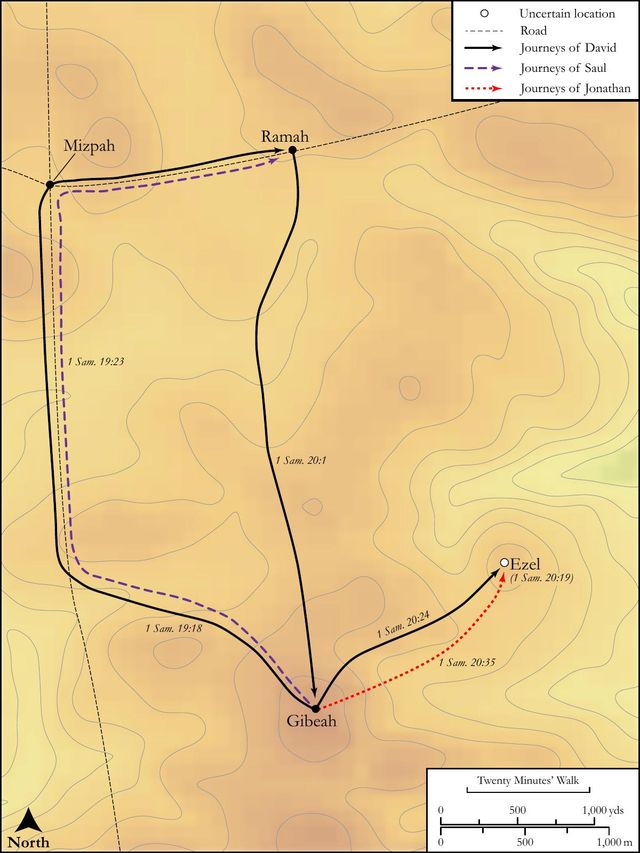
See on the biblical-era map
Study this verse
Public-domain commentary
Matthew Henry
From his Commentary on the Whole Bible. Henry comments on passages, not single verses — this entry covers 1 Samuel 19:11–17. His two-level outline is real structure in the source text, so it is rendered as structure.
Here is, I. Saul's further design of mischief to David. When David had escaped the javelin, supposing he went straight to his own house, as indeed he did, Saul sent some of his guards after him to lay wait at the door of his house, and to assassinate him in the morning as soon as he stirred out, Sa1 19:11. Josephus says the design was to seize him and to hurry him before a court of justice that was ordered to condemn him and put him to death as a traitor; but we are here told it was a shorter way they were to take with him: they were ordered to slay him. Well might David complain that his enemies were bloody men, as he did in the psalm which he penned at this time, and upon this occasion (Ps. 59), when Saul sent, and they watched the house to kill him. See Sa1 19:2, Sa1 19:3, and Sa1 19:7. He complains that swords were in their lips.
II.David's wonderful deliverance out of this danger.
Michal was the instrument of it, whom Saul gave him to be a snare to him, but she proved to be his protector and helper. Often is the devil out-shot with his own bow. How Michal came to know the danger her husband was in does not appear; perhaps she had notice sent her from court, or rather was herself aware of the soldiers about the house, when they were going to bed, though they kept so still and silent that they said, Who dost hear? which David takes notice of, Psa 59:7. She, knowing her father's great indignation at David, soon suspected the design, and bestirred herself for her husband's safety.
1.She got David out of the danger. She told him how imminent the peril was (Sa1 19:11): Tomorrow thou wilt be slain. As Josephus paraphrases it, she told him that if the sun saw him there next morning it would never see him more; and then put him in a way of escape. David himself was better versed in the art of fighting than of flying, and had it been lawful it would have been easy for him to have cleared his house, by dint of sword, from those that haunted it; but Michal let him down through a window (Sa1 19:12), all the doors being guarded; and so he fled and escaped. And now it was that, either in his own closet before he went or in the hiding-place to which he fled, he penned that fifty-ninth Psalm, which shows that, in his fright and hurry, his mind was composed, and, in this great danger, his faith was strong and fixed on God; and, whereas the plot was to slay him in the morning, he speaks there with the greatest assurance (Sa1 19:16), I will sing aloud of thy mercy in the morning.
2.She practised a deception upon Saul and those whom he employed to be the instruments of his cruelty. When the doors of the house were opened in the morning, and David did not appear, the messengers would search the house for him, and did so. But Michal told them he was sick in bed (Sa1 19:14), and, if they would not believe her, they might see, for (Sa1 19:13) she had put a wooden image in the bed, and wrapped it up close and warm as if it had been David asleep, not in a condition to be spoken to; the goats' hair about the image was to resemble David's hair, the better to impose upon them. Michal can by no means be justified in telling a lie, and covering it thus with a cheat. God's truth needed not her lie. But she intended hereby to keep Saul in suspense for a while, that David might have some time to secure himself, not doubting but those messengers would pursue him if they found he had gone. The messengers had so much humanity as not to offer him any disturbance when they heard he was sick; for to those that are in this misery pity should be shown; but Saul, when he heard it, gave positive orders that he should be brought to him sick or well: Bring him to me in the bed, that I may slay him, Sa1 19:15. It was base and barbarous thus to triumph over a sick man; and to vow the death of one who for aught that he knew was dying by the hand of nature. So earnestly did he thirst after his blood, and so greedy was his revenge, that he could not be pleased to see him dead, unless he himself was the death of him; though awhile ago he had said, Let not my hand be upon him. Thus when men lay the reins on the neck of their passions they grow more and more outrageous. When the messengers were sent again, the cheat was discovered, Sa1 19:16. But by this time it was to be hoped that David was safe, and therefore Michal was not then much concerned at the discovery. Saul chid her for helping David to escape (Sa1 19:17): Why hast thou deceived me so? What a base spirit was Saul of, to expect that, because Michal was his daughter, she must therefore betray her own husband to him unjustly. Ought she not to forsake and forget her father and her father's house, to cleave to her husband? Those that themselves will be held by no bonds of reason or religion are ready to think that others should as easily break those bonds. In answer to Saul's chiding, Michal is not so careful of her husband's reputation as she had been of his person, when she makes this her excuse: He said, Let me go, why should I kill thee? As her insinuating that she would have hindered his flight was false (it was she that put him upon it and furthered it), so it was an unjust unworthy reflection upon him to suggest that he threatened to kill her if she would not let him go, and might confirm Saul in his rage against him. David was far from being so barbarous a man and so imperious a husband, so brutish in his resolves and so haughty in his menaces, as she here represented him. But David suffered both from friends and foes, and so did the son of David.
Historical interpretation
Two Centuries of Reception
2 surviving comments on this verse. Each one is dated, so this reads as a timeline rather than a list.
Select a marker to jump to its quote. Markers stagger vertically where authors wrote within a few decades of each other.
The story relates how, when the vehement emotion of the demonic spirit had settled on Saul and the holy David quieted the disturbance of the passion by means of his psaltery, Saul found the spear that was standing by him, aimed it straight at David and hurled it against his benefactor. David, however, avoided the attack on himself by means of the divine alliance, and the assault of the spear fixed itself deeply in the wall. He fled the royal dwellings and was in his own house, in the hope that repentance would alter the king’s anger. But Saul placed his spearmen around David’s house and ordered the executioners to kill him. He barely escaped the dangers by letting himself down into the open through a window and avoiding detection by the guard.
“Then Saul sent and watched his house to kill him.” This too is fittingly associated with the Lord’s passion, for house indicates the tomb where he rested in a three-day death. The Jews’ leaders sent men to guard it, to destroy so to say the fame of his name, so that by some trick it should not be claimed that he rose again, an eventuality which Christ had been heard earlier proclaiming. It was better that his enemies should of their own accord desire to condemn this, for it allowed the whole world to acknowledge the fact more certainly. The evidence which the unwilling witness offers is beyond doubt; it cannot be called partisan when confirmed by the guilty person.
Continue studying 1 Samuel 19:12 across the web’s major study libraries — every link below opens this exact verse, chapter, or book on the destination site.
Read & Compare
 BibleGatewayThis verse in more than 200 translations and 70 languages.
 Bible.comThe YouVersion reader — hundreds of translations, reading plans, and highlights.
 ESV.orgCrossway's official English Standard Version reader.
 NET BibleThe NET translation with 60,000+ translators' notes on every rendering decision.
 STEP BibleTyndale House's free study tool — original text, vocabulary, and scholarly resources.
 BibliaLogos Bible Software's free web reader.
 USCCBThe New American Bible (Revised Edition) with the U.S. bishops' study notes.
Commentaries
 BibleHub CommentariesDozens of classic commentaries on this verse, gathered on one page.
 StudyLightMore than 100 commentary sets — the largest collection on the web.
 BibleRefPlain-English commentary on what this verse means, verse by verse.
 Enduring WordDavid Guzik's free commentary on this chapter, widely used by Bible teachers.
 Bible Study ToolsVerse commentary alongside Greek and Hebrew study aids.
Original Language & Research
- BibleHub InterlinearThe verse word by word — original language, transliteration, and English.
- BibleHub LexiconEvery word's original-language definition and Strong's entry.
 Blue Letter BibleDeep-study tools — Strong's numbers, concordance, and word studies.
 SefariaThe Hebrew text with Rashi and centuries of Jewish commentary.
Sermons, Hymns & Audio


TrulyRandomVerse is not affiliated with these sites and doesn’t control their content. They’re linked because they’re genuinely useful.
Summary
1 Samuel 19:12 chronicles a pivotal moment in David's life, depicting his urgent escape from King Saul's murderous pursuit. This verse vividly portrays the immediate and mortal danger David faced and underscores the swift, courageous, and decisive intervention of his wife, Michal, whose unwavering loyalty and quick thinking were instrumental in preserving his life and ensuring the continuation of God's redemptive plan for Israel through His chosen king.
Context
ShowHideLiterary Context
This verse is situated within a rapidly escalating and intensely dramatic narrative detailing King Saul's profound jealousy and paranoia toward David. Saul's animosity began to fester after David's triumphant victory over Goliath and the subsequent popular acclamation he received from the Israelite women, as recorded in 1 Samuel 18:7. Prior to this incident, Saul had already made two direct attempts on David's life with a spear (1 Samuel 18:11 and 1 Samuel 19:10). In the immediate preceding narrative of 1 Samuel 19, Saul explicitly commanded his servants, and even his son Jonathan, to kill David (1 Samuel 19:1). Despite Jonathan's successful intercession and Saul's temporary repentance, the tormenting evil spirit from the Lord returned, prompting Saul to dispatch messengers to David's house with the clear and deadly intent to seize and execute him. Michal's desperate and ingenious intervention, first by feigning David's illness with an idol and goat hair, and then by facilitating his escape through the window, is a direct and immediate response to this mortal threat, marking the beginning of David's prolonged period as a fugitive.
Historical & Cultural Context
In monarchical Israel, the king's authority was generally considered absolute, and defying a royal command, especially one concerning life and death, was an act of extreme courage, desperation, or profound conviction. The architectural features of houses during this period, particularly those of wealthier individuals or royal family members, often included upper stories with windows that could serve as alternative points of entry or exit, as evidenced in other biblical accounts such as Rahab's assistance to the Israelite spies in Joshua 2:15. Michal's actions in this verse reflect a profound tension between her filial duty to her father, the reigning king, and her marital loyalty to her husband, David. Her audacious decision to save David's life, even at significant personal risk and in direct defiance of her father's murderous decree, powerfully underscores the deep bond and loyalty she held for David at this critical juncture, prioritizing his life above all else.
Key Themes
ShowHideThe dramatic events surrounding 1 Samuel 19:12 powerfully illuminate several recurring and foundational themes within the book of Samuel and the broader biblical narrative. Firstly, Divine Providence and Protection are paramount; despite Saul's relentless and increasingly desperate efforts to eliminate David, God consistently and miraculously provides a means of escape, demonstrating His unwavering commitment to His chosen king and His ultimate, unfolding plan for Israel's future (Psalm 34:7). Secondly, the theme of Loyalty and Betrayal is starkly presented: Michal's courageous loyalty to David stands in sharp contrast to King Saul's escalating betrayal of his own son-in-law, trusted servant, and anointed successor. Thirdly, the Persecution of the Righteous emerges as a dominant motif, as David, an innocent and divinely anointed man, is unjustly hunted and forced into exile, a narrative pattern that foreshadows the suffering of many faithful individuals throughout salvation history. Finally, this pivotal escape marks the definitive beginning of David's prolonged period of Flight and Wilderness Wandering, a crucible of testing, profound dependence on God, and essential preparation for his eventual kingship, echoing the formative journey of the nation of Israel itself through the wilderness (1 Samuel 21:1).
Exposition and Analysis
ShowHideKey Word Analysis
ShowHideThe verb translated "let down" is derived from the primitive root יָרַד (yârad), meaning "to descend" or "to go downwards." In the Hiphil stem, as it appears here (וַתֹּרֶד, vattored), it takes on a causative sense, meaning "to cause to go down" or "to let down." This grammatical construction powerfully emphasizes Michal's active, deliberate, and instrumental role in David's escape. It was not a passive descent by David, but an intentional act of lowering him, suggesting the use of ropes or some other means, and highlighting her decisive agency and quick thinking in a moment of extreme urgency.
The term חַלּוֹן (challôwn) refers to a window, specifically an opening in the wall of a house. In the houses of that day, windows were often located on upper floors, serving purposes of ventilation, light, or, as in this dramatic instance, an emergency exit. The detail of the "window" implies a significant drop from an elevated position, necessitating David being "let down" rather than simply stepping out. This detail underscores the precariousness of the escape and the immediate danger, as it was the only viable, unguarded exit to evade Saul's messengers who were likely surrounding and guarding the main entrance.
The sequence of verbs "fled, and escaped" vividly portrays the urgency, desperation, and ultimate success of David's flight. "Fled" is from the root בָּרַח (bârach), meaning "to bolt" or "to flee suddenly," emphasizing the hurried and immediate departure from danger. "Escaped" is from the root מָלָט (mâlaṭ), meaning "to be smooth," and by implication, "to escape (as if by slipperiness)" or "to be delivered." This verb signifies a successful evasion of peril and a safe deliverance from the threat. The combination of these two verbs highlights that David not only departed in haste but also successfully eluded capture and death, confirming the effectiveness of Michal's intervention and God's protective hand.
Verse Breakdown
ShowHide"So Michal let David down through a window"
This initial clause establishes Michal's decisive and pivotal action as the central focus. Faced with her father's murderous intent against her husband, she actively and courageously intervenes to save him. The specific detail of the "window" signifies the only available, albeit dangerous and unconventional, route of escape, emphasizing the immediate and desperate nature of the situation. Her agency and quick thinking here are paramount, demonstrating profound loyalty and courage.
"and he went"
This concise phrase indicates David's immediate and swift departure from the house. It conveys the urgency and necessity of his movement, highlighting that he did not linger but acted at once upon Michal's aid. This marks the definitive beginning of his prolonged period of flight and exile.
"and fled"
This verb emphasizes the nature of David's departure—a hurried, desperate flight from an imminent and life-threatening danger. It underscores the fact that David was not merely leaving his home but actively escaping a situation of mortal peril, thereby becoming a fugitive from the king's unrighteous wrath.
"and escaped"
This final verb confirms the successful outcome of the immediate crisis. Despite the extreme danger posed by King Saul's determined pursuit, David was miraculously delivered from capture and death. This escape is not merely a physical act but a powerful testament to divine protection, ensuring that God's overarching plan for David's life and his future kingship would not be thwarted by human malice or opposition.
Literary Devices
ShowHideThe narrative of 1 Samuel 19:12 is rich with literary devices that amplify its dramatic impact and theological significance. Suspense is palpable throughout the preceding verses and culminates in this moment, as Saul's messengers close in on David's house, creating an intense sense of urgency and danger that is dramatically resolved by Michal's desperate measure. The scene masterfully employs Dramatic Irony, as King Saul's own daughter, Michal, becomes the unexpected instrument of his intended victim's salvation, directly thwarting her father's murderous plot against the man God has chosen. This also powerfully highlights the theme of Loyalty vs. Kinship, as Michal's choice to save her husband directly pits her marital bond against her filial duty to a tyrannical and unrighteous father. The "window" itself can be seen as potent Symbolism, representing a narrow aperture of divine deliverance in a seemingly inescapable situation, a precarious portal from certain death to a newfound, albeit dangerous, freedom. Furthermore, this incident serves as crucial Foreshadowing for David's long period of flight and exile, establishing a recurring pattern of unjust persecution that will define much of his pre-kingship narrative. The swift, concise verbs ("went, and fled, and escaped") contribute to the rapid Pacing of the narrative, effectively conveying the life-or-death urgency of the event.
Theological and Thematic Connections
ShowHideThe dramatic escape of David, meticulously orchestrated by Michal in 1 Samuel 19:12, stands as a profound testament to God's unwavering providence and His steadfast faithfulness to His covenant promises. Despite the escalating hostility of King Saul and the seemingly insurmountable odds David faced, God consistently intervenes, often through unexpected human agents, to preserve the life of His anointed servant. This event powerfully underscores the theological truth that no human scheme, however powerful or malicious, can ultimately thwart the divine will or derail God's sovereign plan. David's deliverance is not merely a fortunate turn of events but a direct manifestation of God's protective hand, ensuring that His chosen king would survive to fulfill the destiny laid out for him. It illustrates that God often works through the courage, ingenuity, and loyalty of individuals, even those who must defy earthly authorities for a higher, righteous purpose, to accomplish His sovereign plan and protect His chosen instruments.
Reflection and Application
ShowHideThe narrative of David's desperate escape in 1 Samuel 19:12 offers profound and enduring lessons for contemporary believers facing various forms of adversity, persecution, or seemingly impossible circumstances. It serves as a powerful reminder that even when confronted by overwhelming opposition, seemingly insurmountable obstacles, or unjust persecution, God's sovereign hand is actively at work, often providing unexpected and unconventional means of deliverance. This story encourages us to cultivate a deep and abiding trust in God's providential care, knowing with certainty that His ultimate plans for us will prevail, even when our immediate circumstances appear bleak or hopeless. Furthermore, Michal's courageous and self-sacrificing act challenges us to examine the depth of our own loyalty, conviction, and moral courage. Are we willing to take risks, to stand for what is right, and to offer support to those who are unjustly treated, even when it demands personal sacrifice, defiance of popular opinion, or navigating complex ethical dilemmas? The invaluable worth of loyal relationships—those who stand with us in times of trouble and danger—is also powerfully highlighted, urging us to be such faithful friends to others and to cherish those who demonstrate unwavering loyalty to us. Ultimately, this passage is a compelling call to unwavering faith, courageous action, and spiritual discernment in recognizing and responding to God's miraculous deliverance in our own lives.
Questions for Reflection
ShowHideFAQ
ShowHideWas Michal's deception of her father, Saul, morally justifiable?
ShowHideThis question delves into the complex ethical issue of "lying to save a life" within biblical narratives. While the Bible consistently condemns lying as a general principle (Proverbs 12:22), there are indeed instances where deception is employed to protect the innocent or to further God's righteous purposes, and the narrative either does not condemn it or implicitly affirms it through the outcome. Notable examples include Rahab lying to protect the Israelite spies (Joshua 2:4-6), the Hebrew midwives lying to Pharaoh to save the male infants (Exodus 1:15-21), and even Samuel's partial truth when going to anoint David (1 Samuel 16:2). In Michal's specific case, she was protecting an innocent man, her husband, from an unjust, murderous, and divinely disfavored king who was acting outside of God's will. The narrative's focus is on Michal's loyalty and David's miraculous deliverance, not on a condemnation of her specific method. Many theologians would argue that in such extreme circumstances, where an innocent life is under direct threat from a tyrannical and unrighteous authority, protecting that life takes precedence over a literal adherence to the truth, especially when the deception is not for selfish gain but for the preservation of life and the furtherance of God's unfolding plan.
What happened to Michal and David's relationship later?
ShowHideMichal's act of loyalty in 1 Samuel 19:12 marks a high point in her relationship with David. However, their relationship becomes tragically complicated and ultimately strained over time. After David fled Saul's court, Saul, in an act of further hostility and disdain, gave Michal to another man, Palti, son of Laish (1 Samuel 25:44). When David eventually rose to power and sought to consolidate his kingdom, he demanded Michal's return as a strategic move to solidify his legitimacy and connection to Saul's royal house (2 Samuel 3:13-16). While she was indeed returned to him, their relationship never regained its former intimacy or affection. The final recorded interaction between them occurs after David brings the Ark of the Covenant into Jerusalem with great celebration and unrestrained worship. Michal despises David for dancing before the Lord with abandon, viewing his actions as undignified and beneath a king (2 Samuel 6:16 and 2 Samuel 6:20-23). For her contempt and lack of spiritual understanding, she is cursed with childlessness, and the text explicitly states that she had no child to the day of her death, marking a poignant and tragic end to her significant, yet ultimately sorrowful, role in David's life.
Christ-Centered Fulfillment
ShowHideThe dramatic and divinely orchestrated escape of David in 1 Samuel 19:12 serves as a profound and multi-layered foreshadowing of God's ultimate and perfect deliverance through Jesus Christ. David, the anointed king, unjustly persecuted and relentlessly hunted by a jealous and unrighteous ruler, powerfully mirrors Christ, the true and eternal King, who faced relentless opposition and numerous attempts on His life from His very birth. Just as David was supernaturally protected and preserved by God to fulfill his destiny as king, so too was Jesus miraculously preserved from Herod's murderous decree, escaping to Egypt as an infant (Matthew 2:13-15), and later slipping through the crowds who sought to harm Him before His appointed time (Luke 4:28-30). The "window" through which David escaped can be seen as a potent symbol of the narrow way of salvation and God's often surprising and unconventional means of rescue. Ultimately, Christ's mission was not merely to escape physical death temporarily, but to conquer it definitively. He willingly laid down His life, not to flee from His enemies, but to deliver humanity from the far greater enemies of sin, death, and the power of the devil (Hebrews 2:14-15). Through His glorious resurrection, Jesus provides the ultimate and eternal "escape" for all who believe, granting eternal life, freedom from the tyranny of sin, and the assurance that no one can snatch His sheep out of His hand (John 10:28). Thus, David's physical deliverance points powerfully to the spiritual and eternal deliverance offered by Christ, the King of kings.