


Acts 9:24
- ἐγνώσθηegnōsthēbecame knownG1097V-2API-3SVerb 2nd Aorist Passive Indicative 3rd Singular
- δὲdehoweverG1161CONJConjunction
- τῷtō<the>G3588T-DSMDefinite article Dative Singular Masculine
- ΣαύλῳSaulōto SaulG4569N-DSM-PNoun Dative Singular Masculine Individual
- ἡhētheG3588T-NSFDefinite article Nominative Singular Feminine
- ἐπιβουλὴepiboulēplotG1917N-NSFNoun Nominative Singular Feminine
- αὐτῶνautōnof themG846P-GPMPersonal pronoun Genitive Plural Masculine
- παρετηροῦντοparetērountoThey were themselves watchingG3906V-IMI-3PVerb Imperfect Middle Indicative 3rd Plural
- δὲdenowG1161CONJConjunction
- τὰςtastheG3588T-APFDefinite article Accusative Plural Feminine
- πύλαςpulasgatesG4439N-APFNoun Accusative Plural Feminine
- ἡμέραςhēmerasby dayG2250N-GSFNoun Genitive Singular Feminine
- τεteandG5037CONJConjunction
- καὶkaialsoG2532CONJConjunction
- νυκτόςnuktosnightG3571N-GSFNoun Genitive Singular Feminine
- ὅπωςhopōsso thatG3704CONJConjunction
- αὐτὸνautonhimG846P-ASMPersonal pronoun Accusative Singular Masculine
- ἀνέλωσιν·anelōsinthey may executeG337V-2AAS-3PVerb 2nd Aorist Active Subjunctive 3rd Plural
English is a literal word-by-word gloss of the Greek, not the KJV's wording. Why?
This is the original text the KJV's translators worked from — each Greek word with its own literal English meaning in this verse, prepared by scholars at Tyndale House, Cambridge. The KJV translates whole sentences, not word by word, so its wording differs: one Greek word can become several English words, and the KJV may choose “charity” where the gloss reads “love”. Both are faithful — they answer different questions. For the KJV's own rendering, switch to the KJV text.
Details
See on the biblical-era map
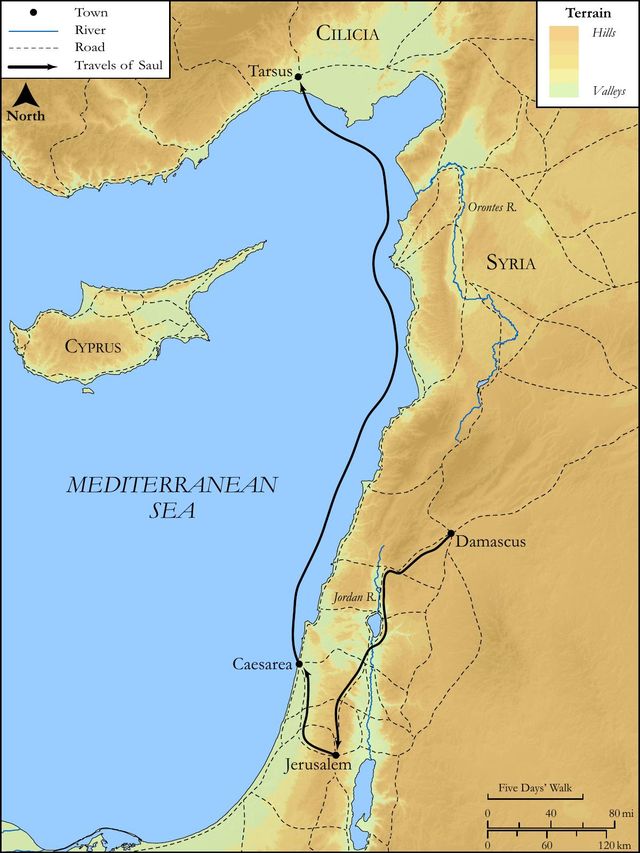
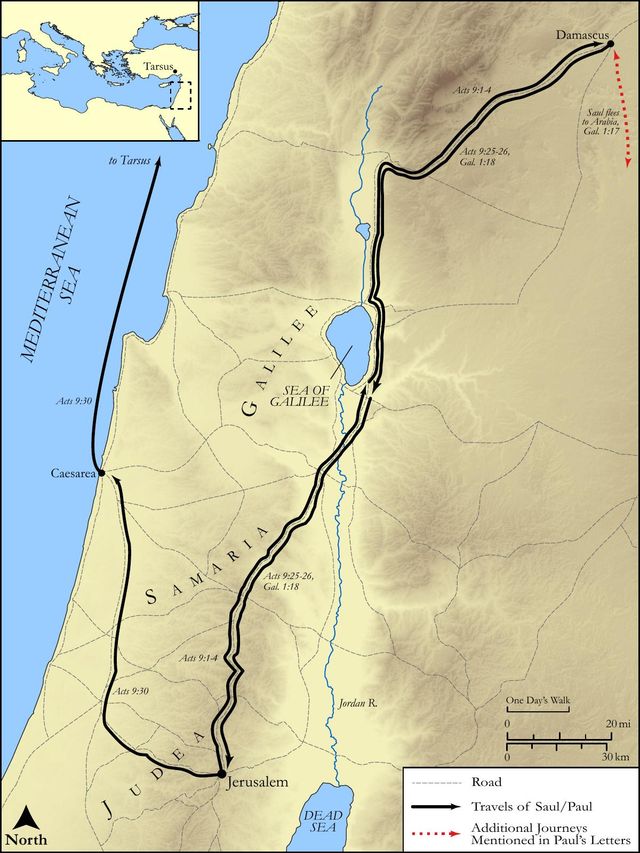
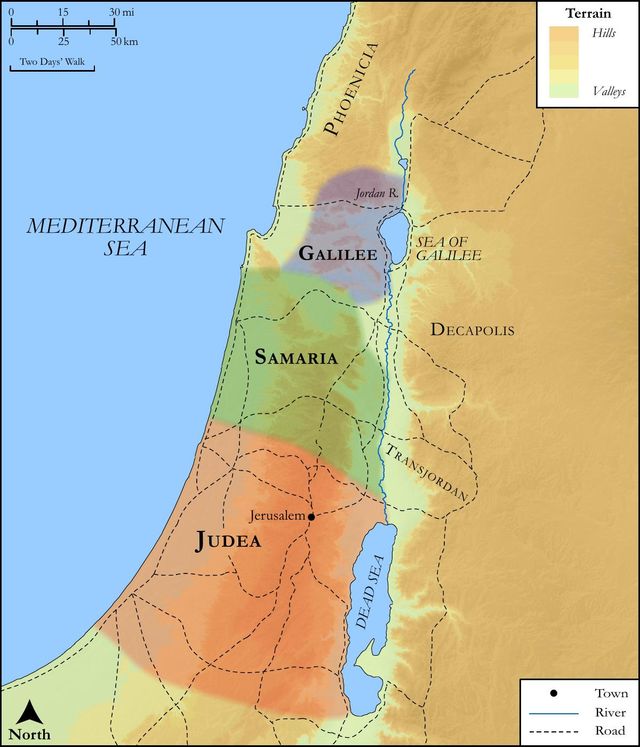
Study this verse
Public-domain commentary
Matthew Henry
From his Commentary on the Whole Bible. Henry comments on passages, not single verses — this entry covers Acts 9:23–31. His four-level outline is real structure in the source text, so it is rendered as structure.
Luke here makes no mention of Paul's journey into Arabia, which he tells us himself was immediately after his conversion, Gal 1:16, Gal 1:17. As soon as God had revealed his Son in him, that he might preach him, he went not up to Jerusalem, to receive instructions from the apostles (as any other convert would have done, that was designed for the ministry), but he went to Arabia, where there was new ground to break up, and where he would have opportunity of teaching, but not learning; thence he returned to Damascus, and there, three years after his conversion, this happened, which is here recorded.
I.He met with difficulties at Damascus, and had a narrow escape of being killed there. Observe,
1.What his danger was (Act 9:23): The Jews took counsel to kill him, being more enraged at him than at any other of the preachers of the gospel, not only because he was more lively and zealous in his preaching than any of them, and more successful, but because he had been such a remarkable deserter, and his being a Christian was a testimony against them. It is said (Act 9:24), The Jews watched the gates day and night to kill him; they incensed the governor against him, as a dangerous man, who therefore kept the city with a guard to apprehend him, at his going out or coming in, Co2 11:32. Now Christ showed Paul what great things he must suffer for his name (Act 9:16), when here was presently the government in arms against him, which was a great thing, and, as all his other sufferings afterwards, helped to make him considerable. Saul was no sooner a Christian than a preacher, no sooner a preacher than a sufferer; so quickly did he rise to the summit of his preferment. Note, Where God gives great grace he commonly exercises it with great trials.
2.How he was delivered.
(1.)The design against him was discovered: Their lying in wait was known of Saul, by some intelligence, whether from heaven or from men we are not told.
(2.)The disciples contrived to help him away - hid him, it is likely, by day; and in the night, the gates being watched, that he could not get away through them, they let him down by the wall, in a basket, as he himself relates it (Co2 11:33), so he escaped out of their hands. This story, as it shows us that when we enter into the way of God we must look for temptation, and prepare accordingly, so it shows us that the Lord knows how to deliver the godly out of temptation, and will with the temptation also make a way to escape, that we may not be by it deterred nor driven from the way of God.
II.He met with difficulties at Jerusalem the first time he went thither, Act 9:26.
He came to Jerusalem. This is thought to be that journey to Jerusalem of which he himself speaks (Gal 1:18): After three years I went up to Jerusalem, saith he, to see Peter, and abode with him fifteen days. But I rather incline to think that this was a journey before that, because his coming in and going out, his preaching and disputing (Act 9:28, Act 9:29), seem to be more than would consist with his fifteen days' stay (for that was no more) and to require a longer time; and, besides, now he came a stranger, but then he came, historēsai - to confer with Peter, as one he was intimate with; however, it might possibly be the same. Now observe,
1.How shy his friends were of him (Act 9:26): When he came to Jerusalem, he did not go to the chief priests and the Pharisees (he had taken his leave of them long since), but he assayed to join himself to the disciples. Wherever he came, he owned himself one of that despised persecuted people, and associated with them. They were now in his eyes the excellent ones of the earth, in whom was all his delight. He desired to be acquainted with them, and to be admitted into communion with them; but they looked strange upon him, shut the door against him, and would not go about any of their religious exercises if he were by, for they were afraid of him. Now might Paul be tempted to think himself in an ill case, when the Jews had abandoned and persecuted him, and the Christians would not receive and entertain him. Thus does he fall into divers temptations, and needs the armour of righteousness, as we all do, both on the right hand and on the left, that we may not be discouraged either by the unjust treatment of our enemies or the unkind treatment of our friends.
(1.)See what was the cause of their jealousy of him: They believed not that he was a disciple, but only pretended to be so, and came among them as a spy or an informer. They knew what a bitter persecutor he had been, with what fury he went to Damascus some time ago; they had heard nothing of him since, and therefore thought he was but a wolf in sheep's clothing. The disciples of Christ had need to be cautious whom they admit into communion with them. Believe not every spirit. There is need of the wisdom of the serpent, to keep the mean between the extremes of suspicion on the one hand and credulity on the other; yet methinks it is safer to err on the charitable side, because it is an adjudged case that it is better the tares should be found among the wheat than that the wheat should any of it be rooted up and thrown out of the field.
(2.)See how it was removed (Act 9:27): Barnabas took him to the apostles themselves, who were not so scrupulous as the inferior disciples, to whom he first assayed to join himself, and he declared to them,
[1.]What Christ had done for him: He had shown himself to him in the way and spoken to him; and what he said.
[2.]What he had since done for Christ: He had preached boldly at Damascus in the name of Jesus. How Barnabas came to know this, more than the rest of them, we are not told; whether he had himself been at Damascus, or had had letters thence, or discoursed with some of that city, by which he came to the knowledge of this; or whether he had formerly been acquainted with Paul in the Grecian synagogues, or at the feet of Gamaliel, and had such an account of his conversion from himself as he saw cause enough to give credit to: but so it was that, being satisfied himself, he gave satisfaction to the apostles concerning him, he having brought no testimonials from the disciples at Damascus, thinking he needed not, as some others, epistles of commendation, Co2 3:1. Note, The introducing of a young convert into the communion of the faithful is a very good work, and one which, as we have opportunity, we should be ready to do.
2.How sharp his enemies were upon him.
(1.)He was admitted into the communion of the disciples, which was no little provocation to his enemies. It vexed the unbelieving Jews to see Saul a trophy of Christ's victory, and a captive to his grace, who had been such a champion for their cause - to see him coming in, and going out, with the apostles (Act 9:28), and to hear them glorying in him, or rather glorifying God in him.
(2.)He appeared vigorous in the cause of Christ, and this was yet more provoking to them (Act 9:29): He spoke boldly in the name of the Lord Jesus. Note, Those that speak for Christ have reason to speak boldly; for they have a good cause, and speak for one who will at last speak for himself and them too. The Grecians, or Hellenist Jews, were most offended at him, because he had been one of them; and they drew him into a dispute, in which, no doubt, he was too hard for them, as he had been for the Jews at Damascus. One of the martyrs said, Though she could not dispute for Christ, she could die for Christ; but Paul could do both. Now the Lord Jesus divided the spoils of the strong man armed in Saul. For that same natural quickness and fervour of spirit which, while he was in ignorance and unbelief, made him a furious bigoted persecutor of the faith, made him a most zealous courageous defender of the faith.
(3.)This brought him into peril of his life, with which he narrowly escaped: The Grecians, when they found they could not deal with him in disputation, contrived to silence him another way; they went about to slay him, as they did Stephen when they could not resist the Spirit by which he spoke, Act 6:10. That is a bad cause that has recourse to persecution for its last argument. But notice was given of this conspiracy too, and effectual care taken to secure this young champion (Act 9:30): When the brethren knew what was designed against him they brought him down to Cesarea. They remembered how the putting of Stephen to death, upon his disputing with the Grecians, had been the beginning of a sore persecution; and therefore were afraid of having such a vein opened again, and hastened Paul out of the way. He that flies may fight again. He that fled from Jerusalem might do service at Tarsus, the place of his nativity; and thither they desired him by all means to go, hoping he might there go on in his work with more safety than at Jerusalem. Yet it was also by direction from heaven that he left Jerusalem at this time, as he tells us himself (Act 22:17, Act 22:18), that Christ now appeared to him, and ordered him to go quickly out of Jerusalem, for he must be sent to the Gentiles, Act 9:15. Those by whom God has work to do shall be protected from all the designs of their enemies against them till it be done. Christ's witnesses cannot be slain till they have finished their testimony.
III.The churches had now a comfortable gleam of liberty and peace (Act 9:31):
Then had the churches rest. Then, when Saul was converted, so some; when that persecutor was taken off, those were quiet whom he used to irritate, and then those were quiet whom he used to molest. Or, then, when he had gone from Jerusalem, the fury of the Grecian Jews was a little abated, and they were the more willing to bear with the other preachers now that Saul had gone out of the way. Observe,
1.The churches had rest. After a storm comes a calm. Though we are always to expect troublesome times, yet we may expect that they shall not last always. This was a breathing-time allowed them, to prepare them for the next encounter. The churches that were already planted were mostly in Judea, Galilee, and Samaria, within the limits of the holy land. There were the first Christian churches, where Christ had himself laid the foundation.
2.They made a good use of this lucid interval. Instead of growing more secure and wanton in the day of their prosperity, they abounded more in their duty, and made a good use of their tranquillity.
(1.)They were edified, were built up in their most holy faith; the more free and constant enjoyment they had of the means of knowledge and grace, the more they increased in knowledge and grace.
(2.)They walked in the fear of the Lord - were more exemplary themselves for a holy heavenly conversation. They so lived that all who conversed with them might say, Surely the fear of God reigns in those people.
(3.)They walked in the comfort of the Holy Ghost - were not only faithful, but cheerful, in religion; they stuck to the ways of the Lord, and sang in those ways. The comfort of the Holy Ghost was their consolation, and that which they made their chief joy. They had recourse to the comfort of the Holy Ghost, and lived upon that, not only in days of trouble and affliction, but in days of rest and prosperity. The comforts of the earth, when they had the most free and full enjoyment of them, could not content them without the comfort of the Holy Ghost. Observe the connection of these two: when they walked in the fear of the Lord, then they walked in the comfort of the Holy Ghost. Those are most likely to walk cheerfully that walk circumspectly.
3.God blessed it to them for their increase in number: They were multiplied. Sometimes the church multiplies the more for its being afflicted, as Israel in Egypt; yet if it were always so, the saints of the Most High would be worn out. At other times its rest contributes to its growth, as it enlarges the opportunity of ministers, and invites those in who at first are afraid of suffering. Or, then, when they walked in the fear of God and his comforts, they were multiplied. Thus those that will not be won by the word may be won by the conversation of professors.
Historical interpretation
Three Centuries of Reception
2 surviving comments on this verse. Each one is dated, so this reads as a timeline rather than a list.
Select a marker to jump to its quote. Markers stagger vertically where authors wrote within a few decades of each other.
"But their laying await was known of Saul. And they watched the gates day and night to kill him." For this was more intolerable to them than the miracles which had taken place-than the five thousand, the three thousand, than everything, in short. And observe him, how he is delivered, not by miraculous grace, but by man's wisdom-not as the apostles were-that thou mayest learn the energetic character of the man, how he shines even without miracles.
The Jews made a council to kill him. But the plot against Paul was known to him; and they watched the gates of the city day and night to kill him. It was not the Jews who kept watch, but the citizens themselves with their king Aretas, as the Apostle himself, who was besieged and escaped, writes to the Galatians. For both Gentiles and Jews, although they disagree among themselves, always agree in the persecution of Christians.
Continue studying Acts 9:24 across the web’s major study libraries — every link below opens this exact verse, chapter, or book on the destination site.
Read & Compare
 BibleGatewayThis verse in more than 200 translations and 70 languages.
 Bible.comThe YouVersion reader — hundreds of translations, reading plans, and highlights.
 ESV.orgCrossway's official English Standard Version reader.
 NET BibleThe NET translation with 60,000+ translators' notes on every rendering decision.
 STEP BibleTyndale House's free study tool — original text, vocabulary, and scholarly resources.
 BibliaLogos Bible Software's free web reader.
 USCCBThe New American Bible (Revised Edition) with the U.S. bishops' study notes.
Commentaries
 BibleHub CommentariesDozens of classic commentaries on this verse, gathered on one page.
 StudyLightMore than 100 commentary sets — the largest collection on the web.
 BibleRefPlain-English commentary on what this verse means, verse by verse.
 Enduring WordDavid Guzik's free commentary on this chapter, widely used by Bible teachers.
 Bible Study ToolsVerse commentary alongside Greek and Hebrew study aids.
Original Language & Research
- BibleHub InterlinearThe verse word by word — original language, transliteration, and English.
- BibleHub LexiconEvery word's original-language definition and Strong's entry.
 Blue Letter BibleDeep-study tools — Strong's numbers, concordance, and word studies.
 CNTR CollationThe earliest Greek manuscripts of this verse, collated letter by letter.
Sermons, Hymns & Audio


TrulyRandomVerse is not affiliated with these sites and doesn’t control their content. They’re linked because they’re genuinely useful.
Summary
Acts 9:24 details a critical moment in the nascent ministry of Saul, soon to be known as the Apostle Paul. Having undergone a profound conversion experience and immediately begun boldly proclaiming Jesus as the Son of God in Damascus, Saul's radical transformation from persecutor to preacher ignited a fierce backlash. This verse reveals the extreme and deadly plot orchestrated by Jewish authorities who, unable to counter his irrefutable arguments, resorted to a coordinated assassination attempt, vigilantly watching the city gates to prevent his escape.
Context
ShowHideLiterary Context
Acts 9:24 is situated immediately after Saul's dramatic conversion on the road to Damascus, recounted in Acts 9:1-19. Following this life-altering encounter with the risen Christ, Saul spent a few days with the disciples in Damascus before embarking on his immediate and bold proclamation that Jesus is the Son of God. His powerful and confounding arguments, which proved Jesus to be the Messiah, quickly incited the wrath of the Jewish leaders in Damascus. This verse, therefore, serves as the climax of this initial phase of Saul's ministry, demonstrating the intense opposition his message provoked and setting the stage for his miraculous escape in Acts 9:25, which propels him out of Damascus and eventually into broader ministry. The event's significance is underscored by Paul's later recounting, highlighting its formative impact on his apostolic journey.
Historical & Cultural Context
The Jewish leaders in Damascus, likely representing the Sanhedrin's authority abroad, felt their religious and social order threatened by Saul's preaching. Saul had initially come to Damascus with letters from the high priest to arrest Christians, making his conversion and subsequent preaching a profound betrayal in their eyes. In the ancient world, city gates were not merely entry points but central hubs of commerce, legal proceedings, and public life. Controlling the gates, as the plotters did, was a strategic move to ensure no one could enter or exit without detection, making an escape nearly impossible. The intensity of the "day and night" watch underscores the determination of the plotters and the gravity of the threat to Saul's life. This hostile environment was typical for early Christian evangelists, as the message of a crucified and resurrected Messiah often clashed with established religious and political powers, leading to persecution, imprisonment, and even death.
Key Themes
ShowHideThis verse powerfully illustrates several key themes prevalent in the book of Acts and the broader New Testament. Firstly, it highlights the Intense Opposition to the Gospel, demonstrating that the proclamation of Christ often elicits fierce resistance, especially from those whose power or worldview is challenged. The plot against Saul is a stark example of the spiritual warfare inherent in spreading the good news. Secondly, it underscores Divine Providence and Protection. Despite the grave and meticulously planned danger, Saul's life was preserved. His awareness of the plot, whether through divine revelation or human intelligence, signifies God's protective hand, ensuring His chosen vessel would continue his mission. This event foreshadows God's continued faithfulness to complete His work through His servants, even in the direst circumstances. Lastly, it vividly portrays Saul's Transformed Identity. The very man who had breathed out "threatenings and slaughter" against believers was now himself the target of a deadly plot, a dramatic reversal that profoundly underscores the radical and transformative power of his conversion to Christ.
Exposition and Analysis
ShowHideKey Word Analysis
ShowHideFrom a presumed compound of epi (upon) and boulomai (to will, intend), this term signifies a "plan against someone," specifically a "plot" or "ambush." Its use here emphasizes the treacherous, premeditated, and malicious nature of the design against Saul, indicating a deliberate and concerted effort to harm him rather than a spontaneous act of violence.
This verb means "to know" in a comprehensive sense, implying not just intellectual awareness but often a deep, experiential, or certain knowledge. The passive voice ("was known") suggests that the information came to Saul, possibly through divine revelation, a sympathetic informant, or keen observation. It signifies that Saul had reliable intelligence about the specific danger, which was crucial for his survival.
Derived from para (alongside) and tēreō (to watch, guard), this word means "to inspect alongside," often with the connotation of "noting insidiously" or "scrupulously observing." It implies a continuous, diligent, and perhaps even sinister surveillance. The imperfect tense in the Greek (παρετηροῦντο) suggests an ongoing, persistent action, highlighting the enemies' unwavering determination and the constant peril Saul faced.
Verse Breakdown
ShowHide"But their laying await was known of Saul."
This opening clause introduces a crucial turning point, indicating that the meticulously planned assassination plot by Saul's enemies did not remain a secret. The adversative "But" (G1161, dé) signals a contrast to the preceding verses where the Jews were merely "plotting together" (Acts 9:23). Now, their sinister intention has been exposed to Saul. The passive construction "was known of Saul" suggests that Saul gained this critical intelligence, enabling him to prepare for the danger, though the specific means of his discovery are not detailed here. This revelation underscores God's providential care for His servant.
"And they watched the gates day and night to kill him."
This second clause elaborates on the nature and intensity of the plot. The "they" refers to the Jewish authorities and their confederates who sought Saul's life. Their strategic decision to "watch the gates" indicates their understanding that Saul would likely attempt to escape the city. The phrase "day and night" emphasizes the relentless, unceasing vigilance of the plotters, highlighting their extreme determination and the constant, pervasive threat to Saul's life. The ultimate objective, "to kill him," leaves no doubt about the deadly intent behind their actions, demonstrating the profound hatred and fear Saul's gospel proclamation had stirred.
Literary Devices
ShowHideActs 9:24 employs several powerful literary devices. Irony is prominent, as the very man who had come to Damascus to persecute followers of Christ is now himself the target of a deadly plot by those who once supported his mission. This reversal underscores the transformative power of God and the radical shift in Saul's allegiance. The verse also creates significant Suspense, as the reader is made aware of the imminent danger Saul faces, intensifying the narrative tension before the resolution in the following verse. Furthermore, the meticulous "day and night" watch at the gates uses Hyperbole to emphasize the extreme dedication and unwavering resolve of Saul's enemies, conveying the overwhelming nature of the threat. This vivid imagery also serves as Foreshadowing for the numerous persecutions and life-threatening situations Paul would face throughout his apostolic ministry, establishing a pattern of divine protection amidst intense opposition.
Theological and Thematic Connections
ShowHideActs 9:24 offers profound theological insights into the nature of Christian ministry and God's sovereignty. It reveals that faithful proclamation of the gospel often provokes intense opposition, a pattern evident throughout biblical history and the experience of the early church. This resistance is not merely human but often has spiritual roots, as unseen forces oppose the advance of God's kingdom. Yet, even in the face of such grave danger, God's providential hand is evident. Saul's knowledge of the plot, leading to his eventual escape, demonstrates God's commitment to protecting His chosen instruments until their divine purpose is fulfilled. This narrative reassures believers that their lives and ministries are ultimately in God's hands, and no human plot can thwart His ultimate plan.
Reflection and Application
ShowHideActs 9:24 serves as a powerful reminder that following Christ and proclaiming His truth can often invite significant opposition, even from unexpected sources. Just as Saul faced a deadly plot for his transformed faith and bold witness, believers today may encounter resistance, misunderstanding, ridicule, or even hostility when they faithfully stand for biblical principles and share the gospel. This verse calls us to cultivate spiritual discernment to recognize the threats, both overt and subtle, that may arise in our lives and ministries. It also encourages us to develop wisdom in navigating such challenges, not by compromising truth, but by trusting in God's ultimate plan and protection. We are reminded that our lives are not our own, but belong to God, who is sovereign over all circumstances. Therefore, even in the face of grave danger, we can find courage and peace, knowing that God is capable of preserving His servants to fulfill His purposes, much like Saul's dramatic escape in the very next verse. Our call is to remain faithful, courageous, and dependent on Him, even when the "gates" of opposition seem to be closing in.
Questions for Reflection
ShowHideFAQ
ShowHideWhy were the Jewish leaders trying to kill Saul?
ShowHideThe Jewish leaders were trying to kill Saul because his dramatic conversion and subsequent, immediate, and powerful preaching of Jesus as the Messiah directly contradicted their religious beliefs and authority. Saul, who had originally come to Damascus with their authorization to persecute Christians, was now proclaiming the very message they sought to suppress. His arguments were so compelling that they "confounded the Jews" (Acts 9:22), meaning they could not refute him. Unable to win the intellectual or spiritual argument, they resorted to violence as a means to silence him and eliminate what they perceived as a dangerous threat to their established order and traditions.
How did Saul find out about the plot against his life?
ShowHideThe text of Acts 9:24 simply states, "But their laying await was known of Saul." It does not explicitly detail how he came to know of the plot. Possible explanations include divine revelation, a warning from a sympathetic believer or even a non-believer, or perhaps Saul's own astute observation and discernment given the escalating tension. Regardless of the specific means, the fact that the plot "was known" highlights God's providential care for Saul, ensuring he received the necessary information to prepare for his escape and continue his vital ministry.
What happened immediately after this plot was discovered?
ShowHideImmediately after the plot was discovered, Saul's disciples took action to ensure his safety. As recounted in Acts 9:25, "Then the disciples took him by night, and let him down by the wall in a basket." This dramatic escape, also mentioned by Paul himself in 2 Corinthians 11:32-33, allowed Saul to evade his would-be assassins and eventually travel to Jerusalem, where he would face further challenges but continue his ministry.
Christ-Centered Fulfillment
ShowHideActs 9:24, detailing a deadly plot against Saul, finds its ultimate Christ-centered fulfillment in the life and mission of Jesus Himself. Just as Saul faced a "laying await" and constant vigilance aimed at his destruction, Jesus warned His disciples that they would be persecuted just as He was. Indeed, He Himself faced constant plots and attempts on His life from religious authorities who sought to silence His truth. Saul's experience is a microcosm of the greater spiritual warfare that culminated in the crucifixion of the Lamb of God who was slain. However, the divine protection over Saul, allowing him to escape and continue his mission, points to Christ's ultimate triumph. While Jesus willingly submitted to death, it was not a defeat but a strategic victory over sin and death, leading to His ultimate triumph over death and sin. Saul's escape ensures the continued proclamation of the gospel, a mission rooted in Christ's finished work and empowered by His resurrection. Thus, Saul's suffering and deliverance serve as a powerful testimony to the enduring power of the gospel and the sovereign protection of God, mirroring the path of the suffering Messiah and ensuring the advancement of His kingdom through His chosen vessels, even amidst the fiercest opposition, just as Saul's call to suffer for Christ's name was part of God's redemptive plan.