


Acts 20:19
- δουλεύωνdouleuōnservingG1398V-PAP-NSMVerb Present Active Participle Nominative Singular Masculine
- τῷtōtheG3588T-DSMDefinite article Dative Singular Masculine
- κυρίῳkuriōLordG2962N-DSM-TNoun Dative Singular Masculine Title
- μετὰmetawithG3326PREPPreposition
- πάσηςpasēsallG3956A-GSFAdjective Genitive Singular Feminine
- ταπεινοφροσύνηςtapeinophrosunēshumilityG5012N-GSFNoun Genitive Singular Feminine
- καὶkaiandG2532CONJConjunction
- πολλῶνpollōnmanyG4183A-GPNAdjective Genitive Plural Neuter
- δακρύωνdakruōntearsG1144N-GPNNoun Genitive Plural Neuter
- καὶkaiandG2532CONJConjunction
- πειρασμῶνpeirasmōntrialsG3986N-GPMNoun Genitive Plural Masculine
- τῶνtōnthatG3588T-GPMDefinite article Genitive Plural Masculine
- συμβάντωνsumbantōnwere happeningG4819V-2AAP-GPMVerb 2nd Aorist Active Participle Genitive Plural Masculine
- μοιmoito meG3165P-1DSPersonal pronoun Dative 1st Singular
- ἐνeninG1722PREPPreposition
- ταῖςtaistheG3588T-DPFDefinite article Dative Plural Feminine
- ἐπιβουλαῖςepiboulaisplotsG1917N-DPFNoun Dative Plural Feminine
- τῶνtōnof theG3588T-GPMDefinite article Genitive Plural Masculine
- Ἰουδαίων·IoudaiōnJewsG2453N-GPM-PGNoun Genitive Plural Masculine Person Gentilic
English is a literal word-by-word gloss of the Greek, not the KJV's wording. Why?
This is the original text the KJV's translators worked from — each Greek word with its own literal English meaning in this verse, prepared by scholars at Tyndale House, Cambridge. The KJV translates whole sentences, not word by word, so its wording differs: one Greek word can become several English words, and the KJV may choose “charity” where the gloss reads “love”. Both are faithful — they answer different questions. For the KJV's own rendering, switch to the KJV text.
Details
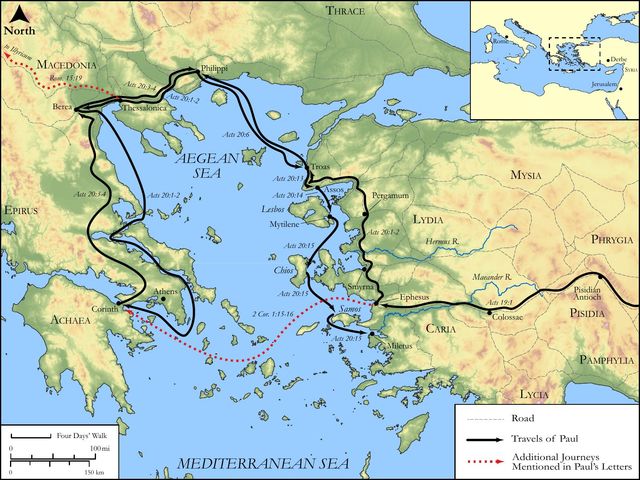
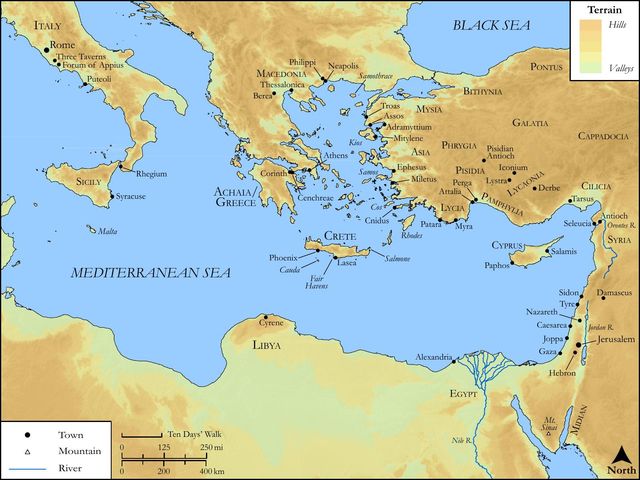
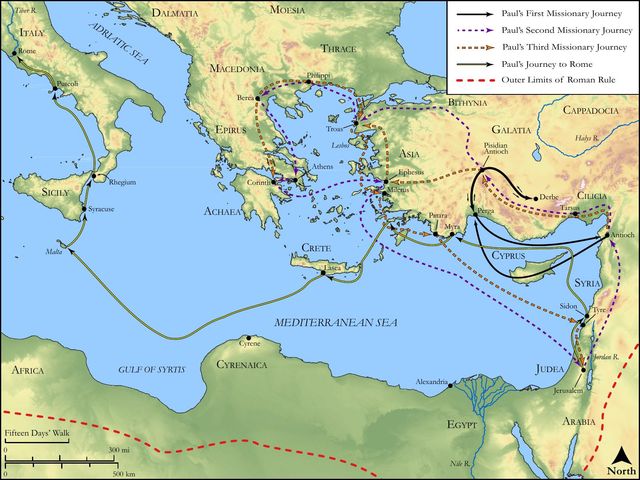
See on the biblical-era map
Study this verse
Public-domain commentary
Matthew Henry
From his Commentary on the Whole Bible. Henry comments on passages, not single verses — this entry covers Acts 20:17–35. His four-level outline is real structure in the source text, so it is rendered as structure.
It should seem the ship Paul and his companions were embarked in for Jerusalem attended him on purpose, and staid or moved as he pleased; for when he came to Miletus, he went ashore, and tarried thee so long as to send for the elders of Ephesus to come to him thither; for if he had gone up to Ephesus, he could never have got away from them. These elders, or presbyters, some think, were those twelve who received the Holy Ghost by Paul's hands, ch. xix. 6. But, besides these, it is probable that Timothy had ordained other elders there for the service of that church, and the country about; these Paul sent for, that he might instruct and encourage them to go on in the work to which they had laid their hands. And what instructions he gave to them they would give to the people under their charge.
It is a very pathetic and practical discourse with Paul here takes leave of these elders, and has in it much of the excellent spirit of this good man.
I.He appeals to them concerning both his life and doctrine, all the time he had been in and about Ephesus (v.
18): "You know after what manner I have been with you, and how I have done the work of an apostle among you." He mentions this as a confirmation of his commission and consequently of the doctrine he had preached among them. They all knew him to be a man of serious, gracious, heavenly spirit, that he was no designing self-seeking man, as seducers are; he could not have been carried on with so much evenness and constancy in his services and sufferings, but by the power of divine grace. The temper of his mind, and the tenour both of his preaching and conversation, were such as plainly proved that God was with him of a truth, and that he was actuated and animated by a better spirit than his own.—He likewise makes this reference to his own conduct as an instruction to them, in whose hands the work was now left, to follow his example: "You know after what manner I have been with you, how I have conducted myself as a minister; in like manner be you with those that are committed to your charge when I am gone (Phil. iv. 9), what you have seen in me that is good do."
1.His spirit and conversation were excellent and exemplary; they knew after what manner he had been among them, and how he had had his conversation towards them, in simplicity and godly sincerity (2 Cor. i. 12), how holily, justly, and unblamably he behaved himself, and how gentle he was towards them, 1 Thess. ii. 7, 10.
(1.)He had conducted himself well all along, from the very first day that he came into Asia—at all seasons; the manner of his entering in among them was such as nobody could find fault with. He appeared from the first day they knew him to be a man that aimed not only to do well, but to do good, wherever he came. He was a man that was consistent with himself, and all of a piece; take him where you would he was the same at all seasons, he did not turn with the wind nor change with the weather, but was uniform like a die, which, throw it which way you will, lights on a square side.
(2.)He had made it his business to serve the Lord, to promote the honour of God and the interest of Christ and his kingdom among them. He never served himself, nor made himself a servant of men, of their lusts and humours, nor was he a time-server; but he made it his business to serve the Lord. In his ministry, in his whole conversation, he proved himself what he wrote himself, Paul a servant of Jesus Christ, Rom. i. 1.
(3.)He had done his work with all humility of mind—meta pases tapeinophrosynes, that is, in all works of condescension, modesty, and self-abasement. Though he was one that God had put a great deal of honour upon, and done a great deal of good by, yet he never took state upon him, nor kept people at a distance, but conversed as freely and familiarly with the meanest, for their good, as if he had stood upon a level with them. He was willing to stoop to any service, and to make himself and his labours as cheap as they could desire. Note, Those that would in any office serve the Lord acceptably to him, and profitably to others, must do it with all humility of mind, Matt. xx. 26, 27.
(4.)He had always been very tender, affectionate, and compassionate, among them; he had served the Lord with many tears. Paul was herein like his Master; often in tears; in his praying, he wept and made supplication, Hos. xii. 5. In his preaching, what he had told them before he told them again, even weeping, Phil. iii. 18. In his concern for them, though his acquaintance with them was but of a late standing, yet so near did they lie to his heart that he wept with those that wept, and mingled his tears with theirs upon every occasion, which was very endearing.
(5.)He had struggled with many difficulties among them. He went on in his work in the face of much opposition, many temptations, trials of his patience and courage, such discouragements as perhaps were sometimes temptations to him, as to Jeremiah in a like case to say, I will not speak any more in the name of the Lord, Jer. xx. 8, 9. These befel him by the lying in wait of the Jews, who still were plotting some mischief or other against him. Note, Those are the faithful servants of the Lord that continue to serve him in the midst of troubles and perils, that care not what enemies they make, so that they can but approve themselves to their Master, and make him their friend. Paul's tears were owing to his temptations; his afflictions helped to excite his good affections.
2.His preaching was likewise such as it should be, v. 20, 21. He came to Ephesus to preach the gospel of Christ among them, and he had been faithful both to them and to him that appointed him. (1.) He was a plain preacher, and one that delivered his message so as to be understood. This is intimated in two words, I have shown you, and have taught you. He did not amuse them with nice speculations, nor lead them into, and then lose them in, the clouds of lofty notions and expressions; but he showed them the plain truths of the gospel, which were of the greatest consequence and importance, and taught them as children are taught. "I have shown you the right way to happiness, and taught you to go in it." (2.) He was a powerful preacher, which is intimated in his testifying to them; he preached as one upon oath, that was himself fully assured of the truth of what he preached and was desirous to convince them of it and to influence and govern them by it. He preached the gospel, not as a hawker proclaims news in the street (it is all one to him whether it be true or false), but as a conscientious witness gives in his evidence at the bar, with the utmost seriousness and concern. Paul preached the gospel as a testimony to them if they received it, but as a testimony against them if they rejected it. (3.) He was a profitable preacher, one that in all his preaching aimed at doing good to those he preached to; he studied that which was profitable unto them, which had a tendency to make them wise and good, wiser and better, to inform their judgments and reform their hearts and lives. He preached ta sympheronta, such things as brought with them divine light, and heat, and power to their souls. It is not enough not to preach that which is hurtful, which leads into error or hardens in sin, but we must preach that which is profitable. We do all things, dearly beloved, for your edifying. Paul aimed to preach not that which was pleasing, but that which was profitable, and to please only in order to profit. God is said to teach his people to profit, Isa. xlviii. 17. Those teach for God that teach people to profit. (4.) He was a painstaking preacher, very industrious and indefatigable in his work; he preached publicly, and from house to house. He did not confine himself to a corner when he had opportunity of preaching in the great congregation; nor did he confine himself to the congregation when there was occasion for private and personal instruction. He was neither afraid nor ashamed to preach the gospel publicly, nor did he grudge to bestow his pains privately, among a few, when there was occasion for it. He preached publicly to the flock that came together into the green pastures, and went from house to house to seek those that were weak and had wandered, and did not think that the one would excuse him from the other. Ministers should in their private visits, and as they go from house to house, discourse of those things which they have taught publicly, repeat them, inculcate them, and explain them, if it be needful, asking, Have you understood all these things? And, especially, they should help persons to apply the truth to themselves and their own case. (5.) He was a faithful preacher. He not only preached that which was profitable, but he preached every thing that he thought might be profitable, and kept back nothing, though the preaching of it might either cost him more pains or be disobliging to some and expose him to their ill-will. He declined not preaching whatever he thought might be profitable, though it was not fashionable, nor to some acceptable. He did not keep back reproofs, when they were necessary and would be profitable, for fear of offending; nor did he keep back the preaching of the cross, though he knew it was to the Jews a stumbling-block and to the Greeks foolishness, as the Roman missionaries in China lately did. (6.) He was a catholic preacher. He testified both to the Jews and also to the Greeks. Though he was born and bred a Jew, and had an entire affection for that nation, and was trained up in their prejudices against the Gentiles, yet he did not therefore confine himself to the Jews and avoid the Gentiles; but preached as readily to them as to the Jews, and conversed as freely with them. And, on the other hand, though he was called to be the apostle of the Gentiles, and the Jews had an implacable enmity against him upon that score, had done him many an ill turn, and here at Ephesus were continually plotting against him, yet he did not therefore abandon them as reprobates, but continued to deal with them for their good. Ministers must preach the gospel with impartiality; for they are ministers of Christ for the universal church. (7.) He was a truly Christian evangelical preacher. He did not preach philosophical notions, or matters of doubtful disputation, nor did he preach politics, or intermeddle at all with affairs of state or the civil government; but he preached faith and repentance, the two great gospel graces, the nature and necessity of them; these he urged upon all occasions. [1.] Repentance towards God; that those who by sin had gone away from God, and were going further and further from him into a state of endless separation from him, should by true repentance look towards God, turn towards him, move towards him, and hasten to him. He preached repentance as God's great command (ch. xvii. 30), which we must obey—that men should repent, and turn to God, and do works meet for repentance (so he explains it, ch. xxvi. 20); and he preached it as Christ's gift, in order to the remission of sins (ch. v. 31), and directed people to look up to him for it. [2.] Faith towards our Lord Jesus Christ. We must be repentance look towards God as our end; and by faith towards Christ as our way to God. Sin must by repentance be abandoned and forsaken, and then Christ must by faith be relied on for the pardon of sin. Our repentance towards God is not sufficient, we must have a true faith in Christ as our Redeemer and Saviour, consenting to him as our Lord and our God. For there is no coming to God, as penitent prodigals to a Father, but in the strength and righteousness of Jesus Christ as Mediator.
Such a preacher as this they all knew Paul had been; and, if they will carry on the same work, they must walk in the same spirit, in the same steps.
II.He declares his expectation of sufferings and afflictions in his present journey to Jerusalem, v.
22-24. Let them not think that he quitted Asia now for fear of persecution; nor, he was so far from running away like a coward from the post of danger that he was now like a hero hastening to the high places of the field, where the battle was likely to be hottest: Now, behold, I go bound in the spirit to Jerusalem, which may be understood either, (1.) Of the certain foresight he had of trouble before him. Though he was not yet bound in body, he was bound in spirit; he was in full expectation of trouble, and made it his daily business to prepare for it. He was bound in spirit, as all good Christians are poor in spirit, endeavouring to accommodate themselves to the will of God if they should be reduced to poverty. Or, (2.) Of the strong impulse he was under from the Spirit of God working upon his spirit to go this journey: "I go bound in the spirit, that is, firmly resolved to proceed, and well assured that it is by a divine direction and influence that I am so, and not from any humour or design of my own. I go led by the Spirit, and bound to follow him wherever he leads me."
1.He does not know particularly the things that shall befal him at Jerusalem. Whence the trouble shall spring, what shall be the occasion of it, what the circumstances and to what degree it shall arise, God had not thought fit to reveal to him. It is good for us to be kept in the dark concerning future events, that we may be always waiting on God and waiting for him. When we go abroad, it should be with this thought, we know not the things that shall befal us, nor what a day, or a night, or an hour, may bring forth; and therefore must refer ourselves to God, let him do with us as seemeth good in his eyes, and study to stand complete in his whole will.
2.Yet he does know in general that thee is a storm before him; for the prophets in every city he passed through told him, by the Holy Ghost, that bonds and afflictions awaited him. Besides the common notice given to all Christians and ministers to expect and prepare for sufferings, Paul had particular intimations of an extraordinary trouble, greater and longer than any he had yet met with, that was now before him.
3.He fixes a brave and heroic resolution to go on with his work, notwithstanding. It was a melancholy peal that was rung in his ears in every city, that bonds and afflictions did abide him; it was a hard case for a poor man to labour continually to do good, and to be so ill treated for his pains. Now it is worth while to enquire how he bore it. He was flesh and blood as well as other men; he was so, and yet by the grace of God he was enabled to go on with his work, and to look with a gracious and generous contempt upon all the difficulties and discouragements he met with in it. Let us take it from his own mouth here (v. 24), where he speaks not with obstinacy nor ostentation, but with a holy humble resolution: "None of these things move me; all my care is to proceed and to persevere in the way of my duty, and to finish well." Paul is here an example,
(1.)Of holy courage and resolution in our work, notwithstanding the difficulties and oppositions we meet with in it; he saw them before him, but he made nothing of them: None of these things move me; oudenos logon poioumai—I make no account of them. He did not lay these things to heart, Christ and heaven lay there. None of these things moved him.
[1.]They did not drive him off from his work; he did not tack about, and go back again, when he saw the storm rise, but went on resolutely, preaching there, where he knew how dearly it would cost him.
[2.]They did not deprive him of his comfort, nor make him drive on heavily in his work. In the midst of troubles he was as one unconcerned. In his patience he possessed his soul, and, when he was as sorrowful, yet he was always rejoicing, and in all things more than a conqueror. Those that have their conversation in heaven can look down, not only upon the common troubles of this earth but upon the threatening rage and malice of hell itself, and say that none of these things moved them, as knowing that none of these things can hurt them.
(2.)Of a holy contempt of life, and the continuance and comforts of it: Neither count I my life dear to myself. Life is sweet, and is naturally dear to us. All that a man has will he give for his life; but all that a man has, and life too, will he give who understands himself aright and his own interest, rather than lose the favour of God and hazard eternal life. Paul was of this mind. Though to an eye of nature life is superlatively valuable, yet to an eye of faith it is comparatively despicable; it is not so dear but it can be cheerfully parted with for Christ. This explains Luke xiv. 26, where we are required to hate our own lives, not in a hasty passion, as Job and Jeremiah, but in a holy submission to the will of God, and a resolution to die for Christ rather than to deny him.
(3.)Of a holy concern to go through with the work of life, which should be much more our care than to secure either the outward comforts of it or the countenance of it. Blessed Paul counts not his life dear in comparison with this, and resolves in the strength of Christ, non propter vitam vivendi perdere causas—that he never will, to save his life, lose the ends of living. He is willing to spend his life in labour, to hazard his life in dangerous services, to waste it in toilsome services; nay, to lay down his life in martyrdom, so that he may but answer the great intentions of his birth, of his baptism, and of his ordination to the apostleship. Two things this great and good man is in care about, and if he gain them it is no matter to him what becomes of life:—[1.] That he may be found faithful to the trust reposed in him, that he may finish the ministry which he has received of the Lord Jesus, may do the work which he was sent into the world about, or, rather, which he was sent into the church about,—that he may complete the service of his generation, may make full proof of his ministry,—that he may go through the business of it, and others may reap the advantage of it, to the utmost of what was designed,—that he may, as is said of the two witnesses, finish his testimony (Rev. xi. 7), and may not do his work by halves. Observe, First, The apostleship was a ministry both to Christ and to the souls of men; and those that were called to it considered more the ministry of it than the dignity or dominion of it; and, if the apostles did so, much more ought the pastors and teachers to do so, and to be in the church as those who serve. Secondly, This ministry was received from the Lord Jesus. He entrusted them with it, and from him they received their charge; for him they do their work, in his name, in his strength; and to him they must give up their account. It was Christ that put them into the ministry (1 Tim. i. 12); it is he that carries them on in their ministry, and from him they have strength to do their service and bear up under the hardships of it. Thirdly, The work of this ministry was to testify the gospel of the grace of God, to publish it to the world, to prove it, and to recommend it; and, being the gospel of the grace of God, it has enough in it to recommend itself. It is a proof of God's good-will to us, and a means of his good work in us; it shows him gracious towards us, and tends to make us gracious, and so is the gospel of the grace of God. Paul made it the business of his life to testify this, and desired not to live a day longer than he might be instrumental to spread the knowledge and savour and power of this gospel. [2.] That he may finish well. He cares not when the period of his life comes, nor how, be it ever so soon, ever so sudden, ever so sad, as to outward circumstances, so that he may but finish his course with joy. First, He looks upon his life as a course, a race, so the word is. Our life is a race set before us, Heb. xii. 1. This intimates that we have our labours appointed us, for we were not sent into the world to be idle; and our limits appointed us, for we were not sent into the world to be here always, but to pass through the world, nay, to run through it, and it is soon run through; I may add, to run the gauntlet through it. Secondly, He counts upon the finishing of his course, and speaks of it as sure and near, and that which he had his thoughts continually upon. Dying is the end of our race, when we come off either with honour or shame. Thirdly, He is full of care to finish it well, which implies a holy desire of obtaining and a holy fear of coming short. "Oh! that I may but finish my course with joy; and then all will be well, perfectly and eternally well." Fourthly, He thinks nothing too much to do, nor too hard to suffer, so that he may but finish well, finish with joy. We must look upon it as the business of our life to provide for a joyful death, that we may not only die safely, but die comfortably.
III.Counting upon it that this was the last time they should see him, he appeals to their consciences concerning his integrity, and demands of them a testimony to it.
1.He tells them that he was now taking his last leave of them (v. 25): I know that you all, among whom I have been conversant preaching the kingdom of God, though you may have letters from me, shall never see my face again. When any of us part with our friends, we may say, and should say, "We know not that ever we shall see one another again: our friends may be removed, or we ourselves may." But Paul here speaks it with assurance, by the Spirit of prophecy, that these Ephesians should see his face no more; and we cannot think that he who spoke so doubtfully of that which he was not sure of (not knowing the things that shall befal me there, v. 22) would speak this with so much confidence, especially when he foresaw what a trouble it would be to his friends here, unless he had had a special warrant from the Spirit to say it, to whom I think those do wrong who suppose that, notwithstanding this, Paul did afterwards come to Ephesus, and see them again. He would never have said thus solemnly, Now, behold, I know it, if he had not known it for certain. Not but that he foresaw that he had a great deal of time and work yet before him, but he foresaw that his work would be cut out for him in other places, and in these parts he had no more to do. Here he had for a great while gone about preaching the kingdom of God, preaching down the kingdom of sin and Satan, and preaching up the authority and dominion of God in Christ, preaching the kingdom of glory as the end and the kingdom of grace as the way. Many a time they had been glad to see his face in the pulpit, and saw it as it had been the face of an angel. If the feet of these messengers of peace were beautiful upon the mountains, what were their faces? But now they shall see his face no more. Note, We ought often to think of it, that those who now are preaching to us the kingdom of God will shortly be removed and we shall see their faces no more: the prophets, do they live for ever? Yet a little while is their light with us; it concerns us therefore to improve it while we have it, that when we shall see their faces no more on earth, yet we may hope to look them in the face with comfort in the great day.
2.He appeals to them concerning the faithful discharge of his ministry among them (v. 26): "Wherefore, seeing my ministry is at an end with you, it concerns both you and me to reflect, and look back;" and,
(1.)He challenges them to prove him unfaithful, or to have said or done any thing by which he had made himself accessory to the ruin of any precious soul: I am pure from the blood of all men, the blood of souls. This plainly refers to that of the prophet (Ezek. xxxiii. 6), where the blood of him that perishes by the sword of the enemy is said to be required at the hand of the unfaithful watchman that did not give warning: "You cannot say but I have given warning, and therefore no man's blood can be laid at my door." If a minister has approved himself faithful, he may have this rejoicing in himself, I am pure from the blood of all men, and ought to have this testimony from others.
(2.)He therefore leaves the blood of those that perish upon their own heads, because they had fair warning given them, but they would not take it.
(3.)He charges these ministers to look to it that they took care and pains, as he had done: "I am pure from the blood of all men, see that you keep yourselves so too. I take you to record this day"—en te semeron hemera, "I call this day to witness to you:" so Streso. As sometimes the heaven and earth are appealed to, so here this day shall be a witness, this parting day.
3.He proves his own fidelity with this (v. 27): For I have not shunned to declare unto you all the counsel of God.
(1.)He had preached to them nothing but the counsel of God, and had not added any inventions of his own; "it was pure gospel, and nothing else, the will of God concerning your salvation." The gospel is the counsel of God; it is admirably contrived by his wisdom, it is unalterably determined by his will, and it is kindly designed by his grace for our glory, 1 Cor. ii. 7. This counsel of God it is the business of ministers to declare as it is revealed, and not otherwise nor any further.
(2.)He had preached to them the whole counsel of God. As he had preached to them the whole counsel of God. As he had preached to them the gospel pure, so he had preached it to them entire; he had gone over a body of divinity among them, that, having the truths of the gospel opened to them methodically from first to last in order, they might the better understand them, by seeing them in their several connections with, and dependences upon, one another.
(3.)He had not shunned to do it; had not wilfully nor designedly avoided the declaring of any part of the counsel of God. He had not, to save his own pains, declined preaching upon the most difficult parts of the gospel, nor, to save his own credit, declined preaching upon the most plain and easy parts of it; he had not shunned preaching those doctrines which he knew would be provoking to the watchful enemies of Christianity, or displeasing to the careless professors of it, but faithfully took his work before him, whether they would hear or forbear. And thus it was that he kept himself pure from the blood of all men.
IV.He charges them as ministers to be diligent and faithful in their work.
1.He commits the care of the church at Ephesus, that is, the saints, the Christians that were there and thereabouts (Eph. i. 1), to them, who, though doubtless they were so numerous that they could not all meet in one place, but worshipped God in several congregations, under the conduct of several ministers, are yet called here one flock, because they not only agreed in one faith, as they did with all Christian churches, but in many instances they kept up communion one with another. To these elders or presbyters the apostle here, upon the actual foresight of his own final leaving them, commits the government of this church, and tells them that not he, but the Holy Ghost, had made them overseers, episkopous—bishops of the flock. "You that are presbyters are bishops of the Holy Ghost's making, that are to take the oversight of this part of the church of God," 1 Pet. v. 1, 2; Tit. i. 5, 7. While Paul was present at Ephesus, he presided in all the affairs of that church, which made the elders loth to part with him; but now this eagle stirs up the nest, flutters over her young; now that they begin to be fledged they must learn to fly themselves, and to act without him, for the Holy Ghost had made them overseers. They took not this honour to themselves, nor was it conferred upon them by any prince or potentate, but the Holy Ghost in them qualified them for, and enriched them to, this great undertaking, the Holy Ghost fell upon them, ch. xix. 6. The Holy Ghost also directed those that chose, and called, and ordained, them to this work in answer to prayer.
2.He commanded them to mind the work to which they were called. Dignity calls for duty; if the Holy Ghost has made them overseers of the flock, that is, shepherds, they must be true to their trust. (1.) They must take heed to themselves in the first place, must have a very jealous eye upon all the motions of their own souls, and upon all they said and did, must walk circumspectly, and know how to behave themselves aright in the house of God, in which they were now advanced to the office of stewards: "You have many eyes upon you, some to take example by you, others to pick quarrels with you, and therefore you ought to take heed to yourselves." Those are not likely to be skilful or faithful keepers of the vineyards of others that do not keep their own. (2.) "Take heed to the flock, to all the flock, some to one part of it, others to another, according as your call and opportunity are, but see that no part of it be neglected among you." Ministers must not only take heed to their own souls, but must have a constant regard to the souls of those who are under their charge, as shepherds have to their sheep, that they may receive no damage: "Take heed to all the flock, that none of them either of themselves wander from the fold or be seized by the beasts of prey; that none of them be missing, or miscarry, through your neglect." (3.) They must feed the church of God, must do all the parts of the shepherd's office, must lead the sheep of Christ into the green pastures, must lay meat before them, must do what they can to heal those that are distempered and have no appetite to their meat, must feed them with wholesome doctrine, with a tender evangelical discipline, and must see that nothing is wanting that is necessary in order to their being nourished up to eternal life. There is need of pastors, not only to gather the church of God by bringing in of those that are without, but to feed it by building up those that are within. (4.) They must watch (v. 31), as shepherds keep watch over their flocks by night, must be awake and watchful, must not give way to spiritual sloth and slumber, but must stir up themselves to their business and closely attend it. Watch thou in all things (2 Tim. iv. 5), watch against every thing that will be hurtful to the flock, and watch to every thing that will be advantageous to it; improve every opportunity of doing it a kindness.
3.He gives them several good reasons why they should mind the business of their ministry.
(1.)Let them consider the interest of their Master, and his concern for the flock that was committed to their charge, v. 28. It is the church which he has purchased with his own blood. [1.] "It is his own; you are but his servants to take care of it for him. It is your honour that you are employed for God, who will own you in his service; but then your carelessness and treachery are so much the worse if you neglect your work, for you wrong God and are false to him. From him you received the trust, and to him you must give up your account, and therefore take heed to yourselves. And, if it be the church of God, he expects you should show your love to him by feeding his sheep and lambs." [2.] He has purchased it. The world is God's by right of creation, but the church is his by right of redemption, and therefore it ought to be dear to us, for it was dear to him, because it cost him dear, and we cannot better show it than by feeding his sheep and his lambs. [3.] This church of God is what he has purchased; not as Israel of old, when he gave men for them, and people for their life (Isa. xliii. 3, 4), but with his own blood. This proves that Christ is God, for he is called so here, where yet he is said to purchase the church with his own blood; the blood was his as man, yet so close is the union between the divine and human nature that it is here called the blood of God, for it was the blood of him who is God, and his being so put such dignity and worth into it as made it both a valuable ransom of us from evil, and a valuable purchase for us of all good, nay, a purchase of us to Christ, to be to him a peculiar people: Thine they were, and thou gavest them to me. In consideration of this, therefore, feed the church of God, because it is purchased at so dear a rate. Did Christ lay down his life to purchase it, and shall his ministers be wanting in any care and pains to feed it? Their neglect of its true interest is a contempt of his blood that purchased it.
(2.)Let them consider the danger that the flock was in of being made a prey to its adversaries, v. 29, 30. "If the flock be thus precious upon the account of its relation to God, and its redemption by Christ, then you are concerned to take heed both to yourselves and to it." Here are reasons for both. [1.] Take heed to the flock, for wolves are abroad, that seek to devour (v. 29): I know this, that after my departure grievous wolves shall enter in among you. First, Some understand it of persecutors, that will inform against the Christians, and incense the magistrates against them, and will have no compassion on the flock. They thought, because, while Paul was with them, the rage of the Jews was most against him, that, when he had gone out of the country, they would be quiet: "No," says he, "after my departure you will find the persecuting spirit still working, therefore take heed to the flock, confirm them in the faith, comfort and encourage them, that they may not either leave Christ for fear of suffering or lose their peace and comfort in their sufferings." Ministers must take a more ordinary care of the flock in times of persecution. Secondly, It is rather to be understood of seducers and false teachers. Probably Paul has an eye to those of the circumcision, who preached up the ceremonial law; these he calls grievous wolves, for though they came in sheep's clothing, nay, in shepherds' clothing, they made mischief in the congregations of Christians, sowed discord among them, drew away many from the pure gospel of Christ, and did all they could to blemish and defame those that adhered to it; not sparing the most valuable members of the flock, stirring up those whom they could influence to bite and devour them (Gal. v. 15); therefore they are called dogs (Phil. iii. 2), as here wolves. While Paul was at Ephesus, they kept away, for they durst not face him; but, when he was gone, then they entered in among them, and sowed their tares where he had sown the good seed. "Therefore take heed to the flock, and do all you can to establish them in the truth, and to arm them against the insinuations of the false teachers." [2.] Take heed to yourselves, for some shepherds will apostatise (v. 30): "Also of your ownselves, among the members, nay, perhaps, among the ministers of your own church, among you that I am now speaking to (though I am willing to hope it does not go so far as that), shall men arise speaking perverse things, things contrary to the right rule of the gospel, and destructive of the great intentions of it. Nay, they will pervert some sayings of the gospel, and wrest them to make them patronize their errors, 2 Pet. iii. 16. Even those that were well thought of among you, and that you had confidence in, will grow proud, and conceited, and opinionative, and will refine upon the gospel, and will pretend with more nice and curious speculations to advance you to a higher form; but it is to draw away disciples after them, to make a party for themselves, that shall admire them, and be led by them, and pin their faith upon their sleeve." Some read it, to draw away disciples after them—those that are already disciples of Christ, draw them from him to follow them. "Therefore, take heed to yourselves; when you are told that some of you shall betray the gospel, you are each of you concerned to ask, Is it I? and to look well to yourselves." This was there fulfilled in Phygellus and Hermogenes, who turned away from Paul and the doctrine he had preached (2 Tim. i. 15), and in Hymeneus and Philetus, who concerning the truth erred, and overthrew the faith of some (2 Tim. ii. 18), which explains the expression here. But, though there were some such seducers in the church of Ephesus, yet it should seem by Paul's Epistle to that church (wherein we do not find such complaints and reprehensions as we meet with in some other of his epistles) that that church was not so much infested with false teachers, at least not so much infected with their false doctrine, as some other churches were; but its peace and purity were preserved by the blessing of God on the pains and vigilance of these presbyters, to whom the apostle, in the actual foresight and consideration of the rise of heresies and schisms, as well as of his own death, committed the government of this church.
(3.)Let them consider the great pains that Paul had taken in planting this church (v. 31): "Remember that for the space of three years" (for so long he had been preaching in Ephesus, and the parts adjacent) "I ceased not to warn every one night and day with tears; and be not you negligent in building upon that foundation which I was so diligent to lay." [1.] Paul, like a faithful watchman, had warned them, and, by the warnings he gave men of the danger of their continuing in their Judaism and heathenism, he prevailed with them to embrace Christianity. [2.] He warned every one; besides the public warnings he gave in his preaching, he applied himself to particular persons according as he saw their case called for it, which he had something to say peculiar to. [3.] He was constant in giving warning; he warned night and day; his time was filled up with his work. In the night, when he should have been reposing himself, he was dealing with those he could not get to speak with in the day about their souls. [4.] He was indefatigable in it; he ceased not to warn. Though they were ever so obstinate against his warnings, yet he did not cease to warn, not knowing but that at length they might, by the grace of God, be overcome; though they were ever so pliable to his warnings, yet he did not think this would be a sufficient excuse for him to desist, but still he warned those that were righteous as not to turn from their righteousness, as he had warned them when they were wicked to turn from their wickedness, Ezek. iii. 18-21. [5.] He spoke to them about their souls with a great deal of affection and concern: he warned them with tears. As he had served the Lord, so he had served them, with many tears, v. 19. He warned them with tears of compassion, thereby showing how much he was himself affected with their misery and danger in a sinful state and way, that he might affect them with it. Thus Paul had begun the good work at Ephesus, thus free had he been of his pains; and why then should they be sparing of their pains in carrying it on?
V.He recommends them to divine direction and influence (v.
32): "And now, brethren, having given you this solemn charge and caution, I commend you to God. Now that I have said what I have to say, The Lord be with you; I must leave you, but I leave you in good hands." They were in care what would become of them, how they should go on in their work, break through their difficulties, and what provision would be made for them and their families. In answer to all these perplexities, Paul directs them to look up to God with an eye of faith, and beseeches God to look down on them with an eye of favour.
1.See here to whom he commends them. He calls them brethren, not only as Christians, but as ministers, and thereby encourages them to hope in God, as he had done; for they and he were brethren.
(1.)He commends them to God, begs of God to provide for them, to take care of them, and to supply all their needs, and encourages them to cast all their care upon him, with an assurance that he cared for them: "Whatever you want, go to God, let your eye be ever towards him, and your dependence upon him, in all your straits and difficulties; and let this be your comfort, that you have a God to go to, a God all sufficient." I commend you to God, that is, to his providence, and to the protection and care of that. It is enough that, from whomsoever we are separated, still we have God nigh unto us, 1 Pet. iv. 19.
(2.)He commends them to the word of his grace, by which some understand Christ: he is the word (John i. 1), the word of life, because life is treasured up for us in him (1 John i. 1), and in the same sense he is here called the word of God's grace, because from his fulness we receive grace for grace. He commends them to Christ, puts them into his hand, as being his servants, whom he would in a particular manner take care of. Paul commends them not only to God and to his providence, but to Christ and his grace as Christ himself did his disciples when he was leaving them: You believe in God, believe also in me. It comes to much the same thing, if by the word of his grace we understand the gospel of Christ, for it is Christ in the word that is nigh unto us for our support and encouragement, and his word is spirit and life: "You will find much relief by acting faith on the providence of God, but much more by acting faith on the promises of the gospel." He commends them to the word of Christ's grace, which he spoke to his disciples when he sent them forth, the commission he gave them, with assurance that he would be with them always to the end of the world: "Take hold of that word, and God give you the benefit and comfort of it, and you need no more." He commends them to the word of God's grace, not only as the foundation of their hope and the fountain of their joy, but as the rule of their walking: "I commend you to God, as your Master, whom you are to serve, and I have found him a good Master, and to the word of his grace, as cutting you out your work, and by which you are to govern yourselves; observe the precepts of this word, and then live upon the promises of it."
2.See here what he commends them to the word of God's grace for, not so much for a protection from their enemies, or a provision for their families, as for the spiritual blessings which they most needed and ought most to value. They had received the gospel of the grace of God, and were entrusted to preach it. Now he recommends them to that,
(1.)For their edification: "It is able (the Spirit of grace working with it and by it) to build you up, and you may depend upon this, while you keep close to it, and are deriving daily from it. Though you are already furnished with good gifts, yet this is able to build you up; there is that in it with which you need to be better acquainted and more affected." Note, Ministers, in preaching the word of grace, must aim at their own edification as well as at the edification of others. The most advanced Christians, while they are in this world, are capable of growing, and they will find the word of grace to have still more and more in it to contribute to their growth. It is still able to build them up.
(2.)For their glorification: It is able to give you an inheritance among all those who are sanctified. The word of God's grace gives it, not only as it gives the knowledge of it (for life and immortality are brought to light by the gospel), but as it gives the promise of it, the promise of a God that cannot lie, and which is yea and amen in Christ; and by the word, as the ordinary vehicle, the Spirit of grace is given (ch. x. 44), to be the seal of the promise, and the earnest of the eternal life promised; and thus it is the word of God's grace that gives us the inheritance. Note,
[1.]Heaven is an inheritance which gives an indefeasible right to all the heirs; it is an inheritance like that of the Israelites in Canaan, which was by promise and yet by lot, but was sure to all the seed.
[2.]This inheritance is entailed upon and secured to all those, and those only, that are sanctified; for as those cannot be welcome guests to the holy God, or the holy society above, that are unsanctified, so really heaven would be no heaven to them; but to all that are sanctified, that are born again, and on whom the image of God is renewed, it is as sure as almighty power and eternal truth can make it. Those therefore that would make out a title to that inheritance must make it sure that they are among the sanctified, are joined to them and incorporated with them, and partake of the same image and nature; for we cannot expect to be among the glorified hereafter unless we be among the sanctified here.
VI.He recommends himself to them as an example of indifference to this world, and to every thing in it, which, if they would walk in the same spirit and in the same steps, they would find to contribute greatly to their easy and comfortable passage through it. He had recommended them to God, and to the word of his grace, for spiritual blessings, which, without doubt, are the best blessings; but what shall they do for food for their families, an agreeable subsistence for themselves, and portions for their children? "As to these," Paul says, "do as I did;" and how was that? He here tells them,
1.That he never aimed at worldly wealth (v. 33): "I have coveted no man's silver, or gold, or apparel; nor do you, and then you will be easy." There were many in Ephesus, and many of those that had embraced the Christian faith, who were rich, had a great deal of money, and plate, and rich furniture, and wore very good clothes, and made a very good appearance. Now,
(1.)Paul was not ambitious to live like them. We may take it in this sense: "I never coveted to have so much silver and gold at command as I see others have, nor to wear such rich clothes as I see others wear. I neither condemn them nor envy them. I can live comfortably and usefully without living great." The false apostles desired to make a fair show in the flesh (Gal. vi. 12), to make a figure in the world; but Paul did not do so. He knew how to want and how to be abased.
(2.)He was not greedy to receive from them, silver, or gold, or apparel; so far from being always craving that he was not so much as coveting, nor desired them to allow him so and so for his pains among them, but was content with such things as he had; he never made a gain of them, 2 Cor. xii. 17. He could not only say with Moses (Num. xvi. 15), and with Samuel (1 Sam. xii. 3, 5), Whose ox have I taken? Or whom have I defrauded? But, "Whose kindness have I coveted, or asked? Or to whom have I been burdensome?" He protests against desiring a gift, Phil. iv. 17.
2.That he had worked for his living, and taken a great deal of pains to get bread (v. 34) "Yea, you yourselves know, and have been eye-witnesses of it, that these hands of mine have ministered to my necessities, and to those that were with me; you have seen me busy early and late, cutting out tents and making them up;" and, they being commonly made of leather, it was very hard work. Observe,
(1.)Paul was sometimes reduced to necessities, and the want of the common supports of life, though he was so great a favourite of Heaven and so great a blessing to this earth. What an unthinking, unkind, and ungrateful world is this, that could let such a man as Paul be poor in it!
(2.)He desired no more than to have his necessities supplied; he did not work at his calling to enrich himself, but to maintain himself with food and raiment.
(3.)When he was to earn his bread, he did it by a manual occupation. Paul had a head and a tongue that he might have got money by, but they were these hands, saith he, that ministered to my necessities. What a pity was it that those hands by the laying on of which the Holy Ghost had been so often conferred, those hands by which God had wrought special miracles, and both these at Ephesus too (ch. xix. 6, 11), should there be obliged to lay themselves to the needle and shears, the awl and tacking-end, in tent-making, purely to get bread! Paul puts these presbyters (and others in them) in mind of this, that they may not think it strange if they be thus neglected, and yet to go on in their work, and make the best shift they can to live; the less encouragement they have from men, the more they shall have from God.
(4.)He worked not only for himself, but for the support of those also that were with him. This was hard indeed. It had better become them to have worked for him (to maintain him as their tutor) than he for them. But so it is; those that are willing to take the labouring oar will find those about them willing they should have it. If Paul will work for the maintenance of his companions, he is welcome to do it.
Historical interpretation
Historical reception
2 surviving comments on this verse. Each one is dated, so this reads as a timeline rather than a list.
And what is wonderful, Not for one day nor for two, says he, have I continued doing this. He wishes to cheer them for the future, that they may bravely bear all things, both the parting from him, and the trials about to take place-just as it was in the case of Moses and Joshua. And see how he begins: "How I have been with you the whole time, serving the Lord with all humility of mind." Observe, what most becomes rulers: "hating pride" (Exod. xviii. 21, LXX.), says (Moses): which (qualification) is especially in point for rulers, because to them there is (almost) a necessity of becoming arrogant. This (humility) is the groundwork of all that is good, as in fact Christ saith, "Blessed are the poor in spirit." (Matt. v. 3.) And (here) not simply, "with humility of mind," but, "with all humility." For there are many kinds of humility, in word and in action, towards rulers, and toward the ruled.
Then, that he may not seem to be arrogant, he lays a foundation beforehand, removing that suspicion: For, "if, says he, I have acted 'with all humility of mind,' it is not from arrogance that I say the things I say." Then for his gentleness, ever with much condescension making them his fellows. "With you," he says, "have I been, serving the Lord;" he makes the good works common to them with himself: none of it his own peculiar. "What?" (you will say) "why, against God could he possibly bear himself arrogantly?" And yet there are many who do bear themselves arrogantly against God: but this man not even against his own disciples. This is the merit of a teacher, by his own achievements of virtue to form the character of his disciples. Then for his fortitude, upon which also he is very concise. "With many tears," he says, "and temptations which befell me by the lying in wait of the Jews." Do you see that he grieves at their doings? But here too he seems to show how sympathizing he was: for he suffered for those who were going to perdition, for the doers themselves: what was done to himself, he even rejoiced at it; for he belonged to that band which "rejoiced that they were counted worthy to suffer shame for that Name (Acts v. 41): and again he says, "Now I rejoice in my sufferings for you" (Col. i. 24): and again, "For our light affliction, which is but for the moment, worketh for us a far more exceeding and eternal weight of glory." (2 Cor. iv. 17). These things, however, he says, by way of making the least of his merits. But there he shows his fortitude, not so much of daring, as of enduring: "I," says he, "have been evil entreated, but it was with you: and what is indeed the grievous part of the business, at the hands of Jews." Observe, he puts here both love and fortitude.
Continue studying Acts 20:19 across the web’s major study libraries — every link below opens this exact verse, chapter, or book on the destination site.
Read & Compare
 BibleGatewayThis verse in more than 200 translations and 70 languages.
 Bible.comThe YouVersion reader — hundreds of translations, reading plans, and highlights.
 ESV.orgCrossway's official English Standard Version reader.
 NET BibleThe NET translation with 60,000+ translators' notes on every rendering decision.
 STEP BibleTyndale House's free study tool — original text, vocabulary, and scholarly resources.
 BibliaLogos Bible Software's free web reader.
 USCCBThe New American Bible (Revised Edition) with the U.S. bishops' study notes.
Commentaries
 BibleHub CommentariesDozens of classic commentaries on this verse, gathered on one page.
 StudyLightMore than 100 commentary sets — the largest collection on the web.
 BibleRefPlain-English commentary on what this verse means, verse by verse.
 Enduring WordDavid Guzik's free commentary on this chapter, widely used by Bible teachers.
 Bible Study ToolsVerse commentary alongside Greek and Hebrew study aids.
Original Language & Research
- BibleHub InterlinearThe verse word by word — original language, transliteration, and English.
- BibleHub LexiconEvery word's original-language definition and Strong's entry.
 Blue Letter BibleDeep-study tools — Strong's numbers, concordance, and word studies.
 CNTR CollationThe earliest Greek manuscripts of this verse, collated letter by letter.
Sermons, Hymns & Audio


TrulyRandomVerse is not affiliated with these sites and doesn’t control their content. They’re linked because they’re genuinely useful.
Summary
Acts 20:19 encapsulates the Apostle Paul's profound summary of his three-year ministry in Ephesus, delivered to the Ephesian elders in Miletus. It reveals the core characteristics of his service: unwavering dedication to the Lord marked by deep humility, emotional vulnerability expressed through tears, and the relentless endurance of severe trials and opposition, particularly from hostile Jewish factions. This verse serves as a powerful testament to the costly and self-sacrificial nature of authentic Christian leadership and discipleship.
Context
ShowHideLiterary Context
This verse is an integral part of Paul's poignant farewell address to the Ephesian elders, delivered in Miletus as he makes his final journey to Jerusalem (Acts 20:17-38). Having called the elders to meet him, Paul begins a deeply personal and reflective account of his ministry among them (Acts 20:18-21). He emphasizes not only the content of his preaching – "repentance toward God, and faith toward our Lord Jesus Christ" (Acts 20:21) – but also the character and method of his service. Acts 20:19 specifically details the internal disposition and external hardships that defined his apostolic labor, setting the stage for his subsequent warnings against false teachers (Acts 20:29-30) and his final exhortations to shepherd the flock (Acts 20:28). It underscores the integrity and perseverance required for true spiritual leadership.
Historical & Cultural Context
Paul's ministry in Ephesus (Acts 19) was significant, lasting over two years and impacting the entire province of Asia (Acts 19:10). Ephesus was a major port city, a center of Roman administration, and home to the Temple of Artemis, one of the Seven Wonders of the Ancient World, making it a hub of pagan worship and commerce. Paul's successful evangelism directly challenged the established religious and economic order, leading to significant opposition, as evidenced by the riot instigated by Demetrius the silversmith (Acts 19:23-41). The "lying in wait of the Jews" refers to the persistent and often violent opposition Paul encountered from Jewish communities who rejected his message of Jesus as the Messiah. This was a recurring theme throughout his missionary journeys, as seen in cities like Iconium, Lystra, and Thessalonica, where Jewish leaders often stirred up crowds against him. This verse highlights the hostile environment in which the early church often operated, requiring immense courage and resilience from its leaders.
Key Themes
ShowHideActs 20:19 contributes significantly to several overarching themes in the book of Acts and Paul's broader theology. It powerfully illustrates the theme of Suffering for the Gospel, portraying Paul's ministry as one marked by constant adversity and personal cost. This aligns with Paul's consistent teaching that suffering is an expected part of the Christian life and ministry, as he later tells Timothy that "all that will live godly in Christ Jesus shall suffer persecution" 2 Timothy 3:12. Another crucial theme is Humility in Leadership. Paul's emphasis on "all humility of mind" directly counters the common ancient world's pursuit of honor and status, presenting a counter-cultural model of service rooted in self-abasement before God and others. This humility is a hallmark of true Christian leadership, echoing the example of Christ himself, who "made himself of no reputation" Philippians 2:7. Finally, the verse underscores the theme of Perseverance in Ministry, demonstrating Paul's unwavering commitment despite intense opposition and emotional distress. His steadfastness serves as a model for all believers called to serve the Lord, particularly those in leadership roles, to remain faithful even when facing "great tribulation" Revelation 7:14.
Exposition and Analysis
ShowHideKey Word Analysis
ShowHideMeaning "to be a slave to (literal or figurative, involuntary or voluntary)." Paul's choice of this word emphasizes that his service to the Lord was not merely a job or a casual commitment, but a complete and devoted surrender, akin to the absolute allegiance of a slave to a master. This highlights the totality and self-effacing nature of his ministry.
Meaning "humiliation of mind, i.e., modesty." This compound word combines "lowly" (tapeinos) and "mind/heart" (phren), signifying an inner disposition of modesty, self-abasement, and freedom from pride. It describes a profound spiritual posture where one does not think too highly of oneself but rather recognizes one's dependence on God and sees others as more significant.
Meaning "a putting to proof (by experiment (of good), experience (of evil), solicitation, discipline or provocation); by implication, adversity." In this context, "temptations" refers not to enticements to sin, but to the severe trials, afflictions, and adversities that Paul endured. These were external pressures and difficulties that tested his faith and resolve, proving the genuineness of his commitment.
Verse Breakdown
ShowHide"Serving the Lord with all humility of mind"
This phrase establishes the foundational character of Paul's ministry. His service (douleúō) was directed towards "the Lord" (Jesus Christ, G2962, kýrios), indicating a divine master. The manner of this service was "with all humility of mind" (tapeinophrosýnē), signifying a complete absence of pride, self-promotion, or arrogance. It was a ministry marked by a deep sense of unworthiness and dependence on God, putting Christ first in every thought and action.
"and with many tears"
This clause reveals the emotional depth and personal cost of Paul's ministry. The "many tears" (dákry) speak to the profound sorrow, anguish, and emotional burden he carried. These tears likely stemmed from grief over spiritual resistance, concern for the churches, the pain of persecution, and the deep empathy he felt for those he served, indicating a ministry not just of doctrine but of heartfelt compassion.
"and temptations"
Following "many tears," this refers to the numerous trials (peirasmós), afflictions, and hardships Paul encountered. These were not internal struggles with sin but external pressures, difficulties, and adversities that tested his endurance and faith, demonstrating the arduous reality of his apostolic life.
"which befell me by the lying in wait of the Jews"
This final clause specifies the primary source of many of Paul's trials. The "lying in wait" (epiboulḗ) denotes deliberate plots, malicious schemes, and ambushes orchestrated by hostile Jewish groups (Ioudaîos). This highlights the consistent and targeted opposition Paul faced from those who rejected his message about Jesus as the Messiah, underscoring the dangerous and often life-threatening nature of his ministry.
Literary Devices
ShowHidePaul's concise summary in Acts 20:19 is rich with literary devices that amplify its emotional and theological impact. The phrase "with many tears, and temptations" employs Pathos, appealing directly to the emotions by highlighting the profound suffering and emotional burden Paul endured. This evokes sympathy and underscores the human cost of his divine calling. The description of "Serving the Lord" functions as a Metaphor, portraying Paul's relationship to Christ as that of a devoted slave to a master, emphasizing total submission and allegiance, which contrasts sharply with the self-aggrandizement often seen in ancient leadership. Furthermore, the juxtaposition of "humility of mind" with the "lying in wait of the Jews" creates a powerful Contrast. It pits Paul's internal disposition of self-abasement against the external hostility and malicious plotting of his adversaries, emphasizing the counter-cultural nature of his ministry and the spiritual battle he engaged in.
Theological and Thematic Connections
ShowHideActs 20:19 offers profound theological insights into the nature of true Christian service and leadership. It presents a model of ministry that is fundamentally Christ-centered, characterized by a deep humility that mirrors Christ's own self-emptying, and a willingness to embrace suffering as an inevitable part of faithfully proclaiming the Gospel. Paul's tears reveal a pastoral heart that grieves over sin and rejoices in salvation, demonstrating that effective ministry is not merely intellectual but deeply empathetic. His endurance through "temptations" and "lying in wait" underscores the reality of spiritual warfare and the necessity of divine strength to persevere against opposition, reminding believers that faithfulness often comes at a high personal cost. This verse serves as a timeless paradigm for all who seek to serve God, emphasizing that genuine spiritual authority flows from a posture of vulnerability, dependence, and unwavering commitment despite adversity.
Reflection and Application
ShowHideActs 20:19 serves as a profound mirror for every believer, particularly those in leadership, prompting a deep examination of the heart behind our service. Paul's "humility of mind" challenges us to evaluate our motives: do we serve for recognition, personal gain, or out of a genuine desire to exalt Christ and uplift others? His "many tears" remind us that ministry, and indeed the Christian life, is not always comfortable or easy; it involves deep emotional investment, empathy for a broken world, and often, personal sorrow over spiritual realities. The "temptations" and "lying in wait" highlight the inevitable opposition that arises when one faithfully follows Christ. This verse calls us to cultivate a resilient spirit, recognizing that trials are not anomalies but often integral to God's refining process. It encourages us to persevere with integrity and grace, knowing that our ultimate reward is not earthly acclaim but the commendation of the Lord we serve, even when facing significant personal cost.
Questions for Reflection
ShowHideFAQ
ShowHideWhat does Paul mean by "temptations" in this context, and who are "the Jews" he refers to?
ShowHideIn Acts 20:19, the Greek word for "temptations" is peirasmós (G3986), which, while it can mean enticement to sin, primarily refers here to trials, tests, or adversities. Paul is not speaking of internal struggles with sinful desires but rather the external hardships, afflictions, and difficulties he faced in his ministry. These were the "proofs" or "tests" of his faith and endurance. The phrase "the Jews" (G2453, Ioudaîos) refers to those Jewish individuals and groups who actively opposed Paul's message that Jesus was the Messiah. Throughout the book of Acts, Paul frequently encountered strong resistance and persecution from Jewish leaders and communities who rejected the Gospel, often stirring up crowds against him, plotting his harm, and attempting to undermine his work. This opposition was a consistent source of his "temptations" or trials, as seen in various cities he visited, such as Antioch in Pisidia Acts 13:45-50, Iconium Acts 14:2, and Thessalonica Acts 17:5.
Christ-Centered Fulfillment
ShowHideActs 20:19, while describing Paul's ministry, profoundly foreshadows and reflects the very nature of Christ's own service and sacrifice. Paul's "humility of mind" is a direct echo of Christ, who, though being in the form of God, "made himself of no reputation, and took upon him the form of a servant" Philippians 2:7. Jesus' entire earthly life was one of humble service, culminating in His ultimate act of servanthood on the cross. Similarly, Paul's "many tears" resonate with Christ's own weeping over Jerusalem Luke 19:41 and His anguish in Gethsemane Luke 22:44, revealing a Savior who deeply empathized with human suffering and bore the weight of sin. The "temptations" and "lying in wait of the Jews" that Paul endured find their ultimate parallel in Christ's constant opposition from religious leaders, His trials, and His crucifixion, which was the ultimate "lying in wait" by those who rejected Him John 19:15. Paul's suffering service is thus a participation in the sufferings of Christ Philippians 3:10, demonstrating that true discipleship and ministry are always patterned after the humble, suffering, and ultimately victorious Lamb of God, who came not to be served, but to serve, and to give His life as a ransom for many Mark 10:45.