


Acts 9:23
- ὡςhōsWhenG5613PRTParticle or Disjunctive
- δὲdenowG1161CONJConjunction
- ἐπληροῦντοeplērountowere passedG4137V-IPI-3PVerb Imperfect Passive Indicative 3rd Plural
- ἡμέραιhēmeraidaysG2250N-NPFNoun Nominative Plural Feminine
- ἱκαναίhikanaimanyG2425A-NPFAdjective Nominative Plural Feminine
- συνεβουλεύσαντοsunebouleusantoplotted togetherG4823V-AMI-3PVerb Aorist Middle Indicative 3rd Plural
- οἱhoitheG3588T-NPMDefinite article Nominative Plural Masculine
- ἸουδαῖοιIoudaioiJewsG2453N-NPM-PGNoun Nominative Plural Masculine Person Gentilic
- ἀνελεῖνaneleinto executeG337V-2AANVerb 2nd Aorist Active Infinitive
- αὐτόν·autonhimG846P-ASMPersonal pronoun Accusative Singular Masculine
English is a literal word-by-word gloss of the Greek, not the KJV's wording. Why?
This is the original text the KJV's translators worked from — each Greek word with its own literal English meaning in this verse, prepared by scholars at Tyndale House, Cambridge. The KJV translates whole sentences, not word by word, so its wording differs: one Greek word can become several English words, and the KJV may choose “charity” where the gloss reads “love”. Both are faithful — they answer different questions. For the KJV's own rendering, switch to the KJV text.
Details
See on the biblical-era map
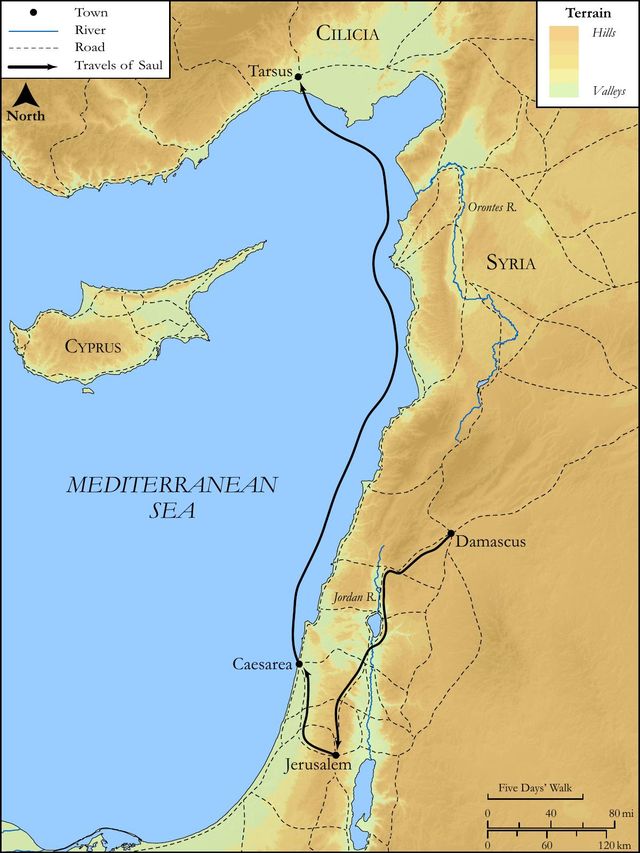
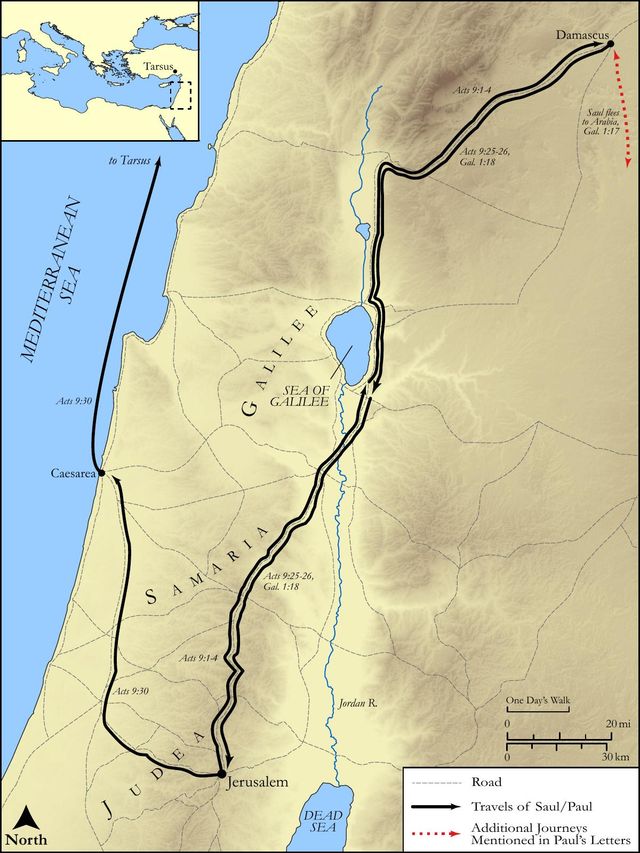
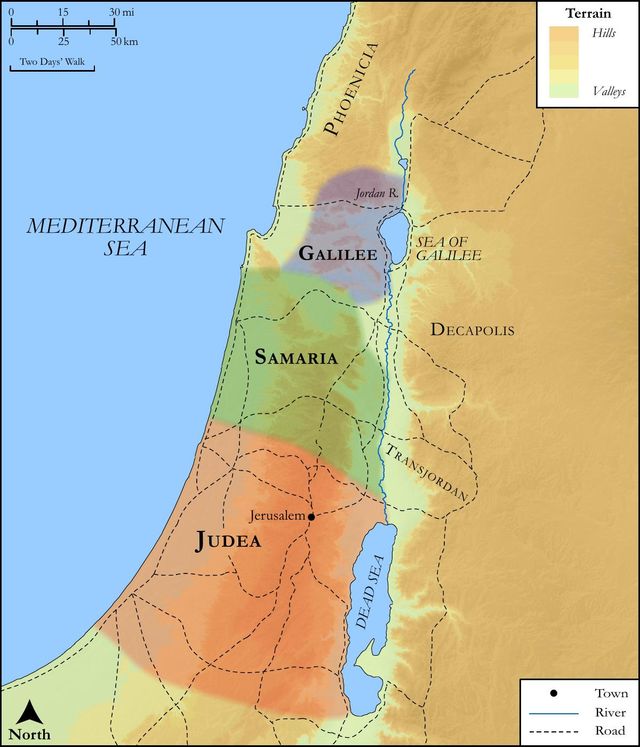
Study this verse
Public-domain commentary
Matthew Henry
From his Commentary on the Whole Bible. Henry comments on passages, not single verses — this entry covers Acts 9:23–31. His four-level outline is real structure in the source text, so it is rendered as structure.
Luke here makes no mention of Paul's journey into Arabia, which he tells us himself was immediately after his conversion, Gal 1:16, Gal 1:17. As soon as God had revealed his Son in him, that he might preach him, he went not up to Jerusalem, to receive instructions from the apostles (as any other convert would have done, that was designed for the ministry), but he went to Arabia, where there was new ground to break up, and where he would have opportunity of teaching, but not learning; thence he returned to Damascus, and there, three years after his conversion, this happened, which is here recorded.
I.He met with difficulties at Damascus, and had a narrow escape of being killed there. Observe,
1.What his danger was (Act 9:23): The Jews took counsel to kill him, being more enraged at him than at any other of the preachers of the gospel, not only because he was more lively and zealous in his preaching than any of them, and more successful, but because he had been such a remarkable deserter, and his being a Christian was a testimony against them. It is said (Act 9:24), The Jews watched the gates day and night to kill him; they incensed the governor against him, as a dangerous man, who therefore kept the city with a guard to apprehend him, at his going out or coming in, Co2 11:32. Now Christ showed Paul what great things he must suffer for his name (Act 9:16), when here was presently the government in arms against him, which was a great thing, and, as all his other sufferings afterwards, helped to make him considerable. Saul was no sooner a Christian than a preacher, no sooner a preacher than a sufferer; so quickly did he rise to the summit of his preferment. Note, Where God gives great grace he commonly exercises it with great trials.
2.How he was delivered.
(1.)The design against him was discovered: Their lying in wait was known of Saul, by some intelligence, whether from heaven or from men we are not told.
(2.)The disciples contrived to help him away - hid him, it is likely, by day; and in the night, the gates being watched, that he could not get away through them, they let him down by the wall, in a basket, as he himself relates it (Co2 11:33), so he escaped out of their hands. This story, as it shows us that when we enter into the way of God we must look for temptation, and prepare accordingly, so it shows us that the Lord knows how to deliver the godly out of temptation, and will with the temptation also make a way to escape, that we may not be by it deterred nor driven from the way of God.
II.He met with difficulties at Jerusalem the first time he went thither, Act 9:26.
He came to Jerusalem. This is thought to be that journey to Jerusalem of which he himself speaks (Gal 1:18): After three years I went up to Jerusalem, saith he, to see Peter, and abode with him fifteen days. But I rather incline to think that this was a journey before that, because his coming in and going out, his preaching and disputing (Act 9:28, Act 9:29), seem to be more than would consist with his fifteen days' stay (for that was no more) and to require a longer time; and, besides, now he came a stranger, but then he came, historēsai - to confer with Peter, as one he was intimate with; however, it might possibly be the same. Now observe,
1.How shy his friends were of him (Act 9:26): When he came to Jerusalem, he did not go to the chief priests and the Pharisees (he had taken his leave of them long since), but he assayed to join himself to the disciples. Wherever he came, he owned himself one of that despised persecuted people, and associated with them. They were now in his eyes the excellent ones of the earth, in whom was all his delight. He desired to be acquainted with them, and to be admitted into communion with them; but they looked strange upon him, shut the door against him, and would not go about any of their religious exercises if he were by, for they were afraid of him. Now might Paul be tempted to think himself in an ill case, when the Jews had abandoned and persecuted him, and the Christians would not receive and entertain him. Thus does he fall into divers temptations, and needs the armour of righteousness, as we all do, both on the right hand and on the left, that we may not be discouraged either by the unjust treatment of our enemies or the unkind treatment of our friends.
(1.)See what was the cause of their jealousy of him: They believed not that he was a disciple, but only pretended to be so, and came among them as a spy or an informer. They knew what a bitter persecutor he had been, with what fury he went to Damascus some time ago; they had heard nothing of him since, and therefore thought he was but a wolf in sheep's clothing. The disciples of Christ had need to be cautious whom they admit into communion with them. Believe not every spirit. There is need of the wisdom of the serpent, to keep the mean between the extremes of suspicion on the one hand and credulity on the other; yet methinks it is safer to err on the charitable side, because it is an adjudged case that it is better the tares should be found among the wheat than that the wheat should any of it be rooted up and thrown out of the field.
(2.)See how it was removed (Act 9:27): Barnabas took him to the apostles themselves, who were not so scrupulous as the inferior disciples, to whom he first assayed to join himself, and he declared to them,
[1.]What Christ had done for him: He had shown himself to him in the way and spoken to him; and what he said.
[2.]What he had since done for Christ: He had preached boldly at Damascus in the name of Jesus. How Barnabas came to know this, more than the rest of them, we are not told; whether he had himself been at Damascus, or had had letters thence, or discoursed with some of that city, by which he came to the knowledge of this; or whether he had formerly been acquainted with Paul in the Grecian synagogues, or at the feet of Gamaliel, and had such an account of his conversion from himself as he saw cause enough to give credit to: but so it was that, being satisfied himself, he gave satisfaction to the apostles concerning him, he having brought no testimonials from the disciples at Damascus, thinking he needed not, as some others, epistles of commendation, Co2 3:1. Note, The introducing of a young convert into the communion of the faithful is a very good work, and one which, as we have opportunity, we should be ready to do.
2.How sharp his enemies were upon him.
(1.)He was admitted into the communion of the disciples, which was no little provocation to his enemies. It vexed the unbelieving Jews to see Saul a trophy of Christ's victory, and a captive to his grace, who had been such a champion for their cause - to see him coming in, and going out, with the apostles (Act 9:28), and to hear them glorying in him, or rather glorifying God in him.
(2.)He appeared vigorous in the cause of Christ, and this was yet more provoking to them (Act 9:29): He spoke boldly in the name of the Lord Jesus. Note, Those that speak for Christ have reason to speak boldly; for they have a good cause, and speak for one who will at last speak for himself and them too. The Grecians, or Hellenist Jews, were most offended at him, because he had been one of them; and they drew him into a dispute, in which, no doubt, he was too hard for them, as he had been for the Jews at Damascus. One of the martyrs said, Though she could not dispute for Christ, she could die for Christ; but Paul could do both. Now the Lord Jesus divided the spoils of the strong man armed in Saul. For that same natural quickness and fervour of spirit which, while he was in ignorance and unbelief, made him a furious bigoted persecutor of the faith, made him a most zealous courageous defender of the faith.
(3.)This brought him into peril of his life, with which he narrowly escaped: The Grecians, when they found they could not deal with him in disputation, contrived to silence him another way; they went about to slay him, as they did Stephen when they could not resist the Spirit by which he spoke, Act 6:10. That is a bad cause that has recourse to persecution for its last argument. But notice was given of this conspiracy too, and effectual care taken to secure this young champion (Act 9:30): When the brethren knew what was designed against him they brought him down to Cesarea. They remembered how the putting of Stephen to death, upon his disputing with the Grecians, had been the beginning of a sore persecution; and therefore were afraid of having such a vein opened again, and hastened Paul out of the way. He that flies may fight again. He that fled from Jerusalem might do service at Tarsus, the place of his nativity; and thither they desired him by all means to go, hoping he might there go on in his work with more safety than at Jerusalem. Yet it was also by direction from heaven that he left Jerusalem at this time, as he tells us himself (Act 22:17, Act 22:18), that Christ now appeared to him, and ordered him to go quickly out of Jerusalem, for he must be sent to the Gentiles, Act 9:15. Those by whom God has work to do shall be protected from all the designs of their enemies against them till it be done. Christ's witnesses cannot be slain till they have finished their testimony.
III.The churches had now a comfortable gleam of liberty and peace (Act 9:31):
Then had the churches rest. Then, when Saul was converted, so some; when that persecutor was taken off, those were quiet whom he used to irritate, and then those were quiet whom he used to molest. Or, then, when he had gone from Jerusalem, the fury of the Grecian Jews was a little abated, and they were the more willing to bear with the other preachers now that Saul had gone out of the way. Observe,
1.The churches had rest. After a storm comes a calm. Though we are always to expect troublesome times, yet we may expect that they shall not last always. This was a breathing-time allowed them, to prepare them for the next encounter. The churches that were already planted were mostly in Judea, Galilee, and Samaria, within the limits of the holy land. There were the first Christian churches, where Christ had himself laid the foundation.
2.They made a good use of this lucid interval. Instead of growing more secure and wanton in the day of their prosperity, they abounded more in their duty, and made a good use of their tranquillity.
(1.)They were edified, were built up in their most holy faith; the more free and constant enjoyment they had of the means of knowledge and grace, the more they increased in knowledge and grace.
(2.)They walked in the fear of the Lord - were more exemplary themselves for a holy heavenly conversation. They so lived that all who conversed with them might say, Surely the fear of God reigns in those people.
(3.)They walked in the comfort of the Holy Ghost - were not only faithful, but cheerful, in religion; they stuck to the ways of the Lord, and sang in those ways. The comfort of the Holy Ghost was their consolation, and that which they made their chief joy. They had recourse to the comfort of the Holy Ghost, and lived upon that, not only in days of trouble and affliction, but in days of rest and prosperity. The comforts of the earth, when they had the most free and full enjoyment of them, could not content them without the comfort of the Holy Ghost. Observe the connection of these two: when they walked in the fear of the Lord, then they walked in the comfort of the Holy Ghost. Those are most likely to walk cheerfully that walk circumspectly.
3.God blessed it to them for their increase in number: They were multiplied. Sometimes the church multiplies the more for its being afflicted, as Israel in Egypt; yet if it were always so, the saints of the Most High would be worn out. At other times its rest contributes to its growth, as it enlarges the opportunity of ministers, and invites those in who at first are afraid of suffering. Or, then, when they walked in the fear of God and his comforts, they were multiplied. Thus those that will not be won by the word may be won by the conversation of professors.
Historical interpretation
Three Centuries of Reception
3 surviving comments on this verse. Each one is dated, so this reads as a timeline rather than a list.
Select a marker to jump to its quote. Markers stagger vertically where authors wrote within a few decades of each other.
"And after that many days were fulfilled, the Jews took counsel to kill him." The Jews again resort to that valid argument of theirs, not now seeking false-accusers and false-witnesses; they cannot wait for these now: but what do they? They set about it by themselves. For as they see the affair on the increase, they do not even use the form of a trial.
Therefore "after many days" this happens: viz. the Jews "took counsel to kill him. And their laying await was known of Saul." What does this mean? It is likely that for awhile he did not choose to depart thence, though many, perhaps, besought him; but when he learnt it, then he permitted his disciples: for he had disciples immediately.
The Jews made a council to kill him. But the plot against Paul was known to him; and they watched the gates of the city day and night to kill him. It was not the Jews who kept watch, but the citizens themselves with their king Aretas, as the Apostle himself, who was besieged and escaped, writes to the Galatians. For both Gentiles and Jews, although they disagree among themselves, always agree in the persecution of Christians.
Continue studying Acts 9:23 across the web’s major study libraries — every link below opens this exact verse, chapter, or book on the destination site.
Read & Compare
 BibleGatewayThis verse in more than 200 translations and 70 languages.
 Bible.comThe YouVersion reader — hundreds of translations, reading plans, and highlights.
 ESV.orgCrossway's official English Standard Version reader.
 NET BibleThe NET translation with 60,000+ translators' notes on every rendering decision.
 STEP BibleTyndale House's free study tool — original text, vocabulary, and scholarly resources.
 BibliaLogos Bible Software's free web reader.
 USCCBThe New American Bible (Revised Edition) with the U.S. bishops' study notes.
Commentaries
 BibleHub CommentariesDozens of classic commentaries on this verse, gathered on one page.
 StudyLightMore than 100 commentary sets — the largest collection on the web.
 BibleRefPlain-English commentary on what this verse means, verse by verse.
 Enduring WordDavid Guzik's free commentary on this chapter, widely used by Bible teachers.
 Bible Study ToolsVerse commentary alongside Greek and Hebrew study aids.
Original Language & Research
- BibleHub InterlinearThe verse word by word — original language, transliteration, and English.
- BibleHub LexiconEvery word's original-language definition and Strong's entry.
 Blue Letter BibleDeep-study tools — Strong's numbers, concordance, and word studies.
 CNTR CollationThe earliest Greek manuscripts of this verse, collated letter by letter.
Sermons, Hymns & Audio


TrulyRandomVerse is not affiliated with these sites and doesn’t control their content. They’re linked because they’re genuinely useful.
Summary
Acts 9:23 marks a pivotal moment in the narrative of Saul's (Paul's) early ministry, revealing the immediate and intense opposition he faced after his radical conversion. Following a period of fervent preaching in Damascus, where he boldly proclaimed Jesus as the Son of God, his former Jewish compatriots, astonished and enraged by his defection and powerful message, conspired to assassinate him, setting the stage for his miraculous escape and subsequent journey.
Context
ShowHideLiterary Context
Acts 9:23 is situated immediately after the dramatic account of Saul's conversion on the road to Damascus and his subsequent healing by Ananias (Acts 9:1-19). The narrative highlights Saul's immediate and astonishing transformation from a zealous persecutor of Christians into an equally zealous preacher of Christ. Verses 20-22 describe Saul's initial preaching in the synagogues, where he "confounded the Jews which dwelt at Damascus, proving that this is very Christ." This verse, therefore, represents the direct, escalating consequence of Saul's effective and provocative evangelism. His sudden allegiance to "the Way" (Christianity) and his powerful arguments for Jesus' Messiahship stirred not only astonishment but also profound hostility among those who had previously known him as their champion against the nascent Christian movement.
Historical & Cultural Context
Damascus was a significant city, a major center for trade and Jewish life outside of Jerusalem. The Jewish community there, like those throughout the diaspora, maintained strong ties to the religious authorities in Jerusalem, including the Sanhedrin. Saul had originally come to Damascus with letters from the high priest to arrest Christians (Acts 9:1-2), indicating the Sanhedrin's perceived jurisdiction and influence. For the Jews in Damascus, Saul's conversion was not merely a personal change but a profound betrayal and a direct challenge to their religious identity and authority. His preaching of a crucified Messiah was considered blasphemous, and his abandonment of the Mosaic Law for faith in Christ was seen as an existential threat to their traditions. Conspiracies to kill those deemed heretical or dangerous were not uncommon in this period, reflecting the deep-seated religious and political tensions between various Jewish factions and the emerging Christian movement.
Key Themes
ShowHideThis verse contributes significantly to several overarching themes within Acts and the broader biblical narrative. Firstly, it powerfully illustrates the theme of Radical Transformation and Its Consequences. Saul, once a persecutor, now faces the very persecution he inflicted upon others, underscoring the profound and life-altering nature of his encounter with Christ. Secondly, it highlights the Inevitable Opposition to the Gospel. The plot against Saul demonstrates that proclaiming the truth of Christ often provokes intense hostility from those who reject its claims, a theme echoed throughout the New Testament (e.g., John 15:18). Thirdly, it subtly introduces the theme of Divine Sovereignty and Protection. Despite the serious threat, God's plan for Saul's life and ministry would not be thwarted, foreshadowing His continuous safeguarding of His chosen instruments, ensuring His purposes are fulfilled, even through trials, as seen in Saul's eventual escape from Damascus, which is detailed in Acts 9:24-25.
Exposition and Analysis
ShowHideKey Word Analysis
ShowHideThis word (G4137) means "to make replete," "to cram," "to fill up," "to accomplish," or "to finish (a period or task)." In this context, "many days were fulfilled" indicates that a significant, though unspecified, period of time had elapsed. It suggests a completion of a certain duration, implying that Saul's preaching and the Jews' growing animosity had reached a critical point, culminating in their decision to act. This is not a casual passage of time but a divinely appointed or narratively significant completion.
This term (G4823) means "to give (or take) advice jointly," "to recommend," "to deliberate," or "to determine." The use of this verb emphasizes that the Jews' decision was not a spontaneous outburst of anger but a deliberate, organized, and premeditated conspiracy. It implies a formal or informal meeting where a plan was discussed, agreed upon, and set into motion, highlighting the seriousness and depth of their opposition to Saul and his message.
This word (G337) means "to take up," but by implication, "to take away violently," "to abolish," or "to murder." Its use here underscores the extreme nature of the Jews' intent. They sought not merely to silence Saul or expel him from the city, but to end his life, demonstrating the profound threat they perceived him to be to their religious and social order. This premeditated intent to murder reveals the depth of their hatred and rejection of the gospel message Saul was proclaiming.
Verse Breakdown
ShowHide"And after that many days were fulfilled"
This phrase indicates a significant passage of time following Saul's conversion and initial preaching in Damascus. While the exact duration is not specified in Acts, it is traditionally understood to encompass a period of intense theological reflection and preparation, possibly including Saul's sojourn in Arabia mentioned in Galatians 1:17-18. During this time, Saul's understanding of the gospel deepened, and his preaching became even more potent, leading to the heightened opposition described.
"the Jews took counsel to kill him"
This clause reveals the extreme and violent nature of the opposition Saul faced. "The Jews" here refers to those in the Damascus synagogues who rejected Jesus as the Messiah and viewed Saul's conversion and proclamation as a grave apostasy and blasphemy. Their "taking counsel" signifies a deliberate, organized plot, a conspiracy to assassinate Saul. This was not a spontaneous act of anger but a calculated decision, underscoring the perceived threat Saul posed to their religious authority and traditions.
Literary Devices
ShowHideActs 9:23 employs several literary devices to enhance its narrative impact. The most prominent is Foreshadowing, as this verse sets the stage for the recurring theme of intense persecution that will characterize Paul's entire apostolic ministry. It signals that his life will be marked by constant threats, plots, and suffering for the sake of the gospel, a reality vividly documented throughout the book of Acts and in his epistles. There is also a strong element of Irony present; the very man who sought to "make havock of the church" (Acts 8:3) and bring Christians to Jerusalem for punishment now finds himself the target of similar, if not identical, violent intentions from his former allies. This reversal of roles underscores the transformative power of Christ. Finally, the verse builds Dramatic Tension, creating suspense as the reader anticipates how Saul will escape this deadly plot, thereby highlighting God's protective hand over His chosen servant.
Theological and Thematic Connections
ShowHideActs 9:23 serves as a powerful testament to the inherent conflict between the Kingdom of God and the kingdoms of this world, particularly when the truth of the Gospel challenges established religious and cultural norms. Saul's experience demonstrates that genuine conversion and bold proclamation of Christ will inevitably invite opposition, often from unexpected or previously allied sources. This opposition is not merely personal animosity but a spiritual struggle against the advance of God's redemptive plan. Yet, the verse also subtly affirms divine sovereignty, indicating that even the most malicious human plots cannot thwart God's ultimate purposes for His servants or the spread of His message. It reminds believers that faithfulness to Christ often comes with a cost, but God's protective hand is always at work.
Reflection and Application
ShowHideActs 9:23 offers profound lessons for contemporary believers. It reminds us that faithfully following Christ and proclaiming His truth can lead to significant opposition, even from those we might expect to be allies or from within our own communities. Saul's experience teaches us the importance of perseverance in the face of adversity; just as he continued to preach despite the death threats, we are called to stand firm in our faith and mission, even when facing hostility or misunderstanding. This verse underscores that Christian discipleship is not always easy or comfortable; it may involve sacrifice, misunderstanding, and even danger, echoing Christ's own warnings to His followers about taking up their cross. Ultimately, it calls us to trust in God's unwavering purpose and protection, knowing that even when plots are laid against His servants, He remains sovereign, and His plans for their lives and for the spread of His Gospel will ultimately prevail.
Questions for Reflection
ShowHideFAQ
ShowHideHow long were "many days" in Acts 9:23?
ShowHideThe exact duration of "many days" is not specified in the book of Acts. However, a common interpretation, supported by Paul's own testimony in Galatians 1:17-18, suggests that this period includes three years that Saul spent in Arabia before returning to Damascus. During this time, he likely received further revelation and preparation from the Lord, deepening his understanding of the gospel and strengthening his resolve before resuming his public ministry in Damascus. This extended period allowed his message to gain significant traction, intensifying the opposition.
Why did "the Jews" want to kill Saul?
ShowHideThe Jews in Damascus, particularly the religious leaders and those zealous for the Mosaic Law, saw Saul's conversion and his subsequent preaching of Jesus as the Messiah as a profound betrayal and a dangerous heresy. Saul, formerly a persecutor of Christians, was now advocating for the very faith he once sought to destroy. His arguments, based on the Scriptures and empowered by the Holy Spirit, were so convincing that they confounded his opponents (Acts 9:22). This not only threatened their religious authority and traditions but also challenged their understanding of God's covenant and the identity of the Messiah. For them, Saul's message was blasphemous and a direct assault on their way of life, leading them to seek his death.
How did Saul escape this plot?
ShowHideThe narrative immediately following Acts 9:23 details Saul's dramatic escape. Acts 9:24-25 states that the Jews "watched the gates day and night to kill him." However, Saul's disciples took him by night and let him down through an opening in the city wall in a basket. This miraculous escape highlights God's protective hand over His chosen servant, ensuring that His purposes for Saul's life and ministry would not be thwarted by human malice.
Christ-Centered Fulfillment
ShowHideActs 9:23, while detailing a moment of intense human opposition against Saul, profoundly points to Christ in its broader theological implications. Saul's suffering and the divine protection he experienced foreshadow the pattern of the apostolic ministry, which is always an extension of Christ's own suffering and triumph. Just as Jesus faced relentless opposition and plots against His life, ultimately culminating in His crucifixion, so too would His chosen instrument, Paul, endure similar trials. However, like Christ's resurrection, which demonstrated God's ultimate victory over death and human evil, Paul's escape from the Damascus plot reveals God's sovereign power to preserve His servants for His purposes. Paul's subsequent ministry, marked by both suffering and miraculous deliverance, becomes a living testament to the power of the crucified and risen Christ. His willingness to suffer for the name of Jesus (Acts 9:16) and God's faithfulness in delivering him, echoes Christ's own journey of suffering leading to glory, providing a powerful example for all who are called to bear witness to the Lamb of God, who takes away the sin of the world!.