


1 Samuel 25:44
Bible text: King James Version (1769 Blayney text) · Public domain
Bible text: Berean Standard Bible · Public domain
Bible text: American Standard Version (1901) · Public domain
Bible text: World English Bible, Messianic edition · Public domain
Bible text: Geneva Bible (1599) · Public domain
Bible text: Young's Literal Translation · Public domain
- וְשָׁאוּלve·sha·'Uland SaulH7586Conj-w ¦ N-proper-mNoun Proper MasculineוְandשָׁאוּלSaul
- נָתַןna·Tanhe had givenH5414V-Qal-Perf-3msVerb Qal Perfect 3rd Singular Masculine
- אֶת'et<obj.>H853DirObjMParticle Object Indicator
- מִיכַלmi·KhalMichalH4324N-proper-fNoun Proper Feminine
- בִּתּוֹbi·Tohis daughterH1323N-fsc ¦ 3msNoun Singular Feminine Constructבִּתּdaughterוֹhis
- אֵשֶׁת'E·shet[the] wife ofH802N-fscNoun Singular Feminine Construct
- דָּוִדda·VidDavidH1732N-proper-mNoun Proper Masculine
- לְפַלְטִיle·fal·Tito PaltiH6406Prep-l ¦ N-proper-mNoun Proper MasculineלְtoפַלְטִיPalti
- בֶןven[the] son ofH1121N-mscNoun Singular Masculine Construct
- לַיִשׁLa·yishLaishH3919N-proper-mNoun Proper Masculine
- אֲשֶׁר'a·SherwhoH834RelParticle Relative
- מִגַּלִּיםmi·ga·Lim[was] from GallimH1554Prep-m ¦ N-properNoun Proper Locationמִ[was] fromגַּלִּיםGallim
English is a literal word-by-word gloss of the Hebrew, not the KJV's wording. Why?
This is the original text the KJV's translators worked from — each Hebrew word with its own literal English meaning in this verse, prepared by scholars at Tyndale House, Cambridge. The KJV translates whole sentences, not word by word, so its wording differs: one Hebrew word can become several English words, and the KJV may choose “the LORD” where the gloss reads “Yahweh”. Both are faithful — they answer different questions. For the KJV's own rendering, switch to the KJV text.
Details
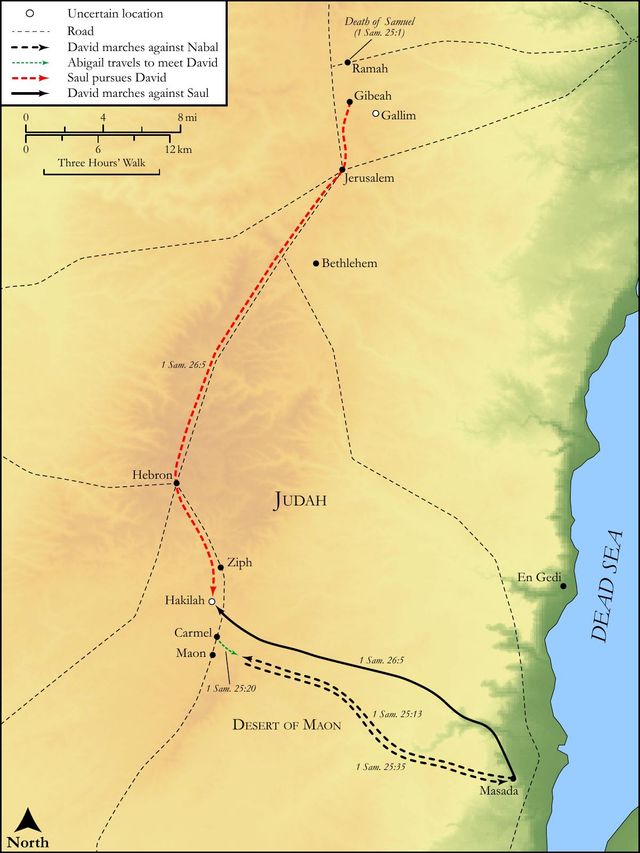
See on the biblical-era map
Study this verse
Public-domain commentary
Matthew Henry
From his Commentary on the Whole Bible. Henry comments on passages, not single verses — this entry covers 1 Samuel 25:36–44. His three-level outline is real structure in the source text, so it is rendered as structure.
We are now to attend Nabal's funeral and Abigail's wedding.
I.Nabal's funeral.
The apostle speaks of some that were twice dead, Jde 1:12. We have hare Nabal thrice dead, though but just now wonderfully rescued from the sword of David and delivered from so great a death; for the preservations of wicked men are but reservations for some further sorer strokes of divine wrath. Here is,
1.Nabal dead drunk, Sa1 25:36. Abigail came home, and, it should seem, he had so many people and so much plenty about him that he neither missed her nor the provisions she took to David; but she found him in the midst of his jollity, little thinking how near he was to ruin by one whom he had foolishly made his enemy. Sinners are often most secure when they are most in danger and destruction is at the door. Observe,
(1.)How extravagant he was in the entertainment of his company: He held a feast like the feast of a king, so magnificent and abundant, though his guests were but his sheep-shearers. This abundance might have been allowed if he had considered what God gave him his estate for, not to look great with, but to do good with. It is very common for those that are most niggardly in any act of piety or charity to be most profuse in gratifying a vain humour or a base lust. A mite is grudged to God and his poor; but, to make a fair show in the flesh, gold is lavished out of the bag. If Nabal had not answered to his name, he would never have been thus secure and jovial, till he had enquired whether he was safe from David's resentments; but (as bishop Hall observes) thus foolish are carnal men, that give themselves over to their pleasures before they have taken any care to make their peace with God.
(2.)How sottish he was in the indulgence of his own brutish appetite: He was very drunk, a sign he was Nabal, a fool, that could not use his plenty without abusing it, could not be pleasant with his friends without making a beast of himself. There is not a surer sign that a man has but little wisdom, nor a surer way to ruin the little he has, than drinking to excess. Nabal, that never thought he could bestow too little in charity, never thought he could bestow too much in luxury. Abigail, finding him in this condition (and probably those about him little better, when the master of the feast set them so bad an example), had enough to do to set the disordered house to-rights a little, but told Nabal nothing of what she had done with reference to David, nothing of his folly in provoking David, of his danger or of his deliverance, for, being drunk, he was as incapable to hear reason as he was to speak it. To give good advice to those that are in drink is to cast pearls before swine; it is better to stay till they are sober.
2.Nabal again dead with melancholy, Sa1 25:37. Next morning, when he had come to himself a little, his wife told him how near to destruction he had brought himself and his family by his own rudeness, and with what difficulty she had interposed to prevent it; and, upon this, his heart died within him and he became as a stone. Some suggest that the expense of the satisfaction made to David, by the present Abigail brought him, broke his heart: it seems rather that the apprehension he now had of the danger he had narrowly escaped put him into a consternation, and seized his spirits so that he could not recover it. He grew sullen, and said little, ashamed of his own folly, put out of countenance by his wife's wisdom. How is he changed! His heart over-night merry with wine, next morning heavy as a stone; so deceitful are carnal pleasures, so transient the laughter of the fool. The end of that mirth is heaviness. Drunkards are sometimes sad when they reflect upon their own folly. Joy in God makes the heart always light. Abigail could never, by her wise reasonings, bring Nabal to repentance; but now, by her faithful reproof, she brings him to despair.
3.Nabal, at last, dead indeed: About ten days after, when he had been kept so long under this pressure and pain, the Lord smote him that he died (Sa1 25:38), and, it should seem, he never held up his head; it is just with God (says bishop Hall) that those who live without grace should die without comfort, nor can we expect better while we go on in our sins. Here is no lamentation made for Nabal. He departed without being lamented. Every one wished that the country might never sustain a greater loss. David, when he heard the news of his death, gave God thanks for it, Sa1 25:39. He blessed God,
(1.)That he had kept him from killing him: Blessed be the lord, who hath kept his servant from evil. He rejoices that Nabal died a natural death and not by his hand. We should take all occasions to mention and magnify God's goodness to us in keeping us from sin.
(2.)That he had taken the work into his own hands, and had vindicated David's honour, and not suffered him to go unpunished who had been abusive to him; hereby his interest would be confirmed, and all would stand in awe of him, as one for whom God fought.
(3.)That he had thereby encouraged him and all others to commit their cause to God, when they are in any way injured, with an assurance that, in his own time, he will redress their wrongs if they sit still and leave the matter to him.
II.Abigail's wedding.
David was so charmed with the beauty of her person, and the uncommon prudence of her conduct and address, that, as soon as was convenient, after he heard she was a widow, he informed her of his attachment to her (Sa1 25:39), not doubting but that she who approved herself so good a wife to so bad a husband as Nabal would much more make a good wife to him, and having taken notice of her respect to him and her confidence of his coming to the throne.
1.He courted by proxy, his affairs, perhaps, not permitting him to come himself.
2.She received the address with great modesty and humility (Sa1 25:41), reckoning herself unworthy of the honour, yet having such a respect for him that she would gladly be one of the poorest servants of his family, to wash the feet of the other servants. None so fit to be preferred as those that can thus humble themselves.
3.She agreed to the proposal, went with his messenger, took a retinue with her agreeable to her quality, and she became his wife, Sa1 25:42. She did not upbraid him with his present distresses, and ask him how he could maintain her, but valued him,
(1.)Because she knew he was a very good man.
(2.)Because she believed he would, in due time, be a very great man. She married him in faith, not questioning but that, though now he had not a house of his own that he durst bring her to, yet God's promise go him would at length be fulfilled. Thus those who join themselves to Christ must be willing now to suffer with him, believing that hereafter they shall reign with him.
Lastly, On this occasion we have some account of David's wives. 1. One that he had lost before he married Abigail, Michal, Saul's daughter, his first, and the wife of his youth, to whom he would have been constant if she would have been so to him, but Saul had given her to another (Sa1 25:44), in token of his displeasure against him and disclaiming the relation of a father-in-law to him. 2. Another that he married besides Abigail (Sa1 25:43), and, as should seem, before her, for she is named first, Sa1 27:3. David was carried away by the corrupt custom of those times; but from the beginning it was not so, nor is it so now that Messias has come, and the times of reformation, Mat 19:4, Mat 19:5. Perhaps Saul's defrauding David of his only rightful wife was the occasion of his running into this irregularity; for, when the knot of conjugal affection is once loosed, it is scarcely ever tied fast again. When David could not keep his first wife he thought that would excuse him if he did not keep to his second. But we deceive ourselves if we think to make others' faults a cloak for our own.
Historical interpretation
Historical reception
1 surviving comment on this verse from the historical church.
But Saul gave Michal his daughter as a wife to David, etc. Phalti means my savior, Lais means lion, or fears for himself, Gallim means those who are transmigrated. The leaders and teachers of the Jews, after they saw that the Gentiles believed in Christ, withdrew the common people subject to the Synagogue from him and taught them to believe rather in the Antichrist, whom they await as their savior at the end, indeed the son of the devil, who was made so that he would fear no one, and roamed around like a roaring lion seeking whom he may devour (I Pet. V); and he is numbered among the unclean spirits, who also formerly transmigrated from the heavens to Tartarus, and daily do not cease to lead their followers from virtues to vices, from bad to worse.
Continue studying 1 Samuel 25:44 across the web’s major study libraries — every link below opens this exact verse, chapter, or book on the destination site.
Read & Compare
 BibleGatewayThis verse in more than 200 translations and 70 languages.
 Bible.comThe YouVersion reader — hundreds of translations, reading plans, and highlights.
 ESV.orgCrossway's official English Standard Version reader.
 NET BibleThe NET translation with 60,000+ translators' notes on every rendering decision.
 STEP BibleTyndale House's free study tool — original text, vocabulary, and scholarly resources.
 BibliaLogos Bible Software's free web reader.
 USCCBThe New American Bible (Revised Edition) with the U.S. bishops' study notes.
Commentaries
 BibleHub CommentariesDozens of classic commentaries on this verse, gathered on one page.
 StudyLightMore than 100 commentary sets — the largest collection on the web.
 BibleRefPlain-English commentary on what this verse means, verse by verse.
 Enduring WordDavid Guzik's free commentary on this chapter, widely used by Bible teachers.
 Bible Study ToolsVerse commentary alongside Greek and Hebrew study aids.
Original Language & Research
- BibleHub InterlinearThe verse word by word — original language, transliteration, and English.
- BibleHub LexiconEvery word's original-language definition and Strong's entry.
 Blue Letter BibleDeep-study tools — Strong's numbers, concordance, and word studies.
 SefariaThe Hebrew text with Rashi and centuries of Jewish commentary.
Sermons, Hymns & Audio


TrulyRandomVerse is not affiliated with these sites and doesn’t control their content. They’re linked because they’re genuinely useful.
Summary
1 Samuel 25:44 records King Saul's deliberate and illegitimate act of giving his daughter Michal, who was already legitimately married to David, to another man named Phalti. This calculated maneuver by Saul was a desperate attempt to publicly delegitimize David's claim to the throne by severing his marital ties to the royal family, reflecting the profound depth of Saul's animosity, jealousy, and his futile efforts to thwart God's anointing on David.
Context
ShowHideLiterary Context
This verse appears as a concise, yet profoundly significant, parenthetical detail within the broader narrative of David's fugitive period. It immediately follows David's dramatic encounter with Nabal and Abigail, culminating in his marriage to Abigail and Ahinoam of Jezreel, solidifying his growing influence and alliances (1 Samuel 25:39-43). The inclusion of 1 Samuel 25:44 at this juncture serves to starkly underscore the escalating conflict between Saul and David. While David is gaining wives and strengthening his position, Saul is simultaneously attempting to undermine David's existing, legitimate connections to the royal house. This act by Saul is a direct counterpoint to David's rising stature and foreshadows David's later insistence on Michal's return, highlighting the enduring validity of his original marriage covenant and his rightful claim to the throne.
Historical & Cultural Context
In ancient Israel, especially within royal families, marriage was frequently a strategic political alliance, solidifying power and succession. Michal was originally given to David by Saul as a bride price for killing 200 Philistines, a dangerous task Saul hoped would lead to David's death (1 Samuel 18:20-27). This made David Saul's son-in-law and formally connected him to the royal lineage. Saul's subsequent act of giving Michal to Phalti was a profound violation of established marital norms and a blatant abuse of patriarchal authority. While a father held significant control over his daughter's marriage, unilaterally re-marrying an already married daughter was an illegitimate act designed to publicly shame David, invalidate his claim, and assert Saul's absolute control over his family and perceived enemies. Phalti "of Gallim" likely places him within Saul's tribal territory of Benjamin, indicating a local, perhaps loyal, family chosen to solidify Saul's control and further distance Michal from David.
Key Themes
ShowHideThis verse powerfully illustrates several key themes running through the book of 1 Samuel. Firstly, it highlights Saul's escalating paranoia and jealousy towards David, demonstrating the destructive nature of his unchecked animosity and his descent into tyrannical behavior. His actions are not merely personal but are a desperate attempt to thwart God's chosen successor. Secondly, it underscores the theme of divine sovereignty versus human machinations. Despite Saul's calculated efforts to delegitimize David, God's plan for David's kingship remains unshakeable and ultimately prevails, as seen in David's eventual ascension to the throne (2 Samuel 5:1-5). Thirdly, the verse touches upon the sanctity and violation of covenant. Saul's disregard for the marriage covenant between David and Michal reflects his broader pattern of disobedience and disregard for divine principles, contrasting sharply with David's general adherence to God's will, even in difficult circumstances. This act also sets the stage for David's later demand for Michal's return, emphasizing the enduring legitimacy of his claim to the throne and his rightful marriage to her, as seen in 2 Samuel 3:14.
Exposition and Analysis
ShowHideKey Word Analysis
ShowHideThe Hebrew verb נָתַן (nâthan) means "to give, place, set, or appoint." Its use here is crucial, emphasizing that Saul's action was not passive abandonment but a deliberate, formal, and authoritative transfer. He actively "assigned" Michal to Phalti, reinforcing his perceived right to control his daughter's marital status despite her existing, legitimate bond with David. This highlights Saul's tyrannical exercise of power and his determination to use any means to undermine David.
Michal, identified as Saul's daughter, was David's first wife, given to him as a reward for his military prowess. Her name, Mîykâl, meaning "revulet," carries a subtle irony in this context, as her life with David was anything but a peaceful flow, often disrupted by her father's machinations. By giving her to another, Saul was not merely arranging a new marriage for his daughter but was attempting to annul a pre-existing, divinely sanctioned union, thereby directly challenging David's status and connection to the royal family.
The Hebrew word אִשָּׁה (ʼishshâh) means "a woman" or "wife." The explicit mention of Michal as "David's wife" in the text is a critical parenthetical clarification. It serves as a strong reminder to the reader that Michal was not a free woman but was already bound in a legitimate marriage to David. This detail underscores the egregious nature of Saul's act, making it clear that he was violating an established covenant and attempting to usurp David's conjugal rights, rather than simply arranging a new marriage for an unmarried daughter.
Verse Breakdown
ShowHide"But Saul had given Michal his daughter, David's wife,"
This clause immediately establishes Saul's agency and the object of his action. The phrase "David's wife" is paramount, reminding the reader of the existing, valid marriage covenant that Saul is unilaterally violating. This act is presented as a direct, hostile move against David, aimed at stripping him of his connection to the royal house and publicly shaming him. It underscores Saul's desperation and his willingness to disregard established norms and personal relationships in his relentless pursuit of David, demonstrating his increasing moral decay and abuse of power.
"to Phalti the son of Laish, which [was] of Gallim."
This specifies the recipient of Michal, a man named Phalti, identified by his father Laish and his hometown Gallim. The detail "of Gallim" places Phalti within the territory of Benjamin, Saul's own tribe and region. This suggests that Phalti was likely a loyalist or someone Saul could easily control, further emphasizing the political nature of this forced remarriage. It was not merely a personal slight but a strategic attempt to create a new, loyal bond within Saul's sphere of influence, solidifying his control and further isolating David from any legitimate claim to the throne through his marriage to Michal.
Literary Devices
ShowHideThe verse employs several significant literary devices. Foreshadowing is evident, as Saul's illegitimate act sets the stage for David's later demand for Michal's return in 2 Samuel 3:14, demonstrating that Saul's attempt to sever the bond was ultimately futile and God's plan would prevail. There is a strong element of irony in Saul's actions: by attempting to delegitimize David through this marital manipulation, he inadvertently highlights his own instability, his disregard for divine and human law, and the illegitimacy of his rule, contrasting sharply with David's divinely ordained destiny. The narrative uses contrast to highlight the diverging paths of Saul and David; while David is growing in stature, gaining allies, and experiencing divine favor, Saul is descending into petty, vindictive acts, losing his grip on both his kingdom and his sanity. Finally, Michal herself functions as a symbol in this narrative. Her initial marriage to David symbolized his rightful connection to the throne and his integration into the royal family, and Saul's act of giving her away symbolizes his desperate, yet ultimately powerless, attempt to deny David's legitimacy and sever his ties to the royal lineage.
Theological and Thematic Connections
ShowHideSaul's act in 1 Samuel 25:44 is a stark illustration of human rebellion against divine will and the destructive consequences of unchecked power and jealousy. Theologically, it underscores the sanctity of marriage as a covenant, even when manipulated for political ends. Saul's disregard for Michal's existing marriage to David reflects a broader pattern of disrespect for God's established order and His chosen king. Despite Saul's machinations, God's plan for David's kingship remained secure, demonstrating divine sovereignty over human attempts to thwart His purposes. This narrative reminds us that while human beings may act unjustly and violate sacred bonds, God's faithfulness to His promises ultimately prevails, ensuring that His ultimate plan will be accomplished regardless of human opposition.
Reflection and Application
ShowHideThis ancient historical detail offers profound insights into the human condition and God's unwavering sovereignty. Saul's actions vividly demonstrate the corrupting influence of unchecked power, the destructive nature of jealousy, and the bitter fruit of animosity. His willingness to violate a sacred marital bond for political gain serves as a cautionary tale, reminding us how personal insecurities and a thirst for control can lead to profound injustices, impacting not only individuals but entire families and nations. For us today, this narrative challenges us to examine our own hearts: are we tempted to undermine others, disregard commitments, or manipulate situations for personal advantage or perceived security? It calls us to respect established bonds, whether marital, familial, or communal, and to recognize the inherent dignity of others, even those we perceive as rivals. Ultimately, despite Saul's desperate attempts to thwart God's plan for David, God's purposes prevailed. This encourages us to trust in divine sovereignty, even when faced with betrayal, injustice, or seemingly insurmountable opposition, knowing that God's ultimate plan will be accomplished, and His justice will ultimately prevail.
Questions for Reflection
ShowHideFAQ
ShowHideWhy did Saul give Michal to another man?
ShowHideSaul's decision to give Michal to Phalti was a deliberate and calculated political maneuver driven by his intense jealousy and animosity towards David. By severing David's marital ties to the royal family, Saul aimed to publicly delegitimize David's claim to the throne and strip him of any perceived connection to the royal lineage. It was an act of public shaming and an attempt to assert Saul's absolute control and authority, signaling that David was no longer considered a part of the royal household. This action also reflects Saul's increasingly unstable and vengeful character as he desperately tried to thwart God's anointing on David, who he perceived as a threat to his kingship.
Was this a legal divorce according to Israelite law?
ShowHideNo, this act by Saul was not a legal divorce initiated by David according to Israelite law. David had not divorced Michal. Instead, Saul, acting unilaterally and abusively, "re-married" his daughter despite her being legitimately married to David. This was an illegitimate and unlawful act, a clear violation of the existing marriage covenant. While fathers had significant authority in arranging marriages, they did not have the right to dissolve an existing, valid marriage and force a remarriage without the husband's consent or a legitimate cause for divorce. This highlights Saul's abuse of power and his disregard for divine and societal norms in his desperate attempt to undermine David.
What happened to Michal and Phalti later?
ShowHideAfter Saul's death, when David was consolidating his power and negotiating with Abner (Saul's former commander), David made Michal's return a non-negotiable condition for any alliance. In 2 Samuel 3:14-16, David explicitly demands, "Restore my wife Michal, whom I espoused to me for a hundred foreskins of the Philistines." Abner then took Michal from Phalti. The text movingly describes Phalti following her, weeping as far as Bahurim, indicating his genuine affection for her, despite the circumstances of their "marriage." Michal was returned to David, though their relationship subsequently became strained, particularly after Michal criticized David's behavior during the ark's procession (2 Samuel 6:16-23).
Christ-Centered Fulfillment
ShowHideThe political machinations of Saul, particularly his illegitimate act of giving Michal to another, find profound Christ-centered fulfillment in the ultimate King, Jesus. Saul's desperate attempts to delegitimize David, God's anointed, foreshadow the world's futile opposition to God's true King. Just as Saul sought to sever David's rightful connection to the throne, humanity, in its rebellion, often attempts to deny or undermine the rightful reign of Christ. However, Jesus's kingship is not dependent on human lineage or political maneuvering but is divinely appointed and eternal (Luke 1:32-33). Furthermore, Saul's violation of Michal's marriage covenant, a sacred bond, points to the perfect faithfulness of Christ to His bride, the Church. Unlike Saul, who broke covenant, Christ "loved the church and gave himself up for her, that he might sanctify her" (Ephesians 5:25-27), establishing an unbreakable, eternal covenant founded on His sacrificial love. The futility of Saul's efforts to thwart God's plan for David ultimately reflects the utter futility of any human or demonic opposition to God's redemptive plan in Christ, as seen when "the kings of the earth set themselves, and the rulers take counsel together, against the Lord and against his Anointed" (Acts 4:27-28). In the end, Christ's ultimate vindication and the establishment of His eternal kingdom, where "the kingdom of the world has become the kingdom of our Lord and of his Christ, and he shall reign forever and ever" (Revelation 11:15), stands in stark contrast to Saul's temporary and illegitimate reign, affirming God's unwavering sovereignty over all human schemes and His triumphant reign through His Son.