


1 Samuel 25:43
Bible text: King James Version (1769 Blayney text) · Public domain
Bible text: Berean Standard Bible · Public domain
Bible text: American Standard Version (1901) · Public domain
Bible text: World English Bible, Messianic edition · Public domain
Bible text: Geneva Bible (1599) · Public domain
Bible text: Young's Literal Translation · Public domain
- וְאֶתve·'Etand <obj.>H853Conj-w ¦ DirObjMParticle Object Indicatorוְandאֶת<obj.>
- אֲחִינֹעַם'a·chi·No·'amAhinoamH293N-proper-fNoun Proper Feminine
- לָקַחla·Kachhe had takenH3947V-Qal-Perf-3msVerb Qal Perfect 3rd Singular Masculine
- דָּוִדda·VidDavidH1732N-proper-mNoun Proper Masculine
- מִיִּזְרְעֶאלmi·yiz·re·'Elfrom JezreelH3157Prep-m ¦ N-properNoun Proper LocationמִfromיִּזְרְעֶאלJezreel
- וַתִּהְיֶיןָva·tih·Yei·naand they becameH1961Conj-w ¦ V-Qal-ConsecImperf-3fpVerb Qal Consecutive Imperfect 3rd Plural Feminineוַandתִּהְיֶיןָthey became
- גַּםgamalsoH1571AdvAdverb
- שְׁתֵּיהֶןshe·tei·Henboth of themH8147N-fdc ¦ 3fpNoun Dual Feminine Constructשְׁתֵּיboth ofהֶןthem
- לוֹloof himPrep-l ¦ 3msSuffix Personal 3rd Singular Masculineלofוֹhim
- לְנָשִׁיםle·na·Shim<into> wivesH802Prep-l ¦ N-mpNoun Plural Masculine Absoluteלְ<into>נָשִׁיםwives
English is a literal word-by-word gloss of the Hebrew, not the KJV's wording. Why?
This is the original text the KJV's translators worked from — each Hebrew word with its own literal English meaning in this verse, prepared by scholars at Tyndale House, Cambridge. The KJV translates whole sentences, not word by word, so its wording differs: one Hebrew word can become several English words, and the KJV may choose “the LORD” where the gloss reads “Yahweh”. Both are faithful — they answer different questions. For the KJV's own rendering, switch to the KJV text.
Details
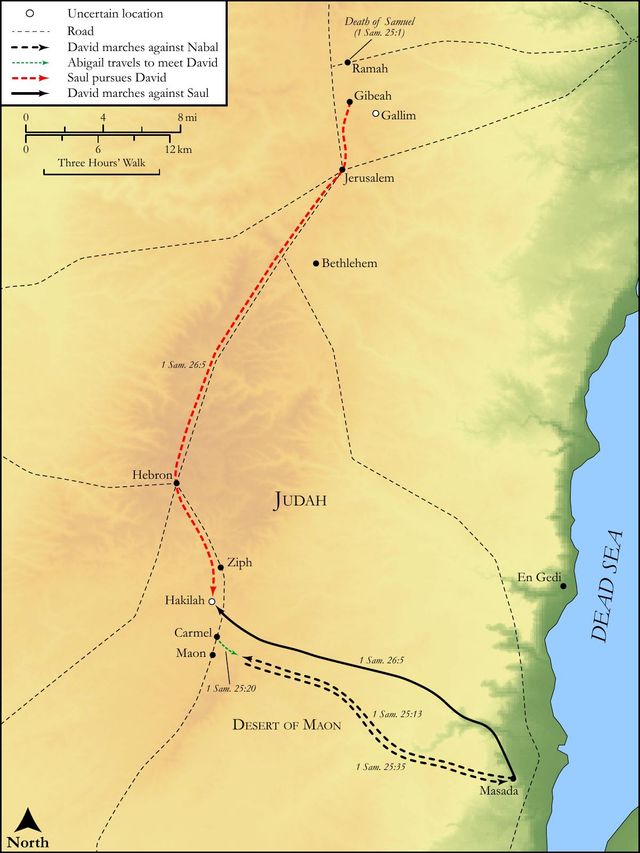
See on the biblical-era map
Study this verse
Public-domain commentary
Matthew Henry
From his Commentary on the Whole Bible. Henry comments on passages, not single verses — this entry covers 1 Samuel 25:36–44. His three-level outline is real structure in the source text, so it is rendered as structure.
We are now to attend Nabal's funeral and Abigail's wedding.
I.Nabal's funeral.
The apostle speaks of some that were twice dead, Jde 1:12. We have hare Nabal thrice dead, though but just now wonderfully rescued from the sword of David and delivered from so great a death; for the preservations of wicked men are but reservations for some further sorer strokes of divine wrath. Here is,
1.Nabal dead drunk, Sa1 25:36. Abigail came home, and, it should seem, he had so many people and so much plenty about him that he neither missed her nor the provisions she took to David; but she found him in the midst of his jollity, little thinking how near he was to ruin by one whom he had foolishly made his enemy. Sinners are often most secure when they are most in danger and destruction is at the door. Observe,
(1.)How extravagant he was in the entertainment of his company: He held a feast like the feast of a king, so magnificent and abundant, though his guests were but his sheep-shearers. This abundance might have been allowed if he had considered what God gave him his estate for, not to look great with, but to do good with. It is very common for those that are most niggardly in any act of piety or charity to be most profuse in gratifying a vain humour or a base lust. A mite is grudged to God and his poor; but, to make a fair show in the flesh, gold is lavished out of the bag. If Nabal had not answered to his name, he would never have been thus secure and jovial, till he had enquired whether he was safe from David's resentments; but (as bishop Hall observes) thus foolish are carnal men, that give themselves over to their pleasures before they have taken any care to make their peace with God.
(2.)How sottish he was in the indulgence of his own brutish appetite: He was very drunk, a sign he was Nabal, a fool, that could not use his plenty without abusing it, could not be pleasant with his friends without making a beast of himself. There is not a surer sign that a man has but little wisdom, nor a surer way to ruin the little he has, than drinking to excess. Nabal, that never thought he could bestow too little in charity, never thought he could bestow too much in luxury. Abigail, finding him in this condition (and probably those about him little better, when the master of the feast set them so bad an example), had enough to do to set the disordered house to-rights a little, but told Nabal nothing of what she had done with reference to David, nothing of his folly in provoking David, of his danger or of his deliverance, for, being drunk, he was as incapable to hear reason as he was to speak it. To give good advice to those that are in drink is to cast pearls before swine; it is better to stay till they are sober.
2.Nabal again dead with melancholy, Sa1 25:37. Next morning, when he had come to himself a little, his wife told him how near to destruction he had brought himself and his family by his own rudeness, and with what difficulty she had interposed to prevent it; and, upon this, his heart died within him and he became as a stone. Some suggest that the expense of the satisfaction made to David, by the present Abigail brought him, broke his heart: it seems rather that the apprehension he now had of the danger he had narrowly escaped put him into a consternation, and seized his spirits so that he could not recover it. He grew sullen, and said little, ashamed of his own folly, put out of countenance by his wife's wisdom. How is he changed! His heart over-night merry with wine, next morning heavy as a stone; so deceitful are carnal pleasures, so transient the laughter of the fool. The end of that mirth is heaviness. Drunkards are sometimes sad when they reflect upon their own folly. Joy in God makes the heart always light. Abigail could never, by her wise reasonings, bring Nabal to repentance; but now, by her faithful reproof, she brings him to despair.
3.Nabal, at last, dead indeed: About ten days after, when he had been kept so long under this pressure and pain, the Lord smote him that he died (Sa1 25:38), and, it should seem, he never held up his head; it is just with God (says bishop Hall) that those who live without grace should die without comfort, nor can we expect better while we go on in our sins. Here is no lamentation made for Nabal. He departed without being lamented. Every one wished that the country might never sustain a greater loss. David, when he heard the news of his death, gave God thanks for it, Sa1 25:39. He blessed God,
(1.)That he had kept him from killing him: Blessed be the lord, who hath kept his servant from evil. He rejoices that Nabal died a natural death and not by his hand. We should take all occasions to mention and magnify God's goodness to us in keeping us from sin.
(2.)That he had taken the work into his own hands, and had vindicated David's honour, and not suffered him to go unpunished who had been abusive to him; hereby his interest would be confirmed, and all would stand in awe of him, as one for whom God fought.
(3.)That he had thereby encouraged him and all others to commit their cause to God, when they are in any way injured, with an assurance that, in his own time, he will redress their wrongs if they sit still and leave the matter to him.
II.Abigail's wedding.
David was so charmed with the beauty of her person, and the uncommon prudence of her conduct and address, that, as soon as was convenient, after he heard she was a widow, he informed her of his attachment to her (Sa1 25:39), not doubting but that she who approved herself so good a wife to so bad a husband as Nabal would much more make a good wife to him, and having taken notice of her respect to him and her confidence of his coming to the throne.
1.He courted by proxy, his affairs, perhaps, not permitting him to come himself.
2.She received the address with great modesty and humility (Sa1 25:41), reckoning herself unworthy of the honour, yet having such a respect for him that she would gladly be one of the poorest servants of his family, to wash the feet of the other servants. None so fit to be preferred as those that can thus humble themselves.
3.She agreed to the proposal, went with his messenger, took a retinue with her agreeable to her quality, and she became his wife, Sa1 25:42. She did not upbraid him with his present distresses, and ask him how he could maintain her, but valued him,
(1.)Because she knew he was a very good man.
(2.)Because she believed he would, in due time, be a very great man. She married him in faith, not questioning but that, though now he had not a house of his own that he durst bring her to, yet God's promise go him would at length be fulfilled. Thus those who join themselves to Christ must be willing now to suffer with him, believing that hereafter they shall reign with him.
Lastly, On this occasion we have some account of David's wives. 1. One that he had lost before he married Abigail, Michal, Saul's daughter, his first, and the wife of his youth, to whom he would have been constant if she would have been so to him, but Saul had given her to another (Sa1 25:44), in token of his displeasure against him and disclaiming the relation of a father-in-law to him. 2. Another that he married besides Abigail (Sa1 25:43), and, as should seem, before her, for she is named first, Sa1 27:3. David was carried away by the corrupt custom of those times; but from the beginning it was not so, nor is it so now that Messias has come, and the times of reformation, Mat 19:4, Mat 19:5. Perhaps Saul's defrauding David of his only rightful wife was the occasion of his running into this irregularity; for, when the knot of conjugal affection is once loosed, it is scarcely ever tied fast again. When David could not keep his first wife he thought that would excuse him if he did not keep to his second. But we deceive ourselves if we think to make others' faults a cloak for our own.
Historical interpretation
Three Centuries of Reception
2 surviving comments on this verse. Each one is dated, so this reads as a timeline rather than a list.
Select a marker to jump to its quote. Markers stagger vertically where authors wrote within a few decades of each other.
David had two wives, Ahinoam the Jezreelite, and Abigail, whom he took later. The first was somewhat severe, the other full of mercy and graciousness, a kindly and generous soul who saw the Father with face unveiled, gazing on his glory. She received that heavenly dew of the grace of the Father, as her name is interpreted. What is the dew of the Father but the Word of God, which fills the hearts of all with the waters of faith and justice?Beautifully does the true David say to this soul what was said to Abigail: “Blessed be the Lord God of Israel, who sent you this day to meet me, and blessed be your customs.” And again he says to her, “Go in peace into your house, behold now I have heard your voice and have honored your face.” In the Canticles, too, these are the words of the bridegroom to his bride: “Show me your face and let me hear your voice.”
Then she was sent away, since she had another husband who was called, in Hebrew, Nabal, which, in Latin, means foolish, harsh, unkind, ungentle, ungrateful, for he did not know how to show gratitude. Later, when her husband died, David the prophet took her as his wife, since she was set free from the law of her husband. Through this union is signified the mystery of the church of the Gentiles which would believe, for, after losing her husband to whom she was at first united, she made her way to Christ, bringing a dowry of piety, of humility and of faith, and enriched with the heritage of mercy.
But David also took Ahinoam of Jezreel, etc. Ahinoam means brother's beauty, Jezreel is interpreted as seed of God. Therefore, the Lord chose not only from the synagogue of the Jews those whom He would join to Himself with internal love, but also graciously took from the gentiles a people to be imbued with His sacraments, confirmed by His love. He who is rightly called brother's beauty, insofar as he delights in seeking the glory of his Redeemer, not his own. For He Himself deigned to become our brother, either because of the humanity of His nature similar to ours which He assumed; or because He gave the power to become sons of God to as many as received Him (John 1). Finally, in the Song of Songs, the Lord Himself is called the brother of the Church because of the communion of the same nature, and she is called His sister; whence this: You have wounded my heart, my sister, my spouse, you have wounded my heart (Song 4). And she, desiringly expecting His incarnation in the ancient faithful: Who will give you to me for my brother, sucking the breasts of my mother, that I may find you outside and kiss you (Song 8)? that is, that I may deserve to see and speak to you in the form of a man, whom I have always been accustomed to believe, love, and adore in the invisible nature of deity. He who is most beautifully called brother's beauty from Jezreel, that is, born of the seed of God, namely that seed that went out to sow, who sows (Matthew 13), that is, the word of faith; which, after He Himself entrusted to the Jews, the Lord also took care to evangelize to the foreign gentiles through His apostles; so that, according to the parable of the Gospel, there might be one fold and one shepherd (John 10).
Continue studying 1 Samuel 25:43 across the web’s major study libraries — every link below opens this exact verse, chapter, or book on the destination site.
Read & Compare
 BibleGatewayThis verse in more than 200 translations and 70 languages.
 Bible.comThe YouVersion reader — hundreds of translations, reading plans, and highlights.
 ESV.orgCrossway's official English Standard Version reader.
 NET BibleThe NET translation with 60,000+ translators' notes on every rendering decision.
 STEP BibleTyndale House's free study tool — original text, vocabulary, and scholarly resources.
 BibliaLogos Bible Software's free web reader.
 USCCBThe New American Bible (Revised Edition) with the U.S. bishops' study notes.
Commentaries
 BibleHub CommentariesDozens of classic commentaries on this verse, gathered on one page.
 StudyLightMore than 100 commentary sets — the largest collection on the web.
 BibleRefPlain-English commentary on what this verse means, verse by verse.
 Enduring WordDavid Guzik's free commentary on this chapter, widely used by Bible teachers.
 Bible Study ToolsVerse commentary alongside Greek and Hebrew study aids.
Original Language & Research
- BibleHub InterlinearThe verse word by word — original language, transliteration, and English.
- BibleHub LexiconEvery word's original-language definition and Strong's entry.
 Blue Letter BibleDeep-study tools — Strong's numbers, concordance, and word studies.
 SefariaThe Hebrew text with Rashi and centuries of Jewish commentary.
Sermons, Hymns & Audio


TrulyRandomVerse is not affiliated with these sites and doesn’t control their content. They’re linked because they’re genuinely useful.
Summary
First Samuel 25:43 records David's marriage to Ahinoam of Jezreel, noting that she, along with Abigail (whom David had just taken as wife in the preceding verse), were both his wives. This brief statement highlights the expansion of David's household during his fugitive period, signaling his growing status and the consolidation of his future royal family, even as he remains pursued by King Saul. The verse sets the stage for understanding the complex dynamics of David's personal life and the societal norms of polygamy in ancient Israel, which would have significant implications for his future reign.
Context
ShowHideLiterary Context
This verse immediately follows David's dramatic encounter with Nabal and Abigail, culminating in David taking Abigail as his wife after Nabal's death, as detailed in 1 Samuel 25:42. The inclusion of Ahinoam in this verse, stating "David also took Ahinoam," indicates that this marriage occurred around the same time or was being recorded concurrently as part of David's growing household. The subsequent verse, 1 Samuel 25:44, reveals Saul's hostile act of giving David's first wife, Michal, to another man. This stark contrast underscores David's expanding influence and the establishment of his family, foreshadowing his eventual kingship, while simultaneously highlighting Saul's diminishing power and malicious actions against God's anointed. The narrative sequence emphasizes David's transition from a hunted outlaw to a leader gathering a substantial following and establishing a legitimate family, a crucial step toward his destined throne.
Historical & Cultural Context
Among the kings of the nations and in the households of the patriarchs, polygamy was a common practice, particularly among powerful men. Taking multiple wives often served various purposes beyond personal affection, including forging political alliances, securing heirs, and demonstrating wealth and status. For a man like David, who was establishing himself as a leader and future king, the acquisition of wives like Abigail (from a wealthy family) and Ahinoam (from Jezreel, a significant location) could have been seen as a means of consolidating power and legitimacy within the tribal structures of Israel. While the Bible records these practices as historical realities, it is crucial to understand that they operated within a cultural framework different from God's original design for marriage, as established in Genesis 2:24. The practice, while culturally accepted, often led to significant familial strife and complex challenges, as evidenced in David's later life with events like Amnon's sin in 2 Samuel 13 and Absalom's rebellion in 2 Samuel 15.
Key Themes
ShowHideThis verse contributes to several overarching themes within 1 Samuel. Firstly, it illustrates David's Expanding Household and Legitimacy, showing that even as a fugitive, his status is growing, and he is building the foundations of a royal family, preparing him for the kingship God promised. Secondly, it touches upon the theme of Polygamy in the Old Testament, presenting it as a societal reality among prominent figures, though not necessarily as God's ideal. The narrative records the practice without explicit endorsement, often allowing the subsequent consequences to speak for themselves. Thirdly, it subtly reinforces the Contrast Between David and Saul. While David is building and consolidating, despite his imperfections, Saul is shown to be destructive and self-serving, even dismantling David's existing family by giving Michal away in 1 Samuel 25:44. This highlights the diverging paths of the two men and God's continued favor on David, even amidst his human flaws.
Exposition and Analysis
ShowHideKey Word Analysis
ShowHideThe Hebrew verb לָקַח (lâqach) is a primitive root meaning "to take" in a wide variety of applications, including to accept, acquire, or receive. In the context of marriage, as used here, it signifies the act of taking a woman as a wife, implying the establishment of a formal or informal marital union and the assumption of possession. This emphasizes David's active role in expanding his marital household and thus his social and political standing.
The Hebrew word שְׁנַיִם (shᵉnayim) is a dual form meaning "two" or "both." Its inclusion explicitly confirms that David now had two wives, Abigail and Ahinoam, simultaneously. This detail is crucial for understanding the immediate state of David's household and his polygamous status at this point in the narrative, setting the stage for the complex family dynamics that would characterize his later life and reign.
The Hebrew word אִשָּׁה (ʼishshâh) is the feminine form of "man," meaning "woman" or "wife." Here, it is used in its plural form (נָשִׁים, nashim), explicitly denoting that both Abigail and Ahinoam held the status of "wives" to David. The use of the plural unequivocally states David's polygamous status, a common practice for powerful men in that era, which would have significant implications for his family life and future reign.
Verse Breakdown
ShowHide"David also took Ahinoam of Jezreel;"
This clause introduces Ahinoam as another wife David acquired, following the account of his marriage to Abigail. The word "also" (גם - gam) links this action directly to the preceding verse, indicating a concurrent or closely sequential expansion of his marital household. "Jezreel" identifies Ahinoam's place of origin, which was a significant city in the tribal territory of Issachar, indicating her background and possibly hinting at a strategic or regional connection for David, perhaps broadening his network of support.
"and they were also both of them his wives."
This concluding clause explicitly confirms the marital status of both Abigail and Ahinoam. The repetition of "also" reinforces that both women simultaneously held the status of "wives." This statement solidifies the fact that David was now a polygamist, a common practice for leaders in that era, which would have profound implications for his family life and future reign, often leading to internal strife as seen later in his story.
Literary Devices
ShowHideThe verse employs several subtle literary devices. Narrative Detail is evident in the precise naming of Ahinoam and her hometown, Jezreel, adding specificity and historical grounding to David's personal life and highlighting the geographical scope of his alliances. The repeated use of the word "also" (גם) within the verse creates a sense of Accumulation or Addition, emphasizing the rapid expansion of David's household and status even while he remains a fugitive. Furthermore, when read in conjunction with the preceding and succeeding verses, it functions as Juxtaposition. David's act of taking wives (expanding his family and influence) is immediately juxtaposed with Saul's act of giving Michal away in 1 Samuel 25:44, powerfully highlighting the contrasting trajectories of the two men: one building and consolidating, the other diminishing and acting maliciously. This also serves as Foreshadowing of the complex and often tumultuous family life that would characterize David's reign, a direct consequence of his polygamous marriages.
Theological and Thematic Connections
ShowHideFirst Samuel 25:43, by recording David's polygamous marriage, presents a tension between biblical description and divine prescription. While the text honestly portrays the cultural realities of the time, it does not endorse polygamy as God's ideal. God's original design for marriage, established in creation, was a monogamous union between one man and one woman. This verse, therefore, serves as a reminder that God often works through imperfect individuals and within imperfect societal structures to accomplish His perfect will. David, despite his flaws and adherence to cultural norms that diverged from God's ideal, remained God's chosen king, demonstrating God's sovereignty and patience. The complexities and eventual strife within David's family, often exacerbated by his multiple wives and children, implicitly highlight the challenges inherent in departing from God's foundational design for relationships.
Reflection and Application
ShowHideThis verse offers profound insights into the nature of biblical narrative and God's interaction with humanity. It challenges us to distinguish between what the Bible records as historical reality and what it prescribes as divine ideal. David, a man after God's own heart, lived within a culture where polygamy was accepted, yet the subsequent narratives often reveal the relational and societal costs of such practices. We learn that God's plan unfolds through imperfect people, not because He condones their imperfections, but because His grace and sovereignty are greater than human failings. For contemporary believers, this prompts reflection on cultural norms versus biblical principles. We are called to discern God's perfect will for marriage and relationships, as revealed progressively through Scripture, culminating in Christ's teaching. It encourages us to trust in God's overarching plan even when faced with complex or seemingly contradictory elements in the biblical narrative, understanding that His ways are higher than ours and His standards are ultimately for our flourishing.
Questions for Reflection
ShowHideFAQ
ShowHideWhy did David have multiple wives, and was this practice endorsed by God?
ShowHideDavid, like many powerful figures and kings of that day, practiced polygamy. This was a common cultural norm of the time, often serving to cement political alliances, increase progeny, and demonstrate status. The Bible records David's polygamous marriages as a historical fact, but it does not explicitly endorse polygamy as God's ideal. God's original design for marriage, as established in Genesis 2:24, was a monogamous union between one man and one woman. Furthermore, the Law given to kings in Deuteronomy 17:17 explicitly warned against multiplying wives, as it could lead the king's heart astray. While God worked through David despite this practice, the subsequent narratives in 2 Samuel often illustrate the significant familial strife and complex challenges that arose from David's polygamous household, implicitly highlighting the negative consequences of departing from God's original design for marriage.
Christ-Centered Fulfillment
ShowHideWhile 1 Samuel 25:43 describes a specific historical detail of David's expanding, yet imperfect, household, it ultimately points us to the perfect King and His perfect bride. David, though chosen by God, was a flawed human king whose polygamous marriages led to internal strife and disunity within his family, foreshadowing the challenges and imperfections of his earthly kingdom. In contrast, Jesus Christ, the true Son of David and the ultimate King, establishes a perfect and unified household, the Church. He has one bride, the Church, for whom He gave Himself up, to make her holy and blameless before Him, as beautifully described in Ephesians 5:25-27. The ideal of marriage, distorted in David's time, finds its ultimate and glorious fulfillment in the relationship between Christ and His Church, a union characterized by perfect love, purity, and unity, eagerly anticipated at the marriage supper of the Lamb in Revelation 19:7-9 and envisioned as the New Jerusalem, the bride, in Revelation 21:2. David's imperfect family, though part of God's redemptive history, serves to highlight the profound need for the perfect, singular, and eternally faithful covenant relationship offered by Christ, who perfectly fulfills all that David could only imperfectly prefigure.