


2 Samuel 5:13
Bible text: King James Version (1769 Blayney text) · Public domain
Bible text: King James Version with Strong's numbers · Public domain
Bible text: Berean Standard Bible · Public domain
Bible text: American Standard Version (1901) · Public domain
Bible text: World English Bible, Messianic edition · Public domain
Bible text: Geneva Bible (1599) · Public domain
Bible text: Young's Literal Translation · Public domain
- וַיִּקַּחvai·yi·Kachand he tookH3947Conj-w ¦ V-Qal-ConsecImperf-3msVerb Qal Consecutive Imperfect 3rd Singular Masculineוַandיִּקַּחhe took
- דָּוִדda·VidDavidH1732N-proper-mNoun Proper Masculine
- עוֹדodagainH5750Adj-msAdjective Numerical Singular Masculine Absolute
- פִּלַגְשִׁיםpi·lag·ShimconcubinesH6370N-mpNoun Plural Masculine Absolute
- וְנָשִׁיםve·na·Shimand wivesH802Conj-w ¦ N-mpNoun Plural Masculine Absoluteוְandנָשִׁיםwives
- מִירוּשָׁלִַםmi·Ru·sha·Limfrom JerusalemH3389Prep-m ¦ N-properNoun Proper LocationמִfromירוּשָׁלִַםJerusalem
- אַחֲרֵי'a·cha·ReiafterH310Adj-mpcAdjective Numerical Plural Masculine Construct
- בֹּאוֹbo·'Ohe cameH935V-Qal-Inf ¦ 3msVerb Qal Infinitive Constructבֹּאcameוֹhe
- מֵחֶבְרוֹןme·chev·Ronfrom HebronH2275Prep-m ¦ N-properNoun Proper LocationמֵfromחֶבְרוֹןHebron
- וַיִּוָּלְדּוּvai·yi·Val·duand they were bornH3205Conj-w ¦ V-Niphal-ConsecImperf-3mpVerb Niphal Consecutive Imperfect 3rd Plural Masculineוַandיִּוָּלְדּוּthey were born
- עוֹדodagainH5750Adj-msAdjective Numerical Singular Masculine Absolute
- לְדָוִדle·da·Vidto DavidH1732Prep-l ¦ N-proper-mNoun Proper MasculineלְtoדָוִדDavid
- בָּנִיםba·NimsonsH1121N-mpNoun Plural Masculine Absolute
- וּבָנוֹתu·va·Notand daughtersH1323Conj-w ¦ N-fpNoun Plural Feminine Absoluteוּandבָנוֹתdaughters
English is a literal word-by-word gloss of the Hebrew, not the KJV's wording. Why?
This is the original text the KJV's translators worked from — each Hebrew word with its own literal English meaning in this verse, prepared by scholars at Tyndale House, Cambridge. The KJV translates whole sentences, not word by word, so its wording differs: one Hebrew word can become several English words, and the KJV may choose “the LORD” where the gloss reads “Yahweh”. Both are faithful — they answer different questions. For the KJV's own rendering, switch to the KJV text.
Details
See on the biblical-era maps
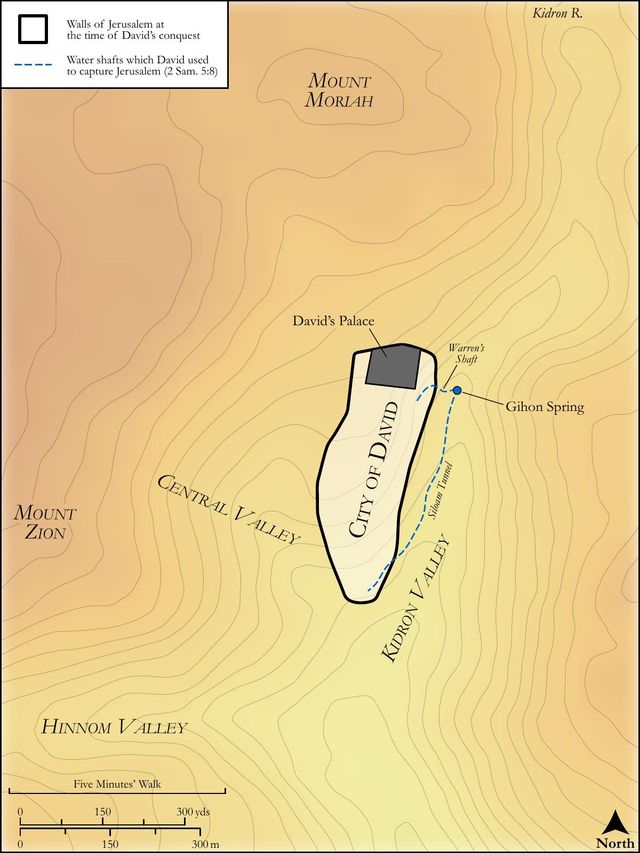
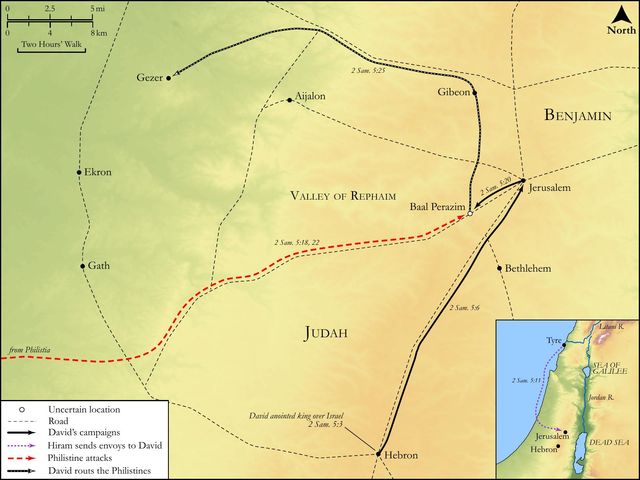
Study this verse
Public-domain commentary
Matthew Henry
From his Commentary on the Whole Bible. Henry comments on passages, not single verses — this entry covers 2 Samuel 5:11–16. His two-level outline is real structure in the source text, so it is rendered as structure.
Here is, I. David's house built, a royal palace, fit for the reception of the court he kept and the homage that was paid to him, Sa2 5:11. The Jews were husbandmen and shepherds, and did not much addict themselves either to merchandise or manufactures; and therefore Hiram, king of Tyre, a wealthy prince, when he sent to congratulate David on his accession to the throne, offered him workmen to build him a house. David thankfully accepted the offer, and Hiram's workmen built David a house to his mind. Many have excelled in arts and sciences who were strangers to the covenants of promise. Yet David's house was never the worse, nor the less fit to be dedicated to God, for being built by the sons of the stranger. It is prophesied of the gospel church, The sons of the strangers shall build up thy walls, and their kings shall minister unto thee, Isa 60:10.
II.David's government settled and built up, Sa2 5:12.
1.His kingdom was established, there was nothing to shake it, none to disturb his possession or question his title. He that made him king established him, because he was to be a type of Christ, with whom God's hand should be established, and his covenant stand fast, Psa 89:21-28. Saul was made king, but not established; so Adam in innocency. David was established king, so is the Son of David, with all who through him are made to our God kings and priests.
2.It was exalted in the eyes both of its friends and enemies. Never had the nation of Israel looked so great or made such a figure as it began now to do. Thus it is promised of Christ that he shall be higher than the kings of the earth, Psa 89:27. God has highly exalted him, Phi 2:9.
3.David perceived, by the wonderful concurrence of providences to his establishment and advancement, that God was with him. By this I know that thou favourest me, Psa 41:11. Many have the favour of God and do not perceive it, and so want the comfort of it: but to be exalted to that and established in it, and to perceive it, is happiness enough.
4.He owned that it was for his people Israel's sake that God had done great things for him, that he might be a blessing to them and they might be happy under his administration. God did not make Israel his subjects for his sake, that he might be great, and rich, and absolute: but he made him their king for their sake, that he might lead, and guide, and protect them. Kings are ministers of God to their people for good, Rom 13:4.
III.David's family multiplied and increased.
All the sons that were born to him after he came to Jerusalem are here mentioned together, eleven in all, besides the six that were born to him before in Hebron, Sa2 3:2, Sa2 3:5. There the mothers are mentioned, not here; only, in general, it is said that he took more concubines and wives, Sa2 5:13. Shall we praise him for this? We praise him not; we justify him not; nor can we scarcely excuse him. The bad example of the patriarchs might make him think there was no harm in it, and he might hope it would strengthen his interest, by multiplying his alliances, and increasing the royal family. Happy is the man that has his quiver full of these arrows. But one vine by the side of the house, with the blessing of God, may send boughs to the sea and branches to the rivers. Adam, by one wife, peopled the world, and Noah re-peopled it. David had many wives, and yet that did not keep him from coveting his neighbour's wife and defiling her; for men that have once broken the fence will wander endlessly. Of David's concubines, see Sa2 15:16; Sa2 16:22; Sa2 19:5. Of his sons, see Ch1 3:1-9.
Historical interpretation
Historical reception
1 surviving comment on this verse from the historical church.
David took more concubines and wives of Jerusalem: Not harlots, but wives of an inferior condition; for such, in scripture, are styled concubines.
Continue studying 2 Samuel 5:13 across the web’s major study libraries — every link below opens this exact verse, chapter, or book on the destination site.
Read & Compare
 BibleGatewayThis verse in more than 200 translations and 70 languages.
 Bible.comThe YouVersion reader — hundreds of translations, reading plans, and highlights.
 ESV.orgCrossway's official English Standard Version reader.
 NET BibleThe NET translation with 60,000+ translators' notes on every rendering decision.
 STEP BibleTyndale House's free study tool — original text, vocabulary, and scholarly resources.
 BibliaLogos Bible Software's free web reader.
 USCCBThe New American Bible (Revised Edition) with the U.S. bishops' study notes.
Commentaries
 BibleHub CommentariesDozens of classic commentaries on this verse, gathered on one page.
 StudyLightMore than 100 commentary sets — the largest collection on the web.
 BibleRefPlain-English commentary on what this verse means, verse by verse.
 Enduring WordDavid Guzik's free commentary on this chapter, widely used by Bible teachers.
 Bible Study ToolsVerse commentary alongside Greek and Hebrew study aids.
Original Language & Research
- BibleHub InterlinearThe verse word by word — original language, transliteration, and English.
- BibleHub LexiconEvery word's original-language definition and Strong's entry.
 Blue Letter BibleDeep-study tools — Strong's numbers, concordance, and word studies.
 SefariaThe Hebrew text with Rashi and centuries of Jewish commentary.
Sermons, Hymns & Audio


TrulyRandomVerse is not affiliated with these sites and doesn’t control their content. They’re linked because they’re genuinely useful.
Summary
Following his anointing as king over all Israel and the strategic conquest of Jerusalem, 2 Samuel 5:13 provides a concise but profoundly significant detail about King David's personal life: his expansion of his royal household through the acquisition of additional concubines and wives. This act, while culturally normative for the kings of that day and a symbol of increasing power and status, subtly introduces a tension with divine law, foreshadowing future complexities and challenges within David's family and reign, even as God's sovereign plan for his dynasty continues to unfold.
Context
ShowHideLiterary Context
This verse is strategically positioned immediately after the momentous events that solidify David's kingship over all Israel. The preceding narrative details David's anointing by all the tribes at Hebron, signifying the long-awaited unification of the kingdom under his leadership, fulfilling God's promise 2 Samuel 5:1-5. This is swiftly followed by his decisive conquest of Jerusalem from the Jebusites, transforming it into the political and spiritual capital of his burgeoning kingdom, a move of immense strategic and symbolic importance 2 Samuel 5:6-9. The narrative then highlights David's growing international standing and divine favor through his alliance with Hiram of Tyre 2 Samuel 5:11-12. Verse 13 then shifts focus from David's public triumphs and political consolidation to a crucial aspect of his private life, revealing how his personal choices regarding his household aligned with or diverged from the expectations of an Israelite king, subtly setting the stage for the narrative's subsequent exploration of his family dynamics and the profound consequences of his actions that will unfold in later chapters. The immediate mention of "sons and daughters" born to him underscores the tangible outcome of these marital choices, which will play a significant role in the succession narrative and the tragic events within his household.
Historical & Cultural Context
Among the kings of that day, the practice of polygamy and the maintenance of a large harem were common, indeed expected, among kings and powerful rulers. Such practices were not merely about personal desire but served crucial political, economic, and dynastic purposes. A large number of wives and concubines could signify a king's wealth, status, and ability to forge alliances through marriage with foreign princesses or powerful families within his own realm. Furthermore, producing many sons was vital for securing the succession and ensuring the stability and continuity of the dynasty, as a large male progeny reduced the risk of a contested throne. David's actions in taking "more concubines and wives out of Jerusalem" reflect this prevalent cultural norm, indicating his full embrace of the trappings of kingship as understood in his era. However, this cultural practice stood in direct tension with specific Mosaic laws given to Israelite kings in Deuteronomy 17:14-20, particularly the prohibition against multiplying wives Deuteronomy 17:17. This tension highlights the complex interplay between societal norms and divine expectations within the biblical narrative, foreshadowing the challenges David would face.
Key Themes
ShowHideThis verse contributes to several overarching themes in 2 Samuel and the broader Deuteronomistic History. Firstly, it underscores the theme of Kingship and its Responsibilities, revealing how David, though chosen by God and uniquely favored, navigated the complexities of leadership, sometimes conforming to regional customs rather than adhering strictly to divine mandates. His actions here set him on a path that would later lead to significant personal and national turmoil, despite his generally righteous reign. Secondly, it subtly introduces the theme of Human Imperfection and its Consequences, foreshadowing the later domestic strife and moral failures within David's family that stemmed, in part, from his expansive household and the rivalries it engendered. The tragic events involving Amnon, Tamar, and Absalom 2 Samuel 13 and the succession struggles in 1 Kings 1 are direct outgrowths of the dynamics introduced by a large, complex royal family. Thirdly, despite David's choices, the verse implicitly reinforces the theme of Divine Sovereignty and Covenant Faithfulness. Even amidst the imperfections of human leaders, God remains committed to His covenant promises, particularly the establishment of David's dynasty 2 Samuel 7:12-16. The narrative records David's actions without immediate explicit condemnation, allowing the subsequent events to demonstrate the long-term implications of choices made in deviation from God's ideal, yet also showcasing God's persistent grace.
Exposition and Analysis
ShowHideKey Word Analysis
ShowHideThis verb, a primitive root, carries a broad semantic range, encompassing "to take," "to acquire," "to seize," or "to receive." In the context of marriage, it signifies the act of taking a wife, often implying a formal or deliberate acquisition. Here, it highlights David's active decision and initiative in expanding his household. It is not a passive reception but an intentional act of acquisition, reflecting his royal prerogative and growing power. The implication of "more" suggests a continuous, deliberate pattern of behavior in accumulating wives and concubines.
A concubine was a secondary wife, a woman of lower status who lived with a man as his wife, often for the primary purpose of bearing children. While her legal and social standing was generally less than that of a primary wife ('ishshâh), her children were considered legitimate and could inherit, though often with different or lesser rights than those of children born to primary wives. The inclusion of concubines alongside wives indicates the full scope of David's expanded household and the various levels of marital relationships within it, common for powerful rulers seeking to secure their lineage and produce numerous heirs.
This word, the feminine form of "man," generally refers to a woman or a wife. In this context, it denotes women who held the full legal and social status of wives, distinct from concubines. The mention of both "concubines and wives" underscores David's comprehensive expansion of his marital household, encompassing women of varying social standing, all contributing to the proliferation of his lineage and the display of his royal power and prestige.
Verse Breakdown
ShowHide"And David took him more concubines and wives out of Jerusalem"
This clause describes a deliberate and significant action by King David. The phrase "took him more" indicates that David already had wives (as noted in 2 Samuel 3:2-5), and this act represents a further, intentional increase in his marital household. The location "out of Jerusalem" specifies that these new additions occurred after he had established his capital there. This was a common practice for the kings of that day, symbolizing power, prestige, and the ability to produce many heirs, which was crucial for dynastic stability and succession.
"after he was come from Hebron"
This temporal marker precisely places the expansion of David's harem after his move from Hebron, where he had reigned for seven and a half years as king over Judah. His arrival in Jerusalem marked a new, unified phase in his reign, now as king over all Israel. Residing in his newly conquered capital, David's expanded household reflects this elevated status and the consolidation of his power, signifying his full embrace of royal prerogatives.
"and there were yet sons and daughters born to David"
This final clause highlights the direct consequence and primary purpose of acquiring more wives and concubines: the production of offspring. The phrase "yet sons and daughters" implies a continuation and increase of his lineage, emphasizing the ongoing fulfillment of God's promise of a dynasty, even amidst David's imperfect choices regarding polygamy. These numerous children would later become key figures, for good or ill, in the unfolding narrative of David's reign, his family's internal struggles, and the eventual succession to the throne.
Literary Devices
ShowHideThe verse primarily employs Narrative Detail, providing a succinct but highly significant piece of information about David's personal life that directly contributes to the broader story. This detail serves as a subtle yet potent form of Foreshadowing, as the expansion of David's harem, while culturally accepted, stands in clear tension with divine commands for Israelite kings found in Deuteronomy 17:17. This tension will later contribute to the internal strife, moral failings, and succession crises within his family, exemplified by the tragic stories of Amnon, Absalom, and Adonijah. The author presents this information with an Objective Tone, simply stating the facts without immediate explicit judgment or condemnation. This implicit commentary allows the reader to connect David's actions to later events, demonstrating how human decisions, even those of a "man after God's own heart," can have profound, often negative, repercussions that ripple through generations, illustrating the principle that actions have consequences, even if not immediately stated.
Theological and Thematic Connections
ShowHideThis verse, while seemingly a simple statement of fact, carries significant theological weight, highlighting the enduring tension between cultural norms and divine ideals, particularly concerning marriage and kingship. David's actions, though common for rulers of his time and a symbol of his consolidated power, subtly deviate from God's original design for marriage as a monogamous union established in Genesis 2:24. More specifically, it directly contravenes the Mosaic prohibition for Israelite kings against multiplying wives, a command intended to prevent their hearts from turning away from God and to safeguard against the very entanglements and rivalries that would later plague David's household Deuteronomy 17:17. The narrative does not explicitly condemn David here, but it records his choices, allowing the subsequent events of his life—marked by family strife, rebellion, and moral failings—to implicitly reveal the painful consequences of such deviations. This serves as a potent reminder that even God's chosen leaders are fallible and that human choices, even when culturally sanctioned, have profound spiritual and practical ramifications, ultimately demonstrating that true flourishing comes from aligning with God's timeless principles rather than merely conforming to societal expectations.
Reflection and Application
ShowHide2 Samuel 5:13 offers a profound opportunity for reflection on the nature of leadership, personal choices, and the long-term impact of our actions. David, a man chosen by God and blessed with immense success and divine favor, still operated within the cultural frameworks of his time, even when those frameworks diverged from God's ideal. This verse challenges us to consider where our own lives might be shaped more by prevailing societal norms or personal desires than by divine wisdom and revealed truth. It serves as a sobering reminder that even seemingly minor deviations from God's design can have significant, often unforeseen, and painful consequences, particularly within the sacred unit of the family and for future generations. For believers today, it underscores the critical importance of diligently seeking God's will in all areas of life, especially in marriage, family, and relationships, and recognizing that true flourishing and spiritual integrity come from aligning with His timeless principles, rather than merely conforming to cultural expectations or personal preferences. It also offers a nuanced perspective on God's grace, showing that even those greatly used by Him are imperfect and subject to the consequences of their choices, yet God's sovereign plan and covenant faithfulness can still prevail amidst human frailty.
Questions for Reflection
ShowHideFAQ
ShowHideWas David's taking of multiple wives and concubines considered sinful by God?
ShowHideWhile the text of 2 Samuel 5:13 itself does not explicitly condemn David's actions with an immediate pronouncement of judgment, the practice of a king multiplying wives was explicitly prohibited in the Mosaic Law Deuteronomy 17:17. This prohibition was given to prevent the king's heart from turning away from God, to avoid entanglements that could lead to idolatry, and to prevent the very internal strife and division that would later plague David's family and Solomon's reign. Therefore, while culturally accepted and even expected for powerful rulers among the nations, David's actions were a clear deviation from God's specific command for Israelite kings. The subsequent narrative in 2 Samuel and 1 Kings implicitly demonstrates the negative consequences of this practice within David's own family, including rivalries, rape, murder, and rebellion (e.g., 2 Samuel 13 and 2 Samuel 15), illustrating that such actions, though not always immediately punished, carried significant long-term spiritual, social, and personal repercussions, ultimately hindering the peace and stability of his household and kingdom.
Christ-Centered Fulfillment
ShowHide2 Samuel 5:13, detailing David's expansion of his harem, stands in stark contrast to the perfect kingship of Jesus Christ and underscores the profound need for a flawless, ultimate King. David, though a "man after God's own heart" and a type of the coming Messiah, was deeply flawed; his multiplying of wives, while culturally normative, directly contravened God's law and foreshadowed the internal strife, moral failings, and succession crises that would plague his family and kingdom. This highlights the inherent limitations and imperfections of even the best human kings, pointing to the necessity of a perfect King who would fully embody God's ideal. Jesus, the true Son of David, is that King. He does not multiply wives for dynastic security or personal prestige; instead, He is presented as the one, faithful Bridegroom with one glorious Bride, the Church, whom He loves and sanctifies Ephesians 5:25-27. His kingdom is not built on human alliances, the proliferation of earthly heirs, or cultural conformity, but on spiritual regeneration, perfect obedience to God's will, and an eternal, unbreakable covenant Hebrews 8:6. Where David's choices regarding his household led to familial dysfunction, moral compromise, and national unrest, Christ's perfect obedience, self-sacrificial love, and singular devotion to God's plan establish a kingdom characterized by righteousness, peace, and joy in the Holy Spirit Romans 14:17. The limitations and imperfections of David's reign, including his personal choices regarding marriage, ultimately serve to magnify the superior, unblemished, and eternally secure reign of Christ, who perfectly fulfills God's design for humanity and kingship, bringing true and lasting peace to His people.