


2 Samuel 5:12
Bible text: King James Version (1769 Blayney text) · Public domain
Bible text: Berean Standard Bible · Public domain
Bible text: American Standard Version (1901) · Public domain
Bible text: World English Bible, Messianic edition · Public domain
Bible text: Geneva Bible (1599) · Public domain
Bible text: Young's Literal Translation · Public domain
- וַיֵּדַעvai·Ye·da'and he knewH3045Conj-w ¦ V-Qal-ConsecImperf-3msVerb Qal Consecutive Imperfect 3rd Singular Masculineוַandיֵּדַעhe knew
- דָּוִדda·VidDavidH1732N-proper-mNoun Proper Masculine
- כִּיkithatH3588PrtParticle Conditional
- הֱכִינוֹhe·khi·Nohe had appointed himH3559V-Hiphil-Perf-3ms ¦ 3msVerb Hiphil Perfect 3rd Singular Masculineהֱכִינhe had appointedוֹhim
- יְהוָהYah·wehYahwehH3068N-properNoun Proper Title
- לְמֶלֶךְle·Me·lekhto kingH4428Prep-l ¦ N-msNoun Singular Masculine Absoluteלְtoמֶלֶךְking
- עַל'aloverH5921PrepPreposition
- יִשְׂרָאֵלYis·ra·'ElIsraelH3478N-properNoun Proper Location
- וְכִיve·Khiand thatH3588Conj-w ¦ PrtParticle Conditionalוְandכִיthat
- נִשֵּׂאni·Se'he had exaltedH5375V-Piel-Perf-3msVerb Piel Perfect 3rd Singular Masculine
- מַמְלַכְתּוֹmam·lakh·Tohis kingdomH4467N-fsc ¦ 3msNoun Singular Feminine Constructמַמְלַכְתּkingdomוֹhis
- בַּעֲבוּרba·'a·Vurfor sake ofH5668Prep-b ¦ N-mscNoun Singular Masculine Constructבַּforעֲבוּרsake of
- עַמּוֹa·Mohis peopleH5971N-msc ¦ 3msNoun Singular Masculine Constructעַמּpeopleוֹhis
- יִשְׂרָאֵלYis·ra·'ElIsraelH3478N-properNoun Proper Location
English is a literal word-by-word gloss of the Hebrew, not the KJV's wording. Why?
This is the original text the KJV's translators worked from — each Hebrew word with its own literal English meaning in this verse, prepared by scholars at Tyndale House, Cambridge. The KJV translates whole sentences, not word by word, so its wording differs: one Hebrew word can become several English words, and the KJV may choose “the LORD” where the gloss reads “Yahweh”. Both are faithful — they answer different questions. For the KJV's own rendering, switch to the KJV text.
Details
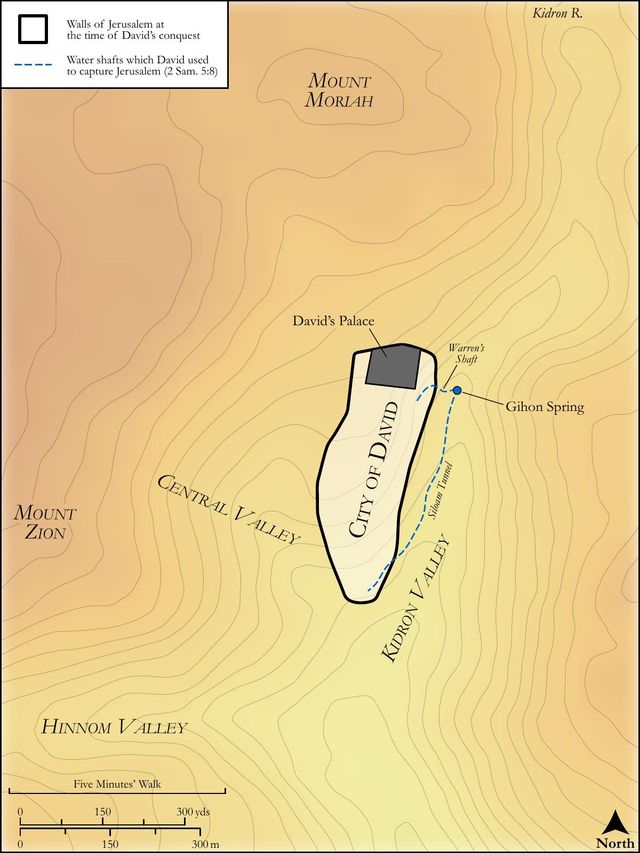
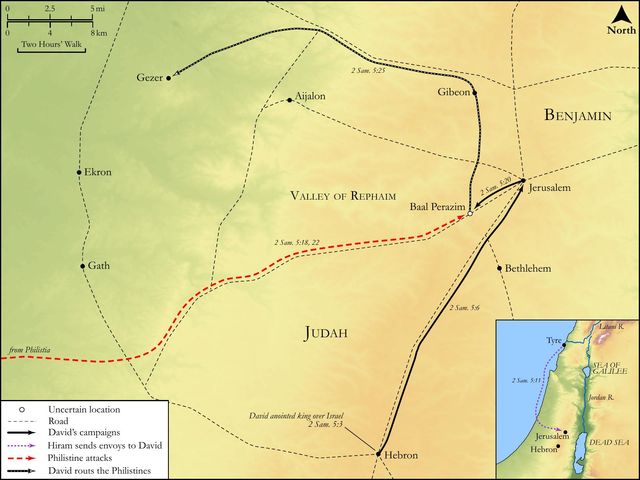
See on the biblical-era maps
Study this verse
Public-domain commentary
Matthew Henry
From his Commentary on the Whole Bible. Henry comments on passages, not single verses — this entry covers 2 Samuel 5:11–16. His two-level outline is real structure in the source text, so it is rendered as structure.
Here is, I. David's house built, a royal palace, fit for the reception of the court he kept and the homage that was paid to him, Sa2 5:11. The Jews were husbandmen and shepherds, and did not much addict themselves either to merchandise or manufactures; and therefore Hiram, king of Tyre, a wealthy prince, when he sent to congratulate David on his accession to the throne, offered him workmen to build him a house. David thankfully accepted the offer, and Hiram's workmen built David a house to his mind. Many have excelled in arts and sciences who were strangers to the covenants of promise. Yet David's house was never the worse, nor the less fit to be dedicated to God, for being built by the sons of the stranger. It is prophesied of the gospel church, The sons of the strangers shall build up thy walls, and their kings shall minister unto thee, Isa 60:10.
II.David's government settled and built up, Sa2 5:12.
1.His kingdom was established, there was nothing to shake it, none to disturb his possession or question his title. He that made him king established him, because he was to be a type of Christ, with whom God's hand should be established, and his covenant stand fast, Psa 89:21-28. Saul was made king, but not established; so Adam in innocency. David was established king, so is the Son of David, with all who through him are made to our God kings and priests.
2.It was exalted in the eyes both of its friends and enemies. Never had the nation of Israel looked so great or made such a figure as it began now to do. Thus it is promised of Christ that he shall be higher than the kings of the earth, Psa 89:27. God has highly exalted him, Phi 2:9.
3.David perceived, by the wonderful concurrence of providences to his establishment and advancement, that God was with him. By this I know that thou favourest me, Psa 41:11. Many have the favour of God and do not perceive it, and so want the comfort of it: but to be exalted to that and established in it, and to perceive it, is happiness enough.
4.He owned that it was for his people Israel's sake that God had done great things for him, that he might be a blessing to them and they might be happy under his administration. God did not make Israel his subjects for his sake, that he might be great, and rich, and absolute: but he made him their king for their sake, that he might lead, and guide, and protect them. Kings are ministers of God to their people for good, Rom 13:4.
III.David's family multiplied and increased.
All the sons that were born to him after he came to Jerusalem are here mentioned together, eleven in all, besides the six that were born to him before in Hebron, Sa2 3:2, Sa2 3:5. There the mothers are mentioned, not here; only, in general, it is said that he took more concubines and wives, Sa2 5:13. Shall we praise him for this? We praise him not; we justify him not; nor can we scarcely excuse him. The bad example of the patriarchs might make him think there was no harm in it, and he might hope it would strengthen his interest, by multiplying his alliances, and increasing the royal family. Happy is the man that has his quiver full of these arrows. But one vine by the side of the house, with the blessing of God, may send boughs to the sea and branches to the rivers. Adam, by one wife, peopled the world, and Noah re-peopled it. David had many wives, and yet that did not keep him from coveting his neighbour's wife and defiling her; for men that have once broken the fence will wander endlessly. Of David's concubines, see Sa2 15:16; Sa2 16:22; Sa2 19:5. Of his sons, see Ch1 3:1-9.
Continue studying 2 Samuel 5:12 across the web’s major study libraries — every link below opens this exact verse, chapter, or book on the destination site.
Read & Compare
 BibleGatewayThis verse in more than 200 translations and 70 languages.
 Bible.comThe YouVersion reader — hundreds of translations, reading plans, and highlights.
 ESV.orgCrossway's official English Standard Version reader.
 NET BibleThe NET translation with 60,000+ translators' notes on every rendering decision.
 STEP BibleTyndale House's free study tool — original text, vocabulary, and scholarly resources.
 BibliaLogos Bible Software's free web reader.
 USCCBThe New American Bible (Revised Edition) with the U.S. bishops' study notes.
Commentaries
 BibleHub CommentariesDozens of classic commentaries on this verse, gathered on one page.
 StudyLightMore than 100 commentary sets — the largest collection on the web.
 BibleRefPlain-English commentary on what this verse means, verse by verse.
 Enduring WordDavid Guzik's free commentary on this chapter, widely used by Bible teachers.
 Bible Study ToolsVerse commentary alongside Greek and Hebrew study aids.
Original Language & Research
- BibleHub InterlinearThe verse word by word — original language, transliteration, and English.
- BibleHub LexiconEvery word's original-language definition and Strong's entry.
 Blue Letter BibleDeep-study tools — Strong's numbers, concordance, and word studies.
 SefariaThe Hebrew text with Rashi and centuries of Jewish commentary.
Sermons, Hymns & Audio


TrulyRandomVerse is not affiliated with these sites and doesn’t control their content. They’re linked because they’re genuinely useful.
Summary
2 Samuel 5:12 marks a pivotal theological and political moment in David's reign, capturing his profound spiritual insight into the divine orchestration of his kingship. Following his anointing as king over all Israel and the strategic establishment of Jerusalem as his capital, David clearly perceives that his ascendancy and the flourishing of his kingdom are not merely the result of human effort or political maneuvering, but are direct, sovereign acts of the LORD. Crucially, he understands that this divine establishment and exaltation are not for his personal glory or benefit, but are explicitly "for his people Israel's sake," thereby underscoring the selfless, covenantal purpose inherent in his God-given authority.
Context
ShowHideLiterary Context
This verse is strategically placed immediately after two monumental events in David's life: his anointing as king over all twelve tribes of Israel at Hebron, following his seven-and-a-half-year reign over Judah (2 Samuel 5:1-5), and his subsequent capture of Jerusalem from the Jebusites, establishing it as his capital, the "City of David" (2 Samuel 5:6-10). The verse, therefore, functions as David's theological reflection on these momentous achievements. It reveals his understanding that these successes were not due to his own prowess but were divinely ordained, serving as a foundational statement for the remainder of his reign. It sets the stage for the subsequent narrative, emphasizing that David's stability and prosperity are rooted in God's favor and faithfulness, rather than human strength.
Historical & Cultural Context
David's ascension to the throne over a unified Israel marked a significant transition from a loose tribal confederacy, governed by judges and a failed monarchy under Saul, to a centralized kingdom. The choice of Jerusalem as the capital was a masterstroke, as it was a neutral city belonging to no single tribe, thereby fostering unity. Among the nations, kings often claimed divine backing for their rule, but David's perception transcends mere political rhetoric. It reflects a genuine understanding of Yahweh's unique covenant relationship with Israel. Unlike the surrounding nations where kings were often deified or seen as semi-divine, Israel's monarch was a servant of Yahweh, chosen and empowered by Him to shepherd His people. This context highlights the distinct nature of Israelite kingship, where the king's authority was derived from and accountable to God, serving as a conduit for God's blessings to the nation.
Key Themes
ShowHideThis verse powerfully encapsulates several foundational themes central to the books of Samuel and the broader Old Testament narrative. Firstly, it underscores Divine Sovereignty in Leadership, asserting that David's kingship was not a human accomplishment but a direct, deliberate act of God. This echoes God's earlier selection and anointing of David through Samuel, as recorded in 1 Samuel 16:13, confirming a long-held divine purpose. Secondly, the phrase "for his people Israel's sake" introduces the theme of Servant Leadership, emphasizing that God's blessings and exaltation of a leader are ultimately intended to benefit the community, not merely the individual. This principle foreshadows the enduring covenant God would later make with David in 2 Samuel 7, promising an eternal dynasty for the sake of His people. Lastly, David's act of "perceiving" highlights the theme of Spiritual Discernment and Humility, demonstrating his recognition that his success stemmed from divine favor and faithfulness to God's covenant with Israel, rather than his own merit or strength.
Exposition and Analysis
ShowHideKey Word Analysis
ShowHideThis verb signifies more than simple intellectual knowledge; it denotes a deep, experiential, and intimate understanding or knowing. David didn't merely deduce or hear that God established him; he had a profound, spiritual realization and acknowledgment of God's active, sovereign hand in his life and reign. It implies a recognition that transformed his perspective and guided his actions, signifying a deep, personal acquaintance with God's will.
This word means to set up, confirm, make firm, or secure. It speaks directly to the stability, permanence, and divine ordination of David's kingship. It implies that God was the active agent who not only placed David on the throne but also fortified and secured his position, ensuring the stability and legitimacy of his rule over Israel, making it sure and proper.
Meaning to lift, carry, or magnify, this term describes the elevation and prominence God gave to David's kingdom. It speaks to the growth, strength, and renown that David's reign achieved, directly attributed to God's favor. This exaltation was not merely about an increase in power, but about the kingdom's increasing influence and blessing, signifying God's act of raising it up.
Verse Breakdown
ShowHide"And David perceived that the LORD had established him king over Israel"
This clause reveals David's profound spiritual insight and humble recognition. He did not attribute his rise to power to his own military prowess, political acumen, or popular support, but recognized it as a direct, sovereign act of Yahweh. The phrase "the LORD had established him" signifies divine initiative and confirmation, indicating that David's kingship was part of God's unfolding plan for His people, a fulfillment of earlier promises and anointings. This perception profoundly shaped David's understanding of his role and responsibility.
"and that he had exalted his kingdom"
This phrase further elaborates on God's active involvement in David's reign. It's not just David personally who was established, but his entire kingdom was elevated, magnified, and given prominence. This speaks to the growth, strength, and influence of David's reign, which God Himself orchestrated and magnified. The exaltation implies divine blessing on the nation under David's leadership, leading to stability and success beyond mere human capability.
"for his people Israel's sake."
This crucial concluding phrase provides the divine rationale and ultimate purpose behind David's establishment and the exaltation of his kingdom. It explicitly states that God's actions were not for David's personal glory, power, or wealth, but for the welfare, security, and flourishing of the covenant people, Israel. This highlights the altruistic nature of God's blessings and defines the essence of true, godly leadership as inherently communal and service-oriented, prioritizing the well-being of the nation.
Literary Devices
ShowHideThe verse employs several significant literary devices to convey its profound theological message. The use of Divine Passive in "the LORD had established him" and "he had exalted his kingdom" subtly emphasizes God as the primary, active agent behind David's success, even without explicitly stating "God established David" or "God exalted his kingdom." This highlights divine sovereignty and causality, attributing all true power and success to Yahweh. Furthermore, the phrase "for his people Israel's sake" functions as a Purpose Clause, explicitly stating the ultimate beneficiary and altruistic intent behind God's actions. This serves to qualify and define the nature of David's divinely ordained rule, shifting the focus from the king's personal glory to the welfare of the nation. There is also an element of Parallelism in the two main clauses ("established him king over Israel" and "exalted his kingdom"), which reinforces the comprehensive nature of God's work in both David's personal kingship and the broader realm of his dominion, showing God's hand in both the leader and the led.
Theological and Thematic Connections
ShowHideThis verse stands as a foundational statement on the nature of divine sovereignty and the purpose of leadership within God's covenant plan. David's perception underscores that true authority and success are not self-generated but are gifts from God, granted for specific, often communal, purposes. It challenges the human tendency to claim credit for achievements and instead calls for humble recognition of God's active hand in all spheres of life. The emphasis on "Israel's sake" reveals God's enduring faithfulness to His covenant people, demonstrating that His blessings on individuals are often a conduit for His broader redemptive purposes for the community. This principle extends beyond the monarchy, teaching that any position of influence or blessing bestowed by God is ultimately intended to serve others and advance His kingdom.
Reflection and Application
ShowHideDavid's profound perception in 2 Samuel 5:12 offers a timeless model for believers today, inviting us to cultivate a similar spiritual discernment regarding God's activity in our own lives. It challenges us to look beyond superficial explanations for our successes, opportunities, or positions of influence, and to humbly acknowledge that every good and perfect gift comes from above. More importantly, it compels us to examine the purpose of any blessing or exaltation we receive. Are we prone to view our achievements as solely for our personal gain, comfort, or prestige? Or do we, like David, understand that God often establishes and exalts us "for others' sake"—to be a blessing, to serve, to lead with integrity, and to contribute to the well-being of our families, communities, and the broader body of Christ? This verse calls us to a posture of servant-hearted stewardship, recognizing that our lives, talents, and resources are ultimately meant to be channels of God's grace for the benefit of His people and the world, reflecting His benevolent character.
Questions for Reflection
ShowHideFAQ
ShowHideWhy is David's "perception" so important here, rather than just the fact that God established him?
ShowHideDavid's "perception" (Hebrew: yâdaʻ) signifies a deep, experiential, and spiritual understanding, not just mere intellectual knowledge. It's crucial because it demonstrates David's humility and his recognition of God's absolute sovereignty. Many kings might acknowledge divine favor, but David's perception suggests a profound, internal grasp that his success was not due to his own merit or power, but entirely to God's active hand. This acknowledgment shaped his reign, fostering dependence on God and a commitment to serving God's purposes for Israel. It highlights that true godly leadership begins with a humble heart that discerns and submits to divine will, rather than claiming personal credit for divine blessings. This deep knowing is what distinguished David's rule.
What does "for his people Israel's sake" imply about the nature of godly leadership?
ShowHideThis phrase is foundational to understanding godly leadership. It unequivocally states that the ultimate purpose of David's divine establishment and the exaltation of his kingdom was not for his personal glory, wealth, or power, but for the welfare, security, and flourishing of the covenant people, Israel. This implies that true leadership, especially that which is divinely appointed, is inherently altruistic and service-oriented. Leaders are stewards of God's blessings, meant to channel those blessings for the good of those they lead. It sets a high standard, calling leaders to prioritize the well-being of their community above their own interests, reflecting God's own benevolent character towards His people. This principle applies to all forms of leadership, whether in the church, family, or society, emphasizing that authority is given for the benefit of others, not for self-aggrandizement, aligning with the call to love one's neighbor as oneself.
Christ-Centered Fulfillment
ShowHide2 Samuel 5:12, with its emphasis on David's divinely established and exalted kingdom "for his people Israel's sake," finds its ultimate and perfect fulfillment in Jesus Christ. David's kingship, though glorious and divinely appointed, was a shadow and a type of the eternal, righteous reign of the Messiah. Just as David "perceived" God's hand in his establishment, Jesus perfectly embodied the Father's will, always doing what pleased Him and acknowledging His divine authority in every aspect of His life and ministry (John 8:29). The LORD truly "established" Jesus as King, not of an earthly kingdom, but of a spiritual and eternal one, as prophesied by Gabriel (Luke 1:32-33). God "exalted His kingdom" through Christ's perfect life, atoning death, and glorious resurrection, leading to His enthronement at the right hand of the Father, where "every knee should bow" in recognition of His supreme Lordship (Philippians 2:9-11). Crucially, this divine establishment and exaltation of Christ's kingdom is supremely "for His people's sake"—not just Israel, but all who believe, encompassing a new covenant people from every tribe and nation. He came not to be served, but to serve, and to give His life as a ransom for many (Matthew 20:28). Through His reign, His people receive forgiveness, eternal life, and the promise of a new creation, demonstrating the ultimate purpose of God's sovereign plan: the redemption and blessing of humanity through the Lamb of God, who takes away the sin of the world (John 1:29).