


Romans 13:1
Bible text: King James Version (1769 Blayney text) · Public domain
Bible text: King James Version with Strong's numbers · Public domain
Bible text: Berean Standard Bible · Public domain
Bible text: American Standard Version (1901) · Public domain
Bible text: World English Bible, Messianic edition · Public domain
Bible text: Geneva Bible (1599) · Public domain
Bible text: Young's Literal Translation · Public domain
- ΠᾶσαPasaEveryG3956A-NSFAdjective Nominative Singular Feminine
- ψυχὴpsuchēsoulG5590N-NSFNoun Nominative Singular Feminine
- ἐξουσίαιςexousiaisto the authoritiesG1849N-DPFNoun Dative Plural Feminine
- ὑπερεχούσαιςhuperechousaisbeing above [him]G5242V-PAP-DPFVerb Present Active Participle Dative Plural Feminine
- ὑποτασσέσθωhupotassesthōshould be subjectG5293V-PPM-3SVerb Present Passive Imperative 3rd Singular
- οὐouNotG3756PRT-NNegative Particle Negative
- γὰρgarforG1063CONJConjunction
- ἔστινestinthere isG1510V-PAI-3SVerb Present Active Indicative 3rd Singular
- ἐξουσίαexousiaauthorityG1849N-NSFNoun Nominative Singular Feminine
- εἰeionlyG1487CONDConjunction
- μὴmēexceptG3361PRT-NNegative Particle Negative
- ὑπὸhupobyG5259PREPPreposition
- θεοῦtheouGodG2316N-GSM-TNoun Genitive Singular Masculine Title
- αἱhaithoseG3588T-NPFDefinite article Nominative Plural Feminine
- δὲdehoweverG1161CONJConjunction
- οὖσαιousaiexistingG1510V-PAP-NPFVerb Present Active Participle Nominative Plural Feminine
- ἐξουσίαιexousiaiauthoritiesG1849N-NPFNoun Nominative Plural Feminine
- ὑπὸhupobyG5259PREPPreposition
- τοῦtou<the>G3588T-GSMDefinite article Genitive Singular Masculine
- θεοῦtheouGodG2316N-GSM-TNoun Genitive Singular Masculine Title
- τεταγμέναιtetagmenaiinstitutedG5021V-RPP-NPFVerb Perfect Passive Participle Nominative Plural Feminine
- εἰσίνeisinareG1510V-PAI-3PVerb Present Active Indicative 3rd Plural
English is a literal word-by-word gloss of the Greek, not the KJV's wording. Why?
This is the original text the KJV's translators worked from — each Greek word with its own literal English meaning in this verse, prepared by scholars at Tyndale House, Cambridge. The KJV translates whole sentences, not word by word, so its wording differs: one Greek word can become several English words, and the KJV may choose “charity” where the gloss reads “love”. Both are faithful — they answer different questions. For the KJV's own rendering, switch to the KJV text.
Details
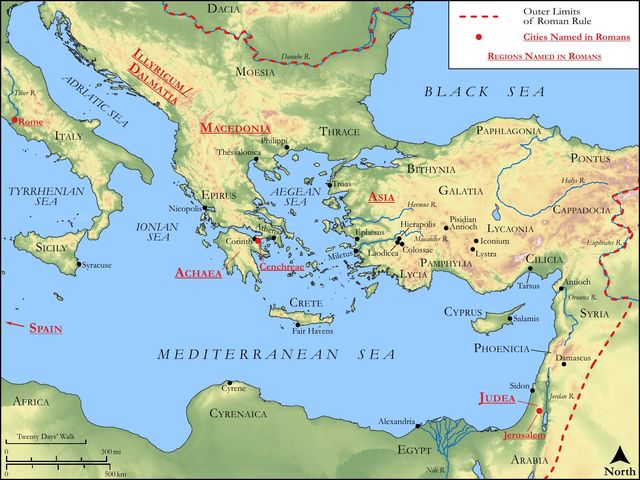
See on the biblical-era maps

Study this verse
Public-domain commentary
Matthew Henry
From his Commentary on the Whole Bible. Henry comments on passages, not single verses — this entry covers Romans 13:1–6. His four-level outline is real structure in the source text, so it is rendered as structure.
We are here taught how to conduct ourselves towards magistrates, and those that are in authority over us, called here the higher powers, intimating their authority (they are powers), and their dignity (they are higher powers), including not only the king as supreme, but all inferior magistrates under him: and yet it is expressed, not by the persons that are in that power, but the place of power itself, in which they are. However the persons themselves may be wicked, and of those vile persons whom the citizen of Zion contemneth (Psa 15:4), yet the just power which they have must be submitted to and obeyed. The apostle had taught us, in the foregoing chapter, not to avenge ourselves, nor to recompense evil for evil; but, lest it should seem as if this did cancel the ordinance of a civil magistracy among Christians, he takes occasion to assert the necessity of it, and of the due infliction of punishment upon evil doers, however it may look like recompensing evil for evil. Observe,
I.The duty enjoined:
Let every soul be subject. Every soul - every person, one as well as another, not excluding the clergy, who call themselves spiritual persons, however the church of Rome may not only exempt such from subjection to the civil powers, but place them in authority above them, making the greatest princes subject to the pope, who thus exalteth himself above all that is called God. - Every soul. Not that our consciences are to be subjected to the will of any man. It is God's prerogative to make laws immediately to bind conscience, and we must render to God the things that are God's. But it intimates that our subjection must be free and voluntary, sincere and hearty. Curse not the king, no, not in thy thought, Ecc 10:20. To compass and imagine are treason begun. The subjection of soul here required includes inward honour (Pe1 2:17) and outward reverence and respect, both in speaking to them and in speaking of them - obedience to their commands in things lawful and honest, and in other things a patient subjection to the penalty without resistance - a conformity in every thing to the place and duty of subjects, bringing our minds to the relation and condition, and the inferiority and subordination of it. "They are higher powers; be content they should be so, and submit to them accordingly." Now there was good reason for the pressing of this duty of subjection to civil magistrates,
1.Because of the reproach which the Christian religion lay under in the world, as an enemy to public peace, order, and government, as a sect that turned the world upside down, and the embracers of it as enemies to Caesar, and the more because the leaders were Galileans - an old slander. Jerusalem was represented as a rebellious city, hurtful to kings and provinces, Ezr 4:15, Ezr 4:16. Our Lord Jesus was so reproached, though he told them his kingdom was not of this world: no marvel, then, if his followers have been loaded in all ages with the like calumnies, called factious, seditious, and turbulent, and looked upon as the troublers of the land, their enemies having found such representations needful for the justifying of their barbarous rage against them. The apostle therefore, for the obviating of this reproach and the clearing of Christianity from it, shows that obedience to civil magistrates is one of the laws of Christ, whose religion helps to make people good subjects; and it was very unjust to charge upon Christianity that faction and rebellion to which its principles and rules are so directly contrary.
2.Because of the temptation which the Christians lay under to be otherwise affected to civil magistrates, some of them being originally Jews, and so leavened with a principle that it was unmeet for any of the seed of Abraham to be subject to one of another nation - their king must be of their brethren, Deu 17:15. Besides, Paul had taught them that they were not under the law, they were made free by Christ. Lest this liberty should be turned into licentiousness, and misconstrued to countenance faction and rebellion, the apostle enjoins obedience to civil government, which was the more necessary to be pressed now because the magistrates were heathens and unbelievers, which yet did not destroy their civil power and authority. Besides, the civil powers were persecuting powers; the body of the law was against them.
II.The reasons to enforce this duty. Why must we be subject?
1.For wrath's sake. Because of the danger we run ourselves into by resistance. Magistrates bear the sword, and to oppose them is to hazard all that is dear to us in this world; for it is to no purpose to contend with him that bears the sword. The Christians were then in those persecuting times obnoxious to the sword of the magistrate for their religion, and they needed not make themselves more obnoxious by their rebellion. The least show of resistance or sedition in a Christian would soon be aggravated and improved, and would be very prejudicial to the whole society; and therefore they had more need than others to be exact in their subjection, that those who had so much occasion against them in the matter of their God might have no other occasion. To this head must that argument be referred (Rom 13:2), Those that resist shall receive to themselves damnation: krima lēpsontai, they shall be called to an account for it. God will reckon with them for it, because the resistance reflects upon him. The magistrates will reckon with them for it. They will come under the lash of the law, and will find the higher powers too high to be trampled upon, all civil governments being justly strict and severe against treason and rebellion; so it follows (Rom 13:3), Rulers are a terror. This is a good argument, but it is low for a Christian.
2.We must be subject, not only for wrath, but for conscience' sake; not so much formidine poenae - from the fear of punishment, as virtutis amore - from the love of virtue. This makes common civil offices acceptable to God, when they are done for conscience' sake, with an eye to God, to his providence putting us into such relations, and to his precept making subjection the duty of those relations. Thus the same thing may be done from a very different principle. Now to oblige conscience to this subjection he argues, Rom 13:1-4, Rom 13:6,
(1.)From the institution of magistracy: There is no power but of God. God as the ruler and governor of the world hath appointed the ordinance of magistracy, so that all civil power is derived from him as from its original, and he hath by his providence put the administration into those hands, whatever they are that have it. By him kings reign, Pro 8:15. The usurpation of power and the abuse of power are not of God, for he is not the author of sin; but the power itself is. As our natural powers, though often abused and made instruments of sin, are from God's creating power, so civil powers are from God's governing power. The most unjust and oppressive princes in the world have no power but what is given them from above (Joh 19:11), the divine providence being in a special manner conversant about those changes and revolutions of governments which have such an influence upon states and kingdoms, and such a multitude of particular persons and smaller communities. Or, it may be meant of government in general: it is an instance of God's wisdom, power, and goodness, in the management of mankind, that he has disposed them into such a state as distinguishes between governors and governed, and has not left them like the fishes of the sea, where the greater devour the less. He did herein consult the benefit of his creatures. - The powers that be: whatever the particular form and method of government are - whether by monarchy, aristocracy, or democracy - wherever the governing power is lodged, it is an ordinance of God, and it is to be received and submitted to accordingly; though immediately an ordinance of man (Pe1 2:13), yet originally an ordinance of God. - Ordained of God - tetagmenai, a military word, signifying not only the ordination of magistrates, but the subordination of inferior magistrates to the supreme, as in an army; for among magistrates there is a diversity of gifts, and trusts, and services. Hence it follows (Rom 13:2) that whosoever resisteth the power resisteth the ordinance of God. There are other things from God that are the greatest calamities; but magistracy is from God as an ordinance, that is, it is a great law, and it is a great blessing: so that the children of Belial, that will not endure the yoke of government, will be found breaking a law and despising a blessing. Magistrates are therefore called gods (Psa 82:6), because they bear the image of God's authority. And those who spurn at their power reflect upon God himself. This is not at all applicable to the particular rights of kings and kingdoms, and the branches of their constitution; nor can any certain rule be fetched from this for the modelling of the original contracts between the governors and governed; but it is intended for direction to private persons in their private capacity, to behave themselves quietly and peaceably in the sphere in which God has set them, with a due regard to the civil powers which God in his providence has set over them, Ti1 2:1, Ti1 2:2. Magistrates are here again and again called God's ministers. he is the minister of God, Rom 13:4, Rom 13:6. Magistrates are in a more peculiar manner God's servants; the dignity they have calls for duty. Though they are lords to us, they are servants to God, have work to do for him, and an account to render to him. In the administration of public justice, the determining of quarrels, the protecting of the innocent, the righting of the wronged, the punishing of offenders, and the preserving of national peace and order, that every man may not do what is right in his own eyes - in these things it is that magistrates act as God's ministers. As the killing of an inferior magistrate, while he is actually doing his duty, is accounted treason against the prince, so the resisting of any magistrates in the discharge of these duties of their place is the resisting of an ordinance of God.
(2.)From the intention of magistracy: Rulers are not a terror to good works, but to the evil, etc. Magistracy was designed to be,
[1.]A terror to evil works and evil workers. They bear the sword; not only the sword of war, but the sword of justice. They are heirs of restraint, to put offenders to shame; Laish wanted such, Jdg 18:7. Such is the power of sin and corruption that many will not be restrained from the greatest enormities, and such as are most pernicious to human society, by any regard to the law of God and nature or the wrath to come; but only by the fear of temporal punishments, which the wilfulness and perverseness of degenerate mankind have made necessary. Hence it appears that laws with penalties for the lawless and disobedient (Ti1 1:9) must be constituted in Christian nations, and are agreeable with, and not contradictory to, the gospel. When men are become such beasts, such ravenous beasts, one to another, they must be dealt with accordingly, taken and destroyed in terrorem - to deter others. The horse and the mule must thus be held in with bit and bridle. In this work the magistrate is the minister of God, Rom 13:4. He acts as God's agent, to whom vengeance belongs; and therefore must take heed of infusing into his judgments any private personal resentments of his own. - To execute wrath upon him that doeth evil. In this the judicial processes of the most vigilant faithful magistrates, though some faint resemblance and prelude of the judgments of the great day, yet come far short of the judgment of God: they reach only to the evil act, can execute wrath only on him that doeth evil: but God's judgment extends to the evil thought, and is a discerner of the intents of the heart. - He beareth not the sword in vain. It is not for nothing that God hath put such a power into the magistrate's hand; but it is intended for the restraining and suppressing of disorders. And therefore, "If thou do that which is evil, which falls under the cognizance and censure of the civil magistrate, be afraid; for civil powers have quick eyes and long arms." It is a good thing when the punishment of malefactors is managed as an ordinance of God, instituted and appointed by him. First, As a holy God, that hates sin, against which, as it appears and puts up its head, a public testimony is thus borne. Secondly, As King of nations, and the God of peace and order, which are hereby preserved. Thirdly, As the protector of the good, whose persons, families, estates, and names, are by this means hedged about. Fourthly, As one that desires not the eternal ruin of sinners, but by the punishment of some would terrify others, and so prevent the like wickedness, that others may hear and fear, and do no more presumptuously. Nay, it is intended for a kindness to those that are punished, that by the destruction of the flesh the spirit may be saved in the day of the Lord Jesus.
[2.]A praise to those that do well. Those that keep in the way of their duty shall have the commendation and protection of the civil powers, to their credit and comfort. "Do that which is good (Rom 13:3), and thou needest not be afraid of the power, which, though terrible, reaches none but those that by their own sin make themselves obnoxious to it; the fire burns only that which is combustible: nay, thou shalt have praise of it." This is the intention of magistracy, and therefore we must, for conscience' sake, be subject to it, as a constitution designed for the public good, to which all private interests must give way. But pity it is that ever this gracious intention should be perverted, and that those who bear the sword, while they countenance and connive at sin, should be a terror to those who do well. But so it is, when the vilest men are exalted (Psa 12:1, Psa 12:8); and yet even then the blessing and benefit of a common protection, and a face of government and order, are such that it is our duty in that case rather to submit to persecution for well-doing, and to take it patiently, than by any irregular and disorderly practices to attempt a redress. Never did sovereign prince pervert the ends of government as Nero did, and yet to him Paul appealed, and under him had the protection of the law and the inferior magistrates more than once. Better a bad government than none at all.
(3.)From our interest in it: "He is the minister of God to thee for good. Thou hast the benefit and advantage of the government, and therefore must do what thou canst to preserve it, and nothing to disturb it." Protection draws allegiance. If we have protection from the government, we owe subjection to it; by upholding the government, we keep up our own hedge. This subjection is likewise consented to by the tribute we pay (Rom 13:6): "For this cause pay you tribute, as a testimony of your submission, and an acknowledgment that in conscience you think it to be due. You do by paying taxes contribute your share to the support of the power; if therefore you be not subject, you do but pull down with one hand what you support with the other; and is that conscience?" "By your paying tribute you not only own the magistrate's authority, but the blessing of that authority to yourselves, a sense of which you thereby testify, giving him that as a recompence for the great pains he takes in the government; for honour is a burden: and, if he do as he ought, he is attending continually upon this very thing, for it is enough to take up all a man's thoughts and time, in consideration of which fatigue, we pay tribute, and must be subject." - Pay you tribute, phorous teleite. He does not say, "You give it as an alms," but, "You pay it as a just debt, or lend it to be repaid in all the blessings and advantages of public government, of which you reap the benefit." This is the lesson the apostle teaches, and it becomes all Christians to learn and practise it, that the godly in the land may be found (whatever others are) the quiet and the peaceable in the land.
Historical interpretation
Eleven Centuries of Reception
15 surviving comments on this verse. Each one is dated, so this reads as a timeline rather than a list.
Select a marker to jump to its quote. Markers stagger vertically where authors wrote within a few decades of each other.
"But Polycarp said, "To thee I have thought it right to offer an account
For this cause pay ye tribute also; for they are God's ministers, attending continually upon this very thing.".
Paul the apostle also says upon this same subject: "Be ye subject to all the higher powers; for there is no power but of God: now those which are have been ordained of God."
No doubt the apostle admonishes the Romans to be subject to all power, because there is no power but of God, and because (the ruler) does not carry the sword without reason, and is the servant of God, nay also, says he, a revenger to execute wrath upon him that doeth evil.
Therefore, as to what relates to the honours due to kings or emperors, we have a prescript sufficient, that it behoves us to be in all obedience, according to the apostle's precept, "subject to magistrates, and princes, and powers; " but within the limits of discipline, so long as we keep ourselves separate from idolatry.
What does Paul mean when he says that “there is no authority except from God?” Is an authority which persecutes the children of God, which attacks the faith and which undermines our religion, from God? We shall answer this briefly. Nobody will deny that our senses—sight, sound and thought—are given to us by God. But although we get them from God, what we do with them is up to us.… God will judge us righteously for having abused what he gave us to use for good. Likewise, God’s judgment against the authorities will be just, if they have used the powers they have received according to their own ungodliness and not according to the laws of God.
The ruler is saved not through much power but through divine grace.
Be subject to all royal power and dominion in things which are pleasing to God, as to the ministers of God, and the punishers of the ungodly. Render all the fear that is due to them, all offerings, all customs, all honour, gifts, and taxes. For this is God's command, that you owe nothing to any one but the pledge of love, which God has commanded by Christ.
“Judas the Galilean revolted in the days of the census,” says Gamaliel in the Acts of the Apostles, and “drew away some of the people after him,” refusing to obey the order of the Romans and register their goods, for which reason Quirinius had been sent to Syria.… But as Judas’s decision was the cause of domestic murders and of a rebellion against the authorities which did much harm to the people, it seems to me that here the apostle is condemning any attempt to imitate him based on the illusion that it is a godly thing to disobey rulers. He has a good deal to say about this, condemning it as a mistaken way of thinking.
As Paul has already ordered that the law of heavenly righteousness be followed, he now commends earthly law as well, so as not to appear to be slighting it. For if the earthly law is not kept, the heavenly law will not be kept either. The earthly law is a kind of tutor, who helps little children along so that they can tackle a stronger degree of righteousness. For mercy cannot be imputed to anyone who does not seek righteousness.Therefore, in order to back up the authority and fear of the natural law, Paul bears witness to the fact that God is the author of both and that the ministers of the earthly law have God’s permission to act, so that no one should despise it as a merely human construction. In effect, Paul sees the divine law as being delegated to human authorities.
The book of Proverbs teaches us that kings do not come to rule apart from the dispensation and will of God: “Through me kings reign and princes decree justice.”
Of this subject he makes much account in other epistles also, setting subjects under their rulers as household servants are under their masters. And this he does to show that it was not for the subversion of the commonwealth that Christ introduced His laws, but for the better ordering of it, and to teach men not to be taking up unnecessary and unprofitable wars. For the plots that are formed against us for the truth's sake are sufficient and we have no need to be adding temptations superfluous and unprofitable. And observe too how well-timed his entering upon this subject is. For when he had demanded that great spirit of heroism, and made men fit to deal either with friends or foes, and rendered them serviceable alike to the prosperous and those in adversity and need, and in fact to all, and had planted a conversation worthy of angels, and had discharged anger, and taken down recklessness, and had in every way made their mind even, he then introduces his exhortation upon these matters also. For if it be right to requite those that injure us with the opposite, much more is it our duty to obey those that are benefactors to us. But this he states toward the end of his exhortation, and hitherto does not enter on these reasonings which I mention, but those only that enjoin one to do this as a matter of debt. And to show that these regulations are for all, even for priests, and monks, and not for men of secular occupations only, he hath made this plan at the outset, by saying as follows: "let every soul be subject unto the higher powers," if thou be an Apostle even, or an Evangelist, or a Prophet, or anything whatsoever, inasmuch as this subjection is not subversive of religion. And he does not say merely "obey," but "be subject." And the first claim such an enactment has upon us, and the reasoning that suiteth the faithful, is, that all this is of God's appointment.
"For there is no power," he says, "but of God." What say you? it may be said; is every ruler then elected by God? This I do not say, he answers. Nor am I now speaking about individual rulers, but about the thing in itself. For that there should be rulers, and some rule and others be ruled, and that all things should not just be carried on in one confusion, the people swaying like waves in this direction and that; this, I say, is the work of God's wisdom. Hence he does not say, "for there is no ruler but of God;" but it is the thing he speaks of, and says, "there is no power but of God. And the powers that be, are ordained of God." Thus when a certain wise man saith, "It is by the Lord that a man is matched with a woman" (Prov. xix. 14, LXX.), he means this, God made marriage, and not that it is He that joineth together every man that cometh to be with a woman. For we see many that come to be with one another for evil, even by the law of marriage, and this we should not ascribe to God. But as He said Himself, "He which made them at the beginning, made them male and female, and said, For this cause shall a man leave father and mother, and shall leave to his wife, and they twain shall be one flesh." (Matt. xix. 4, Matt. xix. 5; Gen. ii. 24.) And this is what that wise man meant to explain. For since equality of honor does many times lead to fightings, He hath made many governments and forms of subjection; as that, for instance, of man and wife, that of son and father, that of old men and young, that of bond and free, that of ruler and ruled, that of master and disciple. And why are you surprised in the case of mankind, when even in the body He hath done the same thing? For even here He hath not made all parts of equal honor, but He hath made one less and another greater, and some of the limbs hath He made to rule and some to be ruled. And among the unreasoning creatures one may notice this same principle, as amongst bees, amongst cranes, amongst herds of wild cattle. And even the sea itself is not without this goodly subordination; for there too many of the clans are ranged under one among the fishes, and are led thus as an army, and make long expeditions from home. For anarchy, be where it may, is an evil, and a cause of confusion. After having said then whence governments come, he proceeds, "Whosoever therefore resisteth the power, resisteth the ordinance of God." See what he has led the subject on to, and how fearful he makes it, and how he shows this to be a matter of debt. For lest the believers should say, You are making us very cheap and despicable, when you put us, who are to enjoy the Kingdom of Heaven, under subjection to rulers, he shows that it is not to rulers, but to God again that he makes them subject in doing this. For it is to Him, that he who subjects himself to authorities is obedient. Yet he does not say this-for instance that it is God to Whom a man who listens to authorities is obedient-but he uses the opposite case to awe them, and gives it a more precise form by saying, that he who listeneth not thereto is fighting with God, Who framed these laws. And this he is in all cases at pains to show, that it is not by way of favor that we obey them, but by way of debt. For in this way he was more likely to draw the governors who were unbelievers to religion, and the believers to obedience. For there was quite a common report in those days, which maligned the Apostles, as guilty of a sedition and revolutionary scheme, and as aiming in all they did and said at the subversion of the received institutions. When then you show our common Master giving this in charge to all His, you will at once stop the mouths of those that malign us as revolutionists, and with great boldness will speak for the doctrines of truth. Be not then ashamed, he says, at such subjection. For God hath laid down this law, and is a strong Avenger of them if they be despised. For it is no common punishment that He will exact of thee, if thou disobey, but the very greatest; and nothing will exempt thee, that thou canst say to the contrary, but both of men thou shalt undergo the most severe vengeance, and there shall be no one to defend thee, and thou wilt also provoke God the more. And all this he intimates when he says,
This is an argument against those who thought that they were obliged to use their Christian freedom in such a way that they gave honor or paid taxes to nobody. Paul wants to humble such people in any way he can, so that they will not suffer reproach on account of their pride instead of on account of God.It seems that Paul is speaking of secular authorities, not all of whom will be just, even if they received their authority from God.… The ruler is set up by God to judge with righteousness, so that sinners might have reason to be afraid should they sin.
Most rightly, Paul warns against anyone who is puffed up with pride by the fact that he has been called by his Lord into freedom and become a Christian, and therefore thinks that he does not have to keep the status given to him in the course of this life or submit to the higher powers to whom the government of temporal things has been confided for a time. For because we are made of soul and body and as long as we are in this life we make use of temporal things as a means of living this life, it is fitting that, as far as this life is concerned, we be subject to the authorities, i.e., to the people who with some recognition administer human affairs. But as far as the spiritual side is concerned, in which we believe in God and are called into his kingdom, it is not right for us to be subject to any man who seeks to overturn in us the very thing which God has been pleased to grant us so that we might obtain eternal life.So if anyone thinks that because he is a Christian he does not have to pay taxes or tribute nor show the proper respect to the authorities who take care of these things, he is in very great error. Likewise, if anyone thinks that he ought to submit to the point where he accepts that someone who is his superior in temporal affairs should have authority even over his faith, he falls into an even greater error. But the balance which the Lord himself prescribed is to be maintained: “Render unto Caesar the things which are Caesar’s but unto God the things which are God’s.” For although we are called into that kingdom where there will be no power of this world, nevertheless, while we are on the way there and until we have reached that state where every principality and power will be destroyed, let us put up with our condition for the sake of human affairs, doing nothing falsely and in this very thing obeying God, who commands us to do it, rather than men.
Even priests, bishops and monks must obey the commands of secular rulers. Of course, they must do so insofar as obedience is consistent with godliness. If the rulers demand something which is ungodly, then on no account are they allowed to do it.The holy apostle teaches us that both authorities and obedience depend entirely on God’s providence, but he does not say that God has specifically appointed one person or another to exercise that authority. For it is not the wickedness of individual rulers which comes from God but the establishment of the ruling power itself.… Since God wants sinners to be punished, he is prepared to tolerate even bad rulers.
1016. After showing how man should behave toward God by using the gifts of His grace [n. 953], the Apostle now shows how man could comport himself toward his neighbor. 503 First, in regard to superiors; secondly, toward all [v. 8; n. 1044]. In regard to the first he does two things: first, he urges men to the subjection owed to superiors; secondly, to show the sign of subjection [v. 6; n. 1037]. In regard to the first he does three things: first, he proposes his teaching; secondly, he assigns a reason [v. 1b; n. 1020]; thirdly, he draws the conclusion [v. 5; n. 1036]. 1017. In regard to the first it should be noted that in the early Church some believers said that they should not be subject to earthly powers on account of the freedom they received from Christ, since it says in Jn (8:36): If the Son makes you free, you will be free indeed." But the freedom granted by Christ is a freedom of the spirit, by which we are set free of sin and death, as was said above (8:2): "The law of the Spirit of life in Christ Jesus has set me free from the law of sin and death." The flesh, however, remains subject to slavery, as was stated above (7:14). Therefore, the time when a man freed by Christ will not be liable to any subjection, either spiritual or carnal, will be "when Christ delivers the kingdom to God the Father after destroying every rule and every authority and power" (I Cor 15:24). In the meantime, as long as we live in the flesh, we are subject to temporal rulers; hence it says in Eph (6:5): "Servants, obey your masters in the flesh." And that is what the Apostle says here: Let every soul be subject to the higher powers. 504 What he calls higher powers are men established in power, to whom we owe subjection according to the order of justice: "Be subject for the Lord’s sake to every human institution, whether it be to the emperor as supreme or to governors as sent by him" (I Pt 2:13). 1018. And he says indefinitely higher powers so that we may subject ourselves to them by reason of the sublimity of their office, even if they are wicked: "Be submissive to your masters, not only to the kind and gentle, cut also to the overbearing" (I Pt 2:18). 1019. The words every soul are to be taken as a synecdoche for "every man," as we find in Gen 17(:14), "That soul shall be destroyed from among his people." And he uses this figure of speech because we owe subjection to the authorities from the soul, i.e., from a pure will: "Not serving to the eye, as though pleasing men, but from the soul with a good will." 1020. Then when he says, For there is no authority, he presents the reason for this admonition: first, because subjection is honorable; secondly, because it is necessary [v. 2b; n. 1026]. In regard to the first he does two things: first, he presents two principles; secondly, he concludes from them [v. 2; n. 1025]. 1021. First, therefore, he speaks about the source of power, saying: There is no power except from God. For whatever is said in common of God and creatures, comes to creatures from God, as in the case of wisdom: "All wisdom comes from God" (Sir 1:1). But power is 505 said of God and of men: "God does not abandon the powers, since He is powerful" (Jb 35:5). Hence, it follows that all human power is from God: "The most high rules the kingdom of men, and gives it to whom he will" (Dan 4:17); "You would have no power over me, unless it had been given you from above" (Jn 19:11). 1022. But a passage in Hosea seems to be against this: "They made kings, but not through me. They set up princes, but without my knowledge" (Hos 8:4). The answer is that royal power or the power associated with any other dignity can be considered from three aspects. First, in regard to the power itself, which is from God "through whom Kings reign," as it says in Pr (8:15). Secondly, in regard to the way in which power is obtained: from this aspect, power is from God sometimes, namely, when a person obtains it rightfully, as it says in Heb (5:4): "One does not take the honor upon himself, but he is called by God, as Aaron was." But sometimes it is not from God but from a man’s perverse desire, which obtains power through ambition or some other unlawful manner: "Have we not by our own strength taken horns for ourselves?" (Am 6:13). Thirdly, it can be considered in regard to its use, and then it is from God sometimes, as when a person observes the precepts of divine justice in using the power granted him: "By me kings rule" (Pr 8:15). But sometimes it is not from God, as when a person uses power given to him to act against divine justice: "The kings of the earth set themselves, and the rulers take counsel together, against the Lord and his anointed" (Ps 2:2). 1023. The question arises whether the power to sin is from God. 506 The answer is that the power by which one sins is from God. For it is the same power that is employed in sinning and in doing right: but that it is directed to good is from God; that it is directed to sin is due to a defect of the creature, inasmuch as it springs from nothingness. 1024. Secondly, he states that those that exist have been instituted by God, the reason being that God made all things through His wisdom, for it says in Ps 104 (v. 24): "In wisdom hast thou made all." But it is the function of wisdom to dispose of things in order: "She reaches mightily from one end of the earth to the other, and she orders all things well" (Wis 8:1). Therefore, divine effects must be orderly: "Do you know the ordinances of the heavens" (Jb 38:33). But God has established a twofold order in His effects: one, whereby all things are ordained to Him: "The Lord has made everything for himself" (Pr 16:4); the other is that whereby divine effects are ordained one to another, as Dt (4:19) says of the sun and the moon and the stars, that He made them to serve all nations. 1025. Then when he says, therefore, he who, he draws the conclusion. For if the power of rulers is from God and nothing is from God without order, it follows that the order whereby the lower are subjected to the higher powers is form God. Therefore, he who acts against the order and resists the authority, resists what God has appointed: "They have not rejected you, but they have rejected me" (1 Sam 8:7); "He who rejects you rejects me" (Lk 10:16). But to resist the divine order is contrary to the good of virtue. Hence, whoever resists power in anything that pertains to the order of this power acts against virtue. 507 1026. Then when he says, those who resist, he shows that this subjection is not only virtuous but necessary. First he states his proposition; secondly, he proves it [v. 3; n. 1029]. 1027. He says, therefore: It has been sated that he who resists the authorities resists what God has appointed, and this should be avoided as contrary to virtue. Yet there are many who have no love for virtue and who do not detest things contrary to virtue. Such persons must be compelled to avoid evil by punishments. In regard to this he says: Those who resist the divine ordinance will incur condemnation for acting against the order of authority. This can be understood in one way as referring to eternal damnation, which is incurred by those who refuse to be subject to authority in matters in which they should be subject. As an example of this, Dathan and Abiron, who resisted Moses and Aaron, were swallowed up by the earth, as it says in Num (16:20). In another way it can be understood as referring to the punishments imposed by the authorities themselves: "The dread wrath of a king is like the growling of a lion; he who provokes him to anger forfeits his life" (Pr 20:2). 1028. But against this is the fact that the apostles and martyrs seem to have resisted rulers and authorities and did not receive damnation from God as a result but rather a reward. The answer is that the Apostle is now speaking of one who resists a lower power as established by God. But the divine order requires that a lower power not be obeyed in opposition to a higher one, as a duke is not obeyed against a king. And every human 508 power is set under the divine power, so that no human power should be obeyed against God, as it says in Ac (5:29): "We must obey God rather than men." 1029. Then, when he says, For rulers, he assigns the reason for what he had said. First, he presents the reason; secondly, from this reason he draws a useful teaching [v. 3b; n. 1031]; thirdly, he shows the necessity of this teaching [v. 4b; n. 1035]. 1030. First, therefore, he says: It has been stated that those who resist authority will incur condemnation, for rulers, who are here called powers, are not a terror, i.e., a cause of terror, to good conduct, i.e., because of good conduct, but to bad, i.e., because of bad conduct. It seems that this should be understood with reference to the reason for establishing rulers. For the reason why rulers are established is in order that those who are not inclined by any love of virtue to avoid evil and do good, may do so by fear of punishment: "A king who sits on the throne of judgment winnows all evil with his eyes" (Pr 20:8). And according to this interpretation it says that rulers are not a terror to good conduct but to bad as regards what rulers do in virtue of their office, as Is 32(:8) says, "But the prince will devise such things as are worthy of a prince." This can also refer to evil rulers, who are not a terror to good conduct, but to bad. For even though they sometimes unjustly persecute those who do good, the latter have no reason to fear; because if they endure it patiently, it turns out for their good: "Even if you do suffer for righteousness’ sake, you will be blessed. Have no fear of them, nor be troubled" (I Pt 3:14). 509 From what is said here the reason can be assigned why those who resist authority incur condemnation, whether it be the punishment inflicted by rulers on those who rebel, or the damnation by which men are punished by God. For if rulers are a terror to bad conduct, it follows that those who resist their authority are acting wickedly and thus are the cause of their temporal and eternal punishment. 1031. Then when he says, Would you have no fear, he draws a useful teaching from what he had said, namely, how to avoid the terror of rulers. First, he suggests by his question that this is desirable, saying: Would you have no fear of him who is in authority? As if to say: this should appeal to a person: "As the roar of a lion, so is the terror of a king" (Pr 20:2). 1032. Secondly, he shows how to avoid this fear, saying: Do what is good. For it says in Pr (16:13): "Righteous lips are the delight of a king," and in Ps 101 (v. 6): "He who walks in the way that is blameless shall minister to me." 1033. Thirdly, he shows the effect of this, saying: If you do what is good, you will not only avoid evil but you will receive his approval. This is obvious when one considers the reason why authority is established. For it is established not only to keep us from evil conduct through fear of punishment but also to induce us to good conduct through rewards, as it says in I Pt (2:14): "Be subject to governors as sent by the emperor to punish those who do wrong and to praise those who do right." This is also true of evil rulers, whose unjust persecution ends in praise for those who endure it patiently: "We call those happy who were steadfast" (Jas 5:11). 1034. Fourthly, he assigns the reason, saying: For he is God’s minister for your good. This is clear in regard to the proper order of rulers. For they are under the 510 authority of God, the supreme ruler, as His ministers: "Because as ministers of his kingdom, you did not rule rightly" (Wis 6:4). But the ruler and the ministers work for the same end: "Like the magistrate of the people, so are his officials" (Sir 10:2). Therefore, just as God works for the good of those who do good, so also do rulers, if they perform their office properly. Furthermore, even wicked rulers are God’s ministers for inflicting punishments according to God’s plan; although this is not their intention: "Ah, Assyria, the rod of my anger, the staff of my fury" (Is 10:5) "But he does not so intend" (v. 7). And also because such wicked rulers sometimes afflict good men, God permitting who profit thereby; for "we know that in everything God works for the good with those who love him" (Rom 8:28). 1035. Then when he says, But if you do wrong, he shows the necessity of this teaching. For it has been stated that if you do right, you will not fear authority; but if you do wrong, be afraid, because you have reason to fear: "Destruction to evildoers" (Pr 10:29); "Wickedness is a cowardly thing, condemned by its own testimony" (Wis 17:11). Secondly, he assigns the reason, saying: for he does not bear the sword in vain. He uses language in keeping with the practice of rulers who carried the instruments of punishment as signs of their power; for example, a bundle of rods for whipping, and axes or swords for killing: "Be afraid of the sword, for wrath brings the punishment of the sword" (Jb 19:29). Thirdly, he explains the reason, saying: He carries the sword, because he is God’s minister to execute his wrath, i.e., God’s wrath, i.e., His just judgment, on the 511 wrongdoers: "Those who do evil are an abomination to kings, for the throne is established by righteousness" (Pr 16:12). From this it is clear that it is not only lawful but meritorious for rulers to execute vengeance on the wicked, when it is done out of zeal for justice. 1036. Then when he says, therefore, one must be subject, he draws the main conclusion, saying: Therefore, i.e., for the reasons given, one must be subject to rulers of necessity, namely, because this is necessary for salvation, or be subject voluntarily to the necessity whereby the ruler’s power inclines you to do right of necessity; not only to avoid God’s wrath, which pertains to the first reason, because he who resists authority resists what God has appointed: "Remind them to be submissive to rulers and authorities" (*** 3:1). 1037. Then when he says, for the same reason, he urges men to show the sign of their subjection to authority: first, he mentions the sign of subjection; secondly, he urges them to render the sign of subjection [v. 7; n. 1042]. 1038. In regard to the first he does two things: first, he mentions the signs of subjection, saying: For the same reason you also pay taxes, i.e., because you are subject, you should pay taxes as a sign of that subjection. Therefore, in a complaining way it says in Lam (1:1); "She that was a princess among the cities has become a vassal." 1039. Secondly, he assigns the reason, saying; for the authorities are the minister of God, attending, on behalf of God and the people, to this very thing, i.e., to receiving tribute. 512 As if to say: Everyone should make a living from his ministry, for it says in I Cor ((:7): "Who tends a flock without getting some of the milk?" And therefore, since our rulers minister to God in governing, they should receive taxes from the people as wages for their ministry and should not look upon it as a reward. For the special reward of a ruler is praise and honor, as the Philosopher says in book five of the Ethics. When this does not satisfy him, he becomes a tyrant. But this should not be understood as referring only to human praise or honor, because such a reward would be futile, but to divine praise and honor, which is bestowed on those who rule well: "O monarchs over the people, honor wisdom, that you may reign forever" (Wis 6:21). Furthermore, they receive these taxes as sustenance, and rulers labor for the peace of all. Hence it says in 2 Tim (2:1): "I urge that supplications be made for kings and all who are in high positions, that we may lead a quiet and peaceful life"; "Pray for the life of Nebuchadnezzar, king of Babylon, that we may live under his shadow" (Bar 1:11). Clerics are free of this debt because of a privilege granted by rulers, which is in fact equitable by nature. Even among the Gentiles those who were devoted to divine things were free from taxation. For we read in Gen 47(:20-22) that Joseph subjected to Pharaoh the entire land of Egypt "except the land of the priests, which had been given them by the king, and to whom also a certain allowance of food was given out of the public stores." And further down it says in the whole land of Egypt, the fifth part of the harvests was paid except for in the land of the priests, which was free from this condition. But this is also equitable, because just as kings have care of the public good in temporal affairs, so God’s ministers in spiritual matters. And so by ministering to God in 513 spiritual matters, they are making a return to the king for his labor in procuring a peaceful life for them. 1041. But it should be noted that although he says that taxes are owed to rulers as a wage for their labors, rulers can sin in two ways by accepting taxes. First, if they do not procure the people’s welfare but are intent only on seizing their goods. Hence it says in Ez (34:si3): "You eat the fat, you clothe yourselves with the wool, you slaughter the fatlings, but you do not feed the sheep." Secondly, if they violently take more than the law permits and more than the people can bear. Hence it says in Mic (3:1): "Hear, you heads of Jacob and rulers of the house of Israel! Is it not you who tear the skin from my people, and their flesh from their bones?" 1042. Then when he says, Pay all, he admonishes them to render the above-mentioned sign of subjection. First, in general, saying: Inasmuch as taxes are owed to rulers, as to God’s ministers, pay all of them their dues. From this it is clear that justice requires subjects to render rulers their due: "To the king was brought one who owed him ten thousand talents" (Mt 18:24); "Render, therefore, to Caesar the things that are Caesar’s and to God the things that are God’s" (Mt 22:21). Secondly, he specifies debts that are paid publicly, saying: taxes to whom taxes are due, for these are paid to the ruler that he might govern the country in peace and quiet: "He saw that a resting place was good, and that the land was pleasant" (Gen 49:15). Revenue to whom revenue is due. This is paid to the ruler in certain places as 514 tolls, for the repair of roads and for safe travel. Or they are the expenses incurred, when the ruler travels through his country. Secondly, he sets out those things which should be rendered interiorly. Here it should be noted that a ruler is owed fear and honor: fear, because he is lord and uses his power to prevent evil men from doing evil: "If I am the Lord, where is my fear?" (Mal 1:6). Hence he says: fear to whom fear is due: "My son, fear the Lord and the king" (Pr 24:21). But inasmuch as the ruler is like a father providing benefits, he deserves praise and honor: "If I am a father, where is my honor?" (Mal 1:6). Therefore, he adds: honor to whom honor is due: "Honor the king (I Pt 2:17). The opposite view is expressed in Lev (19:5): "You shall not defer to the powerful." But this should be interpreted as forbidding a person to deviate from justice to benefit the powerful. Hence it continues: "but in justice shall you judge your neighbor."
Continue studying Romans 13:1 across the web’s major study libraries — every link below opens this exact verse, chapter, or book on the destination site.
Read & Compare
 BibleGatewayThis verse in more than 200 translations and 70 languages.
 Bible.comThe YouVersion reader — hundreds of translations, reading plans, and highlights.
 ESV.orgCrossway's official English Standard Version reader.
 NET BibleThe NET translation with 60,000+ translators' notes on every rendering decision.
 STEP BibleTyndale House's free study tool — original text, vocabulary, and scholarly resources.
 BibliaLogos Bible Software's free web reader.
 USCCBThe New American Bible (Revised Edition) with the U.S. bishops' study notes.
Commentaries
 BibleHub CommentariesDozens of classic commentaries on this verse, gathered on one page.
 StudyLightMore than 100 commentary sets — the largest collection on the web.
 BibleRefPlain-English commentary on what this verse means, verse by verse.
 Enduring WordDavid Guzik's free commentary on this chapter, widely used by Bible teachers.
 Bible Study ToolsVerse commentary alongside Greek and Hebrew study aids.
Original Language & Research
- BibleHub InterlinearThe verse word by word — original language, transliteration, and English.
- BibleHub LexiconEvery word's original-language definition and Strong's entry.
 Blue Letter BibleDeep-study tools — Strong's numbers, concordance, and word studies.
 CNTR CollationThe earliest Greek manuscripts of this verse, collated letter by letter.
Sermons, Hymns & Audio


TrulyRandomVerse is not affiliated with these sites and doesn’t control their content. They’re linked because they’re genuinely useful.
Summary
Romans 13:1 lays a foundational principle for Christian civic responsibility, asserting that all governmental authority originates from God and is divinely established. It calls every individual to submit to these "higher powers," recognizing that their existence and function are part of God's sovereign design for maintaining order and justice in the world. This verse serves as a crucial guide for believers navigating their allegiance to both earthly rulers and the ultimate authority of God.
Context
ShowHideLiterary Context
Romans 13:1 immediately follows Paul's extensive exhortations in Romans 12 concerning the transformed life of a believer. Chapter 12 details how Christians are to live in spiritual worship, exercise their spiritual gifts, relate to fellow believers, and interact with those outside the church, including enemies. Paul transitions seamlessly from personal and ecclesial ethics to civic ethics, demonstrating that Christian discipleship encompasses all spheres of life. The instruction to submit to governing authorities is presented as a natural extension of living a life "transformed by the renewing of your mind" (Romans 12:2), emphasizing that even civic obedience is an act of worship and a demonstration of Christian character. This section then flows into further practical commands regarding taxes and love as the fulfillment of the law in Romans 13:6-10.
Historical & Cultural Context
Paul wrote his letter to the Roman church around A.D. 57-58, during the reign of Emperor Nero. While Nero's early years were relatively stable, his rule later became notoriously tyrannical, marked by persecution of Christians (especially after the Great Fire of Rome in A.D. 64). The Jewish population in Rome had also experienced expulsions and re-admissions, creating a complex social and political environment. For Christians, who were a minority group with allegiance to a "King" other than Caesar, navigating the demands of the Roman Empire was fraught with tension. Caesar worship was prevalent, and refusal to participate could lead to severe consequences. In this context, Paul's instruction was radical: it called for submission to a pagan authority, not rebellion, grounding this obedience in God's ultimate sovereignty. This was particularly significant for a community that included both Jewish and Gentile believers, some of whom might have held revolutionary sentiments against Roman rule.
Key Themes
ShowHideRomans 13:1 contributes significantly to several key themes within the broader book of Romans and Pauline theology. Firstly, it underscores the Sovereignty of God over all creation, including human institutions. Even secular governments, regardless of their nature, function under God's ultimate authority. Secondly, it establishes the theme of Christian Civic Responsibility, outlining the believer's duty to be a law-abiding citizen. This is not merely pragmatic but theological, as submission to earthly authority is framed as submission to God's ordained order. Thirdly, it touches on the theme of Order and Justice, implying that God uses governmental structures, however imperfect, to restrain evil and maintain societal peace. This aligns with Paul's emphasis on living peaceably with all people, as exhorted in Romans 12:18. The passage also implicitly addresses the tension between divine and human authority, a theme explored throughout scripture, from Daniel 2:21 to Jesus' teaching on rendering to Caesar in Matthew 22:21.
Exposition and Analysis
ShowHideKey Word Analysis
ShowHideThis term (G5590) refers to the breath of life, the animal sentient principle, and by implication, the whole person. Paul's use of "every soul" emphasizes the universal application of this command to every individual believer, encompassing their entire being and identity. It is not merely an external act of compliance but an internal disposition of the heart.
This word (G1849) denotes authority, privilege, or delegated influence. Here, it specifically refers to those in positions of governmental or ruling authority. By using exousía, Paul highlights that these authorities possess legitimate, though delegated, power to govern, administer justice, and enforce laws.
The Greek word (G5021) in its perfect passive participle form (tetagmenai) means "having been appointed," "arranged," or "established." This emphasizes that God's act of establishing these authorities is complete and has lasting effects. It signifies a divine arrangement, not merely a passive allowance, but an active, purposeful appointment of governmental structures.
Verse Breakdown
ShowHide"Let every soul be subject unto the higher powers."
This opening imperative establishes a universal command for all believers ("every soul") to place themselves under the authority of those in governing positions ("higher powers"). The Greek word for "be subject" (hypotássō) implies a voluntary submission and obedience, not necessarily a blind or absolute surrender, but a recognition of legitimate authority. It sets the tone for Christian civic engagement.
"For there is no power but of God:"
This clause provides the theological rationale for the preceding command. The conjunction "For" (gar) introduces the reason: the very existence of any governmental "power" (exousía) is ultimately derived from God. It asserts God's absolute sovereignty over all earthly dominion, meaning no authority exists independently of His will or permission.
"the powers that be are ordained of God."
This final clause reinforces and clarifies the previous statement. It explicitly states that the existing authorities ("the powers that be") are not merely permitted by God but are actively "ordained" or appointed by Him. This underscores God's active role in establishing and arranging the structures of human governance, giving them their legitimacy and purpose within His divine plan.
Literary Devices
ShowHideRomans 13:1 employs several literary devices to convey its powerful message. The primary device is Assertion, where Paul makes direct, declarative statements about the divine origin of authority ("there is no power but of God"). This is coupled with Didacticism, as the verse functions as a clear instruction or teaching for believers regarding their civic duties ("Let every soul be subject"). The use of Repetition in the word "power" (exousía) three times within the short verse ("higher powers," "no power but of God," "the powers that be") serves to emphasize the central concept of authority and its divine source, driving home the theological argument. Finally, the verse is structured as a Theological Argument, presenting a command ("Let every soul be subject") followed by its divine justification ("For there is no power but of God: the powers that be are ordained of God"), creating a logical and compelling basis for Christian obedience.
Theological and Thematic Connections
ShowHideRomans 13:1 offers a profound theological framework for understanding the relationship between the divine and human governance. It asserts God's absolute sovereignty, declaring that all earthly authority, regardless of its form or the character of its leaders, ultimately derives its existence and legitimacy from Him. This means that government is not merely a human construct but a divine institution, established by God for the purpose of maintaining order, punishing evil, and promoting justice in a fallen world. While this does not imply divine approval of every action taken by every ruler, it grounds the Christian's general posture of submission in a recognition of God's overarching plan. This perspective elevates civic responsibility from a pragmatic necessity to a spiritual act of obedience to God's ordained order, fostering a disposition of respect for the rule of law.
Reflection and Application
ShowHideRomans 13:1 calls believers to a profound and often challenging posture of submission to governing authorities. This is not a call to blind obedience, but a recognition that God, in His sovereign wisdom, has established governmental structures to maintain order and restrain chaos in a fallen world. For the Christian, submission to earthly powers becomes an act of reverence for God's divine order, a testimony to our trust in His ultimate control, and a demonstration of our commitment to living peaceably. In a world often marked by political division and dissatisfaction with leadership, this verse reminds us to pray for our leaders (1 Timothy 2:1-2), to be exemplary citizens, to pay taxes, and to uphold the law, unless doing so would require direct disobedience to God's clear commands. It challenges us to consider how our civic engagement can reflect the values of the Kingdom of God, even as we navigate imperfect human systems. Ultimately, our primary allegiance is to Christ, and our submission to earthly authorities is always understood within the context of our higher calling to obey God rather than men when their commands conflict (Acts 5:29).
Questions for Reflection
ShowHideFAQ
ShowHideDoes Romans 13:1 mean Christians must obey any government, even tyrannical or unjust ones, without question?
ShowHideNo, Romans 13:1 establishes a general principle of submission to governing authorities because their existence is divinely ordained for the purpose of maintaining order and justice. However, this submission is not absolute or unconditional. The Bible teaches that our ultimate allegiance is to God, and if a government commands something that directly contradicts God's moral law or requires us to betray our faith, then we "must obey God rather than men" (Acts 5:29). This principle of civil disobedience, when necessary, is rooted in a higher obedience to God, as seen in the examples of Daniel, Shadrach, Meshach, and Abednego (Daniel 3 and Daniel 6), and the apostles. The call is for general submission and respect, recognizing God's sovereignty, while maintaining a clear conscience before Him.
What is the primary purpose of government according to Romans 13:1 and the surrounding verses?
ShowHideAccording to Romans 13:1-7, the primary purpose of government, as ordained by God, is to maintain order, punish evil, and commend those who do good. Paul describes rulers as "God's servants" (Romans 13:4) who bear the sword to execute wrath on evildoers. They are instruments of God's justice, designed to prevent chaos and ensure a relatively peaceful society in which believers can live and worship freely (1 Timothy 2:2). This divine mandate provides the theological basis for Christian submission and cooperation with the state.
Christ-Centered Fulfillment
ShowHideWhile Romans 13:1 directly addresses the Christian's relationship with earthly civil authority, it finds its ultimate Christ-centered fulfillment in the person and work of Jesus Christ. He is the supreme example of submission to divine authority, humbling Himself even to the point of death on a cross (Philippians 2:8). Yet, paradoxically, He is also the one to whom "all authority in heaven and on earth has been given" (Matthew 28:18). The "higher powers" of this world are temporary and fallible, but Christ's authority is eternal and perfect. His kingdom "is not of this world" (John 18:36), yet He reigns over all earthly powers, both visible and invisible (Colossians 1:16). Therefore, our submission to earthly authorities, as commanded in Romans 13:1, is not an end in itself, but an act of obedience to the one true King, Jesus Christ, who ultimately holds all power and will one day return as the "King of Kings and Lord of Lords" (Revelation 19:16). Our obedience to earthly rulers is thus a reflection of our greater allegiance to the one who truly ordains and sustains all authority.