


1 Kings 10:9
- יְהִיye·Himay he beH1961V-Qal-Imperf-3msVerb Qal Imperfect 3rd Singular Masculine
- יְהוָהYah·wehYahwehH3068N-properNoun Proper Title
- אֱלֹהֶיךָ'e·lo·Hei·khayour GodH430N-mpc ¦ 2msNoun Plural Masculine ConstructאֱלֹהֶיGodךָyour
- בָּרוּךְba·RukhblessedH1288V-Qal-PassPrtcpl-msVerb Qal Participle Passive Singular Masculine Absolute
- אֲשֶׁר'a·SherwhoH834RelParticle Relative
- חָפֵץcha·Fetzhe delightsH2654V-Qal-Perf-3msVerb Qal Perfect 3rd Singular Masculine
- בְּךָbe·Khain youPrep-b ¦ 2msSuffix Personal 2nd Singular Masculineבְּinךָyou
- לְתִתְּךָle·ti·te·Khato put youH5414Prep-l ¦ V-Qal-Inf ¦ 2msVerb Qal Infinitive Constructלְtoתִתְּputךָyou
- עַל'alonH5921PrepPreposition
- כִּסֵּאki·Se'[the] throne ofH3678N-mscNoun Singular Masculine Construct
- יִשְׂרָאֵלYis·ra·'ElIsraelH3478N-properNoun Proper Location
- בְּאַהֲבַתbe·'a·ha·Vatbecause lovesH157Prep-b ¦ V-Qal-InfVerb Qal Infinitive Constructבְּbecauseאַהֲבַתloves
- יְהוָהYah·wehYahwehH3068N-properNoun Proper Title
- אֶת'et<obj.>H853DirObjMParticle Object Indicator
- יִשְׂרָאֵלYis·ra·'ElIsraelH3478N-properNoun Proper Location
- לְעֹלָםle·'o·Lamfor everH5769Prep-l ¦ N-msNoun Singular Masculine Absoluteלְforעֹלָםever
- וַיְשִׂימְךָvay·si·me·Khaand he has appointed youH7760Conj-w ¦ V-Qal-ConsecImperf-3ms ¦ 2msVerb Qal Consecutive Imperfect 3rd Singular Masculineוַandיְשִׂימְhe has appointedךָyou
- לְמֶלֶךְle·Me·lekhto kingH4428Prep-l ¦ N-msNoun Singular Masculine Absoluteלְtoמֶלֶךְking
- לַעֲשׂוֹתla·'a·Sotto doH6213Prep-l ¦ V-Qal-InfVerb Qal Infinitive Constructלַtoעֲשׂוֹתdo
- מִשְׁפָּטmish·PatjusticeH4941N-msNoun Singular Masculine Absolute
- וּצְדָקָהu·tze·da·Kahand righteousnessH6666Conj-w ¦ N-fsNoun Singular Feminine Absoluteוּandצְדָקָהrighteousness
English is a literal word-by-word gloss of the Hebrew, not the KJV's wording. Why?
This is the original text the KJV's translators worked from — each Hebrew word with its own literal English meaning in this verse, prepared by scholars at Tyndale House, Cambridge. The KJV translates whole sentences, not word by word, so its wording differs: one Hebrew word can become several English words, and the KJV may choose “the LORD” where the gloss reads “Yahweh”. Both are faithful — they answer different questions. For the KJV's own rendering, switch to the KJV text.
Details
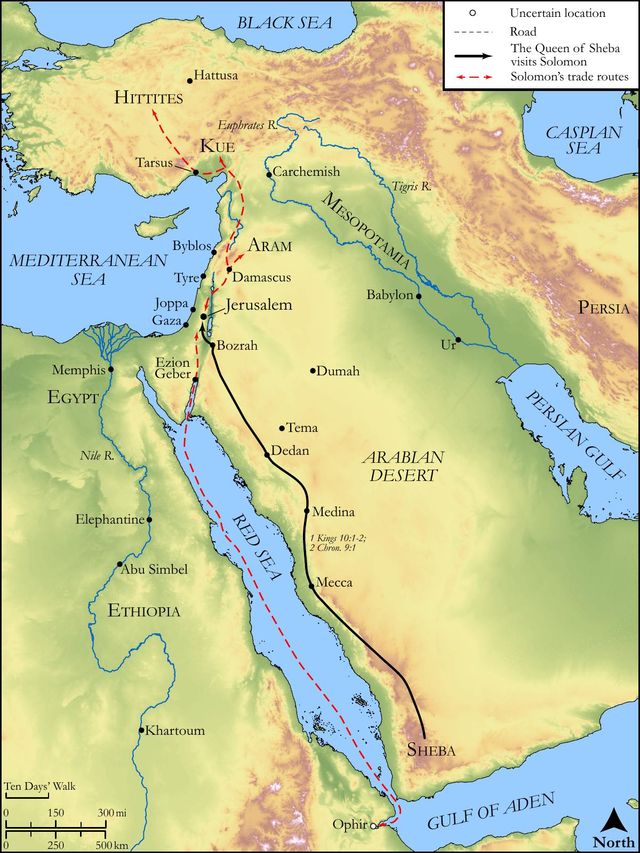
See on the biblical-era map

Study this verse
Public-domain commentary
Matthew Henry
From his Commentary on the Whole Bible. Henry comments on passages, not single verses — this entry covers 1 Kings 10:1–13. His three-level outline is real structure in the source text, so it is rendered as structure.
We have here an account of the visit which the queen of Sheba made to Solomon, no doubt when he was in the height of his piety and prosperity. Our Saviour calls her the queen of the south, for Sheba lay south of Canaan. The common opinion is that it was in Africa; and the Christians in Ethiopia, to this day, are confident that she came from their country, and that Candace was her successor, who is mentioned Act 8:27. But it is more probable that she came from the south part of Arabia the happy. It should seem she was a queen regent, sovereign of her country. Many a kingdom would have been deprived of its greatest blessings if a Salique law had been admitted into its constitution. Observe,
I.On what errand the queen of Sheba came - not to treat of trade or commerce, to adjust the limits of their dominions, to court his alliance for their mutual strength or his assistance against some common enemy, which are the common occasions of the congress of crowned heads and their interviews, but she came,
1.To satisfy her curiosity; for she had heard of his fame, especially for wisdom, and she came to prove him, whether he was so great a man as he was reported to be, Kg1 10:1. Solomon's fleet sailed near the coast of her country, and probably might put in there for fresh water; perhaps it was thus that she heard of the fame of Solomon, that he excelled in wisdom all the children of the east, and nothing would serve her but she would go herself and know the truth of the report.
2.To receive instruction from him. She came to hear his wisdom, and thereby to improve her own (Mat 12:42), that she might be the better able to govern her own kingdom by his maxims of policy. Those whom God has called to any public employment, particularly in the magistracy and ministry, should, by all means possible, be still improving themselves in that knowledge which will more and more qualify them for it, and enable them to discharge their trust well. But, it should seem, that which she chiefly aimed at was to be instructed in the things of God. She was religiously inclined, and had heard not only of the fame of Solomon, but concerning the name of the Lord (Kg1 10:1), the great name of that God whom Solomon worshipped and from whom he received his wisdom, and with this God she desired to be better acquainted. Therefore does our Saviour mention her enquiries after God, by Solomon, as an aggravation of the stupidity of those who enquire not after God by our Lord Jesus Christ, though he, having lain in his bosom, was much better able to instruct them.
II.With what equipage she came, with a very great retinue, agreeable to her rank, intending to try Solomon's wealth and generosity, as well as his wisdom, what entertainment he could and would give to a royal visitant, Kg1 10:2. Yet she came not as one begging, but brought enough to bear her charges, and abundantly to recompense Solomon for his attention to her, nothing mean or common, but gold, and precious stones, and spices, because she came to trade for wisdom, which she would purchase at any rate.
III.What entertainment Solomon gave her.
He despised not the weakness of her sex, blamed her not for leaving her own business at home to come so long a journey, and put herself and him to so much trouble and expense merely to satisfy her curiosity; but he made her welcome and all her train, gave her liberty to put all her questions, though some perhaps were frivolous, some captious, and some over-curious; he allowed her to commune with him of all that was in her heart (Kg1 10:2) and gave her a satisfactory answer to all her questions (Kg1 10:3), whether natural, moral, political, or divine. Were they designed to try him? he gave them such turns as abundantly satisfied her of his uncommon knowledge. Were they designed for her own instruction? (as we suppose most of them were), she received abundant instruction from him, and he made things surprisingly easy which she apprehended insuperably difficult, and satisfied her that there was a divine sentence in the lips of this king. But he informed her no doubt, with particular care, concerning God, and his law and instituted worship. He had taken it for granted (Kg1 8:42) that strangers would hear of his great name, and would come thither to enquire after him; and now that so great a stranger came we may be sure he was not wanting to assist and encourage her enquiries, and give her a description of the temple, and the officers and services of it, that she might be persuaded to serve the Lord whom she now sought.
IV.How she was affected with what she saw and heard in Solomon's court.
Divers things are here mentioned which she admired, the buildings and furniture of his palace, the provision that was made very day for his table (when she saw that perhaps she wondered where there were mouths for all that meat, but when she saw the multitude of his attendants and guests she was as ready to wonder where was the meat for all those mouths), the orderly sitting of his servants, every one in his place, and the ready attendance of his ministers, without any confusion, their rich liveries, and the propriety with which his cup-bearers waited at his table. These things she admired, as adding much to his magnificence. But, above all these, the first thing mentioned (which contained all) is his wisdom (Kg1 10:4), of the transcendency of which she now had incontestable proofs: and the last thing mentioned, which crowned all, is his piety, the ascent by which he went up to the house of the Lord, with what gravity and seriousness, and an air of devotion in his countenance, he appeared, when he went to the temple to worship God, with as much humility then as majesty at other times. Many of the ancient versions read it, The burnt-offerings which he offered in the house of the Lord; she observed with what a generous bounty he brought his sacrifices, and with what a pious fervour he attended the offering of them; never did she see so much goodness with so much greatness. Every thing was so surprising that there was no more spirit in her, but she stood amazed; she had never seen the like.
V.How she expressed herself upon this occasion.
1.She owned her expectation far out-done, though it was highly raised by the report she heard, Kg1 10:6, Kg1 10:7. She is far from repenting her journey or calling herself a fool for undertaking it, but acknowledges it was well worth her while to come so far for the sight of that which she could not believe the report of. Usually things are represented to us, both by common fame and by our own imagination, much greater than we find them when we come to examine them; but here the truth exceeded both fame and fancy. Those who, through grace, are brought to experience the delights of communion with God will say that the one-half was not told them of the pleasures of Wisdom's ways and the advantages of her gates. Glorified saints, much more, will say that it was a true report which they heard of the happiness of heaven, but that the thousandth part was not told them, Co1 2:9.
2.She pronounced those happy that constantly attended him, and waited on him at table: "Happy are thy men, happy are these thy servants (Kg1 10:8); they may improve their own wisdom by hearing thine." She was tempted to envy them and to which herself one of them. Note, It is a great advantage to be in good families, and to have opportunity of frequent converse with those that are wise, and good, and communicative. Many have this happiness who know not how to value it. With much more reason may we say this of Christ's servants, Blessed are those that dwell in his house, they will be still praising him.
3.She blessed God, the giver of Solomon's wisdom and wealth, and the author of his advancement, who had made him king,
(1.)In kindness to him, that he might have the larger opportunity of doing good with his wisdom: He delighted in thee, to set thee on the throne of Israel, Kg1 10:9. Solomon's preferment began in the prophet's calling him Jedidiah, because the Lord loved him, Sa2 12:25. It more than doubles our comforts if we have reason to hope they come from God's delight in us. It was his pleasure concerning thee (so it may be read) to set thee on the throne, not for thy merit's sake, but because it so seemed good unto him.
(2.)In kindness to the people, because the Lord loved Israel for ever, designed them a lasting bliss, long to survive him that laid the foundations of it. "He has made thee king, not that thou mayest live in pomp and pleasure, and do what thou wilt, but to do judgment and justice." This she kindly reminded Solomon of, and no doubt he took it kindly. Both magistrates and ministers must be more solicitous to do the duty of their places than to secure the honours and profits of them. To this she attributes his prosperity, not to his wisdom, for bread is not always to the wise (Ecc 9:11), but whoso doeth judgment and justice, it shall be well with him, Jer 22:15. Thus giving of thanks must be made for kings, for good kings, for such kings; they are what God makes them to be.
VI.How they parted.
1.She made a noble present to Solomon of gold and spices, Kg1 10:10. David had foretold concerning Solomon that to him should be given of the gold of Sheba, Psa 72:15. The present of gold and spices which the wise men of the east brought to Christ was signified by this, Mat 2:11. Thus she paid for the wisdom she had learned and did not think she bought it dearly. Let those that are taught of God give him their hearts, and the present will be more acceptable than this of gold and spices. Mention is made of the great abundance Solomon had of his own, notwithstanding she presented and he accepted this gold. What we present to Christ he needs not, but will have us so to express our gratitude. The almug-trees are here spoken of (Kg1 10:11, Kg1 10:12) as extraordinary, because perhaps much admired by the queen of Sheba.
2.Solomon was not behind-hand with her: He gave her whatsoever, she asked, patterns, we may suppose, of those things that were curious, by which she might make the like; or perhaps he gave her his precepts of wisdom and piety in writing, besides that which he gave her of his royal bounty, Kg1 10:13. Thus those who apply to our Lord Jesus will find him not only greater than Solomon, and wiser, but more kind; whatsoever we ask, it shall be done for us; nay, he will, out of his divine bounty, which infinitely exceeds royal bounty, even Solomon's, do for us more than we are able to ask or think.
Continue studying 1 Kings 10:9 across the web’s major study libraries — every link below opens this exact verse, chapter, or book on the destination site.
Read & Compare
 BibleGatewayThis verse in more than 200 translations and 70 languages.
 Bible.comThe YouVersion reader — hundreds of translations, reading plans, and highlights.
 ESV.orgCrossway's official English Standard Version reader.
 NET BibleThe NET translation with 60,000+ translators' notes on every rendering decision.
 STEP BibleTyndale House's free study tool — original text, vocabulary, and scholarly resources.
 BibliaLogos Bible Software's free web reader.
 USCCBThe New American Bible (Revised Edition) with the U.S. bishops' study notes.
Commentaries
 BibleHub CommentariesDozens of classic commentaries on this verse, gathered on one page.
 StudyLightMore than 100 commentary sets — the largest collection on the web.
 BibleRefPlain-English commentary on what this verse means, verse by verse.
 Enduring WordDavid Guzik's free commentary on this chapter, widely used by Bible teachers.
 Bible Study ToolsVerse commentary alongside Greek and Hebrew study aids.
Original Language & Research
- BibleHub InterlinearThe verse word by word — original language, transliteration, and English.
- BibleHub LexiconEvery word's original-language definition and Strong's entry.
 Blue Letter BibleDeep-study tools — Strong's numbers, concordance, and word studies.
 SefariaThe Hebrew text with Rashi and centuries of Jewish commentary.
Sermons, Hymns & Audio


TrulyRandomVerse is not affiliated with these sites and doesn’t control their content. They’re linked because they’re genuinely useful.
Summary
The Queen of Sheba, profoundly impressed by King Solomon's unparalleled wisdom and the magnificent order of his kingdom, articulates a powerful theological blessing. Her declaration attributes Solomon's extraordinary reign and his divine appointment to the throne of Israel directly to the sovereign pleasure and eternal love of the LORD God for His chosen people. She concludes by affirming that God established Solomon as king specifically to uphold righteousness and administer justice throughout the land, recognizing that his rule was a direct manifestation of God's character and purposes.
Context
ShowHideLiterary Context
This verse is strategically placed at the zenith of the Queen of Sheba's visit to King Solomon, as detailed in 1 Kings 10. Her arduous journey from a distant land, spurred by widespread reports of Solomon's exceptional wisdom and wealth, serves as a powerful testament to the unprecedented fame and divine favor bestowed upon him. Prior to this climactic declaration, the Queen has personally witnessed the vastness of his riches, the meticulous organization of his court, the profound depth of his responses, and the breathtaking grandeur of the Temple and his royal palace (compare 1 Kings 10:4-5). Her words in 1 Kings 10:9 represent the culminating expression of her awe, a pivotal shift from mere admiration of Solomon's human accomplishments to a profound adoration of the God who empowered him. This theological insight validates the divine source of Solomon's wisdom and prosperity, which was initially granted by God in a dream (see 1 Kings 3:12). This passage thus marks the apex of Solomon's reign, portraying him as a king whose wisdom and kingdom uniquely reflect God's glory to the surrounding nations.
Historical & Cultural Context
The visit of the Queen of Sheba, likely originating from a powerful kingdom in modern-day Yemen or Ethiopia, underscores the extensive and sophisticated trade routes and diplomatic relations characteristic of the ancient Near East. Such royal visits were not merely social calls but significant political and economic events, typically involving elaborate exchanges of gifts, the forging of alliances, and demonstrations of regional power. For an Israelite king, receiving tribute and widespread recognition from foreign monarchs was a clear sign of divine blessing and regional dominance, fulfilling ancient prophecies regarding Israel's preeminence among nations (as seen in Deuteronomy 28:13). The Queen's explicit acknowledgment of "the LORD thy God" (Yahweh) by a foreign dignitary is particularly remarkable, signifying the widespread reputation of Israel's monotheistic God and the unique nature of Israel's faith in a predominantly polytheistic world. Her statement reflects an understanding, however partial, of the covenant relationship between God and Israel, where the king's rule was intrinsically understood as a stewardship under direct divine authority.
Key Themes
ShowHideThis verse powerfully encapsulates several foundational themes central to the overarching narrative of 1 Kings. Firstly, it profoundly underscores the theme of Divine Sovereignty and Appointment, emphasizing that Solomon's kingship was not merely a matter of human dynastic succession but a direct, deliberate, and delightful act of God's will. Secondly, it highlights God's Enduring Love and Covenant Faithfulness to Israel, explicitly stating that Solomon was made king "because the LORD loved Israel for ever." This echoes and affirms the foundational promises of the Davidic Covenant, which established an eternal dynasty. Thirdly, the verse articulates the Ideal of Righteous Governance, defining the king's primary and divinely mandated duty as "to do judgment and justice." This ideal, frequently emphasized throughout the Old Testament (for example, in Psalm 72:1-4), posits that true leadership, especially within the covenant nation of Israel, must be characterized by unwavering equity, profound integrity, and steadfast adherence to God's moral and legal standards for the ultimate welfare and flourishing of the people.
Exposition and Analysis
ShowHideKey Word Analysis
ShowHideThis primitive root signifies properly "to incline to," and by implication, "to be pleased with" or "desire." When applied to God, as here, it speaks of His sovereign choice and affectionate disposition towards an individual or a people. It indicates that Solomon's ascent to the throne was not a reluctant concession but an act of divine pleasure and intentional selection, reflecting God's personal investment in his reign and His purposes for Israel. It conveys a sense of God's active, positive affirmation of Solomon's kingship.
This term, a feminine noun, denotes "affection (in a good or a bad sense)" or simply "love." In this context, it describes God's enduring, covenantal love for the nation of Israel. The Queen of Sheba correctly identifies this everlasting divine love as the ultimate motivation behind God's actions, including His establishment of Solomon as king. This love is not fleeting but "for ever," underscoring God's faithfulness to His promises and His chosen people, ensuring their welfare and continuity.
This is a foundational pair of terms in Old Testament ethics and governance. Mishpâṭ refers to "a verdict pronounced judicially," encompassing the administration of law, equitable decisions, and the upholding of legal rights, often implying concrete acts of justice. Tsᵉdâqâh denotes "rightness (abstractly), subjectively (rectitude), objectively (justice), morally (virtue) or figuratively (prosperity)," encompassing integrity, moral rectitude, and adherence to God's standards. Together, they describe the ideal character and function of a righteous ruler who ensures fairness, protects the vulnerable, and promotes moral uprightness throughout society, reflecting God's own attributes and His desire for a just social order.
Verse Breakdown
ShowHide"Blessed be the LORD thy God"
The Queen of Sheba commences her statement with a profound doxology, an expression of praise and adoration directed not primarily at Solomon himself, but at Yahweh, the God of Israel. This acknowledges God's supreme authority, goodness, and sovereignty as the ultimate source of Solomon's wisdom and success. It is a remarkable recognition of divine agency, indicating that the Queen, despite her foreign origin, perceives the direct hand of Israel's God at work in Solomon's reign.
"which delighted in thee, to set thee on the throne of Israel"
This clause directly attributes Solomon's kingship to God's sovereign pleasure and active intervention. It emphasizes that Solomon's reign was not merely a matter of dynastic succession or human political maneuvering but a divine appointment, a clear testament to God's unique favor upon him. The phrase "throne of Israel" highlights the specific theological significance of the Israelite monarchy as God's chosen instrument for His covenant people.
"because the LORD loved Israel for ever"
Here, the Queen identifies the ultimate, overarching reason for God's actions concerning Solomon: His eternal, unwavering, and covenantal love for the nation of Israel. This love is presented as the foundational and enduring motive, positioning Solomon's reign as a manifestation of God's steadfast faithfulness to His covenant promises and His enduring commitment to His chosen people, ensuring their welfare, stability, and continuity.
"therefore made he thee king, to do judgment and justice"
This final clause articulates the divine purpose and mandate behind Solomon's enthronement. God appointed him king specifically to uphold righteousness and administer justice. This is not merely a description of Solomon's duties but a divine imperative, underscoring that the primary function of an Israelite king was to embody and enforce God's moral and legal standards for the benefit of the entire nation, ensuring equity, protecting the vulnerable, and promoting moral order throughout society.
Literary Devices
ShowHideThe verse employs several potent literary devices that amplify its theological weight. The opening phrase, "Blessed be the LORD thy God," functions as a Doxology, a formal and reverent expression of praise directed towards God, immediately elevating the tone from mere admiration of Solomon to profound reverence for the divine source of his power and prosperity. This also serves as a powerful form of Indirect Characterization, revealing the Queen's remarkable spiritual insight and her recognition of Yahweh's supremacy, despite her foreign background and likely polytheistic upbringing. The logical flow of the verse demonstrates clear Cause and Effect, where God's delight in Solomon and His eternal love for Israel are presented as the underlying causes ("which delighted in thee," "because the LORD loved Israel for ever"), leading directly to the intended effect of Solomon's kingship ("therefore made he thee king"). Finally, the pairing of "judgment and justice" is a classic example of a Merism, a literary device where two complementary terms are used to express a single, comprehensive concept – in this instance, the full and ideal scope of righteous governance. This phrase also functions as a Thematic Summary, encapsulating the core ideal of kingship in Israel as divinely ordained for the purpose of upholding God's moral order and ensuring societal equity.
Theological and Thematic Connections
ShowHideThis verse offers profound theological insights into the nature of divine sovereignty and the sacred purpose of human leadership. It unequivocally affirms that all legitimate authority, particularly within God's covenant people, flows directly from God's deliberate choice and His enduring, steadfast love. The Queen of Sheba's declaration serves as a powerful reminder that God's actions are always rooted in His immutable character—His delight in His chosen instruments and His eternal love for His people. Solomon's reign, therefore, was not merely a political event or a historical accident, but a profound theological statement, demonstrating God's unwavering faithfulness to His covenant promises and His desire for His people to live under righteous governance that reflects His own attributes. The mandate to "do judgment and justice" transcends Solomon's specific historical context, serving as a timeless divine expectation for all who hold positions of influence, whether in civil government, community leadership, or the church, emphasizing that true leadership is a sacred trust meant to embody and reflect God's own righteousness and compassionate care for His creation.
Reflection and Application
ShowHideThe Queen of Sheba's profound theological insight in 1 Kings 10:9 challenges believers today to cultivate a similar recognition and acknowledgment of God's sovereign hand in all areas of life, especially in the establishment and function of leadership. Just as Solomon's reign was divinely appointed and purposed, we are called to discern God's active involvement in the world around us, giving Him the glory for every instance of wisdom, order, and justice that we observe. This verse encourages us to pray earnestly for our leaders, that they might embody the principles of "judgment and justice," reflecting God's character in their decision-making and governance. Furthermore, it reminds us that our own positions of influence, no matter how humble or grand, are opportunities for faithful stewardship under God's loving oversight. We are to act with integrity, fairness, and compassion, motivated by God's eternal love for humanity, seeking to promote righteousness and equity in our homes, workplaces, and communities. The Queen's response invites us to move beyond mere admiration of human success to a deeper, more profound adoration of the God who orchestrates all things for His sovereign purposes and for the ultimate good of His people.
Questions for Reflection
ShowHideFAQ
ShowHideWhy is it significant that a foreign queen blesses the LORD, God of Israel?
ShowHideIt is profoundly significant because it powerfully demonstrates the widespread fame and undeniable impact of Yahweh, the God of Israel, and the tangible blessing of His presence upon Solomon's kingdom. For a foreign monarch, likely from a polytheistic culture, to not only acknowledge but explicitly bless the LORD indicates that Solomon's wisdom, wealth, and the order of his kingdom were so extraordinary that they could only be attributed to a divine source, specifically the God of Israel. This serves as a compelling testimony to God's glory extending far beyond Israel's borders, partially fulfilling God's ancient promise to Abraham that through his descendants, "all the families of the earth shall be blessed" (Genesis 12:3). It underscores the universal scope of God's sovereignty and His ability to reveal Himself and His power even to those outside the immediate covenant community.
What does "loved Israel for ever" imply about God's character?
ShowHideThe phrase "loved Israel for ever" profoundly underscores God's unwavering faithfulness, His covenant-keeping nature, and the eternal, unchanging quality of His commitment to His chosen people. It signifies that God's love is not conditional, fleeting, or temporary, but an enduring and foundational aspect of His very character, forming the bedrock of His relationship with Israel. This eternal love is presented as the ultimate reason for His providential care, His establishment of kings like Solomon, and His ongoing work in history to preserve and bless His people. It resonates deeply with other passages emphasizing God's steadfast love, or ḥesed, such as Psalm 100:5, which declares, "For the LORD is good; his mercy is everlasting; and his truth endureth to all generations." This attribute of eternal love provides assurance of God's reliability and His unwavering commitment to His promises.
Christ-Centered Fulfillment
ShowHideWhile King Solomon's reign represents the pinnacle of Israel's earthly glory and a partial, yet significant, fulfillment of God's promises for a righteous king, it ultimately points forward to the perfect, eternal, and universal reign of Jesus Christ. Solomon, despite his unparalleled wisdom, eventually faltered and turned to idolatry (as recorded in 1 Kings 11:1-8), demonstrating the inherent limitations and imperfections of human kingship. Jesus, however, is the true and greater Son of David, the one in whom God truly "delighted" (as affirmed at His baptism in Matthew 3:17), and whom God has definitively "set on the throne" not merely of Israel, but of the entire universe, with all authority and power (see Ephesians 1:20-22). He perfectly embodies "judgment and justice," administering perfect righteousness and equity as the divine King (prophesied in Isaiah 9:7). The Queen of Sheba's profound recognition that God loved Israel "for ever" finds its ultimate and most expansive expression in Christ, for it is through His sacrificial love on the cross that God's eternal love extends not only to Israel but to all humanity, establishing a new and everlasting covenant (as revealed in John 3:16) and an eternal kingdom that will never end (promised in Luke 1:33). Jesus is the greater Solomon, whose wisdom surpasses all earthly wisdom (as He Himself declared in Matthew 12:42), and whose perfect reign truly brings ultimate judgment and justice, establishing God's eternal and righteous kingdom for all who believe.