


1 Kings 10:3
Bible text: King James Version (1769 Blayney text) · Public domain
Bible text: Berean Standard Bible · Public domain
Bible text: American Standard Version (1901) · Public domain
Bible text: World English Bible, Messianic edition · Public domain
Bible text: Geneva Bible (1599) · Public domain
Bible text: Young's Literal Translation · Public domain
- וַיַּגֶּדvai·ya·gedand he toldH5046Conj-w ¦ V-Hiphil-ConsecImperf-3msVerb Hiphil Consecutive Imperfect 3rd Singular Masculineוַandיַּגֶּדhe told
- לָהּlahto herPrep-l ¦ 3fsSuffix Personal 3rd Singular Feminineלָtoהּher
- שְׁלֹמֹהshe·lo·MohSolomonH8010N-proper-mNoun Proper Masculine
- אֶת'et<obj.>H853DirObjMParticle Object Indicator
- כָּלkolallH3605N-mscNoun Singular Masculine Construct
- דְּבָרֶיהָde·va·Rei·haher wordsH1697N-mpc ¦ 3fsNoun Plural Masculine Constructדְּבָרֶיwordsהָher
- לֹאlo'notH3808NegParticle Negative
- הָיָהha·Yahit wasH1961V-Qal-Perf-3msVerb Qal Perfect 3rd Singular Masculine
- דָּבָרda·VaranythingH1697N-msNoun Singular Masculine Absolute
- נֶעְלָםne'·LamhiddenH5956V-Niphal-Prtcpl-msVerb Niphal Participle Singular Masculine Absolute
- מִןminfromH4480PrepPreposition
- הַמֶּלֶךְha·Me·lekhthe kingH4428Art ¦ N-msNoun Singular Masculine Absoluteהַtheמֶּלֶךְking
- אֲשֶׁר'a·SherwhichH834RelParticle Relative
- לֹאlo'notH3808NegParticle Negative
- הִגִּידhi·Gidhe toldH5046V-Hiphil-Perf-3msVerb Hiphil Perfect 3rd Singular Masculine
- לָהּLahto herPrep-l ¦ 3fsSuffix Personal 3rd Singular Feminineלָtoהּher
English is a literal word-by-word gloss of the Hebrew, not the KJV's wording. Why?
This is the original text the KJV's translators worked from — each Hebrew word with its own literal English meaning in this verse, prepared by scholars at Tyndale House, Cambridge. The KJV translates whole sentences, not word by word, so its wording differs: one Hebrew word can become several English words, and the KJV may choose “the LORD” where the gloss reads “Yahweh”. Both are faithful — they answer different questions. For the KJV's own rendering, switch to the KJV text.
Details
See on the biblical-era maps

Study this verse
Public-domain commentary
Matthew Henry
From his Commentary on the Whole Bible. Henry comments on passages, not single verses — this entry covers 1 Kings 10:1–13. His three-level outline is real structure in the source text, so it is rendered as structure.
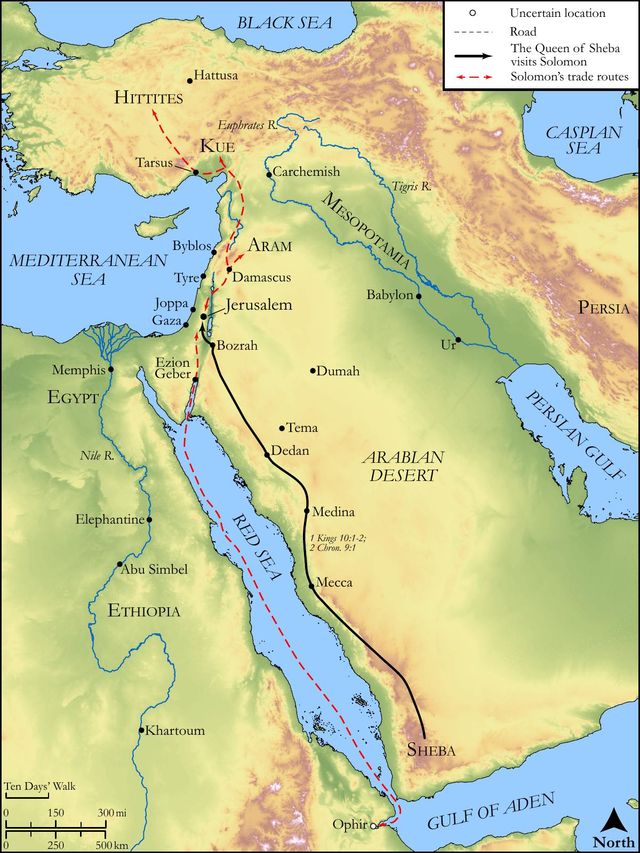
We have here an account of the visit which the queen of Sheba made to Solomon, no doubt when he was in the height of his piety and prosperity. Our Saviour calls her the queen of the south, for Sheba lay south of Canaan. The common opinion is that it was in Africa; and the Christians in Ethiopia, to this day, are confident that she came from their country, and that Candace was her successor, who is mentioned Act 8:27. But it is more probable that she came from the south part of Arabia the happy. It should seem she was a queen regent, sovereign of her country. Many a kingdom would have been deprived of its greatest blessings if a Salique law had been admitted into its constitution. Observe,
I.On what errand the queen of Sheba came - not to treat of trade or commerce, to adjust the limits of their dominions, to court his alliance for their mutual strength or his assistance against some common enemy, which are the common occasions of the congress of crowned heads and their interviews, but she came,
1.To satisfy her curiosity; for she had heard of his fame, especially for wisdom, and she came to prove him, whether he was so great a man as he was reported to be, Kg1 10:1. Solomon's fleet sailed near the coast of her country, and probably might put in there for fresh water; perhaps it was thus that she heard of the fame of Solomon, that he excelled in wisdom all the children of the east, and nothing would serve her but she would go herself and know the truth of the report.
2.To receive instruction from him. She came to hear his wisdom, and thereby to improve her own (Mat 12:42), that she might be the better able to govern her own kingdom by his maxims of policy. Those whom God has called to any public employment, particularly in the magistracy and ministry, should, by all means possible, be still improving themselves in that knowledge which will more and more qualify them for it, and enable them to discharge their trust well. But, it should seem, that which she chiefly aimed at was to be instructed in the things of God. She was religiously inclined, and had heard not only of the fame of Solomon, but concerning the name of the Lord (Kg1 10:1), the great name of that God whom Solomon worshipped and from whom he received his wisdom, and with this God she desired to be better acquainted. Therefore does our Saviour mention her enquiries after God, by Solomon, as an aggravation of the stupidity of those who enquire not after God by our Lord Jesus Christ, though he, having lain in his bosom, was much better able to instruct them.
II.With what equipage she came, with a very great retinue, agreeable to her rank, intending to try Solomon's wealth and generosity, as well as his wisdom, what entertainment he could and would give to a royal visitant, Kg1 10:2. Yet she came not as one begging, but brought enough to bear her charges, and abundantly to recompense Solomon for his attention to her, nothing mean or common, but gold, and precious stones, and spices, because she came to trade for wisdom, which she would purchase at any rate.
III.What entertainment Solomon gave her.
He despised not the weakness of her sex, blamed her not for leaving her own business at home to come so long a journey, and put herself and him to so much trouble and expense merely to satisfy her curiosity; but he made her welcome and all her train, gave her liberty to put all her questions, though some perhaps were frivolous, some captious, and some over-curious; he allowed her to commune with him of all that was in her heart (Kg1 10:2) and gave her a satisfactory answer to all her questions (Kg1 10:3), whether natural, moral, political, or divine. Were they designed to try him? he gave them such turns as abundantly satisfied her of his uncommon knowledge. Were they designed for her own instruction? (as we suppose most of them were), she received abundant instruction from him, and he made things surprisingly easy which she apprehended insuperably difficult, and satisfied her that there was a divine sentence in the lips of this king. But he informed her no doubt, with particular care, concerning God, and his law and instituted worship. He had taken it for granted (Kg1 8:42) that strangers would hear of his great name, and would come thither to enquire after him; and now that so great a stranger came we may be sure he was not wanting to assist and encourage her enquiries, and give her a description of the temple, and the officers and services of it, that she might be persuaded to serve the Lord whom she now sought.
IV.How she was affected with what she saw and heard in Solomon's court.
Divers things are here mentioned which she admired, the buildings and furniture of his palace, the provision that was made very day for his table (when she saw that perhaps she wondered where there were mouths for all that meat, but when she saw the multitude of his attendants and guests she was as ready to wonder where was the meat for all those mouths), the orderly sitting of his servants, every one in his place, and the ready attendance of his ministers, without any confusion, their rich liveries, and the propriety with which his cup-bearers waited at his table. These things she admired, as adding much to his magnificence. But, above all these, the first thing mentioned (which contained all) is his wisdom (Kg1 10:4), of the transcendency of which she now had incontestable proofs: and the last thing mentioned, which crowned all, is his piety, the ascent by which he went up to the house of the Lord, with what gravity and seriousness, and an air of devotion in his countenance, he appeared, when he went to the temple to worship God, with as much humility then as majesty at other times. Many of the ancient versions read it, The burnt-offerings which he offered in the house of the Lord; she observed with what a generous bounty he brought his sacrifices, and with what a pious fervour he attended the offering of them; never did she see so much goodness with so much greatness. Every thing was so surprising that there was no more spirit in her, but she stood amazed; she had never seen the like.
V.How she expressed herself upon this occasion.
1.She owned her expectation far out-done, though it was highly raised by the report she heard, Kg1 10:6, Kg1 10:7. She is far from repenting her journey or calling herself a fool for undertaking it, but acknowledges it was well worth her while to come so far for the sight of that which she could not believe the report of. Usually things are represented to us, both by common fame and by our own imagination, much greater than we find them when we come to examine them; but here the truth exceeded both fame and fancy. Those who, through grace, are brought to experience the delights of communion with God will say that the one-half was not told them of the pleasures of Wisdom's ways and the advantages of her gates. Glorified saints, much more, will say that it was a true report which they heard of the happiness of heaven, but that the thousandth part was not told them, Co1 2:9.
2.She pronounced those happy that constantly attended him, and waited on him at table: "Happy are thy men, happy are these thy servants (Kg1 10:8); they may improve their own wisdom by hearing thine." She was tempted to envy them and to which herself one of them. Note, It is a great advantage to be in good families, and to have opportunity of frequent converse with those that are wise, and good, and communicative. Many have this happiness who know not how to value it. With much more reason may we say this of Christ's servants, Blessed are those that dwell in his house, they will be still praising him.
3.She blessed God, the giver of Solomon's wisdom and wealth, and the author of his advancement, who had made him king,
(1.)In kindness to him, that he might have the larger opportunity of doing good with his wisdom: He delighted in thee, to set thee on the throne of Israel, Kg1 10:9. Solomon's preferment began in the prophet's calling him Jedidiah, because the Lord loved him, Sa2 12:25. It more than doubles our comforts if we have reason to hope they come from God's delight in us. It was his pleasure concerning thee (so it may be read) to set thee on the throne, not for thy merit's sake, but because it so seemed good unto him.
(2.)In kindness to the people, because the Lord loved Israel for ever, designed them a lasting bliss, long to survive him that laid the foundations of it. "He has made thee king, not that thou mayest live in pomp and pleasure, and do what thou wilt, but to do judgment and justice." This she kindly reminded Solomon of, and no doubt he took it kindly. Both magistrates and ministers must be more solicitous to do the duty of their places than to secure the honours and profits of them. To this she attributes his prosperity, not to his wisdom, for bread is not always to the wise (Ecc 9:11), but whoso doeth judgment and justice, it shall be well with him, Jer 22:15. Thus giving of thanks must be made for kings, for good kings, for such kings; they are what God makes them to be.
VI.How they parted.
1.She made a noble present to Solomon of gold and spices, Kg1 10:10. David had foretold concerning Solomon that to him should be given of the gold of Sheba, Psa 72:15. The present of gold and spices which the wise men of the east brought to Christ was signified by this, Mat 2:11. Thus she paid for the wisdom she had learned and did not think she bought it dearly. Let those that are taught of God give him their hearts, and the present will be more acceptable than this of gold and spices. Mention is made of the great abundance Solomon had of his own, notwithstanding she presented and he accepted this gold. What we present to Christ he needs not, but will have us so to express our gratitude. The almug-trees are here spoken of (Kg1 10:11, Kg1 10:12) as extraordinary, because perhaps much admired by the queen of Sheba.
2.Solomon was not behind-hand with her: He gave her whatsoever, she asked, patterns, we may suppose, of those things that were curious, by which she might make the like; or perhaps he gave her his precepts of wisdom and piety in writing, besides that which he gave her of his royal bounty, Kg1 10:13. Thus those who apply to our Lord Jesus will find him not only greater than Solomon, and wiser, but more kind; whatsoever we ask, it shall be done for us; nay, he will, out of his divine bounty, which infinitely exceeds royal bounty, even Solomon's, do for us more than we are able to ask or think.
Continue studying 1 Kings 10:3 across the web’s major study libraries — every link below opens this exact verse, chapter, or book on the destination site.
Read & Compare
 BibleGatewayThis verse in more than 200 translations and 70 languages.
 Bible.comThe YouVersion reader — hundreds of translations, reading plans, and highlights.
 ESV.orgCrossway's official English Standard Version reader.
 NET BibleThe NET translation with 60,000+ translators' notes on every rendering decision.
 STEP BibleTyndale House's free study tool — original text, vocabulary, and scholarly resources.
 BibliaLogos Bible Software's free web reader.
 USCCBThe New American Bible (Revised Edition) with the U.S. bishops' study notes.
Commentaries
 BibleHub CommentariesDozens of classic commentaries on this verse, gathered on one page.
 StudyLightMore than 100 commentary sets — the largest collection on the web.
 BibleRefPlain-English commentary on what this verse means, verse by verse.
 Enduring WordDavid Guzik's free commentary on this chapter, widely used by Bible teachers.
 Bible Study ToolsVerse commentary alongside Greek and Hebrew study aids.
Original Language & Research
- BibleHub InterlinearThe verse word by word — original language, transliteration, and English.
- BibleHub LexiconEvery word's original-language definition and Strong's entry.
 Blue Letter BibleDeep-study tools — Strong's numbers, concordance, and word studies.
 SefariaThe Hebrew text with Rashi and centuries of Jewish commentary.
Sermons, Hymns & Audio


TrulyRandomVerse is not affiliated with these sites and doesn’t control their content. They’re linked because they’re genuinely useful.
Summary
1 Kings 10:3 powerfully illustrates the extraordinary, divinely-granted wisdom of King Solomon. As the Queen of Sheba, renowned for her discerning intellect, presented him with challenging inquiries, this verse affirms Solomon's unparalleled ability to comprehend and articulate comprehensive answers to every single one of her questions. It underscores that no matter how intricate or perplexing, no matter was beyond his grasp, thereby confirming the widespread reports of his profound insight and the faithful fulfillment of God's promise to him.
Context
ShowHideLiterary Context
This verse is strategically placed within the celebrated account of the Queen of Sheba's visit to King Solomon, meticulously detailed in 1 Kings 10:1-13. It immediately follows the Queen's grand arrival in Jerusalem with a vast entourage and her explicit intention "to prove him with hard questions" (1 Kings 10:1). Verse 3 serves as the direct, triumphant response to this intellectual challenge, demonstrating Solomon's complete mastery over all her inquiries. This pivotal declaration then sets the stage for the Queen's profound astonishment and lavish praise for Solomon and his God in the subsequent verses (1 Kings 10:4-9). The verse thus highlights the climax of her intellectual test and provides irrefutable evidence of Solomon's unparalleled, God-given wisdom.
Historical & Cultural Context
A monarch's wisdom was far more than a mere intellectual attribute; it was a foundational pillar of a king's legitimacy, authority, and effective governance, as Solomon's prayer for "an understanding heart to judge thy people" shows. Kings were expected to function as sagacious judges, astute administrators, and insightful problem-solvers. The practice of foreign dignitaries testing a ruler's wisdom, often through riddles, complex inquiries, or profound philosophical debates, was a recognized diplomatic custom. Such tests served to assess the ruler's capabilities and, by extension, the strength and divine favor of their kingdom. The Queen of Sheba's arduous journey from a distant land (traditionally identified as modern-day Yemen or Ethiopia) to Jerusalem underscores the immense reputation Solomon had garnered, not solely for his immense wealth, but primarily for his God-given wisdom, which transcended geographical and cultural boundaries. Her visit was a significant international event, serving to validate Solomon's standing among the nations and, implicitly, to magnify the God of Israel who had bestowed such extraordinary wisdom.
Key Themes
ShowHideThe central theme powerfully illuminated by this verse is the Supernatural Wisdom of Solomon. This wisdom was not merely human intellect or acquired knowledge but a direct, divine endowment, fulfilling God's specific promise to Solomon after his humble prayer for an "understanding heart to judge thy people" (1 Kings 3:9). The verse also vividly illustrates the theme of Divine Equipping of Leaders, showcasing how God fully enables and empowers those He chooses for specific purposes, empowering Solomon to represent divine wisdom to the nations. Furthermore, it strongly reinforces the theme of Confirmed Reputation, as the Queen's direct, personal experience of Solomon's flawless and comprehensive answers served to solidify his widespread fame as the wisest king of his time, a fact she explicitly acknowledges and affirms in her later testimony (1 Kings 10:6-7).
Exposition and Analysis
ShowHideKey Word Analysis
ShowHideFrom the root דָבַר, this term broadly refers to a "word" or "matter," but in this context, as indicated by the KJV's translation "questions," it signifies inquiries, affairs, or subjects of discussion. It implies that the Queen presented Solomon with various complex matters, statements, or perhaps even riddles, designed to probe the depth of his understanding and insight, rather than simple factual inquiries. Solomon's ability to address "all her questions" speaks to his comprehensive grasp of every subject presented.
A primitive root meaning "to veil from sight" or "to conceal," this word emphasizes the complete absence of any obscurity or mystery for Solomon. In this context, it signifies that nothing was too difficult, too intricate, or too obscure for Solomon to comprehend and explain. It highlights the absolute completeness and depth of his knowledge, implying that no secret remained unrevealed and no mystery unsolved in his presence.
A primitive root meaning "to front," "to stand boldly out opposite," and by implication "to manifest" or "to announce." This verb implies not just a simple answer, but a comprehensive, clear, and articulate disclosure of understanding. Solomon didn't merely give brief replies; he fully expounded upon her questions, demonstrating his profound and transparent grasp of every subject, making known what was previously hidden.
Verse Breakdown
ShowHide"And Solomon told her all her questions"
This initial clause establishes the immediate and complete response to the Queen of Sheba's intellectual challenge. It signifies Solomon's active engagement with her inquiries and his comprehensive ability to address every single one. The use of "all" is crucial, emphasizing the exhaustive nature of his replies, leaving no inquiry unaddressed or unanswered.
"there was not [any] thing hid from the king,"
This phrase, constructed as a powerful negative assertion, conveys the profound idea that absolutely nothing was too obscure, too difficult, or too complex for Solomon's understanding. The bracketed "any" in the KJV clarifies the breadth of "thing," meaning not a single item, concept, or mystery was beyond his divinely-granted comprehension. This stands as a testament to the unparalleled depth of his insight.
"which he told her not."
This final clause functions as a double negative, emphatically reinforcing the preceding statement. It means that everything that was not hidden from him—that is, everything he understood—he indeed revealed to her. This powerfully confirms his complete and unreserved disclosure of knowledge, leaving no question unanswered and no explanation incomplete. It underscores the absolute and flawless fulfillment of the Queen's intellectual challenge by Solomon.
Literary Devices
ShowHideThe verse employs several literary devices to underscore Solomon's extraordinary wisdom. Hyperbole is powerfully evident in the declaration that "there was not [any] thing hid from the king, which he told her not." While Solomon, as a human, was not omniscient, this exaggerated language effectively conveys the completeness, perfection, and divine origin of his wisdom in the specific context of the Queen's challenge. It creates a sense of awe and leaves no doubt about his intellectual and spiritual supremacy. The narrative also functions as a Divine Fiat in narrative form, demonstrating the direct and faithful fulfillment of God's promise to Solomon in 1 Kings 3:12, where God explicitly declares, "Behold, I have done according to thy words: lo, I have given thee a wise and an understanding heart." Finally, there is an element of Foreshadowing, as Solomon's wisdom, which drew nations from afar to Jerusalem, implicitly points to a greater wisdom yet to come in the person of Christ, who would draw all people to Himself.
Theological and Thematic Connections
ShowHide1 Kings 10:3 serves as a profound theological statement regarding the source and nature of true wisdom. Solomon's unparalleled ability to answer every question, leaving nothing hidden, points decisively beyond mere human intellect to a divine endowment. This wisdom is not self-generated or acquired through human effort alone but is a gracious, sovereign gift from God, demonstrating His faithfulness to His promises and His desire to equip His chosen servants for their specific tasks. The overarching theological implication is that ultimate, perfect wisdom resides in God alone, and any genuine wisdom found in humanity is a direct reflection or impartation of His own infinite knowledge and understanding. This narrative encourages a posture of humble dependence on God for insight, recognizing that He is the fount of all knowledge and the one who reveals mysteries to those who seek Him.
Reflection and Application
ShowHideThe account of Solomon's unparalleled wisdom in 1 Kings 10:3 offers profound and enduring lessons for contemporary believers. It serves as a powerful reminder that genuine wisdom—the kind that can navigate life's most complex questions, perplexing dilemmas, and moral ambiguities—origates not from human ingenuity, accumulated knowledge, or worldly experience alone, but fundamentally from God. In a world increasingly saturated with information yet often desperately lacking true discernment, this verse calls us to humbly and earnestly seek the wisdom that comes from above. This divine wisdom is not merely intellectual prowess but a spiritual insight that enables us to understand God's will, make righteous decisions, offer counsel that honors Him, and live in a manner that reflects His truth. Just as Solomon's wisdom attracted the Queen of Sheba from a distant land, our lives, when genuinely guided by divine wisdom, can become a compelling and magnetic witness to the transformative power of God, drawing others to seek the profound truth found only in Him. We are encouraged to approach God with our own "hard questions" and life's challenges, trusting that He will provide the understanding and discernment we need to live purposefully and glorify His name.
Questions for Reflection
ShowHideFAQ
ShowHideWhat kind of "questions" did the Queen of Sheba ask Solomon?
ShowHideWhile the Bible does not specify the exact nature of the Queen's "hard questions" (Hebrew: dâbâr, implying matters or inquiries), the context suggests they were not simple factual questions. Instead, they were likely profound, enigmatic, or complex inquiries designed to rigorously test the depth of Solomon's understanding and discernment. These could have encompassed matters of statecraft, philosophy, ethics, natural science, or even spiritual mysteries, all intended to probe the very limits of his renowned wisdom. Her aim was to determine if his widespread reputation was truly deserved, requiring comprehensive and insightful answers that demonstrated profound, divinely-granted insight, as affirmed in 1 Kings 10:3.
Does Solomon's comprehensive knowledge in this verse imply he was omniscient?
ShowHideNo, Solomon's ability to answer all the Queen's questions does not imply omniscience, which is an attribute belonging exclusively to God. Instead, it signifies a divinely-enabled, comprehensive understanding within his human capacity, specifically granted by God to fulfill His promise to Solomon. As recorded in 1 Kings 3:12, God supernaturally equipped Solomon with an extraordinary measure of wisdom and discernment for his unique role as king. This allowed him to excel in all areas of knowledge and administration, and to represent God's glory and wisdom to the nations. It was a specific, miraculous endowment for a particular purpose, not an inherent divine attribute.
Christ-Centered Fulfillment
ShowHideThe account of Solomon's unparalleled wisdom, which drew the Queen of Sheba from the ends of the earth to Jerusalem, finds its ultimate and perfect fulfillment in the person of Jesus Christ. While Solomon's wisdom was a magnificent, divinely-granted gift to a human king, it was still finite, received, and ultimately limited by his humanity and later moral failings. Jesus, however, is not merely wise but is the very embodiment and eternal source of all wisdom. He is the divine Wisdom of God incarnate, in whom "are hid all the treasures of wisdom and knowledge" (Colossians 2:3). Jesus Himself explicitly declared that "a greater than Solomon is here" (Matthew 12:42; Luke 11:31), directly contrasting His own inherent, divine wisdom with Solomon's received wisdom. Just as the Queen sought Solomon for answers to her deepest questions, all humanity, burdened by its profoundest spiritual perplexities and existential riddles, finds the complete and perfect answer in Christ. He is not just a wise teacher or a dispenser of knowledge, but "God made unto us wisdom, and righteousness, and sanctification, and redemption" (1 Corinthians 1:30). The nations that marveled at Solomon's earthly wisdom now have the eternal opportunity to bow before the One who is Wisdom itself, finding in Him the ultimate solution to every riddle of life and the path to eternal truth and salvation.