


Matthew 12:42
- ΒασίλισσαBasilissa[The] queenG938N-NSFNoun Nominative Singular Feminine
- νότουnotouof [the] southG3558N-GSMNoun Genitive Singular Masculine
- ἐγερθήσεταιegerthēsetaiwill rise upG1453V-FPI-3SVerb Future Passive Indicative 3rd Singular
- ἐνeninG1722PREPPreposition
- τῇtēatheG3588T-DSFDefinite article Dative Singular Feminine
- κρίσειkriseijudgmentG2920N-DSFNoun Dative Singular Feminine
- μετὰmetawithG3326PREPPreposition
- τῆςtēs<the>G3588T-GSFDefinite article Genitive Singular Feminine
- γενεᾶςgeneasgenerationG1074N-GSFNoun Genitive Singular Feminine
- ταύτηςtautēsthisG3778D-GSFDemonstrative pronoun Genitive Singular Feminine
- καὶkaiandG2532CONJConjunction
- κατακρινεῖkatakrineiwill condemnG2632V-FAI-3SVerb Future Active Indicative 3rd Singular
- αὐτήνautēnitG846P-ASFPersonal pronoun Accusative Singular Feminine
- ὅτιhotiforG3754CONJConjunction
- ἦλθενēlthenshe cameG2064V-2AAI-3SVerb 2nd Aorist Active Indicative 3rd Singular
- ἐκekfromG1537PREPPreposition
- τῶνtōntheG3588T-GPNDefinite article Genitive Plural Neuter
- περάτωνperatōnendsG4009N-GPNNoun Genitive Plural Neuter
- τῆςtēsof theG3588T-GSFDefinite article Genitive Singular Feminine
- γῆςgēsearthG1093N-GSFNoun Genitive Singular Feminine
- ἀκοῦσαιakousaito hearG191V-AANVerb Aorist Active Infinitive
- τὴνtēntheG3588T-ASFDefinite article Accusative Singular Feminine
- σοφίανsophianwisdomG4678N-ASFNoun Accusative Singular Feminine
- Σολομῶνος·Solomōnosof SolomonG4672N-GSM-PNoun Genitive Singular Masculine Individual
- καὶkaiandG2532CONJConjunction
- ἰδοὺidoubeholdG2400INJInterjection
- πλεῖονpleiongreaterG4119A-NSN-CAdjective Nominative Singular Neuter Comparative
- ΣολομῶνοςSolomōnosthan SolomonG4672N-GSM-PNoun Genitive Singular Masculine Individual
- ὧδεhōdehereG5602ADVAdverb
English is a literal word-by-word gloss of the Greek, not the KJV's wording. Why?
This is the original text the KJV's translators worked from — each Greek word with its own literal English meaning in this verse, prepared by scholars at Tyndale House, Cambridge. The KJV translates whole sentences, not word by word, so its wording differs: one Greek word can become several English words, and the KJV may choose “charity” where the gloss reads “love”. Both are faithful — they answer different questions. For the KJV's own rendering, switch to the KJV text.
Details
See on the biblical-era map
Study this verse
Public-domain commentary
Matthew Henry
From his Commentary on the Whole Bible. Henry comments on passages, not single verses — this entry covers Matthew 12:38–45. His four-level outline is real structure in the source text, so it is rendered as structure.
It is probable that these Pharisees with whom Christ is here in discourse were not the same that cavilled at him (Mat 12:24), and would not credit the signs he gave; but another set of them, who saw that there was no reason to discredit them, but would not content themselves with the signs he gave, nor admit the evidence of them, unless he would give them such further proof as they should demand. Here is,
I.Their address to him, Mat 12:38.
They compliment him with the title of Master, pretending respect for him, when they intended to abuse him; all are not indeed Christ's servants, who call him Master. Their request is, We would see a sign from thee. It was highly reasonable that they should see a sign, that he should by miracles prove his divine mission: see Exo 4:8, Exo 4:9. He came to take down a model of religion that was set up by miracles, and therefore it was requisite he should produce the same credentials; but it was highly unreasonable to demand a sign now, when he had given so many signs already, that did abundantly prove him sent of God. Note, It is natural to proud men to prescribe to God, and then to make that an excuse for not subscribing to him; but a man's offence will never be his defence.
II.His answer to this address, this insolent demand,
1.He condemns the demand, as the language of an evil and adulterous generation, Mat 12:39. He fastens the charge, not only on the scribes and Pharisees, but the whole nation of the Jews; they were all like their leaders, a seed and succession of evil-doers: they were an evil generation indeed, that not only hardened themselves against the conviction of Christ's miracles, but set themselves to abuse him, and put contempt on his miracles. They were an adulterous generation,
(1.)As an adulterous brood; so miserably degenerated from the faith and obedience of their ancestors, that Abraham and Israel acknowledged them not. See Isa 57:3. Or,
(2.)As an adulterous wife; they departed from that God, to whom by covenant they had been espoused: they were not guilty of the whoredom of idolatry, as they had been before the captivity, but they were guilty of infidelity, and all iniquity, and that is whoredom too: they did not look after gods of their own making, but they looked for signs of their own devising; and that was adultery.
2.He refuses to give them any other sign than he has already given them, but that of the prophet Jonas. Note, Though Christ is always ready to hear and answer holy desires and prayers, yet he will not gratify corrupt lusts and humours. Those who ask amiss, ask, and have not. Signs were granted to those who desired them for the confirmation of their faith, as to Abraham and Gideon; but were denied to those who demanded them for the excuse of their unbelief.
Justly might Christ have said, They shall never see another miracle: but see his wonderful goodness; (1.) They shall have the same signs still repeated, for their further benefit, and more abundant conviction. (2.) They shall have one sign of a different kind from all these, and that is, the resurrection of Christ from the dead by his own power, called here the sign of the prophet Jonas this was yet reserved for their conviction, and was intended to be the great proof of Christ's being the Messiah; for by that he was declared to be the Son of God with power, Rom 1:4. That was such a sign as surpassed all the rest, completed and crowned them. "If they will not believe the former signs, they will believe this (Exo 4:9), and if this will not convince them, nothing will." And yet the unbelief of the Jews found out an evasion to shift off that too, by saying, His disciples came and stole him away; for none are so incurably blind as those who are resolved they will not see.
Now this sign of the prophet Jonas he further explains here; (Mat 12:40) As Jonas was three days and three nights in the whale's belly, and then came out again safe and well, thus Christ shall be so long in the grave, and then shall rise again. [1.] The grave was to Christ as the belly of the fish was to Jonah; thither he was thrown, as a Ransom for lives ready to be lost in a storm; there he lay, as in the belly of hell (Jon 2:2), and seemed to be cast out of God's sight. [2.] He continued in the grave just as long as Jonah continued in the fish's belly, three days and three nights; not three whole days and nights: it is probable, Jonah did not lie so long in the whale's belly, but part of three natural days (nuchthēmerai, the Greeks called them); he was buried in the afternoon of the sixth day of the week, and rose again in the morning of the first day; it is a manner of speech very usual; see Kg1 20:29; Est 4:16; Est 5:1; Luk 2:21. So long Jonah was a prisoner for his own sins, so long Christ was a Prisoner for ours. [3.] As Jonah in the whale's belly comforted himself with an assurance that yet he should look again toward God's holy temple (Jon 2:4), so Christ when he lay in the grave, is expressly said to rest in hope, as one assured he should not see corruption, Act 2:26, Act 2:27. [4.] As Jonah on the third day was discharged from his prison, and came to the land of the living again, from the congregation of the dead (for dead things are said to be formed from under the waters, Job 26:5), so Christ on the third day should return to life, and rise out of his grave to send abroad the gospel to the Gentiles.
3.Christ takes this occasion to represent the sad character and condition of that generation in which he lived, a generation that would not be reformed, and therefore could not but be ruined; and he gives them their character, as it would stand in the day of judgment, under the full discoveries and final sentences of that day. Persons and things now appear under false colours; characters and conditions are here changeable: if therefore we would make a right estimate, we must take our measures from the last judgment; things are really, what they are eternally.
Now Christ represents the people of the Jews,
(1.)As a generation that would be condemned by the men of Nineveh, whose repenting at the preaching of Jonas would rise up in judgment against them, Mat 12:41. Christ's resurrection will be the sign of the prophet Jonas to them: but it will not have so happy an effect upon them, as that of Jonas had upon the Ninevites, for they were by it brought to such a repentance as prevented their ruin; but the Jews will be hardened in an unbelief that shall hasten their ruin; and in the day of judgment, the repentance of the Ninevites will be mentioned as an aggravation of the sin, and consequently the condemnation of those to whom Christ preached then, and of those to whom Christ is preached now; for this reason, because Christ is greater than Jonah.
[1.]Jonah was but a man, subject to like passions, to like sinful passions, as we are; but Christ is the Son of God.
[2.]Jonah was a stranger in Nineveh, he came among the strangers that were prejudiced against his country; but Christ came to his own, when he preached to the Jews, and much more when he is preached among professing Christians, that are called by his name.
[3.]Jonah preached but one short sermon, and that with no great solemnity, but as he passed along the streets; Christ renews his calls, sat and taught, taught in the synagogues.
[4.]Jonah preached nothing but wrath and ruin within forty days, gave no instructions, directions, or encouragements, to repent: but Christ, besides the warning given us of our danger, has shown wherein we must repent, and assured us of acceptance upon our repentance, because the kingdom of heaven is at hand.
[5.]Jonah wrought no miracle to confirm his doctrine, showed no good will to the Ninevites; but Christ wrought abundance of miracles, and all miracles of mercy: yet the Ninevites repented at the preaching of Jonas, but the Jews were not wrought upon by Christ's preaching. Note, The goodness of some, who have less helps and advantages for their souls, will aggravate the badness of those who have much greater. Those who by the twilight discover the things that belong to their peace, will shame those who grope at noon-day.
(2.)As a generation that would be condemned by the queen of the south, the queen of Sheba, Mat 12:42. The Ninevites would shame them for not repenting, the queen of Sheba for not believing in Christ. She came from a far country to hear the wisdom of Solomon; yet people will not be persuaded to come and hear the wisdom of Christ, though he is in every thing greater than Solomon.
[1.]The queen of Sheba had no invitation to come to Solomon, nor any promise of being welcome; but we are invited to Christ, to sit at his feet and hear his word.
[2.]Solomon was but a wise man, but Christ is wisdom itself, in whom are hid all the treasures of wisdom.
[3.]The queen of Sheba had many difficulties to break through; she was a woman, unfit for travel, the journey long and perilous; she was a queen, and what would become of her own country in her absence? We have no such cares to hinder us.
[4.]She could not be sure that it would be worth her while to go so far on this errand; fame uses to flatter men, and perhaps she might have in her own country or court wise men sufficient to instruct her; yet, having heard of Solomon's fame, she would see him; but we come not to Christ upon such uncertainties.
[5.]She came from the uttermost parts of the earth, but we have Christ among us, and his word nigh us: Behold he stands at the door, and knocks.
[6.]It should seem the wisdom the queen of Sheba came for was only philosophy and politics; but the wisdom that is to be had with Christ is wisdom to salvation.
[7.]She could only hear Solomon's wisdom; he could not give her wisdom: but Christ will give wisdom to those who come to him; nay, he will himself be made of God to them Wisdom; so that, upon all these accounts, if we do not hear the wisdom of Christ, the forwardness of the queen of Sheba to come and hear the wisdom of Solomon will rise up in judgment against us and condemn us; for Jesus Christ is greater than Solomon.
(3.)As a generation that were resolved to continue in the possession, and under the power, of Satan, notwithstanding all the methods that were used to dispossess him and rescue them. They are compared to one out of whom the devil is gone, but returns with double force, Mat 12:43-45. The devil is here called the unclean spirit, for he has lost all his purity, and delights in and promotes all manner of impurity among men. Now,
[1.]The parable represents his possessing men's bodies: Christ having lately cast out a devil, and they having said he had a devil, gave occasion to show how much they were under the power of Satan. This is a further proof that Christ did not cast out devils by compact with the devil, for then he would soon have returned again; but Christ's ejectment of him was final, and such as barred a re-entry: we find him charging the evil spirit to go out, and enter no more, Mar 9:25. Probably the devil was wont sometimes thus to sport with those he had possession of; he would go out, and then return again with more fury; hence the lucid intervals of those in that condition were commonly followed with the more violent fits. When the devil is gone out, he is uneasy, for he sleeps not except he have done mischief (Pro 4:16); he walks in dry places, like one that is very melancholy; he seeks rest but finds none, till he returns again. When Christ cast the legion out of the man, they begged leave to enter into the swine, where they went not long in dry places, but into the lake presently.
[2.]The application of the parable makes it to represent the case of the body of the Jewish church and nation: So shall it be with this wicked generation, that now resist, and will finally reject, the gospel of Christ. The devil, who by the labours of Christ and his disciples had been cast out of many of the Jews, sought for rest among the heathen, from whose persons and temples the Christians would every where expel him: so Dr. Whitby: or finding no where else in the heathen world such pleasant, desirable habitations, to his satisfaction, as here in the heart of the Jews: so Dr. Hammond: he shall therefore enter again into them, for Christ had not found admission among them, and they, by their prodigious wickedness and obstinate unbelief, were still more ready than ever to receive him; and then he shall take a durable possession here, and the state of this people is likely to be more desperately damnable (so Dr. Hammond) than it was before Christ came among them, or would have been if Satan had never been cast out.
The body of that nation is here represented, First, As an apostate people. After the captivity in Babylon, they began to reform, left their idols, and appeared with some face of religion; but they soon corrupted themselves again: though they never relapsed into idolatry, they fell into all manner of impiety and profaneness, grew worse and worse, and added to all the rest of their wickedness a wilful contempt of, and opposition to, Christ and his gospel. Secondly, As a people marked for ruin. A new commission was passing the seals against that hypocritical nation, the people of God's wrath (like that, Isa 10:6), and their destruction by the Romans was likely to be greater than any other, as their sins had been more flagrant: then it was that wrath came upon them to the uttermost, Th1 2:15, Th1 2:16. Let this be a warning to all nations and churches, to take heed of leaving their first love, of letting fall a good work of reformation begun among them, and returning to that wickedness which they seemed to have forsaken; for the last state of such will be worse than the first.
Historical interpretation
Nine Centuries of Reception
10 surviving comments on this verse. Each one is dated, so this reads as a timeline rather than a list.
Select a marker to jump to its quote. Markers stagger vertically where authors wrote within a few decades of each other.
The church of the Gentiles, which in truth is gathered “from the ends of the earth,” fulfills the place of the queen of the south, not providing gifts in “perishable things, silver” and spices, but faith, the incense of knowledge, the outpouring of an offering, the sweat of the virtues and the blood of martyrdom. For with such gifts the true Solomon is pleased, who is Christ, “our peace.” For “Solomon” is interpreted as “peaceful.”
He said not openly that He should rise again, because they would have derided him, but hints it distantly that even they might believe that He foreknew it. He said not in the earth, but in the heart of the earth, therein declaring His tomb, and that none might suspect that there was only the semblance of death. Therefore also He spake of three days, that it should be believed that He was dead. But the sign itself proves the truth of it; for Jonas was in the whale's belly not in figure but in deed; and surely the sign did not happen in very deed, if the thing signified happened only in figure. Wherefore it is manifest that they are children of the Devil who follow Marcion asserting that the passion of Christ was only a phantasy. And that He should suffer for them also, though they would not profit by it, is shown by that which He speaks, that to this generation should be given the sign of Jonas the Prophet.
That none should think that the same things would come to pass now among the Jews, as had of old been among the Ninevites; that as Jonas converted them and their city was delivered out of danger, so the Jews should be converted after the resurrection, the Lord now shows the contrary, that they should have no fruit of the benefit of the passion, but should suffer moreover grievous things, as He signifies below in the example of the dæmon. But now He first shows what just punishment they shall suffer, saying, The men of Nineveh shall rise in judgment with this generation.
Yet does not the Lord stay here, but adds another denunciation, saying, The queen of the south shall rise in the judgment with this generation, and shall condemn it, for she came from the ends of the earth to hear the wisdom of Solomon. This was yet more than that first. Jonas went to them; the queen of the south waited not for Solomon to come to her, but herself sought him. Both a woman and a barbarian, and dwelling so far away, she was not afraid of death in her desire to hear his wise words. This woman went to Solomon, I came hither; she rose up from the ends of the earth, I go round about your towns and villages; he spake of trees and wood, I of unspeakable mysteries.
But He stops not even at this, but adds also another example, saying, "And the queen of the south shall rise up in judgment with this generation, and shall condemn them, because she came from the uttermost parts of the earth to hear the wisdom of Solomon, and behold a greater than Solomon is here."
This was more than the former. For Jonah went unto them, but the queen of the south waited not for Solomon to come to her, but went herself unto him, although she was both a woman, and a barbarian, and at so great a distance, no threat laid upon her, nor being in fear of death, but simply through the love of wise words. "But behold even a greater than Solomon is here." For in that case the woman came, but here I have come. And she indeed rose up from the uttermost parts of the earth, but I go about cities and villages. And his discourse was of trees and various kinds of wood, which could do no great good to his visitor: but mine, of secret things, and most awful mysteries.
For to hinder thy supposing that the result would be such with the Jews as with the Ninevites; that they would be converted, and that as in their case He established the tottering city, and converted the barbarians, so these too should turn unto Him after His resurrection; hear how He declares altogether the contrary. For that they should reap no good from hence in respect of their own benefit, but rather suffer incurable ills, this too He went on to declare by the parable of the evil spirit.
But for the present He is justifying their future sufferings, signifying that they would suffer justly. For their calamities and their desolation He represents by that similitude; but up to this time He is indicating the justice of their having to suffer all these things: which also in the Old Testament was His wont. Thus when about to destroy Sodom, He first defended Himself to Abraham, by showing the desolation and rareness of virtue, when indeed not even ten men were found in so many cities, who had made it their rule to live chastely. And to Lot also in like manner, He first signifies their inhospitality and their unnatural lusts, and then He brings the fire on them. And with regard to the deluge again He did the selfsame thing, by His acts excusing Himself to Noah. And also to Ezekiel in like manner, when He caused him dwelling in Babylon to see men's evil deeds in Jerusalem. And yet again to Jeremiah, when He said, "Pray not," excusing Himself He added, "Seest thou not what they do?" And everywhere He doeth the selfsame thing, as here also.
For what saith He? "The men of Nineveh shall rise up, and shall condemn this generation, because they repented at the preaching of Jonas, and, behold, a greater than Jonas is here."
For he was a servant, but I am the Master; and he came forth from the whale, but I rose from death; and he proclaimed destruction, but I am come preaching the good tidings of the kingdom. And they indeed believed without a sign, but I have exhibited many signs. And they indeed heard nothing more than those words, but I have given a spring to every kind of self-denial. And he came being ministered unto, but I the very Master and Lord of all am come not threatening, not demanding an account, but bringing pardon. And they were barbarians, but these have conversed with unnumbered prophets. And of him no man had foretold, but of me all, and the facts agreed with their words. And he indeed, when he was to go forth, ran away that he might not be ridiculed; but I, knowing that I am both to be crucified and mocked, am come. And while he did not endure so much as to be reproached for them that were saved, I underwent even death, and that the most shameful death, and after this I sent others again. And he was a strange sort of person, and an alien, and unknown; but I a kinsman after the flesh, and of the same forefathers. And many more topics too might any one collect, were he to seek diligently for more.
But He stops not even at this, but adds also another example, saying, "And the queen of the south shall rise up in judgment with this generation, and shall condemn them, because she came from the uttermost parts of the earth to hear the wisdom of Solomon, and behold a greater than Solomon is here."
This was more than the former. For Jonah went unto them, but the queen of the south waited not for Solomon to come to her, but went herself unto him, although she was both a woman, and a barbarian, and at so great a distance, no threat laid upon her, nor being in fear of death, but simply through the love of wise words. "But behold even a greater than Solomon is here." For in that case the woman came, but here I have come. And she indeed rose up from the uttermost parts of the earth, but I go about cities and villages. And his discourse was of trees and various kinds of wood, which could do no great good to his visitor: but mine, of secret things, and most awful mysteries.
Not by a sentence of judgment, but by the comparison of their example; as He adds, For they repented at the preaching of Jonas; and, behold, a greater than Jonas is here. This word 'hic' is to be taken as an adverb of place, not as a pronoun. Jonas (according to the LXX) preached for three days, (Jonah 3:4 ἔτι τρδῖς ἡμέδαι) I for this so long time; he to the Assyrians an unbelieving nation, I to God's own people the Jews; he preached with his voice only, doing no miracles, I, doing so many wonders, am falsely accused as Beelzebub.
So the queen of the south will condemn the Jews in the same manner as the men of Nineveh will condemn unbelieving Israel. This is the queen of Saba, of whom we read in the book of Kings and Chronicles, who leaving her nation and kingdom came through so many difficulties to hear the wisdom of Solomon, and brought him many gifts. Also in these instances of Nineveh and the queen of Saba, the faith of the Gentiles is significantly set above that of Israel.
(Verse 42.) The Queen of Austria will rise in judgment with this generation, and will condemn it because she came from the ends of the earth to hear the wisdom of Solomon. And behold, someone greater than Solomon is here. In the same way, the Queen of Austria will condemn the people of Judah, just as the men of Nineveh condemned the unbelieving Israel. This, however, is the Queen of Sheba, of whom we read in the Book of Kings and Chronicles: she, despite all the difficulties and leaving her people and empire behind, came to Judah to hear the wisdom of Solomon, and she brought him many gifts. But in Nineveh, the faith of the nations is secretly preferred to that of Israel.
It was nothing strange for Christ to be more than Jonah and to be more than Solomon, for he is the Lord and they are the servants. But who are those who looked askance at the presence of the Lord, whereas foreigners listened to his servants?
The Lord shows in these words that there shall be one resurrection of the good and the bad against certain heretics, who said that there should be two, one of the good, another of the bad. These words likewise overthrow that fable of the Jews, who use to say that the Resurrection shall be held a thousand years before the Judgment; these words clearly proving that the Judgment shall ensue straight upon the Resurrection. And shall condemn it.
Beautifully is the Church gathered out of the Gentiles spoken of as a queen who knows how to rule her ways. Of her the Psalmist speaks; The queen stood on thy right hand. (Ps. 45:9.) She is the queen of the south because she abounds in the fervour of the Holy Spirit. Solomon, interpreted 'peaceful,' signifies Him of whom it is said, He is our peace. (Eph. 2:14.)
The Ninevites typify those who cease from sin—the queen those that know not to sin; for penitence puts away sin, wisdom shuns it.
. The queen, He says, came from a great distance, despite her tender womanhood, to hear about trees and woods and certain things of nature. But though I came to you, speaking of ineffable things, you have not accepted Me.
Continue studying Matthew 12:42 across the web’s major study libraries — every link below opens this exact verse, chapter, or book on the destination site.
Read & Compare
 BibleGatewayThis verse in more than 200 translations and 70 languages.
 Bible.comThe YouVersion reader — hundreds of translations, reading plans, and highlights.
 ESV.orgCrossway's official English Standard Version reader.
 NET BibleThe NET translation with 60,000+ translators' notes on every rendering decision.
 STEP BibleTyndale House's free study tool — original text, vocabulary, and scholarly resources.
 BibliaLogos Bible Software's free web reader.
 USCCBThe New American Bible (Revised Edition) with the U.S. bishops' study notes.
Commentaries
 BibleHub CommentariesDozens of classic commentaries on this verse, gathered on one page.
 StudyLightMore than 100 commentary sets — the largest collection on the web.
 BibleRefPlain-English commentary on what this verse means, verse by verse.
 Enduring WordDavid Guzik's free commentary on this chapter, widely used by Bible teachers.
 Bible Study ToolsVerse commentary alongside Greek and Hebrew study aids.
Original Language & Research
- BibleHub InterlinearThe verse word by word — original language, transliteration, and English.
- BibleHub LexiconEvery word's original-language definition and Strong's entry.
 Blue Letter BibleDeep-study tools — Strong's numbers, concordance, and word studies.
 CNTR CollationThe earliest Greek manuscripts of this verse, collated letter by letter.
Sermons, Hymns & Audio


TrulyRandomVerse is not affiliated with these sites and doesn’t control their content. They’re linked because they’re genuinely useful.
Summary
In Matthew 12:42, Jesus confronts the hardened skepticism of His generation, particularly the religious leaders, by contrasting their unbelief with the eager faith of a Gentile queen from distant lands. He recounts the historical journey of the Queen of Sheba, who traveled from "the uttermost parts of the earth" to hear the renowned wisdom of King Solomon, highlighting her diligent pursuit of truth. Jesus then delivers a powerful indictment, declaring that this queen will "rise up in the judgment" and condemn His contemporaries because, despite having someone "greater than Solomon" in their midst, they refused to acknowledge Him. This verse underscores the severe consequences of rejecting divine revelation and the profound significance of Jesus' identity as the ultimate embodiment of God's wisdom and authority.
Context
ShowHideLiterary Context
This verse is part of a larger discourse in Matthew 12, where Jesus is engaged in intense conflict with the Pharisees. Following His healing of a demon-possessed man who was blind and mute, the Pharisees accuse Him of casting out demons by the power of Beelzebul, the prince of demons (Matthew 12:22-24). Jesus refutes their baseless accusations, warns them against the unforgivable sin of blasphemy against the Holy Spirit (Matthew 12:31-32), and then addresses their demand for a "sign from heaven" (Matthew 12:38). He refuses to give them any sign other than "the sign of the prophet Jonah" (Matthew 12:39), referring to His death and resurrection. Immediately preceding this verse, Jesus cites the men of Nineveh as another example of Gentiles who will condemn "this generation" due to their repentance at Jonah's preaching, contrasting it with the current generation's rejection of one "greater than Jonah" (Matthew 12:41). The Queen of the South serves as the second, equally compelling, Gentile witness against the spiritual blindness of Jesus' contemporaries.
Historical & Cultural Context
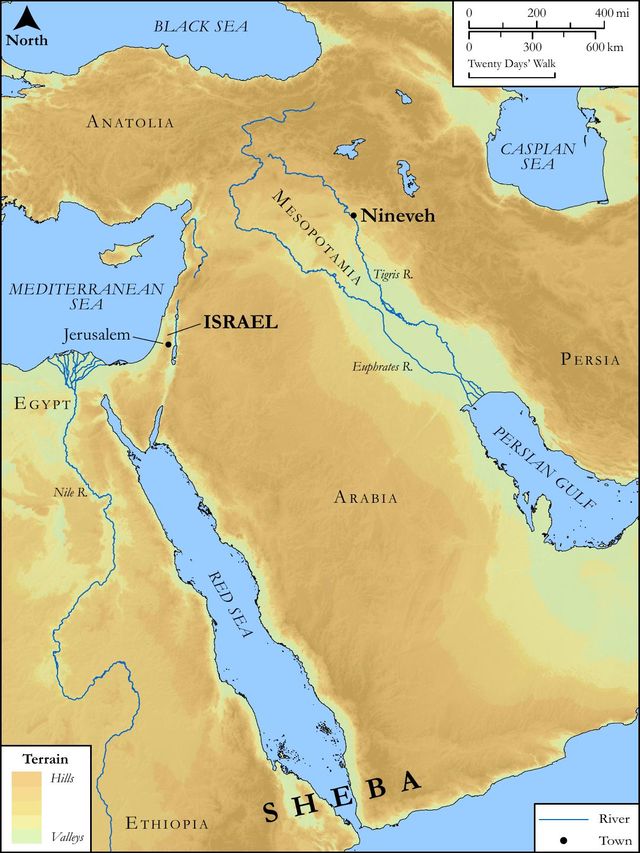
The Queen of the South is historically identified as the Queen of Sheba, whose visit to King Solomon is meticulously recorded in 1 Kings 10:1-13 and 2 Chronicles 9:1-12. Sheba was an ancient kingdom located in what is modern-day Yemen and possibly parts of Ethiopia, a considerable distance from Israel. Her journey involved traversing vast deserts and difficult terrain, signifying immense dedication and expense. Solomon's wisdom was legendary throughout the ancient Near East, attracting rulers and scholars from afar. The cultural expectation was that a king's wisdom reflected divine favor, and Solomon's was seen as unparalleled (1 Kings 4:29-34). Jesus' audience, being Jewish, would have been intimately familiar with the story of Solomon and the Queen of Sheba, making His comparison particularly potent. The irony is that while a distant Gentile queen undertook such an arduous journey to seek wisdom, the Jewish leaders, who possessed the Law and Prophets and had God's incarnate wisdom among them, remained stubbornly skeptical.
Key Themes
ShowHideThis verse powerfully contributes to several key themes within Matthew's Gospel and broader biblical theology. Firstly, it highlights the theme of divine judgment and accountability, emphasizing that those who reject God's revelation, especially when presented clearly, will face condemnation. The Queen of Sheba's example serves as a witness against the unbelieving generation, underscoring the principle that even Gentiles who earnestly seek truth will stand in judgment against those who had greater light but rejected it. Secondly, it reinforces the theme of Jesus' unparalleled supremacy and divine authority. By declaring Himself "greater than Solomon," Jesus asserts His unique identity as the ultimate source of wisdom, truth, and divine revelation, far surpassing any Old Testament figure, no matter how great. This builds upon earlier declarations of His authority over the Sabbath (Matthew 12:8) and His role as the fulfillment of prophecy. Thirdly, the verse touches on the theme of spiritual blindness and hardness of heart, contrasting the open-minded, seeking spirit of the Queen of Sheba with the closed-minded, demanding attitude of the Pharisees, who were more concerned with external signs than internal spiritual truth. This theme is pervasive throughout Jesus' ministry, as He frequently laments the spiritual dullness of those who should have recognized Him (Matthew 13:13-15).
Exposition and Analysis
ShowHideKey Word Analysis
ShowHideThis word refers to a specific age or period, as well as the people living within that time. In this context, Jesus uses it to refer to the contemporary Jewish population, particularly the religious leaders, who were witnessing His ministry firsthand. It implies a collective identity and a shared responsibility for their response to God's revelation in Christ.
This verb means to waken, rouse, or raise up. Here, it is used in the context of the Queen of the South "rising up" in judgment. It suggests an active participation in the divine courtroom, where her actions will stand as a testimony or witness against the unbelieving generation, effectively "rousing" them to accountability.
This word means to judge against or sentence. The Queen of the South will not merely testify but will actively "condemn" this generation. Her earnest seeking and recognition of Solomon's wisdom, despite her Gentile status and the great distance, will serve as a definitive verdict against those who, with far greater access to divine wisdom in Jesus, remained in unbelief.
This is the comparative form of "much" or "many," meaning "more in quantity, number, or quality." When Jesus says "a greater than Solomon," it signifies not just a qualitative superiority but an overwhelming fullness and abundance of wisdom, authority, and divine presence in Himself that far surpasses anything Solomon possessed. It underscores His unique, unparalleled status.
Verse Breakdown
ShowHide"The queen of the south shall rise up in the judgment with this generation, and shall condemn it:"
Jesus declares that the Queen of Sheba, a Gentile ruler, will serve as a witness and even a judge against the Jewish generation of His time at the final judgment. Her earnest seeking of wisdom, despite her pagan background and the immense effort required, stands in stark contrast to the spiritual apathy and rejection displayed by those who had the Son of God in their midst. Her actions will demonstrate their inexcusable unbelief.
"for she came from the uttermost parts of the earth to hear the wisdom of Solomon;"
This clause provides the justification for the Queen's condemning role. It emphasizes the extraordinary lengths she went to—traveling from the most distant known regions—driven by a genuine hunger for truth and wisdom. Her journey underscores her humility and open-mindedness, qualities conspicuously absent in Jesus's critics.
"and, behold, a greater than Solomon [is] here."
This is the climactic declaration, revealing the profound irony and the ultimate reason for the generation's condemnation. Solomon was the epitome of human wisdom, blessed by God. Yet, Jesus asserts His own absolute supremacy, declaring that He embodies a wisdom and authority infinitely superior to Solomon's. The generation's failure to recognize and respond to the presence of God incarnate, the ultimate source of all wisdom, despite His miracles and teachings, seals their fate. The exclamation "behold" (Greek, idoú) draws immediate attention to the astonishing reality of Jesus's presence.
Literary Devices
ShowHideThe verse employs several powerful literary devices. Contrast is central, setting the diligent, seeking faith of the Queen of Sheba against the hardened, demanding unbelief of Jesus's contemporary Jewish generation. This highlights the spiritual blindness of those who should have known better. Allusion is used through the direct reference to the Queen of Sheba and King Solomon, drawing upon a well-known biblical narrative to establish a powerful historical precedent and moral comparison. The phrase "a greater than Solomon" functions as a form of hyperbole or meiosis (understatement) in reverse, where Jesus asserts His unparalleled divine nature and authority in a way that transcends mere human greatness. It is also a form of self-proclamation, subtly but profoundly revealing His identity. Finally, the entire statement carries a strong sense of irony, as a Gentile queen, historically revered for seeking wisdom, is presented as the one who will expose the spiritual folly of God's chosen people who reject their Messiah.
Theological and Thematic Connections
ShowHideMatthew 12:42 profoundly underscores the theme of accountability for divine revelation. The Queen of Sheba, a Gentile, traveled great distances to hear the wisdom of Solomon, demonstrating a commendable hunger for truth. Her earnestness stands as a stark indictment against the Jewish generation of Jesus's time, who had the very embodiment of God's wisdom—Jesus Christ—in their midst, yet rejected Him. This highlights the principle that spiritual privilege brings greater responsibility; those who are given much light will be held to a higher standard in judgment. The verse also powerfully asserts Jesus's divine supremacy, positioning Him not merely as a prophet or wise teacher, but as the ultimate manifestation of God's wisdom and authority, far exceeding any human figure, including the revered King Solomon. This claim is foundational to Christology, affirming His unique status as God incarnate.
Reflection and Application
ShowHideThis verse serves as a profound mirror for self-reflection, challenging us to honestly assess the earnestness of our own spiritual seeking. Are we like the Queen of Sheba, willing to go to great lengths and overcome obstacles to encounter divine wisdom, or are we akin to the generation that rejected Jesus, demanding more signs while ignoring the profound evidence of God's presence right before them? In an age saturated with information, it's easy to become spiritually complacent, treating God's truth as one option among many, rather than the ultimate, life-giving source of all wisdom. We are called to cultivate a heart that hungers for Christ, recognizing that in Him are "hidden all the treasures of wisdom and knowledge" (Colossians 2:3). Our response to Jesus determines our eternal standing; His presence is the ultimate sign, and our acceptance or rejection of Him carries eternal consequences. This passage reminds us that genuine faith is demonstrated by a humble, earnest pursuit of God's truth, not by demanding further proof or clinging to skepticism.
Questions for Reflection
ShowHideFAQ
ShowHideWhat does "the queen of the south" refer to, and why is she important?
ShowHide"The queen of the south" refers to the Queen of Sheba, whose historical visit to King Solomon is recorded in 1 Kings 10 and 2 Chronicles 9. She was a distant Gentile ruler who traveled an immense distance to hear Solomon's renowned wisdom, demonstrating an extraordinary hunger for truth and understanding. Jesus highlights her as a crucial figure because her earnest seeking and recognition of Solomon's wisdom will stand in stark contrast to, and ultimately condemn, the unbelief of His own generation, who had the ultimate source of wisdom—Jesus Himself—in their midst but rejected Him. Her example underscores that genuine seeking, even from an outsider, is more commendable than privileged indifference.
How is Jesus "greater than Solomon"?
ShowHideSolomon was celebrated for his unparalleled wisdom, wealth, and understanding, which were gifts from God (1 Kings 4:29-34). However, Jesus declares Himself "greater than Solomon" in several profound ways. Solomon's wisdom was a finite, human wisdom, albeit divinely granted; Jesus is the very incarnation of divine wisdom (1 Corinthians 1:30). Solomon's kingdom was earthly and temporary; Jesus's kingdom is eternal and spiritual (Luke 1:33). Solomon's glory was a reflection of God's blessing; Jesus is the radiance of God's glory and the exact imprint of His nature (Hebrews 1:3). Solomon was a fallible man who eventually strayed; Jesus is perfect and sinless (Hebrews 4:15). Ultimately, Jesus is greater because He is God Himself, the source of all wisdom and truth, while Solomon was merely a recipient.
Christ-Centered Fulfillment
ShowHideMatthew 12:42 finds its ultimate Christ-centered fulfillment in Jesus's identity as the embodiment of God's wisdom and the final revelation of His truth. The Queen of Sheba's arduous journey to seek Solomon's earthly wisdom foreshadows the spiritual pilgrimage believers undertake to find true wisdom in Christ. Solomon's wisdom, though divinely given, was but a shadow of the perfect, inexhaustible wisdom found in Jesus, who is Himself "the power of God and the wisdom of God" (1 Corinthians 1:24). The condemnation of "this generation" by the Queen of the South highlights the profound tragedy of rejecting the incarnate Word, the very light of the world (John 1:9). In Christ, all the treasures of wisdom and knowledge are hidden (Colossians 2:3), making Him the ultimate object of our spiritual pursuit. His presence among humanity was the greatest sign God could offer, fulfilling the Old Testament longing for divine wisdom and demonstrating that God's ultimate revelation is not in a king or a prophet, but in His Son, through whom all things were created and sustained (Colossians 1:15-17). Thus, the verse powerfully proclaims Jesus's unique and supreme authority as the one who perfectly reveals God and offers true, eternal wisdom to all who seek Him.