


2 Chronicles 9:1
Bible text: King James Version (1769 Blayney text) · Public domain
Bible text: King James Version with Strong's numbers · Public domain
Bible text: Berean Standard Bible · Public domain
Bible text: American Standard Version (1901) · Public domain
Bible text: World English Bible, Messianic edition · Public domain
Bible text: Geneva Bible (1599) · Public domain
Bible text: Young's Literal Translation · Public domain
- וּמַלְכַּתu·mal·katand [the] queen ofH4436Conj-w ¦ N-fscNoun Title Singular Feminine Constructוּandמַלְכַּת[the] queen of
- שְׁבָאshe·Va'ShebaH7614N-properNoun Proper Location
- שָׁמְעָהsha·me·'Ahshe heardH8085V-Qal-Perf-3fsVerb Qal Perfect 3rd Singular Feminine
- אֶת'et<obj.>H853DirObjMParticle Object Indicator
- שֵׁמַעShe·ma'[the] report ofH8088N-mscNoun Singular Masculine Construct
- שְׁלֹמֹהshe·lo·MohSolomonH8010N-proper-mNoun Proper Masculine
- וַתָּבוֹאva·ta·Vo'and she cameH935Conj-w ¦ V-Qal-ConsecImperf-3fsVerb Qal Consecutive Imperfect 3rd Singular Feminineוַandתָּבוֹאshe came
- לְנַסּוֹתle·na·sOtto put to [the] testH5254Prep-l ¦ V-Piel-InfVerb Piel Infinitive Constructלְtoנַסּוֹתput to [the] test
- אֶת'et<obj.>H853DirObjMParticle Object Indicator
- שְׁלֹמֹהshe·lo·MohSolomonH8010N-proper-mNoun Proper Masculine
- בְחִידוֹתve·chi·Dotby difficult mattersH2420Prep-b ¦ N-fpNoun Plural Feminine Absoluteבְbyחִידוֹתdifficult matters
- בִּירוּשָׁלִַםbi·ru·sha·Limin JerusalemH3389Prep-b ¦ N-properNoun Proper LocationבִּinירוּשָׁלִַםJerusalem
- בְּחַיִלbe·Cha·yilwith a retinueH2428Prep-b ¦ N-msNoun Singular Masculine Absoluteבְּwithחַיִלa retinue
- כָּבֵדka·VednumerousH3515Adj-msAdjective Singular Masculine Absolute
- מְאֹדme·'OdveryH3966Adj-msAdjective Numerical Singular Masculine Absolute
- וּגְמַלִּיםU·ge·ma·limand camelsH1581Conj-w ¦ N-cpNoun Plural common gender Absoluteוּandגְמַלִּיםcamels
- נֹשְׂאִיםno·se·'ImcarryingH5375V-Qal-Prtcpl-mpVerb Qal Participle Plural Masculine Absolute
- בְּשָׂמִיםbe·sa·MimspicesH1314N-mpNoun Plural Masculine Absolute
- וְזָהָבve·za·Havand goldH2091Conj-w ¦ N-msNoun Singular Masculine Absoluteוְandזָהָבgold
- לָרֹבla·Roto abundanceH7230Prep-l ¦ N-msNoun Singular Masculine Absoluteלָtoרֹבabundance
- וְאֶבֶןve·'E·venand stone[s]H68Conj-w ¦ N-fsNoun Singular Feminine Absoluteוְandאֶבֶןstone[s]
- יְקָרָהye·ka·RahpreciousH3368Adj-fsAdjective Singular Feminine Absolute
- וַתָּבוֹאva·ta·Vo'and she cameH935Conj-w ¦ V-Qal-ConsecImperf-3fsVerb Qal Consecutive Imperfect 3rd Singular Feminineוַandתָּבוֹאshe came
- אֶל'eltoH413PrepPreposition
- שְׁלֹמֹהshe·lo·MohSolomonH8010N-proper-mNoun Proper Masculine
- וַתְּדַבֵּרva·te·da·Berand she spokeH1696Conj-w ¦ V-Piel-ConsecImperf-3fsVerb Piel Consecutive Imperfect 3rd Singular Feminineוַandתְּדַבֵּרshe spoke
- עִמּוֹi·Mowith himH5973Prep ¦ 3msPrepositionעִמּwithוֹhim
- אֵת'et<obj.>H853DirObjMParticle Object Indicator
- כָּלkolallH3605N-msNoun Singular Masculine Absolute
- אֲשֶׁר'a·SherthatH834RelParticle Relative
- הָיָהha·Yahit wasH1961V-Qal-Perf-3msVerb Qal Perfect 3rd Singular Masculine
- עִם'imwithH5973PrepPreposition
- לְבָבָהּle·va·Vahher heartH3824N-msc ¦ 3fsNoun Singular Masculine Constructלְבָבָheartהּher
English is a literal word-by-word gloss of the Hebrew, not the KJV's wording. Why?
This is the original text the KJV's translators worked from — each Hebrew word with its own literal English meaning in this verse, prepared by scholars at Tyndale House, Cambridge. The KJV translates whole sentences, not word by word, so its wording differs: one Hebrew word can become several English words, and the KJV may choose “the LORD” where the gloss reads “Yahweh”. Both are faithful — they answer different questions. For the KJV's own rendering, switch to the KJV text.
Details
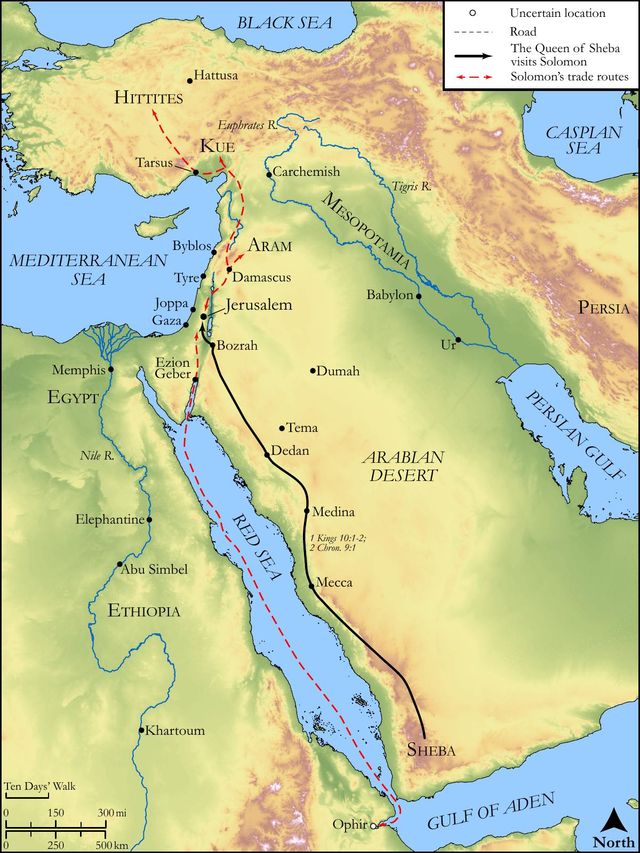
See on the biblical-era map
Study this verse
Public-domain commentary
Matthew Henry
From his Commentary on the Whole Bible. Henry comments on passages, not single verses — this entry covers 2 Chronicles 9:1–12.
This passage of story had been largely considered in the Kings; yet, because our Saviour has proposed it as an example to us in our enquiries after him (Mat 12:42), we must not pass it over without observing briefly, 1. Those who honour God he will honour, Sa1 2:30. Solomon had greatly honoured God, in building, beautifying, and dedicating the temple; all his wisdom and all his wealth were employed for the making of that a consummate piece: and now God made his wisdom and wealth to redound greatly to his reputation. The way to have both the credit and comfort of all our endowments and all our enjoyments is to consecrate them to God and use them for him. 2. Those who know the worth of true wisdom will grudge no pains nor cost to obtain it. The queen of Sheba put herself to a great deal of trouble and expense to hear the wisdom of Solomon; and yet, learning from him to serve God and do her duty, she thought herself well paid for her pains. Heavenly wisdom is that pearl of great price which is a good bargain to purchase by parting with all that we have. 3. As every man has received the gift so he ought to minister the same for the edification of others, as he has opportunity. Solomon was communicative of his wisdom and willing to teach others what he knew himself. Being taught of God, freely he had received, and freely he gave. Let those that are rich in wisdom, as well as wealth, learn to do good and be ready to distribute. Give to every one that asketh. 4. Good order in a family, a great family, especially in the things of God, and a regular discharge of the duties of religious worship, are highly expedient, and to be much admired wherever found. The queen of Sheba was exceedingly affected to see the propriety with which Solomon's servants attended him and with which both he and they attended in the house of God. David's ascent to the house of the Lord was also pleasant and interesting, Psa 42:4. 5. Those are happy who have the opportunity of a constant converse with such as are knowing, wise, and good. The queen of Sheba thought Solomon's servants happy who continually heard his wisdom; for, it seems, even to them he was communicative. And it is observable that the posterity of those who had places in his court were willing to have the names of their ancestors forgotten, and thought themselves sufficiently distinguished and dignified when they were called the children of Solomon's servants (Ezr 2:55; Neh 7:57); so eminent were they that it was honour enough to be named from them. 6. We ought to rejoice and give God thanks for the gifts, graces, and usefulness, of others. The queen of Sheba blessed God for the honour he put upon Solomon, and the favour he did to Israel, in advancing him to the throne, Ch2 9:8. By giving God the praise of the prosperity of others, we share in the comfort of it; whereas, by envying the prosperity of others, we lose the comfort even of our own. The happiness of both king and kingdom she traces up to the fountain of all bliss, the divine favour: it was because thy God delighted in thee and because he loved Israel. Those mercies are doubly sweet in which we can taste the kindness and good will of God as our God. 7. It becomes those that are wise and good to be generous according to their place and power. The queen of Sheba was so to Solomon, Solomon was so to her, Ch2 9:9, Ch2 9:12. They both knew how to value wisdom, and therefore were neither of them covetous of their money, but cultivated the acquaintance and confirmed the friendship they had contracted by mutual presents. Our Lord Jesus has promised to give us all our desire: Ask, and it shall be given you. Let us study what we shall render to him, and not think any thing too much to do, or suffer, or part with, for him.
Continue studying 2 Chronicles 9:1 across the web’s major study libraries — every link below opens this exact verse, chapter, or book on the destination site.
Read & Compare
 BibleGatewayThis verse in more than 200 translations and 70 languages.
 Bible.comThe YouVersion reader — hundreds of translations, reading plans, and highlights.
 ESV.orgCrossway's official English Standard Version reader.
 NET BibleThe NET translation with 60,000+ translators' notes on every rendering decision.
 STEP BibleTyndale House's free study tool — original text, vocabulary, and scholarly resources.
 BibliaLogos Bible Software's free web reader.
 USCCBThe New American Bible (Revised Edition) with the U.S. bishops' study notes.
Commentaries
 BibleHub CommentariesDozens of classic commentaries on this verse, gathered on one page.
 StudyLightMore than 100 commentary sets — the largest collection on the web.
 BibleRefPlain-English commentary on what this verse means, verse by verse.
 Enduring WordDavid Guzik's free commentary on this chapter, widely used by Bible teachers.
 Bible Study ToolsVerse commentary alongside Greek and Hebrew study aids.
Original Language & Research
- BibleHub InterlinearThe verse word by word — original language, transliteration, and English.
- BibleHub LexiconEvery word's original-language definition and Strong's entry.
 Blue Letter BibleDeep-study tools — Strong's numbers, concordance, and word studies.
 SefariaThe Hebrew text with Rashi and centuries of Jewish commentary.
Sermons, Hymns & Audio


TrulyRandomVerse is not affiliated with these sites and doesn’t control their content. They’re linked because they’re genuinely useful.
Summary
The opening verse of 2 Chronicles 9 introduces the momentous visit of the Queen of Sheba to King Solomon in Jerusalem. Driven by the widespread fame of Solomon's divinely bestowed wisdom and unparalleled prosperity, she embarked on a significant journey, accompanied by a lavish retinue bearing vast quantities of spices, gold, and precious stones. Her primary intent was to "prove" Solomon, presenting him with challenging questions and engaging in deep, open dialogue about all that was on her heart, thereby validating the global recognition of God's extraordinary blessing upon the Israelite king.
Context
ShowHideLiterary Context
This verse serves as a climactic moment in the narrative of Solomon's reign, following extensive descriptions of his immense wealth, the construction and dedication of the magnificent Temple, and the establishment of his glorious kingdom (chapters 1-8). The preceding chapters detail God's covenant with Solomon and His promise to bless him with wisdom and riches if he remained faithful. The Queen of Sheba's visit, also recounted in 1 Kings 10:1-13, provides external validation of the international impact and recognition of God's favor upon Solomon, demonstrating that the fame of Israel's God had spread far beyond its borders. It highlights the fulfillment of God's promise to make Solomon's kingdom renowned.
Historical & Cultural Context
The Queen of Sheba likely ruled a prosperous kingdom in ancient South Arabia (modern-day Yemen) or possibly Ethiopia, a region renowned for its trade in exotic spices, frankincense, myrrh, and gold. Her journey to Jerusalem would have been a formidable undertaking, traversing vast desert landscapes, underscoring the extraordinary nature of her motivation. Among the kings of that day, diplomatic visits often involved the exchange of lavish gifts and the testing of a ruler's wisdom through riddles or difficult questions, a common intellectual pastime among royalty. Her "proving" of Solomon was not necessarily hostile but a genuine inquiry to ascertain the depth and truth of his renowned wisdom, a crucial aspect of a king's reputation and legitimacy.
Key Themes
ShowHideThis verse powerfully underscores several key themes central to the book of Chronicles. Foremost is the theme of Divine Wisdom Recognized, emphasizing that Solomon's extraordinary insight was a direct gift from God, as requested in 2 Chronicles 1:10. The Queen's arduous journey from a distant land to test this wisdom validates its supernatural origin and widespread acknowledgment. Another prominent theme is God's Blessing and Prosperity, evident in the lavish gifts brought by the Queen and the reciprocal generosity of Solomon, showcasing the abundance bestowed upon Israel. This event also highlights the International Recognition of Israel's God, as the Queen's visit ultimately leads her to praise the Lord God of Israel in 2 Chronicles 9:8. Finally, the Queen's "hard questions" introduce the theme of Seeking Truth and Understanding, portraying her as a diligent seeker of profound insight.
Exposition and Analysis
ShowHideKey Word Analysis
ShowHideThis word denotes a report, rumor, or reputation. Here, it signifies the widespread renown and recognition of Solomon's wisdom and wealth that had reached distant lands. It implies not just a casual hearing but a significant, compelling report that motivated a royal visit. This "fame" was ultimately a reflection of God's blessing upon Solomon, drawing attention to the God of Israel.
While "prove" can sometimes carry a negative connotation of testing with malicious intent, in this context, it signifies a genuine desire to ascertain the truth or measure the extent of Solomon's wisdom. It implies a rigorous examination, a putting to the test, to confirm the extraordinary claims she had heard. It was a quest for verification, not merely a casual inquiry.
This term refers to a puzzle, conundrum, sententious maxim, dark saying, or riddle. These were not simple inquiries but intellectual and philosophical challenges designed to probe the depths of one's understanding, insight, and discernment. The Queen's use of chîydâh indicates her intent to truly test the limits of Solomon's renowned wisdom, seeking profound answers to complex matters of life, governance, or even spiritual truth.
Verse Breakdown
ShowHide"And when the queen of Sheba heard of the fame of Solomon"
This opening clause establishes the catalyst for the entire encounter. Solomon's reputation, specifically his renowned wisdom and prosperity, had spread globally, reaching the distant kingdom of Sheba. This highlights the powerful impact of God's blessing on Solomon, which transcended geographical and cultural boundaries.
"she came to prove Solomon with hard questions at Jerusalem"
This reveals her explicit purpose and destination. Her journey was not merely a diplomatic courtesy but a deliberate quest to personally verify the extraordinary reports about Solomon's wisdom. The "hard questions" signify her intent to rigorously test the depth of his understanding, seeking profound insights rather than superficial answers. Jerusalem, as the capital and the site of the Temple, was the natural destination for such an inquiry.
"with a very great company, and camels that bare spices, and gold in abundance, and precious stones"
This clause vividly describes the lavishness of her expedition, indicative of her own immense wealth and the customary grandeur of ancient diplomatic exchanges. The "very great company" speaks to her royal status and the importance of the mission, while the specific mention of "spices, and gold in abundance, and precious stones" highlights the valuable commodities of her kingdom and the magnitude of the tribute she brought, underscoring the prosperity of both kingdoms.
"and when she was come to Solomon, she communed with him of all that was in her heart"
This concluding phrase emphasizes the depth and openness of their interaction. "Communed" (from the Hebrew dâbar, "to speak") suggests a profound and unreserved dialogue. The phrase "all that was in her heart" indicates that she felt free to share her deepest inquiries, concerns, and perhaps even spiritual yearnings with Solomon, trusting in his wisdom to provide answers and understanding.
Literary Devices
ShowHideThe verse employs several literary devices to convey its significance. Hyperbole is evident in the description of her retinue and gifts: "a very great company, and camels that bare spices, and gold in abundance, and precious stones." While likely true to a degree, the language emphasizes the extraordinary scale and opulence of the visit, magnifying Solomon's fame and the wealth drawn to him. Symbolism is also present; the lavish gifts brought by the Queen symbolize the wealth and homage of the nations being drawn to Jerusalem and to Solomon's wisdom, which ultimately points to the God of Israel. This foreshadows a future time when nations would come to worship the true God. The narrative structure itself uses Anticipation by building up to the encounter, having first established Solomon's unparalleled wisdom and wealth, making the Queen's arrival the natural, anticipated consequence of his renown.
Theological and Thematic Connections
ShowHideThe Queen of Sheba's visit is a profound theological statement. It demonstrates that God's blessing upon Solomon, particularly his extraordinary wisdom, was not merely for Israel's internal benefit but was intended to extend its influence globally. This event serves as a tangible fulfillment of God's promise to make Solomon's name great and to establish his kingdom. The Queen's arduous journey, driven by a desire to seek and verify wisdom, underscores the magnetic power of divine truth and insight. Her coming from a distant, gentile land to acknowledge and ultimately praise the God of Israel (as seen later in the chapter) illustrates God's universal plan of salvation, hinting at the future ingathering of the nations to worship Him. Solomon, in his wisdom and glory, becomes a type of the ultimate King whose fame would draw all peoples.
Reflection and Application
ShowHideThe account of the Queen of Sheba's visit offers a rich tapestry for reflection on the nature of divine wisdom and its impact. Her diligent pursuit of truth, traveling great distances and bringing her deepest questions to Solomon, challenges us to consider our own earnestness in seeking wisdom. Are we willing to invest time, effort, and resources to uncover profound truths, especially those found in God's Word? The magnetic quality of Solomon's God-given wisdom suggests that true, Spirit-led insight has an undeniable attractiveness; it draws people seeking answers, meaning, and purpose. Our lives, when lived in alignment with God's wisdom and blessed by His hand, can become a testimony that prompts others to inquire about the source of our strength, peace, or insight. Furthermore, the Queen's openness to "commune with him of all that was in her heart" encourages us to approach God with complete transparency, bringing our "hard questions" and deepest concerns before Him, trusting in His infinite wisdom to provide clarity and guidance.
Questions for Reflection
ShowHideFAQ
ShowHideWho was the Queen of Sheba?
ShowHideThe Queen of Sheba was the ruler of an ancient kingdom, most likely located in modern-day Yemen or possibly Ethiopia, a region renowned for its wealth in spices, gold, and other precious commodities. Her visit to Solomon, as recorded in both 2 Chronicles 9 and 1 Kings 10, confirms her status as a powerful and influential monarch whose kingdom engaged in extensive trade and diplomacy with other ancient powers.
What were "hard questions"?
ShowHideThe Hebrew term for "hard questions" (chîydâh) refers to riddles, enigmas, or perplexing sayings. These were not simple inquiries but profound intellectual, philosophical, or perhaps even spiritual challenges designed to test the depth of Solomon's wisdom and insight. The Queen's intent was to truly "prove" him, to ascertain if his renowned wisdom was as extraordinary as the reports suggested, indicating a genuine search for profound understanding.
Why is her visit significant?
ShowHideHer visit is highly significant for several reasons. First, it validates the divine origin of Solomon's wisdom, demonstrating its global recognition and impact. Second, it showcases the immense prosperity and international standing of Solomon's kingdom, which was a direct result of God's blessing. Third, it foreshadows the future ingathering of the nations, as a gentile queen from a distant land comes to Jerusalem to seek wisdom and ultimately praises the Lord God of Israel (2 Chronicles 9:8). Her journey is cited by Jesus Himself in Matthew 12:42, highlighting her diligence in seeking truth.
Christ-Centered Fulfillment
ShowHideThe visit of the Queen of Sheba to Solomon, a testament to his unparalleled wisdom and glory, finds its ultimate and perfect fulfillment in Jesus Christ. Solomon's wisdom, though divinely given, was finite and imperfect; it was a shadow pointing to a greater reality. Jesus declared, "Behold, something greater than Solomon is here" (Matthew 12:42). Christ is not merely wise, but He is the very wisdom of God incarnate, in whom "are hidden all the treasures of wisdom and knowledge" (Colossians 2:3). The Queen of Sheba's arduous journey from the ends of the earth to seek truth from Solomon beautifully foreshadows the coming of all nations to Christ, the true King of kings, to find ultimate wisdom, salvation, and the answers to life's deepest "hard questions." Just as Solomon's fame drew people, the Gospel of Christ, the power of God and the wisdom of God (1 Corinthians 1:24), draws people from every tribe and tongue to worship Him and receive His inexhaustible riches.