


2 Chronicles 9:9
Bible text: King James Version (1769 Blayney text) · Public domain
Bible text: King James Version with Strong's numbers · Public domain
Bible text: Berean Standard Bible · Public domain
Bible text: American Standard Version (1901) · Public domain
Bible text: World English Bible, Messianic edition · Public domain
Bible text: Geneva Bible (1599) · Public domain
Bible text: Young's Literal Translation · Public domain
- וַתִּתֵּןva·ti·Tenand she gaveH5414Conj-w ¦ V-Qal-ConsecImperf-3fsVerb Qal Consecutive Imperfect 3rd Singular Feminineוַandתִּתֵּןshe gave
- לַמֶּלֶךְla·Me·lekhto the kingH4428Prep-l ¦ N-msNoun Singular Masculine Absoluteלַto theמֶּלֶךְking
- מֵאָהme·'Ahone hundredH3967N-fsNoun Singular Feminine Absolute
- וְעֶשְׂרִיםve·'es·Rimand twentyH6242Conj-w ¦ N-mpNoun Plural Masculine Absoluteוְandעֶשְׂרִיםtwenty
- כִּכַּרki·Kartalent[s] ofH3603N-fscNoun Singular Feminine Construct
- זָהָבza·HavgoldH2091N-msNoun Singular Masculine Absolute
- וּבְשָׂמִיםu·ve·sa·Mimand spicesH1314Conj-w ¦ N-mpNoun Plural Masculine Absoluteוּandבְשָׂמִיםspices
- לָרֹבla·Roto abundanceH7230Prep-l ¦ N-msNoun Singular Masculine Absoluteלָtoרֹבabundance
- מְאֹדme·'OdexceedinglyH3966Adj-msAdjective Numerical Singular Masculine Absolute
- וְאֶבֶןve·'E·venand stone[s]H68Conj-w ¦ N-fsNoun Singular Feminine Absoluteוְandאֶבֶןstone[s]
- יְקָרָהye·ka·RahpreciousH3368Adj-fsAdjective Singular Feminine Absolute
- וְלֹאve·Lo'and notH3808Conj-w ¦ NegParticle Negativeוְandלֹאnot
- הָיָהha·Yahit has beenH1961V-Qal-Perf-3msVerb Qal Perfect 3rd Singular Masculine
- כַּבֹּשֶׂםka·Bo·semlike the spiceH1314Prep-k ¦ N-msNoun Singular Masculine Absoluteכַּlike theבֹּשֶׂםspice
- הַהוּאha·Hu'<the> thatH1931Art ¦ Pro-3msPronoun Personal 3rd Singular Masculineהַ<the>הוּאthat
- אֲשֶׁר'a·SherwhichH834RelParticle Relative
- נָתְנָהna·te·Nahshe gaveH5414V-Qal-Perf-3fsVerb Qal Perfect 3rd Singular Feminine
- מַלְכַּתmal·kat[the] queen ofH4436N-fscNoun Title Singular Feminine Construct
- שְׁבָאshe·Va'ShebaH7614N-properNoun Proper Location
- לַמֶּלֶךְla·Me·lekhto the kingH4428Prep-l ¦ N-msNoun Singular Masculine Absoluteלַto theמֶּלֶךְking
- שְׁלֹמֹהshe·lo·MohSolomonH8010N-proper-mNoun Proper Masculine
English is a literal word-by-word gloss of the Hebrew, not the KJV's wording. Why?
This is the original text the KJV's translators worked from — each Hebrew word with its own literal English meaning in this verse, prepared by scholars at Tyndale House, Cambridge. The KJV translates whole sentences, not word by word, so its wording differs: one Hebrew word can become several English words, and the KJV may choose “the LORD” where the gloss reads “Yahweh”. Both are faithful — they answer different questions. For the KJV's own rendering, switch to the KJV text.
Details
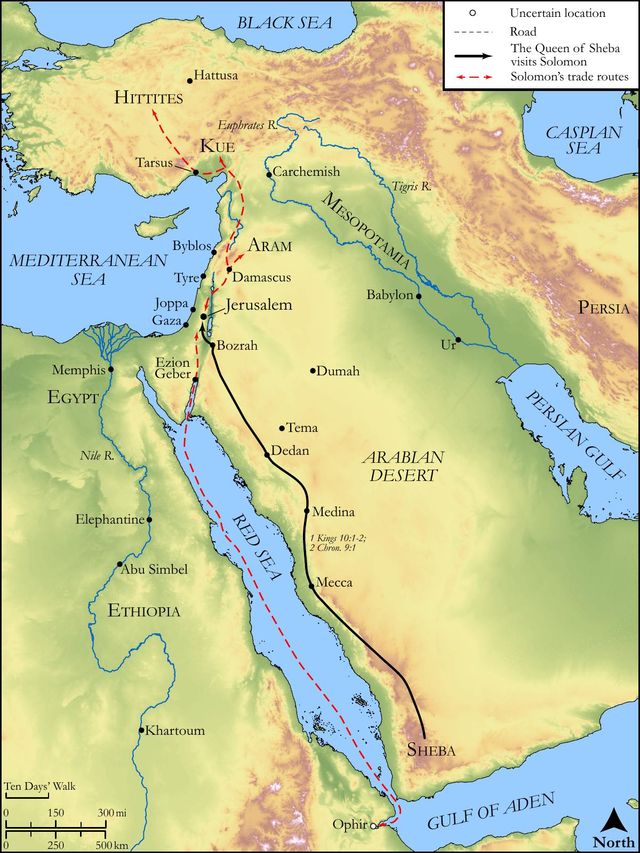
See on the biblical-era map
Study this verse
Public-domain commentary
Matthew Henry
From his Commentary on the Whole Bible. Henry comments on passages, not single verses — this entry covers 2 Chronicles 9:1–12.
This passage of story had been largely considered in the Kings; yet, because our Saviour has proposed it as an example to us in our enquiries after him (Mat 12:42), we must not pass it over without observing briefly, 1. Those who honour God he will honour, Sa1 2:30. Solomon had greatly honoured God, in building, beautifying, and dedicating the temple; all his wisdom and all his wealth were employed for the making of that a consummate piece: and now God made his wisdom and wealth to redound greatly to his reputation. The way to have both the credit and comfort of all our endowments and all our enjoyments is to consecrate them to God and use them for him. 2. Those who know the worth of true wisdom will grudge no pains nor cost to obtain it. The queen of Sheba put herself to a great deal of trouble and expense to hear the wisdom of Solomon; and yet, learning from him to serve God and do her duty, she thought herself well paid for her pains. Heavenly wisdom is that pearl of great price which is a good bargain to purchase by parting with all that we have. 3. As every man has received the gift so he ought to minister the same for the edification of others, as he has opportunity. Solomon was communicative of his wisdom and willing to teach others what he knew himself. Being taught of God, freely he had received, and freely he gave. Let those that are rich in wisdom, as well as wealth, learn to do good and be ready to distribute. Give to every one that asketh. 4. Good order in a family, a great family, especially in the things of God, and a regular discharge of the duties of religious worship, are highly expedient, and to be much admired wherever found. The queen of Sheba was exceedingly affected to see the propriety with which Solomon's servants attended him and with which both he and they attended in the house of God. David's ascent to the house of the Lord was also pleasant and interesting, Psa 42:4. 5. Those are happy who have the opportunity of a constant converse with such as are knowing, wise, and good. The queen of Sheba thought Solomon's servants happy who continually heard his wisdom; for, it seems, even to them he was communicative. And it is observable that the posterity of those who had places in his court were willing to have the names of their ancestors forgotten, and thought themselves sufficiently distinguished and dignified when they were called the children of Solomon's servants (Ezr 2:55; Neh 7:57); so eminent were they that it was honour enough to be named from them. 6. We ought to rejoice and give God thanks for the gifts, graces, and usefulness, of others. The queen of Sheba blessed God for the honour he put upon Solomon, and the favour he did to Israel, in advancing him to the throne, Ch2 9:8. By giving God the praise of the prosperity of others, we share in the comfort of it; whereas, by envying the prosperity of others, we lose the comfort even of our own. The happiness of both king and kingdom she traces up to the fountain of all bliss, the divine favour: it was because thy God delighted in thee and because he loved Israel. Those mercies are doubly sweet in which we can taste the kindness and good will of God as our God. 7. It becomes those that are wise and good to be generous according to their place and power. The queen of Sheba was so to Solomon, Solomon was so to her, Ch2 9:9, Ch2 9:12. They both knew how to value wisdom, and therefore were neither of them covetous of their money, but cultivated the acquaintance and confirmed the friendship they had contracted by mutual presents. Our Lord Jesus has promised to give us all our desire: Ask, and it shall be given you. Let us study what we shall render to him, and not think any thing too much to do, or suffer, or part with, for him.
Continue studying 2 Chronicles 9:9 across the web’s major study libraries — every link below opens this exact verse, chapter, or book on the destination site.
Read & Compare
 BibleGatewayThis verse in more than 200 translations and 70 languages.
 Bible.comThe YouVersion reader — hundreds of translations, reading plans, and highlights.
 ESV.orgCrossway's official English Standard Version reader.
 NET BibleThe NET translation with 60,000+ translators' notes on every rendering decision.
 STEP BibleTyndale House's free study tool — original text, vocabulary, and scholarly resources.
 BibliaLogos Bible Software's free web reader.
 USCCBThe New American Bible (Revised Edition) with the U.S. bishops' study notes.
Commentaries
 BibleHub CommentariesDozens of classic commentaries on this verse, gathered on one page.
 StudyLightMore than 100 commentary sets — the largest collection on the web.
 BibleRefPlain-English commentary on what this verse means, verse by verse.
 Enduring WordDavid Guzik's free commentary on this chapter, widely used by Bible teachers.
 Bible Study ToolsVerse commentary alongside Greek and Hebrew study aids.
Original Language & Research
- BibleHub InterlinearThe verse word by word — original language, transliteration, and English.
- BibleHub LexiconEvery word's original-language definition and Strong's entry.
 Blue Letter BibleDeep-study tools — Strong's numbers, concordance, and word studies.
 SefariaThe Hebrew text with Rashi and centuries of Jewish commentary.
Sermons, Hymns & Audio


TrulyRandomVerse is not affiliated with these sites and doesn’t control their content. They’re linked because they’re genuinely useful.
Summary
2 Chronicles 9:9 meticulously records the unparalleled generosity of the Queen of Sheba, who presented King Solomon with an immense tribute of gold, an abundance of rare spices, and precious stones. This verse highlights the climax of her visit, underscoring not only her profound respect and awe for Solomon's divinely granted wisdom and the splendor of his kingdom but also the extraordinary nature of her offerings, particularly the spices, which were deemed unique and unmatched in their quality and quantity.
Context
ShowHideLiterary Context
This verse is a crucial part of the detailed account of the Queen of Sheba's visit to King Solomon, which spans 2 Chronicles 9:1-12. The Chronicler parallels this narrative with 1 Kings 10:1-13, emphasizing Solomon's extraordinary wisdom and wealth as a direct fulfillment of God's promise in 2 Chronicles 1:12. The queen's visit, and especially her lavish gifts, serve as external validation of Solomon's unparalleled status and the glory of God manifested through him. The verse immediately follows her declaration of Solomon's wisdom and the blessedness of his people, setting the stage for the material expression of her awe and reverence.
Historical & Cultural Context
Among the kings of that day, elaborate diplomatic exchanges were common, where gifts were not merely tokens of goodwill but often reflections of the giver's wealth, the recipient's status, and the nature of the relationship. The Queen of Sheba, likely ruling a prosperous kingdom in modern-day Yemen or Ethiopia, would have commanded significant resources, particularly in valuable commodities like gold, frankincense, and myrrh, which were integral to the lucrative trade routes of the Arabian Peninsula. Her journey to Jerusalem, a considerable undertaking, signifies the widespread renown of Solomon's kingdom. The sheer scale of her gifts, as detailed in this verse, was far beyond typical tribute, indicating a profound impression made by Solomon's wisdom and the visible prosperity of Israel, which was understood as a divine blessing.
Key Themes
ShowHide2 Chronicles 9:9 contributes significantly to several overarching themes in Chronicles. Foremost is the theme of Divine Blessing and Wisdom, where Solomon's unparalleled wealth and wisdom are consistently presented as direct results of God's covenant faithfulness and provision, as promised in 2 Chronicles 1:12. The queen's lavish gifts serve as tangible evidence of this divine favor, demonstrating that God's blessing extends to international recognition. Another key theme is Solomon's Glory and Splendor, which the Chronicler highlights to underscore the ideal state of the kingdom under a righteous king. The uniqueness and abundance of the gifts also point to the theme of Unprecedented Abundance, reflecting the prosperity of Israel under Solomon's reign, a prosperity that exceeded all previous and subsequent kings, as noted in 2 Chronicles 9:22.
Exposition and Analysis
ShowHideKey Word Analysis
ShowHideThis term refers to a significant unit of weight, not a coin, typically estimated at around 75 pounds (approximately 34 kilograms). Thus, "an hundred and twenty talents of gold" represents an astonishing 9,000 pounds (over 4,000 kilograms) of gold. This staggering quantity underscores the immense wealth and generosity of the Queen of Sheba and the extraordinary value of her tribute, far exceeding what would be considered customary diplomatic gifts. It signifies a profound level of respect and awe.
From a root meaning "fragrance," this word refers to highly prized aromatic substances used for incense, perfumes, anointing oils, and medicinal purposes. The phrase "great abundance" (H3966 mᵉʼôd and H7230 rôb) and the subsequent declaration "neither was there any such spice" emphasize their extraordinary quantity, rarity, and exceptional quality. Such spices would have been extremely valuable, often transported over long distances, and their uniqueness suggests a special, perhaps even sacred, significance.
This refers to gemstones of high value and rarity, qualified by the adjective yâqâr (H3368), meaning "valuable" or "costly." While the specific types are not enumerated, their inclusion alongside gold and unique spices further highlights the opulence and preciousness of the queen's gifts. Among the nations of that day, precious stones were often associated with royalty, divine favor, and sometimes even magical or protective properties, adding to the grandeur of Solomon's court.
Verse Breakdown
ShowHide"And she gave the king an hundred and twenty talents of gold"
This clause immediately establishes the immense scale of the queen's generosity. The specific quantity of gold, 120 talents, is a staggering sum, signifying an extraordinary transfer of wealth. It highlights the queen's vast resources and her willingness to bestow such a fortune upon Solomon, acknowledging his superior status and the impression he made upon her.
"and of spices great abundance, and precious stones"
This expands on the nature of the gifts, adding two more categories of highly valuable commodities. The "great abundance" of spices, coupled with the "precious stones," emphasizes the luxurious and exotic nature of her tribute. These items were not just valuable in monetary terms but also in their rarity and the status they conferred, further enhancing the splendor of Solomon's court and underscoring the global recognition of his prosperity.
"neither was there any such spice as the queen of Sheba gave king Solomon"
This final clause provides a powerful qualitative assessment of the spices. The emphatic declaration of their uniqueness ("neither was there any such spice") highlights their unparalleled rarity and exceptional quality. This statement serves to elevate the significance of the gifts beyond mere quantity, underscoring the extraordinary nature of the queen's offering and, by extension, the unparalleled glory of Solomon's reign, which attracted such unique tribute.
Literary Devices
ShowHideThe Chronicler employs several literary devices in 2 Chronicles 9:9 to underscore the magnificence of Solomon's reign and the divine favor upon him. Hyperbole is evident in the phrase "neither was there any such spice," an exaggeration that emphasizes the unprecedented rarity and quality of the queen's gifts. While perhaps not literally true that no such spice ever existed, it powerfully conveys the idea that these were of a caliber never before seen in Jerusalem, magnifying Solomon's splendor. Symbolism is also at play, as the lavish gifts—gold, spices, and precious stones—symbolize the queen's profound respect, the universal recognition of Solomon's wisdom, and the tangible manifestation of God's abundant blessing on Israel. The gifts are not just material wealth but represent the awe inspired by divine wisdom. Furthermore, there is an element of Contrast implied, as the Chronicler implicitly contrasts Solomon's divinely-granted wealth and wisdom with the more limited resources and wisdom of other earthly rulers, thereby elevating Solomon's status as uniquely blessed by God.
Theological and Thematic Connections
ShowHideThe extraordinary tribute from the Queen of Sheba, as detailed in 2 Chronicles 9:9, serves as a powerful testament to God's abundant provision and the far-reaching impact of true, divinely-granted wisdom. It illustrates that when God's people walk in obedience and seek His wisdom, He not only blesses them materially but also grants them honor and recognition even from distant nations. The queen's response of lavish generosity is a natural outflow of her awe at what she perceived as divine wisdom and blessing, mirroring the principle that true worship often involves costly sacrifice and heartfelt giving in response to God's goodness. This narrative reinforces the Chronicler's overarching theme that faithfulness to God leads to prosperity and glory, while also subtly foreshadowing a greater King whose wisdom and glory would draw all nations.
Reflection and Application
ShowHideThe account of the Queen of Sheba's visit and her extraordinary gifts in 2 Chronicles 9:9 invites us to reflect on the nature of true wealth, the source of genuine wisdom, and our own responses to divine revelation. The queen, a powerful and wealthy monarch, was not impressed by Solomon's material possessions alone, but by the profound wisdom she encountered, which she rightly attributed to God. Her lavish generosity was a natural and fitting response to the overwhelming evidence of God's blessing on Solomon. This challenges us to consider what truly impresses us and what we value most. Do we prioritize earthly riches, or do we, like the queen, seek out and appreciate the wisdom that comes from God, recognizing it as infinitely more valuable? Furthermore, her generosity serves as a powerful example of giving in response to receiving. When we encounter the boundless wisdom and grace of God, our natural response should be one of profound gratitude, expressed not only in words but also in our willingness to give generously of our time, talents, and resources for His glory. This verse encourages us to live lives that reflect God's abundant blessing, drawing others to seek the source of our wisdom and prosperity.
Questions for Reflection
ShowHideFAQ
ShowHideWhat was the approximate value of 120 talents of gold in modern terms?
ShowHideWhile a precise modern equivalent is difficult due to fluctuating gold prices and ancient purchasing power, 120 talents of gold was an immense fortune. A single talent was approximately 75 pounds (34 kilograms). Therefore, 120 talents would be about 9,000 pounds (over 4,000 kilograms) of gold. At current market prices (e.g., $2,300 USD per troy ounce, or approx. $74,000 USD per kilogram), this would translate to hundreds of millions of US dollars. This staggering sum highlights the Queen of Sheba's vast wealth and the extraordinary nature of her tribute, signifying a gift of unprecedented scale for that day, further emphasizing Solomon's immense prosperity as described in 2 Chronicles 9:22.
Why were the spices so significant that the text notes "neither was there any such spice"?
ShowHideThe spices were significant for several reasons. First, they were incredibly valuable commodities, used for perfumes, incense in worship, anointing oils, and medicinal purposes, often transported over vast distances. Second, the phrase "neither was there any such spice" emphasizes their unparalleled rarity and exceptional quality. This suggests they were not common trade goods but perhaps unique to her region or specially cultivated, making them an exclusive and highly prized gift. Their uniqueness underscored the extraordinary nature of the entire tribute and added to the exotic and luxurious atmosphere of Solomon's court, further highlighting the global recognition of his kingdom's splendor, which was a direct result of God's blessing on him, as seen throughout 2 Chronicles 9.
Christ-Centered Fulfillment
ShowHideThe glory and wisdom of King Solomon, so magnificently displayed in 2 Chronicles 9:9 and throughout his reign, serve as a profound foreshadowing of the ultimate wisdom and glory found in Jesus Christ. Just as the Queen of Sheba traveled from the ends of the earth to hear Solomon's wisdom and offered him lavish gifts, so too will all nations ultimately be drawn to Christ, who is the very wisdom of God incarnate. Solomon's earthly kingdom, with its unparalleled wealth and international renown, was a type of the spiritual kingdom of God, which is established and ruled by Christ. The precious gifts brought by the queen anticipate the worship and tribute that will be offered to Christ, the true King of Kings, by people from every tribe and nation, as envisioned in passages like Revelation 21:24-26. While Solomon's glory was temporal and ultimately faded due to his unfaithfulness, Christ's glory is eternal and His kingdom will have no end. He is the one of whom a greater wisdom is spoken, for He is the Son of God, infinitely surpassing Solomon in every way, and drawing all who seek true wisdom and life to Himself, not with earthly riches, but with the unsearchable riches of His grace.