


2 Chronicles 9:10
- וְגַםve·gamand alsoH1571Conj-w ¦ AdvAdverbוְandגַםalso
- עַבְדֵי'av·Dei[the] servants ofH5650N-mpcNoun Plural Masculine Construct
- חוּרָםchi·ramHuramH2361N-proper-mNoun Proper Masculine
- וְעַבְדֵיve·'av·Deiand [the] servants ofH5650Conj-w ¦ N-mpcNoun Plural Masculine Constructוְandעַבְדֵי[the] servants of
- שְׁלֹמֹהshe·lo·MohSolomonH8010N-proper-mNoun Proper Masculine
- אֲשֶׁר'a·SherwhoH834RelParticle Relative
- הֵבִיאוּhe·Vi·'uthey broughtH935V-Hiphil-Perf-3cpVerb Hiphil Perfect 3rd Plural common gender
- זָהָבza·HavgoldH2091N-msNoun Singular Masculine Absolute
- מֵאוֹפִירme·'o·Firfrom OphirH211Prep-m ¦ N-properNoun Proper LocationמֵfromאוֹפִירOphir
- הֵבִיאוּhe·Vi·'uthey broughtH935V-Hiphil-Perf-3cpVerb Hiphil Perfect 3rd Plural common gender
- עֲצֵי'a·Tzeiwood<s> ofH6086N-mpcNoun Plural Masculine Construct
- אַלְגּוּמִּים'al·gu·Mimalgum<s>H418N-mpNoun Plural Masculine Absolute
- וְאֶבֶןve·'E·venand stone[s]H68Conj-w ¦ N-fsNoun Singular Feminine Absoluteוְandאֶבֶןstone[s]
- יְקָרָהye·ka·RahpreciousH3368Adj-fsAdjective Singular Feminine Absolute
English is a literal word-by-word gloss of the Hebrew, not the KJV's wording. Why?
This is the original text the KJV's translators worked from — each Hebrew word with its own literal English meaning in this verse, prepared by scholars at Tyndale House, Cambridge. The KJV translates whole sentences, not word by word, so its wording differs: one Hebrew word can become several English words, and the KJV may choose “the LORD” where the gloss reads “Yahweh”. Both are faithful — they answer different questions. For the KJV's own rendering, switch to the KJV text.
Details
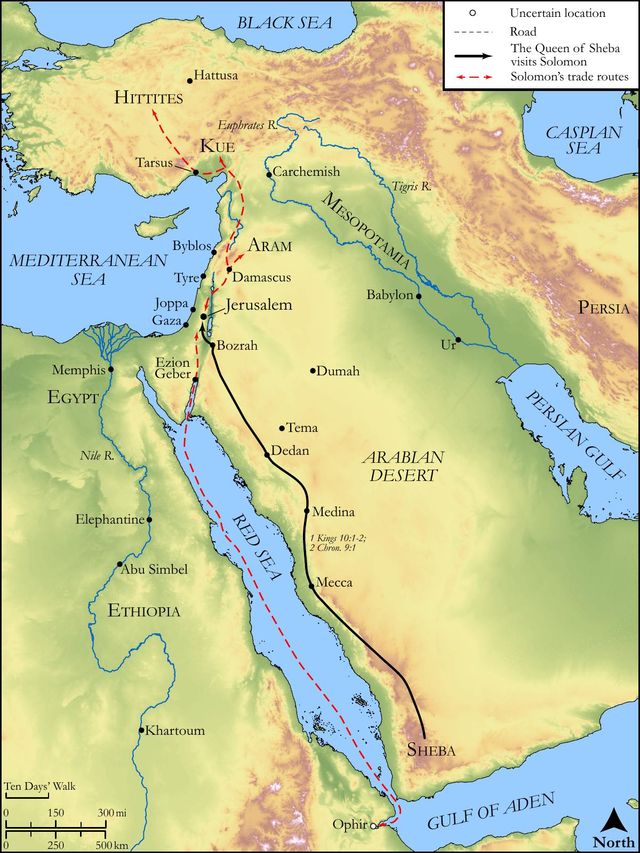
See on the biblical-era map
Study this verse
Public-domain commentary
Matthew Henry
From his Commentary on the Whole Bible. Henry comments on passages, not single verses — this entry covers 2 Chronicles 9:1–12.
This passage of story had been largely considered in the Kings; yet, because our Saviour has proposed it as an example to us in our enquiries after him (Mat 12:42), we must not pass it over without observing briefly, 1. Those who honour God he will honour, Sa1 2:30. Solomon had greatly honoured God, in building, beautifying, and dedicating the temple; all his wisdom and all his wealth were employed for the making of that a consummate piece: and now God made his wisdom and wealth to redound greatly to his reputation. The way to have both the credit and comfort of all our endowments and all our enjoyments is to consecrate them to God and use them for him. 2. Those who know the worth of true wisdom will grudge no pains nor cost to obtain it. The queen of Sheba put herself to a great deal of trouble and expense to hear the wisdom of Solomon; and yet, learning from him to serve God and do her duty, she thought herself well paid for her pains. Heavenly wisdom is that pearl of great price which is a good bargain to purchase by parting with all that we have. 3. As every man has received the gift so he ought to minister the same for the edification of others, as he has opportunity. Solomon was communicative of his wisdom and willing to teach others what he knew himself. Being taught of God, freely he had received, and freely he gave. Let those that are rich in wisdom, as well as wealth, learn to do good and be ready to distribute. Give to every one that asketh. 4. Good order in a family, a great family, especially in the things of God, and a regular discharge of the duties of religious worship, are highly expedient, and to be much admired wherever found. The queen of Sheba was exceedingly affected to see the propriety with which Solomon's servants attended him and with which both he and they attended in the house of God. David's ascent to the house of the Lord was also pleasant and interesting, Psa 42:4. 5. Those are happy who have the opportunity of a constant converse with such as are knowing, wise, and good. The queen of Sheba thought Solomon's servants happy who continually heard his wisdom; for, it seems, even to them he was communicative. And it is observable that the posterity of those who had places in his court were willing to have the names of their ancestors forgotten, and thought themselves sufficiently distinguished and dignified when they were called the children of Solomon's servants (Ezr 2:55; Neh 7:57); so eminent were they that it was honour enough to be named from them. 6. We ought to rejoice and give God thanks for the gifts, graces, and usefulness, of others. The queen of Sheba blessed God for the honour he put upon Solomon, and the favour he did to Israel, in advancing him to the throne, Ch2 9:8. By giving God the praise of the prosperity of others, we share in the comfort of it; whereas, by envying the prosperity of others, we lose the comfort even of our own. The happiness of both king and kingdom she traces up to the fountain of all bliss, the divine favour: it was because thy God delighted in thee and because he loved Israel. Those mercies are doubly sweet in which we can taste the kindness and good will of God as our God. 7. It becomes those that are wise and good to be generous according to their place and power. The queen of Sheba was so to Solomon, Solomon was so to her, Ch2 9:9, Ch2 9:12. They both knew how to value wisdom, and therefore were neither of them covetous of their money, but cultivated the acquaintance and confirmed the friendship they had contracted by mutual presents. Our Lord Jesus has promised to give us all our desire: Ask, and it shall be given you. Let us study what we shall render to him, and not think any thing too much to do, or suffer, or part with, for him.
Continue studying 2 Chronicles 9:10 across the web’s major study libraries — every link below opens this exact verse, chapter, or book on the destination site.
Read & Compare
 BibleGatewayThis verse in more than 200 translations and 70 languages.
 Bible.comThe YouVersion reader — hundreds of translations, reading plans, and highlights.
 ESV.orgCrossway's official English Standard Version reader.
 NET BibleThe NET translation with 60,000+ translators' notes on every rendering decision.
 STEP BibleTyndale House's free study tool — original text, vocabulary, and scholarly resources.
 BibliaLogos Bible Software's free web reader.
 USCCBThe New American Bible (Revised Edition) with the U.S. bishops' study notes.
Commentaries
 BibleHub CommentariesDozens of classic commentaries on this verse, gathered on one page.
 StudyLightMore than 100 commentary sets — the largest collection on the web.
 BibleRefPlain-English commentary on what this verse means, verse by verse.
 Enduring WordDavid Guzik's free commentary on this chapter, widely used by Bible teachers.
 Bible Study ToolsVerse commentary alongside Greek and Hebrew study aids.
Original Language & Research
- BibleHub InterlinearThe verse word by word — original language, transliteration, and English.
- BibleHub LexiconEvery word's original-language definition and Strong's entry.
 Blue Letter BibleDeep-study tools — Strong's numbers, concordance, and word studies.
 SefariaThe Hebrew text with Rashi and centuries of Jewish commentary.
Sermons, Hymns & Audio


TrulyRandomVerse is not affiliated with these sites and doesn’t control their content. They’re linked because they’re genuinely useful.
Summary
Second Chronicles 9:10 meticulously details the ongoing maritime trade ventures orchestrated jointly by the servants of King Huram of Tyre and King Solomon. These expeditions, which embarked from the renowned land of Ophir, were not solely responsible for the vast quantities of gold previously noted, but also introduced highly coveted algum trees and precious stones into Solomon's realm. This verse powerfully underscores the extensive reach of Solomon's international trade networks and highlights the divine abundance that facilitated his magnificent building endeavors and the unparalleled splendor of his kingdom.
Context
ShowHideLiterary Context
This verse is strategically placed within the larger narrative of King Solomon's glorious reign, immediately following the climactic visit of the Queen of Sheba in 2 Chronicles 9:1-9. Her awe-struck assessment of Solomon's wisdom and wealth sets the stage for the specific details provided in verse 10, which elaborates on the sources of his immense riches. While 2 Chronicles 9:9 mentions the gold brought from Ophir, verse 10 expands this by adding "algum trees and precious stones" to the list of valuable imports. This sequential and increasingly detailed description serves to emphasize the sheer abundance and diverse nature of the resources at Solomon's disposal, directly contributing to the grandeur described throughout the chapter, particularly the construction and adornment of the Temple and his royal palace. The verse thus functions as a concrete illustration of the general prosperity highlighted in the preceding narrative.
Historical & Cultural Context
King Solomon's reign (approximately 970-931 BC) represents a zenith of peace, prosperity, and international influence for the ancient kingdom of Israel. His strategic alliance with King Huram (also known as Hiram) of Tyre was a cornerstone of this era, as Tyre was a preeminent maritime power with established access to distant trade routes. This pivotal partnership enabled Solomon to engage in extensive overseas commerce, reaching legendary lands like Ophir, which was universally synonymous with immense wealth, especially gold. While its precise geographical location remains a subject of scholarly debate (theories range from East Africa to India or the Arabian Peninsula), Ophir symbolized the far-reaching extent of Solomon's economic empire. The "algum trees" (also referred to as "almug trees" in 1 Kings 10:11) were a highly prized type of timber, likely a variety of sandalwood, valued for its fragrance, durability, and beautiful grain, making it essential for the luxurious furnishings and adornments of both the Temple and the royal palace.
Key Themes
ShowHideThis verse powerfully reinforces several key themes that permeate the biblical accounts of Solomon's reign. Firstly, it highlights the theme of Unparalleled Wealth and Divine Blessing. Solomon's extraordinary prosperity, exemplified by the continuous influx of gold, rare timber, and precious stones, is consistently presented as a direct fulfillment of God's promises to bless him with riches and honor in response to his humble request for wisdom (e.g., 1 Kings 3:13). Secondly, the verse underscores the theme of Extensive International Trade and Alliances. The joint venture with Huram's servants from Tyre showcases Solomon's sophisticated diplomatic and economic networks, which extended Israel's influence and brought exotic goods from distant lands, solidifying his status as a powerful regional leader. Finally, the specific mention of "algum trees" and "precipus stones" points to the theme of Materials for Magnificence and Temple Building. These imported commodities were not merely for personal enrichment but were crucial components used to adorn the magnificent Temple in Jerusalem (e.g., 1 Kings 6:1) and his royal palace, contributing to the overall splendor that reflected God's glory on earth.
Exposition and Analysis
ShowHideKey Word Analysis
ShowHideDerived from a root meaning "whiteness," suggesting nobility, Huram refers to King Huram of Tyre. He was a powerful Phoenician monarch who maintained a strong, cooperative alliance with King Solomon. Huram was instrumental in providing skilled craftsmen, vast quantities of timber (especially cedar and cypress), and crucial naval support for Solomon's ambitious building projects, including the Temple and his royal palace. His direct involvement in these trade expeditions, as indicated by his "servants," highlights the strategic economic and political partnerships that were a hallmark of Solomon's reign.
Of uncertain derivation, Ophir is a legendary land frequently mentioned in biblical texts as a primary source of immense wealth, particularly gold. It is also identified as the name of a son of Joktan, linking it to ancient genealogies. While its precise geographical location remains unknown and debated among scholars, its inclusion here emphasizes the extraordinary scale and global reach of Solomon's trade empire, painting a vivid picture of unparalleled prosperity derived from the far-flung corners of the known world.
This term refers to "sticks of algum wood," a precious and rare type of timber. It is likely a transposition for "almug," as found in parallel accounts. This wood, often identified as sandalwood, was highly valued for its durability, fine grain, aromatic qualities, and aesthetic beauty. This timber was not merely decorative; it was used for significant purposes within the Temple and the king's palace, including the creation of musical instruments (harps and lyres for the Temple singers) and ornate railings or supports, underscoring its high value and specialized use.
Verse Breakdown
ShowHide"And the servants also of Huram, and the servants of Solomon"
This opening phrase immediately establishes the collaborative nature of the enterprise. It highlights a joint venture between two powerful kings, Solomon of Israel and Huram of Tyre, signifying a robust diplomatic and economic alliance. The specific mention of "servants" underscores the vast logistical and human resources mobilized for these extensive maritime expeditions, indicating a well-organized and large-scale operation.
"which brought gold from Ophir"
This clause provides essential context by referencing the primary and most famous commodity brought from Ophir, namely gold. It serves as a direct link back to previous mentions of Ophir's gold (e.g., 2 Chronicles 9:9), reinforcing the idea of a continuous and highly profitable trade route that supplied the kingdom's immense wealth. This continuous supply of gold was a key indicator of Solomon's prosperity.
"brought algum trees and precious stones"
This final clause expands the scope of the imports, revealing the diversity of valuable resources obtained from these expeditions. The addition of "algum trees" (a type of precious timber) and "precious stones" demonstrates that the trade was not limited to gold but encompassed a range of rare and valuable commodities. These materials were essential for the construction, adornment, and luxury of Solomon's kingdom, particularly the magnificent Temple and his royal palace, showcasing the comprehensive nature of his economic reach.
Literary Devices
ShowHideThe verse employs Enumeration by explicitly listing specific valuable commodities—gold, algum trees, and precious stones. This detailed cataloging serves to emphasize the vastness, diversity, and exotic nature of Solomon's acquired wealth, creating a vivid mental image of the riches flowing into Jerusalem. Within the broader narrative context of Solomon's reign, there is also a subtle use of Hyperbole, where the sheer volume and exotic nature of the imports from a legendary land like Ophir contribute to portraying his wealth as unparalleled and almost mythical, surpassing that of all other kings. Furthermore, the mention of "servants" can be seen as a form of Synecdoche, where a part (the servants who execute the trade) represents the whole (the extensive trade infrastructure, economic power, and diplomatic alliances of both King Solomon and King Huram's kingdoms).
Theological and Thematic Connections
ShowHideThis seemingly simple verse is rich with profound theological implications, serving as a powerful testament to God's abundant provision and the faithful fulfillment of His promises to Solomon. The influx of immense wealth—gold, precious timber, and rare stones—was not merely a result of human ingenuity or strategic alliances, but a direct manifestation of God's blessing upon a king who initially sought wisdom above all else. This divine favor enabled Solomon to fulfill his mandate to build a magnificent Temple for the Lord, a physical representation of God's dwelling among His people and a symbol of His glory. However, the verse also subtly invites reflection on the nature of true wealth; while earthly treasures are temporary and can fade, the spiritual riches of wisdom, a right relationship with God, and obedience to His commands are enduring and of eternal value.
Reflection and Application
ShowHideThe detailed account of Solomon's extraordinary wealth, vividly exemplified by the exotic imports in 2 Chronicles 9:10, offers profound insights for contemporary believers. It serves as a powerful reminder that God is the ultimate source of all resources, and He often provides abundantly for the accomplishment of His divine purposes. Solomon's wealth was not merely for personal luxury or aggrandizement, but was instrumental in building the Temple, a sacred place of worship and a tangible symbol of God's presence among His people. This narrative challenges us to critically examine how we steward the resources—whether material possessions, intellectual capacities, spiritual gifts, or time—that God has graciously entrusted to us. Are we using our "gold from Ophir," our "algum trees," and our "precipus stones" for the advancement of God's kingdom, for acts of worship, for serving others, and for generous giving? Furthermore, the transient nature of earthly wealth, even that of a king as rich as Solomon, points us toward the enduring value of spiritual riches, prompting us to invest our lives in what truly lasts for eternity.
Questions for Reflection
ShowHideFAQ
ShowHideWhat were "algum trees" and how were they used?
ShowHide"Algum trees," also referred to as "almug trees" in the parallel account in 1 Kings 10:11, refer to a highly prized and rare type of timber, most likely a variety of sandalwood or red sandalwood. This wood was esteemed for its beautiful grain, exceptional durability, and aromatic qualities. In Solomon's time, it was used for significant and luxurious purposes, including the construction of musical instruments (specifically harps and lyres for the Temple singers) and for creating ornate railings, supports, or other decorative elements within the magnificent Temple in Jerusalem and Solomon's royal palace, as further detailed in 1 Kings 10:12.
Where was Ophir located?
ShowHideThe exact geographical location of Ophir remains one of the enduring mysteries of biblical archaeology and geography. It is consistently described in biblical texts as a distant land renowned for its immense wealth, particularly gold, but also for precious stones and rare timber like the algum trees mentioned here. Scholars have proposed various theories for its location, ranging from regions in East Africa (such as Somalia or Ethiopia) to India or the Arabian Peninsula, and even the Arabian Peninsula itself. Despite the lack of definitive archaeological evidence, Ophir served as a powerful symbol of the vast reach of Solomon's trade network and the unprecedented abundance of resources at his disposal, underscoring the extraordinary wealth and international influence of his kingdom.
Christ-Centered Fulfillment
ShowHideThe unparalleled wealth, wisdom, and glory of Solomon's kingdom, so vividly depicted in 2 Chronicles 9:10, serve as a profound foreshadowing of the far greater spiritual riches and eternal glory found in Jesus Christ. Solomon's physical Temple, meticulously constructed with precious materials like gold, algum trees, and precious stones, points to Christ as the ultimate cornerstone of a new, spiritual Temple—the Church—built not with perishable materials but with living stones, believers united in Him (e.g., 1 Peter 2:5). While the Queen of Sheba traveled great distances to witness Solomon's earthly wisdom and wealth, Jesus Himself declared that "something greater than Solomon is here" (Matthew 12:42). Christ embodies the ultimate wisdom, in whom "are hidden all the treasures of wisdom and knowledge" (Colossians 2:3). The "gold from Ophir" and the "precious stones" that adorned Solomon's kingdom, though magnificent, pale in comparison to the "unsearchable riches of Christ" (Ephesians 3:8) that are freely offered to all who believe. Ultimately, Solomon's earthly reign, though glorious, was temporary and flawed; Christ's kingdom is eternal, and His provision for His people is not merely material but spiritual, offering redemption, righteousness, and everlasting life.