


2 Chronicles 9:11
Bible text: King James Version (1769 Blayney text) · Public domain
Bible text: King James Version with Strong's numbers · Public domain
Bible text: Berean Standard Bible · Public domain
Bible text: American Standard Version (1901) · Public domain
Bible text: World English Bible, Messianic edition · Public domain
Bible text: Geneva Bible (1599) · Public domain
Bible text: Young's Literal Translation · Public domain
- וַיַּעַשׂvai·Ya·'asand he madeH6213Conj-w ¦ V-Qal-ConsecImperf-3msVerb Qal Consecutive Imperfect 3rd Singular Masculineוַandיַּעַשׂhe made
- הַמֶּלֶךְHa·Me·lekhthe kingH4428Art ¦ N-msNoun Singular Masculine Absoluteהַtheמֶּלֶךְking
- אֶת'et<obj.>H853DirObjMParticle Object Indicator
- עֲצֵי'a·Tzei[the] wood<s> ofH6086N-mpcNoun Plural Masculine Construct
- הָאַלְגּוּמִּיםha·'al·gu·Mimthe algum<s>H418Art ¦ N-mpNoun Plural Masculine Absoluteהָtheאַלְגּוּמִּיםalgum<s>
- מְסִלּוֹתme·si·LottracksH4546N-fpNoun Plural Feminine Absolute
- לְבֵיתle·veitfor [the] house ofH1004Prep-l ¦ N-mscNoun Singular Masculine Constructלְforבֵית[the] house of
- יְהוָהYah·wehYahwehH3068N-properNoun Proper Title
- וּלְבֵיתu·le·Veitand for [the] house ofH1004Conj-w ¦ Prep-l ¦ N-mscNoun Singular Masculine Constructוּandלְforבֵית[the] house of
- הַמֶּלֶךְha·Me·lekhthe kingH4428Art ¦ N-msNoun Singular Masculine Absoluteהַtheמֶּלֶךְking
- וְכִנֹּרוֹתve·khi·no·Rotand harpsH3658Conj-w ¦ N-fpNoun Plural Feminine Absoluteוְandכִנֹּרוֹתharps
- וּנְבָלִיםu·ne·va·Limand lyresH5035Conj-w ¦ N-mpNoun Plural Masculine Absoluteוּandנְבָלִיםlyres
- לַשָּׁרִיםla·sha·Rimfor the singersH7891Prep-l ¦ V-Qal-Prtcpl-mpVerb Qal Participle Plural Masculine Absoluteלַfor theשָּׁרִיםsingers
- וְלֹאve·lo'and notH3808Conj-w ¦ NegParticle Negativeוְandלֹאnot
- נִרְאוּnir·'Uthey had been seenH7200V-Niphal-Perf-3cpVerb Niphal Perfect 3rd Plural common gender
- כָהֵםkha·Hemlike themPrep-k ¦ 3mpSuffix Personal 3rd Plural Masculineכָlikeהֵםthem
- לְפָנִיםle·fa·Nim<to> beforeH6440Prep-l ¦ N-mpNoun Plural Masculine Absoluteלְ<to>פָנִיםbefore
- בְּאֶרֶץbe·'E·retzin [the] land ofH776Prep-b ¦ N-fscNoun Singular Feminine Constructבְּinאֶרֶץ[the] land of
- יְהוּדָהye·hu·DahJudahH3063N-properNoun Proper Location
English is a literal word-by-word gloss of the Hebrew, not the KJV's wording. Why?
This is the original text the KJV's translators worked from — each Hebrew word with its own literal English meaning in this verse, prepared by scholars at Tyndale House, Cambridge. The KJV translates whole sentences, not word by word, so its wording differs: one Hebrew word can become several English words, and the KJV may choose “the LORD” where the gloss reads “Yahweh”. Both are faithful — they answer different questions. For the KJV's own rendering, switch to the KJV text.
Details
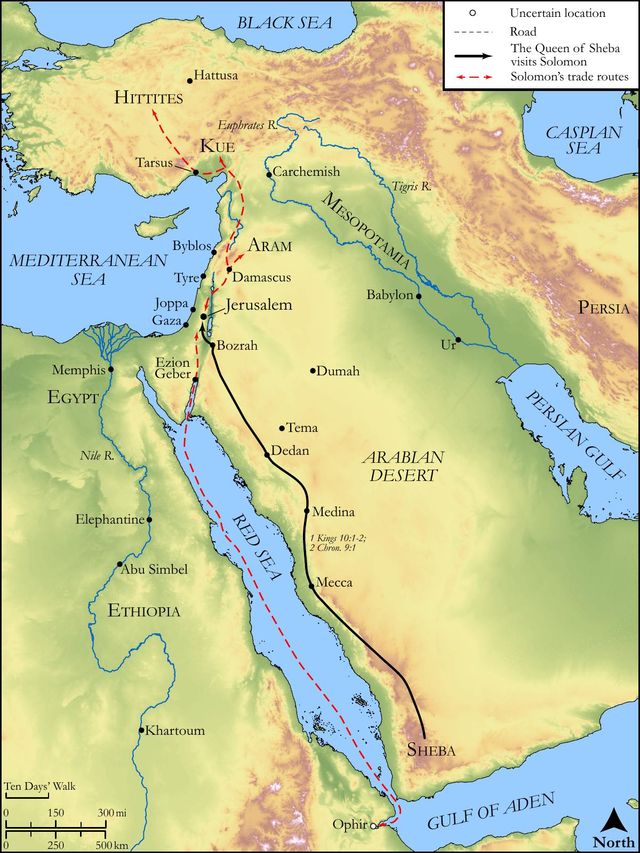
See on the biblical-era map
Study this verse
Public-domain commentary
Matthew Henry
From his Commentary on the Whole Bible. Henry comments on passages, not single verses — this entry covers 2 Chronicles 9:1–12.
This passage of story had been largely considered in the Kings; yet, because our Saviour has proposed it as an example to us in our enquiries after him (Mat 12:42), we must not pass it over without observing briefly, 1. Those who honour God he will honour, Sa1 2:30. Solomon had greatly honoured God, in building, beautifying, and dedicating the temple; all his wisdom and all his wealth were employed for the making of that a consummate piece: and now God made his wisdom and wealth to redound greatly to his reputation. The way to have both the credit and comfort of all our endowments and all our enjoyments is to consecrate them to God and use them for him. 2. Those who know the worth of true wisdom will grudge no pains nor cost to obtain it. The queen of Sheba put herself to a great deal of trouble and expense to hear the wisdom of Solomon; and yet, learning from him to serve God and do her duty, she thought herself well paid for her pains. Heavenly wisdom is that pearl of great price which is a good bargain to purchase by parting with all that we have. 3. As every man has received the gift so he ought to minister the same for the edification of others, as he has opportunity. Solomon was communicative of his wisdom and willing to teach others what he knew himself. Being taught of God, freely he had received, and freely he gave. Let those that are rich in wisdom, as well as wealth, learn to do good and be ready to distribute. Give to every one that asketh. 4. Good order in a family, a great family, especially in the things of God, and a regular discharge of the duties of religious worship, are highly expedient, and to be much admired wherever found. The queen of Sheba was exceedingly affected to see the propriety with which Solomon's servants attended him and with which both he and they attended in the house of God. David's ascent to the house of the Lord was also pleasant and interesting, Psa 42:4. 5. Those are happy who have the opportunity of a constant converse with such as are knowing, wise, and good. The queen of Sheba thought Solomon's servants happy who continually heard his wisdom; for, it seems, even to them he was communicative. And it is observable that the posterity of those who had places in his court were willing to have the names of their ancestors forgotten, and thought themselves sufficiently distinguished and dignified when they were called the children of Solomon's servants (Ezr 2:55; Neh 7:57); so eminent were they that it was honour enough to be named from them. 6. We ought to rejoice and give God thanks for the gifts, graces, and usefulness, of others. The queen of Sheba blessed God for the honour he put upon Solomon, and the favour he did to Israel, in advancing him to the throne, Ch2 9:8. By giving God the praise of the prosperity of others, we share in the comfort of it; whereas, by envying the prosperity of others, we lose the comfort even of our own. The happiness of both king and kingdom she traces up to the fountain of all bliss, the divine favour: it was because thy God delighted in thee and because he loved Israel. Those mercies are doubly sweet in which we can taste the kindness and good will of God as our God. 7. It becomes those that are wise and good to be generous according to their place and power. The queen of Sheba was so to Solomon, Solomon was so to her, Ch2 9:9, Ch2 9:12. They both knew how to value wisdom, and therefore were neither of them covetous of their money, but cultivated the acquaintance and confirmed the friendship they had contracted by mutual presents. Our Lord Jesus has promised to give us all our desire: Ask, and it shall be given you. Let us study what we shall render to him, and not think any thing too much to do, or suffer, or part with, for him.
Continue studying 2 Chronicles 9:11 across the web’s major study libraries — every link below opens this exact verse, chapter, or book on the destination site.
Read & Compare
 BibleGatewayThis verse in more than 200 translations and 70 languages.
 Bible.comThe YouVersion reader — hundreds of translations, reading plans, and highlights.
 ESV.orgCrossway's official English Standard Version reader.
 NET BibleThe NET translation with 60,000+ translators' notes on every rendering decision.
 STEP BibleTyndale House's free study tool — original text, vocabulary, and scholarly resources.
 BibliaLogos Bible Software's free web reader.
 USCCBThe New American Bible (Revised Edition) with the U.S. bishops' study notes.
Commentaries
 BibleHub CommentariesDozens of classic commentaries on this verse, gathered on one page.
 StudyLightMore than 100 commentary sets — the largest collection on the web.
 BibleRefPlain-English commentary on what this verse means, verse by verse.
 Enduring WordDavid Guzik's free commentary on this chapter, widely used by Bible teachers.
 Bible Study ToolsVerse commentary alongside Greek and Hebrew study aids.
Original Language & Research
- BibleHub InterlinearThe verse word by word — original language, transliteration, and English.
- BibleHub LexiconEvery word's original-language definition and Strong's entry.
 Blue Letter BibleDeep-study tools — Strong's numbers, concordance, and word studies.
 SefariaThe Hebrew text with Rashi and centuries of Jewish commentary.
Sermons, Hymns & Audio


TrulyRandomVerse is not affiliated with these sites and doesn’t control their content. They’re linked because they’re genuinely useful.
Summary
This verse highlights the unparalleled wealth and artistic endeavors of King Solomon, detailing the specific application of the rare and valuable algum trees imported from Ophir. These exotic woods were meticulously crafted into grand terraces for both the sacred House of the LORD and the king's opulent palace, and also fashioned into exquisite harps and psalteries for the Temple singers, underscoring a period of unprecedented splendor and the dedication of the finest resources to both divine worship and royal majesty in Judah.
Context
ShowHideLiterary Context
This verse is situated within a broader narrative detailing the zenith of King Solomon's reign, particularly his immense wisdom, wealth, and international prestige. Following the awe-inspiring visit of the Queen of Sheba (2 Chronicles 9:1-9), the text shifts to elaborate on the sources and extent of Solomon's riches. Specifically, 2 Chronicles 9:10 explicitly states that the algum trees, along with vast quantities of gold and precious stones, were brought from Ophir by the servants of Hiram and Solomon. Therefore, 2 Chronicles 9:11 serves as the immediate continuation, detailing how these exceptionally rare and valuable materials were utilized, not merely acquired. It provides concrete examples of the luxury and craftsmanship that characterized Solomon's kingdom, setting the stage for the subsequent accounts of his unparalleled prosperity before the narrative begins to pivot towards his later decline.
Historical & Cultural Context
King Solomon's reign (c. 970-931 BC) is historically recognized as a period of significant peace, prosperity, and architectural expansion for Israel. His strategic alliances, particularly with Hiram, King of Tyre, facilitated extensive trade networks that brought exotic goods from distant lands, such as Ophir. The "algum trees" (also called "almug" in 1 Kings 10:11) refer to a highly prized, imported wood, most likely sandalwood, renowned for its fragrance, durability, and beauty. Its use for both the Temple and the palace underscores the close intertwining of sacred and royal spheres in ancient Israelite society. Terraces were common architectural features, often grand staircases or elevated platforms, signifying status and grandeur. The crafting of musical instruments like harps and psalteries from such rare wood highlights the sophisticated musical culture, especially within Temple worship, where music played a crucial role in praising God, as seen in the extensive musical arrangements for the Temple detailed in 1 Chronicles 25. The phrase "none such seen before" emphasizes the unprecedented nature of Solomon's wealth and the unique quality of these imports, distinguishing his reign from all previous eras in Judah.
Key Themes
ShowHideThis verse powerfully illustrates several key themes prevalent in the book of Chronicles concerning Solomon's reign. Firstly, it highlights Solomon's unparalleled wealth and wisdom, demonstrating how divine blessing manifested in material prosperity and the ability to acquire and utilize the finest resources (see 2 Chronicles 9:22). Secondly, it emphasizes the dedication of resources to God's house, as the most precious materials were used for the Temple, reflecting a commitment to honoring God with the best. This aligns with the Chronicler's emphasis on the Temple as the central place of worship and God's dwelling. Thirdly, the verse showcases the splendor and glory of the Davidic kingdom under Solomon, portraying an era of peace, prosperity, and artistic excellence that served as a model of God's ideal rule. Finally, it subtly points to the integration of sacred and secular life within the monarchy, as the same precious wood was used for both the Temple and the king's palace, indicating that even royal grandeur was intertwined with the divine blessing that flowed through the king.
Exposition and Analysis
ShowHideKey Word Analysis
ShowHideThis term, referring to "sticks of algum wood," denotes a rare and highly valuable type of wood, widely believed to be sandalwood, imported from the distant land of Ophir (as noted in 2 Chronicles 9:10). Its exotic origin and inherent qualities like fragrance and durability made it exceptionally prized for both construction and artistic endeavors, underscoring the vastness of Solomon's trading empire and the unprecedented luxury available during his reign.
Derived from a root meaning "to cast up" or "to build a highway," mᵉçillâh refers to a thoroughfare, a viaduct, or a staircase. In this context, it suggests impressive architectural features, likely grand staircases or elevated platforms, enhancing the grandeur and accessibility of both the Temple complex and the royal palace. These were not merely functional pathways but significant structural and aesthetic elements, signifying status and majesty.
This term denotes a specific type of stringed musical instrument, often translated as a lyre or viol. Its name is derived from its resemblance in shape to a "skin-bag for liquids" or a "vase." The nebel was typically larger than the "harps" (Hebrew, kinnôwr) also mentioned in the verse and produced a deeper, richer sound. Its inclusion here highlights the importance of sophisticated musical accompaniment in Temple worship and courtly life, emphasizing the dedication of the finest materials to instruments used for sacred praise.
Verse Breakdown
ShowHide"And the king made [of] the algum trees terraces to the house of the LORD"
This clause reveals Solomon's primary use of the precious algum wood for significant architectural elements within the Temple complex. The construction of "terraces" (likely grand staircases or elevated platforms) from such rare material indicates a profound commitment to adorning God's dwelling with the most exquisite and durable resources available, reflecting the reverence and honor due to the divine presence.
"and to the king's palace"
The parallel use of the same rare wood for the king's own palace underscores the immense personal wealth and splendor of Solomon. It also signifies the close relationship between the sacred and royal spheres in ancient Israel, where the king, as God's anointed, was expected to embody divine blessing and majesty in his own dwelling as well.
"and harps and psalteries for singers"
Beyond architectural applications, the algum wood was also fashioned into high-quality musical instruments. This detail emphasizes the importance of music in both Temple worship and courtly entertainment. The use of such valuable wood for instruments suggests a commitment to excellence in musical performance and a desire to provide the finest tools for those who led praise and provided entertainment.
"and there were none such seen before in the land of Judah"
This concluding phrase serves as a powerful hyperbole, emphasizing the unprecedented nature of these items. It highlights the unique prosperity, artistic craftsmanship, and exotic resources that characterized Solomon's reign, setting it apart as a golden age unmatched in the history of Judah.
Literary Devices
ShowHideThe verse employs several literary devices to convey its message of unparalleled splendor. Hyperbole is evident in the concluding phrase, "and there were none such seen before in the land of Judah." This exaggeration effectively underscores the extraordinary and unique nature of the algum wood and the items crafted from it, emphasizing Solomon's unprecedented wealth and the magnificent quality of his reign. Symbolism is also at play, as the rare and valuable algum wood itself symbolizes divine blessing, the vastness of Solomon's kingdom, and the dedication of the finest resources to both sacred and royal purposes. The wood's exotic origin further symbolizes the international reach and prestige of Solomon's rule. Furthermore, there is a subtle juxtaposition between the "house of the LORD" and "the king's palace," highlighting how Solomon's immense resources were simultaneously directed towards both sacred worship and royal grandeur, demonstrating the integrated nature of his divinely blessed reign.
Theological and Thematic Connections
ShowHideThe use of the finest and most unique materials for both the Temple and the palace in Solomon's reign reflects a profound theological principle: the offering of one's "best" to God. This echoes the Old Testament emphasis on quality sacrifices and offerings, where the unblemished and most valuable were consecrated to the Lord. Solomon's dedication of such rare wood for the Temple's terraces and instruments of worship signifies a recognition that God deserves the utmost honor and excellence in all things. This act of giving from abundance also foreshadows the glory and splendor of God's future kingdom, where all creation will ultimately reflect His beauty and majesty.
Reflection and Application
ShowHideThis verse serves as a powerful reminder of stewardship and dedication. Solomon, blessed with unparalleled resources, chose to use the finest and most unique materials not only for his own palace but, significantly, for the house of the LORD and the instruments of worship. This challenges us to consider how we utilize the "algum trees" – the unique gifts, talents, resources, and opportunities – that God has entrusted to us. Are we reserving our "best" for ourselves, or are we dedicating our finest to God's purposes, whether in our worship, service, or daily lives? The principle extends beyond material wealth to our time, energy, and abilities. Just as the rare wood contributed to the beauty and functionality of the Temple, our dedicated and excellent use of our gifts can contribute to the flourishing of God's kingdom and the beauty of His presence in the world. It calls us to integrate our spiritual and daily lives, recognizing that all we have comes from God and should ultimately be used to honor Him and bless others.
Questions for Reflection
ShowHideFAQ
ShowHideWhat are "algum trees" and where did they come from?
ShowHide"Algum trees," also known as "almug trees" in 1 Kings 10:11, refer to a rare and highly prized type of wood imported during Solomon's reign. While its exact botanical identification is debated, many scholars believe it was a form of sandalwood. These trees were brought from Ophir, a distant and rich land, along with vast quantities of gold and precious stones, indicating a sophisticated and far-reaching trade network established by Solomon and Hiram of Tyre (as mentioned in 2 Chronicles 9:10).
Why were these materials considered so special?
ShowHideThese materials were considered exceptionally special primarily due to their rarity, exotic origin, and unique properties. As an imported wood from a distant land like Ophir, algum wood was not readily available in Judah, making it incredibly valuable. If it was indeed sandalwood, it would have been prized for its aromatic fragrance, fine grain, durability, and beautiful color. The phrase "none such seen before in the land of Judah" underscores its unprecedented nature and luxurious status, symbolizing the peak of Solomon's wealth and the unique splendor of his kingdom.
What is the significance of using the wood for both the Temple and the palace?
ShowHideThe dual use of the precious algum wood for both the Temple (the House of the LORD) and the king's palace carries significant meaning. Firstly, it highlights the immense and unparalleled wealth of King Solomon, as he could afford to use such rare and costly materials for both sacred and royal structures. Secondly, it demonstrates the close relationship between the sacred and royal spheres in ancient Israel. The king, as God's anointed representative, was expected to reflect divine blessing and order in his own dwelling, just as the Temple symbolized God's presence among His people. This integration signifies that even the king's personal grandeur was seen as part of the overall divine blessing and glory bestowed upon the nation.
Christ-Centered Fulfillment
ShowHideThe unparalleled splendor of Solomon's reign, epitomized by the use of the unique algum trees for the Temple and royal palace, serves as a magnificent but ultimately incomplete foreshadowing of the ultimate King, Jesus Christ. Solomon's glory, though extraordinary, was earthly and temporary, eventually marred by his own failings and the kingdom's division. Yet, the dedication of the finest materials to the Temple hinted at a greater reality: the coming of a perfect King who would establish an eternal kingdom of incomparable glory. Jesus Christ is the true "Temple," not made with hands, in whom the fullness of God dwells bodily (Colossians 2:9). He is building a spiritual house, not of wood or stone, but of living stones—His redeemed people, gathered from every nation, tribe, and tongue (1 Peter 2:5). The "none such seen before" aspect of Solomon's reign points to the truly incomparable and eternal glory of Christ's kingdom, where there will be no need for a physical temple because the Lord God Almighty and the Lamb are its temple (Revelation 21:22-27). Just as the algum wood was fashioned into instruments for worship, believers in Christ are called to be instruments of praise, offering spiritual sacrifices and the fruit of lips that acknowledge His name (Hebrews 13:15). In Christ, the ultimate dedication of the finest "materials"—His own perfect life and sacrifice—has been made, securing a glory that far surpasses any earthly kingdom (John 1:14).