


Revelation 5:8
Bible text: King James Version (1769 Blayney text) · Public domain
Bible text: King James Version with Strong's numbers · Public domain
Bible text: Berean Standard Bible · Public domain
Bible text: American Standard Version (1901) · Public domain
Bible text: World English Bible, Messianic edition · Public domain
Bible text: Geneva Bible (1599) · Public domain
Bible text: Young's Literal Translation · Public domain
- καὶkaiAndG2532CONJConjunction
- ὅτεhotewhenG3753CONJConjunction
- ἔλαβενelabenHe had takenG2983V-2AAI-3SVerb 2nd Aorist Active Indicative 3rd Singular
- τὸtotheG3588T-ASNDefinite article Accusative Singular Neuter
- βιβλίονbiblionscrollG975N-ASNNoun Accusative Singular Neuter
- τὰtatheG3588T-NPNDefinite article Nominative Plural Neuter
- τέσσαραtessarafourG5064A-NPNAdjective Nominative Plural Neuter
- ζῷαzōaliving creaturesG2226N-NPNNoun Nominative Plural Neuter
- καὶkaiandG2532CONJConjunction
- οἱhoitheG3588T-NPMDefinite article Nominative Plural Masculine
- εἴκοσιeikositwentyG1501A-NUIAdjective
- τέσσαρεςtessaresfourG5064A-NPMAdjective Nominative Plural Masculine
- πρεσβύτεροιpresbuteroieldersG4245N-NPMNoun Nominative Plural Masculine
- ἔπεσανepesanfell downG4098V-2AAI-3PVerb 2nd Aorist Active Indicative 3rd Plural
- ἐνώπιονenōpionbeforeG1799PREPPreposition
- τοῦtoutheG3588T-GSNDefinite article Genitive Singular Neuter
- ἀρνίουarniouLambG721N-GSNNoun Genitive Singular Neuter
- ἔχοντεςechonteshavingG2192V-PAP-NPMVerb Present Active Participle Nominative Plural Masculine
- ἕκαστοςhekastoseachG1538A-NSMAdjective Nominative Singular Masculine
- κιθάρανkitharana harpG2788N-ASFNoun Accusative Singular Feminine
- καὶkaiandG2532CONJConjunction
- φιάλαςphialasbowlsG5357N-APFNoun Accusative Plural Feminine
- χρυσᾶςchrusasgoldenG5552A-APFAdjective Accusative Plural Feminine
- γεμούσαςgemousasbeing fullG1073V-PAP-APFVerb Present Active Participle Accusative Plural Feminine
- θυμιαμάτωνthumiamatōnof incensesG2368N-GPNNoun Genitive Plural Neuter
- αἵaiwhichG3739R-NPFRelative pronoun Nominative Plural Feminine
- εἰσινeisinareG1510V-PAI-3PVerb Present Active Indicative 3rd Plural
- αἱhaitheG3588T-NPFDefinite article Nominative Plural Feminine
- προσευχαὶproseuchaiprayersG4335N-NPFNoun Nominative Plural Feminine
- τῶνtōnof theG3588T-GPMDefinite article Genitive Plural Masculine
- ἁγίωνhagiōnsaintsG40A-GPMAdjective Genitive Plural Masculine
English is a literal word-by-word gloss of the Greek, not the KJV's wording. Why?
This is the original text the KJV's translators worked from — each Greek word with its own literal English meaning in this verse, prepared by scholars at Tyndale House, Cambridge. The KJV translates whole sentences, not word by word, so its wording differs: one Greek word can become several English words, and the KJV may choose “charity” where the gloss reads “love”. Both are faithful — they answer different questions. For the KJV's own rendering, switch to the KJV text.
Details
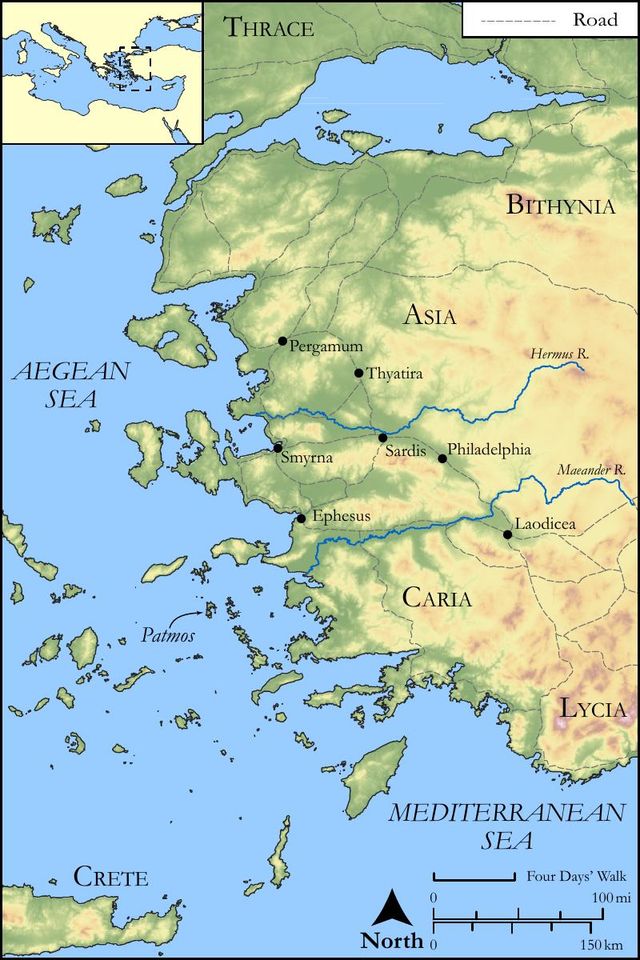
See on the biblical-era maps

Study this verse
Public-domain commentary
Matthew Henry
From his Commentary on the Whole Bible. Henry comments on passages, not single verses — this entry covers Revelation 5:6–14. His four-level outline is real structure in the source text, so it is rendered as structure.
Here, I. The apostle beholds this book taken into the hands of the Lord Jesus Christ, in order to its being unsealed and opened by him. Here Christ is described, 1. By his place and station: In the midst of the throne, and of the four beasts, and of the elders. He was on the same throne with the Father; he was nearer to him than either the elders or ministers of the churches. Christ, as man and Mediator, is subordinate to God the Father, but is nearer to him than all the creatures; for in him all the fulness of the Godhead dwells bodily. The ministers stand between God and the people. Christ stands as the Mediator between God and both ministers and people. 2. The form in which he appeared. Before he is called a lion; here he appears as a lamb slain. He is a lion to conquer Satan, a lamb to satisfy the justice of God. He appears with the marks of his sufferings upon him, to show that he interceded in heaven in the virtue of his satisfaction. He appears as a lamb, having seven horns and seven eyes, perfect power to execute all the will of God and perfect wisdom to understand it all and to do it in the most effectual manner; for he hath the seven Spirits of God, he has received the Holy Spirit without measure, in all perfection of light, and life, and power, by which he is able to teach and rule all parts of the earth. 3. He is described by his act and deed: He came, and took the book out of the right hand of him that sat on the throne (Rev 5:7), not by violence, nor by fraud, but he prevailed to do it (as Rev 5:5), he prevailed by his merit and worthiness, he did it by authority and by the Father's appointment. God very willingly and justly put the book of his eternal counsels into the hand of Christ, and Christ as readily and gladly took it into his hand; for he delights to reveal and to do the will of his Father.
II.The apostle observes the universal joy and thanksgiving that filled heaven and earth upon this transaction.
No sooner had Christ received this book out of the Father's hand than he received the applauses and adorations of angels and men, yea, of every creature. And, indeed, it is just matter of joy to all the world to see that God does not deal with men in a way of absolute power and strict justice, but in a way of grace and mercy through the Redeemer. He governs the world, not merely as a Creator and Lawgiver, but as our God and Saviour. All the world has reason to rejoice in this. The song of praise that was offered up to the Lamb on this occasion consists of three parts, one part sung by the church, another by the church and the angels, the third by every creature.
1.The church begins the doxology, as being more immediately concerned in it (Rev 5:8), the four living creatures, and the four-and-twenty elders, the Christian people, under their minister, lead up the chorus. Here observe,
(1.)The object of their worship - the Lamb, the Lord Jesus Christ; it is the declared will of God that all men should honour the Son as they honour the Father; for he has the same nature.
(2.)Their posture: They fell down before him, gave him not an inferior sort of worship, but the most profound adoration.
(3.)The instruments used in their adorations - harps and vials; the harps were the instruments of praise, the vials were full of odours or incense, which signify the prayers of the saints: prayer and praise should always go together.
(4.)The matter of their song: it was suited to the new state of the church, the gospel-state introduced by the Son of God. In this new song,
[1.]They acknowledge the infinite fitness and worthiness of the Lord Jesus for this great work of opening and executing the counsel and purposes of God (Rev 5:9): Thou art worthy to take the book, and to open the seals thereof, every way sufficient for the work and deserving the honour.
[2.]They mention the grounds and reasons of this worthiness; and though they do not exclude the dignity of his person as God, without which he had not been sufficient for it, yet they chiefly insist upon the merit of his sufferings, which he had endured for them; these more sensibly struck their souls with thankfulness and joy. Here, First, They mention his suffering: "Thou wast slain, slain as a sacrifice, thy blood was shed." Secondly, The fruits of his sufferings. 1. Redemption to God; Christ has redeemed his people from the bondage of sin, guilt, and Satan, redeemed them to God, set them at liberty to serve him and to enjoy him. 2. High exaltation: Thou hast made us to our God kings and priests, and we shall reign on the earth, Rev 5:10. Every ransomed slave is not immediately preferred to honour; he thinks it a great favour to be restored to liberty. But when the elect of God were made slaves by sin and Satan, in every nation of the world, Christ not only purchased their liberty for them, but the highest honour and preferment, made them kings and priests - kings, to rule over their own spirits, and to overcome the world, and the evil one; and he has made them priests, given them access to himself, and liberty to offer up spiritual sacrifices, and they shall reign on the earth; they shall with him judge the world at the great day.
2.The doxology, thus begun by the church, is carried on by the angels; they take the second part, in conjunction with the church, Rev 5:11. They are said to be innumerable, and to be the attendants on the throne of God and guardians to the church; though they did not need a Saviour themselves, yet they rejoice in the redemption and salvation of sinners, and they agree with the church in acknowledging the infinite merits of the Lord Jesus as dying for sinners, that he is worthy to receive power, and riches, and wisdom, and strength, and honour, and glory, and blessing.
(1.)He is worthy of that office and that authority which require the greatest power and wisdom, the greatest fund, all excellency, to discharge them aright; and,
(2.)He is worthy of all honour, and glory, and blessing, because he is sufficient for the office and faithful in it.
3.This doxology, thus begun by the church, and carried on by the angels, is resounded and echoed by the whole creation, Rev 5:13. Heaven and earth ring with the high praises of the Redeemer. The whole creation fares the better for Christ. By him all things consist; and all the creatures, had they sense and language, would adore that great Redeemer who delivers the creature from that bondage under which it groans, through the corruption of men, and the just curse denounced by the great God upon the fall; that part which (by a prosopopoeia) is made for the whole creation is a song of blessing, and honour, and glory, and power,
(1.)To him that sits on the throne, to God as God, or to God the Father, as the first person in the Trinity and the first in the economy of our salvation; and,
(2.)To the Lamb, as the second person in the Godhead and the Mediator of the new covenant. Not that the worship paid to the Lamb is of another nature, an inferior worship, for the very same honour and glory are in the same words ascribed to the Lamb and to him that sits on the throne, their essence being the same; but, their parts in the work of our salvation being distinct they are distinctly adored. We worship and glorify one and the same God for our creation and for our redemption.
We see how the church that began the heavenly anthem, finding heaven and earth join in the concert, closes all with their Amen, and end as they began, with a low prostration before the eternal and everlasting God. Thus we have seen this sealed book passing with great solemnity from the hand of the Creator into the hand of the Redeemer.
Historical interpretation
Eight Centuries of Reception
10 surviving comments on this verse. Each one is dated, so this reads as a timeline rather than a list.
Select a marker to jump to its quote. Markers stagger vertically where authors wrote within a few decades of each other.
Since, therefore, the name of the Son belongs to the Father, and since in the omnipotent God the Church makes offerings through Jesus Christ, He says well on both these grounds, "And in every place incense is offered to My name, and a pure sacrifice. "Now John, in the Apocalypse, declares that the "incense "is "the prayers of the saints."
Those who have become acquainted with the secondary (i.e., under Christ) constitutions of the apostles, are aware that the Lord instituted a new oblation in the new covenant, according to [the declaration of] Malachi the prophet. For, "from the rising of the sun even to the setting my name has been glorified among the Gentiles, and in every place incense is offered to my name, and a pure sacrifice;" as John also declares in the Apocalypse: "The incense is the prayers of the saints."
We regard the spirit of every good person as an altar from which arises an incense that is truly and spiritually sweet-smelling, namely, the prayers ascending from a pure conscience. Therefore it is said by John in the Revelation, “The odors are the prayers of the saints”; and by the psalmist, “Let my prayer come before you as incense.” And the statues and gifts that are fit offerings to God are the work of no common mechanics but are wrought and fashioned in us by the Word of God, to wit, the virtues in which we imitate “the firstborn of all creation,” who has set us an example of justice, of temperance, of courage, of wisdom, of piety, and of the other virtues.
"Twenty-four elders and four living creatures, having harps and phials, and singing a new song." The proclamation of the Old Testament associated with the New, points out the Christian people singing a new song, that is, bearing their confession publicly. It is a new thing that the Son of God should become man. It is a new thing to ascend into the heavens with a body. It is a new thing to give remission of sins to men. It is a new thing for men to be sealed with the Holy Spirit. It is a new thing to receive the priesthood of sacred observance, and to look for a kingdom of unbounded promise. The harp, and the chord stretched on its wooden frame, signifies the flesh of Christ linked with the wood of the passion. The phial signifies the Confession, and the race of the new Priesthood. But it is the praise of many angels, yea, of all, the salvation of all, and the testimony of the universal creation, bringing to our Lord thanksgiving for the deliverance of men from the destruction of death. The unsealing of the seals, as we have said, is the opening of the Old Testament, and the foretelling of the preachers of things to come in the last times, which, although the prophetic Scripture speaks by single seals, yet by all the seals opened at once, prophecy takes its rank.
The bowls that are accepted by God are the pious confession in which no one is hidden with a duplicitous heart but is rather sincere with an open affection. They are also the golden vessels that are in the great house, burning with the sweetness of the pleasant odor of Christ. Moreover, the prayers of the saints are the grateful deeds of those who rejoice over the salvation of the world and their intercessions for the wellbeing of the helpless. [The apostle] says, “Christ suffered for us, leaving for us an example that we should walk in his footsteps.” When, therefore, “those who belong to Christ crucify their own flesh with its passions and desires,” it is as though they are playing to Christ on harps, so that what he has done for them, they might do for him, “looking to Jesus, the pioneer and perfecter of our faith.”
The harps indicate the harmonious and melodious divine doxology, while the incense indicates the sweet-smelling sacrifice of the faithful that is offered through a most pure life, as the apostle says: “We are the aroma of Christ.” The bowls are symbolic of the thoughts from which the sweet aroma of good works and pure prayer come.
And when He had opened the book, etc. When by His passion the Lord proved that the proclamations of both Testaments were fulfilled in Him, the Church, giving thanks, also offers itself to sufferings, so that, according to the Apostle, it may complete in its flesh what is lacking in Christ’s afflictions (Col. 1). For in the harps where strings are stretched on wood, the bodies ready to die are signified; by the bowls, the hearts open wide in the breadth of charity are signified.
Just as it is proper for us to seek the Lord shining with the light of good works, so also is it proper for us to seek him abundantly provided with the gift of spiritual prayers. Hence it is good that the women who came to the tomb early in the morning are reported to have been carrying with them the spices that they had prepared. Our spices are our voices in prayer, in which we set forth before the Lord the desires of our hearts, as the apostle John attested in the describing mystically the purest inmost longings of the saints, saying, “They had golden bowls full of incense, which are the prayers of the saints.” What in Greek is called “spice” in Latin is called “incense.” We bear spices to the tomb of the Lord early in the morning when, mindful of the passion and death that he underwent for us, we show to our neighbor outwardly the light of our good actions and are inwardly aflame in our heart with the delight of simple compunction. We must do this at all times, but especially when we go into church in order to pray and when we draw near to the altar in order to partake of the mysteries of the body and blood of the Lord.
And when he had opened the book, the four living creatures, and the four and twenty ancients fell down before the Lamb, having every one of them harps, and golden vials full of odours, which are the prayers of saints. The Lamb opened the book when he fulfilled the work of his voluntary Passion. Now what does it mean that the living creatures and the ancients have harps, if not that the Church of the elect is filling up those things which are wanting of the afflictions of Christ? [Cf. Col. 1:24] It is fitting for the sufferings of Christ to be symbolized by harps, for in a harp some strings are stretched more tightly and others more loosely, but, albeit stretched differently, they do not at all produce each a different song: it is the same with the different members in the body of Christ: some imitate his sufferings more fully and others less, but they resound with one praise in harmony. So the living creatures and the ancients fall before the Lamb with harps because all the saints attribute the merit of everything they suffer for Christ to Christ and not to themselves. By the golden vials we understand love, a love capable of praying not only for friends but also for enemies, which is why it is said that they were full. It is right for the vials to be mentioned after the harps, because the Lord first climbed the cross, and then thus prayed for his persecutors with an incomparable love, saying, Father, forgive them, etc. [Luke 23:34]
Having received the little scroll from the Lord, all worshiped it, fully aware of the salvation it is destined to bring to humanity, and the punishment it holds for the impure demons. The elders holding harps signify the harmonious and melodious nature of their confession to God, according to the written word: "Sing to our God, sing." (Ps. 46:7)
The incense symbolizes the offering from all the nations. For Malachi says, in the person of God, to the disobedient Israel: "I do not accept a sacrifice from your hands, because from the rising of the sun to its setting, my name has been glorified among the nations, and in every place incense is offered in my name, and a pure sacrifice." (Mal. 1:10-11) Proclaiming beforehand through these the faith and gift-bearing of the nations.
Continue studying Revelation 5:8 across the web’s major study libraries — every link below opens this exact verse, chapter, or book on the destination site.
Read & Compare
 BibleGatewayThis verse in more than 200 translations and 70 languages.
 Bible.comThe YouVersion reader — hundreds of translations, reading plans, and highlights.
 ESV.orgCrossway's official English Standard Version reader.
 NET BibleThe NET translation with 60,000+ translators' notes on every rendering decision.
 STEP BibleTyndale House's free study tool — original text, vocabulary, and scholarly resources.
 BibliaLogos Bible Software's free web reader.
 USCCBThe New American Bible (Revised Edition) with the U.S. bishops' study notes.
Commentaries
 BibleHub CommentariesDozens of classic commentaries on this verse, gathered on one page.
 StudyLightMore than 100 commentary sets — the largest collection on the web.
 BibleRefPlain-English commentary on what this verse means, verse by verse.
 Enduring WordDavid Guzik's free commentary on this chapter, widely used by Bible teachers.
 Bible Study ToolsVerse commentary alongside Greek and Hebrew study aids.
Original Language & Research
- BibleHub InterlinearThe verse word by word — original language, transliteration, and English.
- BibleHub LexiconEvery word's original-language definition and Strong's entry.
 Blue Letter BibleDeep-study tools — Strong's numbers, concordance, and word studies.
 CNTR CollationThe earliest Greek manuscripts of this verse, collated letter by letter.
Sermons, Hymns & Audio


TrulyRandomVerse is not affiliated with these sites and doesn’t control their content. They’re linked because they’re genuinely useful.
Summary
Revelation 5:8 vividly portrays a pivotal moment in heavenly worship as the Lamb of God takes the sealed scroll, symbolizing God's sovereign redemptive plan. In response, the four living creatures and the twenty-four elders prostrate themselves in adoration, each bearing harps for praise and golden vials filled with fragrant odours, which are explicitly identified as the prayers of the saints. This scene underscores the Lamb's unparalleled worthiness, the profound nature of celestial worship, and the precious, active role of believers' prayers in the divine economy.
Context
ShowHideLiterary Context
This verse is deeply embedded within the unfolding vision of heavenly worship and divine sovereignty in the book of Revelation. It immediately follows the dramatic scene in Revelation 5:1-7 where a scroll sealed with seven seals is introduced, and a profound lament arises because no one in heaven or on earth is found worthy to open it. This crisis is resolved by the appearance of the "Lion of the tribe of Judah, the Root of David," who is then revealed as a "Lamb standing as though it had been slain." The Lamb's unique worthiness, established by His sacrifice, empowers Him to take the scroll, triggering the immediate and universal worship described in Revelation 5:8-14. The actions of the four living creatures (representing creation) and the twenty-four elders (often symbolizing the redeemed community from both Old and New Covenants, first seen in Revelation 4:4) are a direct, spontaneous response to the Lamb's redemptive authority and His initiation of God's final purposes.
Historical & Cultural Context
The imagery in Revelation 5:8 draws heavily from both Old Testament temple worship and the customs of that day for scrolls, musical instruments, and ritual vessels. The "scroll" (Greek: biblíon) would have been understood as a legal document, a will, or a divine decree, signifying authority and destiny. The "harps" (Greek: kithára) were common instruments for praise and celebration in Israelite worship (e.g., Psalm 33:2). Most significantly, the "golden vials" (Greek: phiálē) refer to broad, shallow bowls, distinct from narrow bottles. These were often used for libations or for holding incense in ancient rituals. The "odours" (Greek: thymíama) directly evoke the fragrant incense burned on the altar of incense in the Tabernacle and Temple, which symbolized the prayers of God's people ascending to Him (Exodus 30:1-10; Psalm 141:2). This rich Old Testament background would have immediately conveyed to John's original audience the sacredness and divine acceptance of the prayers being offered.
Key Themes
ShowHideThis verse powerfully contributes to several overarching themes within Revelation and broader biblical theology. Firstly, it amplifies the theme of the Worthiness of the Lamb, establishing Jesus Christ's unique qualification, through His atoning sacrifice, to execute God's ultimate plan for creation and redemption. This worthiness elicits universal adoration and submission. Secondly, it vividly portrays Heavenly Worship and Adoration, demonstrating that worship is the primary activity of the heavenly host, characterized by profound reverence, joyous praise (harps), and unified prostration before the divine throne. This celestial liturgy serves as a foundational model for earthly worship. Thirdly, and perhaps most strikingly, the verse highlights the Value and Efficacy of Saints' Prayers, explicitly identifying the "odours" as "the prayers of saints." This imagery elevates human prayer to a precious, fragrant offering that is not only heard but actively collected and presented before God's throne, underscoring its vital role in the unfolding of divine purposes, a theme echoed later in Revelation 8:3-4.
Exposition and Analysis
ShowHideKey Word Analysis
ShowHideThis term refers to a broad, shallow bowl or saucer, rather than a narrow bottle. In ancient contexts, such vessels were commonly used for pouring libations (drink offerings) or holding incense. The choice of this specific type of vessel emphasizes its capacity to collect and present a substantial quantity of the "odours," underscoring the abundance and collective nature of the prayers being offered.
Derived from a word meaning "to burn incense," this term refers specifically to fragrant incense or the act of burning it. In the Old Testament, incense was a crucial element of temple worship, symbolizing the prayers of Israel ascending to God (Psalm 141:2). By directly identifying these "odours" as "the prayers of saints," the verse establishes a profound symbolic connection, signifying that believers' prayers are a sweet-smelling aroma, pleasing and acceptable to God.
This word denotes general prayer or worship. Its inclusion here makes the symbolism of the "odours" explicit and unmistakable. It signifies that the petitions, intercessions, and worshipful expressions of God's people, both individually and corporately, are not lost or forgotten but are actively gathered, cherished, and presented before the divine throne, becoming an integral part of heavenly activity.
Verse Breakdown
ShowHide"And when he had taken the book"
This clause marks the pivotal moment following the Lamb's identification as the only one worthy to open the sealed scroll. His act of taking the scroll signifies His authority, His acceptance of the divine commission, and the imminent unfolding of God's sovereign plan for the end times. It is the catalyst for the ensuing worship.
"the four beasts and four and twenty elders fell down before the Lamb"
This describes the immediate and profound response of the celestial beings. The "four beasts" (or living creatures) represent all creation, and the "four and twenty elders" symbolize the redeemed people of God. Their act of falling down (píptō) indicates deep reverence, submission, and worship of the Lamb, acknowledging His supreme authority and worthiness.
"having every one of them harps"
The harps (kithára) are instruments of praise and joyous celebration. Their presence signifies that the worship offered to the Lamb is not merely reverent but also filled with exultation and adoration. They are used to accompany the new song sung to the Lamb in the following verses (Revelation 5:9).
"and golden vials full of odours"
The "golden vials" (phiálē) are broad, shallow bowls, emphasizing their capacity to hold a substantial amount. Their golden nature signifies purity, preciousness, and divine value. These bowls are "full of odours" (thymíama), which are fragrant, smoke-like offerings, directly linking to the incense used in Old Testament temple worship.
"which are the prayers of saints."
This is the crucial interpretive clause, explicitly identifying the symbolic meaning of the "odours." It reveals that the fragrant incense represents the collective prayers of all believers throughout history. This declaration elevates the significance of prayer, portraying it not as a mere human utterance but as a precious, divinely collected, and highly valued offering that ascends to God's throne.
Literary Devices
ShowHideRevelation 5:8 is rich in Symbolism. The "book" or scroll symbolizes God's sovereign plan and ultimate destiny for creation. The "Lamb" is a profound symbol of Jesus Christ, representing both His sacrificial death (as a slain lamb) and His triumphant power and authority (as the worthy one). The "harps" symbolize joyous praise and worship. Most notably, the "golden vials full of odours, which are the prayers of saints" employ powerful Metaphor and Imagery. The "odours" or incense are a metaphor for prayers, drawing on Old Testament temple imagery where incense symbolized the ascent of prayers to God. This vivid imagery transforms abstract prayers into a tangible, precious, and fragrant offering, emphasizing their divine acceptance and value. The act of the elders and living creatures "falling down" is a form of Prostration, a universal gesture of profound reverence and submission to a superior being, highlighting the Lamb's supreme authority.
Theological and Thematic Connections
ShowHideRevelation 5:8 profoundly impacts our understanding of God's character, the nature of worship, and the significance of human prayer. The scene unequivocally establishes the Lamb, Jesus Christ, as the central figure of the worship of heaven, deserving of all adoration due to His unique worthiness wrought through His redemptive sacrifice. This worthiness is the foundation upon which God's sovereign plan unfolds. Furthermore, the verse elevates prayer from a simple spiritual discipline to a vital, active component of heavenly activity. It demonstrates that the prayers of believers are not forgotten or dismissed but are collected, cherished, and presented before God as a fragrant offering, actively participating in the unfolding of His divine purposes. This underscores God's attentiveness, His delight in His people's communication, and the profound spiritual reality that our prayers truly matter in the economy of God's kingdom.
Reflection and Application
ShowHideRevelation 5:8 offers profound encouragement and a powerful call to worship for every believer. This heavenly scene reminds us that our prayers are not merely whispered words into the void; they are precious, fragrant offerings that ascend to the very throne of God, collected and cherished in golden bowls. This should instill immense confidence and perseverance in our prayer lives, knowing that our petitions, intercessions, and expressions of worship are not only heard but are highly valued in the heavenly realm, playing an active role in God's unfolding plan. Moreover, the universal adoration of the Lamb compels us to direct our worship wholly and unreservedly to Jesus Christ. His unique worthiness, established through His sacrificial love and triumph, is the singular focus of all true worship, both in heaven and on earth. This verse calls us to align our earthly worship with the heavenly reality, recognizing Christ's supreme authority and participating in the ongoing praise that reverberates throughout creation.
Questions for Reflection
ShowHideFAQ
ShowHideWho are the "four beasts" and "four and twenty elders" mentioned in this verse?
ShowHideThe "four beasts" (more accurately translated "four living creatures") are symbolic beings first introduced in Revelation 4:6-8, representing the fullness of creation in its worship of God. They are often seen as guardians of God's throne and spokespersons for creation. The "four and twenty elders" are figures seated on thrones around God's throne, first appearing in Revelation 4:4. While their exact identity is debated, they are widely understood to symbolize the redeemed people of God, representing both the twelve tribes of Israel (Old Covenant) and the twelve apostles (New Covenant), thus encompassing the entire church, glorified and reigning with Christ. Their presence signifies the participation of all creation and all the redeemed in the worship of the Lamb.
What do the "harps" and "golden vials full of odours" symbolize?
ShowHideThe "harps" (Greek: kithára) symbolize praise, joyous celebration, and musical adoration. They represent the melodic expression of worship and are often associated with heavenly praise throughout Scripture (Psalm 33:2; Revelation 14:2). The "golden vials" (Greek: phiálē), which are broad, shallow bowls, symbolize precious vessels used for collecting and presenting something valuable. The "odours" (Greek: thymíama) refer to fragrant incense. The verse explicitly states that these odours "are the prayers of saints," making the symbolism clear: the prayers of God's people are precious, fragrant, and ascend before God's throne as a sweet-smelling offering, actively collected and presented in heaven.
Christ-Centered Fulfillment
ShowHideRevelation 5:8 finds its ultimate Christ-centered fulfillment in the person and work of Jesus Christ, the Lamb who was slain. This scene is a direct response to His unique worthiness, a worthiness earned through His perfect obedience, His sacrificial death on the cross, and His glorious resurrection. He alone is found worthy to take the scroll, initiating the unfolding of God's redemptive plan because He is the Lamb of God who takes away the sin of the world. Our prayers, symbolized by the fragrant odours, are made acceptable and effective precisely because they are offered through Him and His mediatorial work. As our great high priest, Jesus continually intercedes for us before the Father (Hebrews 7:25), and it is through His merit that our imperfect prayers become a sweet aroma to God. Thus, the worship and the prayers depicted in Revelation 5:8 are not merely a general heavenly phenomenon but are entirely centered on and empowered by the Lamb, Jesus Christ, who is both the object of adoration and the means by which our communion with God is perfected. He is the one who has made us kings and priests to our God, enabling our prayers to ascend and participate in His ongoing reign.