


Revelation 8:3
- ΚαὶKaiAndG2532CONJConjunction
- ἄλλοςallosanotherG243A-NSMAdjective Nominative Singular Masculine
- ἄγγελοςangelosangelG32N-NSMNoun Nominative Singular Masculine
- ἦλθενēlthencameG2064V-2AAI-3SVerb 2nd Aorist Active Indicative 3rd Singular
- καὶkaiandG2532CONJConjunction
- ἐστάθηestathēhe stoodG2476V-API-3SVerb Aorist Passive Indicative 3rd Singular
- ἐπὶepiatG1909PREPPreposition
- τοῦtoutheG3588T-GSNDefinite article Genitive Singular Neuter
- θυσιαστηρίουthusiastērioualtarG2379N-GSNNoun Genitive Singular Neuter
- ἔχωνechōnhavingG2192V-PAP-NSMVerb Present Active Participle Nominative Singular Masculine
- λιβανωτὸνlibanōtona censerG3031N-ASMNoun Accusative Singular Masculine
- χρυσοῦνchrusoungoldenG5552A-ASMAdjective Accusative Singular Masculine
- καὶkaiandG2532CONJConjunction
- ἐδόθηedothēwas givenG1325V-API-3SVerb Aorist Passive Indicative 3rd Singular
- αὐτῷautōto himG846P-DSMPersonal pronoun Dative Singular Masculine
- θυμιάματαthumiamataincenseG2368N-NPNNoun Nominative Plural Neuter
- πολλὰpollamuchG4183A-NPNAdjective Nominative Plural Neuter
- ἵναinathatG2443CONJConjunction
- δώσειdōseihe will give [it]G1325V-FAI-3SVerb Future Active Indicative 3rd Singular
- ταῖςtaiswith theG3588T-DPFDefinite article Dative Plural Feminine
- προσευχαῖςproseuchaisprayersG4335N-DPFNoun Dative Plural Feminine
- τῶνtōnof theG3588T-GPMDefinite article Genitive Plural Masculine
- ἁγίωνhagiōnsaintsG40A-GPMAdjective Genitive Plural Masculine
- πάντωνpantōnallG3956A-GPMAdjective Genitive Plural Masculine
- ἐπὶepiuponG1909PREPPreposition
- τὸtotheG3588T-ASNDefinite article Accusative Singular Neuter
- θυσιαστήριονthusiastērionaltarG2379N-ASNNoun Accusative Singular Neuter
- τὸto<the>G3588T-ASNDefinite article Accusative Singular Neuter
- χρυσοῦνchrusoungoldenG5552A-ASNAdjective Accusative Singular Neuter
- τὸto<the>G3588T-ASNDefinite article Accusative Singular Neuter
- ἐνώπιονenōpionbeforeG1799PREPPreposition
- τοῦtoutheG3588T-GSMDefinite article Genitive Singular Masculine
- θρόνουthronouthroneG2362N-GSMNoun Genitive Singular Masculine
English is a literal word-by-word gloss of the Greek, not the KJV's wording. Why?
This is the original text the KJV's translators worked from — each Greek word with its own literal English meaning in this verse, prepared by scholars at Tyndale House, Cambridge. The KJV translates whole sentences, not word by word, so its wording differs: one Greek word can become several English words, and the KJV may choose “charity” where the gloss reads “love”. Both are faithful — they answer different questions. For the KJV's own rendering, switch to the KJV text.
Details
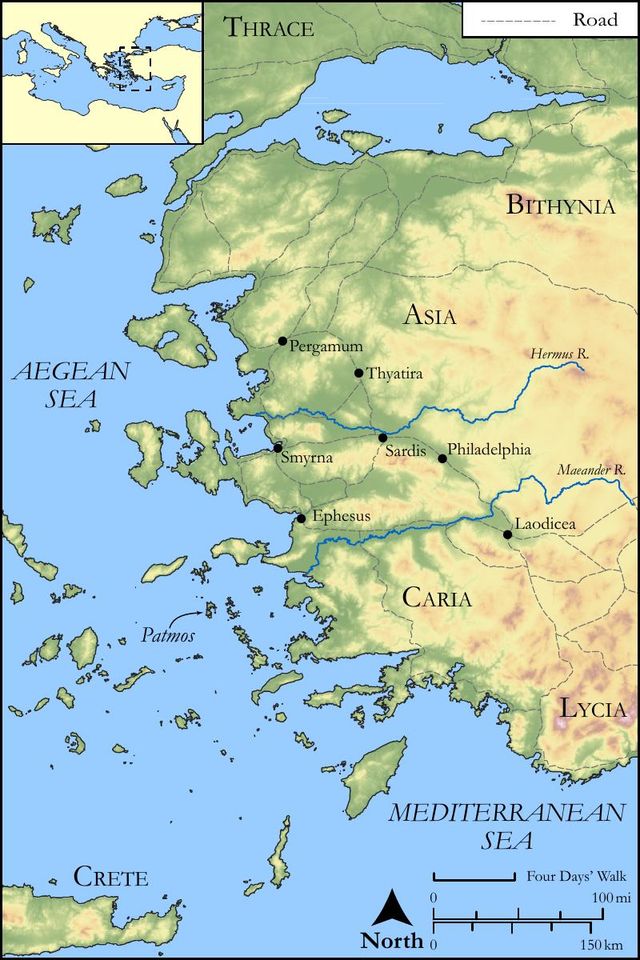
See on the biblical-era map

Study this verse
Public-domain commentary
Matthew Henry
From his Commentary on the Whole Bible. Henry comments on passages, not single verses — this entry covers Revelation 8:1–6. His two-level outline is real structure in the source text, so it is rendered as structure.
In these verses we have the prelude to the sounding of the trumpets in several parts.
I.The opening of the last seal.
This was to introduce a new set of prophetical iconisms and events; there is a continued chain of providence, one part linked to another (where one ends another begins), and, though they may differ in nature and in time, they all make up one wise, well-connected, uniform design in the hand of God.
II.A profound silence in heaven for the space of half an hour, which may be understood either,
1.Of the silence of peace, that for this time no complaints were sent up to the ear of the Lord God of sabaoth; all was quiet and well in the church, and therefore all silent in heaven, for whenever the church on earth cries, through oppression, that cry comes up to heaven and resounds there; or,
2.A silence of expectation; great things were upon the wheel of providence, and the church of God, both in heaven and earth, stood silent, as became them, to see what God was doing, according to that of Zac 2:13, Be silent, O all flesh, before the Lord, for he has risen up out of his holy habitation. And elsewhere, Be still, and know that I am God.
III.The trumpets were delivered to the angels who were to sound them.
Still the angels are employed as the wise and willing instruments of divine Providence, and they are furnished with all their materials and instructions from God our Saviour. As the angels of the churches are to sound the trumpet of the gospel, the angels of heaven are to sound the trumpet of Providence, and every one has his part given him.
IV.To prepare for this, another angel must first offer incense, Rev 8:3.
It is very probable that this other angel is the Lord Jesus, the high priest of the church, who is here described in his sacerdotal office, having a golden censer and much incense, a fulness of merit in his own glorious person, and this incense he was to offer up, with the prayers of all the saints, upon the golden altar of his divine nature. Observe,
1.All the saints are a praying people; none of the children of God are born dumb, a Spirit of grace is always a Spirit of adoption and supplication, teaching us to cry, Abba, Father. Psa 32:6, For this shall every one that is godly pray unto thee.
2.Times of danger should be praying times, and so should times of great expectation; both our fears and our hopes should put us upon prayer, and, where the interest of the church of God is deeply concerned, the hearts of the people of God in prayer should be greatly enlarged.
3.The prayers of the saints themselves stand in need of the incense and intercession of Christ to make them acceptable and effectual, and there is provision made by Christ for that purpose; he has his incense, his censer, and his altar; he is all himself to his people.
4.The prayers of the saints come up before God in a cloud of incense; no prayer, thus recommended, was ever denied audience or acceptance.
5.These prayers that were thus accepted in heaven produced great changes upon earth in return to them; the same angel that in his censer offered up the prayers of the saints in the same censer took of the fire of the altar, and cast it into the earth, and this presently caused strange commotions, voices, and thunderings, and lightnings, and an earthquake; these were the answers God gave to the prayers of the saints, and tokens of his anger against the world and that he would do great things to avenge himself and his people of their enemies; and now, all things being thus prepared, the angels discharge their duty.
Historical interpretation
Eight Centuries of Reception
9 surviving comments on this verse. Each one is dated, so this reads as a timeline rather than a list.
Select a marker to jump to its quote. Markers stagger vertically where authors wrote within a few decades of each other.
See that no one escape you," he added; "and if any escape you, I will try them at the altar."
To this is further added the charge of irreverence,-intelligible even to the nations themselves, if they had any sense. If, on the one hand, it is irreverent to sit under the eye, and over against the eye, of him whom you most of all revere and venerate; how much more, on the other hand, is that deed most irreligious under the eye of the living God, while the angel Of prayer is still standing by unless we are upbraiding God that prayer has wearied us!
The seven angels received trumpets, and another [angel], it says, came. One might think that this one came after the seven angels, although he saw all of this at one time. As the angel was coming, those seven received their trumpets, that is, when Christ the Lord was coming, his church received the power to preach. And we understand that he himself came over the altar, that is, over the church, which is wholly assumed as the body of the same priesthood and to whom Peter said, “[You are] a holy nation, a chosen race, a royal priesthood.” He had a golden censer, which is his immaculate body that was conceived by the overshadowing of the Holy Spirit and that he offered as an oblation and sweet-smelling sacrifice to God for the redemption of the world and through which he cleansed the conscience of all from dead works. He is also said to have received the prayers of the saints and to have offered them, for through him the prayers of all are able to come to God in an agreeable manner.
Although what is revealed to the saints is depicted in material form and with colors, whether it be the altar or the censer or something else, in reality these things are invisible and intellectual. And it is at such an altar that the angel stands and swings the censer (that is, that bowl that receives incense) bearing to God the prayers of the saints as though they were incense.… The “altar” is Christ upon which every ministering and holy power is established and upon which the sacrifices of the martyrs are offered. This altar was prefigured in the altar that was shown to Moses on Mount Sinai together with the tabernacle. The “incense” is the prayers of the saints.… He says that the altar, namely, Christ, is “before the throne,” that is, before the most eminent and holy of powers who are there because of the abundance of the divine love and of the pure wisdom and knowledge in them.
And there was given unto him much incense, etc. From the prayers of the saints he offered the incense. For to them the Church entrusted its prayers, saying: "Let my prayer be directed as incense in thy sight" (Psalm 140). It is said that he received from the prayers of the saints and offered it, because through him the prayers of all can sweetly reach God.
And he stood before the altar, having a golden censer. Clearly, he appeared in the sight of the Church, having become the censer, from which God received the odor of sweetness, and was propitiated towards the world. Another Edition has "Upon the altar," which means that He offered His golden censer, that is, His immaculate body conceived by the Holy Spirit, upon the altar of the cross to the Father for us.
And another angel came. He did not say, "Then he came," but proposing that the angels had received the trumpets, he goes back to explain how they had received them. For although the Church preached before the coming of the Lord, it was not everywhere, until it was confirmed by His Spirit.
And I saw seven angels standing in the sight of God; and there were given to them seven trumpets. And another angel came, and stood before the altar, having a golden censer. In this place he upsets the order of the narration and interposes something; for, as the following will show, the angel with the censer came and stood before the altar before they received the seven trumpets. He interposes something because he introduced this angel with the censer in the middle before he had finished talking about the others. So, what do we understand by the seven angels but the holy Church in its preachers, who are the announcers of eternal life? It is also right for them to be said to be seven in number, because they are filled up with the sevenfold Spirit, or because they are put in charge of the totality of believers. They are said to be standing in the sight of God because they have trodden earthly desires underfoot and stick to divine contemplation. What is shown by their seven trumpets but the perfect preaching of the Old and of the New Testament? According to this: Lift up thy voice like a trumpet. [Is. 58:1] By the fact that it is the office of a priest to stand by the altar and burn incense prepared with spices, we realize that this angel is the Mediator between God and men, the Angel of the seven angels, and, so to speak, the Pontiff of the seven priests, he about whom the prophet said, angel of great counsel. [Is. 9:6 acc. to LXX, where the verse is number 5.] From this we clearly gather that he came before the seven angels received the trumpets. By the altar are represented the elect, in whom a spiritual sacrifice is being performed. So, the angel came by the flesh, and stood by the divinity. Also, what is represented by the censer but Christ's humanity? It is appropriate for it to be called golden, because the flesh assumed by the Word of God is, together with him, the wisdom about which it is said, Take wisdom as gold. [Variant of Prov. 16:16] The censer, in which spices are burned, may also symbolize the Church, which says every day, kindled by the fire of divine love, Let my prayer be directed as incense, etc. [Ps. 140:2] Then it is rightly said after that concerning Christ alone: And there was given to him much incense, that he should offer of the prayers of the saints upon the golden altar, which is before the throne. And the smoke of the incense of the prayers of the saints ascended up before God from the hand of the angel. Just as smoke comes out of burned spices, so is the virtue of devotion produced by zeal for prayer. However, in order for the incense to become pleasing to God, it is given to the angel, which means that the zeal of prayers is entrusted to our Redeemer. The body is totally unable to speak to God but by the agency of the Head. The fact that the incense is offered on the golden altar shows that the sacrifice of prayers is accepted by him nowhere else but in the body of Christ, all of which shines with the wisdom of the divine Word. Note also that the throne and the altar before the throne do not signify two Churches, but one, just like Noah's ark and the eight souls in it. [Cf. Gen. 6; 1 Peter 3:20]
The altar is said to be incense [λιβανωτὸν], as it receives the incense. When Christ appeared, as a kind of first fruits and precious offering, the prayers of the saints are presented to Him by the angels who oversee us. These prayers are naturally fragrant and become even more fragrant through the cooperation of the holy angels.
Therefore, it has been said that much incense offerings was given to him. Indeed, it was given by God as a clear sign to entrust humans to the angels and to make their prayers welcome. Those who receive it grant a fragrant aroma to the prayers of the saints.
Continue studying Revelation 8:3 across the web’s major study libraries — every link below opens this exact verse, chapter, or book on the destination site.
Read & Compare
 BibleGatewayThis verse in more than 200 translations and 70 languages.
 Bible.comThe YouVersion reader — hundreds of translations, reading plans, and highlights.
 ESV.orgCrossway's official English Standard Version reader.
 NET BibleThe NET translation with 60,000+ translators' notes on every rendering decision.
 STEP BibleTyndale House's free study tool — original text, vocabulary, and scholarly resources.
 BibliaLogos Bible Software's free web reader.
 USCCBThe New American Bible (Revised Edition) with the U.S. bishops' study notes.
Commentaries
 BibleHub CommentariesDozens of classic commentaries on this verse, gathered on one page.
 StudyLightMore than 100 commentary sets — the largest collection on the web.
 BibleRefPlain-English commentary on what this verse means, verse by verse.
 Enduring WordDavid Guzik's free commentary on this chapter, widely used by Bible teachers.
 Bible Study ToolsVerse commentary alongside Greek and Hebrew study aids.
Original Language & Research
- BibleHub InterlinearThe verse word by word — original language, transliteration, and English.
- BibleHub LexiconEvery word's original-language definition and Strong's entry.
 Blue Letter BibleDeep-study tools — Strong's numbers, concordance, and word studies.
 CNTR CollationThe earliest Greek manuscripts of this verse, collated letter by letter.
Sermons, Hymns & Audio


TrulyRandomVerse is not affiliated with these sites and doesn’t control their content. They’re linked because they’re genuinely useful.
Summary
Revelation 8:3 unveils a profound scene in the heavenly throne room, immediately following the awe-inspiring silence of the seventh seal's opening. Here, a distinct angel, equipped with a golden censer, is divinely entrusted with a significant quantity of incense. This incense is then mingled with the collective prayers of all God's saints, ascending together upon the golden altar positioned before the very throne of God, signifying the vital connection between earthly supplications and divine action preceding the impending trumpet judgments.
Context
ShowHideLiterary Context
This verse serves as a crucial transition point within John's apocalyptic vision. It directly follows the opening of the seventh seal, which introduced a profound silence in heaven, building immense anticipation for what was to come. The scene in Revelation 8:3 acts as a prelude to the subsequent trumpet judgments, establishing a direct link between the prayers of God's people and the unfolding of His divine judgments on Earth. It emphasizes that divine action is not arbitrary but is, in part, a response to the cries and petitions of the faithful.
Historical & Cultural Context
The imagery presented in Revelation 8:3 draws heavily from Old Testament temple and tabernacle worship. The "golden censer" and "golden altar" immediately evoke the altar of incense (also known as the golden altar) located in the Holy Place of the Israelite tabernacle and temple, directly before the veil separating it from the Most Holy Place, where the Ark of the Covenant (representing God's throne) resided. In Jewish tradition, the burning of incense was a daily ritual, symbolizing the ascent of prayers to God (e.g., Psalm 141:2). The angel's priestly role in offering incense with prayers mirrors the High Priest's function, underscoring the sacred and mediatorial nature of this heavenly liturgy.
Key Themes
ShowHideRevelation 8:3 powerfully illustrates several key themes. Firstly, it highlights Divine Intercession and Access, showing a heavenly being facilitating the presentation of human prayers directly before God's throne. This underscores the accessibility of God to His people and the active involvement of angelic beings in His cosmic plan. Secondly, the mingling of "much incense" with "the prayers of all saints" emphasizes the Efficacy and Preciousness of Prayer. It portrays prayers not as mere words, but as a fragrant offering, valuable and potent in God's sight, capable of influencing the unfolding of divine purposes, a concept also vividly depicted in Revelation 5:8. Lastly, the detailed depiction of the altar, censer, and incense points to Heavenly Worship and Liturgy, revealing a continuous, active, and structured worship service occurring in the celestial realm, mirroring and perfecting earthly temple practices.
Exposition and Analysis
ShowHideKey Word Analysis
ShowHideMeaning a messenger, especially a divine messenger. In this context, "another angel" (G243, állos) implies a distinct angelic being, not one of the seven angels with trumpets or a specific archangel mentioned elsewhere. This angel acts as a servant of God, performing a crucial liturgical function in the heavenly sanctuary, demonstrating the ordered hierarchy and active participation of celestial beings in God's plan.
Referring to an aroma or fragrant powder burnt in religious service, or by implication, the burning itself. Here, "much incense" (G4183, polýs) signifies a generous, abundant quantity, emphasizing the richness and importance of what is being offered. Symbolically, incense represents the prayers of God's people, ascending to Him as a pleasing aroma, a concept deeply rooted in Old Testament sacrificial and worship practices.
Meaning prayer or worship. The phrase "prayers of all saints" (G3956, pâs and G40, hágios) is profoundly significant. "Saints" refers to all believers, those set apart by God, whether living or martyred. This indicates that the prayers are not just those of a select few, but the collective supplications of the entire body of Christ throughout history, highlighting the universal nature and cumulative power of the church's petitions.
Verse Breakdown
ShowHide"And another angel came and stood at the altar"
This introduces a new angelic figure distinct from those previously mentioned. The act of "coming" (G2064, érchomai) and "standing" (G2476, hístēmi) at the altar (G2379, thysiastḗrion) denotes a deliberate, purposeful action and a position of service or ministration within the heavenly sanctuary. The altar here is the golden altar of incense, not the altar of sacrifice.
"having a golden censer"
The angel is equipped with a "golden censer" (G3031, libanōtós, G5552, chrýseos), a vessel used for burning incense. The material, "golden," signifies purity, preciousness, and divine origin, underscoring the sacredness of the task and the value of what is contained within it.
"and there was given unto him much incense"
The phrase "there was given unto him" (G1325, dídōmi) indicates a divine bestowal or authorization. The "much incense" (G2368, thymíama) is not something the angel produces but receives, emphasizing that the means for this heavenly liturgy are provided by God Himself, highlighting His initiative in the process.
"that he should offer [it] with the prayers of all saints"
This clause reveals the angel's precise mission: to "offer" (G1325, dídōmi) the divinely provided incense in conjunction "with the prayers" (G4335, proseuchḗ) of "all saints" (G3956, pâs G40, hágios). The mingling of incense and prayers signifies their indivisible connection and the way in which the prayers of believers are made acceptable and potent before God.
"upon the golden altar which was before the throne"
This specifies the exact location of this sacred act. The "golden altar" (G2379, thysiastḗrion, G5552, chrýseos) is positioned "before the throne" (G1799, enṓpion, G2362, thrónos). This proximity to God's ultimate authority and presence underscores the direct access and divine reception of these prayers, indicating their immediate and profound impact in the heavenly court.
Literary Devices
ShowHideRevelation 8:3 is rich in Symbolism. The "golden censer" and "golden altar" symbolize purity, preciousness, and the divine nature of the heavenly worship. The "incense" is a potent symbol for the prayers of the saints, signifying their ascent to God, their pleasing aroma, and their efficacy. The angel himself acts as a symbolic Mediator or priest, bridging the gap between earthly petitions and the divine throne. The entire scene employs vivid Imagery, painting a detailed picture of the heavenly temple, allowing the reader to visualize the solemn and sacred ritual. The act of "offering" the incense and prayers can also be seen as a form of Anthropomorphism, attributing human-like actions (offering, receiving) to divine and angelic beings within a heavenly liturgical context, making the divine reality more comprehensible to human understanding. The "much incense" also suggests Hyperbole to emphasize the abundance and significance of the prayers being offered.
Theological and Thematic Connections
ShowHideRevelation 8:3 profoundly underscores the active and vital role of prayer in God's cosmic plan. It reveals that the prayers of believers are not merely private utterances but are collected, valued, and presented before the highest authority in the universe. This scene highlights God's attentiveness to His people's cries, demonstrating that their petitions are integral to the unfolding of His sovereign will and even precede significant divine judgments. The imagery of incense ascending signifies the preciousness and efficacy of these prayers, assuring believers that their supplications are heard, cherished, and have real impact in the heavenly realm. This divine reception of prayer is a testament to God's intimate relationship with His saints and His commitment to responding to their faithful cries.
Reflection and Application
ShowHideRevelation 8:3 offers profound encouragement and a powerful call to prayer for believers today. It assures us that our prayers, whether whispered in private anguish or offered in corporate worship, are not lost in the void. Instead, they are carefully gathered, purified, and presented before the very throne of God by a heavenly minister. This vision dignifies our petitions, revealing them as precious, fragrant offerings that ascend to the Almighty and are interwoven with His divine purposes. It challenges us to embrace prayer not as a last resort, but as a primary, potent spiritual discipline that actively participates in God's work in the world. Knowing that our prayers contribute to the unfolding of God's justice and redemptive plan should ignite a fervent, persistent, and confident prayer life, trusting that our petitions have cosmic significance and are deeply valued by our Heavenly Father.
Questions for Reflection
ShowHideFAQ
ShowHideWho is this "another angel" and what is their significance?
ShowHideThe text refers to "another angel," indicating a distinct angelic being, not specifically identified by name. This angel is not Christ, but a heavenly servant appointed by God for this specific liturgical task. Their significance lies in their role as a mediator, receiving and presenting the prayers of "all saints" to God. This highlights the ordered nature of the heavenly realm and the divine provision for our prayers to reach God's throne, even if not directly by human hands.
What is the symbolic meaning of the "golden censer" and "much incense" in this verse?
ShowHideThe "golden censer" symbolizes purity, preciousness, and the sacredness of the vessel used in heavenly worship. Gold is consistently associated with divinity and holiness throughout scripture. The "much incense" (G2368, thymíama) is a powerful symbol for the prayers (G4335, proseuchḗ) of God's people. Just as incense produces a fragrant smoke that ascends, so too do the prayers of believers rise to God as a pleasing aroma. This imagery, rooted in Old Testament temple practices (e.g., Exodus 30:7-8), signifies the preciousness, acceptance, and efficacy of prayer in God's sight.
What does "the prayers of all saints" encompass, and why is this phrase important?
ShowHide"The prayers of all saints" (G3956, pâs G40, hágios) refers to the collective supplications of all believers throughout history – those who have died and are now with the Lord, and those who are currently living on Earth. This phrase is crucial because it emphasizes the unity of the church, both triumphant and militant, in prayer. It signifies that God hears and values the cumulative petitions of His entire redeemed community, not just individual prayers. These collective prayers are so significant that they are presented before the throne and play a role in the unfolding of God's ultimate purposes and judgments, as seen in the subsequent trumpet judgments in Revelation 8.
Christ-Centered Fulfillment
ShowHideWhile Revelation 8:3 depicts an angel mediating the prayers of the saints, the ultimate and perfect fulfillment of this mediatorial role is found in Jesus Christ. He is the true and eternal High Priest, who, unlike the angels or Old Testament priests, entered the heavenly sanctuary not with the blood of animals, but with His own blood, securing eternal redemption (Hebrews 9:11-12). Our prayers are made acceptable and potent before God not by the merits of an angel, but by the perfect righteousness and intercession of Christ Himself. He ever lives to make intercession for us (Hebrews 7:25), ensuring that our petitions, offered in His name, reach the Father's throne. The "golden altar" before the throne ultimately points to the access and acceptance we have through Christ's finished work, allowing us to draw near to the throne of grace with confidence (Hebrews 4:14-16). Thus, the angelic ministry in Revelation 8:3 beautifully foreshadows and highlights the superior, perfect, and ongoing intercessory work of our Lord Jesus Christ, through whom all our prayers are sanctified and presented to the Father.