


Revelation 9:13
Bible text: King James Version (1769 Blayney text) · Public domain
Bible text: Berean Standard Bible · Public domain
Bible text: American Standard Version (1901) · Public domain
Bible text: World English Bible, Messianic edition · Public domain
Bible text: Geneva Bible (1599) · Public domain
Bible text: Young's Literal Translation · Public domain
- ΚαὶKaiAndG2532CONJConjunction
- ὁhotheG3588T-NSMDefinite article Nominative Singular Masculine
- ἕκτοςhektossixthG1623A-NSMAdjective Nominative Singular Masculine
- ἄγγελοςangelosangelG32N-NSMNoun Nominative Singular Masculine
- ἐσάλπισενesalpisensounded [his] trumpetG4537V-AAI-3SVerb Aorist Active Indicative 3rd Singular
- καὶkaiandG2532CONJConjunction
- ἤκουσαēkousaI heardG191V-AAI-1SVerb Aorist Active Indicative 1st Singular
- φωνὴνphōnēnvoiceG5456N-ASFNoun Accusative Singular Feminine
- μίανmianoneG1520A-ASFAdjective Accusative Singular Feminine
- ἐκekfromG1537PREPPreposition
- τῶνtōntheG3588T-GPNDefinite article Genitive Plural Neuter
- τεσσάρωνtessarōnfourG5064A-GPNAdjective Genitive Plural Neuter
- κεράτωνkeratōnhornsG2768N-GPNNoun Genitive Plural Neuter
- τοῦtouof theG3588T-GSNDefinite article Genitive Singular Neuter
- θυσιαστηρίουthusiastērioualtarG2379N-GSNNoun Genitive Singular Neuter
- τοῦtou<the>G3588T-GSNDefinite article Genitive Singular Neuter
- χρυσοῦchrusougoldenG5552A-GSNAdjective Genitive Singular Neuter
- τοῦtou<the>G3588T-GSNDefinite article Genitive Singular Neuter
- ἐνώπιονenōpionbeforeG1799PREPPreposition
- τοῦtou<the>G3588T-GSMDefinite article Genitive Singular Masculine
- θεοῦtheouGodG2316N-GSM-TNoun Genitive Singular Masculine Title
English is a literal word-by-word gloss of the Greek, not the KJV's wording. Why?
This is the original text the KJV's translators worked from — each Greek word with its own literal English meaning in this verse, prepared by scholars at Tyndale House, Cambridge. The KJV translates whole sentences, not word by word, so its wording differs: one Greek word can become several English words, and the KJV may choose “charity” where the gloss reads “love”. Both are faithful — they answer different questions. For the KJV's own rendering, switch to the KJV text.
Details
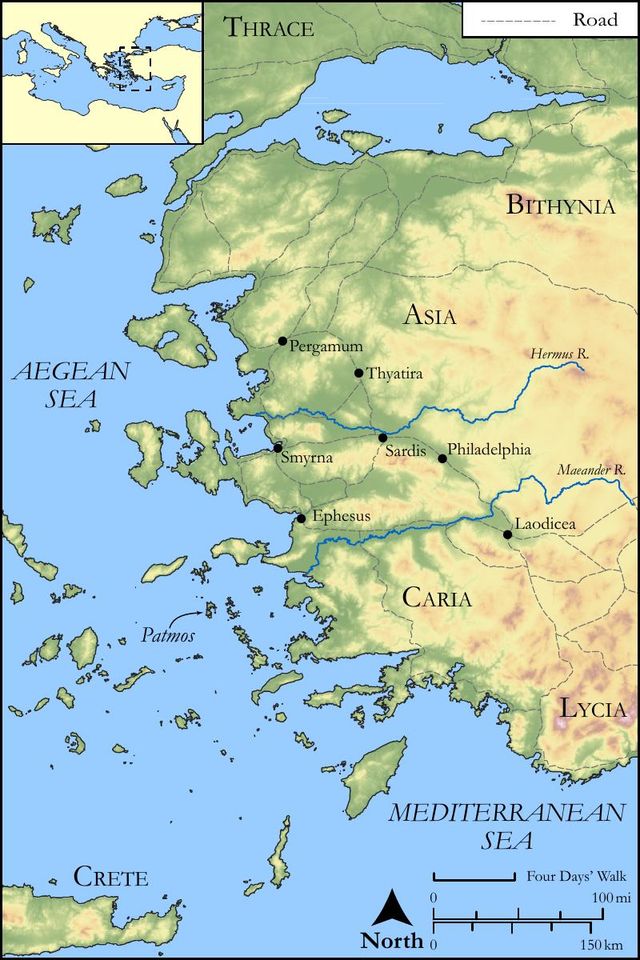
See on the biblical-era maps

Study this verse
Public-domain commentary
Matthew Henry
From his Commentary on the Whole Bible. Henry comments on passages, not single verses — this entry covers Revelation 9:13–21. His three-level outline is real structure in the source text, so it is rendered as structure.
Here let us consider the preface to this vision, and then the vision itself.
I.The preface to this vision:
A voice was heard from the horns of the golden altar, Rev 9:13, Rev 9:14. Here observe,
1.The power of the church's enemies is restrained till God gives the word to have them turned loose.
2.When nations are ripe for punishment, those instruments of God's anger that were before restrained are let loose upon them, Rev 9:14.
3.The instruments that God makes use of to punish a people may sometimes lie at a great distance from them, so that no danger may be apprehended from them. These four messengers of divine judgment lay bound in the river Euphrates, a great way from the European nations. Here the Turkish power had its rise, which seems to be the story of this vision.
II.The vision itself:
And the four angels that had been bound in the great river Euphrates were now loosed, Rev 9:15, Rev 9:16. And here observe,
1.The time of their military operations and executions is limited to an hour, and a day, and a month, and a year. Prophetic characters of time are hardly to be understood by us; but in general the time is fixed to an hour, when it shall begin and when it shall end; and how far the execution shall prevail, even to a third part of the inhabitants of the earth. God will make the wrath of man praise him, and the remainder of wrath he will restrain.
2.The army that was to execute this great commission is mustered, and the number found to be of horsemen two hundred thousand thousand; but we are left to guess what the infantry must be. In general, it tells us, the armies of the Mahomedan empire should be vastly great; and so it is certain they were.
3.Their formidable equipage and appearance, Rev 9:17. As the horses were fierce, like lions, and eager to rush into the battle, so those who sat upon them were clad in bright and costly armour, with all the ensigns of martial courage, zeal, and resolution.
4.The vast havoc and desolation that they made in the Roman empire, which had now become antichristian: A third part of them were killed; they went as far as their commission suffered them, and they could go no further.
5.Their artillery, by which they made such slaughter, described by fire, smoke, and brimstone, issuing out of the mouths of their horses, and the stings that were in their tails. It is Mr. Mede's opinion that this is a prediction of great guns, those instruments of cruelty which make such destruction: he observes, These were first used by the Turks at the siege of Constantinople, and, being new and strange, were very terrible, and did great execution. However, here seems to be an allusion to what is mentioned in the former vision, that, as antichrist had his forces of a spiritual nature, like scorpions poisoning the minds of men with error and idolatry, so the Turks, who were raised up to punish the antichristian apostasy, had their scorpions and their stings too, to hurt and kill the bodies of those who had been the murderers of so many souls.
6.Observe the impenitency of the antichristian generation under these dreadful judgments (Rev 9:20); the rest of the men who were not killed repented not, they still persisted in those sins for which God was so severely punishing them, which were,
(1.)Their idolatry; they would not cast away their images, though they could do them no good, could not see, nor hear, nor walk.
(2.)Their murders (Rev 9:21), which they had committed upon the saints and servants of Christ. Popery is a bloody religion, and seems resolved to continue such.
(3.)Their sorceries; they have their charms, and magic arts, and rites in exorcism and other things.
(4.)Their fornication; they allow both spiritual and carnal impurity, and promote it in themselves and others.
(5.)Their thefts; they have by unjust means heaped together a vast deal of wealth, to the injury and impoverishing of families, cities, princes, and nations. These are the flagrant crimes of antichrist and his agents; and, though God has revealed his wrath from heaven against them, they are obstinate, hardened, and impenitent, and judicially so, for they must be destroyed.
III.From this sixth trumpet we learn,
1.God can make one enemy of the church to be a scourge and plague to another.
2.He who is the Lord of hosts has vast armies at his command, to serve his own purposes.
3.The most formidable powers have limits set them, which they cannot transgress.
4.When God's judgments are in the earth, he expects the inhabitants thereof should repent of sin, and learn righteousness.
5.Impenitency under divine judgments is an iniquity that will be the ruin of sinners; for where God judges he will overcome.
Historical interpretation
Seven Centuries of Reception
6 surviving comments on this verse. Each one is dated, so this reads as a timeline rather than a list.
Select a marker to jump to its quote. Markers stagger vertically where authors wrote within a few decades of each other.
"And I heard a voice from the four horns of the golden altar which is in the presence of God, saying to the sixth angel which had the trumpet, Loose the four angels." That is, the four corners of the earth which hold the four winds.
"Which are bound in the great river Euphrates." By the corners of the earth, or the four winds across the river Euphrates, are meant four nations, because to every nation is sent an angel; as said the law, "He determined them by the number of the angels of God," until the number of the saints should be filled up. They do not overpass their bounds, because at the last they shall come with Antichrist.
When it says that the first woe has passed and the trumpet of the sixth angel has sounded, it announces the final preaching, that of the sixth age.
In the altar that is in the sight of God we are to understand the church. In the time of the last persecution she will despise the words and commands of that most inhumane of kings and will separate from those who have submitted to him.
And the sixth angel sounded his trumpet, etc. The sixth angel represents the preachers of the final battle, who, at the prompting of the Gospel, expose the frauds of the Antichrist. The horns of the golden altar indeed represent the preeminent Gospels of the Church.
After these things the sixth angel also sounded the trumpet: and I heard the voice of one of the horns of the golden altar, which is before the eyes of God, saying to the sixth angel, who had the trumpet: Loose the four angels, who are bound in the great river Euphrates. The altar is the Church, and it is golden because it is illuminated by heavenly wisdom. Note also that the altar is before the eyes of God because the eyes of the Lord are upon the just. [Ps. 33:16] The horns of the altar are holy preachers, and by this one horn we understand the leader of preachers, that is Christ. He tells the sixth angel sounding the trumpet, that is, he proclaims to the Church, to loose the four angels, because he has granted it the power to bind and loose in heaven and on earth, according to this: Whatsoever thou shalt bind, etc. [Matt. 16:19] In the four angels we recognize the entire body of the reprobates, which consists of evil spirits and wicked men, of course separate in nature, but united in iniquity. Indeed the number four is frequently used to signify totality, whence it is said that in the end of the world the elect will be taken from the four winds of the sky by angels. [Matt. 24:31 and Mark 13:27] By the Euphrates, which is often mentioned with a negative meaning, is represented the worldly kingdom’s power, hostile to Christ and the Church; and the old enemy is said to be bound in this power with his body because he is not permitted to do as much harm as he wants. So let us take Loose the four angels who are bound in the great river Euphrates as if the Church were told, “Loose both men in angels, and angels in men, and bear in mind how much you ought to endure the hardships of persecution with equanimity, since your enemies are not able to inflict them on you except by your own judgment, which is in your Head, which proclaims for you and in you, All power is given to me in heaven and in earth.” [Matt. 28:18]
When "the angel sounded", "I heard a voice" coming "from the horns of the altar". "The horns of the altar", he says, are those that stand out among the angels and surpass the others.
He calls the altar "golden" because of its honor and divine nature, made from precious material known to us, depicting a marvelous altar.
Just as we understood "the horns of the altar" to represent the rulers of the angels, so the altar itself symbolizes all the ministering spirits; because it offers a spiritual [λογικήν] sacrifice to God.
Continue studying Revelation 9:13 across the web’s major study libraries — every link below opens this exact verse, chapter, or book on the destination site.
Read & Compare
 BibleGatewayThis verse in more than 200 translations and 70 languages.
 Bible.comThe YouVersion reader — hundreds of translations, reading plans, and highlights.
 ESV.orgCrossway's official English Standard Version reader.
 NET BibleThe NET translation with 60,000+ translators' notes on every rendering decision.
 STEP BibleTyndale House's free study tool — original text, vocabulary, and scholarly resources.
 BibliaLogos Bible Software's free web reader.
 USCCBThe New American Bible (Revised Edition) with the U.S. bishops' study notes.
Commentaries
 BibleHub CommentariesDozens of classic commentaries on this verse, gathered on one page.
 StudyLightMore than 100 commentary sets — the largest collection on the web.
 BibleRefPlain-English commentary on what this verse means, verse by verse.
 Enduring WordDavid Guzik's free commentary on this chapter, widely used by Bible teachers.
 Bible Study ToolsVerse commentary alongside Greek and Hebrew study aids.
Original Language & Research
- BibleHub InterlinearThe verse word by word — original language, transliteration, and English.
- BibleHub LexiconEvery word's original-language definition and Strong's entry.
 Blue Letter BibleDeep-study tools — Strong's numbers, concordance, and word studies.
 CNTR CollationThe earliest Greek manuscripts of this verse, collated letter by letter.
Sermons, Hymns & Audio


TrulyRandomVerse is not affiliated with these sites and doesn’t control their content. They’re linked because they’re genuinely useful.
Summary
Revelation 9:13 marks a critical juncture in John's apocalyptic vision, as the sounding of the sixth trumpet ushers in a new phase of divine judgment. This verse describes John hearing a powerful voice emanating from the four horns of the golden altar, which stands directly before God in the heavenly sanctuary. This dramatic scene underscores the divine origin and authority behind the unfolding judgments, signaling that the next wave of devastation is not random but a direct decree from God's holy presence, intimately connected to the prayers and purposes of His heavenly court.
Context
ShowHideLiterary Context
Revelation 9:13 is positioned within the sequence of the seven trumpet judgments, which dominate Revelation chapters 8-11. These judgments follow the opening of the seventh seal and represent a progressive intensification of God's wrath upon a rebellious world. The preceding verses in Revelation 9:1-12 detail the first woe, unleashed by the fifth trumpet, involving demonic locusts tormenting humanity. The sounding of the sixth trumpet in Revelation 9:13 signals the commencement of the second woe, indicating a deliberate and escalating progression of divine retribution. The heavenly setting, particularly the mention of the golden altar, directly links this judgment to the heavenly throne room and the prayers of the saints depicted earlier in Revelation 8:3-5, where an angel offers incense with the prayers of all saints upon this very altar.
Historical & Cultural Context
The imagery of the "golden altar" and its "horns" is deeply rooted in Old Testament sacrificial and tabernacle/temple practices. In the Mosaic Law, there were two primary altars: the bronze altar of burnt offering in the courtyard and the golden altar of incense within the Holy Place, directly before the veil separating it from the Most Holy Place (Exodus 30:1-6). The horns on these altars were prominent features, often associated with power, refuge (as seen with Adonijah clinging to the altar horns in 1 Kings 1:50), and the application of sacrificial blood. In Revelation, the golden altar consistently symbolizes the prayers of the saints ascending to God (Revelation 5:8). The voice emanating from this altar, therefore, carries immense theological weight, suggesting that the impending judgments are either a direct response to the prayers for justice or a divine decree originating from the very place where God's holiness and the petitions of His people meet.
Key Themes
ShowHideThis verse powerfully contributes to several overarching themes in Revelation. Firstly, it emphasizes the Divine Authority and Sovereignty of God over all creation and judgment. The voice coming directly from before God, specifically from the altar, underscores that these cataclysmic events are not chaotic but are precisely orchestrated by the Almighty. Secondly, the Significance of the Altar is highlighted; though traditionally a place of prayer and intercession, it now becomes the source of a command for judgment, indicating that divine patience has reached its limit and that the prayers for justice and the vindication of God's people are being answered. Thirdly, the verse reinforces the theme of Progressive Judgment and Woe, as the sixth trumpet introduces the second of three "woes" (Revelation 9:12), signifying an intensification of suffering and destruction upon those who refuse to repent, demonstrating God's deliberate and measured approach to bringing about His ultimate purposes.
Exposition and Analysis
ShowHideKey Word Analysis
ShowHideThis term denotes a tone, an articulate sound, or an address. Here, it signifies a direct, authoritative communication from a divine source. The fact that it comes from the altar's horns, rather than directly from the throne, adds layers of meaning concerning the origin and nature of the command.
Literally referring to the projections on the corners of the altar, "horns" in biblical symbolism often represent power, strength, or authority. Their connection to the altar of incense, where prayers ascend, suggests that the power now being unleashed is intimately linked to the divine response to those prayers or to the inherent authority of God's holy presence.
This word refers to a place of sacrifice, specifically the golden altar of incense in the heavenly sanctuary. Its golden nature (G5552) emphasizes its purity, holiness, and direct connection to God's presence. The voice emanating from it signifies that the command for judgment proceeds from the very heart of divine worship and justice.
Verse Breakdown
ShowHide"And the sixth angel sounded,"
This clause marks the progression of the trumpet judgments. Following the fifth trumpet's release of demonic locusts, the sounding of the sixth trumpet signals the commencement of the second "woe," indicating a new and more severe phase of divine retribution. It emphasizes the predetermined, orderly unfolding of God's eschatological plan.
"and I heard a voice"
John's auditory experience highlights the divine origin of the subsequent command. The "voice" is not a mere sound but an articulate, authoritative communication, drawing attention to its source and significance. It implies a direct revelation or instruction being given.
"from the four horns of the golden altar"
This is a highly symbolic detail. The voice does not come from the throne directly but from the altar, specifically its horns. The golden altar is the altar of incense, symbolizing the prayers of the saints. The horns, representing power and authority, suggest that the command for judgment is either a response to the prayers for justice, or it emanates from the inherent power and holiness associated with God's presence and the altar's sacred purpose. The "four horns" may also symbolize a universal decree, reaching all corners of the earth.
"which is before God,"
This phrase firmly establishes the location of the altar and the voice's origin within the immediate presence of God in the heavenly sanctuary. It underscores the divine sanction and ultimate authority behind the command that is about to be issued, ensuring that the ensuing judgments are understood as God's direct will, not random chaos.
Literary Devices
ShowHideThe verse employs several significant literary devices. Symbolism is paramount, with the "golden altar" representing the heavenly sanctuary and the prayers of the saints, while its "four horns" symbolize divine power and universal authority. The anthropomorphism of a "voice" emanating from an inanimate object (the altar) personifies the divine decree, making it tangible and impactful. The sequential narration of the trumpet judgments (Revelation 8:6-12) creates a sense of escalating drama and predetermined progression, emphasizing God's control over time and events. The use of auditory imagery ("sounded," "heard a voice") immerses the reader in John's experience, making the divine pronouncement vivid and immediate.
Theological and Thematic Connections
ShowHideRevelation 9:13 profoundly underscores the truth of God's absolute sovereignty and the certainty of His divine judgments. The voice emanating from the golden altar, a place intrinsically linked to the prayers of the saints, suggests a profound connection between the petitions of God's people and the unfolding of His justice. It implies that the cries for vindication and the longing for righteousness from those who have suffered for Christ are heard and are being answered, not necessarily in the form of immediate rescue, but in the systematic execution of God's righteous wrath upon those who reject Him. This scene serves as a powerful reminder that even in the midst of seemingly chaotic events, God remains firmly in control, orchestrating every detail according to His perfect will and timing.
Reflection and Application
ShowHideRevelation 9:13 calls believers to a profound reflection on God's character: He is both merciful and just. While the world often dismisses divine judgment, this verse reminds us that God's patience is not infinite, and His justice will ultimately prevail. For those who belong to Him, this truth brings comfort and assurance that evil will not triumph indefinitely, and that their prayers for righteousness and the coming of His kingdom are not in vain. It also serves as a solemn warning to those who remain unrepentant, highlighting the severity of God's wrath against sin. This passage encourages a deeper commitment to living righteously, knowing that every action is observed by a holy God. It compels us to cultivate a life of prayer and intercession, trusting that our petitions are heard in the heavenly sanctuary and play a part in God's unfolding plan, whether for mercy or for justice. Ultimately, it fosters a healthy fear of the Lord and a renewed urgency to share the Gospel of repentance and salvation.
Questions for Reflection
ShowHideFAQ
ShowHideWhat is the significance of the "golden altar" in Revelation?
ShowHideThe "golden altar" in Revelation is consistently identified as the altar of incense, distinct from the altar of burnt offering. It is located in the heavenly sanctuary, directly "before God." Its primary significance is as the place where the prayers of the saints ascend to God, often mingled with incense (Revelation 5:8 and Revelation 8:3-5). In Revelation 9:13, the voice emanating from its horns signifies that the subsequent judgments are not random but are divinely ordained, perhaps even in response to the prayers for justice from God's persecuted people.
Why do the judgments in Revelation come in a sequence (trumpets, woes)?
ShowHideThe sequential nature of the judgments in Revelation (seals, trumpets, bowls) emphasizes God's deliberate, orderly, and progressive unfolding of His plan for both judgment and redemption. Each series intensifies the previous one, demonstrating God's long-suffering patience but also His unwavering commitment to justice. The "woes" (Revelation 9:12) specifically highlight particularly severe and devastating judgments, serving as escalating warnings intended to lead humanity to repentance before the final, ultimate judgment. This progression underscores God's sovereignty and His methodical approach to bringing history to its appointed climax.
Christ-Centered Fulfillment
ShowHideWhile Revelation 9:13 describes a scene of impending judgment, its Christ-centered fulfillment lies in understanding that all divine judgment ultimately flows from the perfect justice and holiness of God, fully embodied in Jesus Christ. The voice from the altar, initiating further judgment, speaks from a heavenly sanctuary where Christ himself intercedes as our great High Priest (Hebrews 4:14-16). The very altar from which judgment is decreed is also the place where the prayers of the saints, made effective through Christ's atoning sacrifice, ascend to God. Jesus, the Lamb of God who takes away the sin of the world, bore the full weight of God's wrath on the cross, thereby offering a way of escape from the judgments described in Revelation for all who believe in Him (Romans 5:9). Furthermore, Christ is not only the intercessor but also the righteous Judge (John 5:22), who will ultimately execute all of God's decrees, bringing both justice to the unrepentant and final vindication to His faithful people (Revelation 19:11-16). Thus, the judgments from the altar ultimately point to the sovereign rule of Christ, who is both the means of salvation and the instrument of divine justice.