


2 Chronicles 8:18
Bible text: King James Version (1769 Blayney text) · Public domain
Bible text: King James Version with Strong's numbers · Public domain
Bible text: Berean Standard Bible · Public domain
Bible text: American Standard Version (1901) · Public domain
Bible text: World English Bible, Messianic edition · Public domain
Bible text: Geneva Bible (1599) · Public domain
Bible text: Young's Literal Translation · Public domain
- וַיִּשְׁלַחvai·yish·lachand he sentH7971Conj-w ¦ V-Qal-ConsecImperf-3msVerb Qal Consecutive Imperfect 3rd Singular Masculineוַandיִּשְׁלַחhe sent
- לוֹloto himPrep-l ¦ 3msSuffix Personal 3rd Singular Masculineלtoוֹhim
- חוּרָםchu·RamHuramH2361N-proper-mNoun Proper Masculine
- בְּיַדbe·yadby [the] hand ofH3027Prep-b ¦ N-cscNoun Singular common gender Constructבְּbyיַד[the] hand of
- עֲבָדָיו'a·va·Davhis servantsH5650N-mpc ¦ 3msNoun Plural Masculine Constructעֲבָדָיservantsוhis
- אֳנִיּוֹת'o·ni·yotshipsH591N-fpNoun Plural Feminine Absolute
- וַעֲבָדִיםva·'a·va·Dimand servantsH5650Conj-w ¦ N-mpNoun Plural Masculine Absoluteוַandעֲבָדִיםservants
- יוֹדְעֵיYod·'ei[who] knewH3045V-Qal-Prtcpl-mpVerb Qal Participle Plural Masculine Construct
- יָםyam<of> [the] seaH3220N-msNoun Singular Masculine Absolute
- וַיָּבֹאוּvai·ya·Vo·'uand they wentH935Conj-w ¦ V-Qal-ConsecImperf-3mpVerb Qal Consecutive Imperfect 3rd Plural Masculineוַandיָּבֹאוּthey went
- עִם'imwithH5973PrepPreposition
- עַבְדֵי'av·Dei[the] servants ofH5650N-mpcNoun Plural Masculine Construct
- שְׁלֹמֹהshe·lo·MohSolomonH8010N-proper-mNoun Proper Masculine
- אוֹפִירָה'o·Fi·rahOphir towardsH211N-proper ¦ SfxNoun Proper LocationאוֹפִירָOphirהtowards
- וַיִּקְחוּvai·yik·Chuand they tookH3947Conj-w ¦ V-Qal-ConsecImperf-3mpVerb Qal Consecutive Imperfect 3rd Plural Masculineוַandיִּקְחוּthey took
- מִשָּׁםmi·Shamfrom thereH8033Prep-m ¦ AdvAdverbמִfromשָּׁםthere
- אַרְבַּע'ar·ba'fourH702N-csNoun Singular common gender Absolute
- מֵאוֹתme·'othundred<s>H3967N-fpNoun Plural Feminine Absolute
- וַחֲמִשִּׁיםva·cha·mi·Shimand fiftyH2572Conj-w ¦ N-mpNoun Plural Masculine Absoluteוַandחֲמִשִּׁיםfifty
- כִּכַּרki·Kartalent[s] ofH3603N-fscNoun Singular Feminine Construct
- זָהָבza·HavgoldH2091N-msNoun Singular Masculine Absolute
- וַיָּבִיאוּvai·ya·Vi·'uand they brought [it]H935Conj-w ¦ V-Hiphil-ConsecImperf-3mpVerb Hiphil Consecutive Imperfect 3rd Plural Masculineוַandיָּבִיאוּthey brought [it]
- אֶל'eltoH413PrepPreposition
- הַמֶּלֶךְha·Me·lekhthe kingH4428Art ¦ N-msNoun Singular Masculine Absoluteהַtheמֶּלֶךְking
- שְׁלֹמֹהshe·lo·MohSolomonH8010N-proper-mNoun Proper Masculine
English is a literal word-by-word gloss of the Hebrew, not the KJV's wording. Why?
This is the original text the KJV's translators worked from — each Hebrew word with its own literal English meaning in this verse, prepared by scholars at Tyndale House, Cambridge. The KJV translates whole sentences, not word by word, so its wording differs: one Hebrew word can become several English words, and the KJV may choose “the LORD” where the gloss reads “Yahweh”. Both are faithful — they answer different questions. For the KJV's own rendering, switch to the KJV text.
Details
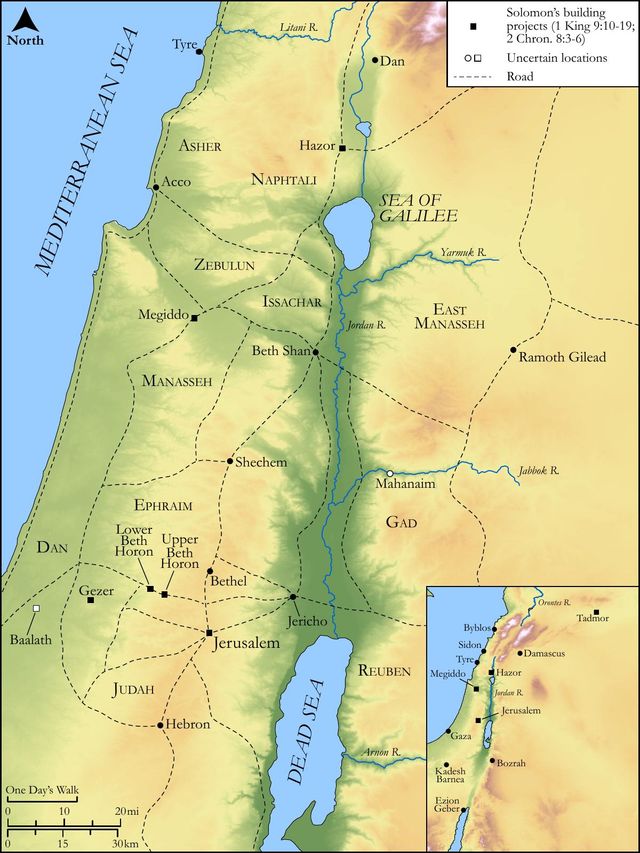
See on the biblical-era map
Study this verse
Public-domain commentary
Matthew Henry
From his Commentary on the Whole Bible. Henry comments on passages, not single verses — this entry covers 2 Chronicles 8:12–18.
Here is, I. Solomon's devotion. The building of the temple was in order to the service of the temple. Whatever cost he was at in rearing the structure, if he had neglected the worship that was to be performed there, it would all have been to no purpose. Assisting the devotion of others will not atone for our own neglects. When Solomon had built the temple, 1. He kept up the holy sacrifices there, according to the law of Moses, Ch2 8:12, Ch2 8:13. In vain had the altar been built, and in vain had fire come down from heaven, if sacrifices had not been constantly brought as the food of the altar and the fuel of that fire. There were daily sacrifices, a certain rate every day, as duly as the day came, weekly sacrifices on the sabbath, double to what was offered on other days, monthly sacrifices on the new moons, and yearly sacrifices at the three solemn feasts. Those are spiritual sacrifices that are now required of us, which we are to bring daily and weekly; and it is good to be in a settled method of devotion. 2. He kept up the holy songs there, according to the law of David, who is here called the man of God, as Moses was, because he was both instructed and authorised of God to make these establishments; and Solomon took care to see them observed as the duty of every day required, Ch2 8:14. Solomon, though a wise and great man and the builder of the temple, did not attempt to amend, alter, or add to what the man of God had, in God's name, commanded, but closely adhered to that, and used his authority to have that duly observed; and then none departed from the commandment of the king concerning any matter, Ch2 8:15. He observed God's laws, and then all obeyed his orders. When the service of the temple was put into this good order, then it is said, The house of the Lord was perfected, Ch2 8:16. The work was the main matter, not the place; the temple was unfinished till all this was done.
II.Solomon's merchandise.
He did himself in person visit the sea-port towns of Eloth and Ezion-geber; for those that deal much in the world will find it their interest, as far as they can, to inspect their affairs themselves and to see with their own eyes, Ch2 8:17. Canaan was a rich country, and yet must send to Ophir for gold; the Israelites were a wise and understanding people, and yet must be beholden to the king of Tyre for men that had knowledge of the seas, Ch2 8:18. Yet Canaan was God's peculiar land, and Israel God's peculiar people. This teaches us that grace, and not gold, is the best riches, and acquaintance with God and his law, not with arts and sciences, the best knowledge.
Continue studying 2 Chronicles 8:18 across the web’s major study libraries — every link below opens this exact verse, chapter, or book on the destination site.
Read & Compare
 BibleGatewayThis verse in more than 200 translations and 70 languages.
 Bible.comThe YouVersion reader — hundreds of translations, reading plans, and highlights.
 ESV.orgCrossway's official English Standard Version reader.
 NET BibleThe NET translation with 60,000+ translators' notes on every rendering decision.
 STEP BibleTyndale House's free study tool — original text, vocabulary, and scholarly resources.
 BibliaLogos Bible Software's free web reader.
 USCCBThe New American Bible (Revised Edition) with the U.S. bishops' study notes.
Commentaries
 BibleHub CommentariesDozens of classic commentaries on this verse, gathered on one page.
 StudyLightMore than 100 commentary sets — the largest collection on the web.
 BibleRefPlain-English commentary on what this verse means, verse by verse.
 Enduring WordDavid Guzik's free commentary on this chapter, widely used by Bible teachers.
 Bible Study ToolsVerse commentary alongside Greek and Hebrew study aids.
Original Language & Research
- BibleHub InterlinearThe verse word by word — original language, transliteration, and English.
- BibleHub LexiconEvery word's original-language definition and Strong's entry.
 Blue Letter BibleDeep-study tools — Strong's numbers, concordance, and word studies.
 SefariaThe Hebrew text with Rashi and centuries of Jewish commentary.
Sermons, Hymns & Audio


TrulyRandomVerse is not affiliated with these sites and doesn’t control their content. They’re linked because they’re genuinely useful.
Summary
2 Chronicles 8:18 vividly portrays a significant achievement in King Solomon's reign, detailing the successful maritime expedition to Ophir, facilitated by his strategic alliance with King Huram of Tyre. This verse highlights the immense wealth acquired—specifically four hundred and fifty talents of gold—which contributed substantially to the unparalleled prosperity and grandeur of Solomon's kingdom, underscoring God's abundant blessing and the kingdom's extensive international reach and sophisticated economic infrastructure.
Context
ShowHideLiterary Context
This verse is strategically placed within 2 Chronicles 8-9, a section meticulously chronicling the consolidation and flourishing of Solomon's kingdom after the completion of the Temple and his royal palace, as detailed in 2 Chronicles 7. Having established his religious and administrative centers, Solomon systematically turns his attention to economic expansion and securing his borders through various building projects and strategic alliances. The Chronicler, writing for a post-exilic audience, emphasizes Solomon's divinely granted wisdom and wealth as foundational to his reign, presenting him as an ideal king. This expedition to Ophir serves as a concrete example of the vast resources at his disposal, paralleling accounts found in 1 Kings 9-10. The acquisition of such immense wealth directly precedes the detailed description of Solomon's unparalleled glory and the Queen of Sheba's visit in 2 Chronicles 9, demonstrating the material basis for his renown and the fulfillment of God's promises.
Historical & Cultural Context
The kingdoms round about Israel formed a complex network of burgeoning empires and trading nations, where alliances and maritime prowess were critical for economic and political dominance. Tyre, under King Huram (often referred to as Hiram in 1 Kings 5), was a preeminent Phoenician city-state, renowned for its skilled sailors, shipbuilders, and extensive trade routes that spanned the Mediterranean and potentially beyond. Solomon's alliance with Huram was a diplomatic masterstroke, leveraging Tyre's naval expertise and access to distant markets that Israel, primarily an agrarian society, lacked. Long-distance trade expeditions, often undertaken by joint ventures, were common for acquiring exotic goods and precious metals, signifying national power and influence. Ophir, though its exact location remains one of biblical archaeology's enduring mysteries (theories include regions in East Africa, India, or the Arabian Peninsula), was universally recognized in antiquity as a fabled source of high-quality gold. Its successful procurement, therefore, was not merely an economic transaction but a testament to the scale, sophistication, and international influence of Solomon's commercial enterprises and his kingdom's unprecedented prosperity.
Key Themes
ShowHide2 Chronicles 8:18 powerfully illustrates several key themes central to the Chronicler's narrative of Solomon's reign and, by extension, God's providential care for His people. Firstly, it highlights International Cooperation, showcasing the strategic and mutually beneficial alliance between Solomon and Huram. This partnership was absolutely essential for Israel's economic prosperity and global reach, allowing Solomon to access resources and expertise far beyond his immediate borders, demonstrating the value of leveraging diverse strengths. Secondly, the verse underscores Solomon's Unparalleled Prosperity, directly demonstrating the tangible fulfillment of God's promise to grant Solomon "riches and wealth and honor" (2 Chronicles 1:12). The acquisition of 450 talents of gold was an extraordinary sum, emphasizing the divine blessing upon his reign, which enabled his vast building projects, including the magnificent Temple, and his lavish lifestyle, as further detailed in 2 Chronicles 9:22. Lastly, it emphasizes the importance of Maritime Trade and Naval Power in Solomon's day, revealing the sophisticated economic infrastructure Solomon developed, moving Israel beyond a purely agrarian society into a significant player in global commerce and influence.
Exposition and Analysis
ShowHideKey Word Analysis
ShowHideFrom an unused root meaning "whiteness," suggesting "noble." Huram was the king of Tyre, a powerful Phoenician city-state renowned for its maritime prowess and skilled artisans. He was a crucial ally to Solomon, providing not only materials like cedar and cypress timber for the Temple and palace (2 Chronicles 2:3-10) but also invaluable naval expertise and personnel for long-distance trade expeditions, as seen in this verse. His partnership was foundational to Solomon's economic success and the grandeur of his building projects.
Of uncertain derivation, Ophir is the name of a son of Joktan, and also a legendary gold region in the East. It was renowned in antiquity for its abundant and high-quality gold, as well as precious stones and almug wood. While its exact geographical location remains a subject of scholarly debate, ranging from regions in East Africa, India, or the Arabian Peninsula, its mention immediately evokes images of immense wealth and distant, exotic lands. For the biblical audience, Ophir symbolized the ultimate source of material riches, signifying the vastness of Solomon's reach and resources.
From a root meaning "to circle," referring to a circle, a circumjacent tract, a loaf, or a talent (a large, round coin or weight). In this context, "talents" refers to a unit of weight, not a coin, representing a substantial quantity of gold. In Israel, a talent typically weighed between 75 and 125 pounds (approximately 34-57 kg). Thus, 450 talents of gold would translate to an astonishing amount, potentially over 50,000 pounds (over 22,000 kg) of gold, highlighting the truly immense scale of the wealth acquired by Solomon and the unprecedented prosperity of his kingdom.
Verse Breakdown
ShowHide"And Huram sent him by the hands of his servants ships, and servants that had knowledge of the sea"
This initial clause highlights the crucial and indispensable contribution of King Huram of Tyre to Solomon's ambitious maritime ventures. It emphasizes not only the provision of physical vessels ("ships") but, more importantly, the invaluable human capital: "servants that had knowledge of the sea." This phrase denotes a specialized skill set, encompassing navigation, shipbuilding, and long-distance trade logistics, underscoring the collaborative nature of the enterprise and Solomon's strategic reliance on Huram's superior naval expertise.
"and they went with the servants of Solomon to Ophir"
This part of the verse details the joint nature of the expedition, emphasizing a true partnership. Huram's skilled Phoenician mariners accompanied Solomon's own servants, forming a combined crew for this significant undertaking. The destination, "Ophir," immediately signals the primary purpose of the voyage: the acquisition of precious metals, particularly gold, from a renowned, albeit distant, source. The journey to such a fabled and remote land speaks volumes about the ambition, logistical capabilities, and extensive reach of Solomon's kingdom.
"and took thence four hundred and fifty talents of gold, and brought [them] to king Solomon"
This final clause reveals the successful and immensely profitable outcome of the expedition. The quantity "four hundred and fifty talents of gold" represents an extraordinary and almost unimaginable sum for that day, signifying the vast wealth accumulated. The gold was then delivered directly to "king Solomon," emphasizing his central role as the recipient and ultimate beneficiary of this immense prosperity, which further solidified his kingdom's economic power, grandeur, and international standing as a divinely blessed ruler.
Literary Devices
ShowHideThe Chronicler employs several literary devices in 2 Chronicles 8:18 to convey its profound significance and underscore the unparalleled nature of Solomon's reign. The most prominent is Amplification, or perhaps even Hyperbole, in the sheer quantity of gold mentioned (450 talents). While likely historically accurate, the number is presented in a way that magnifies the scale of Solomon's wealth and the divine favor bestowed upon him, elevating his reign to a legendary status of prosperity. The mention of "Ophir" functions as Symbolism, representing a distant, almost mythical source of ultimate material riches, thereby enhancing the perception of Solomon's power, global reach, and the exotic nature of his kingdom's resources. The concise narrative style, focusing sharply on the action and its successful outcome, demonstrates Narrative Economy, efficiently conveying a massive undertaking and its successful conclusion within a single, impactful verse. Furthermore, the Chronicler's account here shows Parallelism with the earlier narrative in 1 Kings 9:26-28, a common technique used to affirm and expand upon the historical record, underscoring the consistent theme of Solomon's divinely blessed prosperity across biblical accounts and reinforcing its theological significance.
Theological and Thematic Connections
ShowHideThe acquisition of immense wealth by Solomon, as meticulously detailed in 2 Chronicles 8:18, transcends a mere record of economic success; it stands as a profound theological statement of God's covenant faithfulness and His lavish blessing upon Solomon and the nation of Israel. This unprecedented prosperity was a direct and tangible fulfillment of God's promise to Solomon, who had humbly prioritized wisdom and God's kingdom above personal riches and long life (1 Kings 3:13). The gold from Ophir contributed significantly to the splendor of the Temple, the very dwelling place of God's presence, signifying that material blessings, when stewarded under divine guidance, can indeed serve to glorify God and advance His redemptive purposes on earth. This narrative reminds us that God is the ultimate source of all wealth and resources, and He can provide abundantly to accomplish His sovereign will, demonstrating His power and generosity to those who seek Him and His kingdom first.
Reflection and Application
ShowHide2 Chronicles 8:18, while describing an ancient king's extraordinary wealth, offers timeless principles for contemporary reflection and application in our lives. Solomon's strategic alliance with Huram highlights the enduring value of wise partnerships and leveraging diverse skills for mutual benefit and greater impact. In our personal endeavors, professional careers, and communal ministries, recognizing and collaborating with others who possess complementary strengths can lead to far greater effectiveness and broader reach than isolated efforts. Furthermore, the immense wealth brought to Solomon serves as a powerful reminder of God's boundless capacity for abundant provision. It challenges us to consider our own resources—whether financial, intellectual, relational, or spiritual—not as ends in themselves, but as precious gifts from God to be stewarded wisely for His glory and the good of His kingdom. Just as Solomon used his wealth to build the magnificent Temple and expand his kingdom's influence, we are called to align our resources with God's purposes, remembering that true prosperity is found not merely in accumulation, but in faithfulness, generosity, and using what we have to bless others and advance His work in the world. This verse encourages us to trust in God's ability to provide for our needs and to use what He has given us to be channels of His blessing.
Questions for Reflection
ShowHideFAQ
ShowHideWhat was a "talent" of gold, and how much was 450 talents?
ShowHideA "talent" (Hebrew: kikkār) was a significant unit of weight in Israel, not a monetary coin. Its exact weight varied slightly by region and period, but it typically ranged from 75 to 125 pounds (approximately 34-57 kilograms). Therefore, 450 talents of gold would represent an astonishing quantity, potentially over 50,000 pounds (more than 22,000 kilograms) of pure gold. This immense sum underscores the unparalleled wealth and economic power of King Solomon's kingdom, making it one of the wealthiest empires of its time, as also noted in 1 Kings 10:14, where it is recorded that he received 666 talents of gold annually.
Where was Ophir located?
ShowHideThe precise location of Ophir remains one of the most enduring mysteries in biblical geography and archaeology. While universally recognized in ancient texts as a fabled source of high-quality gold, precious stones, and rare woods (like almug wood), its exact whereabouts are debated by scholars. Theories range widely, suggesting locations in East Africa (e.g., modern-day Somalia or Ethiopia), India (e.g., the Malabar Coast), or various sites within the Arabian Peninsula. Despite the lack of a definitive answer, the consistent mention of Ophir in the biblical text signifies a distant, exotic, and immensely rich land, emphasizing the extensive reach of Solomon's trade network and the vastness of his divinely blessed resources.
Who was King Huram, and why was his partnership with Solomon so important?
ShowHideKing Huram (also known as Hiram in 1 Kings 5) was the powerful ruler of Tyre, a prominent Phoenician city-state located on the Mediterranean coast. Tyre was renowned for its advanced maritime capabilities, skilled craftsmen, and extensive trade routes by sea and land. His partnership with Solomon was critically important because it provided Israel with access to vital resources and expertise it lacked as a primarily land-based kingdom. Huram supplied high-quality timber (cedar and cypress) and skilled artisans for the monumental construction of the Temple and Solomon's palace (2 Chronicles 2:3-10). Crucially, as seen in 2 Chronicles 8:18, he also provided ships and experienced mariners, enabling Solomon to engage in long-distance maritime trade expeditions to places like Ophir. This strategic alliance was a cornerstone of Solomon's economic prosperity and contributed significantly to the grandeur and international standing of his kingdom.
Christ-Centered Fulfillment
ShowHideThe earthly glory, profound wisdom, and unparalleled material wealth of Solomon, vividly displayed in the acquisition of immense gold from Ophir, serve as a profound foreshadowing of the far greater spiritual riches and eternal reign of Jesus Christ. While Solomon's kingdom was magnificent and blessed by God, it was ultimately temporal, limited by human sin, and destined to decline. The New Testament consistently presents Jesus as the true and ultimate King, far surpassing Solomon in every conceivable way. Jesus Himself declared that "something greater than Solomon is here" (Matthew 12:42), implying that the wisdom, glory, and eternal nature of His kingdom infinitely transcend anything seen in Solomon's earthly reign. The vast quantity of gold brought to Solomon points to the immeasurable spiritual treasures found in Christ, "in whom are hidden all the treasures of wisdom and knowledge" (Colossians 2:3). Through Christ, believers are blessed not with perishable earthly talents of gold, but with "every spiritual blessing in the heavenly places in Christ" (Ephesians 1:3). His kingdom is not built with finite, perishable gold, but with eternal righteousness, peace, and joy in the Holy Spirit (Romans 14:17). The ultimate fulfillment of Solomon's golden age is found in the New Jerusalem, whose streets are pure gold (Revelation 21:21), symbolizing the divine glory, unblemished perfection, and eternal abundance of Christ's everlasting reign, from whose fullness "we have all received, grace upon grace" (John 1:16).