


1 Kings 9:27
Bible text: King James Version (1769 Blayney text) · Public domain
Bible text: Berean Standard Bible · Public domain
Bible text: American Standard Version (1901) · Public domain
Bible text: World English Bible, Messianic edition · Public domain
Bible text: Geneva Bible (1599) · Public domain
Bible text: Young's Literal Translation · Public domain
- וַיִּשְׁלַחvai·yish·Lachand he sentH7971Conj-w ¦ V-Qal-ConsecImperf-3msVerb Qal Consecutive Imperfect 3rd Singular Masculineוַandיִּשְׁלַחhe sent
- חִירָםchi·RamHiramH2438N-proper-mNoun Proper Masculine
- בָּאֳנִיbo·'o·Niin the ship[s]H590Prep-b ¦ N-csNoun Singular common gender Absoluteבָּin theאֳנִיship[s]
- אֶת'et<obj.>H853DirObjMParticle Object Indicator
- עֲבָדָיו'a·va·Davhis servantsH5650N-mpc ¦ 3msNoun Plural Masculine Constructעֲבָדָיservantsוhis
- אַנְשֵׁי'an·Sheimen ofH582N-mpcNoun Plural Masculine Construct
- אֳנִיּוֹת'o·ni·YotshipsH591N-fpNoun Plural Feminine Absolute
- יֹדְעֵיyo·de·'Ei[who] knewH3045V-Qal-Prtcpl-mpVerb Qal Participle Plural Masculine Construct
- הַיָּםhai·Yam<of> the seaH3220Art ¦ N-msNoun Singular Masculine Absoluteהַ<of> theיָּםsea
- עִם'imwithH5973PrepPreposition
- עַבְדֵי'av·Dei[the] servants ofH5650N-mpcNoun Plural Masculine Construct
- שְׁלֹמֹהshe·lo·MohSolomonH8010N-proper-mNoun Proper Masculine
English is a literal word-by-word gloss of the Hebrew, not the KJV's wording. Why?
This is the original text the KJV's translators worked from — each Hebrew word with its own literal English meaning in this verse, prepared by scholars at Tyndale House, Cambridge. The KJV translates whole sentences, not word by word, so its wording differs: one Hebrew word can become several English words, and the KJV may choose “the LORD” where the gloss reads “Yahweh”. Both are faithful — they answer different questions. For the KJV's own rendering, switch to the KJV text.
Details
See on the biblical-era maps

Study this verse
Public-domain commentary
Matthew Henry
From his Commentary on the Whole Bible. Henry comments on passages, not single verses — this entry covers 1 Kings 9:15–28. His two-level outline is real structure in the source text, so it is rendered as structure.
We have here a further account of Solomon's greatness.
I.His buildings.
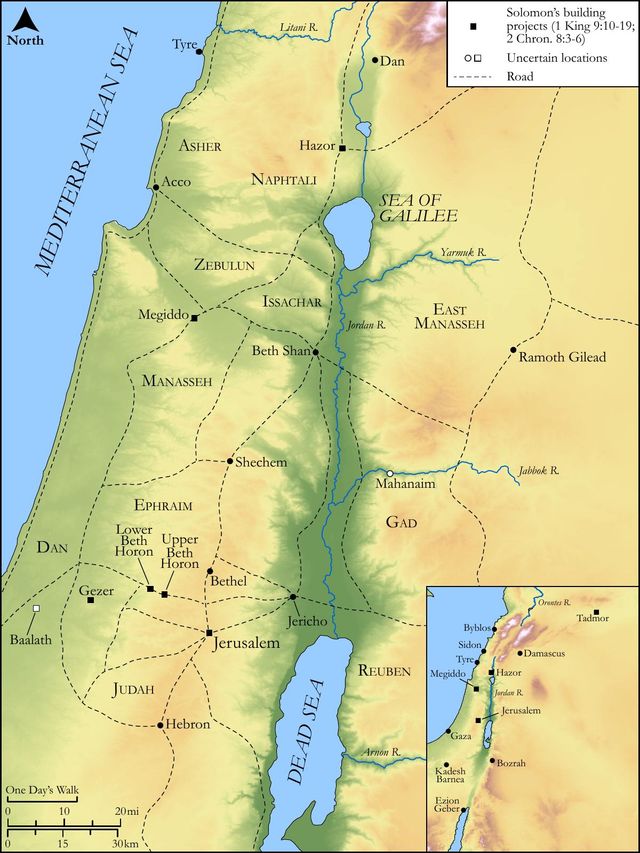
He raised a great levy both of men and money, because he projected a great deal of building, which would both employ many hands and put him to a vast expense, Kg1 9:15. And he was a wise builder, who sat down first, and counted the cost, and would not begin to build till he found himself able to finish. Perhaps there was some complaint of the heaviness of the taxes, which the historian excuses from the greatness of his undertakings. He raised it, not for war (as other princes), which would spend the blood of his subjects, but for building, which would require only their labour and purses. Perhaps David observed Solomon's genius to lie towards building, and foresaw he would have his head and hands full of it, when he penned that song of degrees for Solomon, which begins, Except the Lord build the house, those labour in vain that build it (Psa 127:1), directing him to acknowledge God in all his ways, and, by prayer and faith in his providence, to take him along with him in all his designs of this kind. And Solomon verily began his work at the right end, for he built God's house first, and finished that before he began his own; and then God blessed him, and he prospered in all his other buildings. If we begin with God, he will go on with us. Let the first-fruits be his, and the after-fruits will the more comfortably be ours, Mat 6:33. Solomon built a church first and then he was enabled to build houses, and cities, and walls. Those consult not their own interest that defer to the last what they design for pious uses. The further order in Solomon's buildings is observable. God's house first for religion, then his own for his own convenience, then a house for his wife, to which she removed as soon as it was ready for her (Kg1 9:24), then Millo, the town-house or guild-hall, then the wall of Jerusalem, the royal city, then some cities of note and strength in the country, which were decayed and unfortified, Hazor, Megiddo, etc. As he rebuilt these at his own charge, the inhabitants would be not only his subjects, but his tenants, which would increase the revenues of the crown for the benefit of his successors. Among the rest, he built Gezer, which Pharaoh took out of the hands of the Canaanites, and made a present of to his daughter, Solomon's wife, Kg1 9:16. See how God maketh the earth to help the woman. Solomon was not himself a warlike prince, but the king of Egypt, who was, took cities for him to build. Then he built cities for convenience, for store, for his chariots, and for his horsemen, Kg1 9:19. And, lastly, he built for pleasure in Lebanon, for his hunting perhaps, or other diversions there. Let piety begin, and profit proceed, and leave pleasure to the last.
II.His workmen and servants.
In doing such great works, he must needs employ abundance of workmen. The honour of great men is borrowed from their inferiors, who do that which they have the credit of.
1.Solomon employed those who remained of the conquered and devoted nations in all the slavish work, Kg1 9:20, Kg1 9:21. We may suppose that they renounced their idolatry and submitted to Solomon's government, so that he could not, in honour, utterly destroy them, and they were so poor that he could not levy money on them; therefore he served himself of their labour. Herein he observed God's law (Lev 25:44, Thy bondmen shall be of the heathen), and fulfilled Noah's curse upon Canaan, A servant of servants shall he be unto his brethren, Gen 9:25.
2.He employed Israelites in the more creditable services (Kg1 9:22, Kg1 9:23): Of them he made no bondmen, for they were God's freemen, but he made them soldiers and courtiers, and gave them offices, as he saw them qualified, among his chariots and horsemen, appointing some to support the service of the inferior labourers. Thus he preserved the dignity and liberty of Israel and honoured their relation to God as a kingdom of priests.
III.His piety and devotion (Kg1 9:25):
Three times in a year he offered burnt-offerings extraordinary (namely, at the three yearly feasts, the passover, pentecost, and feast of tabernacles) in honour of the divine institution, besides what he offered at other times, both statedly and upon special occasions. With his sacrifices he burnt incense, not himself (that was king Uzziah's crime), but the priest for him, at his charge, and for his particular use. It is said, He offered on the altar which he himself built. He took care to build it, and then,
1.He himself made use of it. Many will assist the devotions of others that neglect their own. Solomon did not think his building an altar would excuse him from sacrificing, but rather engage him the more to it.
2.He himself had the benefit and comfort of it. Whatever pains we take, for the support of religion, to the glory of God and the edification of others, we ourselves are likely to have the advantage of it.
IV.His merchandise.
He built a fleet of trading ships at Ezion-geber (Kg1 9:26), a port on the coast of the Red Sea, the furthest stage of the Israelites when they wandered in the wilderness, Num 33:35. Probably that wilderness now began to be peopled by the Edomites, which it was not then. To them this port had belonged, but, David having subdued the Edomites, it now pertained to the crown of Judah. The fleet traded to Ophir in the East Indies, supposed to be that which is now called Ceylon. Gold was the commodity traded for, substantial wealth. It should seem, Solomon had before been Hiram's partner, or put a venture into his ships, which made him a rich return of 120 talents (Kg1 9:14), which encouraged him to build a fleet of his own. The success of others in any employment should quicken our industry; for in all labour there is profit. Solomon sent his own servants as factors, and merchants, and super-cargoes, but hired Tyrians for sailors, for they had knowledge of the sea, Kg1 9:27. Thus one nation needs another, Providence so ordering it that there may be mutual commerce and assistance; for not only as Christians, but as men, we are members one of another. The fleet brought home to Solomon 420 talents of gold, Kg1 9:28. Canaan, the holy land, the glory of all lands, had no gold in it, which teaches us that that part of the wealth of this world which is for hoarding and trading is not the best part of it, but that which is more immediately for the present support and comfort of life, our own and others'; such were the productions of Canaan. Solomon got much by his merchandise, but, it should seem, David got much more by his conquests. What were Solomon's 420 talents to David's 100,000 talents of gold? Ch1 22:14; Ch1 29:4. Solomon got much by his merchandise, and yet has directed us to a better trade, within reach of the poorest, having assured us from his own experience of both that the merchandise of wisdom is better than the merchandise of silver and the gain thereof than fine gold, Pro 3:14.
Continue studying 1 Kings 9:27 across the web’s major study libraries — every link below opens this exact verse, chapter, or book on the destination site.
Read & Compare
 BibleGatewayThis verse in more than 200 translations and 70 languages.
 Bible.comThe YouVersion reader — hundreds of translations, reading plans, and highlights.
 ESV.orgCrossway's official English Standard Version reader.
 NET BibleThe NET translation with 60,000+ translators' notes on every rendering decision.
 STEP BibleTyndale House's free study tool — original text, vocabulary, and scholarly resources.
 BibliaLogos Bible Software's free web reader.
 USCCBThe New American Bible (Revised Edition) with the U.S. bishops' study notes.
Commentaries
 BibleHub CommentariesDozens of classic commentaries on this verse, gathered on one page.
 StudyLightMore than 100 commentary sets — the largest collection on the web.
 BibleRefPlain-English commentary on what this verse means, verse by verse.
 Enduring WordDavid Guzik's free commentary on this chapter, widely used by Bible teachers.
 Bible Study ToolsVerse commentary alongside Greek and Hebrew study aids.
Original Language & Research
- BibleHub InterlinearThe verse word by word — original language, transliteration, and English.
- BibleHub LexiconEvery word's original-language definition and Strong's entry.
 Blue Letter BibleDeep-study tools — Strong's numbers, concordance, and word studies.
 SefariaThe Hebrew text with Rashi and centuries of Jewish commentary.
Sermons, Hymns & Audio


TrulyRandomVerse is not affiliated with these sites and doesn’t control their content. They’re linked because they’re genuinely useful.
Summary
1 Kings 9:27 details a pivotal aspect of King Solomon's ambitious maritime trade ventures: the indispensable partnership with King Hiram of Tyre. Following the construction of Solomon's fleet at Ezion-geber, this verse highlights Hiram's provision of highly skilled Phoenician mariners, described as "shipmen that had knowledge of the sea," to accompany Solomon's own less experienced servants. This collaboration was absolutely vital for the success of these long-distance expeditions, primarily aimed at acquiring vast quantities of valuable resources like gold from Ophir, thereby underscoring Solomon's administrative wisdom in leveraging international expertise for the prosperity and glory of his kingdom.
Context
ShowHideLiterary Context
This verse is strategically placed within a broader narrative in 1 Kings that meticulously chronicles the zenith of King Solomon's reign, focusing on his monumental building projects, the consolidation of his immense wealth, and the expansion of his kingdom's influence. Immediately preceding 1 Kings 9:27, 1 Kings 9:26 sets the stage by describing Solomon's construction of a formidable fleet of ships at Ezion-geber, a crucial port located at the northern tip of the Gulf of Aqaba. The subsequent verse, 1 Kings 9:28, immediately reveals the spectacular success and purpose of these maritime endeavors: the acquisition of an astonishing quantity of gold from Ophir. Thus, 1 Kings 9:27 functions as a critical explanatory link, elucidating how these extraordinarily successful and lucrative expeditions were made possible through a strategic and divinely blessed international cooperation, thereby further showcasing Solomon's unparalleled administrative acumen and the divine favor resting upon his reign, which extended far beyond the construction of the Temple and palace to encompass vast economic expansion.
Historical & Cultural Context
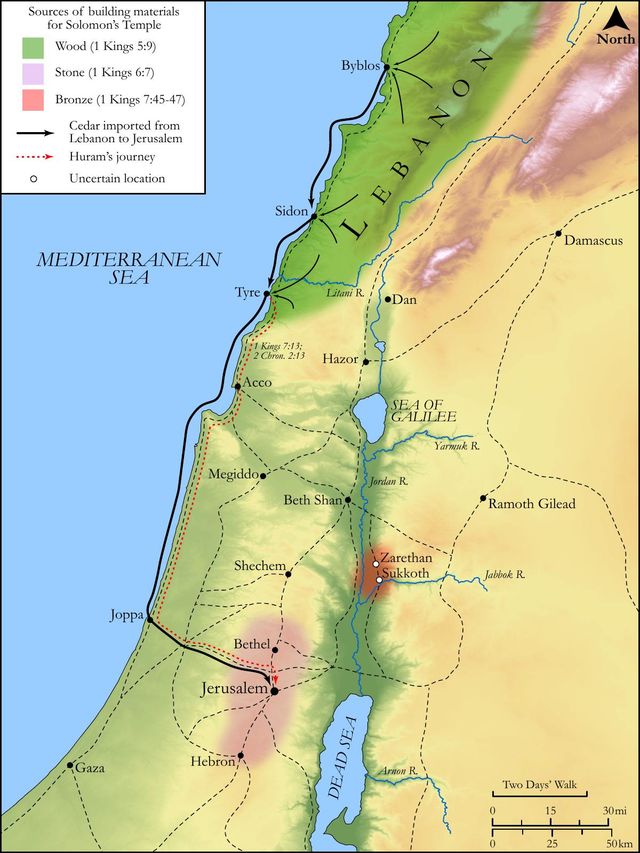
In that day, maritime trade was an exceedingly specialized, complex, and often perilous undertaking, requiring profound knowledge and experience. The Phoenicians, particularly the inhabitants of Tyre and Sidon, were universally recognized as the undisputed masters of seafaring and international commerce during this era. They possessed unparalleled expertise in shipbuilding, advanced navigation techniques, and an intricate understanding of sea routes across both the Mediterranean and Red Seas. In stark contrast, Israel was predominantly an agrarian society with very limited access to the sea and virtually no indigenous naval tradition or expertise. King Hiram of Tyre had already forged a robust and enduring alliance with Solomon, providing invaluable timber (cedar and cypress) and highly skilled craftsmen for the construction of the magnificent Temple and Solomon's royal palace, as detailed in 1 Kings 5:1-12. This verse vividly illustrates the continuation and strategic expansion of this mutually beneficial relationship into the crucial realm of large-scale maritime commerce. Ezion-geber, situated strategically at the northern tip of the Gulf of Aqaba, was Israel's sole direct access point to the Red Sea, thereby opening up vital trade routes to the resource-rich Arabian Peninsula and the distant lands of East Africa, regions renowned for their abundant gold, precious stones, and exotic goods.
Key Themes
ShowHide1 Kings 9:27 powerfully contributes to several overarching and significant themes woven throughout the book of 1 Kings. Firstly, it profoundly underscores the theme of International Collaboration and Strategic Alliance, demonstrating with clarity how Solomon's reign was uniquely characterized by astute partnerships that brought unprecedented prosperity, stability, and influence to Israel. The enduring alliance with Hiram, initially forged by King David and meticulously solidified by Solomon, served as a foundational cornerstone of Israel's remarkable economic success and geopolitical standing. Secondly, the verse highlights Solomon's Exceptional Wisdom in Governance and Administration. His divinely bestowed wisdom was not confined to judicial pronouncements or theological insights but extended pragmatically to the intricate matters of statecraft. He wisely recognized Israel's inherent limitations in maritime expertise and, with profound foresight, sought out external, specialized knowledge to achieve ambitious national goals. This exemplifies a pragmatic, resourceful, and truly sagacious approach to leadership, demonstrating that true wisdom often involves humble recognition of one's own deficiencies and a willingness to leverage the strengths of others. Thirdly, the verse emphatically emphasizes the Indispensable Importance of Specialized Knowledge and Expertise. The crucial phrase "shipmen that had knowledge of the sea" is paramount, underscoring that success in complex, large-scale endeavors frequently necessitates skills and proficiencies beyond one's immediate capabilities, thereby mandating a humble reliance on others' mastery. This theme resonates deeply with the broader biblical principle of diverse gifts and mutual dependence, beautifully articulated in New Testament passages like Romans 12:4-5, where different members contribute unique functions to the overall health and effectiveness of the body.
Exposition and Analysis
ShowHideKey Word Analysis
ShowHideThe king of Tyre, a formidable and wealthy Phoenician city-state celebrated for its unparalleled maritime prowess and extensive trade networks. Hiram's consistent and unwavering cooperation with Solomon, which encompassed providing not only raw materials and skilled craftsmen for the construction of the Temple and palace but also supplying expert mariners for naval expeditions, signifies a deep, enduring, and mutually beneficial political and economic alliance. His active involvement in this verse is not merely incidental but absolutely foundational to Solomon's ability to engage in large-scale, long-distance international trade, thereby highlighting the strategic and indispensable nature of this relationship for Israel's economic flourishing.
While the KJV translates this as "shipmen," the Hebrew word H591 primarily refers to "a ship" or, collectively, "a fleet." However, in context, especially when combined with H582 (man/men) as implied in the KJV's "shipmen," it clearly denotes professional sailors or mariners. The emphasis here is on those specifically trained and profoundly experienced in the intricate art of seafaring. Their presence was not merely helpful but utterly essential for the safe and successful navigation of Solomon's newly constructed fleet across potentially treacherous and uncharted waters, given Israel's lack of naval tradition.
This Hebrew root is rich in meaning, signifying "to know" in a profound and comprehensive sense. It implies not merely theoretical understanding but a deep, intimate, experiential, and practical skill gained through extensive experience. In the context of "knowledge of the sea," it highlights the highly specialized, invaluable, and practical expertise of the Phoenician sailors. These were masters of navigation, shipbuilding, understanding complex sea currents, predicting weather patterns, and managing the myriad challenges of long-distance voyages—skills that were absolutely indispensable for the success of Solomon's ambitious maritime ventures.
Verse Breakdown
ShowHide"And Hiram sent in the navy his servants,"
This opening clause immediately establishes King Hiram's proactive and direct involvement in Solomon's burgeoning maritime enterprise. It goes beyond a mere passive agreement, indicating an active deployment of his own highly trained personnel. The phrase "in the navy" signifies that these servants were seamlessly integrated directly into Solomon's fleet, suggesting a close operational partnership rather than merely advisory roles, implying shared risk and shared reward in the venture.
"shipmen that had knowledge of the sea,"
This is the pivotal descriptive phrase, precisely articulating the unique and indispensable qualification of Hiram's servants. It emphatically underscores their professional expertise, which was the very reason for their inclusion. Without this specialized, practical knowledge of navigation, currents, and maritime conditions, Solomon's newly built fleet, staffed by his own servants who were likely inexperienced in naval matters, would have been woefully ill-equipped for the formidable challenges of open-sea voyages to distant lands.
"with the servants of Solomon."
This concluding clause clarifies the truly collaborative nature of the expedition. Hiram's expert mariners were not operating independently, nor were they merely passengers; rather, they were integrated directly with Solomon's own personnel. This implies a genuine joint venture, likely with the Phoenicians providing the critical navigation, technical skills, and leadership in seafaring, while Solomon's servants handled other essential aspects of the voyage, such as cargo management, trade negotiations, and perhaps learning from their experienced counterparts. It signifies a true partnership where both parties contributed their respective, complementary strengths for a common, prosperous goal.
Literary Devices
ShowHideThe verse employs several effective literary devices to convey its profound message. Emphasis is powerfully placed on the specialized and indispensable knowledge of Hiram's servants through the descriptive phrase "shipmen that had knowledge of the sea," highlighting the critical nature of their unique expertise for the success of the venture. This meticulous detail also serves as a form of Characterization for King Solomon, portraying him not merely as a wise judge but as an exceptionally pragmatic and discerning ruler who fully understands the immense value of leveraging external skills and specialized knowledge for the benefit and prosperity of his kingdom, rather than relying solely on internal, potentially insufficient, resources. The entire passage, including this verse, functions as a clear Narrative Exposition, meticulously explaining the practical and strategic means by which Solomon's vast and legendary wealth, particularly the immense quantity of gold from Ophir mentioned in the subsequent verse (1 Kings 9:28), was successfully acquired. Furthermore, the long-standing, deep, and mutually beneficial relationship between Solomon and Hiram, so vividly exemplified here, serves as a powerful Symbol of effective international diplomacy, strategic economic cooperation, and the flourishing of a divinely blessed reign.
Theological and Thematic Connections
ShowHideThis verse, while seemingly a straightforward historical detail concerning ancient trade, carries profound theological and thematic weight, offering enduring spiritual insights. It beautifully illustrates God's intricate provision for His people, demonstrating that His blessings are not always manifested through miraculous, supernatural intervention, but often through the wise and strategic utilization of human relationships, diverse gifts, and astute collaboration. Solomon's humble reliance on Hiram's "shipmen that had knowledge of the sea" powerfully demonstrates a wise recognition of his kingdom's inherent limitations and a pragmatic willingness to seek out and integrate external expertise. This reflects a broader, foundational biblical principle that God frequently works through human collaboration, valuing the unique skills, specialized knowledge, and distinct contributions of different individuals, communities, and even nations. It teaches that true wisdom, a gift ultimately granted by God, involves the spiritual discernment of when and how to partner with others who possess complementary strengths, thereby fostering a healthy interdependence rather than isolated self-sufficiency. This strategic alliance facilitated the flow of immense resources that contributed significantly to the unparalleled splendor and prosperity of Solomon's reign, which was ultimately intended to glorify God and showcase His abundant blessing upon Israel as a testimony to the surrounding nations.
Reflection and Application
ShowHideThe historical account of Solomon and Hiram's collaborative maritime venture in 1 Kings 9:27 offers timeless and profound wisdom for contemporary life and faith. It powerfully challenges us to critically examine areas where we might be attempting to operate in isolation, neglecting the vast wealth of knowledge, skill, and diverse gifts available within the wider community, particularly within the interconnected body of Christ. Just as Solomon, despite his unparalleled wisdom and immense resources, humbly recognized his limitations and the critical need for specialized maritime expertise he did not possess, we too must cultivate a profound humility to acknowledge our own deficiencies and actively seek out those with complementary gifts and specialized knowledge. This principle applies universally—to personal endeavors, professional projects, and most especially to the multifaceted mission of the church. Effective ministry and impactful kingdom work often necessitate a diverse array of talents—gifted teachers, meticulous administrators, creative artists, skilled technicians, compassionate caregivers—all working together in unity, each contributing their unique "knowledge of the sea" in their respective domains. Embracing genuine collaboration, valuing specialized skills, and fostering authentic, trusting partnerships can unlock far greater effectiveness and achieve outcomes that extend far beyond what any individual or single group could ever accomplish alone, ultimately bringing profound glory to God through shared effort, mutual dependence, and the synergistic deployment of His diverse gifts.
Questions for Reflection
ShowHideFAQ
ShowHideWhy was Hiram's help necessary for Solomon's navy?
ShowHideHiram's help was absolutely necessary because ancient Israel, primarily an agrarian society with its focus on land-based agriculture and military, lacked a significant maritime tradition and, crucially, the specialized expertise required for long-distance, open-sea voyages. The Phoenicians, particularly those from the powerful city-state of Tyre, were renowned master mariners with centuries of unparalleled experience in shipbuilding, advanced navigation techniques, and intricate international trade routes. Solomon's newly constructed fleet at Ezion-geber would have been utterly useless for its intended purpose of fetching immense quantities of gold from distant lands like Ophir (1 Kings 9:28) without the profound "knowledge of the sea" that Hiram's highly skilled "shipmen" possessed. This strategic partnership filled a critical and otherwise insurmountable gap in Israel's capabilities, enabling Solomon's ambitious and highly profitable economic ventures.
What was the nature of the relationship between Solomon and Hiram?
ShowHideThe relationship between King Solomon of Israel and King Hiram of Tyre was a strong, enduring, and profoundly mutually beneficial political and economic alliance. This alliance was rooted in an earlier friendship established between Hiram and King David (2 Samuel 5:11). Hiram provided essential resources and unparalleled expertise for Solomon's grand and extensive building projects, including vast quantities of timber (cedar and cypress) and highly skilled craftsmen for the construction of the magnificent Temple and his royal palace (1 Kings 5:1-12). In return, Solomon provided Hiram with abundant food supplies, particularly wheat and oil (1 Kings 5:11), and later, twenty cities in Galilee (1 Kings 9:10-14). The sending of "shipmen that had knowledge of the sea" for Solomon's navy (1 Kings 9:27) further solidified this alliance, demonstrating a deep level of trust, strategic cooperation, and shared economic interest that extended to joint ventures in maritime commerce.
Christ-Centered Fulfillment
ShowHideWhile 1 Kings 9:27 describes a historical alliance forged for earthly gain and national prosperity, it subtly yet powerfully points to a greater, spiritual reality ultimately fulfilled in Christ. Solomon, despite his unparalleled, divinely bestowed wisdom, humbly recognized his limitations and wisely sought external, specialized expertise from Hiram's "shipmen that had knowledge of the sea" to achieve his kingdom's material prosperity. This pragmatic reliance foreshadows Christ, the ultimate King, who in His divine wisdom and omnipotence is entirely self-sufficient and lacks nothing. Yet, in His magnificent redemptive plan, He graciously chooses to build His eternal church through the diverse gifts, collaborative efforts, and humble service of His redeemed people (Ephesians 4:11-16). Just as Hiram's skilled men brought their specialized maritime abilities to navigate Solomon's navy, so the Holy Spirit sovereignly equips believers with unique spiritual gifts, enabling the body of Christ to function effectively, extend His kingdom, and fulfill its global mission of proclaiming the Gospel to the uttermost parts of the earth (1 Corinthians 12:4-11). The "gold from Ophir" that Solomon's ships brought back can be seen as a type of the immeasurable spiritual riches, the unsearchable wealth of Christ, and the eternal glory that Christ, through His perfect atoning work on the cross, has secured for His people (Ephesians 1:7-8). Furthermore, it points to the nations bringing their glory and honor into the New Jerusalem, a city built of pure gold (Revelation 21:24-26). Ultimately, Christ is the true "King of wisdom" who, though needing no external help, graciously employs and empowers His people, equipping them with His Spirit and diverse gifts, to extend His spiritual kingdom and gather the spiritual treasures of a redeemed humanity for His eternal glory.