


2 Samuel 5:11
- וַיִּשְׁלַחVai·yish·lachand he sentH7971Conj-w ¦ V-Qal-ConsecImperf-3msVerb Qal Consecutive Imperfect 3rd Singular Masculineוַandיִּשְׁלַחhe sent
- חִירָםchi·RamHiramH2438N-proper-mNoun Proper Masculine
- מֶלֶךְMe·lekh[the] king ofH4428N-mscNoun Singular Masculine Construct
- צֹרtzorTyreH6865N-properNoun Proper Location
- מַלְאָכִיםmal·'a·KhimmessengersH4397N-mpNoun Plural Masculine Absolute
- אֶל'eltoH413PrepPreposition
- דָּוִדda·VidDavidH1732N-proper-mNoun Proper Masculine
- וַעֲצֵיva·'a·Tzeiand trees ofH6086Conj-w ¦ N-mpcNoun Plural Masculine Constructוַandעֲצֵיtrees of
- אֲרָזִים'a·ra·ZimcedarsH730N-mpNoun Plural Masculine Absolute
- וְחָרָשֵׁיve·cha·ra·Sheiand craftsmen ofH2796Conj-w ¦ N-mpcNoun Plural Masculine Constructוְandחָרָשֵׁיcraftsmen of
- עֵץ'EtzwoodH6086N-msNoun Singular Masculine Absolute
- וְחָרָשֵׁיve·cha·ra·Sheiand craftsmen ofH2796Conj-w ¦ N-mpcNoun Plural Masculine Constructוְandחָרָשֵׁיcraftsmen of
- אֶבֶן'E·ven[the] stone ofH68N-fscNoun Singular Feminine Construct
- קִירKira wallH7023N-msNoun Singular Masculine Absolute
- וַיִּבְנוּvai·yiv·nuand they builtH1129Conj-w ¦ V-Qal-ConsecImperf-3mpVerb Qal Consecutive Imperfect 3rd Plural Masculineוַandיִּבְנוּthey built
- בַיִתVa·yita houseH1004N-msNoun Singular Masculine Absolute
- לְדָוִדle·da·Vidfor DavidH1732Prep-l ¦ N-proper-mNoun Proper MasculineלְforדָוִדDavid
English is a literal word-by-word gloss of the Hebrew, not the KJV's wording. Why?
This is the original text the KJV's translators worked from — each Hebrew word with its own literal English meaning in this verse, prepared by scholars at Tyndale House, Cambridge. The KJV translates whole sentences, not word by word, so its wording differs: one Hebrew word can become several English words, and the KJV may choose “the LORD” where the gloss reads “Yahweh”. Both are faithful — they answer different questions. For the KJV's own rendering, switch to the KJV text.
Details
See on the biblical-era map
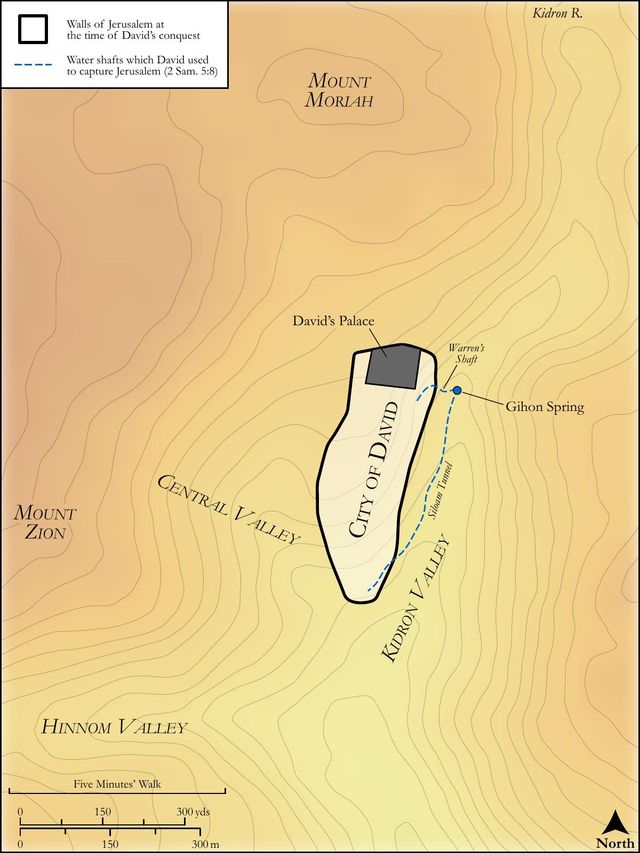
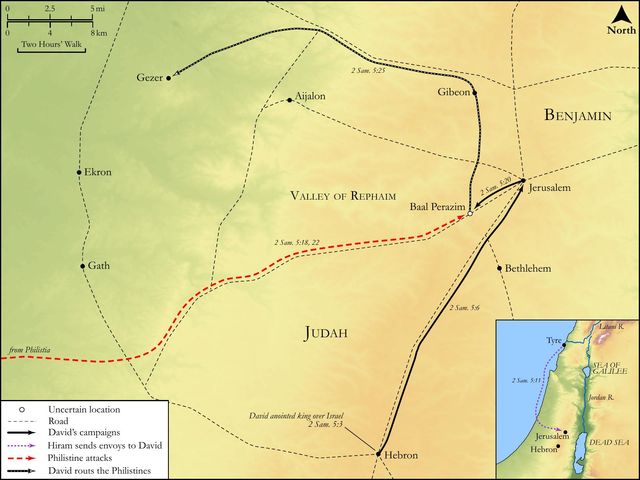
Study this verse
Public-domain commentary
Matthew Henry
From his Commentary on the Whole Bible. Henry comments on passages, not single verses — this entry covers 2 Samuel 5:11–16. His two-level outline is real structure in the source text, so it is rendered as structure.
Here is, I. David's house built, a royal palace, fit for the reception of the court he kept and the homage that was paid to him, Sa2 5:11. The Jews were husbandmen and shepherds, and did not much addict themselves either to merchandise or manufactures; and therefore Hiram, king of Tyre, a wealthy prince, when he sent to congratulate David on his accession to the throne, offered him workmen to build him a house. David thankfully accepted the offer, and Hiram's workmen built David a house to his mind. Many have excelled in arts and sciences who were strangers to the covenants of promise. Yet David's house was never the worse, nor the less fit to be dedicated to God, for being built by the sons of the stranger. It is prophesied of the gospel church, The sons of the strangers shall build up thy walls, and their kings shall minister unto thee, Isa 60:10.
II.David's government settled and built up, Sa2 5:12.
1.His kingdom was established, there was nothing to shake it, none to disturb his possession or question his title. He that made him king established him, because he was to be a type of Christ, with whom God's hand should be established, and his covenant stand fast, Psa 89:21-28. Saul was made king, but not established; so Adam in innocency. David was established king, so is the Son of David, with all who through him are made to our God kings and priests.
2.It was exalted in the eyes both of its friends and enemies. Never had the nation of Israel looked so great or made such a figure as it began now to do. Thus it is promised of Christ that he shall be higher than the kings of the earth, Psa 89:27. God has highly exalted him, Phi 2:9.
3.David perceived, by the wonderful concurrence of providences to his establishment and advancement, that God was with him. By this I know that thou favourest me, Psa 41:11. Many have the favour of God and do not perceive it, and so want the comfort of it: but to be exalted to that and established in it, and to perceive it, is happiness enough.
4.He owned that it was for his people Israel's sake that God had done great things for him, that he might be a blessing to them and they might be happy under his administration. God did not make Israel his subjects for his sake, that he might be great, and rich, and absolute: but he made him their king for their sake, that he might lead, and guide, and protect them. Kings are ministers of God to their people for good, Rom 13:4.
III.David's family multiplied and increased.
All the sons that were born to him after he came to Jerusalem are here mentioned together, eleven in all, besides the six that were born to him before in Hebron, Sa2 3:2, Sa2 3:5. There the mothers are mentioned, not here; only, in general, it is said that he took more concubines and wives, Sa2 5:13. Shall we praise him for this? We praise him not; we justify him not; nor can we scarcely excuse him. The bad example of the patriarchs might make him think there was no harm in it, and he might hope it would strengthen his interest, by multiplying his alliances, and increasing the royal family. Happy is the man that has his quiver full of these arrows. But one vine by the side of the house, with the blessing of God, may send boughs to the sea and branches to the rivers. Adam, by one wife, peopled the world, and Noah re-peopled it. David had many wives, and yet that did not keep him from coveting his neighbour's wife and defiling her; for men that have once broken the fence will wander endlessly. Of David's concubines, see Sa2 15:16; Sa2 16:22; Sa2 19:5. Of his sons, see Ch1 3:1-9.
Continue studying 2 Samuel 5:11 across the web’s major study libraries — every link below opens this exact verse, chapter, or book on the destination site.
Read & Compare
 BibleGatewayThis verse in more than 200 translations and 70 languages.
 Bible.comThe YouVersion reader — hundreds of translations, reading plans, and highlights.
 ESV.orgCrossway's official English Standard Version reader.
 NET BibleThe NET translation with 60,000+ translators' notes on every rendering decision.
 STEP BibleTyndale House's free study tool — original text, vocabulary, and scholarly resources.
 BibliaLogos Bible Software's free web reader.
 USCCBThe New American Bible (Revised Edition) with the U.S. bishops' study notes.
Commentaries
 BibleHub CommentariesDozens of classic commentaries on this verse, gathered on one page.
 StudyLightMore than 100 commentary sets — the largest collection on the web.
 BibleRefPlain-English commentary on what this verse means, verse by verse.
 Enduring WordDavid Guzik's free commentary on this chapter, widely used by Bible teachers.
 Bible Study ToolsVerse commentary alongside Greek and Hebrew study aids.
Original Language & Research
- BibleHub InterlinearThe verse word by word — original language, transliteration, and English.
- BibleHub LexiconEvery word's original-language definition and Strong's entry.
 Blue Letter BibleDeep-study tools — Strong's numbers, concordance, and word studies.
 SefariaThe Hebrew text with Rashi and centuries of Jewish commentary.
Sermons, Hymns & Audio


TrulyRandomVerse is not affiliated with these sites and doesn’t control their content. They’re linked because they’re genuinely useful.
Summary
Second Samuel 5:11 records a pivotal moment in David's reign, immediately following his anointing as king over all Israel and the strategic capture of Jerusalem. This verse details the initiative of King Hiram of Tyre, who dispatched envoys bearing invaluable cedar timber and master craftsmen—carpenters and masons—to construct a magnificent royal palace for David. This event not only signifies David's consolidated power and burgeoning international recognition but also powerfully symbolizes God's divine favor and the secure establishment of his kingdom in Jerusalem, setting the stage for future covenantal promises.
Context
ShowHideLiterary Context
This verse is strategically positioned directly after David's anointing as king over all twelve tribes of Israel in Hebron and his decisive capture of the Jebusite stronghold, Jerusalem, which he established as his capital. The building of his royal palace (his "house") is presented as the immediate and logical next step in solidifying his rule and establishing Jerusalem as the permanent seat of government and a central hub for the unified kingdom. This act of construction precedes the significant events of bringing the Ark of the Covenant to Jerusalem in 2 Samuel 6 and the monumental Davidic Covenant in 2 Samuel 7, where God promises to build David an enduring "house" or dynasty, making the physical house a precursor and symbol of the spiritual one.
Historical & Cultural Context
In the ancient Near East, the construction of a grand royal palace was a crucial symbol of a king's power, wealth, and stability. It was not merely a dwelling but the administrative and symbolic heart of the kingdom. The mention of "Hiram king of Tyre" is highly significant. Tyre, a prominent Phoenician city-state, was renowned for its maritime trade, vast access to the prized cedar forests of Lebanon, and its master craftsmen in woodworking and stonemasonry. Israel, while growing in military strength under David, lacked these specialized skills and the abundant resources of high-quality timber. The alliance with Hiram thus represents a strategic diplomatic and commercial partnership, providing David with essential resources and expertise that were unmatched in the region, underscoring his burgeoning international standing and the divine provision for his reign.
Key Themes
ShowHideThis verse contributes to several major themes within the book of Samuel and the broader biblical narrative. Firstly, it highlights the divine establishment and blessing upon David's reign, demonstrating God's hand in solidifying his rule and providing the necessary means for his kingdom to flourish. The transition from a nomadic, struggling leader to a settled monarch in a magnificent palace powerfully illustrates God's faithfulness to His promises. Secondly, it emphasizes the importance of strategic alliances and resourcefulness in fulfilling divine purposes; God often uses human means, even foreign partnerships, to achieve His will. The collaboration with Tyre was vital for this major architectural project and set a precedent for the even larger undertaking of building the Temple during Solomon's reign, as seen in 1 Kings 5. Finally, the building of David's "house" underscores the centrality of Jerusalem as the unified capital and the administrative heart of Israel, a theme that will continue to develop throughout the biblical narrative, culminating in its spiritual significance.
Exposition and Analysis
ShowHideKey Word Analysis
ShowHideThis refers to the powerful and influential Phoenician monarch who ruled Tyre during David's and later Solomon's reigns. His initiative to send messengers and resources to David signifies a significant diplomatic recognition of David's consolidated kingdom. This act established a crucial international alliance that would prove beneficial for both nations, particularly in providing access to superior building materials and craftsmanship essential for royal and sacred architecture.
These refer to the majestic Cedrus libani or cedars of Lebanon, highly prized throughout the ancient Near East. Valued for their immense size, durability, aromatic qualities, and natural resistance to decay, cedar wood was the preferred timber for royal palaces, temples, and other prestigious structures. Their provision by Hiram indicates the high quality and grandeur intended for David's palace, a luxury not readily available within Israel, signifying the lavishness of God's provision for His chosen king.
This term denotes a skilled fabricator or artificer of any material, encompassing craftsmen who work with wood (chârâsh 'ets) and stone (chârâsh 'eben). The Phoenicians, particularly from Tyre, were renowned for their advanced building techniques and highly specialized labor. Their expertise was crucial for constructing a structure of the scale and quality befitting a royal palace, demonstrating the superior resources available through this international alliance and the divine orchestration of skilled labor.
Verse Breakdown
ShowHide"And Hiram king of Tyre sent messengers to David"
This opening clause establishes the diplomatic initiative from Hiram, signifying the formal recognition of David's kingship and the establishment of an important international relationship. It highlights David's growing stature on the world stage, indicating that his reign was not merely a local phenomenon but one acknowledged by powerful neighboring states.
"and cedar trees"
This specifies the primary material provided, emphasizing its high value and the luxury it afforded David's building project. The cedars were essential for the grandeur, durability, and symbolic prestige of a royal residence, demonstrating a level of quality previously unattainable for Israelite rulers.
"and carpenters, and masons:"
This details the skilled labor provided, indicating that Israel, at this stage, likely lacked the specialized expertise required for such a sophisticated architectural undertaking. The inclusion of these master craftsmen underscores the comprehensive nature of Hiram's assistance and the divine provision of specific skills.
"and they built David an house."
This final clause states the outcome of Hiram's provision: the construction of David's royal palace. The "house" here is not merely a dwelling but a potent symbol of David's consolidated power, the stability of his reign, and the establishment of Jerusalem as the permanent capital of a unified Israel, laying the groundwork for the future Temple and the Davidic dynasty.
Literary Devices
ShowHideThe verse employs several literary devices to convey its profound significance. Symbolism is prominent, as David's "house" or palace serves as a powerful symbol of his established kingdom, God's blessing upon his reign, and the new, central status of Jerusalem. The very materials—cedar—and the skilled labor from Tyre also symbolize the wealth, stability, and international recognition David now commanded, all pointing to divine favor. The narrative also employs foreshadowing, as this alliance with Hiram and the use of Tyrian resources for David's palace directly anticipates the even more extensive collaboration between Hiram and David's son, Solomon, in the construction of the First Temple in Jerusalem (1 Kings 5:1-12). While not explicitly stated, the underlying theme of Divine Providence is profoundly evident; the seemingly opportune arrival of Hiram's aid can be understood as God orchestrating events to establish His chosen king and prepare the way for future divine plans, demonstrating His faithfulness to His covenant with David.
Theological and Thematic Connections
ShowHideThis passage powerfully illustrates God's sovereign hand in establishing His chosen leaders and providing the necessary resources for the fulfillment of His purposes. David's reign, though marked by human effort and strategic alliances, is ultimately presented as divinely ordained and enabled. The provision of foreign expertise and materials through Hiram underscores that God's provision is not limited to conventional or internal means but can come from unexpected sources, demonstrating His boundless capacity to equip His servants. This event solidifies David's position as the divinely appointed king and prepares the way for the grander promises of the Davidic Covenant, where God Himself promises to build David an enduring "house" or dynasty, a spiritual lineage that culminates in Christ.
Reflection and Application
ShowHideThe construction of David's palace, facilitated by unexpected international aid, serves as a profound reminder that God is the ultimate provider and enabler of His work. Just as He established David's kingdom and supplied the precise resources needed for its physical manifestation, so too does He equip and empower believers today for the tasks He calls them to. This verse encourages us to recognize that God's provision often comes through means we might not anticipate – through strategic partnerships, the skills of others, or resources from seemingly external sources. It challenges us to cultivate a spirit of dependence on God, trusting that when He establishes a work or a person, He will also supply the necessary means, skills, and relationships for its success. Furthermore, it calls us to wisely steward the resources and connections God brings into our lives, using them for His glory and the advancement of His kingdom, understanding that every good and perfect gift comes from above and is intended for His purposes.
Questions for Reflection
ShowHideFAQ
ShowHideWhy was Hiram of Tyre so important for David's palace?
ShowHideHiram, king of Tyre, was crucial because his kingdom possessed resources and expertise that Israel lacked. Tyre was renowned for its vast cedar forests in Lebanon, providing the highly prized and durable timber necessary for a grand royal palace. Furthermore, the Phoenicians were master craftsmen, and Hiram supplied skilled carpenters and masons whose advanced building techniques were superior to those readily available in Israel. This alliance allowed David to construct a palace befitting a unified kingdom, symbolizing his consolidated power and international standing, and setting a precedent for the even grander construction of the Temple during Solomon's reign, as detailed in 1 Kings 5.
What is the significance of "an house" for David in this context?
ShowHideThe "house" built for David was far more than a personal dwelling; it was a royal palace, serving as the administrative and symbolic heart of his newly unified kingdom. In the ancient Near East, a magnificent royal residence was an essential emblem of a king's power, wealth, and stability. Its construction in Jerusalem solidified the city's status as the capital of Israel and demonstrated David's consolidated rule over all the tribes. The building of this physical "house" also profoundly foreshadows the theological concept of God building David an enduring "house" or dynasty, as promised in the Davidic Covenant in 2 Samuel 7, where God's covenantal faithfulness secures David's lineage and kingdom forever.
Christ-Centered Fulfillment
ShowHideThe building of David's physical "house" in 2 Samuel 5:11, facilitated by divine provision and strategic alliances, serves as a powerful foreshadowing of the ultimate "house" that God builds: His spiritual kingdom through Jesus Christ. David's earthly palace, a symbol of his established reign and the stability of his kingdom, points to Christ, the greater Son of David, who builds an eternal, spiritual "house" that will never crumble. Just as Hiram provided the finest materials and skilled labor for David's dwelling, so God, through Christ, provides the spiritual "living stones"—believers—and the divine craftsmanship of the Holy Spirit to construct His Church. Jesus explicitly declares, "I will build my church, and the gates of hell shall not prevail against it". Believers are described as "living stones... being built up a spiritual house" and "fellow citizens with the saints, and of the household of God," built on the foundation of the apostles and prophets, with Christ Jesus Himself as the chief cornerstone (Ephesians 2:20-22). Thus, David's palace, a testament to God's favor and establishment of an earthly kingdom, ultimately points to the glorious and eternal spiritual dwelling place that Christ is building, where He reigns forever as King over His redeemed people (Hebrews 3:3-6).