


1 Kings 7:1
- וְאֶתve·'Etand <obj.>H853Conj-w ¦ DirObjMParticle Object Indicatorוְandאֶת<obj.>
- בֵּיתוֹbei·Tohis own houseH1004N-msc ¦ 3msNoun Singular Masculine Constructבֵּיתown houseוֹhis
- בָּנָהba·Nahhe builtH1129V-Qal-Perf-3msVerb Qal Perfect 3rd Singular Masculine
- שְׁלֹמֹהshe·lo·MohSolomonH8010N-proper-mNoun Proper Masculine
- שְׁלֹשׁshe·Loshthir-H7969N-cscNoun Singular common gender Construct
- עֶשְׂרֵה'es·RehteenH6240N-csNoun Singular common gender Absolute
- שָׁנָהsha·Nahyear[s]H8141N-fsNoun Singular Feminine Absolute
- וַיְכַלvay·Khaland he completedH3615Conj-w ¦ V-Piel-ConsecImperf-3msVerb Piel Consecutive Imperfect 3rd Singular Masculineוַandיְכַלhe completed
- אֶת'et<obj.>H853DirObjMParticle Object Indicator
- כָּלkolallH3605N-mscNoun Singular Masculine Construct
- בֵּיתוֹbei·Tohis houseH1004N-msc ¦ 3msNoun Singular Masculine Constructבֵּיתhouseוֹhis
English is a literal word-by-word gloss of the Hebrew, not the KJV's wording. Why?
This is the original text the KJV's translators worked from — each Hebrew word with its own literal English meaning in this verse, prepared by scholars at Tyndale House, Cambridge. The KJV translates whole sentences, not word by word, so its wording differs: one Hebrew word can become several English words, and the KJV may choose “the LORD” where the gloss reads “Yahweh”. Both are faithful — they answer different questions. For the KJV's own rendering, switch to the KJV text.
Details
See on the biblical-era map

Study this verse
Public-domain commentary
Matthew Henry
From his Commentary on the Whole Bible. Henry comments on passages, not single verses — this entry covers 1 Kings 7:1–12.
Never had any man so much of the spirit of building as Solomon had, nor to better purpose; he began with the temple, built for God first, and then all his other buildings were comfortable. The surest foundations of lasting prosperity are those which are laid in an early piety, Mat 6:33. 1. He built a house for himself (Kg1 7:1), where he dwelt, Kg1 7:8. His father had built a good house; but it was no reflection upon his father for him to build a better, in proportion to the estate wherewith God had blessed him. Much of the comfort of this life is connected with an agreeable house. He was thirteen years building this house, whereas he built the temple in little more than seven years; not that he was more exact, but less eager and intent, in building his own house than in building God's. He was in no haste for his own palace, but impatient till the temple was finished and fit for use. Thus we ought to prefer God's honour before our own ease and satisfaction. 2. He built the house of the forest at Lebanon (Kg1 7:2), supposed to be a country seat near Jerusalem, so called from the pleasantness of its situation and the trees that encompassed it. I rather incline to think that it was a house built in the forest of Lebanon itself, whither (though far distant from Jerusalem) Solomon (having so many chariots and horses, and those dispersed into chariot-cities, which probably were his stages) might frequently retire with ease. It does not appear that his throne (mentioned Kg1 7:7) was at the house of the forest of Lebanon, and it was not at all improper to put his shields there as in a magazine. Express notice is taken of his buildings, not only in Jerusalem, but in Lebanon (Kg1 9:19), and we read of the tower of Lebanon, which looks towards Damascus (Sol 7:4), which probably was part of this house. A particular account is given of this house, that being built in Lebanon, a place famed for cedars, the pillars, and beams, and roof, were all cedar (Kg1 7:2, Kg1 7:3), and, being designed for pleasant prospects, there were three tiers of windows on each side, light against light (Kg1 7:4, Kg1 7:5), or, as it may be read, prospect against prospect. Those whose lost i cast in the country may be well reconciled to a country life by this, that some of the greatest princes have thought those the most pleasant of their days which they have spent in their country retirements. 3. He built piazzas before one of his houses, either that at Jerusalem or that in Lebanon, which were very famous - a porch of pillars (Kg1 7:6), perhaps for an exchange or a guard-house, or for those to walk in that attended him about business till they could have audience, or for state and magnificence. He himself speaks of Wisdom's building her house, and hewing out her seven pillars (Pro 9:1), for the shelter of those that, three verses before (Kg1 8:34), are said to watch daily at her gates and to wait at the posts of her doors. 4. At his house where he dwelt in Jerusalem he built a great hall, or porch of judgment, where was set the throne, or king's bench, for the trial of causes, in which he himself was appealed to (placita coram ipso rege tenenda - causes were to be adjusted in the king's presence), and this was richly wainscoted with cedar, from the floor to the roof, Kg1 7:7. He had there also another court within the porch, nearer his house, of similar work, for his attendants to walk in, Kg1 7:8. 5. He built a house for his wife, where she kept her court, Kg1 7:8. It is said to be like the porch, because built of cedar like it, though not in the same form; this, no doubt, was nearer adjoining to his own palace, yet perhaps if it had been as near as it ought to have been Solomon would not have multiplied wives as he did.
The wonderful magnificence of all these buildings is taken notice of, Kg1 7:9, etc. All the materials were the best of their kind. The foundation-stones were costly for their size, four or five yards square, or at least so many yards long (Kg1 7:10), and the stones of the building were costly for the workmanship, hewn and sawn, and in all respects finely wrought, Kg1 7:9, Kg1 7:11. The court of his own house was like that of the temple (Kg1 7:12, compare Kg1 6:36); so well did he like the model of God's courts that he made his own by it.
Continue studying 1 Kings 7:1 across the web’s major study libraries — every link below opens this exact verse, chapter, or book on the destination site.
Read & Compare
 BibleGatewayThis verse in more than 200 translations and 70 languages.
 Bible.comThe YouVersion reader — hundreds of translations, reading plans, and highlights.
 ESV.orgCrossway's official English Standard Version reader.
 NET BibleThe NET translation with 60,000+ translators' notes on every rendering decision.
 STEP BibleTyndale House's free study tool — original text, vocabulary, and scholarly resources.
 BibliaLogos Bible Software's free web reader.
 USCCBThe New American Bible (Revised Edition) with the U.S. bishops' study notes.
Commentaries
 BibleHub CommentariesDozens of classic commentaries on this verse, gathered on one page.
 StudyLightMore than 100 commentary sets — the largest collection on the web.
 BibleRefPlain-English commentary on what this verse means, verse by verse.
 Enduring WordDavid Guzik's free commentary on this chapter, widely used by Bible teachers.
 Bible Study ToolsVerse commentary alongside Greek and Hebrew study aids.
Original Language & Research
- BibleHub InterlinearThe verse word by word — original language, transliteration, and English.
- BibleHub LexiconEvery word's original-language definition and Strong's entry.
 Blue Letter BibleDeep-study tools — Strong's numbers, concordance, and word studies.
 SefariaThe Hebrew text with Rashi and centuries of Jewish commentary.
Sermons, Hymns & Audio


TrulyRandomVerse is not affiliated with these sites and doesn’t control their content. They’re linked because they’re genuinely useful.
Summary
Following the magnificent seven-year construction of the Temple of the Lord, 1 Kings 7:1 pivots the narrative to King Solomon's equally ambitious, yet more protracted, personal building projects. This verse concisely states that Solomon spent thirteen years constructing his own royal complex, ultimately bringing all aspects of it to completion. It serves as a crucial transitional statement, highlighting the immense scale of Solomon's architectural endeavors in Jerusalem and subtly setting up a contrast between the time and resources dedicated to God's house versus the king's own dwelling.
Context
ShowHideLiterary Context
This verse serves as a critical narrative bridge, transitioning directly from the detailed account of the Temple's construction and completion in 1 Kings 6 to the subsequent elaborate description of Solomon's grand palace complex in 1 Kings 7:2-12. The opening "But" (or "And" in some translations) signals a subtle yet significant shift in narrative focus, immediately drawing attention to a new subject. It implicitly contrasts the seven years spent on God's house, which concluded in 1 Kings 6:38, with the thirteen years dedicated to the king's own residence. This juxtaposition is not overtly judgmental within the text itself but invites the reader to consider the implications of such a disparity in time and resources. Furthermore, the verse sets the stage for understanding the full scope of Solomon's monumental building program, which ultimately spanned twenty years in total, as later summarized in 1 Kings 9:10.
Historical & Cultural Context
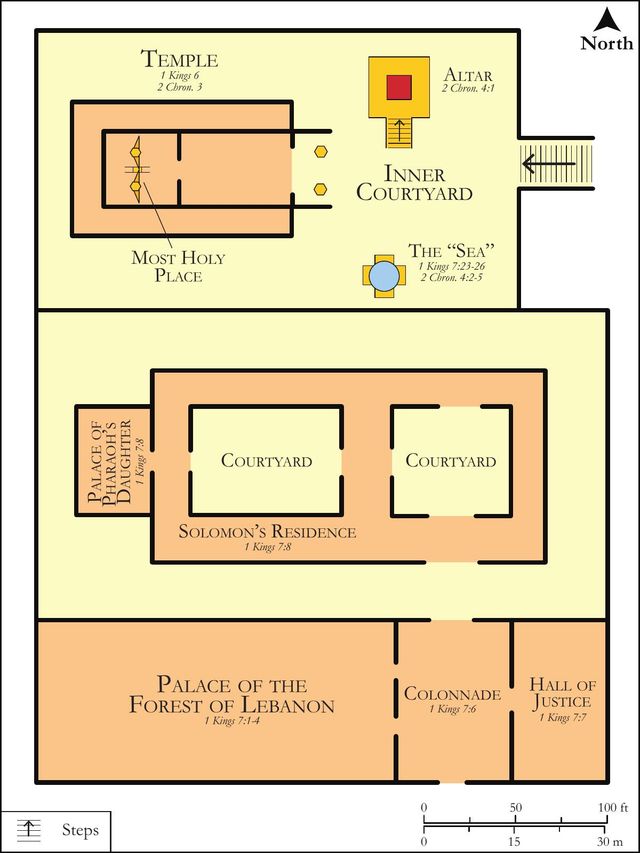
Solomon's reign (c. 970-931 BC) is depicted as a golden age for Israel, marked by unparalleled peace, prosperity, and significant international influence. In the ancient Near East, massive building projects were a defining characteristic of powerful monarchs, serving as tangible symbols of their wealth, authority, and the stability of their empires. Under Solomon, Jerusalem was transformed into a capital city befitting a great king, with the newly completed Temple at its spiritual heart and the extensive palace complex as its administrative, judicial, and royal center. The construction involved vast resources, including precious materials and skilled labor, notably from Phoenicia, as evidenced by the involvement of Hiram of Tyre, mentioned later in 1 Kings 7:13-14. The "house" of Solomon was not a single dwelling but an expansive complex comprising several distinct structures, including the House of the Forest of Lebanon, the Porch of Pillars, the Porch of the Throne (Hall of Judgment), his private residence, and a separate house for Pharaoh's daughter, reflecting the multifaceted needs of the monarchy.
Key Themes
ShowHideThe primary theme emerging from this verse, particularly when read in conjunction with the preceding chapter, is that of Priorities and Stewardship. The stark numerical contrast between the seven years dedicated to the Temple and the thirteen years for the palace immediately prompts reflection on the allocation of time, resources, and devotion. While Solomon's initial building of the Temple demonstrates a proper initial priority, the extended duration of his personal project raises subtle questions about the balance between glorifying God and establishing personal grandeur. This verse also powerfully underscores Solomon's Immense Wealth and Power, showcasing his unparalleled ability to undertake such colossal and prolonged construction. This solidified his reputation and contributed to the prosperity of his kingdom, as further detailed in 1 Kings 10:23-27. Finally, the phrase "he finished all his house" highlights Completion and Accomplishment, emphasizing Solomon's administrative prowess and the successful execution of his ambitious vision, contributing to the broader narrative of his reign as a period of significant achievement.
Exposition and Analysis
ShowHideKey Word Analysis
ShowHideA primitive root meaning "to build (literally and figuratively)." In this context, it refers to the ongoing, physical construction of Solomon's royal complex. The use of the participle "was building" emphasizes the continuous nature of this monumental undertaking over a significant period.
A versatile noun meaning "a house (in the greatest variation of applications, especially family, etc.)." Here, "his own house" refers not to a simple dwelling but to an extensive, multi-structure royal complex that served as the administrative, judicial, and personal center of Solomon's kingdom. Its repeated use underscores the king's personal investment in this grand project.
A primitive root meaning "to end, whether intransitive (to cease, be finished, perish) or transitived (to complete, prepare, consume)." This word signifies the successful completion of the entire thirteen-year building project, highlighting Solomon's administrative capability and the thoroughness with which he brought his ambitious vision to fruition.
Verse Breakdown
ShowHide"But Solomon was building his own house"
This opening clause immediately signals a narrative shift from the sacred to the royal. The conjunction "But" (or "And") introduces a new focus, drawing attention away from the recently completed Temple of the Lord to Solomon's personal architectural endeavors. The phrase "his own house" clearly distinguishes this project as the king's private, yet immensely public, undertaking, emphasizing his personal investment in establishing a grand residence and administrative center befitting his unparalleled wealth and power.
"thirteen years"
This precise temporal detail is profoundly significant. By explicitly stating the duration as thirteen years, the text implicitly invites a direct comparison with the seven years taken to build the Temple, a fact fresh in the reader's mind from 1 Kings 6:38. This numerical disparity highlights the extensive time, immense resources, and vast labor Solomon dedicated to his personal comfort and royal prestige, prompting the reader to ponder the implications of such an allocation of effort.
"and he finished all his house"
This concluding phrase emphasizes the successful and complete execution of the massive construction project. "All his house" indicates that the entire complex, comprising multiple distinct structures, was brought to full completion. This speaks to Solomon's administrative prowess and the successful realization of his ambitious vision, signifying the culmination of twenty years of continuous, monumental building activity in Jerusalem when combined with the Temple's construction.
Literary Devices
ShowHideThe verse primarily employs Juxtaposition and Numerical Contrast. By immediately following the detailed account of the Temple's seven-year construction with the concise statement of the thirteen-year building of Solomon's palace, the text deliberately places these two monumental projects side-by-side. This Juxtaposition is subtly reinforced by the opening "But," which draws attention to the shift in focus and the differing durations. The Numerical Contrast (7 years for the Temple vs. 13 years for the palace) is not explicitly judgmental within the verse itself, but it functions as a powerful rhetorical device, implicitly inviting the reader to reflect on Solomon's priorities and the allocation of his immense resources. This subtle literary technique can also be interpreted as a form of Foreshadowing, hinting at a potential shift in Solomon's focus from singular devotion to God towards personal grandeur and self-aggrandizement, a theme that becomes more pronounced and problematic in later accounts of his reign. Furthermore, the palace itself functions as Symbolism, representing Solomon's immense wealth, power, and the stability of his kingdom, but also potentially serving as a symbol of human ambition and the dangers of misplaced priorities.
Theological and Thematic Connections
ShowHide1 Kings 7:1, in its succinct declaration, invites profound theological reflection on the nature of priorities and stewardship. The striking contrast between the seven years dedicated to God's house and the thirteen years spent on Solomon's own palace complex implicitly raises questions about where true devotion and investment lie. While a king certainly needed a suitable residence and administrative center, the disproportionate time allocation can be seen as a subtle narrative critique or at least a point of caution regarding the potential for human ambition to overshadow divine priorities. It prompts believers to examine their own lives: are we dedicating our primary time, energy, and resources to building God's kingdom and glorifying Him, or are our personal comforts, ambitions, and worldly pursuits inadvertently consuming a greater share of our lives? The verse serves as a timeless reminder that while earthly responsibilities are necessary, our ultimate allegiance and most significant investments should be directed towards the divine.
Reflection and Application
ShowHideThe account of Solomon's building projects, particularly the thirteen years spent on his own house after the seven years for the Temple, offers a potent mirror for self-examination. It challenges us to consider what we are truly "building" with our lives—our time, talents, and treasures. Are our personal aspirations, comforts, and material possessions consuming a disproportionate amount of our focus and resources compared to our devotion to God and His purposes? While it is not inherently wrong to build a comfortable home or pursue personal goals, the narrative subtly warns against a potential imbalance where self-interest overshadows spiritual priorities. This verse encourages us to assess our stewardship, ensuring that our "houses" (our careers, finances, relationships, hobbies) are built in a way that ultimately serves God's glory and advances His kingdom, rather than becoming ends in themselves. It also reminds us of the importance of completing what we start, as Solomon "finished all his house," but with a spiritual discernment about what we are finishing and why.
Questions for Reflection
ShowHideFAQ
ShowHideWhy did it take Solomon longer to build his own house than the Temple?
ShowHideThe biblical text does not explicitly state the reasons for the disparity in building times, but several factors can be inferred. First, the "house" of Solomon was not a single dwelling but an extensive royal complex, encompassing multiple structures such as the House of the Forest of Lebanon, the Porch of Pillars, the Porch of the Throne (Hall of Judgment), his private residence, and a house for Pharaoh's daughter (1 Kings 7:2-8). This complex was likely larger in overall footprint and perhaps more intricate in its various functions than the Temple, which, while magnificent, was a single, albeit large, structure. Second, while the Temple was a sacred undertaking with divine urgency, the palace might have been built at a more leisurely pace, or its construction may have been phased. The contrast in time also serves a narrative purpose, subtly inviting the reader to reflect on Solomon's priorities, particularly when compared to the seven years for the Temple (1 Kings 6:38).
What was included in "his own house" that took thirteen years to build?
ShowHideAs described in the verses immediately following 1 Kings 7:1, Solomon's "house" was an elaborate royal complex that served as the center of royal administration, justice, and personal living. It included:
Does this verse imply Solomon had wrong priorities?
ShowHideThe verse itself, 1 Kings 7:1, is a factual statement of duration and completion and does not explicitly offer a moral judgment. However, by juxtaposing the thirteen years for his own house with the seven years for the Temple (mentioned in 1 Kings 6:38), the narrative invites the reader to consider the implications of this contrast. While it was necessary for a king to have a suitable residence, the greater time investment in his personal complex compared to the sacred Temple can be seen as a subtle hint of a potential shift in Solomon's focus. This subtle narrative technique allows the reader to draw their own conclusions about the balance between devotion to God and the pursuit of personal grandeur, a theme that becomes more pronounced as Solomon's reign progresses and he begins to accumulate wealth and wives in ways that ultimately lead to his spiritual decline (1 Kings 11:1-8).
Christ-Centered Fulfillment
ShowHideWhile Solomon built a magnificent physical house for himself, taking thirteen years to complete it, the New Testament reveals a far greater "house" being built by a greater King. Jesus Christ, unlike Solomon who focused on earthly splendor, declared that "the Son of Man has nowhere to lay his head" (Matthew 8:20), signifying that His kingdom was not of this world. He did not build a physical palace for Himself, but rather spoke of building His Church, a spiritual house composed of living stones—believers united in Him (Matthew 16:18; 1 Peter 2:5). Christ is presented as the ultimate builder, superior to Moses and Solomon, who builds God's true "house" (His people) for eternity (Hebrews 3:3-6). Furthermore, Jesus promised to prepare a "place" for His disciples in His Father's house (John 14:2-3), pointing to a heavenly dwelling not made with human hands. Ultimately, the fulfillment of God's dwelling among humanity, the ultimate "house," is realized in the new heavens and new earth, where God's tabernacle is with His people, and He will dwell with them forever (Revelation 21:3). Thus, Solomon's earthly building, while grand, pales in comparison to the eternal, spiritual dwelling Christ builds for His people and the ultimate dwelling of God with humanity.