


2 Chronicles 8:1
Bible text: King James Version (1769 Blayney text) · Public domain
Bible text: Berean Standard Bible · Public domain
Bible text: American Standard Version (1901) · Public domain
Bible text: World English Bible, Messianic edition · Public domain
Bible text: Geneva Bible (1599) · Public domain
Bible text: Young's Literal Translation · Public domain
- וַיְהִיvay·Hiand it wasH1961Conj-w ¦ V-Qal-ConsecImperf-3msVerb Qal Consecutive Imperfect 3rd Singular Masculineוַandיְהִיit was
- מִקֵּץmi·Ketzfrom [the] end ofH7093Prep-m ¦ N-mscNoun Singular Masculine Constructמִfromקֵּץ[the] end of
- עֶשְׂרִים'es·RimtwentyH6242N-mpNoun Plural Masculine Absolute
- שָׁנָהsha·Nahyear[s]H8141N-fsNoun Singular Feminine Absolute
- אֲשֶׁר'a·SherwhichH834RelParticle Relative
- בָּנָהba·Nahhe builtH1129V-Qal-Perf-3msVerb Qal Perfect 3rd Singular Masculine
- שְׁלֹמֹהshe·lo·MohSolomonH8010N-proper-mNoun Proper Masculine
- אֶת'et<obj.>H853DirObjMParticle Object Indicator
- בֵּיתbeit[the] house ofH1004N-mscNoun Singular Masculine Construct
- יְהוָהYah·wehYahwehH3068N-properNoun Proper Title
- וְאֶתve·'Etand <obj.>H853Conj-w ¦ DirObjMParticle Object Indicatorוְandאֶת<obj.>
- בֵּיתוֹbei·Tohis own houseH1004N-msc ¦ 3msNoun Singular Masculine Constructבֵּיתown houseוֹhis
English is a literal word-by-word gloss of the Hebrew, not the KJV's wording. Why?
This is the original text the KJV's translators worked from — each Hebrew word with its own literal English meaning in this verse, prepared by scholars at Tyndale House, Cambridge. The KJV translates whole sentences, not word by word, so its wording differs: one Hebrew word can become several English words, and the KJV may choose “the LORD” where the gloss reads “Yahweh”. Both are faithful — they answer different questions. For the KJV's own rendering, switch to the KJV text.
Details
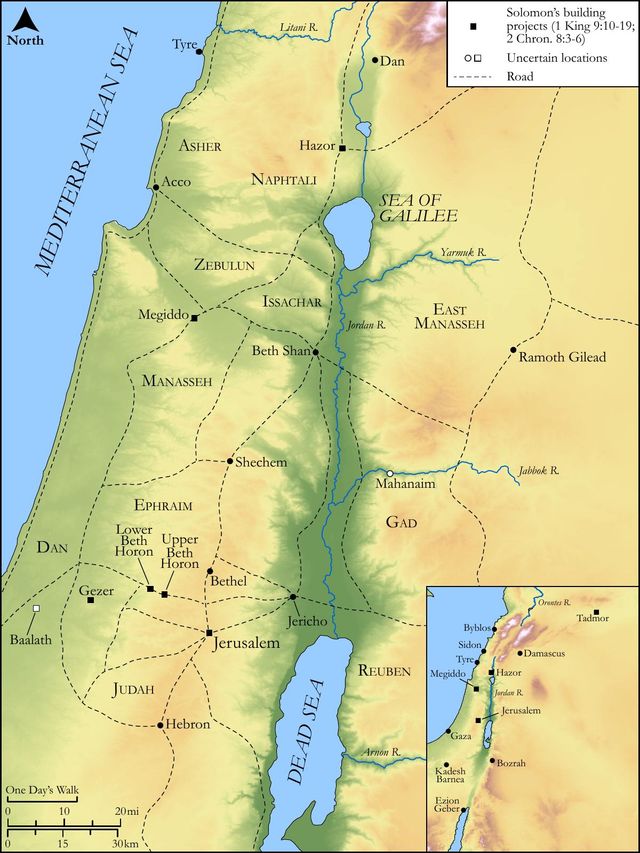
See on the biblical-era map
Study this verse
Public-domain commentary
Matthew Henry
From his Commentary on the Whole Bible. Henry comments on passages, not single verses — this entry covers 2 Chronicles 8:1–11. His two-level outline is real structure in the source text, so it is rendered as structure.
This we had Kg1 9:10-24, and therefore shall only observe here,
I.Though Solomon was a man of great learning and knowledge, yet he spent his days, not in contemplation, but in action, not in his study, but in his country, in building cities and fortifying them, in a time of peace preparing for a time of war, which is as much a man's business as it is in summer to provide food for winter.
II.As he was a man of business himself, and did not consult his own ease, so he employed a great many hands, kept abundance of people to work.
It is the interest of a state by all means possible to promote and encourage industry, and to keep its subjects from idleness. A great many strangers there were in Israel, many that remained of the Canaanites; and they were welcome to live there, but not to live and do nothing. The men of Laish, who had no business, were an easy prey to the invaders, Jdg 18:7.
III.When Solomon had begun with building the house of God, and made good work and quick work of that, he prospered in all his undertakings, so that he built all that he desired to build, Ch2 8:6. Those who have a genius for building find that one project draws on another, and the latter must amend and improve the former. Now observe,
1.How the divine providence gratified even Solomon's humour, and gave him success, not only in all that he needed to build and that it was for his advantage to build, but in all that he had a mind to build. So indulgent a Father God is sometimes to the innocent desires of his children that serve him. Thus he pleased Jacob with that promise, Joseph shall put his hand on thy eyes.
2.Solomon knew how to set bounds to his desires. He was not one of those that enlarge them endlessly, and can never be satisfied, but knew when to draw in; for he finished all he desired, and then he desired no more. He did not sit down and fret that he had not more cities to build, as Alexander did that he had not more worlds to conquer, Hab 2:5.
IV.That one reason why Solomon built a palace on purpose for the queen, and removed her and her court to it, was because he thought it by no means proper that she should dwell in the house of David (Ch2 8:11), considering that that had been a place of great piety, and perhaps her house was a place of great vanity. She was proselyted, it is likely, to the Jewish religion; but it is a question whether all her servants were. Perhaps they had among them the idols of Egypt, and a great deal of profaneness and debauchery. Now, though Solomon had not zeal and courage enough to suppress and punish what was amiss there, yet he so far consulted the honour of his father's memory that he would not suffer that place to be thus profaned where the ark of God had been and where holy David had prayed many a good prayer and sung many a sweet psalm. Not that all the places where the ark had been were so holy as never to be put to a common use; for then the houses of Abinadab and Obed-edom must have been so. But the place where it had been so long, and had been so publicly attended on, was so venerable that it was not fit to be the place of so much gaiety, not to say iniquity, as was to be found, I fear, in the court that Pharaoh's daughter kept. Note, Between things sacred and things common the ancient landmarks ought to be kept up. It was an outer-court of the temple that was the court of the women.
Continue studying 2 Chronicles 8:1 across the web’s major study libraries — every link below opens this exact verse, chapter, or book on the destination site.
Read & Compare
 BibleGatewayThis verse in more than 200 translations and 70 languages.
 Bible.comThe YouVersion reader — hundreds of translations, reading plans, and highlights.
 ESV.orgCrossway's official English Standard Version reader.
 NET BibleThe NET translation with 60,000+ translators' notes on every rendering decision.
 STEP BibleTyndale House's free study tool — original text, vocabulary, and scholarly resources.
 BibliaLogos Bible Software's free web reader.
 USCCBThe New American Bible (Revised Edition) with the U.S. bishops' study notes.
Commentaries
 BibleHub CommentariesDozens of classic commentaries on this verse, gathered on one page.
 StudyLightMore than 100 commentary sets — the largest collection on the web.
 BibleRefPlain-English commentary on what this verse means, verse by verse.
 Enduring WordDavid Guzik's free commentary on this chapter, widely used by Bible teachers.
 Bible Study ToolsVerse commentary alongside Greek and Hebrew study aids.
Original Language & Research
- BibleHub InterlinearThe verse word by word — original language, transliteration, and English.
- BibleHub LexiconEvery word's original-language definition and Strong's entry.
 Blue Letter BibleDeep-study tools — Strong's numbers, concordance, and word studies.
 SefariaThe Hebrew text with Rashi and centuries of Jewish commentary.
Sermons, Hymns & Audio


TrulyRandomVerse is not affiliated with these sites and doesn’t control their content. They’re linked because they’re genuinely useful.
Summary
This verse marks a pivotal chronological and thematic transition in the narrative of King Solomon's reign, signaling the culmination of his two most significant architectural undertakings: the construction of the Temple of the LORD and his own elaborate royal palace. It serves as a concise summary of a monumental twenty-year building period, setting the stage for subsequent accounts of Solomon's administrative, economic, and defensive activities, thereby highlighting his immense wealth, power, and the stability of his kingdom.
Context
ShowHideLiterary Context
This verse immediately follows a profound account of God's reaffirmation of His covenant with Solomon, delivered after the dedication of the Temple in 2 Chronicles 7:11-22. The preceding chapters meticulously detail the planning, construction, and dedication of the Temple, culminating in the glorious manifestation of God's presence. 2 Chronicles 8:1 acts as a summary statement, drawing a clear chronological line under this intensive building phase before the narrative shifts to Solomon's further administrative and infrastructural projects. It significantly parallels the account in 1 Kings 9:10, which also notes the completion of the two houses after twenty years, providing a crucial chronological anchor for understanding the progression of Solomon's reign. The Chronicler, in particular, emphasizes the completion of the Temple as a fulfillment of David's vision and God's promise, underscoring the divine favor upon Solomon and the central role of the sanctuary in Israelite life.
Historical & Cultural Context
Among the kings of that day, monumental building projects were a hallmark of powerful and successful kings, serving as tangible expressions of their wealth, dominion, and divine favor. The construction of a grand temple for the national deity and an opulent royal palace were essential for establishing a capital city's prestige and a king's legitimate rule. Solomon's twenty-year building program, encompassing the Temple and his extensive palace complex, was an undertaking of immense scale, requiring vast resources, skilled labor (both Israelite and foreign, as detailed in 1 Kings 5), and sophisticated logistical planning. The Temple, in particular, was not merely a building but the central locus of Israelite worship and the symbolic dwelling place of God, solidifying Jerusalem's status as the religious and political heart of the kingdom. The completion of these structures signaled a period of unprecedented peace, prosperity, and stability, reflecting the fulfillment of God's promises to David concerning his dynasty and kingdom, as seen in 2 Samuel 7:12-13.
Key Themes
ShowHide2 Chronicles 8:1 encapsulates several significant themes within the book of Chronicles. Firstly, it highlights Completion and Fulfillment, marking the successful culmination of David's vision for a permanent dwelling for God and Solomon's primary architectural endeavors. This underscores the theme of God's faithfulness in bringing His plans to fruition through human agents. Secondly, it subtly touches upon Stewardship and Prioritization, as Solomon dedicated immense resources and time to these projects, building the Temple first before his own house (though the verse summarizes the total time for both). This sequence, detailed in 1 Kings 6 and 1 Kings 7, suggests an initial dedication to God's glory. Thirdly, the verse points to Solomon's Grandeur and Wisdom, as the successful execution of such monumental projects cemented his reputation for immense wealth, power, and the divinely-granted wisdom mentioned in 1 Kings 4:29-30. Finally, it functions as a Historical Marker, providing a crucial chronological pivot point in Solomon's reign, shifting the narrative focus from foundational construction to the administration, defense, and expansion of his kingdom, as detailed in the remainder of 2 Chronicles 8.
Exposition and Analysis
ShowHideKey Word Analysis
ShowHideDerived from a root meaning "to cut off" or "to cease," this word denotes an extremity, a conclusion, or the termination of a period. In 2 Chronicles 8:1, it precisely marks the conclusion of the specified twenty-year building period, signaling a definitive end to this phase of Solomon's reign and a transition to new activities. It emphasizes the completion and finality of the monumental construction projects.
This primitive root signifies not merely physical construction but also establishment, restoration, and the founding of a family or nation. In the context of the Temple, it carries profound theological weight, indicating the establishment of a permanent dwelling for God's presence among His people, fulfilling the long-held desire for a fixed sanctuary after centuries of the portable tabernacle. For Solomon's own house, it speaks to the establishment of his royal authority and the stability of his dynasty. The verb emphasizes the successful and complete execution of these grand undertakings.
This versatile word refers to a physical dwelling or structure, but it also carries broader meanings, including a household, a family, a dynasty, or even a lineage. In this verse, "the house of the LORD" (bayith YHWH) refers specifically to the Temple, God's dwelling place, while "his own house" (bêto) refers to Solomon's royal palace complex. The juxtaposition highlights the two central pillars of Solomon's reign: the religious center and the political/royal center, both of which he established and fortified.
Verse Breakdown
ShowHide"And it came to pass at the end of twenty years,"
This opening phrase serves as a precise chronological marker, indicating that a significant and defined period of time has elapsed. It is a common narrative device in historical books, signaling a transition or a summary of events that occurred over a specific duration. The "twenty years" is a specific, rounded figure, emphasizing the immense scale and sustained effort required for the projects that follow, encompassing seven years for the Temple and thirteen for the palace complex.
"wherein Solomon had built"
This clause identifies the primary actor, King Solomon, and his monumental accomplishment. The verb "built" (from bânâh) emphasizes the completion of the construction, not merely the beginning or ongoing process, highlighting the successful culmination of his architectural endeavors. Solomon is presented as the divinely appointed architect and overseer of these grand undertakings, fulfilling the vision given to his father, David.
"the house of the LORD,"
This refers to the First Temple in Jerusalem, the magnificent sanctuary dedicated to Yahweh. Its construction was the fulfillment of David's fervent desire and a central act of Solomon's reign, signifying the establishment of a permanent, central place of worship for Israel and the visible manifestation of God's covenant presence. This was the primary and most significant of his building projects, representing the spiritual core of the kingdom.
"and his own house,"
This refers to Solomon's royal palace complex, which included his personal residence, the House of the Forest of Lebanon, the Hall of Pillars, the Hall of the Throne, and the house for Pharaoh's daughter. While the Temple took seven years to build, the palace complex took thirteen years, demonstrating its immense size and elaborate nature. The mention of both structures together highlights the dual focus of Solomon's early reign: establishing both the sacred and secular centers of his kingdom, essential for governance and national identity.
Literary Devices
ShowHideThe primary literary device at play in 2 Chronicles 8:1 is Chronological Marker. The phrase "at the end of twenty years" serves as a precise temporal anchor, segmenting Solomon's reign into distinct phases. This device allows the Chronicler to efficiently summarize a significant period of intense activity and then transition to subsequent events without re-detailing the construction processes already covered in earlier chapters (and more extensively in 1 Kings). Closely related is Summary or Recapitulation, as the verse condenses two decades of monumental construction into a single, concise statement. This technique efficiently conveys the scale of Solomon's accomplishments and the passage of time. Furthermore, there is an implicit Juxtaposition between "the house of the LORD" and "his own house." While presented as completed simultaneously in this summary, their distinct purposes and the priority given to the Temple's construction (as detailed elsewhere) subtly highlight the balance, or potential tension, between sacred devotion and royal grandeur in Solomon's reign, a theme that becomes more pronounced later in the narrative.
Theological and Thematic Connections
ShowHide2 Chronicles 8:1 stands as a testament to the fulfillment of divine promises and the importance of human stewardship in God's grand design. The completion of the Temple signifies the establishment of God's dwelling place among His people, a tangible symbol of His covenant faithfulness and presence. This monumental achievement, alongside the construction of the royal palace, underscores Solomon's role as God's chosen instrument to bring about a period of unprecedented peace and prosperity for Israel. It reflects a theological principle: that when a nation or leader prioritizes God's work and dedicates resources to His glory, divine blessing and stability often follow. However, it also subtly foreshadows the potential for human ambition and personal comfort to eventually overshadow divine priorities, a theme that becomes more pronounced in Solomon's later reign. The verse, therefore, invites reflection on how we, as God's people, are called to steward the time, talents, and resources He entrusts to us, always ensuring that the "house of the LORD"—whether a physical sanctuary or the spiritual body of believers—takes precedence.
Reflection and Application
ShowHideThe completion of Solomon's building projects, spanning two decades, offers profound insights for contemporary believers. It reminds us that significant, God-honoring endeavors often require sustained commitment, long-term vision, and diligent effort, rather than immediate gratification. The sheer scale of these projects speaks to the immense resources and wisdom God entrusted to Solomon, prompting us to consider how we are stewarding the gifts, talents, and time He has given us for His kingdom purposes. While Solomon initially prioritized the Temple, his subsequent dedication to his own palace, though necessary for governance, serves as a subtle caution: our personal comforts and ambitions, while not inherently wrong, must never eclipse our devotion to God's work and His glory. This verse challenges us to evaluate our own "building projects" – our careers, families, ministries, and personal pursuits – and to ensure that the "house of the LORD," in its spiritual manifestation as the Church and the advancement of the Gospel, remains our primary focus and investment. It calls us to patience in the process, faithfulness in stewardship, and unwavering devotion to God's priorities above our own.
Questions for Reflection
ShowHideFAQ
ShowHideWhy is the "twenty years" period so significant in this verse?
ShowHideThe "twenty years" is significant because it marks the completion of Solomon's two most monumental and symbolic building projects: the Temple of the LORD and his own royal palace. The Temple took seven years to build (1 Kings 6:38), and the palace complex took thirteen years (1 Kings 7:1). This specific timeframe serves as a crucial chronological anchor, signaling the end of an intensive construction era and the beginning of a new phase in Solomon's reign focused on administration, defense, and trade, as detailed in the subsequent verses of 2 Chronicles 8). It underscores the immense scale of these undertakings and the sustained effort required, highlighting Solomon's dedication and the kingdom's prosperity under his rule.
Christ-Centered Fulfillment
ShowHideWhile 2 Chronicles 8:1 recounts the completion of a physical temple and palace, its ultimate fulfillment is found in Jesus Christ. Solomon's Temple, though magnificent and divinely ordained, was merely a shadow, a temporary dwelling place for God's presence, pointing to a greater reality. Jesus declared Himself to be greater than the Temple (Matthew 12:6), and He spoke of destroying and rebuilding the Temple in three days, referring to His own body (John 2:19-21). Christ is the ultimate "house of the LORD," the very embodiment of God's presence among humanity, the one through whom God truly dwells with His people (Colossians 2:9). Furthermore, just as Solomon built a physical house for God, Christ is the master builder of a spiritual house, His Church, composed of living stones (1 Peter 2:5), and He promised to build His church, against which the gates of hell would not prevail (Matthew 16:18). The completion of Solomon's house also foreshadows Christ's establishment of His eternal kingdom, a spiritual "house" or dynasty that will never end (Luke 1:32-33), where He reigns as the true King of kings, bringing ultimate peace and a perfect dwelling for all who believe, a dwelling that will culminate in the new heavens and new earth where God will dwell with His people forever (Revelation 21:3).