


2 Chronicles 8:2
- וְהֶעָרִיםve·he·'a·Rimand the citiesH5892Conj-w ¦ Art ¦ N-mpNoun Plural Masculine Absoluteוְandהֶtheעָרִיםcities
- אֲשֶׁר'a·SherwhichH834RelParticle Relative
- נָתַןna·Tanhe had givenH5414V-Qal-Perf-3msVerb Qal Perfect 3rd Singular Masculine
- חוּרָםchu·RamHuramH2361N-proper-mNoun Proper Masculine
- לִשְׁלֹמֹהlish·lo·Mohto SolomonH8010Prep-l ¦ N-proper-mNoun Proper MasculineלִtoשְׁלֹמֹהSolomon
- בָּנָהba·Nahhe rebuiltH1129V-Qal-Perf-3msVerb Qal Perfect 3rd Singular Masculine
- שְׁלֹמֹהshe·lo·MohSolomonH8010N-proper-mNoun Proper Masculine
- אֹתָם'o·Tam<obj.> themH853DirObjM ¦ 3mpParticle Object Indicatorאֹתָ<obj.>םthem
- וַיּוֹשֶׁבvai·Yo·o·shevand he caused to dwellH3427Conj-w ¦ V-Hiphil-ConsecImperf-3msVerb Hiphil Consecutive Imperfect 3rd Singular Masculineוַandיּוֹשֶׁבhe caused to dwell
- שָׁםshamthereH8033AdvAdverb
- אֶת'et<obj.>H853DirObjMParticle Object Indicator
- בְּנֵיbe·Nei[the] people ofH1121N-mpcNoun Plural Masculine Construct
- יִשְׂרָאֵלYis·ra·'ElIsraelH3478N-properNoun Proper Location
English is a literal word-by-word gloss of the Hebrew, not the KJV's wording. Why?
This is the original text the KJV's translators worked from — each Hebrew word with its own literal English meaning in this verse, prepared by scholars at Tyndale House, Cambridge. The KJV translates whole sentences, not word by word, so its wording differs: one Hebrew word can become several English words, and the KJV may choose “the LORD” where the gloss reads “Yahweh”. Both are faithful — they answer different questions. For the KJV's own rendering, switch to the KJV text.
Details
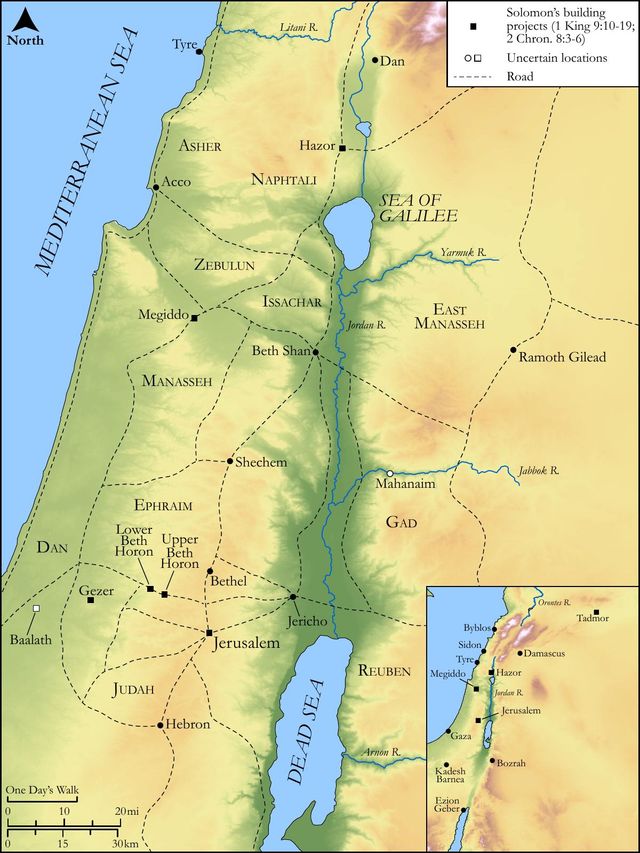
See on the biblical-era map
Study this verse
Public-domain commentary
Matthew Henry
From his Commentary on the Whole Bible. Henry comments on passages, not single verses — this entry covers 2 Chronicles 8:1–11. His two-level outline is real structure in the source text, so it is rendered as structure.
This we had Kg1 9:10-24, and therefore shall only observe here,
I.Though Solomon was a man of great learning and knowledge, yet he spent his days, not in contemplation, but in action, not in his study, but in his country, in building cities and fortifying them, in a time of peace preparing for a time of war, which is as much a man's business as it is in summer to provide food for winter.
II.As he was a man of business himself, and did not consult his own ease, so he employed a great many hands, kept abundance of people to work.
It is the interest of a state by all means possible to promote and encourage industry, and to keep its subjects from idleness. A great many strangers there were in Israel, many that remained of the Canaanites; and they were welcome to live there, but not to live and do nothing. The men of Laish, who had no business, were an easy prey to the invaders, Jdg 18:7.
III.When Solomon had begun with building the house of God, and made good work and quick work of that, he prospered in all his undertakings, so that he built all that he desired to build, Ch2 8:6. Those who have a genius for building find that one project draws on another, and the latter must amend and improve the former. Now observe,
1.How the divine providence gratified even Solomon's humour, and gave him success, not only in all that he needed to build and that it was for his advantage to build, but in all that he had a mind to build. So indulgent a Father God is sometimes to the innocent desires of his children that serve him. Thus he pleased Jacob with that promise, Joseph shall put his hand on thy eyes.
2.Solomon knew how to set bounds to his desires. He was not one of those that enlarge them endlessly, and can never be satisfied, but knew when to draw in; for he finished all he desired, and then he desired no more. He did not sit down and fret that he had not more cities to build, as Alexander did that he had not more worlds to conquer, Hab 2:5.
IV.That one reason why Solomon built a palace on purpose for the queen, and removed her and her court to it, was because he thought it by no means proper that she should dwell in the house of David (Ch2 8:11), considering that that had been a place of great piety, and perhaps her house was a place of great vanity. She was proselyted, it is likely, to the Jewish religion; but it is a question whether all her servants were. Perhaps they had among them the idols of Egypt, and a great deal of profaneness and debauchery. Now, though Solomon had not zeal and courage enough to suppress and punish what was amiss there, yet he so far consulted the honour of his father's memory that he would not suffer that place to be thus profaned where the ark of God had been and where holy David had prayed many a good prayer and sung many a sweet psalm. Not that all the places where the ark had been were so holy as never to be put to a common use; for then the houses of Abinadab and Obed-edom must have been so. But the place where it had been so long, and had been so publicly attended on, was so venerable that it was not fit to be the place of so much gaiety, not to say iniquity, as was to be found, I fear, in the court that Pharaoh's daughter kept. Note, Between things sacred and things common the ancient landmarks ought to be kept up. It was an outer-court of the temple that was the court of the women.
Continue studying 2 Chronicles 8:2 across the web’s major study libraries — every link below opens this exact verse, chapter, or book on the destination site.
Read & Compare
 BibleGatewayThis verse in more than 200 translations and 70 languages.
 Bible.comThe YouVersion reader — hundreds of translations, reading plans, and highlights.
 ESV.orgCrossway's official English Standard Version reader.
 NET BibleThe NET translation with 60,000+ translators' notes on every rendering decision.
 STEP BibleTyndale House's free study tool — original text, vocabulary, and scholarly resources.
 BibliaLogos Bible Software's free web reader.
 USCCBThe New American Bible (Revised Edition) with the U.S. bishops' study notes.
Commentaries
 BibleHub CommentariesDozens of classic commentaries on this verse, gathered on one page.
 StudyLightMore than 100 commentary sets — the largest collection on the web.
 BibleRefPlain-English commentary on what this verse means, verse by verse.
 Enduring WordDavid Guzik's free commentary on this chapter, widely used by Bible teachers.
 Bible Study ToolsVerse commentary alongside Greek and Hebrew study aids.
Original Language & Research
- BibleHub InterlinearThe verse word by word — original language, transliteration, and English.
- BibleHub LexiconEvery word's original-language definition and Strong's entry.
 Blue Letter BibleDeep-study tools — Strong's numbers, concordance, and word studies.
 SefariaThe Hebrew text with Rashi and centuries of Jewish commentary.
Sermons, Hymns & Audio


TrulyRandomVerse is not affiliated with these sites and doesn’t control their content. They’re linked because they’re genuinely useful.
Summary
Second Chronicles 8:2 meticulously details King Solomon's strategic and resourceful development of the cities that King Huram of Tyre had previously returned to him. These territories, initially part of a payment for Huram's extensive assistance in Solomon's monumental building projects, were deemed unsatisfactory by the Tyrian king. Rather than allowing them to remain desolate or a diplomatic liability, Solomon shrewdly rebuilt and fortified these cities, subsequently settling Israelites within their walls. This action not only transformed a perceived setback into a significant asset but also strengthened his kingdom's infrastructure, consolidated its borders, and enhanced its population distribution in key regions, showcasing Solomon's profound administrative wisdom and commitment to national flourishing.
Context
ShowHideLiterary Context
This verse is situated immediately after a concise summary of Solomon's grand architectural achievements, specifically the twenty years he spent constructing the magnificent Temple in Jerusalem and his own opulent royal palace (2 Chronicles 8:1). The narrative in 2 Chronicles 8 transitions from these centralized, monumental building endeavors to the more practical, administrative consolidation and development of his kingdom's peripheral territories. Verse 2 directly addresses the repurposing of land that had been part of an earlier, somewhat problematic, diplomatic exchange with Huram. This demonstrates Solomon's consistent commitment to national development, his astute practical wisdom in managing both resources and territorial assets, and his ability to turn a diplomatic rejection into an opportunity for internal strengthening. It marks a shift from the initial phase of acquisition and construction to a phase of organization, settlement, and long-term strategic planning, ensuring the stability and expansion of the Israelite presence within the promised land.
Historical & Cultural Context
The relationship between Solomon and Huram (known as Hiram in the book of Kings) was a pivotal economic and political alliance in the ancient Near East. Tyre, a prominent Phoenician city-state, was renowned for its superior naval capabilities, highly skilled artisans, and access to invaluable resources like timber from Lebanon and gold. In exchange, Israel provided agricultural produce and strategic land routes. The initial agreement, elaborated in 1 Kings 9:10-14, involved Solomon ceding twenty cities in the region of Galilee to Huram as payment for his extensive services. Huram's subsequent dissatisfaction with these cities, which he famously dubbed "Cabul" (a term likely implying "good for nothing" or "displeasing"), led to their return to Solomon. This incident highlights the differing strategic values and needs of the two kingdoms; what was crucial borderland for Israel might have been perceived as agriculturally poor or lacking in coastal access by the maritime-focused Tyrians. Solomon's subsequent rebuilding and resettlement of these cities exemplify his shrewd statecraft, transforming a diplomatic misstep into a significant opportunity for internal strengthening, border security, and the expansion of Israelite control.
Key Themes
ShowHideThis verse powerfully illustrates several key themes central to the Chronicler's portrayal of Solomon's reign and the broader theological message of Chronicles. Firstly, it underscores Solomon's administrative prowess and divine wisdom, extending beyond grand architectural feats to practical statecraft and resourceful management. His ability to transform rejected assets into valuable national infrastructure demonstrates the strategic foresight and divine blessing that characterized his reign, a quality consistently lauded throughout his narrative (e.g., 1 Kings 4:29-34). Secondly, the verse emphasizes national development and the establishment of God's people, highlighting Solomon's commitment to strengthening his kingdom through internal growth and secure habitation. By rebuilding these cities and settling Israelites there, he consolidated Israelite control over these regions, ensuring population expansion and territorial security, which aligns with the Chronicler's overarching interest in the prosperity and well-being of God's covenant people under righteous leadership. Thirdly, it speaks to the vital principle of resourcefulness and faithful stewardship, as Solomon did not allow the returned cities to lie fallow but actively invested in their transformation, turning a perceived liability into a strategic asset for the long-term benefit of Israel. This reflects a profound principle of wise management of all that God provides, even in seemingly undesirable or rejected circumstances.
Exposition and Analysis
ShowHideKey Word Analysis
ShowHideThe verb נָתַן (nâthan) fundamentally means "to give," but its extensive semantic range includes "to restore" or "to give back." In this specific context, it precisely conveys that Huram "returned" or "gave back" the cities to Solomon. This is not merely a passive act but an active decision by Huram to relinquish possession of these territories, confirming the account in 1 Kings 9:12. The use of nâthan here emphasizes the reversal of the initial transaction and sets the stage for Solomon's subsequent actions of reclamation and development.
The verb בָּנָה (bânâh) means "to build, rebuild, establish." Its use here signifies a substantial and comprehensive effort, implying far more than minor repairs or cosmetic improvements. Solomon undertook extensive construction, likely involving the erection of fortifications, new housing, public buildings, and essential infrastructure necessary to make these cities habitable, defensible, and productive centers. This term underscores the scale of Solomon's investment and his unwavering commitment to developing these areas into fully functional and integrated Israelite settlements.
The verb יָשַׁב (yâshab) means "to sit down, remain, dwell, inhabit." By causing the children of Israel to "dwell" in these cities, Solomon ensured their permanent habitation and integral incorporation into the kingdom. This act of resettlement was crucial for populating strategic border areas, securing the kingdom's frontiers, and expanding the Israelite presence, thereby transforming previously empty or undesirable territories into thriving communities for his people, fulfilling the divine mandate to inhabit the land.
Verse Breakdown
ShowHide"That the cities which Huram had restored to Solomon"
This opening clause immediately identifies the specific subject of the verse: cities that were previously transferred to Huram by Solomon but subsequently returned. It serves as a direct narrative link to the earlier account of the alliance between Solomon and Huram, particularly the details found in 1 Kings 9:10-14. The emphasis here is on the act of "restoration" or "return" by Huram, establishing the critical context for Solomon's subsequent proactive measures.
"Solomon built them"
This phrase describes Solomon's decisive and proactive response to Huram's rejection. Instead of abandoning these cities or allowing them to remain desolate, Solomon undertook a significant and comprehensive construction effort. This implies not just minor renovations but a full-scale rebuilding program, transforming them into suitable, fortified, and functional urban centers. This highlights Solomon's administrative foresight, his strategic vision, and his unwavering commitment to developing his kingdom's infrastructure for long-term stability.
"and caused the children of Israel to dwell there"
This final clause reveals the ultimate purpose and profound benefit of Solomon's rebuilding efforts. By settling Israelites in these newly built or restored cities, he achieved several crucial strategic goals: populating previously undesirable or empty territories, strengthening the Israelite presence in vital border regions, and integrating these areas fully into the fabric of his kingdom. This act of resettlement was paramount for national consolidation, security, and the long-term welfare and prosperity of God's covenant people.
Literary Devices
ShowHideThe verse primarily employs Narrative Economy and Emphasis through Action. The Chronicler's account here, while remarkably concise, efficiently summarizes a complex series of events that are more extensively detailed in 1 Kings 9:10-14. The Chronicler deliberately shifts the narrative focus from Huram's displeasure and the diplomatic awkwardness (as highlighted in Kings) to Solomon's constructive and resourceful response. This shift in emphasis serves the Chronicler's overarching theological agenda, which is to portray Solomon as a wise, divinely blessed, and effective king who consistently works for the benefit, security, and prosperity of God's people. The verse also utilizes Juxtaposition by placing Huram's rejection ("restored") immediately before Solomon's proactive rebuilding and resettlement, thereby magnifying Solomon's wisdom and resourcefulness in contrast to the foreign king's dissatisfaction. The sequence of actions—Huram's return, Solomon's building, and the settlement of Israelites—creates a clear, linear cause-and-effect chain, powerfully emphasizing Solomon's decisive, beneficial, and divinely guided leadership.
Theological and Thematic Connections
ShowHideThe account of Solomon's rebuilding and resettlement of the returned cities underscores a profound theological principle: God's people, especially their leaders, are called to be resourceful and faithful stewards of all that is entrusted to them, transforming even perceived liabilities or rejected assets into opportunities for the flourishing of the kingdom. Solomon's actions reflect a divine wisdom that seeks to bring order, prosperity, and habitation to desolate or undesirable places, mirroring God's own creative and redemptive work in bringing life out of chaos and beauty out of ashes. This demonstrates that true leadership, guided by divine wisdom, does not merely accumulate resources but strategically deploys them for the welfare and establishment of the community, ensuring the flourishing and security of God's covenant people within the promised land. It speaks powerfully to the idea that nothing is truly "good for nothing" when viewed through the lens of God-given potential, wise stewardship, and a commitment to God's purposes.
Reflection and Application
ShowHideSolomon's response to the returned cities offers a powerful and enduring paradigm for contemporary believers facing circumstances that others have deemed undesirable, unproductive, or even "good for nothing." This verse profoundly challenges us to cultivate a vision of potential and divine purpose where others may see only rejection, waste, or insurmountable difficulty. Spiritually, this principle can be applied to various aspects of our lives: our unique gifts and talents that may feel undervalued, past experiences that seem to have led to dead ends, or even relationships that have been "returned" to us in a broken or fractured state. Like Solomon, we are called to not merely accept the status quo of desolation or rejection but to actively "build them" – to prayerfully invest our energy, wisdom, and resources into their transformation. This involves seeking God's discernment to perceive what He can do with seemingly unpromising situations, diligent effort to "build" (which implies developing, restoring, fortifying, and innovating), and a community-minded heart to "cause the children of Israel to dwell there" (to create spaces of flourishing, belonging, and spiritual habitation for others). Ultimately, this narrative encourages us to be active agents of restoration and development in a broken world, turning liabilities into opportunities for God's glory and the holistic good of His people, recognizing that even the seemingly rejected can be repurposed for profound divine purposes.
Questions for Reflection
ShowHideFAQ
ShowHideQ: Why did Huram return the cities to Solomon if they were payment for his services?
ShowHideAccording to 1 Kings 9:10-14, Huram was profoundly displeased with the twenty cities Solomon gave him in Galilee. He famously called them "Cabul," a name that likely carried a derogatory connotation, perhaps meaning "good for nothing," "displeasing," or "as good as nothing" in his estimation. It is widely speculated that these cities were not strategically valuable to Tyre, possibly lacking good harbors, fertile land, or easy access to trade routes, or simply did not meet Huram's high expectations for the immense wealth and resources he had provided for Solomon's grand building projects. His act of returning them unequivocally indicates his dissatisfaction and a desire to either renegotiate the terms of payment or simply refuse what he perceived as an inadequate or unsuitable exchange.
Q: What does "Solomon built them" imply about the state of these cities?
ShowHideThe phrase "Solomon built them" (Hebrew: bânâh) strongly suggests that these cities were in a state of disrepair, underdeveloped, or perhaps even desolate when Huram returned them. It implies a significant and comprehensive construction effort, extending far beyond mere minor repairs. Solomon likely invested substantial resources in fortifying them with walls and defenses, constructing new housing for settlers, establishing essential public infrastructure, and making them suitable for permanent habitation and strategic defense. This transformation turned what was initially a diplomatic disappointment into a vital strategic asset for the kingdom of Israel, powerfully demonstrating Solomon's administrative wisdom, foresight, and unwavering commitment to national development and security.
Q: Is there a discrepancy between 2 Chronicles 8:2 and 1 Kings 9:10-14 regarding these cities?
ShowHideNo, there is no fundamental discrepancy between the two accounts; rather, they offer complementary perspectives on the same historical event. 1 Kings 9:10-14 focuses primarily on Huram's dissatisfaction with the cities and his calling them "Cabul," highlighting the diplomatic tension and the foreign king's perspective. 2 Chronicles 8:2, on the other hand, picks up the narrative from Solomon's perspective, emphasizing his resourceful and proactive response to Huram's rejection. The Chronicler's account deliberately highlights Solomon's wisdom, his beneficial actions for Israel, and the positive outcome of the situation, aligning perfectly with the book's overall aim to portray the Davidic dynasty and its kings in a favorable light, emphasizing their piety and their contributions to the well-being of God's people. Both accounts consistently confirm that the cities were indeed exchanged and subsequently returned to Solomon.
Christ-Centered Fulfillment
ShowHideThe narrative of Solomon transforming the "good for nothing" cities into thriving Israelite settlements finds a profound and glorious Christ-centered fulfillment in the redemptive work of Jesus Christ. Just as Solomon took what was rejected and rebuilt it for the benefit and habitation of his people, Christ takes humanity, marred by sin and deemed "good for nothing" in its fallen, desolate state, and through His perfect sacrifice on the cross and triumphant resurrection, He rebuilds us into living temples for the Holy Spirit (1 Corinthians 3:16). The very stone "rejected by the builders" ultimately becomes the "cornerstone" (Psalm 118:22 and Matthew 21:42), a powerful and prophetic metaphor for Christ Himself, who was rejected by the world yet became the indispensable foundation of God's new creation and the Church. Furthermore, Christ's ultimate mission is to gather and settle His people, not merely in physical cities, but into the eternal spiritual kingdom of God, making us citizens of heaven (Philippians 3:20) and building His Church, against which the very gates of hell will not prevail (Matthew 16:18). His redemptive work is the ultimate act of taking what is spiritually desolate, rejected, and barren, and filling it with abundant life, transforming the spiritually empty into a flourishing, eternal dwelling place for God's glorious presence.