


1 Kings 9:18
Bible text: King James Version (1769 Blayney text) · Public domain
Bible text: King James Version with Strong's numbers · Public domain
Bible text: Berean Standard Bible · Public domain
Bible text: American Standard Version (1901) · Public domain
Bible text: World English Bible, Messianic edition · Public domain
Bible text: Geneva Bible (1599) · Public domain
Bible text: Young's Literal Translation · Public domain
- וְאֶתve·'Etand <obj.>H853Conj-w ¦ DirObjMParticle Object Indicatorוְandאֶת<obj.>
- בַּעֲלָתba·'a·LatBaalathH1191N-properNoun Proper Location
- וְאֶתve·'Etand <obj.>H853Conj-w ¦ DirObjMParticle Object Indicatorוְandאֶת<obj.>
- תַּדְמֹרta·marTadmorH8412N-properNoun Proper Location
- בַּמִּדְבָּרba·mid·Barin the wildernessH4057Prep-b ¦ N-msNoun Singular Masculine Absoluteבַּin theמִּדְבָּרwilderness
- בָּאָרֶץba·'A·retzin the landH776Prep-b ¦ N-fsNoun Singular Feminine Absoluteבָּin theאָרֶץland
English is a literal word-by-word gloss of the Hebrew, not the KJV's wording. Why?
This is the original text the KJV's translators worked from — each Hebrew word with its own literal English meaning in this verse, prepared by scholars at Tyndale House, Cambridge. The KJV translates whole sentences, not word by word, so its wording differs: one Hebrew word can become several English words, and the KJV may choose “the LORD” where the gloss reads “Yahweh”. Both are faithful — they answer different questions. For the KJV's own rendering, switch to the KJV text.
Details
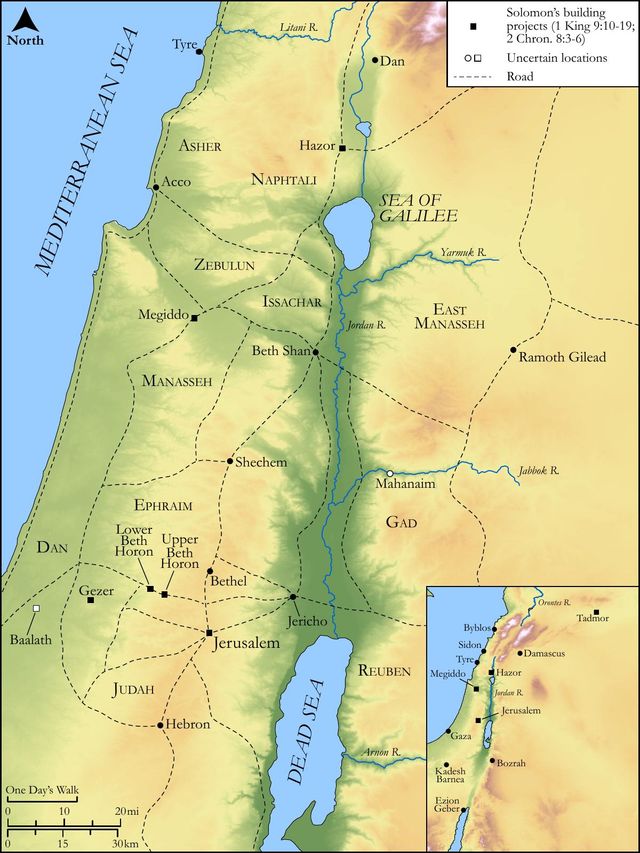
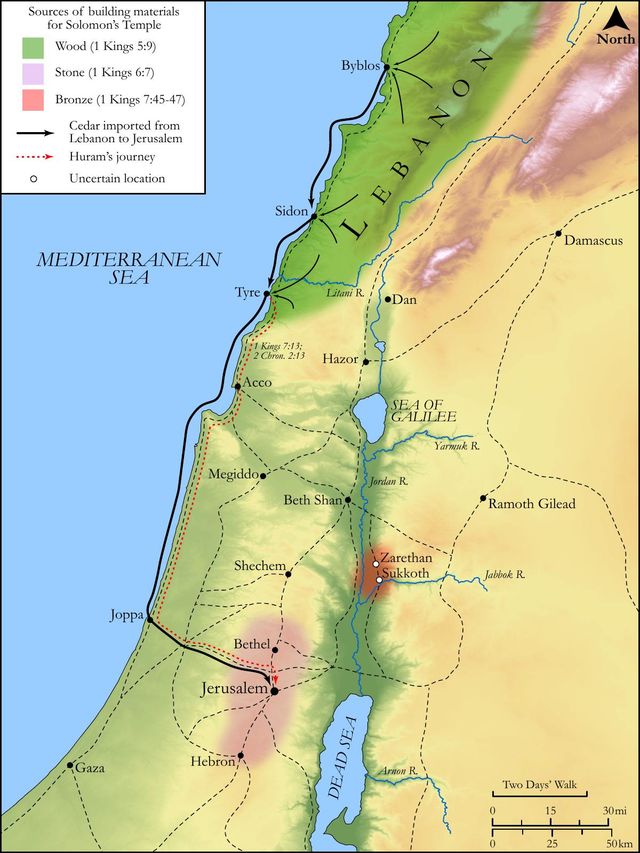
See on the biblical-era maps

Study this verse
Public-domain commentary
Matthew Henry
From his Commentary on the Whole Bible. Henry comments on passages, not single verses — this entry covers 1 Kings 9:15–28. His two-level outline is real structure in the source text, so it is rendered as structure.
We have here a further account of Solomon's greatness.
I.His buildings.
He raised a great levy both of men and money, because he projected a great deal of building, which would both employ many hands and put him to a vast expense, Kg1 9:15. And he was a wise builder, who sat down first, and counted the cost, and would not begin to build till he found himself able to finish. Perhaps there was some complaint of the heaviness of the taxes, which the historian excuses from the greatness of his undertakings. He raised it, not for war (as other princes), which would spend the blood of his subjects, but for building, which would require only their labour and purses. Perhaps David observed Solomon's genius to lie towards building, and foresaw he would have his head and hands full of it, when he penned that song of degrees for Solomon, which begins, Except the Lord build the house, those labour in vain that build it (Psa 127:1), directing him to acknowledge God in all his ways, and, by prayer and faith in his providence, to take him along with him in all his designs of this kind. And Solomon verily began his work at the right end, for he built God's house first, and finished that before he began his own; and then God blessed him, and he prospered in all his other buildings. If we begin with God, he will go on with us. Let the first-fruits be his, and the after-fruits will the more comfortably be ours, Mat 6:33. Solomon built a church first and then he was enabled to build houses, and cities, and walls. Those consult not their own interest that defer to the last what they design for pious uses. The further order in Solomon's buildings is observable. God's house first for religion, then his own for his own convenience, then a house for his wife, to which she removed as soon as it was ready for her (Kg1 9:24), then Millo, the town-house or guild-hall, then the wall of Jerusalem, the royal city, then some cities of note and strength in the country, which were decayed and unfortified, Hazor, Megiddo, etc. As he rebuilt these at his own charge, the inhabitants would be not only his subjects, but his tenants, which would increase the revenues of the crown for the benefit of his successors. Among the rest, he built Gezer, which Pharaoh took out of the hands of the Canaanites, and made a present of to his daughter, Solomon's wife, Kg1 9:16. See how God maketh the earth to help the woman. Solomon was not himself a warlike prince, but the king of Egypt, who was, took cities for him to build. Then he built cities for convenience, for store, for his chariots, and for his horsemen, Kg1 9:19. And, lastly, he built for pleasure in Lebanon, for his hunting perhaps, or other diversions there. Let piety begin, and profit proceed, and leave pleasure to the last.
II.His workmen and servants.
In doing such great works, he must needs employ abundance of workmen. The honour of great men is borrowed from their inferiors, who do that which they have the credit of.
1.Solomon employed those who remained of the conquered and devoted nations in all the slavish work, Kg1 9:20, Kg1 9:21. We may suppose that they renounced their idolatry and submitted to Solomon's government, so that he could not, in honour, utterly destroy them, and they were so poor that he could not levy money on them; therefore he served himself of their labour. Herein he observed God's law (Lev 25:44, Thy bondmen shall be of the heathen), and fulfilled Noah's curse upon Canaan, A servant of servants shall he be unto his brethren, Gen 9:25.
2.He employed Israelites in the more creditable services (Kg1 9:22, Kg1 9:23): Of them he made no bondmen, for they were God's freemen, but he made them soldiers and courtiers, and gave them offices, as he saw them qualified, among his chariots and horsemen, appointing some to support the service of the inferior labourers. Thus he preserved the dignity and liberty of Israel and honoured their relation to God as a kingdom of priests.
III.His piety and devotion (Kg1 9:25):
Three times in a year he offered burnt-offerings extraordinary (namely, at the three yearly feasts, the passover, pentecost, and feast of tabernacles) in honour of the divine institution, besides what he offered at other times, both statedly and upon special occasions. With his sacrifices he burnt incense, not himself (that was king Uzziah's crime), but the priest for him, at his charge, and for his particular use. It is said, He offered on the altar which he himself built. He took care to build it, and then,
1.He himself made use of it. Many will assist the devotions of others that neglect their own. Solomon did not think his building an altar would excuse him from sacrificing, but rather engage him the more to it.
2.He himself had the benefit and comfort of it. Whatever pains we take, for the support of religion, to the glory of God and the edification of others, we ourselves are likely to have the advantage of it.
IV.His merchandise.
He built a fleet of trading ships at Ezion-geber (Kg1 9:26), a port on the coast of the Red Sea, the furthest stage of the Israelites when they wandered in the wilderness, Num 33:35. Probably that wilderness now began to be peopled by the Edomites, which it was not then. To them this port had belonged, but, David having subdued the Edomites, it now pertained to the crown of Judah. The fleet traded to Ophir in the East Indies, supposed to be that which is now called Ceylon. Gold was the commodity traded for, substantial wealth. It should seem, Solomon had before been Hiram's partner, or put a venture into his ships, which made him a rich return of 120 talents (Kg1 9:14), which encouraged him to build a fleet of his own. The success of others in any employment should quicken our industry; for in all labour there is profit. Solomon sent his own servants as factors, and merchants, and super-cargoes, but hired Tyrians for sailors, for they had knowledge of the sea, Kg1 9:27. Thus one nation needs another, Providence so ordering it that there may be mutual commerce and assistance; for not only as Christians, but as men, we are members one of another. The fleet brought home to Solomon 420 talents of gold, Kg1 9:28. Canaan, the holy land, the glory of all lands, had no gold in it, which teaches us that that part of the wealth of this world which is for hoarding and trading is not the best part of it, but that which is more immediately for the present support and comfort of life, our own and others'; such were the productions of Canaan. Solomon got much by his merchandise, but, it should seem, David got much more by his conquests. What were Solomon's 420 talents to David's 100,000 talents of gold? Ch1 22:14; Ch1 29:4. Solomon got much by his merchandise, and yet has directed us to a better trade, within reach of the poorest, having assured us from his own experience of both that the merchandise of wisdom is better than the merchandise of silver and the gain thereof than fine gold, Pro 3:14.
Continue studying 1 Kings 9:18 across the web’s major study libraries — every link below opens this exact verse, chapter, or book on the destination site.
Read & Compare
 BibleGatewayThis verse in more than 200 translations and 70 languages.
 Bible.comThe YouVersion reader — hundreds of translations, reading plans, and highlights.
 ESV.orgCrossway's official English Standard Version reader.
 NET BibleThe NET translation with 60,000+ translators' notes on every rendering decision.
 STEP BibleTyndale House's free study tool — original text, vocabulary, and scholarly resources.
 BibliaLogos Bible Software's free web reader.
 USCCBThe New American Bible (Revised Edition) with the U.S. bishops' study notes.
Commentaries
 BibleHub CommentariesDozens of classic commentaries on this verse, gathered on one page.
 StudyLightMore than 100 commentary sets — the largest collection on the web.
 BibleRefPlain-English commentary on what this verse means, verse by verse.
 Enduring WordDavid Guzik's free commentary on this chapter, widely used by Bible teachers.
 Bible Study ToolsVerse commentary alongside Greek and Hebrew study aids.
Original Language & Research
- BibleHub InterlinearThe verse word by word — original language, transliteration, and English.
- BibleHub LexiconEvery word's original-language definition and Strong's entry.
 Blue Letter BibleDeep-study tools — Strong's numbers, concordance, and word studies.
 SefariaThe Hebrew text with Rashi and centuries of Jewish commentary.
Sermons, Hymns & Audio


TrulyRandomVerse is not affiliated with these sites and doesn’t control their content. They’re linked because they’re genuinely useful.
Summary
1 Kings 9:18 highlights the strategic importance of two cities, Baalath and Tadmor, within King Solomon's extensive building and fortification program. This verse is part of a broader account detailing Solomon's administrative prowess and architectural achievements, underscoring the vast reach of his dominion and his foresight in securing key territories and vital trade routes. These projects were crucial for the stability, defense, and economic prosperity of his flourishing kingdom.
Context
ShowHideLiterary Context
This verse is situated within 1 Kings 9:10-28, a section that meticulously details King Solomon's grand construction endeavors. These projects followed the monumental twenty-year period required for the completion of the Temple and his own royal palace, as noted in 1 Kings 9:10. The preceding verses, specifically 1 Kings 9:15-17, enumerate other significant fortified cities like Gezer, Beth-horon the nether, and Beth-horon the upper, indicating a systematic and comprehensive effort by Solomon to strengthen his kingdom's infrastructure and defense. The inclusion of Baalath and Tadmor extends this list, emphasizing the geographical breadth of his administrative control and the diverse purposes—military, logistical, and economic—these cities served. This passage serves as a transition from the glorious account of the Temple's dedication to the practicalities of maintaining and expanding a vast and prosperous kingdom, setting the stage for Solomon's later interactions and the eventual challenges to his reign.
Historical & Cultural Context
Solomon's reign (circa 970-931 BC) is often depicted as a golden age for ancient Israel, characterized by unprecedented peace, immense wealth, and significant international influence. Grand building projects were a hallmark of the great kings of that day, serving not only practical purposes like defense and administration but also symbolizing royal authority, divine favor, and national prestige. The strategic fortification of cities such as Baalath and Tadmor reflects Solomon's astute understanding of defense in a region frequently prone to conflict and the critical importance of controlling lucrative trade routes. Tadmor, widely identified with the renowned oasis city of Palmyra, was a pivotal hub on major caravan routes connecting Mesopotamia to the Mediterranean. Its control was therefore vital for Israel's economic prosperity and its role as a regional power. Solomon's impressive ability to mobilize vast resources and labor for such extensive projects, including the conscription of non-Israelite labor as mentioned in 1 Kings 9:20-21, was characteristic of the imperial ambitions and sophisticated administrative capabilities of his era.
Key Themes
ShowHideThe mention of these specific cities in 1 Kings 9:18 contributes significantly to several overarching themes present in the book of Kings and the broader Solomonic narrative. Firstly, it powerfully underscores Solomon's Royal Authority and Administration, showcasing his dominion over an expansive kingdom and his remarkable capacity to conceptualize and execute large-scale infrastructure projects. Secondly, the verse highlights Strategic Fortification and National Security, revealing Solomon's foresight in establishing military outposts and securing key territories, particularly those situated "in the wilderness" which, despite their remoteness, were vulnerable yet absolutely vital for communication and commerce. Thirdly, the inclusion of cities like Tadmor emphasizes Economic Prosperity and Trade, as such locations were indispensable for facilitating trans-desert commerce. This trade contributed immensely to the unparalleled wealth and international standing of Israel during Solomon's reign, a prosperity often attributed to his divinely granted wisdom.
Exposition and Analysis
ShowHideKey Word Analysis
ShowHideThis place name, derived from a root meaning "mistressship" or "possessor," refers to a fortified city. While its precise location is debated among scholars, it is also mentioned in 2 Chronicles 8:6 as one of Solomon's store cities. This suggests its function was likely related to logistics, supply storage, or defense within the western or central part of his kingdom. Its inclusion in this list signifies the comprehensive and integrated nature of Solomon's domestic building and defense program.
Almost universally identified with the renowned ancient city of Palmyra in modern-day Syria, Tadmor's name is thought to derive from a root meaning "date palm," which aptly describes its setting as a fertile oasis. Its strategic location deep within the Syrian Desert made it an indispensable hub for caravan routes that connected the eastern empires (like Mesopotamia) with the coast of the great sea. Solomon's fortification of Tadmor vividly demonstrates his extended influence beyond the traditional borders of Israel and his keen understanding of economic and geopolitical control.
While commonly translated as "desert," the Hebrew term midbâr can also refer to open, sparsely populated grazing lands or steppes. In the context of Tadmor, the phrase "in the wilderness" emphasizes its remote, arid, yet strategically vital location. It highlights the challenging environment in which Solomon extended his control, securing crucial trade arteries that traversed vast, uncultivated regions. This detail underscores the ambition and far-reaching influence of his kingdom.
Verse Breakdown
ShowHide"And Baalath"
This phrase introduces the first of two specific cities enumerated in this verse as integral parts of Solomon's extensive building and fortification efforts. Its immediate placement after a list of other fortified cities (such as Gezer and the Beth-horons in 1 Kings 9:17) indicates its inclusion within a broader, interconnected network designed for defense and administration. The precise function of Baalath—whether primarily military, a storage depot, or an administrative center—is implied by its presence in such a list, signifying its importance to the Solomonic state's infrastructure and security.
"and Tadmor in the wilderness"
This clause names the second city, Tadmor, and crucially specifies its geographical context "in the wilderness." This geographical detail is paramount for understanding its strategic significance. Tadmor's remote location, situated far to the northeast of Jerusalem, vividly illustrates the extensive reach of Solomon's power and his profound strategic interest in controlling distant trade routes that traversed the desert, thereby connecting his kingdom to Mesopotamia and other powerful eastern empires. This demonstrates a proactive approach to economic and geopolitical influence.
"in the land"
This concluding phrase, though seemingly generic, serves an important purpose: it affirms that these cities, despite their varied locations and distinct strategic roles, were either directly under Solomon's firm control or firmly within his sphere of influence. It reinforces the overarching idea of a unified and expansive kingdom operating under his singular authority, even encompassing territories that might have been considered peripheral or beyond the traditional, more confined boundaries of Israel. It speaks to the consolidation of his power.
Literary Devices
ShowHideThe primary literary device at play in 1 Kings 9:18 is Cataloging or Listing. This technique is employed throughout the book of Kings to convey the impressive scope and scale of Solomon's achievements, whether detailing his vast wealth, his extensive administrative officials, or, as in this instance, his expansive building projects. By meticulously naming specific cities like Baalath and Tadmor, the text provides concrete evidence of Solomon's power and administrative reach, lending historical authenticity and rich detail to the narrative. The Geographical Specificity inherent in the naming of these locations, further enhanced by the descriptive phrase "in the wilderness," serves to ground the account in a tangible reality, allowing the reader to visualize the immense extent of Solomon's dominion. While not a direct literary device, the inclusion of such precise details also subtly contributes to the overarching theme of Royal Magnificence, portraying Solomon as an exceptionally powerful, wise, and effective ruler whose influence and authority extended far and wide among the nations.
Theological and Thematic Connections
ShowHideSolomon's extensive building program, including the strategic fortification of cities like Baalath and Tadmor, reflects a divinely blessed period of peace and unparalleled prosperity for Israel. This era was, in many ways, a fulfillment of God's promises to David concerning a secure and established kingdom. However, these human endeavors also underscore the profound responsibility of stewardship and strategic planning in managing the abundant resources and opportunities God provides. While these efforts undeniably ensured national security and economic flourishing, they also subtly foreshadow the potential dangers of relying solely on human strength, accumulating excessive wealth, and the eventual temptations that led to Solomon's later deviations from God's explicit commands. The strategic placement of these cities demonstrates a wisdom that was initially a gift from God, intended to establish a righteous and thriving kingdom. Yet, even the most impressive and well-intentioned human endeavors are ultimately temporary and subject to the rise and fall of earthly powers, pointing to a profound need for an eternal, unshakable foundation that transcends human achievements.
Reflection and Application
ShowHideThe detailed account of Solomon's building projects, particularly the mention of Baalath and Tadmor, serves as a profound reminder of the critical importance of wise stewardship and strategic planning in all facets of our lives. Just as King Solomon diligently managed his kingdom's resources for defense, security, and prosperity, believers today are called to wisely manage the gifts, talents, time, and opportunities that God graciously provides. This involves not only careful and deliberate planning but also discerning where to invest our efforts for maximum impact, whether in our personal spiritual growth, the nurturing of family relationships, our professional endeavors, or our engagement within the community. The passage challenges us to critically examine what "foundations" we are laying in our lives and ministries—are they built upon transient earthly successes and fleeting achievements, or are they firmly rooted in the enduring, eternal principles of God's Word? This verse encourages us to be intentional, purposeful, and forward-thinking, understanding that even seemingly mundane details of administration and infrastructure contribute to a larger, divine narrative and God's overarching purposes for our lives.
Questions for Reflection
ShowHideFAQ
ShowHideQuestion? Is Tadmor the same as Palmyra?
ShowHideYes, there is a very strong and widely accepted scholarly consensus that Tadmor, as mentioned in 1 Kings 9:18, is indeed the renowned ancient city of Palmyra. This vital oasis city is located deep in the Syrian Desert, approximately 150 miles northeast of modern-day Damascus. Its Hebrew name, Tadmor (תדמר), is believed to derive from a root meaning "date palm," which is a fitting description for a thriving oasis in an arid region. Solomon's decision to fortify Tadmor was a highly strategic move designed to control and secure the incredibly lucrative east-west trade routes that passed through the desert. These routes connected his kingdom to Mesopotamia and other powerful empires of the East, thereby contributing significantly to Israel's economic prosperity and international standing during his reign.
Question? Why are these specific cities, Baalath and Tadmor, mentioned in this verse?
ShowHideThe specific mention of Baalath and Tadmor (alongside other cities like Gezer and Beth-horon in the preceding verses of 1 Kings 9) serves to powerfully highlight both the geographical breadth and the strategic depth of King Solomon's vast kingdom, as well as his remarkable administrative prowess. Baalath, likely situated in the western or central part of his kingdom (possibly in the tribal territories of Dan or Judah), probably functioned as an important logistical or defensive hub, as its parallel mention as a "store city" in 2 Chronicles 8:6 suggests. Tadmor, in stark contrast, was located far to the northeast in the wilderness, indicating Solomon's extended influence and his strategic control over vital trans-desert trade routes that were crucial for the kingdom's economy. Together, these cities vividly illustrate Solomon's comprehensive approach to national security, economic development, and the assertion of his royal authority across a vast and diverse territory.
Christ-Centered Fulfillment
ShowHideWhile 1 Kings 9:18 meticulously details the impressive, yet ultimately earthly, building projects of King Solomon, these endeavors ultimately serve as a profound foreshadowing of a greater, eternal reality found in Christ Jesus. Solomon, in his divinely granted wisdom and strategic foresight, built a kingdom of stone and mortar, establishing a period of security and prosperity for Israel. Yet, his kingdom, like all earthly dominions, was temporary and eventually succumbed to decline. Jesus, however, is the ultimate builder, not of physical structures, but of an eternal, spiritual kingdom. He famously declared, "I will build my church, and the gates of hell shall not prevail against it" (Matthew 16:18). Solomon's renowned wisdom, which enabled him to secure distant trade routes and fortify strategic cities, points to the perfect and infinite wisdom of Christ, who is indeed "greater than Solomon" (Matthew 12:42) and through whom all things were created and are continually sustained (Colossians 1:16-17). The peace and abundant prosperity that characterized Solomon's reign, facilitated by his strategic building, are but a fleeting shadow of the true and lasting peace and spiritual abundance found in Christ's unshakable kingdom (Hebrews 12:28). We, as believers, are called to be living stones, being built into a spiritual house, with Christ Jesus Himself as the foundational cornerstone—a far more enduring and eternally significant structure than any built by human hands (Ephesians 2:19-22).