


1 Kings 7:4
Bible text: King James Version (1769 Blayney text) · Public domain
Bible text: Berean Standard Bible · Public domain
Bible text: American Standard Version (1901) · Public domain
Bible text: World English Bible, Messianic edition · Public domain
Bible text: Geneva Bible (1599) · Public domain
Bible text: Young's Literal Translation · Public domain
- וּשְׁקֻפִיםu·she·ku·Fimand window framesH8261Conj-w ¦ N-mpNoun Plural Masculine Absoluteוּandשְׁקֻפִיםwindow frames
- שְׁלֹשָׁהshe·lo·ShahthreeH7969N-csNoun Singular common gender Absolute
- טוּרִיםtu·RimrowsH2905N-mpNoun Plural Masculine Absolute
- וּמֶחֱזָהu·me·che·Zahand windowH4237Conj-w ¦ N-fsNoun Singular Feminine Absoluteוּandמֶחֱזָהwindow
- אֶל'el[was] toH413PrepPreposition
- מֶחֱזָהme·che·ZahwindowH4237N-fsNoun Singular Feminine Absolute
- שָׁלֹשׁsha·LoshthreeH7969N-csNoun Singular common gender Absolute
- פְּעָמִיםpe·'a·MimtimesH6471N-mpNoun Plural Masculine Absolute
English is a literal word-by-word gloss of the Hebrew, not the KJV's wording. Why?
This is the original text the KJV's translators worked from — each Hebrew word with its own literal English meaning in this verse, prepared by scholars at Tyndale House, Cambridge. The KJV translates whole sentences, not word by word, so its wording differs: one Hebrew word can become several English words, and the KJV may choose “the LORD” where the gloss reads “Yahweh”. Both are faithful — they answer different questions. For the KJV's own rendering, switch to the KJV text.
Details
See on the biblical-era maps

Study this verse
Public-domain commentary
Matthew Henry
From his Commentary on the Whole Bible. Henry comments on passages, not single verses — this entry covers 1 Kings 7:1–12.
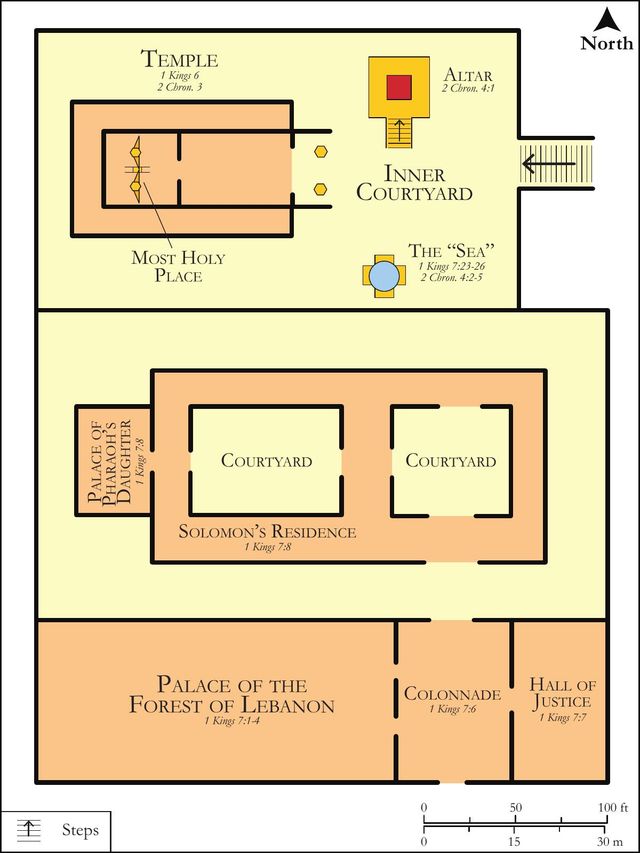
Never had any man so much of the spirit of building as Solomon had, nor to better purpose; he began with the temple, built for God first, and then all his other buildings were comfortable. The surest foundations of lasting prosperity are those which are laid in an early piety, Mat 6:33. 1. He built a house for himself (Kg1 7:1), where he dwelt, Kg1 7:8. His father had built a good house; but it was no reflection upon his father for him to build a better, in proportion to the estate wherewith God had blessed him. Much of the comfort of this life is connected with an agreeable house. He was thirteen years building this house, whereas he built the temple in little more than seven years; not that he was more exact, but less eager and intent, in building his own house than in building God's. He was in no haste for his own palace, but impatient till the temple was finished and fit for use. Thus we ought to prefer God's honour before our own ease and satisfaction. 2. He built the house of the forest at Lebanon (Kg1 7:2), supposed to be a country seat near Jerusalem, so called from the pleasantness of its situation and the trees that encompassed it. I rather incline to think that it was a house built in the forest of Lebanon itself, whither (though far distant from Jerusalem) Solomon (having so many chariots and horses, and those dispersed into chariot-cities, which probably were his stages) might frequently retire with ease. It does not appear that his throne (mentioned Kg1 7:7) was at the house of the forest of Lebanon, and it was not at all improper to put his shields there as in a magazine. Express notice is taken of his buildings, not only in Jerusalem, but in Lebanon (Kg1 9:19), and we read of the tower of Lebanon, which looks towards Damascus (Sol 7:4), which probably was part of this house. A particular account is given of this house, that being built in Lebanon, a place famed for cedars, the pillars, and beams, and roof, were all cedar (Kg1 7:2, Kg1 7:3), and, being designed for pleasant prospects, there were three tiers of windows on each side, light against light (Kg1 7:4, Kg1 7:5), or, as it may be read, prospect against prospect. Those whose lost i cast in the country may be well reconciled to a country life by this, that some of the greatest princes have thought those the most pleasant of their days which they have spent in their country retirements. 3. He built piazzas before one of his houses, either that at Jerusalem or that in Lebanon, which were very famous - a porch of pillars (Kg1 7:6), perhaps for an exchange or a guard-house, or for those to walk in that attended him about business till they could have audience, or for state and magnificence. He himself speaks of Wisdom's building her house, and hewing out her seven pillars (Pro 9:1), for the shelter of those that, three verses before (Kg1 8:34), are said to watch daily at her gates and to wait at the posts of her doors. 4. At his house where he dwelt in Jerusalem he built a great hall, or porch of judgment, where was set the throne, or king's bench, for the trial of causes, in which he himself was appealed to (placita coram ipso rege tenenda - causes were to be adjusted in the king's presence), and this was richly wainscoted with cedar, from the floor to the roof, Kg1 7:7. He had there also another court within the porch, nearer his house, of similar work, for his attendants to walk in, Kg1 7:8. 5. He built a house for his wife, where she kept her court, Kg1 7:8. It is said to be like the porch, because built of cedar like it, though not in the same form; this, no doubt, was nearer adjoining to his own palace, yet perhaps if it had been as near as it ought to have been Solomon would not have multiplied wives as he did.
The wonderful magnificence of all these buildings is taken notice of, Kg1 7:9, etc. All the materials were the best of their kind. The foundation-stones were costly for their size, four or five yards square, or at least so many yards long (Kg1 7:10), and the stones of the building were costly for the workmanship, hewn and sawn, and in all respects finely wrought, Kg1 7:9, Kg1 7:11. The court of his own house was like that of the temple (Kg1 7:12, compare Kg1 6:36); so well did he like the model of God's courts that he made his own by it.
Continue studying 1 Kings 7:4 across the web’s major study libraries — every link below opens this exact verse, chapter, or book on the destination site.
Read & Compare
 BibleGatewayThis verse in more than 200 translations and 70 languages.
 Bible.comThe YouVersion reader — hundreds of translations, reading plans, and highlights.
 ESV.orgCrossway's official English Standard Version reader.
 NET BibleThe NET translation with 60,000+ translators' notes on every rendering decision.
 STEP BibleTyndale House's free study tool — original text, vocabulary, and scholarly resources.
 BibliaLogos Bible Software's free web reader.
 USCCBThe New American Bible (Revised Edition) with the U.S. bishops' study notes.
Commentaries
 BibleHub CommentariesDozens of classic commentaries on this verse, gathered on one page.
 StudyLightMore than 100 commentary sets — the largest collection on the web.
 BibleRefPlain-English commentary on what this verse means, verse by verse.
 Enduring WordDavid Guzik's free commentary on this chapter, widely used by Bible teachers.
 Bible Study ToolsVerse commentary alongside Greek and Hebrew study aids.
Original Language & Research
- BibleHub InterlinearThe verse word by word — original language, transliteration, and English.
- BibleHub LexiconEvery word's original-language definition and Strong's entry.
 Blue Letter BibleDeep-study tools — Strong's numbers, concordance, and word studies.
 SefariaThe Hebrew text with Rashi and centuries of Jewish commentary.
Sermons, Hymns & Audio


TrulyRandomVerse is not affiliated with these sites and doesn’t control their content. They’re linked because they’re genuinely useful.
Summary
1 Kings 7:4 meticulously details a specific architectural feature of King Solomon's "House of the Forest of Lebanon," describing its innovative window design. This verse highlights a sophisticated system where windows were arranged in "three rows" and "light was against light in three ranks," indicating a deliberate strategy to maximize internal illumination. It underscores the exceptional engineering, grandeur, and thoughtful functionality that characterized Solomon's vast building projects, reflecting both his immense wealth and the divine wisdom bestowed upon him.
Context
ShowHideLiterary Context
This verse is situated within 1 Kings chapter 7, which provides a meticulous account of King Solomon's extensive building program for his royal palace complex. Following the completion of the Temple of the Lord, a project spanning seven years (as concluded in 1 Kings 6:38), Solomon dedicated thirteen years to constructing his personal residence and governmental structures. The "House of the Forest of Lebanon" was a particularly prominent and vast hall within this complex, so named for its extensive use of cedar wood imported from Lebanon. The detailed description of its windows in this verse is part of a larger narrative emphasis on the scale, opulence, and architectural ingenuity of Solomon's reign, contrasting his personal dwelling's construction time with that of the sacred Temple.
Historical & Cultural Context
King Solomon's reign (circa 970-931 BC) marked a period of unprecedented peace, prosperity, and international influence for ancient Israel. His era was characterized by significant architectural and engineering advancements, fueled by vast wealth acquired through trade and tribute, and supported by skilled craftsmen from across the region, including Phoenicia. Large public buildings, especially those constructed primarily from timber as the "House of the Forest of Lebanon" was, presented significant challenges in terms of internal illumination. The sophisticated window design described in 1 Kings 7:4 speaks to the advanced understanding of light and space in ancient architecture, aiming to create not just functional but also aesthetically pleasing and awe-inspiring interiors. This level of detail reflects the cultural value placed on grandeur and the practical necessity of maximizing natural light in an age without artificial illumination.
Key Themes
ShowHideThe detailed description of the windows in 1 Kings 7:4 contributes to several overarching themes within the book of Kings and the broader Solomonic narrative. Firstly, it exemplifies Architectural Ingenuity and Grandeur, showcasing the high level of design and construction skill available during Solomon's time, ensuring that even vast, timber-rich structures were adequately lit. Secondly, it highlights Solomon's Wisdom and Wealth, underscoring his divinely granted wisdom (1 Kings 4:29) which manifested in practical, impressive ways, and his unparalleled wealth that enabled such ambitious projects. The very scale and detail of the palace, including its lighting, speak to the extent of his resources. Thirdly, there is an underlying theme of Practicality and Aesthetics in Design, as the repeated mention of "light against light" emphasizes the importance of natural illumination not merely for utility but also for creating an atmosphere of openness and clarity within the royal complex, possibly reflecting a desire for order and divine favor.
Exposition and Analysis
ShowHideKey Word Analysis
ShowHideThis term refers to an embrasure or opening with a beveled jam, specifically designed to admit light. In the context of Solomon's palace, these were not simple holes but architecturally sophisticated openings, arranged to maximize illumination within the vast structure. The use of this specific term suggests a more refined and intentional design than a mere aperture.
Derived from H4237, meaning "to see" or "a vision," this word refers to an opening or window designed to provide light. The phrase "light was against light" (literally, "light to light") indicates a deliberate architectural strategy where windows were positioned in opposition or in a way that light from one opening would directly meet or complement light from another, ensuring maximum illumination throughout the large hall. This unique arrangement speaks to the advanced understanding of natural light management.
This word, from H6471, often meaning a "stroke," "step," or "time," is used here in the sense of an "order" or "rank" of arrangement. Combined with "three" (H7969, shâlôwsh), it describes a systematic, tiered vertical arrangement of the windows, indicating that they were set in three distinct levels or strata. This multi-level design was crucial for distributing natural light effectively throughout the immense interior of the "House of the Forest of Lebanon," ensuring even the deepest parts of the hall received ample illumination.
Verse Breakdown
ShowHide"And [there were] windows [in] three rows"
This clause describes the structural arrangement of the window openings. It indicates a deliberate design where windows were not placed haphazardly but organized in a vertical sequence, likely on multiple stories or levels of the building. This tiered approach was crucial for illuminating a structure as massive as the "House of the Forest of Lebanon," allowing light to penetrate from different heights.
"and light [was] against light [in] three ranks"
This second clause explains the effect and purpose of the window arrangement. The phrase "light against light" signifies that the windows were positioned to maximize illumination, possibly by being directly opposite each other, or by creating a cross-ventilation of light that allowed it to penetrate deeply into the interior. The repetition of "three ranks" reinforces the systematic, multi-level nature of this lighting design, highlighting the advanced architectural planning involved to ensure the vast hall was exceptionally well-lit, creating an atmosphere of grandeur and openness.
Literary Devices
ShowHideThe verse employs several literary devices to convey its meaning and impact. The most prominent is Architectural Description, which meticulously details the physical attributes of Solomon's palace. This precise account serves to emphasize the grandeur, scale, and sophistication of Solomon's building projects, reflecting his immense wealth and wisdom. The use of Repetition in "three rows" and "three ranks" underscores the systematic and layered nature of the window design, drawing attention to its intentionality and effectiveness. Furthermore, the phrase "light against light" functions as an Idiom, conveying a specific architectural technique for maximizing illumination. This focus on light also serves as a subtle form of Emphasis, highlighting the importance of natural light for both practical functionality and aesthetic appeal within the vast structure, possibly even hinting at the divine light of wisdom that inspired such designs.
Theological and Thematic Connections
ShowHideWhile 1 Kings 7:4 appears to be a purely architectural detail, it subtly connects to profound theological themes. The deliberate design for optimal illumination in Solomon's palace, a creation of human wisdom and effort, points to the ultimate source of all light and wisdom: God Himself. Just as the physical structure was engineered to be filled with natural light, God desires to fill His people and His creation with spiritual light—His truth, wisdom, and presence. Solomon's ability to conceive and execute such a sophisticated design was a direct manifestation of the extraordinary wisdom God had granted him, demonstrating that true ingenuity and prosperity flow from divine blessing. The emphasis on light, therefore, transcends mere practicality, hinting at the divine order and clarity that God brings into the world, illuminating paths and revealing truth.
Reflection and Application
ShowHideThe meticulous design of Solomon's palace, particularly its sophisticated system for maximizing light, offers a compelling metaphor for our spiritual lives. Just as the palace was intentionally constructed to be filled with physical light, we are called to intentionally cultivate environments and habits that allow God's spiritual light—His truth, wisdom, and presence—to permeate every aspect of our being. This involves actively seeking His Word, engaging in prayer, and fostering transparency in our lives, allowing the "light against light" principle to illuminate our inner chambers and expose any areas of darkness. Furthermore, as recipients of God's light, we are then commissioned to reflect that light into the world around us, becoming beacons of hope and truth. Our lives, like Solomon's palace, should be designed to showcase the beauty and clarity that comes from walking in God's wisdom, drawing others to the source of all true illumination and demonstrating the transformative power of His presence.
Questions for Reflection
ShowHideFAQ
ShowHideWhat was the "House of the Forest of Lebanon" and why was it named that?
ShowHideThe "House of the Forest of Lebanon" was a major building within King Solomon's sprawling palace complex in Jerusalem. It was a large, impressive hall, likely serving as an armory, a treasury, and possibly a throne room or reception area. It was named for the extensive use of cedar wood from the forests of Lebanon in its construction, which would have given it a distinctive appearance and aroma, reminiscent of a forest. Its sheer size and the quantity of timber used were remarkable, requiring sophisticated lighting solutions like those described in 1 Kings 7:4.
Why is this architectural detail about windows important in a biblical narrative?
ShowHideWhile seemingly a minor detail, the description of the windows in 1 Kings 7:4 serves several important purposes. Firstly, it underscores the immense wealth, power, and sophisticated architectural capabilities of King Solomon's kingdom, a direct result of God's blessing and the wisdom He bestowed upon Solomon. Secondly, it highlights the meticulous and intentional design that went into the royal complex, suggesting a pursuit of both grandeur and functionality. The emphasis on maximizing light can also be seen symbolically, pointing to the importance of divine wisdom and truth illuminating the king's reign and, by extension, the nation.
How does Solomon's palace, including this detail, compare to the Temple he built?
ShowHideSolomon's palace complex, including the "House of the Forest of Lebanon," was a monumental undertaking that took thirteen years to build, nearly twice as long as the seven years dedicated to the Temple of the Lord (1 Kings 6:38). While both structures were grand and showcased exceptional craftsmanship, the Temple was built first and held supreme theological significance as the dwelling place of God's presence among His people. The palace, though magnificent and reflecting Solomon's glory, served human, governmental, and residential purposes. The detailed descriptions of both, including architectural elements like windows, emphasize the distinct functions and sacredness of the Temple versus the royal complex, yet both ultimately testify to the divinely enabled prosperity and wisdom of Solomon's reign.
Christ-Centered Fulfillment
ShowHideThe physical light meticulously engineered into Solomon's palace in 1 Kings 7:4 serves as a profound foreshadowing of Jesus Christ, the ultimate source of spiritual illumination. Just as the "light against light" design was intended to banish darkness from Solomon's grand hall, Jesus declares Himself to be the Light of the World, who came to dispel the spiritual darkness that engulfs humanity (John 1:4-5). Solomon's wisdom, though divinely given and impressive in its architectural manifestation, was but a shadow of the perfect and infinite wisdom embodied in Christ, in whom "are hidden all the treasures of wisdom and knowledge" (Colossians 2:3). The temporary grandeur of Solomon's earthly dwelling, illuminated by natural light, points forward to the eternal dwelling of God with humanity, where Christ Himself is the everlasting light (Revelation 21:23). In Christ, the true "House of God" is built not with cedar and stone, but with living stones, His people, who are called to walk as children of light because they have been united with the true Light of the world.