


1 Kings 6:4
Bible text: King James Version (1769 Blayney text) · Public domain
Bible text: Berean Standard Bible · Public domain
Bible text: American Standard Version (1901) · Public domain
Bible text: World English Bible, Messianic edition · Public domain
Bible text: Geneva Bible (1599) · Public domain
Bible text: Young's Literal Translation · Public domain
- וַיַּעַשׂvai·Ya·'asand he madeH6213Conj-w ¦ V-Qal-ConsecImperf-3msVerb Qal Consecutive Imperfect 3rd Singular Masculineוַandיַּעַשׂhe made
- לַבָּיִתla·Ba·yitfor the houseH1004Prep-l ¦ N-msNoun Singular Masculine Absoluteלַfor theבָּיִתhouse
- חַלּוֹנֵיcha·lo·Neiwindows ofH2474N-mpcNoun Plural Masculine Construct
- שְׁקֻפִיםshe·ku·FimframesH8261N-mpNoun Plural Masculine Absolute
- אֲטֻמִים'a·tu·MimshutH331V-Qal-PassPrtcpl-mpVerb Qal Participle Passive Plural Masculine Absolute
English is a literal word-by-word gloss of the Hebrew, not the KJV's wording. Why?
This is the original text the KJV's translators worked from — each Hebrew word with its own literal English meaning in this verse, prepared by scholars at Tyndale House, Cambridge. The KJV translates whole sentences, not word by word, so its wording differs: one Hebrew word can become several English words, and the KJV may choose “the LORD” where the gloss reads “Yahweh”. Both are faithful — they answer different questions. For the KJV's own rendering, switch to the KJV text.
Details
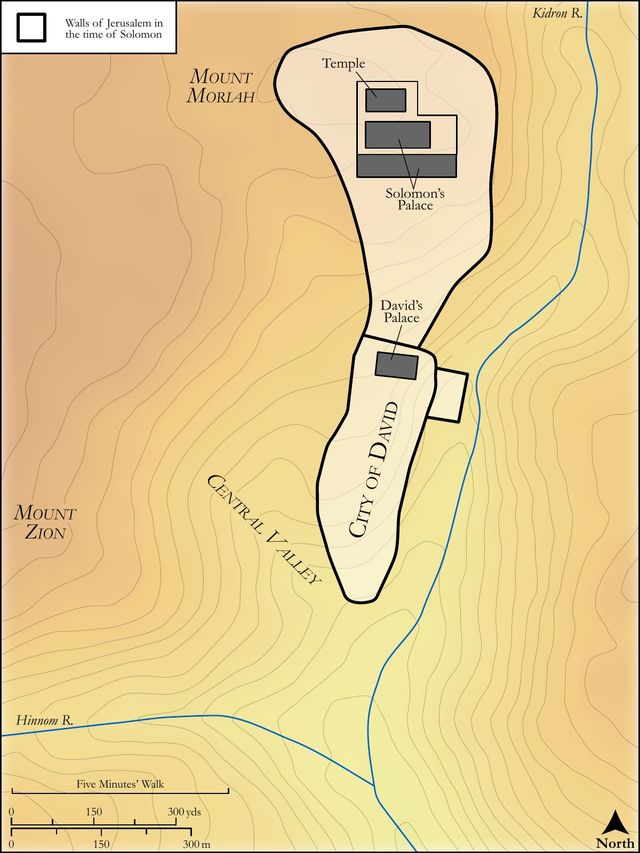
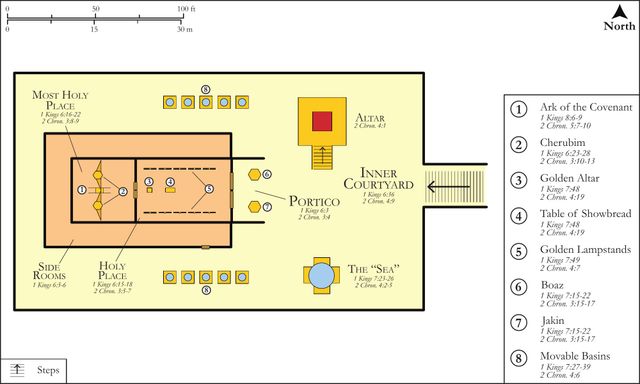
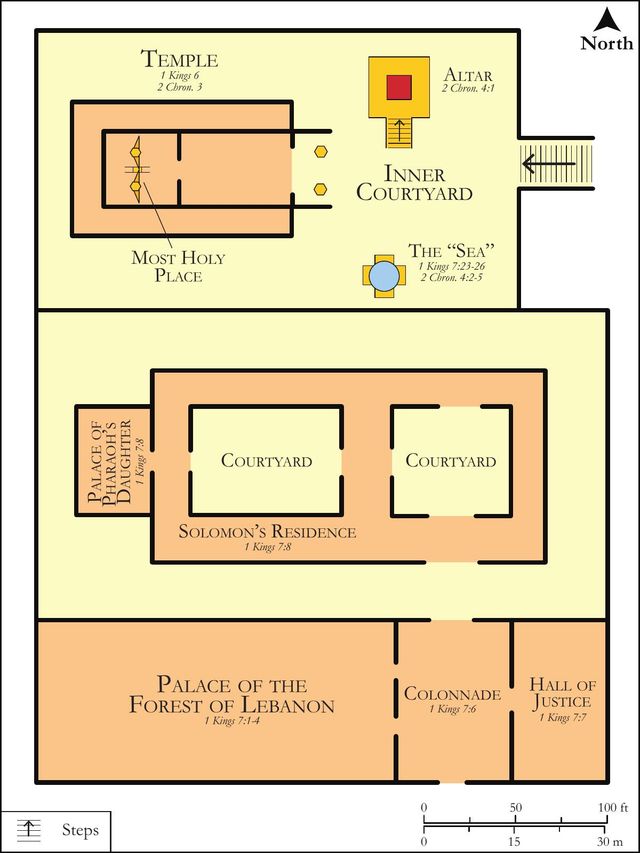
See on the biblical-era maps
Study this verse
Public-domain commentary
Matthew Henry
From his Commentary on the Whole Bible. Henry comments on passages, not single verses — this entry covers 1 Kings 6:1–10. His two-level outline is real structure in the source text, so it is rendered as structure.
Here, I. The temple is called the house of the Lord (Kg1 6:1), because it was, 1. Directed and modelled by him. Infinite Wisdom was the architect, and gave David the plan or pattern by the Spirit, not by word of mouth only, but, for the greater certainty and exactness, in writing (Ch1 28:11, Ch1 28:12), as he had given to Moses in the mouth a draught of the tabernacle. 2. Dedicated and devoted to him and to his honour, to be employed in his service, so his as never any other house was, for he manifested his glory in it (so as never in any other) in a way agreeable to that dispensation; for, when there were carnal ordinances, there was a worldly sanctuary, Heb 9:1, Heb 9:10. This gave it its beauty of holiness, that it was the house of the Lord, which far transcended all its other beauties.
II.The time when it began to be built is exactly set down.
1.It was just 480 years after the bringing of the children of Israel out of Egypt. Allowing forty years to Moses, seventeen to Joshua, 299 to the Judges, forty to Eli, forty to Samuel and Saul, forty to David, and four to Solomon before he began the work, we have just the sum of 480. So long it was after that holy state was founded before that holy house was built, which, in less than 430 years, was burnt by Nebuchadnezzar. It was thus deferred because Israel had, by their sins, rendered themselves unworthy of this honour, and because God would show how little he values external pomp and splendour in his service: he was in no haste for a temple. David's tent, which was clean and convenient, though it was neither stately nor rich, nor, for aught that appears, ever consecrated, is called the house of the Lord (Sa2 12:20), and served as well as Solomon's temple; yet, when God gave Solomon great wealth, he put it into his heart thus to employ it, and graciously accepted him, chiefly because it was to be a shadow of good things to come, Heb 9:9.
2.It was in the fourth year of Solomon's reign, the first three years being taken up in settling the affairs of his kingdom, that he might not find any embarrassment from them in this work. It is not time lost which is spent in composing ourselves for the work of God, and disentangling ourselves from every thing which might distract or divert us. During this time he was adding to the preparations which his father had made (Ch1 22:14), hewing the stone, squaring the timber, and getting every thing ready, so that he is not to be blamed for slackness in deferring it so long. We are truly serving God when we are preparing for his service and furnishing ourselves for it.
III.The materials are brought in, ready for their place (Kg1 6:7), so ready that there was neither hammer nor ax heard in the house while it was in building. In all building Solomon prescribes it as a rule of prudence to prepare the work in the field, and afterwards build, Pro 24:27. But here, it seems, the preparation was more than ordinarily full and exact, to such a degree that, when the several parts came to be put together, there was nothing defective to be added, nothing amiss to be amended. It was to be the temple of God of peace, and therefore no iron tool must be heard in it. Quietness and silence both become and befriend religious exercises: God's work should be done with as much care and as little noise as may be. The temple was thrown down with axes and hammers, and those that threw it down roared in the midst of the congregation (Psa 74:4, Psa 74:6); but it was built up in silence. Clamour and violence often hinder the work of God, but never further it.
IV.The dimensions are laid down (Kg1 6:2, Kg1 6:3) according to the rules of proportion.
Some observe that the length and breadth were just double to that of the tabernacle. Now that Israel had grown more numerous the place of their meeting needed to be enlarged (Isa 54:1, Isa 54:2), and now that they had grown richer they were the better able to enlarge it. Where God sows plentifully he expects to reap so.
V.An account of the windows (Kg1 6:4):
They were broad within, and narrow without, Marg. Such should the eyes of our mind be, reflecting nearer on ourselves than on other people, looking much within, to judge ourselves, but little without, to censure our brethren. The narrowness of the lights intimated the darkness of that dispensation, in comparison with the gospel day.
VI.The chambers are described (Kg1 6:5, Kg1 6:6), which served as vestries, in which the utensils of the tabernacle were carefully laid up, and where the priests dressed and undressed themselves and left the clothes in which they ministered: probably in some of these chambers they feasted upon the holy things. Solomon was not so intent upon the magnificence of the house as to neglect the conveniences that were requisite for the offices thereof, that every thing might be done decently and in order. Care was taken that the beams should not be fastened in the walls to weaken them, Kg1 6:6. Let not the church's strength be impaired under pretence of adding to its beauty or convenience.
Historical interpretation
Historical reception
1 surviving comment on this verse from the historical church.
The windows of the temple are the holy teachers and all the spiritual people in the church to whom when in divine ecstasy it is granted more specially than to the others to see the hidden mysteries of heaven. And when they reveal publicly to the faithful what they have seen in private, they fill all the inner recesses of the temple as windows do with the sunlight they let in. Hence these windows are appropriately said to have been slanting, that is, wider on the inside, because, of course, whoever receives a ray of heavenly contemplation even for a moment must expand the bosom of his heart more fully by mortification and prepare it by resourceful asceticism to strive for greater things.
Continue studying 1 Kings 6:4 across the web’s major study libraries — every link below opens this exact verse, chapter, or book on the destination site.
Read & Compare
 BibleGatewayThis verse in more than 200 translations and 70 languages.
 Bible.comThe YouVersion reader — hundreds of translations, reading plans, and highlights.
 ESV.orgCrossway's official English Standard Version reader.
 NET BibleThe NET translation with 60,000+ translators' notes on every rendering decision.
 STEP BibleTyndale House's free study tool — original text, vocabulary, and scholarly resources.
 BibliaLogos Bible Software's free web reader.
 USCCBThe New American Bible (Revised Edition) with the U.S. bishops' study notes.
Commentaries
 BibleHub CommentariesDozens of classic commentaries on this verse, gathered on one page.
 StudyLightMore than 100 commentary sets — the largest collection on the web.
 BibleRefPlain-English commentary on what this verse means, verse by verse.
 Enduring WordDavid Guzik's free commentary on this chapter, widely used by Bible teachers.
 Bible Study ToolsVerse commentary alongside Greek and Hebrew study aids.
Original Language & Research
- BibleHub InterlinearThe verse word by word — original language, transliteration, and English.
- BibleHub LexiconEvery word's original-language definition and Strong's entry.
 Blue Letter BibleDeep-study tools — Strong's numbers, concordance, and word studies.
 SefariaThe Hebrew text with Rashi and centuries of Jewish commentary.
Sermons, Hymns & Audio


TrulyRandomVerse is not affiliated with these sites and doesn’t control their content. They’re linked because they’re genuinely useful.
Summary
1 Kings 6:4 details a specific architectural feature of Solomon's Temple, stating that "for the house he made windows of narrow lights." This seemingly minor construction detail is profoundly significant, underscoring the meticulous divine blueprint for the sacred edifice and the deliberate design choices that prioritized an internal, divinely-sourced illumination over external, natural light. This design fostered an atmosphere of reverence, separation, and anticipation for the manifestation of God's glory within His dwelling place.
Context
ShowHideLiterary Context
This verse is situated within the extensive and highly detailed account of the construction of Solomon's Temple, primarily found in 1 Kings 6 and 1 Kings 7. The narrative begins with the commencement of the Temple's construction in 1 Kings 6:1 and proceeds to meticulously describe its dimensions, materials, and various architectural components, from its foundational elements to its roof and surrounding chambers. The inclusion of precise architectural elements, such as the "windows of narrow lights," emphasizes the sacredness and exacting precision demanded for God's dwelling place. This level of detail serves to highlight the fulfillment of David's vision and God's covenant promises, meticulously brought to fruition by Solomon, establishing a tangible center for Israel's worship and national identity.
Historical & Cultural Context
The construction of the First Temple occurred during the apex of Israel's power and prosperity under King Solomon's reign, approximately in the 10th century BCE. In Scripture, the house of the LORD was not merely a place of communal worship but the place where He set His name, designed with features that evoked a sense of mystery, awe, and separation. The "windows of narrow lights," often interpreted as "splayed windows" (narrow on the exterior, widening inwards), were a common architectural feature in both sacred and defensive structures of the era, including fortresses and palaces. This design provided structural integrity, enhanced security, and allowed for controlled light and ventilation. Unlike modern architecture that often maximizes natural illumination, the Temple's design likely aimed to minimize external distractions and emphasize the internal, cultic light provided by lamps and, more significantly, the anticipated divine presence, aligning with the concept of a holy, set-apart space for the transcendent God.
Key Themes
ShowHideThe specific detail of the "narrow lights" contributes to several profound themes within 1 Kings and the broader biblical narrative. Firstly, it underscores the Meticulousness of Divine Design and Human Obedience. Every aspect of the Temple's construction, even seemingly minor architectural features, was either divinely prescribed or inspired, reflecting God's demand for precision and Israel's diligent adherence to His will in creating a suitable dwelling. This obedience is a recurring theme, particularly in the accounts of the Tabernacle and Temple. Secondly, it highlights the Sacredness and Separation of God's Presence. The limited external light fostered an atmosphere of solemnity and reverence, distinguishing the Temple from ordinary structures and emphasizing its role as a unique sanctuary where God's glory would dwell, as powerfully demonstrated when the glory of the Lord filled the Temple in 1 Kings 8:10-11. Finally, this detail subtly points to the Symbolism of Light and Divine Illumination. While natural light was restricted, the Temple was intended to be filled with the glory of God, suggesting that true light emanates from His presence, not from external sources, a profound theological truth echoed in passages like Psalm 36:9, which declares God as the fountain of life and light.
Exposition and Analysis
ShowHideKey Word Analysis
ShowHideThis term (H1004) refers to the main structure of the Temple, the sacred edifice itself. While bayith can encompass a wide range of applications from a simple dwelling to a palace or family, in this context, it specifically denotes the primary sanctuary, emphasizing its role as the designated dwelling place for God's presence.
This word (H331), derived from a primitive root meaning "to close" or "to contract," describes the restrictive nature of the windows. It suggests that the openings were intentionally designed to be constricted, perhaps by bevelled jambs, limiting the amount of light and external visibility. This intentional narrowing contributes to the unique atmosphere within the Temple.
This term (H8261), a passive participle, refers to an "embrasure" or "opening," often implying a splayed or recessed design where the opening is narrower on the outside and widens towards the interior. When combined with "narrow" (ʼâṭam), it describes windows that were not merely small but specifically designed to control the influx of light and maintain the sanctity and security of the interior, rather than providing expansive views or abundant natural illumination.
Verse Breakdown
ShowHide"And for the house"
This phrase precisely identifies the recipient of this architectural feature: the central and most sacred structure of the Temple. It distinguishes the main sanctuary from any surrounding courtyards, auxiliary buildings, or the king's palace, emphasizing that this particular design element was integral to the primary dwelling place of God.
"he made windows"
This indicates Solomon's direct agency and the deliberate, intentional construction of these openings. The Hebrew term for "windows" refers to apertures or frames, confirming that these were indeed designed to allow some light and ventilation, yet with a specific, controlled purpose rather than for broad illumination or external views.
"of narrow lights"
This is the critical descriptive element that defines the unique nature of these windows. As detailed in the key word analysis, this phrase points to windows that were either splayed (narrow on the outside, widening inwards) or fixed and non-operable, designed to restrict the influx of natural light and external visibility. This design choice was crucial in contributing to the solemn, mysterious, and sacred atmosphere of the Temple's interior, directing focus inward rather than outward.
Literary Devices
ShowHideThe verse primarily employs Architectural Detail as a prominent literary device, meticulously describing a specific feature of the Temple's construction. This precision serves to emphasize the sacredness and divine origin of the Temple's blueprint, suggesting that every element, no matter how seemingly minor, was significant in creating a dwelling fit for God. The inclusion of such a particular detail also contributes to the overall Realism and Verisimilitude of the narrative, grounding the theological claims in tangible, historical construction. Furthermore, the "narrow lights" function as a subtle yet powerful Symbolism. By limiting external light, the text implicitly highlights the contrast between natural illumination and the anticipated divine glory that would fill the Temple, suggesting that the true light within God's dwelling emanates from His presence, not from the sun. This detail thus contributes to the overarching theme of God's unique and transcendent presence within the sacred space, a presence that defines its very essence.
Theological and Thematic Connections
ShowHideThe seemingly simple architectural detail of the "windows of narrow lights" carries profound theological weight, speaking volumes about God's meticulousness and His desire for a sacred space that is set apart, not merely a functional building. The design, which intentionally limited external light, subtly communicates a profound truth: the true illumination within the Temple would not come from the sun or any earthly source, but from the very presence of God, the ultimate source of all light and glory. This concept reinforces the idea that God's dwelling is distinct from the mundane world, a place where His holiness is paramount and His glory is manifested internally. It foreshadows a spiritual reality where divine light transcends physical limitations, inviting worshippers to seek an inner, spiritual illumination derived from God Himself, emphasizing that His presence is the ultimate light.
Reflection and Application
ShowHideThe detail of the "narrow lights" in Solomon's Temple invites us to consider the profound intentionality with which God designs and desires His dwelling places, both the ancient sanctuary and, by extension, our contemporary lives as believers. Just as the Temple was not meant to be flooded with external light but illuminated by God's glory from within, so too our lives as followers of Christ are called to reflect an inner light—the radiant presence of Christ within us—rather than being solely dependent on the fleeting, often deceptive, illuminations of the world. This verse challenges us to cultivate an internal spiritual environment where God's presence is prioritized, where distractions are minimized, and where our focus is intently on His glory and truth. It serves as a potent reminder that true spiritual insight, wisdom, and illumination come from Him alone, even when our circumstances may feel like "narrow lights," offering limited visibility or comfort in a challenging world. Our lives, like the Temple, are to be set apart, designed for His indwelling presence, and illuminated by His transformative truth.
Questions for Reflection
ShowHideFAQ
ShowHideWhat was the primary purpose of "windows of narrow lights" in Solomon's Temple?
ShowHideThe "windows of narrow lights" served multiple significant purposes. Architecturally, their splayed design (narrow on the outside, widening inwards) provided structural integrity, especially crucial in a large stone building, and offered a degree of security by limiting external access and visibility. Theologically and atmospherically, their design was primarily intended to create a specific ambiance within the Temple – one of solemnity, mystery, and profound reverence. By restricting the influx of natural light, the design emphasized the internal illumination provided by the Temple's lamps and, more significantly, the anticipated glory of God that would fill the sacred space, as powerfully described in 1 Kings 8:10-11. This architectural choice underscored the profound theological truth that the Temple's true and ultimate light was divine, not earthly or natural.
Did the Temple rely solely on these "narrow lights" for illumination?
ShowHideNo, the Temple did not rely solely on the limited natural light from the "narrow lights." While external light was intentionally restricted, the interior of the Temple, particularly the Holy Place, was illuminated by elaborate lampstands. Most notably, the golden lampstand (menorah), as detailed in the instructions for the Tabernacle in Exodus 25:31-40, served as a prototype for the Temple's furnishings. These lamps provided continuous light, symbolizing God's perpetual presence, guidance, and the light of His truth, ensuring that the sacred rituals and priestly duties could be performed. The Most Holy Place (Holy of Holies), where the Ark of the Covenant resided, was likely kept in darkness, except when the High Priest entered on the Day of Atonement, further emphasizing its profound sacredness and the unique, unapproachable nature of God's dwelling there.
Christ-Centered Fulfillment
ShowHideThe "windows of narrow lights" in Solomon's Temple, by limiting external illumination and pointing to an inner, divine light, powerfully foreshadow the person and work of Jesus Christ. While the physical Temple's design restricted natural light to emphasize God's indwelling glory, Jesus declares Himself to be the ultimate and all-sufficient source of spiritual illumination, proclaiming, "I am the light of the world. Whoever follows me will not walk in darkness, but will have the light of life" and echoing this truth in John 9:5. He is the true and ultimate Temple, the very place where God's glory truly dwells among humanity, as affirmed in John 1:14, where the Word became flesh and tabernacled among us. Unlike the Old Testament Temple, which relied on man-made lamps and limited apertures, Christ's light is inherent, all-sufficient, and capable of illuminating the hearts of all who believe, as revealed in 2 Corinthians 4:6. Furthermore, just as the Temple's design emphasized separation and sacredness, Christ's atoning sacrifice establishes a new covenant where believers themselves become "living stones" in a spiritual house (1 Peter 2:5), indwelt by the Holy Spirit, who is the very presence of God. In Him, the restricted and foreshadowing light of the old covenant gives way to the full, unhindered radiance of God's truth and grace, revealing that God's ultimate and eternal dwelling is not in a building made with hands, but supremely in His Son and, through Him, in His redeemed people (Ephesians 2:21-22).